Blog Archives
Review: Torchlight 2
Game: Torchlight 2
Recommended price: $5/bundle
Metacritic Score: 88
Completion Time: 35 hours
Buy If You Like: Torchlight 1, Poorly itemized Diablo-clones

At least the combat feels improved.
Torchlight 2 is the hack-n-slash sequel to the original Torchlight, itself an homage and erstwhile competitor to Blizzard’s Diablo series. Indeed, Torchlight 2 was released around the same time Diablo 3 was making headlines with its controversial always-on requirements and server-dependent gameplay. While it makes a great counter-point to Diablo 3 on the feature listings, Torchlight 2 is essentially more of the same from the original game. Which, in my case, is bad news.
My fundamental gripes with both Torchlight games are their meaningless adherence to archaic game design, and a fundamentally terrible itemization/progression system. Torchlight 2 features four different classes to choose from, each with three separate class trees. While they mainly follow traditional hack-n-slash roles, there does exist room for experimentation: there are more than enough talents to choose from to transform, say, the archer-esque Outlander into a melee-only tank (albeit not likely as powerful as a normal tank class). Where this experimentation immediately breaks down is how there is no respecing in Torchlight 2; at most, you are allowed to get a refund on your last three talent points. While this was how things worked in Diablo 2, it is also true that at one point people thought asbestos as insulation was a good idea.
The more crippling flaw though, and the singular design that undermines everything else the game set out to accomplish is the awful itemization and item progression system. While not as outlandishly terrible as the original Torchlight, it is still entirely possible (and even likely) that you will receive a random drop at level 17 that you will still be using 40 levels later at the end of the game. The core of what made the Diablo series so compelling to play was how items and gold erupted from nearly every enemy you faced, and thus you had a steady supply of dopamine over the course of what otherwise is series of perpetually unengaging clicks. Torchlight 2 has none of that – nearly two-thirds of the game was spent vendoring every ring, helmet, amulet, and pants I came across.
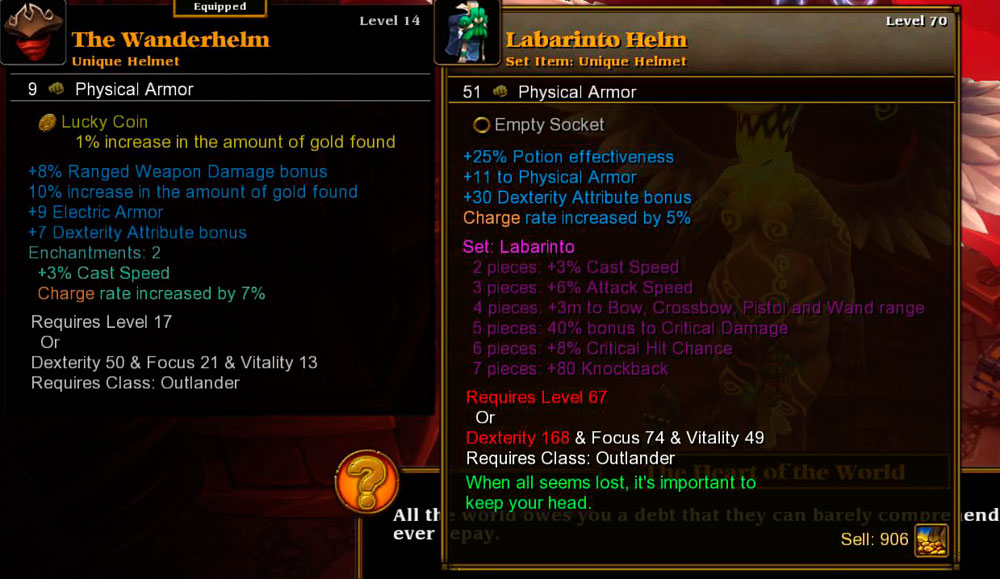
Not even the class-specific helmet from the last boss was much an upgrade to my level 14 helm.
It gets even worse, if you can image that.
Clearing an entire map’s worth of mobs and collecting every single piece of vendorable debris results in what I would like to term one “Gear Unit” (typically 2000g-3000g). Each GU allows you to either purchase one item from a vendor, or upgrade an existing item by either adding gem sockets, enchantments, or purchasing gems themselves. This ridiculous stinginess with gold means you are perpetually strapped for cash, only allowing you to augment the gear you’ve accumulated one map clear at a time. God help you if you’ve finally accepted the fact that you’ll never replace your boots only to have an infinitely rare upgrade drop right after spending 10,000g (or 3 GUs) on your old pair.
Oh, and by the way, the Gold Chests and Boss Chests that you are “rewarded” with for going out of your way to find the keys or defeat said boss end up dropping jack shit 99% of the time. I have found more rares and unique items out of normal, everyday treasure chests than I have ever gotten from boss chests. How do you fuck something like this up?

Oh, hey, a Minecraft reference.
I am spending all this time talking about loot and such because that is the heart and soul of the hack-n-slash genre. To get loot wrong in these sort of games is to create a racing game with poor-handling cars or a FPS where the guns don’t shoot at the crosshairs. Indeed, would anyone play a Diablo-esque game if there was no gear at all? The gameplay, which consists of mowing down tens of thousands of mobs within seconds of their appearing on the screen absolutely is not compelling enough on its own, that’s for goddamn sure.
All of which is certainly a shame, as Torchlight 2 is otherwise an improved sequel in pretty much every other way. The gameplay (such as it is) feels more responsive and impactful; the environments are detailed and fun to look at; the music is about a half dozen artful remixes of the Tristram theme; and I enjoy the visual style. It just feels, you know, completely unrewarding to play.
It is worth mentioning that all of these problems have been solved by better game designers, e.g. the players submitting mods to the game. There are mods that range from introducing new character classes to entirely new dungeons to, you guessed it, fixing the loot issue by guaranteeing Unique or better drops from Gold/Boss chests. I decided early on to stick with the vanilla game because I wanted to get a feel for what the devs learned from the original Torchlight. The answer is “pretty much nothing.” Playing with mods “taints” your character though and otherwise makes you ineligible for achievements. But since the base game feels like such a massive chore to play, I highly recommend anyone deciding to install Torchlight 2 to go ahead and fix what the devs had not the brains and/or balls to do.
Progression
I am probably nearing the end of my focused Hearthstone play. Why? Two words: beta wipes. All progress, cards, gold, etc, will be wiped at least once in the upcoming weeks, and possibly more than once. If you happened to purchase something for real money, you will get the equivalent amount of gold once Hearthstone goes Live.
All of this is known information, so why am I bringing it up? That’s actually an interesting question, as I examined my roiling emotions after a string of recent Arena losses. Scrubbing out at 1-3 or – god help you – 0-3 sucks. Hard. Each Arena buy-in requires $1.99 or 150g, with the latter amount requiring roughly three days of dailies plus 30 wins in Ranked/Unranked play (i.e. against other people) to collect. Or just complete four dailies. Going that route actually works out pretty good as long as you keep Hearthstone as your sort of “side game” that you play for 30-45 minutes each day before playing your main game; as long as you keep yourself from getting too into things, you can legitimately play (Arena) for free pretty easily.
Alternatively, if you win at least 7 Arena matches in the buy-in, you get enough gold to play again.
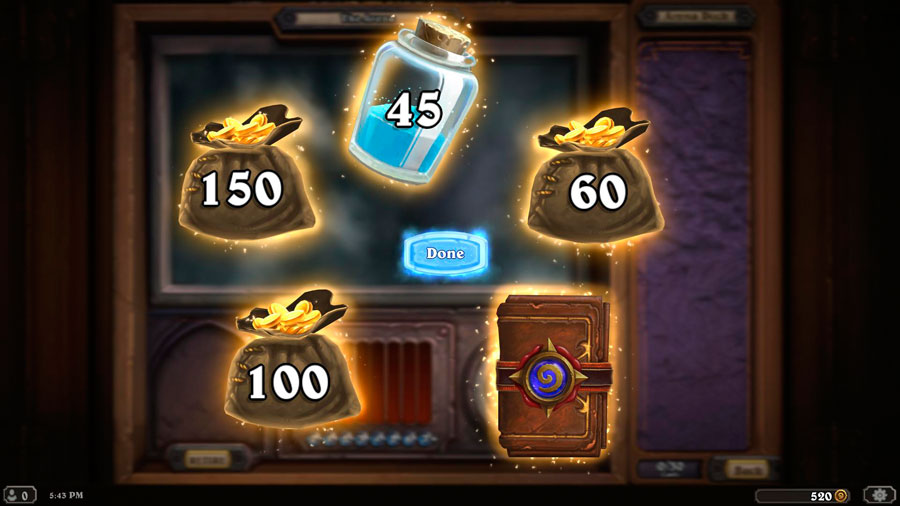
Money in the bank.
As you can see, I received 310g for having gone 9-2 with the Rogue (nine wins is the maximum). An earlier 8-3 record resulted in 215g. Needless to say, I was feeling pretty pleased with myself, especially given the Arena portion of the game is significantly more interesting to me – playing against Constructed decks feels pretty rote in comparison. Plus, where else would I get to screw around with Legendaries in what feels like a guaranteed draw for each Arena match? You aren’t likely to see those and other high-powered cards from packs you open, but seeing epics and such is pretty common across 30 random draws.
But then the RNG floor fell out. I felt I was getting a good handle on which Heroes were best in Arena – things are much different than in Constructed where you can build around combos – but I suddenly realized how exceptional my winning decks truly were. My 8-3 Druid deck had eight removal cards, including AoE removal. The 9-2 Rogue deck had two Saps, a bunch of Silence creatures with multiple ways of returning them to my hand, a fistful of removal, and two Defias Ringleaders that make going second a complete joke when you drop a 2/3 and 2/1 on your first turn.
Here was the deck:

Building this was so much fun.
You don’t need to know anything about the Hearthstone other than that this deck was unfair. Three Fan of Knives, two Blade Flurry, two Sap, two Patient Assassins, Betrayal… Jesus, it was sublime. Hearthstone Arena is entirely about tempo, and let’s just say most games involved me playing dubstep to their John Cage 4’33”.
Needless to say, I have spent the past three days falling back down the Bell Curve face-first. A string of awful Hero choices plus awful card choices plus opponents who all but win by round four (having demolished my early game). It is entirely possible this all has been by design, via hidden MMR rankings. One of the biggest Hearthstone innovations amongst the pile of others has been the fact that Arena games are unmoored from any particular tournament. If you play a Booster Draft in Magic Online, you’re playing either for 15 minutes or two hours depending on your record, against whomever happened to stroll into your tournament with you. In Hearthstone, you can play one Arena game and then come back a week later if you want. This is fantastic… provided you don’t rely on being a big fish in a small pond for your wins.
All this losing made me realize that I don’t like it. Losing, that is. A fair ranking system is based around ensuring you lose 50% of the time, but it seems to me that losing feels much worse than the positive winning emotions, especially when losing results in opportunity costs and/or costs you real money. Presumably the delta between winning and losing is compensated by the fun you have actually playing the game. But I am coming to the realization that it isn’t enough. I need a tangible sense of progression too. Knowing that the pity packs are full of cards going away in X number of months means losses are simply time consigned to the abyss.
The obvious counter-points are A) new gear tiers in MMOs result in obsolescence of progression, B) time spent gaming is technically “wasted” by default, and C) how in god’s name did you play Counter-Strike for four years then?
The answer to the first is pretty simple: properly-formatted achieved goals can’t be taken away. My goal in WoW was never “have BiS gear in every slot” – that is just a recipe for disappointment. Instead, my goals were more general, like “be better off than I was yesterday.” Grinding Valor, getting raid drops, capping Conquest… all of these things resulted in a feeling of sustained progression that persisted even when new tiers came out. In fact, my “investment” in gearing up paid off in getting the new gear quicker or more easily.
Obviously I quit playing WoW, but I still don’t see that time as wasted; leisure activities being a waste of time presupposes an (nonexistent) objective purpose in life, which answers point B.
As for C), well… that’s the pickle. I feel games like Counter-Strike allow you to experience meaningful fun even as you ultimately lose a round/match, probably because winning/losing doesn’t matter in the first place. As long as I pulled off some kind of crazy kill before dying, I could walk away satisfied even if our team was otherwise destroyed. Which is leading me to believe that the existence of progression in a game sets up its own failure, given that losing progression (either directly or via opportunity cost) makes me feel worse than gaining progression. At the same time, I tend to gravitate towards games with “investment” opportunities over games where I am “just” killing time. All games kill time, but killing time + progression makes it feel more meaningful on top of whatever arbitrary goal-achievement neurochemistry is going on.
All of which is an extremely roundabout way of saying that I lost a bunch of Hearthstone Arena matches this weekend and am sad as a result. Going from being more than self-sustaining to practically in-the-hole playing is bad, and there not being any sense of long-term progression (in the beta) makes it worse. Also, trying to unlock Shaman cards in Constructed play feels terrible; seriously, Blizz, why did you put all the juicy Shaman cards in the packs? Chain Lightning is practically required to get anywhere.
Wait a minute, why am I in-game again? Might as well knock out this daily…
Bend It like Bachmann
WoW:
Update!
- Entry into the brawler’s guild is by invitation only. Invitations can be found on the black market auction house, by invitation from somebody within the guild, and occasionally as drops from certain Horde and Alliance NPCs.
GW2:
As we watch Guild Wars 2 mature in its Live environment, we have found that our most dedicated players were achieving their set of Exotic gear and hitting “the Legendary wall.” We designed the process of getting Legendary gear to be a long term goal, but players were ready to start on that path much sooner than we expected and were becoming frustrated with a lack of personal progression. Our desire is to create a game that is more inclusive for hardcore and casual players alike, but we don’t want to overlook the basic need for players to feel like they are progressing and growing even after hitting max level. Adding item progression is a delicate process normally undertaken in an expansion, but we feel it’s important to strive to satisfy the basic needs of our players sooner rather than later.
As the occasional¹ connoisseur of a nice bottle of Schadenfreude, I must admit: this week has been delicious.
While I kind of hoped that the Blizzard folks would have stuck to their guns with the Brawler’s Guild, the original plan always seemed more informed by the source material (“The first rule of Fight Club is…”) as opposed to good top-down game design. Creating “tight knit, underground” communities by throttling access makes the non-instanced, spectator-sport aspect feasible? Sounds like double-win efficient game design… on paper. But as we all know, things that feel good conceptually have a way of not working out in practice.
Speaking of that… whoo boy, ArenaNet.
I think my favorite part of this development is seeing all the mental gymnastics. This thread on Reddit, for example, tries to turn the question around and ask “what is a gear treadmill really?” Part of the OP’s reasoning is that the proposed new tier of gear will be easier to get than, say, in WoW, where you have to contend with random drops and competition between players over what gear does drop. So… if the treadmill is slow enough, it isn’t a treadmill at all!
Seriously, at one point the OP suggested:
O… k? All I see from that quote is that there will be more stuff later. That doesn’t make it a treadmill, just another flight of stairs, if you will.
Oh to be a psychic vampire capable of feeding off this boundless optimism/denial²; I would never go without.
To be honest, I think ArenaNet’s shift is both warranted and necessary. The cessation of reasonable progression is the natural Game Over screen for me, and you run off that cliff the moment you hit 80 and load up on inexpensive Exotics from the AH. This new tier of gear both reintroduces progression and gives players a reason to play the new content more than once.
Really, it is only bad news if you hold the ArenaNet devs up to some impossible standards like:
- “We didn’t want the endgame to be something you could only experience after a hundred hours of gameplay or after you reached some arbitrary number.” (source)
- “If you go into a dungeon in a traditional MMO and you, you hit a wall that you can’t pass and you need better gear, you have to go to a different dungeon and play and get that gear, whereas in Guild Wars if you encounter that, you could get better gear by going to World vs. World or expanding your crafting skills or several other ways,” said Millard. (source)
- “We don’t need to make mandatory gear treadmills, we make all of it optional, so those who find it fun to chase this prestigious gear can do so, but those who don’t are just as powerful and get to have fun too.” (source)
- “Because, like Guild Wars before it, GW2 doesn’t fall into the traps of traditional MMORPGs. It doesn’t suck your life away and force you onto a grinding treadmill; it doesn’t make you spend hours preparing to have fun rather than just having fun; […]. It all gets back to our basic design philosophy. Our games aren’t about preparing to have fun, or about grinding for a future fun reward.” (source)
So everyone just relax. You’re going need your strength for this extra flight of stairs anyway.
¹ Shut up.
² Shut up.
 In An Age