Blog Archives
Impressions: Vintage Story
Vintage Story is a ponderous, “realistic” survival crafting sandbox in the style of Minecraft. Pretty much the exact style of Minecraft, in fact, although it supposedly has a different codebase that allows it to do some interesting things. How interesting those things are will greatly depend on how slow and methodical you like your gaming.
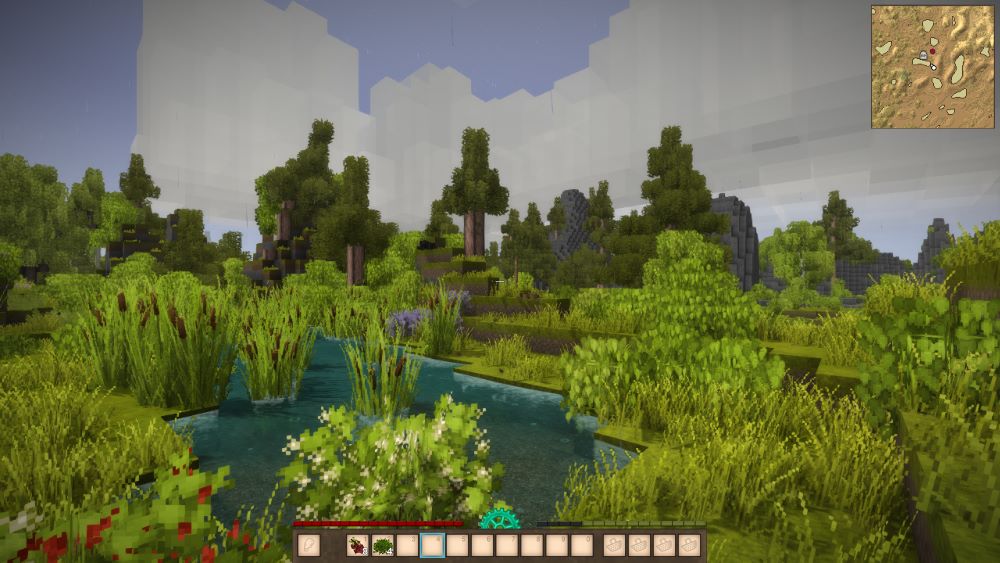
As with most survival games, you start out with just the clothes on your back. From there, you collect flint or some other hard rock to make tools. In Vintage Story though, you literally make the tools: you place the flint down on the ground, and use another piece of flint to “knapp” (e.g. chip) the other piece according to a voxel pattern. Combine the knife head (etc) with a stick in your Minecraft menu and voila, a flint knife. This will allow you to collect things like reeds to be turned into baskets or dry grass to help start a fire. You can’t just punch everything to get the proper resources here.
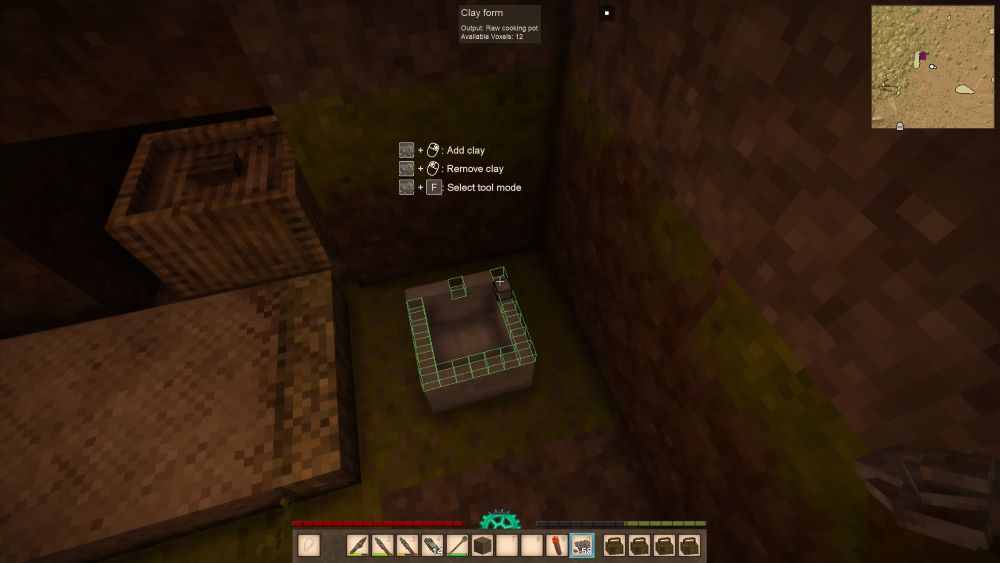
At this point, Vintage Story doubles-down on the intentionality. Flint tools are fine, but you really need clay to get to the next stage of development. Search far and wide for clay deposits, dig up a bunch, and then place some on the ground. You now have the option to create various clay vessels, like bowls, cooking pots, storage vessels, jugs, and so on. Crucially, you will also need tool molds, such as for a pickaxe and hammer. All of these things have to be sculpted, voxel-by-voxel, which is equal parts tedious and zen. Once completed, congratulations… you have still have raw, wet clay. Now you need to dig a hole, fill with dry grass, sticks, and firewood, light it on fire, and then wait 24ish hours for the pieces to harden. Oh, and make sure it’s covered from the rain and also away from flammable material.
Next comes copper. While traveling the overworld, you may come across a few pieces of copper nuggets on the surface. You can collect these – and mark your map since there is ore underground there – but will likely have to pan sand/gravel for additional nuggets. Once you have ~40 copper nuggets, you can begin the smelting process. Which requires charcoal, because firewood cannot hit the necessary temperature. Making charcoal involves digging holes, filling it to the brim with firewood, building a fire on top of that, lighting it, and then covering the whole thing up. A day later, you have charcoal. Go back and heat up the nuggets in a (fired) clay crucible, and using some wooden tongs – can’t have molten copper in your bare hands, of course – pour the copper into the (fired) clay tool molds… and wait. Once it cools, you have a copper pickaxe.
And now, finally, you can dig rocks!
I typed all that out because that is the type of game Vintage Story is. Mostly. Cooked food spoils at a reduced rate inside a clay Storage Vessel, and at an even further reduced rate in a cellar, and at an even more reduced rate if the food itself is stored in a clay Crock Pot sealed with animal fat. Neat. Meanwhile, you can construct your house and cellar by punching dirt blocks and placing them ala vanilla Minecraft. Making flint knives and other tools is a cool process, but the blade and handle are just magically connected somehow. I bring this up because the process of making a bow meanwhile requires twine, made of flax fiber, collected from flax (or looted from Drifters). Getting the first “tier” of armor above basically nothing requires Resin, which only comes from Pine trees at world creation, and only at an extremely limited chance. Like… why? We can hold molten copper in wooden tongs but can’t get some pine resin from pine trees?
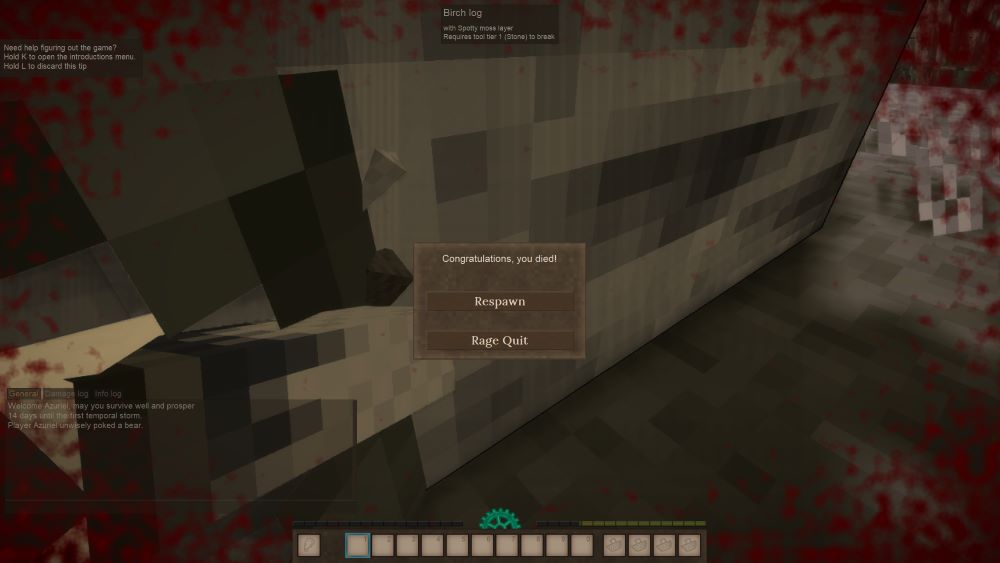
This sort of strained duality extends elsewhere. Wolves and bears are dangerous and will kill you in 1-2 hits. You can avoid them though by using a nerdpole, e.g. quickly placing blocks underneath yourself while jumping. Ore deposits are “realistic” in that they follow veins in specific sort of shapes. Getting to them can be sped up by either digging straight down and nerdpoling your way out, or creating an infinite waterfall via bucket and swimming straight up like in Minecraft. Crops take ages to grow – sometimes more than 1-2 in-game months – but animals generally spawn everywhere. Pemmican doesn’t exist, and not every animal has fat. And so on.
Those design choices are one thing, but the one that’s a bit more unforgivable (IMO) is the back-loading of content. The “real” game doesn’t really start until you can make wooden boards, which requires a copper saw, which requires a copper anvil, which requires enough copper nuggets gained from mining with the copper pickaxe. How do you get copper nuggets to make a copper pickaxe you ask? Panning sand, basically. Anyway, wood boards give you a ton of building and storage options, but the big ones are buckets and barrels, which then allow you to process things into leather, pickle food, and basically… everything. I understand that perhaps the intention was a sort of “congratulations on surviving until the Copper Age!” but that doesn’t mean the early game should be less interesting.
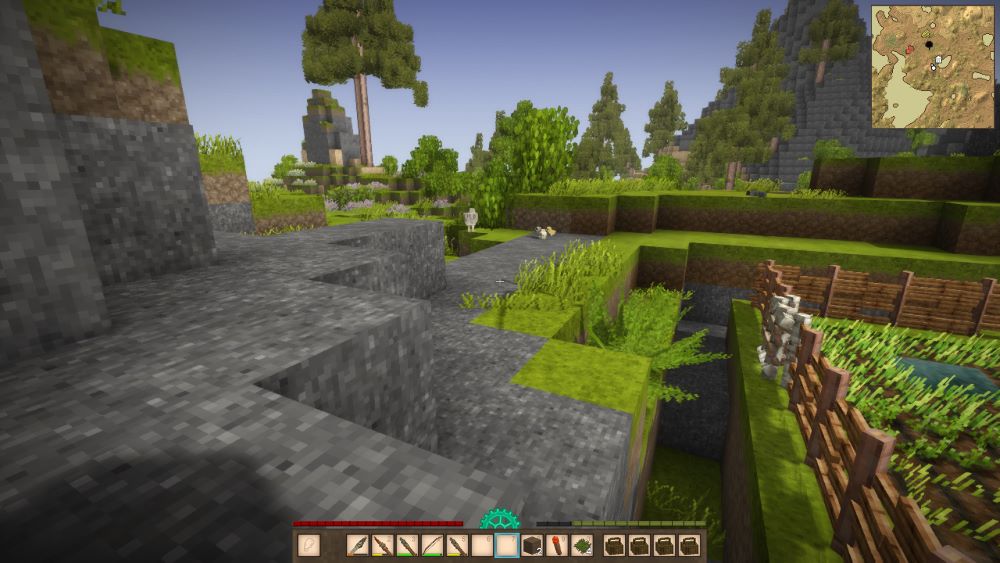
Vintage Story also suffers in the “now what” department. Surviving the first winter with limited resources is a massive struggle. After that? Farms will provide all your caloric needs rather easily. You can eventually craft some windmills and other mechanical tools to automate some tasks too. There are caves to explore and Drifters to fight and teleporter devices that can send you to far distance places. But… that’s it. I’m not saying other survival games do not have a similar endgame issue – there’s no “point” to 7 Days to Die or ARK – but the crucial difference is that playing these other games is, well, fun. They have good moment-to-moment gameplay, they have character progression mechanics that make you want to reach the next level, and so on.
That sort of thing is missing here. Once I finally got my Copper pickaxe and then realized how difficult it was going to be to find copper nodes, I was basically done. Plus, you know, if you lose your Copper Pickaxe somewhere (either by dying in a deep hole or via durability) you have to literally start all over.
Having said all that, Vintage Story is definitely a novel approach to the more traditional survival crafting genre. It is not in early access, still gets beefy updates, and was built from the ground up for mods. Indeed, there are supposedly a lot of mods out there that tackle many of the fundamental issues that I have brought up. I may end up rolling a new world with some of these mods installed and see if that smooths out the experience and make it more interesting.
Which, for the record, it was for a time. Just not enough. For now.
[WISP] The Division
(e.g. Why I Stopped Playing: The Division)
I can show you precisely the moment I decided to stop playing The Division:
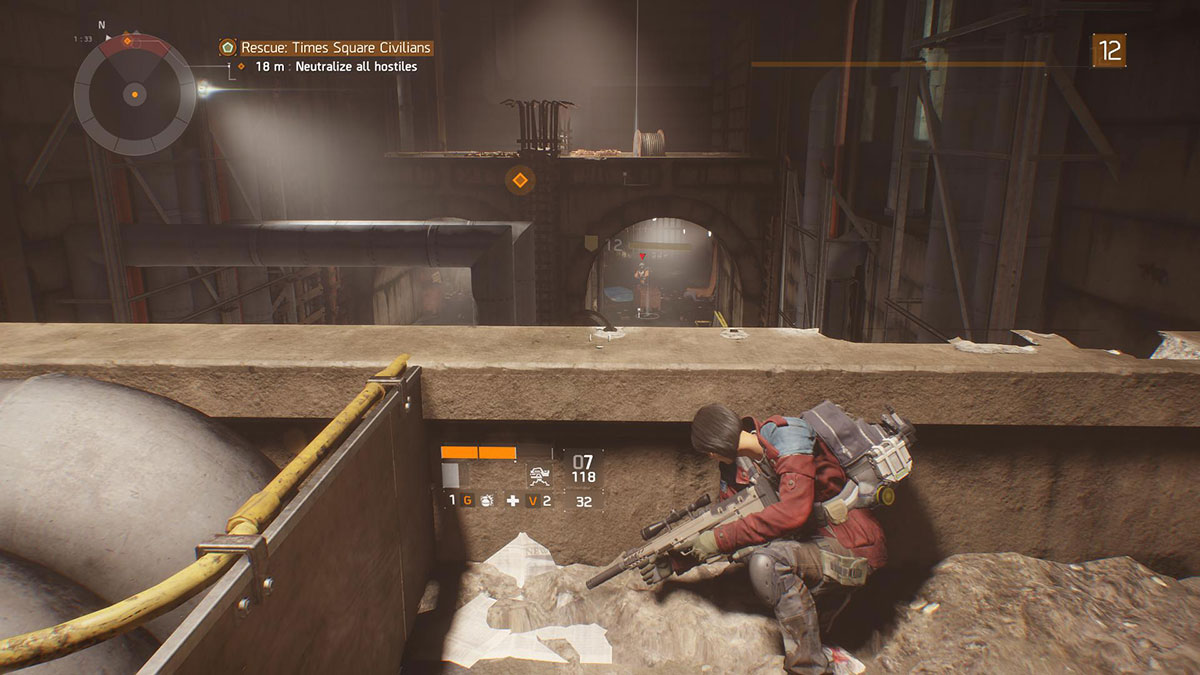
I’d like to read the Tom Clancy book about taking 6+ bullets to the face…
There is nothing particularly special about this “boss” character. I had actually died to him once already, as he has a machine gun and is able to just keep firing for like 30 seconds as he walks around your cover and mows you down in a realistic way. Having respawned, I was able to safely stay at my pictured elevated position. I was compelled to take this screenshot because I just shot this dude 5 times in the face with a sniper rifle, and he still has a sliver of “armor” left.
I have had a tone issue with The Division almost from the beginning. This is not a game where you are shooting zombies. You are not even shooting infected people behaving erratically. You are shooting “looters” or “Cleaners” (who are trying to burn the infection out) or gang members or prisoners who broke out of jail. Granted, all of your enemies appear to be killing innocent civilians or otherwise impeding efforts to maintain law and order. But… The Division (thus far) made no attempt to even address the wholesale slaughter of people trying to survive in a government quarantine zone.
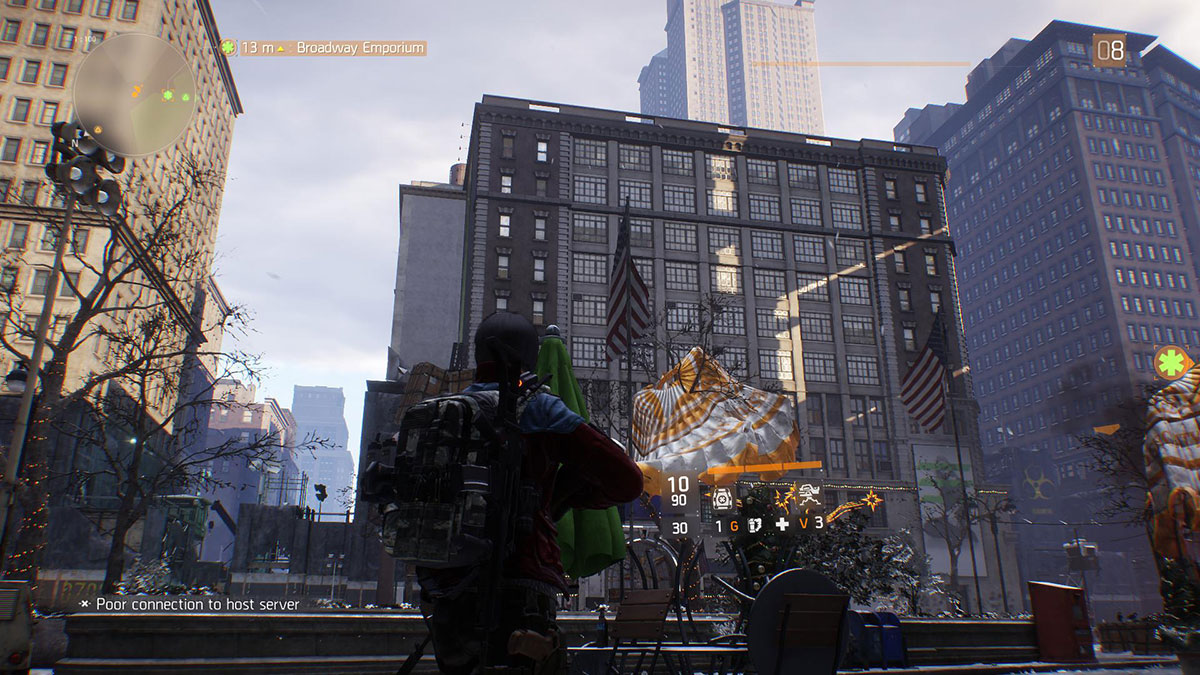
A very, very pretty quarantine zone.
I bring this up because “motivation” is hugely critical in cover-based shooters for me. The core gameplay in these games is so banal and simplified, there is often nothing else to go on. Stay in cover, peek and shoot. Leave cover, die. The Division technically has some additional elements like special powers, and is definitely geared towards small-squad teamplay, including a trinity of sorts.
But otherwise? Peek and shoot. And 100% of the missions up to the point I stopped playing had been about killing people for vague reasons. Even when you are rescuing hostages, there is no sense that A) the hostages were actually being ransomed, or B) the hostages will be better off going back home.
I was actually going to quit playing two weeks ago, but Alex posted this live-action video in the comments. That was… kinda compelling, and set me in the right frame of mind for getting back into the game.
…at least up until I kept encountering these predictable boss characters, with their predictable face armor which takes a half-dozen sniper rifle rounds to remove.
I understand that the game is a looter shooter, and things are not supposed to make too much sense – not quite sure how a new holster is somehow giving me extra armor, but whatever. It would be quite the boring game if the first rifle you picked up from the body of an enemy was the same one you used throughout the entire experience.
But… I just can’t do it anymore. The Division just piles up too much unsupported nonsense and my suspension of disbelief cannot bear the weight. And if I don’t respect the setting and don’t care about the story, there is zero reason to play a cover-based shooter. So I’m not, anymore.
Star Citizen and “Realism”
I have not really been following the development of Star Citizen beyond knowing that it had a pretty successful Kickstarter campaign. I mean, I know the premise and everything, but the name Chris Roberts holds about as much cachet with me as Raph Koster – both supposedly important dudes who made games I never played. Have they done anything lately? No? Okay then.
One thing that did catch my eye the other day though, was a short Massively article talking about Star Citizen’s “realistic” health and wound system. Feel free to read the source material itself. The basic idea is that the designers wanted to further the immersion by making a “fun” limb-based damage system. Take a lot of damage to an arm, and your arm gets blown off and/or ruined. There are a total of 10 specific areas to damage, with eight of them being arms or legs. The “Damaged” state is between 50% and 1% health, and… let me just quote it:
Damaged – Damaged limbs are useless and the player cannot use them unless they get them patched up in the field or taken to a mobile trauma system (see: Healing). This is the state right after the hurt phase, where the pain is so severe to the player, that no matter what limb is damaged, they will have a hard time being mobile. If one of their legs are damaged, they fall to the ground and crawl.
Now, there is something to be said about how the CoD/Battlefield-style run-and-gun regenerating health paradigm removes a lot of the weight of battle.¹ Take some damage, hide behind a wall, and ~15 seconds later you are good to go. Or perhaps rush into that occupied room with a shotgun and hope you get lucky, knowing you’ll get back to the fight faster than any of the other guys.
On the hand… Jesus Christ, can you imagine the grief potential? Enormous. I don’t care under what circumstances we have come to blows, I’m telling you now: I’m shooting your legs. I’m shooting your legs and then, whether or not I survive, you are spending the remaining time crawling pathetically across the floor to get anywhere. I am doing that because it is the most annoying thing I can possibly imagine. Screw headshots, if you want to invade my ship, you will spend the next 15 minutes crawling your way to the command chair over my dead body.
If you want to find me, I’ll be flying the most handicap inaccessible ship I can find. One with stairs!
That post about limb damage mentioned permadeath, which was the first I heard about it in Star Citizen, so I read that article too. The short version is that permadeath exists for lore reasons, but doesn’t actually matter. Taking a cue from Rogue Legacy, any time your character permanently dies, you simply start playing as whomever you marked as your next-of-kin. Since there are no RPG elements apparently (i.e. Skill Points), the most you lose is some reputation standing and whatever emotional attachment you’ve developed for a character in a permadeath-enabled game. Considering that the limb-damage system specifically talks about how difficult it will be to instantly die – a Ruined head might be jaw or eye damage instead of missing skull – it sounds like this might not be entirely relevant anyway.
I do not want to give the impression that I am not looking forward to Star Citizen, at least as much as anyone can about a game that could radically change at any moment. Space sims are not a genre I spend a lot of time thinking about, but I absolutely loved them in the past. I played Colony Wars for the PS1 way back in the day for an inordinate amount of time. The Zone of Enders series might not technically count as a space sim, but it is the first thing I think about whenever I see videos of Star Citizen dogfighting. I would seriously consider buying EVE: Valkyrie on Day 1, even though I’m not particularly impressed with CCP’s other spinoffs.
But if/when I do pick up Star Citizen, it will be in spite of mechanics such as limb-based damage and permadeath. I do not actually see such things adding anything of value to the game that would not have otherwise already been there. Instead, I foresee a future in which there will be a lot of people crawling around on the floor, hoping that Chris Roberts included a method to commit suicide and still wake up back at their spawn point.
¹ I don’t actually believe that much, if any, weight is removed in these games (or at least in Battlefield). Dying is already a miserable experience even with instant respawns, let alone in the context of not being able to capture an objective or prevent the capturing of your own. Attempts to penalize them further just makes the game harder, but not in a particularly fun way. Otherwise death penalties would all be “invalidate your CD key and force you to repurchase the game.”
 In An Age
Survival Equilibrium
Nov 22
Posted by Azuriel
I may have mentioned it before, but I really enjoy Survival games. For the most part.
I am currently playing The Flame in the Flood, which is a Survival roguelike, and not at all a catchy Vance Joy song. The experience was immensely frustrating for my first run, as I felt like I never had enough of any supplies, and was about to uninstall and set the category as Finished in Steam. The second run, which I have been playing for the last five hours or so, has reached that point beyond which eventual victory is all but assured. Nevertheless, I hit up every single location I can, hoarding ever-greater numbers of probably unnecessary supplies for some kind of nightmare scenario. Which kinda makes sense in the vague, post-apocalypse setting.
Hitting that equilibrium moment in Survival games though is bittersweet. It’s like the middle of every Civilization game I have ever played – the game part is over, and now you must go through the motions towards inevitable victory. Ideally, you would want the challenge of the game to match up with the game’s end, and not midway. Some games like 7 Days to Die will try extending the challenge with escalating enemies, but there comes a moment when the escalation outstrips the whole Survival aspect and the underlying game becomes something different entirely, e.g. a shooter.
Then there is the opposite problem, in which the game’s challenge doesn’t ever really end, and part of the reason I added the “for the most part” caveat. I have not played it since its release from Early Access, but I never felt good in The Long Dark. There never seemed to be enough food, or fuel, or supplies. You were always on the precipice. And that’s the goal, right? The precipice is where all the fun is had. But while the surviving part is fun, I feel like there’s an invisible Anxiety Meter that fills up for me, and once it tops off the fun drops to zero.
Plus, sometimes Survival games are bullshit. I frequently found dead bodies in The Long Dark, searched them for candy bars, but could not, you know, take their clothing. I get it, things are simplified and balanced accordingly. Still, it gets a bit annoying when you come across dozens of boarded-up buildings in The Flame in the Flood, but “Old Lumber” is a relatively scarce resource you have to specifically loot from places. Or that Flint is a consumable resource for making a Campfire. Or that nothing could be salvaged from a sprung trap you just made.
Makes me wonder though. Would a more “realistic” Survival game be any fun? Seems like the more realistic it is, the less the game could actually be about Survival. At least, unless you set it out in the straight wilderness. Which kinda brings you back to The Long Dark.
Posted in Commentary
1 Comment
Tags: Challenge, Crafting, Realism, Survival, The Flame in the Flood, The Long Dark