Blog Archives
Laika: Aged in Blood
About a month ago, I was hesitant to pick up Laika: Aged in Blood (Laika) because I was not certain whether I already had it as part of a random bundle. After a while, I decided to just go for it. And what I discovered is a extremely brutal and brutally difficult metroidvania with impressive artwork and a ridiculously great soundtrack.
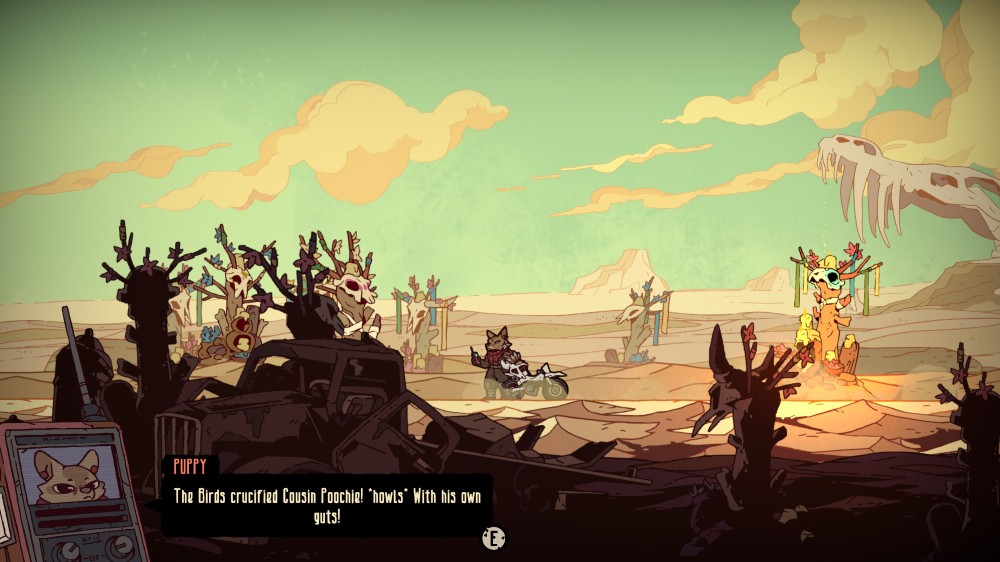
In Laika, you control the eponymous anthropomorphized coyote as she rides around the 2D post-apocalypse wasteland on a motorcycle. The game’s marketing really struck home with the “motorvania” tag, but it’s accurate. On a keyboard, W makes you drive forward, A & D will tilt you forwards or backwards, Spacebar will turn you around, and you use the mouse to aim in any direction and fire. If that sounds clunky… it is. Playing this game will require you to rewire your brain a bit. Especially considering you can only reload your guns by doing a backflip (!!). Yes, every time.
That is only the half of it though. Laika does not have a health bar because every bullet is fatal. Landing upside down is fatal. Hitting your head on a ledge is fatal. If you forget how the controls work, just pressing D for more than 2 seconds is fatal as you flip your bike over, even at a dead stop. Luckily, Laika takes a sort of Super Meat Boy/Hotline Miami approach where you respawn almost instantly… back at whatever checkpoint totem you last activated. Unfortunately, it also takes a halfway Dark Souls approach where you drop 50% of your upgrade currency in a bag at the location of your death.
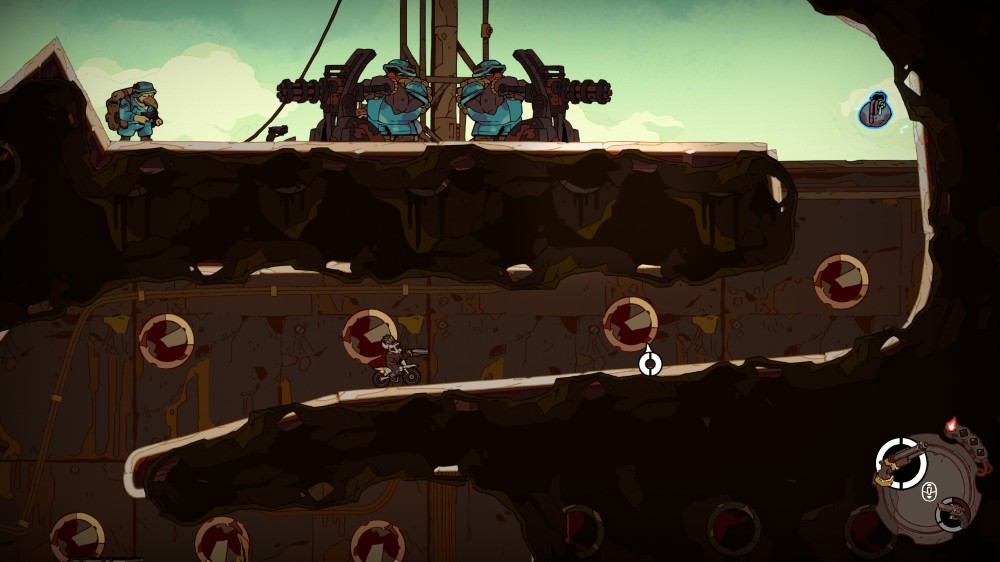
With the exception of a few boss fights, I eventually just vibed with the (death) experience. Your bike will protect you from incoming shots from the bottom and there’s an extremely generous bullet-time feature. It was quite satisfying seeing myself go from timidly seeking out obvious ramps to reload my pistol after every encounter, to trying to backflip from every bump in the road, to eventually just driving into encounters with only one in the chamber knowing I would be spinning around in the air deflecting bullets and reloading automatically anyway. I would still die to dumb shit all the time, of course, but my reaction was mostly on the “haha, oh man!” side rather than frustration. Considering I died 336 times (per Steam achievements), you kinda have to.
As for the rest of the game, it’s equal parts bleak, ultra-violence and touching melancholy. Indeed, the opening sequence has Laika discovering the horrific torture and crucifixion (with his own guts) of her young daughter’s friend at the hands of Birds. And yes, you do see Poochie hanging there. Considering the rest of the game is not nearly as gory and violent – guns and blood and bodies notwithstanding – I assume the devs wanted something extra brutal at the beginning to justify Laika killing all the Birds. Which was not all that needed, IMO, as the Birds were clearly a continued menace to everyone.
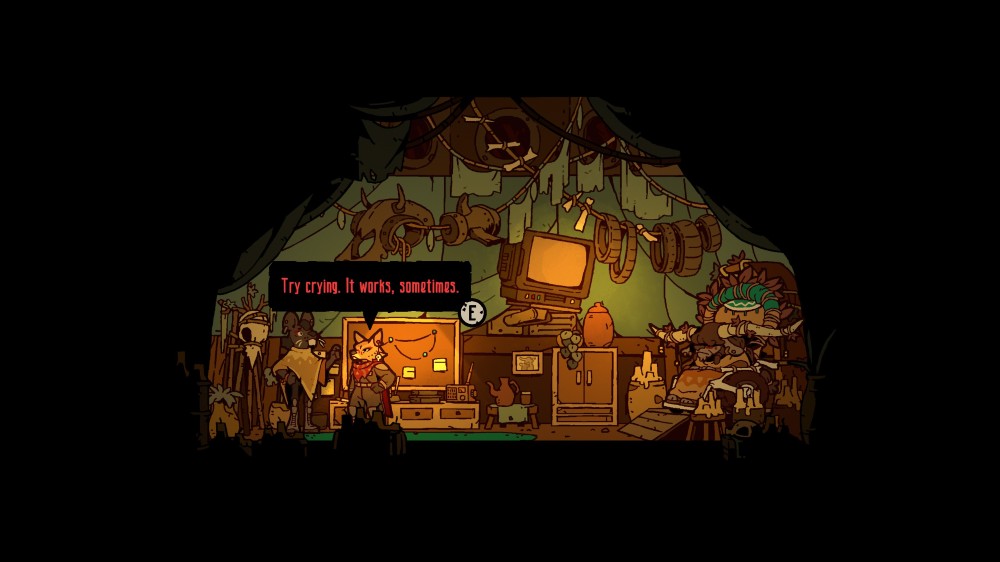
The final aspect I wanted to highlight is the soundtrack. Good Christ is the soundtrack fantastic. It is a lo-fi jazz-bar Western experience that perfectly fits the feeling of the game, or perhaps defines it. Even if you have no desire to play the rest of the game, I highly recommend browsing the soundtrack. The only negative is how some of these songs are collected or purchased from vendors in-game, which means after 18 hours of playing, you might be tired of the ones you heard more than others. Although I never seem to tire of The Whisper, or My Destiny, or even Bloody Sunset. There are technically “normal” non-voiced songs too, but they are more limited to certain locations, boss fights, and such.
So, yeah, that is Laika: Aged in Blood. It’s not a great game, and certainly not something I would play over again. But it joins that gnostic pantheon of games like LISA or Undertale where I am equal parts glad to have experienced it and glad it is over. Sometimes you just need the pathos.
Arcane and Edgerunners
While on my vacation a few weeks ago, away from my PC, I finally found the time to watch both Arcane (e.g. the League of Legends-based show) and Cyberpunk: Edgerunners. Here are my thoughts:
Arcane: Season 1
An amazingly compelling and nuanced show that is better than it really has any right to be. Arcane is at a quality level that it makes you start thinking that Riot created League of Legends as a means to fund the development of Arcane, the thing that they wanted to make all along.
The overall show follows the life of Vi and Powder, two sisters growing up in the undercity slums, and how they try to survive amidst gang wars and oppression from enforcers from the city proper. A series of unfortunate events breaks them apart, and their differing paths through the developing tension between the upper and lower cities forms the backbone of the plot.
I really don’t know what else to say about Arcane. I have never played League of Legends nor have delved into any character lore to see if anything in the show is “accurate.” None it really matters, as the show stands on its own. In fact, outside of a few moments late in the series where there is clearly some “ultimate ability fan service,” you probably wouldn’t ever know it was based on a game.
In any case, whether or not you choose to invest the time in watching Arcane for yourself, I highly recommend at least listening to What Could Have Been and Goodbye. The overall soundtrack is next-level, with a wide range of genres and tempo, but those two in particular elevate the experience.
I am eagerly awaiting the release of Season 2, which is coming out soon.
Cyberpunk: Edgerunners
Cyberpunk: Edgerunners is a Japanese anime based within the Cyberpunk 2077 game world. It follows the life of David Martinez, a teenager who is thrust onto the merciless streets of Night City after a senseless tragedy. Mirroring the base game themes, we see how David tries to make a life for himself despite being surrounded by violence and corruption and cyberpsychosis at every turn.
I watched Edgerunners with the English dub, and that is something I recommend too – the quality is excellent, but the real treat was hearing the same sort of Cyberpunk slang (choom, gonk, flatlined, etc) that you do in-game. Indeed, seeing as how I watched the anime after having played the game in which they added Edgerunner gear as bonus items, it felt as if I were literally watching an in-game show.
Overall, I enjoyed the kinetic, violent affair, but recognize that it might not be for everyone (especially the squeamish). If you liked playing Cyberpunk 2077, you owe it to yourself to watch the show. If you didn’t, but enjoy the cyberpunk genre and are okay with over-the-top gore, then go for it. There is a ton of drama, tragedy, and an impeccable soundtrack (some of which come direct from the game radio).
Impressions: Banners of Ruin
Banners of Ruin is an incredibly slick deckbuilding roguelike that has consumed my life for the past week. While it shares some conventions with other games in the genre, it has a fairly unique mix of them that result in a number surprising interactions. Also, everyone is an anthropomorphized animal.
Before moving on though, let me say this: the visuals and especially the music are phenomenal. The combination sucks you right into the setting, and I found myself humming along with the battle music pretty much the entire time it’s playing. Just like with Tainted Grail before it, I will be tracking down this soundtrack, if it exists.
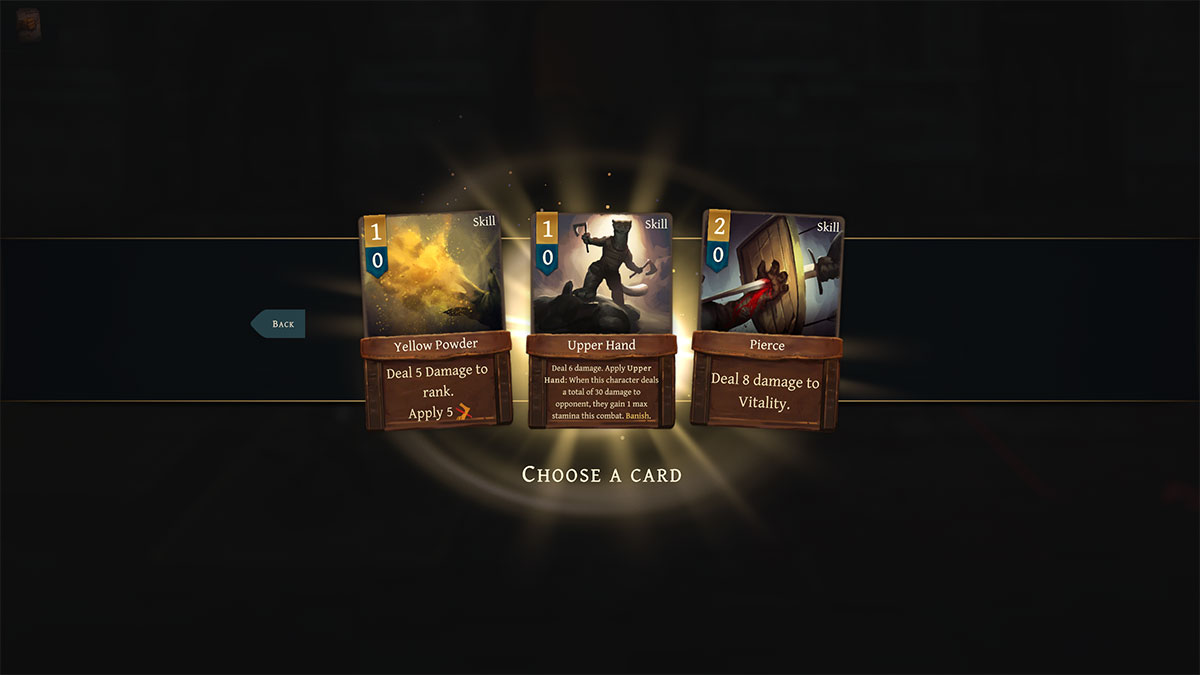
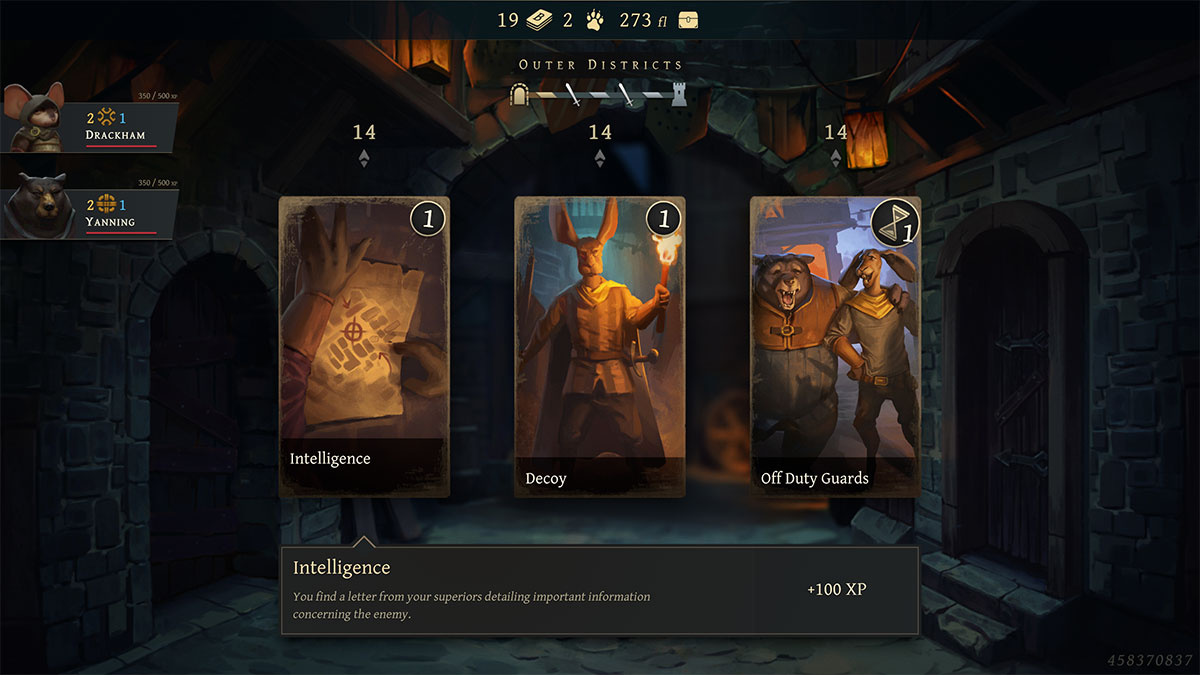
The central premise of the game is that you are a member of a suddenly-deposed House, and you are trying to escape the city with your life. As you navigate the city, you must choose from one of three “path” cards which can lead to combat, shops, or events. These choices are mutually exclusive, and you don’t have a particular notion of what offerings you will get next time. After a specific number of choices, you will encounter the boss fight of the area and then move on, if successful.
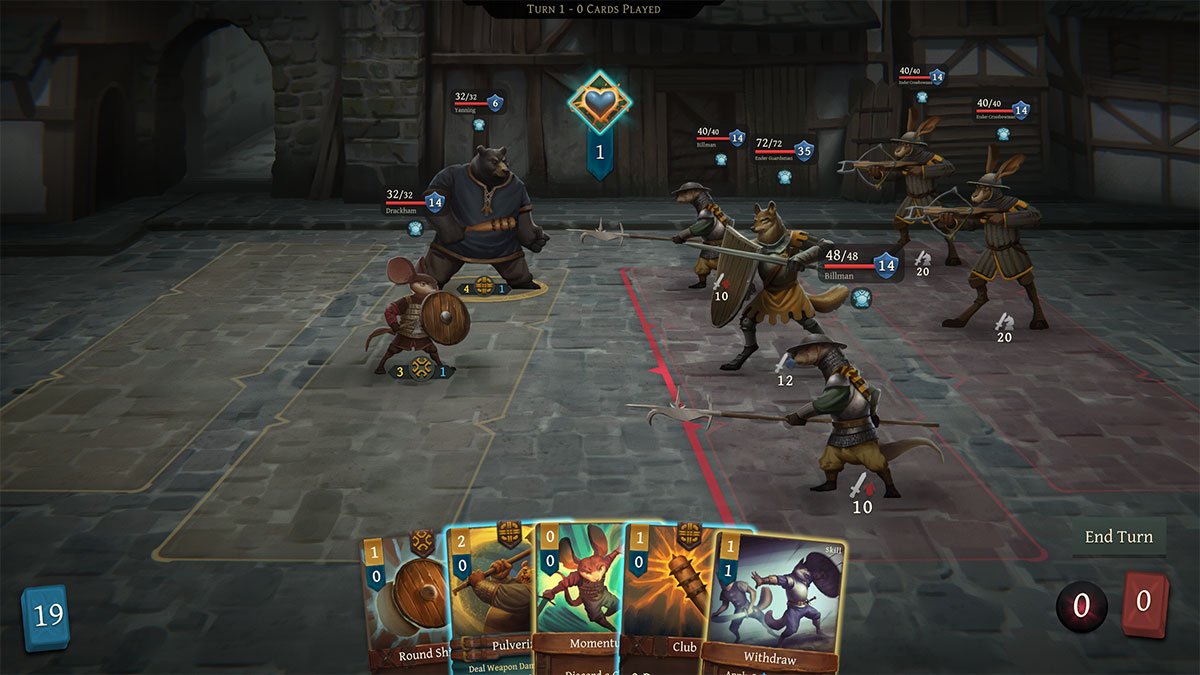
Combat is highly tactical. You start with two characters that can be arranged however you like (ahead of time) on a 2×3 grid; enemies are will be placed in their own 2×3 formation facing opposite. While you are free to play cards every turn, your foes will only act one rank at a time, e.g. the front three positions on Turn 1, then the back three positions on Turn 2, etc, unless there are no enemies in a specific rank.
Positioning matters. Enemies will typically attack a specific horizontal lane. Place one character in front of another, and that front character is likely to eat all of the incoming attacks. However, if three enemies are targeting a character with nobody behind them and then that character moves to a different spot, all three attacks will be negated. And remember when I said that enemies take turns attacking based on which rank they’re in? If they are set to attack you this turn from the front rank and you move them (via a card like Kick) to the back rank… then they don’t attack that turn. Next turn, if you then draw into cards that can move them back to the front, you can skip their turn again.
The tactical nature of the game extends out into deckbuilding and character progression too. Each character has two weapons slots and an armor slot. Equipping a bow will add a Bow card into your deck; equipping two daggers adds two dagger cards instead; a shield will add a shield card, and so on. Armor is more passive insofar as it affects your starting armor only, although there are special armors that have more interesting effects. As characters level up, they can unlock a choice of three Talent cards which are then added to the deck, but only that character can play the card. Same with the weapon cards, actually. Level ups also unlock a choice of passive abilities. Oh, and each race has a racial ability that can be activated any time, as long as you have a secondary resource (Will) available.
What all this combines into is an interesting gumbo of choices, tactics, and deckbuilding strategy.
…until you get to the endgame.
There is a final Final Boss that become accessible after performing a series of steps along the campaign. However, the fight itself is so oppressive and ridiculous that it leads to really just a single strategy to overcome it. Once I understood this, and realized the same strategy works for the rest of the game too, every subsequent run started to feel the same. It doesn’t help that while there is a great variety in character races and Talent cards and passives, the number of defined weapons/armors and enemies in general is much more limited. Indeed, I think all of the bosses are the same each time too.
The potentially good news is that the game appears to still be in active development – there was a major release in November 2021, which added new “hallway” scenarios, some optional difficulty modifiers (aka Ascension ranks), mini-bosses and so on. That is not enough to elevate the endgame to a Slay the Spire level, IMO, but A) not everything needs infinite replay value, and B) maybe a future patch or DLC will spice things up.
Overall, I am very satisfied with my (discounted) purchase of Banners of Ruin. As someone who plays a lot of games in this genre, I definitely appreciated the slick presentation and the novel mix of elements. The sort of defined challenges I complained about earlier might be more of a positive to others who dislike a lot of randomness. Or maybe we can just be happy playing a game for ~30 hours and be done.
We All Lift Together
This is technically old news, but Warframe came out with a new expansion of sorts.
Accompanying this expansion is perhaps one of the best game trailers ever made:
While the video is a delight itself, I am mainly referring to the song. Luckily, someone created an hour-long loop version so that I don’t have to keep clicking the Repeat button and/or fend off auto-playing “recommended” videos.
Listening to this on loop got me thinking… what even are the other contenders for best game trailers ever made? I had to go through several Top 10 lists to reacquaint myself with a few of them. My own list includes, in no particular order:
- Deus Ex: Human Revolution – “I did not ask for this”
- Bonus Deus Ex: HR – Live Action version
- Dead Island – best misleading trailer ever
- WoW: Wrath of the Lich King – (icy) blast from the past
- Warhammer 40k: Dawn of War 3 – best trailer for terrible game
- Xenogears – 78 second trailer in 1997 led me to my favorite game
I’m a sucker for orchestra and choir and Inception noises, apparently.
If you need me, I’ll be listening to a trailer song of an expansion to a game I don’t even play.
Review: Bastion
Game: Bastion
Recommended price: $15 (Full Price)
Metacritic Score: 88
Completion Time: ~6 hours
Buy If You Like: Extremely well designed, short works of action-RPG art.
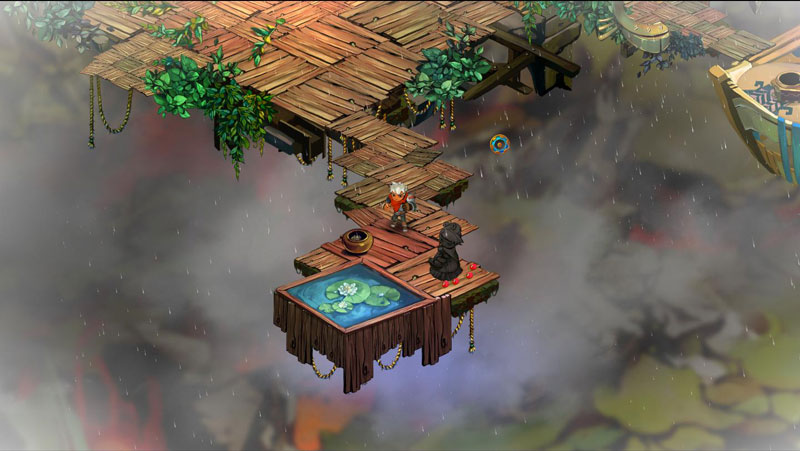
Like LIMBO, another entry in the "Games As Art" category.
Much like LIMBO before it, Bastion puts me in the unfortunate position of having to tell you about an amazing game that concludes much too soon. But let’s not get ahead of ourselves.
On a superficial level, Bastion is a so-so Action RPG in the vein of Diablo meets Kingdom Hearts. You move your character around with WASD on an isometric field, and repeatedly Left-Click or Right-Click depending on which of the two selected weapons you want to use. There is also a dodge (Spacebar) and Block (Shift) button, the latter of which can straight up counter attacks completely if you press it at the right time. There are a bit more than a dozen enemy types, only a few of which require tactics other than simply shooting them with a ranged weapon or repeatedly mashing the melee button. You pick up orbs from killing/breaking things to use as currency for upgrades, leveling doesn’t change much beyond max HP and opening new passive ability slots, and… that’s about it.
By the way, the Mona Lisa is just a chick sitting in front of a river, Starry Night is just some swirls, Seurat liked making a lot of dots, Moonlight Sonata is some piano noises, etc etc.
How things are presented is incredibly important, and it is in this way that the designers of Bastion demonstrate a level of mastery that is damn near sublime. Bastion is a game with its own zeitgeist.
One of the first things people mention about Bastion is the narration by Logan Cunningham, who incredibly has never done voice-acting before. Before I played the game, I thought the concept of background narration a cute “gimmick.” By the end of Bastion, I had no idea how I would cope in games without it. The narration is so much more than a workaround for a silent protagonist and a lack of formal written dialog. Yes, it reacts to things you are doing on-screen – “Kid just rages for a while” (when just smashing objects), “And then the Kid falls to his death… I’m just playin'” (when you fall off the edge of the maps). But it solves a crucial problem endemic in most RPGs: how do you succinctly express emotion? Written dialog only takes you so far, and emotive character models generally do not work outside of LA Noir-esque settings, nevermind how that shackles you into a certain artistic style. Obviously Bastion is not the first game to use voice acting to “solve” the problem, but I am coming up at a loss as to what other game nailed it as hard as this one.
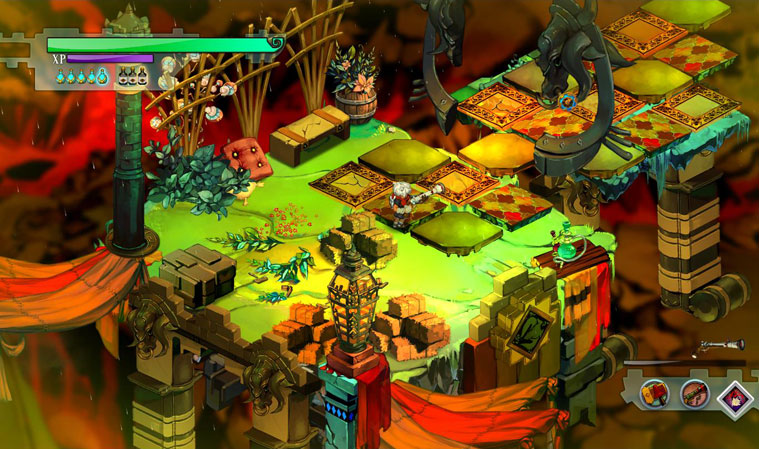
Seriously, Bastion has ruined other games for me, art-wise.
The other aspect that unfortunately does not seem to get as much press time are the visuals. It is somewhat difficult to truly appreciate it during gameplay, but this is the first time I have felt like I was playing a literal work of art since Saga Frontier 2. And it is just not that everything looks amazing; everything simply fits. For example, take a look at any of the screenshots. Do you ever really notice the background? In the entire time I was playing, I recognized that there were edges I could fall off of, and yet never once was I distracted by what that abyss consisted of. That doesn’t happen by accident. Also, the elegance that is the ground flying up to form your path is the sort of design epiphany that solves a more mundane problem (how to prevent the player from seeing their isometric path) in a way that makes the game as a whole better. In other words, it felt like an integral part of the experience rather than arbitrary.
Finally, I would be remiss to not mention the amazing soundtrack. It fades in and out at all the right moments, and is of a quality far beyond what one would expect in a $15 indie game. Part Western, part Eastern, part hip-hop, trip-hop, blues, techno and altogether perfect for what it is. I would not go so far as to buy the $10 soundtrack – typically, battle music isn’t what I look for when I want to relax/browse the web – but you might want to check out Build That Wall (Zia’s Theme) and Mother, I’m Here (Zulf’s Theme) and the hybridized Setting Sail, Coming Home (End Theme). Even if you never actually play the game, those three songs alone will likely make their way to the top of your playlist. Mother, I’m Here in particular so perfectly channels a moment in the game, that it creates a feedback loop with your memory of the experience (which includes the song) that results, at least for me, a reaction far beyond what I actually felt at the time. I literally have not experienced this feeling from a videogame song since Chrono Trigger, FF7, and Xenogears.
Honestly, the only thing stopping this game from rocketing its way towards my Top 5 game list is its six hour duration. That is not to say it felt rushed or incomplete; quite the opposite, in fact! Bastion puts its arm around your shoulder, spins you a fantastic tale, pats you on the back and then saunters off into the sunset. For the completists and sentimentalists, there is a New Game+ option that lets you keep your upgraded weapons and adds more gods to the Shrine, which buffs enemies in various ways to voluntarily increase the challenge.
All good things come to an end though, and god damn if I wished Bastion lasted two, three, hell, five times as long as it did. Lord knows worse games do.
 In An Age