Blog Archives
Un-Necesse-ary
Necesse recently graduated from Early Access to full 1.0 release. I had played it previously for almost 10 hours, so I wanted to give it another go to see what had improved. As it turns out… not much.

I’ve heard the game described as “top-down Terraria meets RimWorld,” but that is criminally misleading. Yes, it is a top-down, open-world survival crafting game with RimWorld-esque colony management functions. But what it’s actually more like is a lower-budget Keplerth. Now, in my Impressions of that game I called it a knockoff Necesse, so there’s some circular referencing going on.
The point is to not go into Necesse thinking you are going to get the same tight, engaging gameplay loops of Terraria or… like anything at all related to RimWorld’s subtle genius. The NPCs you recruit to your village can be assigned tasks like chopping wood or shearing sheep, but they have zero personality, relevant moods, or any necessary functionality at all. Hell, most of the crafting you can do is itself pointless in comparison to random drops.
OK, let’s back up. What’s Necesse and its gameplay loop?

In Necesse, there is a large overworld with various creatures and hazards and biomes to explore. Additionally, there is an underground “layer” full of much more dangerous monsters and random loot. The loose goal is for you to summon bosses using specific item drops, defeat them, and use the resulting drops to unlock the next tier of progression. As you might expect with the top-down perspective, most of the bosses are bullet-hell style affairs with multiple phases.
There is crafting in Necesse, but it feels largely perfunctory and unsatisfactory. Yes, you can collect wood to make a Wood Sword, smelt copper into copper ingots to make a Copper Sword, and so on. You can also just buy weapons from NPCs too, skipping multiple tiers in the process. Indeed, the underground portions of the game feature loads of enemies that have a chance of dropping gear that vastly outstrips anything you could reasonably craft. So, rather than feeling like you are earning your way through escalating challenges, most of the time you are better off just running around under-geared until you very suddenly are not.

There is technically hunger in Necesse, but it is the sort of half-baked nonsense that is unfortunately typical in this space. Are there dozens of food recipes? Yes. Are any of them necessary at all? No. More complicated dishes can grant you larger bonuses to damage (etc) and you can even automate some of the cooking via the NPCs you recruit to your base. But… why? Just eat a bunch of coconuts or berries or whatever else is nearby. Perhaps this sort of thing becomes more required on higher difficulties. It all just feels rote, like designers going through the same motions just because “everyone” builds games this way. It’s 2025, guys: if food isn’t going to be super-scarce resource, then it needs to have a more integrated game function (increasing HP, etc) ala Valheim or similar. Otherwise, just leave it out.
To an extent, it’s a bit unfair to be too harsh on Necesse considering it was largely developed by one dude. Counter-point: Stardew Valley. Also: maybe it’s worth bringing on more people to make the game more engaging? There was a graphics overhaul at one point, which certainly improved things, but the UI itself is still hot garbage. Could they make the icons even tinier? [Fake Edit:] Just found the option for UI scale, but it still looks bad even when scaled up.
Anyway, that’s Necesse.
Impressions: Keplerth
Not going to lie, the name “Keplerth” was both intriguing and ultimately accurate.
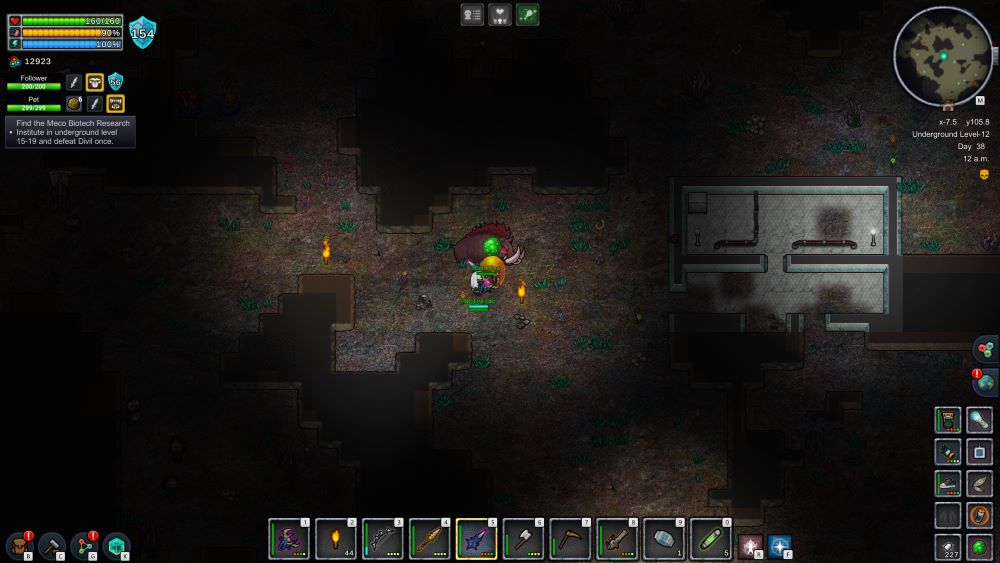
Keplerth is a top-down survival crafting game reminiscent of Terraria, with art assets straight stolen from RimWorld. Other reviews mention this as being a post-apocalypse knock-off of Necesse, if you know of that one. You will punch trees, create crafting benches, craft gear, and then tackle bosses to unlock the next tier of equipment, resources, and mobs. Rinse and repeat.
There are some interesting innovations to the formula though. For example, there is no XP here. Instead, you unlock new genes based on special resources that drop from basically everything in the game, e.g. plants, mobs, minerals, etc. The genes start simple, with stuff like +5% Evasion or +10% Attack Speed. Towards the beginning of the game, you have plenty of room to “equip” every gene you unlock; later on, you have to choose amongst them and their potential synergies.
I also appreciated how equipment bonuses work. Essentially, each piece of gear has a random set bonus and a random set bonus score (+0 through +3). So, the leg armor you craft might have bonuses to +Defense or +Pet Attack instead of the +Melee you were looking for. And even if it does have +Melee, the final set bonus may only trigger when you have 7/7 equipped and the piece you rolled grants +0. While random can be frustrating sometimes, many survival games are kind of rote in that Iron armor is Iron armor, and thus you only need 22 Iron ingots total to kit yourself out on that tier. This at least means you need to collect a buffer amount of resources. Later on, you get the ability to spend other resources to “reroll” the tier bonuses, so it is not too frustrating for long.
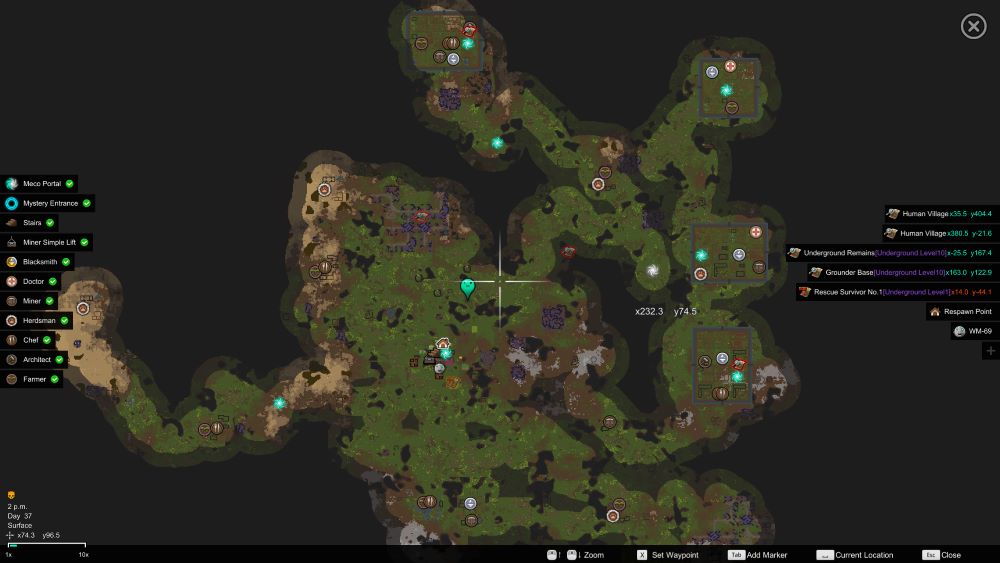
Where Keplerth struggles is… kinda everywhere else.
A lot of the mechanics feel half-baked. One of the early tutorial quests involves you attracting other survivors to your base with a communications tower. What the game doesn’t tell you is that the survivors… don’t really do anything. There is an entire elaborate construction station to create fancy furniture, but ultimately the survivors need 1 (one) recreation item (hot tub) and their heart meter will eventually fill and you click on them for money. That’s it. They do not defend your base, work the fields, or anything. You can also have farm animals like cows, chicken, horses, etc, and they will reproduce asexually as soon as their food meter hits 100%. Cooked food does require a variety of meat and plants for pretty useful buffs, so there is a point to all this, but it doesn’t always make that much sense. Like why have Horse Meat in the game when eggs are really the limiting factor for advanced food?
The special material mechanic I praised earlier is also a bit uneven. A lot of it felt natural at the time, as you just pick up all the things and new stuff seemed to unlock every 5 minutes or so. Eventually though, once your gene grid fills up and you start needing to examine what’s left, you start to realize that 5-6 of the missing genes require Thorns or Apples or some early-game stuff. Luckily the grind isn’t too bad since you can chop most everything down and replant it near your base to more quickly get additional chances when harvesting it – as opposed to having to wander around for more natural-occurring spawns – but the amount of things tagged to Thorns specifically is a bit odd.

What kind of broke the game for me though was one of the mid-tier boss drop weapons. Up to that point, you may have some melee weapons, bow and arrows, some early guns, and so on. Even with guns, there were some trade-offs with damage versus shooting speed. Then you get a 100% drop of an energy beam gun that deals constant damage with zero ammo. While it technically is out-classed in DPS later on, the utility of being able to trigger knockback, certain genes (“each hit adds X effect”), and the lack of ammo makes everything else feel dumb to use in comparison.
Later bosses also get into SHMUP/bullet-hell territory, which forces you to turtle up with your genes and equipment, which makes the fight last ages because you are no longer specced for damage.
Having said all that, I did end up playing the game for ~25 hours or so, somewhat obsessively. Keplerth definitely hit a stride for me after about the 2nd boss, once you unlocked the ability to tame battle pets, get some better weapons, better genes, and start finding other human settlements to spend money at. It is unfortunate how that petered out in the endgame, but what else can you do?
Play something else, I guess.
Impressions: Farworld Pioneers
Steam indicates that I first added Farworld Pioneers to my wishlist back in August 2022. It was described as Terraria/Starbound meets RimWorld/Oxygen Not Included, and since I very much enjoyed all those games, it seemed like this one would be up my alley. Well, it had a surprise (to me) release a few days ago and was on Game Pass to boot, so I was super excited to start playing.
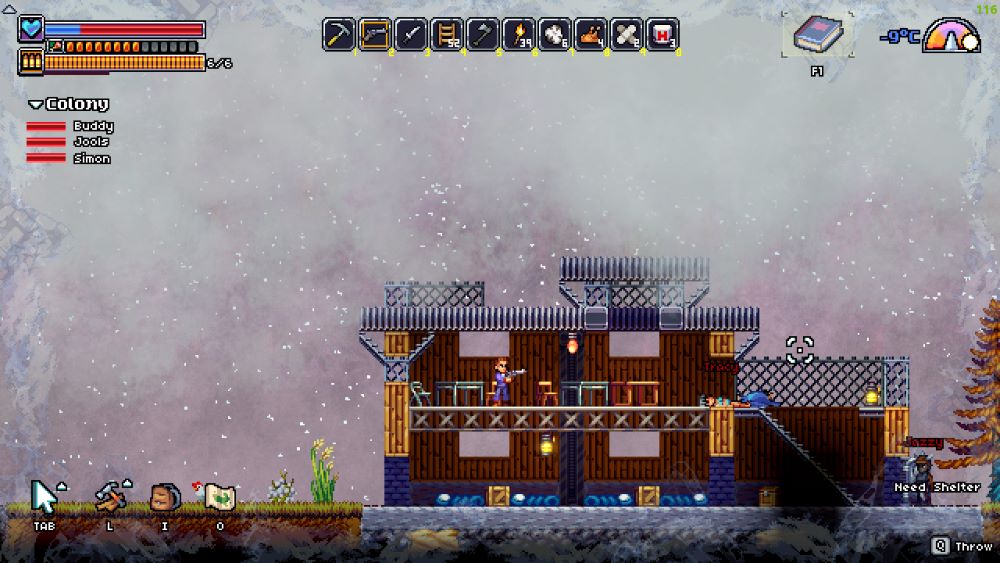
Unfortunately, the game is pretty much trash right now.
First off, the game is labeled “v1.0” but it is very much in the “minimum viable product” category. Like, barely Early Access. There are periods of inexplicable slowdown; all electricity generators delete their fuel whenever you Save & Quit; Colony AI is abysmal to the point where colonists will readily starve/freeze to death while getting stuck on the very resources they were collecting; several research products literally say “Coming Soon!”; the ultimate goal for exploring the rest of the game, the Dropship, simply… doesn’t work. That last one was the final kick in the balls for me, as I ended up exiting the game several times to try and get unstuck from the inside of the cabin, only to finally teleport out back to the original planet… sans Dropship. And its contents. According to others, I was lucky: they didn’t have a teleporter so they were truly trapped and had to abandon 10-hour saves.
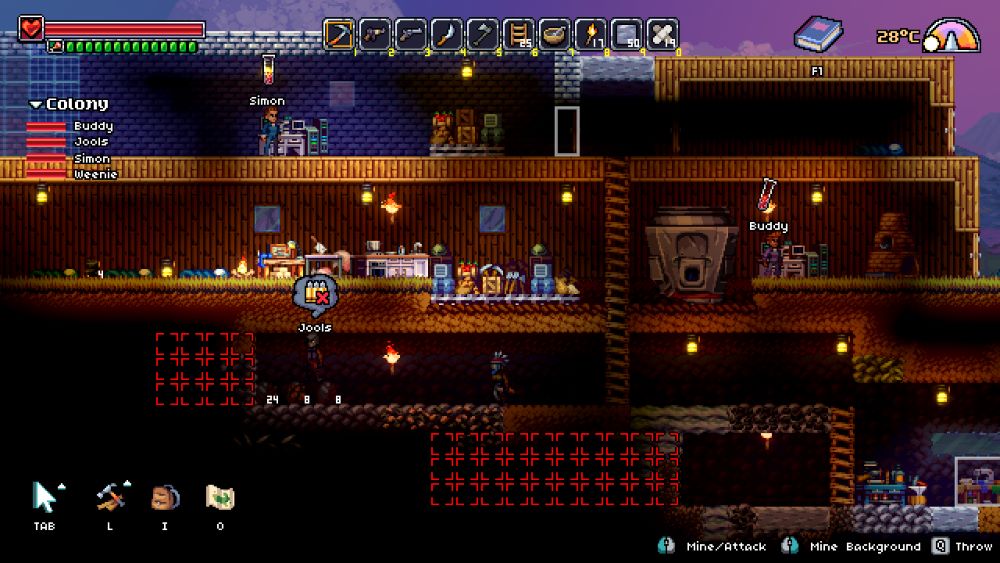
As bugs and sloppy code, those things can hopefully be fixed. What is a bit more concerning is the overall design of the game.
Terraria and Starbound both have NPCs that you can “recruit” to basically progress the game. They are not active members, but more like glorified workbenches or vendors. In colony sims like RimWorld and Oxygen Not Included, giving detailed orders and blueprinting out a base is important because you can’t control people directly. In exchange, you can see most of the map for planning purposes. Farworld Pioneers is a bastardization of the two – main character and colonists – and it just doesn’t work.
You can certainly give orders like “cut down these trees in particular” or “build a concrete room that looks like this.” And if you happen to have the resources in your stockpiles to accommodate the request (and the AI doesn’t wig out), they will even build it for you! The problem is that your colonists will not move the Iron Ore into the Smelter to make Steel Ingots and then move those to make the Steel door. Colonists will use existing resources, and they will work “bills” at crafting stations, but you have to set those up manually yourself. In which case, you may as well do it yourself.
Now, perhaps that is a deficiency of the existing AI. Certainly possible. But even if that piece is fixed, the fundamental problem is that you can only manage things that your character can see – no setting things up remotely while you are mining or exploring underground caves – which kind of renders the entire exercise moot. About the only functional things colonists can do while you are gone is perform Research and farm food.
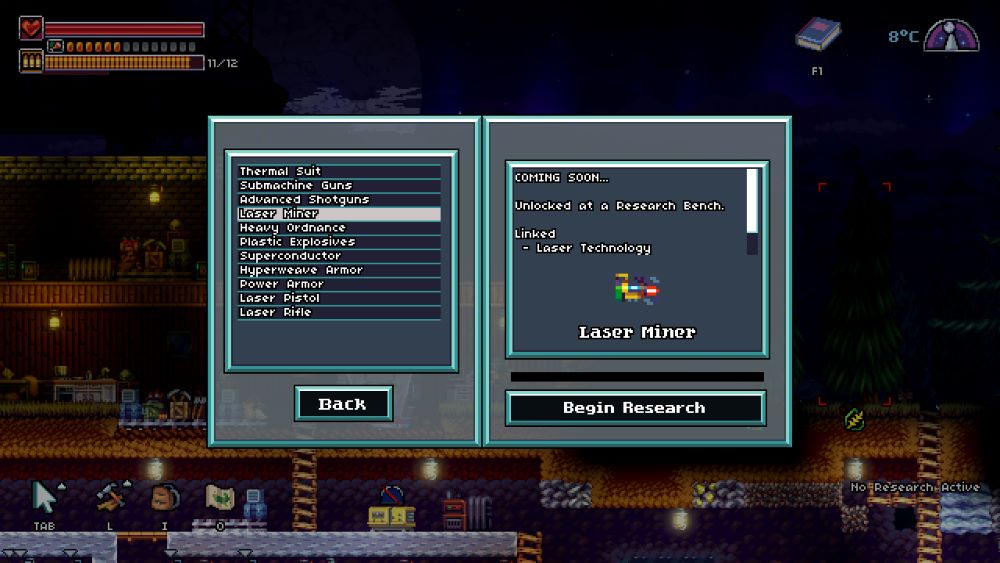
I also have grave concerns about the scope of the game. Obviously building a Dropship and heading to another planet to get more advanced resources is one of the top goals. But what comes after that? Are they truly going the Starbound route wherein you then head to new star systems and discover even more exotic minerals and so on? Based on the current tech tree, it seems unlikely. And based on the gameplay on the starter planet, where you might get notified raiders are attacking your base while you are deep underground, I have my suspicions that this is a more “defend your colony” and/or “play on multiplayer and PvP strangers” endgame.
Overall, the game is a hot mess and should not have been released in this state. As someone starved of exactly the genre Farworld Pioneers professed to belong to, this has been extremely disappointing.
Starbound Again
I played through and “completed” Starbound about 5 months ago, and my conclusion was:
And now, even if the devs end up finishing Starbound, I will have already consumed the lion’s share of the game’s novelty – that ever-finite motivational resource. No more character wipes? Then I’m already at endgame. Character wipes? I already know where to go, what to look for, how to overcome the obstacles, and basically speed my way through normal progression. Assuming I can be bothered to do so a second time.
I’m here to say that I’m wrong, and pretty much all fronts. At least, so far.
For the most part, I wasn’t planning on coming back to Starbound, but I needed a game I could sink my teeth into that also did not require uninterrupted time. Clash Royale and Overwatch used to be my “don’t know my schedule” games, but I’m still adapting to cohabiting with another human being.
And that’s a problem with a rather large number of games, actually. Meanwhile, Starbound is two clicks away from Save & Quit, and they fixed the “issue” with you being teleported back to your ship if you exit the game. Which I had utilized previously as a tricksey way of not having to climb out of the planet-sized hole I dug, but nevermind.
The, ahem, core mechanics of Starbound have not changed, but the tech tree, what minerals show up where, the quest structure, essentially enough has changed to make the experience fresh again. For example, one minor change the devs made was to introduce a sort of invulnerable ghost creature to the moons that contain your FTL fuel. While it is tacitly annoying (and deadly) in the same way as I talked about those Wasted SOB Purifiers before, they achieve a similar purpose – change the way you approach the game. Before, the most deadly thing about stocking up with infinite FTL fuel were meteor showers, which could only kill you in the two seconds before you burrowed underground. Now? It’s a risk/reward decision on how much fuel you grab on the surface (i.e. not much), and meanwhile you’re actively playing the game so as to not get stuck in a hole while getting chased.
So, yeah. The game definitely feels more finished than it did before. I will say though, that the first couple of story missions have been the exact same as the ones I played through previously. Which isn’t necessarily a bad thing… so far. We will see how things progress as I approach the endgame. Considering I already have 32 hours in Starbound, perhaps it doesn’t matter.
Then again, the bar Terraria set is still at 50 hours.
Impression: Craft the World
[Note: Day 3 Blaugust]

The aesthetics work really well, actually.
Craft the World is a game billed as “a unique sandbox strategy game, the mix of Dungeon Keeper, Terraria and Dwarf Fortress.” What initially attracted me to the game was the comparison to Dwarf Fortress, which is one of those mythical games that someone you know spent 6000 hours playing, but you didn’t even bother looking at after seeing the screenshots. I am led to believe there are texture packs for Dwarf Fortress, but considering I can’t even bring myself to play FF12 due to graphics alone, I figure I’ll wait until some fan recreates the entire thing in an actual watchable format.
In the meantime… well, Craft the World.
Right now the game still feels like it’s in beta. I am playing in the “Campaign” mode, which I understand to be an extended tutorial. The problem is that I have no idea how to “beat” the campaign. There’s a 40-60 minute timer which dictates when a monster portal opens, and I have been defeating said monters each time they appear. I think I read something about defeating a boss, who will then drop the portal for the next campaign world. Or something about completing all the “tech trees” to unlock it. Or something.
The actual gameplay is both interesting and somewhat vapid. Instead of controlling an actual character, you are the disembodied cursor simply marking which squares you want dug/built/collected/attacked. If a dwarf is available and feels like it, he will go over and start working the squares. So the gameplay cadence is queuing up a lot of work, spending time in the crafting menu, and then watching your dwarves (hopefully) carry it out. Resources are only collected two items at a time, and said items are only actually available once the dwarf makes it back to your Stash. So the end result for me was usually watching the dwarves go about their business, eyes glazed, and then realize 5 minutes later that they were all standing around idle.
Technically, you can control a dwarf directly at any time if you want to get more hands-on. In fact, you pretty much have to to get any sort of reasonable construction project going. Not only do you have an increased object placement range (uncontrolled dwarves can only reach 2 squares instead of 3), but your controlled dwarf has full access to your entire inventory. Otherwise, yep, the dwarves have to carry over the supplies two items at a time; not a whole lot of fun when you’re trying to get them to build a ladder down a mineshaft.
As I mentioned in the beginning though, the game feels Beta-ish. The controls have clearly been designed around an eventual tablet version, as hotkeys are limited and damn near everything revolves around left-click. There are quests/tasks in the Campaign mode which are either broke, or frustratingly vague. For example, one quest was to start a farm by planting Wheat. I actually had some Wheat, but nothing I did seemed to work in terms of getting it planted. Then I thought perhaps I needed “Grain” first, e.g. seeds, but no amount of Wild Wheat harvesting produced any. And, you know, the quest clearly says to plant Wheat, not Grain. I eventually completed the quest after collecting enough Wild Wheat, which shouldn’t have worked based on the description, but whatever.
In the meantime, I’m willing to give it a little bit more time to get more interesting. I can’t help but feel like there is something there, some nugget of fun waiting to be uncovered. At the same time, I also kinda feel like the devs missed everything that was actually fun about the games they were inspired by. Terraria this ain’t, that’s for damn sure.
October Surprise(s)
October is shaping up to be a busy month.
Hearthstone is going to have its first (and only) beta wipe coinciding with a large rebalancing patch. And apparently more opt-in beta waves. Which is an important distinction from open beta, which this will not be. The good news is that there isn’t going to be any further beta wipes, so progression for those that are in the beta is going to be permanent thereafter.
The “rebalancing” is of most interest to me (of course), as Blizzard is going to have a thread a needle made out of graphene. I have talked about some of the imbalanced cards before, but the most salient point is that the devs do not have the same access to the balance “knobs” as they do in, say, WoW or Diablo 3. Hypothetically, making the Pint-Sized Summoner go from costing 2 mana to 3, for example, is an enormous balancing change that has wide-ranging repercussions on how (and if) the card is played at all. I would personally change the Pint-Sized Summoner to be a 1/1 or maybe a 1/2; the former makes it a dead draw against Mage and Rogue decks, but honestly, I don’t feel like an Arena game should revolve around whether you have a turn-2 removal spell in your opening hand. Maybe they could change it to be only 1 mana off the cost of creatures and leave the rest alone?
Speaking of digital card games, Hex will be beginning its Alpha testing on October 8th. To be honest, even with the weekly Kickstarter updates, I sorta forgot about the fact that I pledged $85 (!) to this game nearly 5 months ago. And even more honestly, Hearthstone kinda sucked all the oxygen out of the CCG room. For however lame its been to go 0-3 or my most recent 3-3 record in the Hearthstone Arena, at least I could choose to pay $0 for those games; going back to $6 drafts will be rough. The Alpha test will give everyone 4 copies of all PvP cards, so at least I won’t have to decide whether to “waste” all my Kickstarter packs before the game comes out (which hopefully dilute the skill pool a bit).
Although I have not been playing it regularly, PlanetSide 2 is due for a huge optimization patch on October 23rd. I’m not actually all that excited about it, even though the devs are supposedly touting a ~30% gain in frame rates across all types of computer configurations. Why? First of all, this optimization work is at the expense of everything else. Changes to the Infiltrator class? Pushed back. New air weapons pushed back. New continent pushed back. And so on.
A fire was clearly lit under someone’s ass about poor performance, but with players leaving in droves, I’m not sure that chasing after the ones that left over computer issues is a winning proposition. And that leads me to reason number two: it’s all really a cynical ploy to get the game ready for the PlayStation 4. “Cynical” as in they only bothered caring about performance nearly a year after release, and only when the opportunity to cash in on a new market presented itself.
I’m a little bitter, if you can’t tell. Every time I get the bug to go play some more of PS2, I hit Instant Action and am sent to some deserted facility that changed hands an hour ago. And when I do happen to find some action, it inevitably dies down quickly and I’m left staring at the 5, 10, 15 minute capture timer. “Open world” and “emergent gameplay” is nice and all, but when I end up playing longer on my phone waiting for something to happen in the main game, something has gone horribly wrong. Ain’t nobody got time to wait around empty bases.
Luckily for me, and rather unfortunately for Sony, Battlefield 4 comes out October 29th.
I am not really all that certain I will be purchasing it on Day 1, although I had a blast playing Battlefield 3 for the six or so months that I was doing so. Looking back in my archives, I didn’t really talk about my experiences with it all that much. Basically, I see it as PlanetSide 2 without the waiting. While BF3 is technically more similar to Call of Duty than a sort of “open world” like PS2, the reality is that all PS2 brings to the table (or my table, anyway) is the ability to hop into a vehicle or airplane without having to wait/steal it from someone else. Every single other thing is better in BF3 – the shooting, the graphics, the action, the tactics, the depth. Again, technically, PS2 can have deeper strategy via Outfits and the like, but to the average player in the average game session, BF3 can’t be beat.
I haven’t really been following the Battlefield 4 news all that closely, but I find it interesting that the new game modes are being heavily skewed towards Call of Duty. Not that CoD invented any of them, of course, but I am more referring to that sort of play-style. Domination, Defuse, Team Deathmatch, Squad Deathmatch, and Rush are all CoDish to me. Conquest is still there in all its glory though, and Obliteration sounds somewhat interesting with its hot potato gameplay. But sometimes I just feel like shooting people in the face, you know? So that’s probably okay. Plus, technically every game mode will be available in all 10 maps, so it is not as though you’re stuck in the same handful of maps for every Conquest game.
Also coming in October: Terraria‘s 1.2 Patch, Don’t Starve‘s final two content patches (October 1st and presumably the final one 3 weeks later), and I guess GTA Online.
Regarding the latter, I am, of course, holding out for the PC release.
Review: Terraria
Game: Terraria
Recommended price: $10 (full)
Metacritic Score: 83
Completion Time: 50+ hours
Buy If You Like: 2D Minecraft, procedurally-generated Metrovania platformers
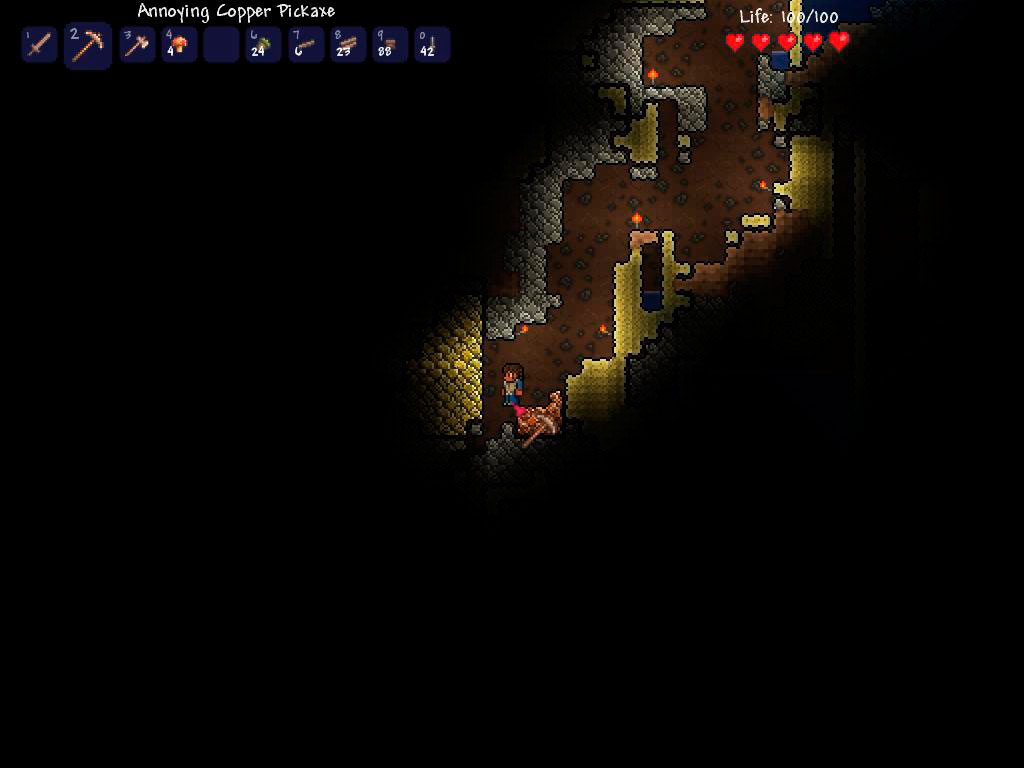
WHY IS THIS SO FUN?! *sobs*
Up until I started playing a few weeks ago, the entire mental space Terraria occupied for me can be summed up as “that 2D Minecraft knock-off.” I am not even sure which game came first, and it did not seem to matter: Terraria was just another game about digging for ore and crafting better pickaxes to mine for more ore. In only two dimensions.
After seeing an entire weekend evaporate in a flurry of clicking pixel blocks however, I am here to say that Terraria is not just a 2D Minecraft clone. It is an unholy union between all the addictive parts of Minecraft combined with legitimately entertaining Metrovania gameplay with a liberal dose of SNES graphical/musical nostalgia thrown into the mix.
Terraria starts out innocently enough, with your character equipped with a copper sword, axe, and mining pick. The beginning hours will be spent chopping trees, building your first crafting station, killing some slimes to turn their quivering innards into fuel for your torches, and so on. Much like Minecraft, zombies and other uglies come out at night which drives you to create shelter and then start digging underground for wont of something else to do.
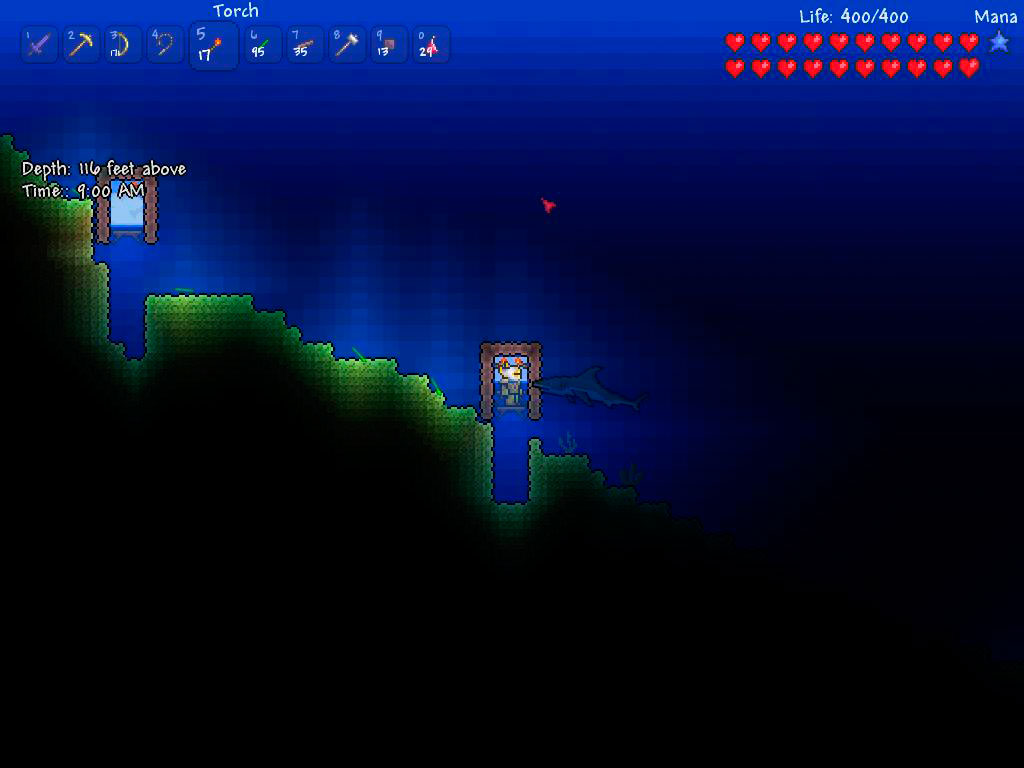
C’mon, this is easily more explainable than average Minecraft shenanigans.
While it might not initially seem so at first, there is a surprising amount of depth (har har) to Terraria’s gameplay. While you are hunting around for Copper and Iron ore, you will of course encounter enemies in the deep places of the earth. You will also frequently encounter priceless clay pots of a forgotten age which can be broken and looted for coins. You will eventually start coming across chests filled with goodies/equipment, and even crystalline Hearts, which can be broken and then consumed to increase your HP.
As you hit certain milestones, the world around you changes. Once you have accumulated 50 silver pieces, a Merchant will hang around your house, provided you build a room for him to sleep in. Finding and hoarding bombs will cause the Demolitionist to start peddling his explosive warez. And once you surpass 200 HP, there is an increasing chance the Eye of Cthulhu (the first boss) will settle its gaze upon your growing hamlet.
Not only does all this progression feel natural, it is also addicting. Your hunt for better ores to craft better armor and weapons to make your life easier leads to encountering stronger foes and ever more secrets. While crafting is a lot less complex than with Minecraft – you can talk to the Guide to see every craftable item that a given ingredient can produce – it simultaneously feels a bit deeper. Hitting Diamond could be accomplished relatively quickly in Minecraft, at which point you were essentially in the endgame. Contrast that with Terraria, where the natural hardiness of your foes directs your exploration of the whole of the game map before culminating in a Final Boss… whose defeat unlocks the Hardmode version of your world, with new enemies and even harder bosses.
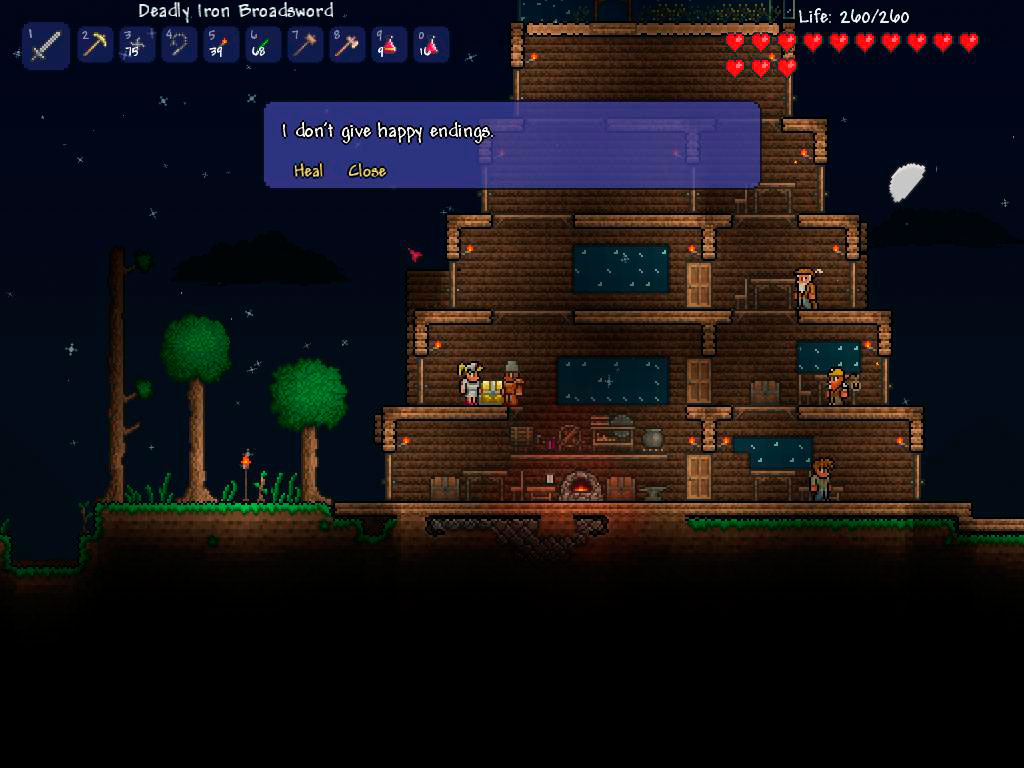
I… I’ll see myself out.
Of course, all of this implicit progression leads to a necessarily more finite resolution. While there are quite a few different set pieces to play around with, you are probably not going to spend the same amount of time building castles and mountain fortresses here as you would in Minecraft. That said, my game clock read 53 hours by the time I finished off the last of the Hardmode bosses and crafted the final piece of my ultimate armor. I could farm these bosses a few more times for their exclusive material drops – who wouldn’t want to run around with a flamethrower? – but it almost seems superfluous at this point. What would be next? Would I reroll a new character in a new procedurally-generated world? I could. But I feel I have already mastered these mechanics, and would simply arrive at the same destination a bit faster this time around. Hell, I could even equip my new character with the flamethrower and best pickaxe in the game to further speed along the process. Or I could go play something else.
Overall, the only real regret I have with Terraria was having spent all the time up to this point thinking of it as just a 2D Minecraft. Both games share many similar qualities, but why would another instance of “cause one to lose all track of time” or “become obsessed with mining better ore” be considered a deficiency? Both games are fun, in slightly different ways. Indeed, I am not even sure which one I would recommend first to someone who has played neither. Show Minecraft first, and like me, you might be a tad disappointed in the more limited forms of customization and Terraria not quite comparing to the sheer scale of an infinite 3D world. With Terraria going first though, you run the risk of having the person balk at Minecraft’s lack of direction and flat sense of progression.

Yes, that’s a lava moat below a lever-operated trapdoor.
In any case, having indie game companies force these tough choices on us when the AAA industry is falling over themselves pumping out derivative, 6-hour long sequels is ultimately a good problem to have.
 In An Age
Dirtbound
Aug 11
Posted by Azuriel
In Starbound, I have officially surpassed the number of hours I spent playing Terraria. And I am more convinced than ever that Terraria is the superior game.
Simply put, Starbound is a game of multitude of systems that have zero synergies with each other. Dig dirt, mine for ore, create armor, and so on. Pretty basic stuff, right? Not really. The actual crafting mechanics in Starbound are terrible, as are 99% of the items you can craft. Your “tier 1” armor is made from iron and woven fabric (made from plant material), but tier 2 is made from tungsten and cotton wool. Not only does this skip Copper, Silver, and Gold ores, but I’ve been playing 20+ hours since the 1.0 release and have encountered a grand total of three (3) cotton plants.
I can understand if the cotton bottleneck was intentional. But it’s not: the interplanetary gas station sells every fabric type other than cotton.
Bold move, Cotton, let’s see if it works out for them.
You can’t explain that.
Indeed, it seems like the devs simply abandoned any attempt to structure progression in the face of a billion procedurally generated worlds (filled the same three enemy attack types). Matter Manipulator modules are a sort of upgrade currency that can be found in nearly every box, everywhere. So are the tech cards, which unlock double-jumping and the Metroid-esque ball rolling. Getting those upgrades early kinda sorta maybe trivializes a lot of the content that comes later. And it’s not as though you get more of them in more dangerous areas – the algorithm basically puts one in 25% of all containers.
Then there is the fact that the best items are drops, full-stop. I mean, I get it, trying to balance gear progression around both player crafting and dropped loot is hard. But the fact that there are effectively zero good weapons from crafting means that that entire element is gone from the game. So your whole desire to dig for ore is reduced to the amount you need to craft the next tier of armor. Without the desire to dig though, you don’t, which means you’re just exploring the surface of the world and missing out on all the dungeons/set pieces that exist beneath it.
“But what about building bases and such?” Yeah, that’s still there. Given the default “survival” mode requires constant eating, it makes sense for even a story-focused character to stake out a simple farm. But honestly? It’s about a million times easier just coming across an already-built set piece randomly, and then planting your flag on it. Or tearing one down and transplanting it elsewhere, as opposed to crafting the individual components.
I don’t know. There are a million more things going on in Starbound than Terraria, but Terraria actually has synergy between what its got. In Terraria, the houses you build unlock NPCs you need, and the act of building settlements attracts monsters and even bosses. The deeper you dig, the more dangerous stuff appears. You can actually craft cool shit in Terraria. All the pieces fit together into a cohesive whole. In Starbound? Not so much.
Posted in Commentary, Review
3 Comments
Tags: Crafting, Starbound, Survival, Synergy, Terraria