Yearly Archives: 2011
Things That Used to Work, Vol. 2
…but don’t anymore.
As with Vol. 1, these listings reflect a personal (d)evolution of sensibilities based on some recent titles I completed.
Stats Games with Invisible Stats/Debuffs
Why It Used to Work: No one knew what they were doing, technical limitations.
Why It Doesn’t Work Anymore: I am much more conscious of questionable game design.
As I mentioned before, many of these categories stemmed from a recent completion of The Witcher, but there have been other games like Dragon Age: Origins that fit into this category. [Edit: for clarification purposes, a “stats game” is one which determines outcomes via visible or invisible dice rolls. God of War and Devil May Cry are not stats games, even if they technically have stats like HP and upgraded items and such. Even Counter-Strike has HP and damage modifiers to weapons (headshots are 3x damage for example), but it is also not a stats game. A headshot in a stats game would deal 3d6+10 damage with a Fortitude save DC 20 for half, assuming you overcame the 7% miss modifier.]
The underlying issue at hand is twofold. The first is when you have a stats game built around stats you cannot see or measure. In The Witcher, the talent trees as filled with “straight-forward” items like Damage +20% in Tier 2, followed by Damage +25% in Tier 3. Are these bonuses additive? Multiplicative? Do they simply replace each other? What is my baseline amount of damage anyway? There is no formal character sheet, so there is no real way to know. Bonus damage is attractive to me as a player, but without the number-crunching followup, it is more cock tease than substance.
The other issue is when a game pretends – or, worse, implements! – debuffs (that) actually matter without giving you a very effective way of understanding them in-game. The Witcher contains debuffs like Pain, Poison, Bleeding, Blinding, Incineration, and the like along with talents that raise your resistance against said debuffs and increasing your chances of inflicting them. Good luck figuring out when they are actually applied though, as the game designers felt that character animations alone should clue you in. Something which is pretty bizarre considering a fair number of talents increase your damage while the enemy is afflicted with a certain debuff. Spending resources debuffing an enemy so as to deal more damage overall than simply bludgeoning them over and over is the first road on the way to strategic depth; the road less traveled, unfortunately enough.
A topical side note comes from scrusi from Procrastination Amplification, who talks about how hiding the numbers can lead to excitement coming from the other direction. I absolutely agree. The point I am making here though is that a game designer cannot have it both ways. By all means, hide the numbers to build excitement… just don’t sneak in Damage +20% and other numbers to get nerd senses tingling without the follow-through.
Amnesia
Why It Used to Work: Built a sense of mystery, allowed naratives to start in medias res instead of always beginning in small villages, gives options for players to reprogram established characters.
Why It Doesn’t Work Anymore: It is almost always nothing more than a meta-narrative crutch.
Amnesia is so cliche a plot element that merely saying it is cliche is itself a cliche. I get why game designers do it, I really do. As mentioned, not having to start every story with a main character at age 17 in a small village is a big draw; not every game can pull off a Fallout 3-style beginning. Amnesia also lets you bypass a large portion of potentially boring but still slightly relevant backstory.
The thing is: none of that has anything to do with actually including amnesia into the narrative itself. Did Geralt having amnesia within the game affect the game in any real way? Not at all. The designers justified it – coming back from the dead! – but it served no other purpose than letting the player choose things Geralt as a historical character with an established narrative might not have done. And that is just damn lazy.
Obviously The Witcher is not alone in this. When I think back to FF7 with Cloud’s amnesia, all I realize is how much that particular plot-point is ostensibly designed to surprise the player, rather than make any real sense. Yes, it is justified in-game – Mako! PTSD! Experiments! – but in almost every single case I can imagine the story being so much more poignant with Cloud knowing the entire time. ¹ And that is what rubs me the wrong way about taking the easy way out via amnesia: all the missed opportunity for legitimate angst.
Nevermind how the amnesia itself rarely becomes more than a sub-plot. I was more okay with the amnesia of Planescape: Torment, for example, because it was not just a plot device, it was the entire plot.
Waiting for Groups
Why It Used to Work: You had to, It Builds Character.™
Why It Doesn’t Work Anymore: Looking For Dungeon, indie games, Steam.
Way back in February, in a post about LFD and difficulty, I just sort of asserted that the WoW LFD genie is out of the bottle and never going back in. I do not think that anyone actually disagrees with that assertion, even those that actively wish LFD was rolled back or limited to specific servers. The thing is, in a real way, I believe the very concept of waiting for groups at all has been irrevocably spoiled for me.
And… I think I’m fine with that.
I played World of Warcraft for ~7700 hours over the course of four years. I started in TBC, not Wrath, nevermind how LFD did not exist until patch 3.3, i.e. Icecrown. In the course of debating Nils on the issue of LFD’s effects on WoW’s social fabric, I keep finding myself examining why it is that so many people say that they went from sociable Friends List-using fellows to asocial LFD dwellers “overnight.” Battlegrounds had this functionality years before you even could form groups for competitive PvP (outside of world PvP of course). Surely battlegrounds are being utilized by more people than heroics are, yes? What made 5m dungeons so pivotal to the community aspect of the MMO?
While thinking on that question, I tried to imagine myself back in a time when what I could do was dictated entirely on the whims of strangers. And I thought: why bother with that? Loaded up on my Steam account right now is Assassin’s Creed: Brotherhood, Audiosurf, Frozen Synapse, Machinarium, Metro 2033, Recettear: An Item Shop’s Tale, Shining in the Darkness, the two Shadowgrounds games, SpaceChem, VVVVVV, and Dawn of War 2: Retribution. Those are simply the ones installed at the moment², not the 16 unplayed games like Mass Effect 1&2, The Witcher 2, and so on.
It sort of boggles my mind now that I would literally sit in Shattrath for hours trying to fill up a group for heroic Magister’s Terrace, back in the day.
Perhaps LFD did ruin things. Perhaps more people do run heroics than BGs. Perhaps the PvE community’s social fabric was hanging by a thread that was ultimately (and ironically) cut on December 8th, 2009. Academic retrospectives aside, I do not feel there is any going back for me, to blithely waiting for groups in any game ever again. I sat through some 40+ minute DPS queues right up towards the end of my Cataclysm run, either Alt-Tabbed or completing dailies, sure. But the way I look at things now, the content at the other end of those forty minutes of waiting better be damn impressive to justify not simply playing something else.
So if nothing else, the one thing LFD did do is disabuse me of the notion that waiting is required. In a world of $5 indie games and Steam deals, it really isn’t anymore.
¹ Keep in mind that I say this as someone who considers FF7 to be his #2 favorite game of all time.
² And I’m only really playing Shadowgrounds and AC: Brotherhood at the moment. The others are simply there for convenience’s sake.
Things That Used to Work, Vol. 1
…but don’t work anymore.
Many of the items on this list were inspired by my recent completion of The Witcher, although my (d)evolved sensibilities have been been growing this way for the past several years. Let’s get started:
Multiple Endings
Why It Used to Work: Replayability, simulates your decisions as being meaningful.
Why It Doesn’t Work Anymore: I am not likely to play ANY game more than once anymore (few people even finish the first time), and if I do, it will only be because the underlying gameplay was fun – in which case a different possible ending is at most a cherry to the already-frosted cake. Also, this could just be a personal thing, but whenever I am working on a game with multiple endings, my choices actually feel less meaningful rather than more, for two reasons.
The first reason is that nagging feeling whenever I reach a path-branching decision that one of the two options will be more fun than the other, and I will be stuck with the less-fun one. In The Witcher, it was choosing between Order, the nonhumans, or the neutral path. In Fallout: New Vegas, it was choosing between NCR, Caesar’s Legion, or your own way. The tenor and tone of each faction has their own charm, and in setting up a mutually exclusive decision, I am made responsible for picking the shittier option.
Even if I do replay the game, I am double-screwed. If the 2nd path ended up being better, I feel gypped that I didn’t pick it the first time. If the 2nd path ends up being worse, I am stuck playing a shittier game.
The second reason my choices actually feel less meaningful is that they typically are. No matter what side you pick in The Witcher, the final hours of the game are the same (same location, differently textured enemies). No matter what side you pick in Fallout: New Vegas, you are still battling on Hoover Dam. Different dialog from different NPCs is meaningfully different (enough that I feel like I’m losing something by not experiencing it), sure, but a lot of times it feels like Mad Lib storylines where they just switch around the Proper Nouns in the plot blanks. The last RPG I played with actual, game-changing decisions was Tactics Ogre way back on the PS1.
No Quest Hubs
Why It Used to Work: No one had really thought of it, Kaplan talks about how “the Christmas Tree effect” can leads to poor pacing and less engagement in any individual quest, it is more of a metagame issue.
Why It Doesn’t Work Anymore: I hate revisiting areas I know haven’t changed in any meaningful way. The Witcher does have a Notice Board which acts like a Fetch Quest Hub of sorts, but when I talk about Quest Hubs I mean the principle of being able to completely “finish” a particular zone at your own pace and move on. If a quest sends me to the fields to kill something, return to the city, then sends me back out into the fields to kill something else, my immediate reaction is “Time Sink!”
The term “boomerang quest” is an example of this principle, but it is slightly more than that. If I had to sum it up in a single way, it would perhaps be “inefficient questing.” Don’t send me on quests to kill the cave spiders, then a follow-up to kill the poison cave spiders deeper in, culminating in a quest to kill the spider queen in the deepest parts of the cave, without giving me all three quests first. Let me multitask! Whatever Wal-Mart has done wrong in crowding out smaller businesses and being jank-central, being able to make one trip and pick up milk, light bulbs, and spark plugs in a single trip is of immense value, lower prices notwithstanding.
Blind Choices (and/or Rewards)
Why It Used to Work: Puts a focus on the decision itself, more immersive/less metagame, perhaps enhances replayability through obfuscation.
Why It Doesn’t Work Anymore: Thank you, great hero! Please choose your reward:
- A book about vampires.
- Your very own hut.
- Wreath of immortelles.
Err… what? Perhaps I am simply too far down the metagame hole at this point, but how can anyone consider a choice with unknown consequences as meaningful? I mean, fine, all decisions and choices we make technically have unforseen consequences. But these game designers are literally giving you nonsense to choose between on top of said unforseen consequences. I don’t consider the choice between door #1 and door #2 to be meaningful at all – I may as well flip a coin or roll a die for as much thinking as it requires.
The above is an actual choice that The Witcher presents you with, and it is not the first nonsese choice. I picked the wreath de immortalies due to the time-honored tradition of game designers making the most useless-seeming items the most radically powerful. Plus, I figured that my own hut wouldn’t be very important to gameplay if I could choose not to have one, and I was likely leaving the area soon besides. Turns out the wreath let me complete an upcoming story quest faster than normal. Woo… hoo?
It is not as though I want WoW-like quest rewards, because there isn’t really any choice there either: something is an upgrade or it isn’t (and you probably can’t wear the other options anyway). When I think about meaningful choices, I remember back to the original Deus Ex when you’d come across upgrades like the cloaking device. Thermal or Electromagnetic? That was a meaningful decision because it shaped your gameplay in a way that had no “wrong” answers. I liked sniping people, and since I couldn’t snipe robots, easily sneaking past them (and cameras) was way more useful. There were plenty of humans/robots in the later stages so it could have gone either way. I wanted both and yet I was almost as fine with just one.
That, my friends, is a good choice to present to players. And they didn’t hide it behind a door or questionable language. You knew exactly what each did, and more importantly, you trusted the designers to present a scenario in which either would be equally useful.
Review: The Witcher
Game: The Witcher: Enhanced Edition Director’s Cut
Recommended price: $10 (current full price)
Metacritic Score: 86
Completion Time: ~52 hours
Buy If You Like: Immersive, mature, point-and-click action RPGs

Expansive views.
The Witcher is a lot of things. Deserving of an 86 Metacritic score is not one of them.
To be charitable, The Witcher can be seperated into two overarching qualities. One of those is the setting: the implied world, the zeitgeist, the plot, the dialog, the visuals and sounds and mood. All of those things are based on a series of novels by Polish author Andrzej Sapkowski, so in one respect The Witcher “cheated” compared to other games that had not the benefit of an established world. Then again, The Witcher absolutely possesses a personality that comes across perfectly fine to someone with zero knowledge of the books, to say nothing of the games impressive visuals and music which have no written analog.
Unfortunately, the other overarching quality is a little-known thing called “the actual game.” And this is where things begin to break down.
See, The Witcher is able to create a compelling setting through the implied world, of which you see very little at all in actuality. This is not unlike the Japanese art concept of Ma, which means “negative space,” in that it paints enough of a picture that you as the viewer fill in the rest. This works for art… but it does not work for gameplay at all. Combat in The Witcher appears to have a depth to it, but as the thin veneer rubs off from frequent use you begin to realize how much negative space the designers were actually papering over.
On the surface, Geralt of Rivia has two swords, one steel and one silver, and there are three fighting techniques for each: Strong, Fast, and Group. Additionally, there are charge-up attacks for each of the six combinations, and each combination has up to four chained attacks. Then there are the five magic spells which also have charge-up secondary functions. Finally you have potions (more on that in a bit) which can alter your fighting prowess and oils/poisons you apply to either of your blades. Oh, and there are bombs too.
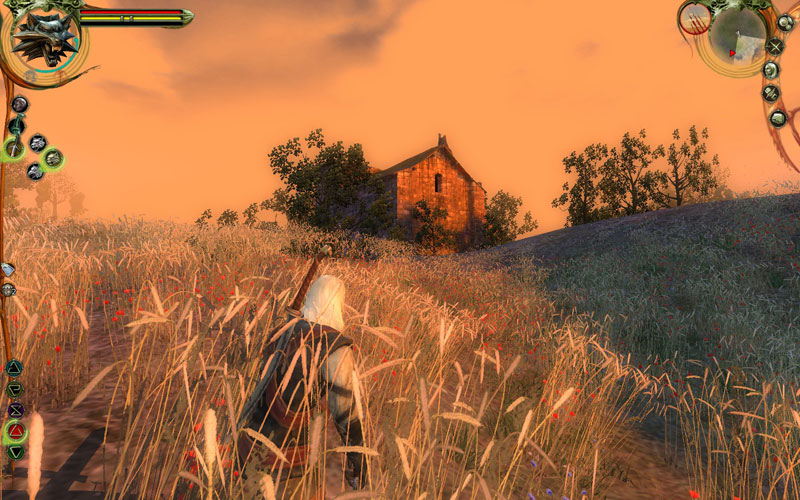
Kidding aside, daaaamn, this looks good.
Beneath the surface though? You left-click on a mob, Geralt performs a fancy sword move, you wait until the cursor “lights up” to left-click again in order to move onto the 2nd hit combo, and so on. If you click too fast or too slow, the attack is interupted and you just do it again. Repeat. In the “Making Of…” videos the designers mentioned how they wanted The Witcher to be more action-oriented than the sort of Neverwinter games they were inspired by, but I have to wonder whether Diablo was ever released in Poland. I ask because The Witcher straddles (and then falls off) that line between Diablo-esque quality mouse-clicking action and a mind-numbing Quick Time Event that is solved entirely by fixating on an inch square of the screen and left-clicking every 3-4 seconds. The motion captured moves are very impressive the first hundred times you see them, but eventually my eyes would unfocus in the interm period while waiting for the cursor to light up. Once you recognize the enemy and whether to use steel or silver, whether to use Strong or Fast styles, combat is essentially a forgone conclusion. You press Q-X (or similar), then Left-Click every few seconds until dead.
Nowhere is the thin veneer more aparent than the Talent trees or the Alchemy aspect, both of which are usually touted as Big Deals in reviews of this game. Simply put, the Talent system in general is a diluted mess of vague game mechanics. You have Bronze, Silver, and Gold talents, and you start out by getting just Bronze ones, then Silver, and so on. In practice, you will have damn near 100% of the Bronze talents and more than enough Silver ones, so all the vaunted “choices” boil down to which ones of the remotely useful talents you want first. Similarlly, Alchemy allows you to collect a huge sum of plant and monster parts to create ~20 different potions, only 3-4 of which are at all especially useful. There is also a Toxicity aspect of potions, presumably designed to prevent players from stacking huge amounts of potion buffs. However, since most potions last for 8 hours and Toxicity can be reduced to zero after resting for 1 hour… well, you see where that is going. Perhaps this sort of “exploiting” is necessary for the harder difficulties, but honestly, why bother otherwise?
There is one more negative aspect I wanted to mention because it is likely the cause of 90% of the players who quit the game before finishing: all the goddamn running around… which gets completely absurd when combined with a Day/Night cycle. At one point in game, I had to perform an autopsy to move the story forward. When I approached the nurse friend about this, she told me to wait until after-hours to talk about it. So I waited until dusk, then talked with her. Then she told me to get the body from the Gravedigger on the other side of town. I go to the other side of town, but the gravedigger isn’t around at night. So I waited until morning, talked with the Gravedigger, and he said he’d deliver it at midnight. So I had to wait until midnight, then run back across town, perform autopsy. Afterwards, nurse friend wants to schedule a get-together, asks me to get booze and invite someone. I run across town to buy booze, but the tavern doesn’t have all the required types. I wait until morning, buy from the vendor near the nurse’s house, wait until dusk. I go to where the friend I want to invite is usually located at, and he isn’t there. I run across town trying to find him, but fail. Then I wait until morning, finally find him where he usually is during the day, invite him, then wait until night to have the party.
You will be doing quests like this all the goddamn time, at least in the first half of the game. And have I mentioned that despite a Day/Night cycle, you can only pass time at campfires or very specific NPCs who might wander off or inexplicably refuse to give you the option to Meditate? Well, consider it mentioned.
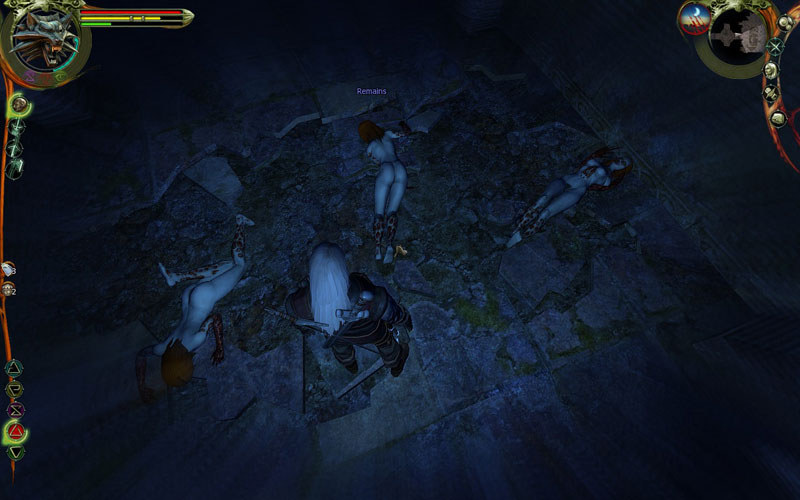
Nothing quite like a screen full of Alp ass.
The Witcher is one of those games that leave me in the uncomfortable position of deciding whether I want to meet it halfway or not. In the sort of verisimilitude of its narrative, The Witcher had me at damn near hello. Even the “contravserial” sex cards or naked vampires/dryads added to the gritty zeitgeist of a world where witchers mutate themselves into monsters to fight monsters, all for a populous unwilling to acknowledge a difference until they are in mortal peril. I want so much to give the rest of the game a pass… but I simply cannot. Combat is almost non-interactive; managing the massive amounts of ultimately useless inventory is a pain; there is so much goddamn running around; Day/Night cycles without a convenient Wait Anywhere feature is sadistic; frequent loading screens for indoor areas discourages exploration; hitting Quicksave creates a new 15-20 MB file every single time (my save game folder was 3.97 GB by the end of Chapter 1), and so on and so forth.
Ultimately, I do not at all regret my time spent in The Witcher’s world – I took more screenshots here than in Fallout: New Vegas – but it is not a game that I can recommend without caveats. And honestly, I am probably being so harsh because of how well Projekt RED nailed the non-game bits of The Witcher. But, well, the game bits of games are important too.
A Glitch Review in 1,500 Words or Less
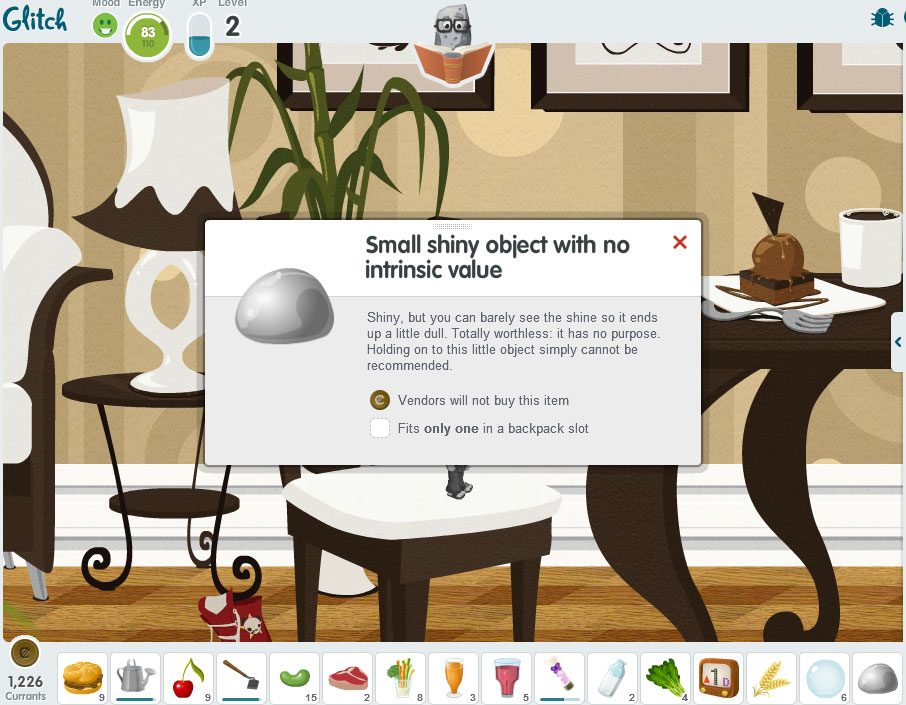
About sums it up.
To be fair, I never had any intention of being fair to Glitch; kind of like hosting a Colorblind Coloring Contest, I just wanted to see what would happen.
I played for about 30-40 minutes, making butterfly cheese and running away from other players trying to interact with me. Then I decided I would give Glitch the benefit of a doubt and take the gameplay more seriously. It was at that moment that I futilely tried to remember where the tutorial told me I could go to purchase a bigger bag, failed to find any quest history related to it, didn’t see any bag-related posts on the help forum, and then gave up.
As I deleted the three email notifications that I had leveled up a skill in-game (in case I forgot, I suppose), I realized that it was probably better for the both of us.
The Torticoli Rebuttal
Our goal with the Guardian Cub is to provide alternative ways for players who don’t want to spend real money to add these pets to their collection.
Bashiok, in the explanation for the Guardian Cub being BoE.

I know, right? It’s not like there’s a game where players can obtain non-combat pets through in-game means, such as looting bosses and grinding reputation. Or crafting. Or achievements. Stuff that does not require real world money.
Torticoli’s rebuttal, on the MMO-Champ forums.
Ouch.
Philosophically, I do not see this as the beginning of some slippery slope – it is just, in fact, a slalom flag more than halfway down the ski course. In many respects, the Diablo 3 RMT AH deal was a dry run for this and future F2P-lite experiments without killing the subscription cow outright. The more, ahem, diabolical aspect of the Disco Cub is how Blizzard once again pulled an utterly massive business coup in the rollout. While it is getting some ire in the forums, what is typically being glossed over is:
- Store pet is no longer BoA, meaning more sales to have them on multiple toons.
- The customer base for pets is being broadened to include speculators.
It is pure, insidious genius, when you think about it. Hypothetically, if market for this pet was ~200,000 accounts, those two changes might have just doubled revenue at zero cost to Blizzard. One of my guild officers was/is a pet collector and she has bought every single pet in the store. She might up and decide to buy two, one to keep and one to sell. Or perhaps she will try and buy one off the AH and save money, but the sale itself is exactly the same to Blizzard… except now she won’t have that same pet on all her toons. And if she ever switches mains… cha-ching!
Edit: In case it wasn’t clear, I’m 100% fine with these cash shop shenanigans, and cannot wait until I can buy level-capped characters on the AH like we will be doing in Diablo 3, or perhaps EVE-esque game cards. You cannot fight the future. It’s simply that the “community managing” spin is pretty grating, especially when Blizzard employees treat it as if value is being added to the transaction, when the reality is quite different. If BoE pets converted into a BoA version of itself after “using” it, that would be a different story.
Butchered
If you want to read a 4,079 word essay on the decline of WoW from the standpoint of two members of the sub-10% of raiders, you cannot go wrong with Failure, Challenge, and the Decline of WoW. If, instead, you were looking for a well-written, relevant essay on WoW’s “decline” exploring actual issues, don’t bother reading it at all. Stede in particular eviscerates the entire argument in a single comment.
What interested me about the essay is how so completely it falls into that utterly bizarre MMO difficulty trap – the sort of notion that MMOs should be social engineering experiments to create a generation of better gamers. The part that struck me the most was when they were talking about The Butcher from the original Diablo:
The best piece of low-level content ever created by Blizzard is found not in current WoW, nor even in old WoW, but 15 years ago in Diablo. The Butcher.
Every NPC in town warns you about The Butcher before your first trip into the dungeon. In case you didn’t bother talking to them, just outside the dungeon entrance you find the previous adventurer who tried to delve in, bloody and dying. Before killing your first mob, a villain is set up. The first half hour of dungeon crawling goes by uneventfully. But somewhere on the second level down, starting to get a little comfortable with your level 4 character, you come upon a small square room completely covered with blood. Maybe you remember the warning, maybe you didn’t, but in either case, it’s your first time playing and you want to know what’s in there, so you open the door. And you get Butchered.
This experience is hard to convey in text to people who’ve never played Diablo. Ask anyone who has if they remember their first time being killed by him. It’s sudden, surprising, and scary. It’s probably your first character death. He does a huge amount of damage, stuns you, and holds you in melee range. He has a loud yell the moment you open the door, an elaborate bloody apron, and a ridiculously-sized cleaver. You’re mostly likely dead before you take in everything that’s happening. And for some reason, it’s the one moment that makes everyone’s eyes briefly glass over in nostalgia.
Having played the original Diablo, I had the same experience of being mercilessly slaughtered by The Butcher. The essay goes on from this point to talk about Hogger, trying to tie both the experiences together while lamenting that Cataclysm and WoW in general has lost this dangerous feeling. The ironic part of these examples is that each were precisely designed to not be difficult. The Butcher was not supposed to be a difficult encounter, it was supposed to kill you. As the author(s) note, you probably had not died yet at this point in Diablo, so it behooves the game designers to set up unwinnable scenario to demonstrate what will happen when you overextend in the game proper. Same exact deal with Hogger: his purpose was demonstrate the difference between non-elite and Elite mobs. You were supposed to die. Neither were difficult in any meaningful sense of the term, and both simply encouraged you to grind mobs until you outleveled them as content.
The original Hogger.
Even Nils has recently demonstrated that the early game is designed to still kill you, Hogger or no Hogger. What gets confused by these challenge-seekers is that leveling was never designed to be challenging. The “kill you” moments or outdoor Elites that could be defeated through skillful actions were not designed to challenge your skill, they were to organically demonstrate how death and resurrection worked without resorting to instant-kill mechanics. And yet people lament the removal of the outdoor Elites near dungeons as if they were designed to spice up gameplay instead of marking territory out-of-bounds for solo players.
It is fine to desire content tailored to your skill level, as those authors so obviously want. But it always strikes me as bizarrely pompous to place said desire on a pedestal as if gamers becoming better at games is some kind of righteous calling, a form of high art compared to the Jersey Shore-ness of current WoW leveling. First, they were wrong about the purpose of early difficulty. But secondly, and more importantly, a high-difficulty paradigm actively destroys the social aspect of MMOs. If I want to experience hard raiding content but the friends that I made leveling up do not, I must abandon them. Read the comments from that article. For every “exclusive content through difficulty” proponent, there are at least two more people grateful that they can finally raid with their friends (until Firelands anyway).
In any event, the other half of the article talks about loot structures in MMOs, which is another post entirely. Suffice it to say, I disagree with them on that point as well.
Reviews: Eufloria, Kane & Lynch 1 and 2, Osmos, Trine
Game: Eufloria
Recommended price: Bundle
Metacritic Score: 63
Completion Time: 16 hours
Buy If You Like: Ambient indie quasi-puzzle games
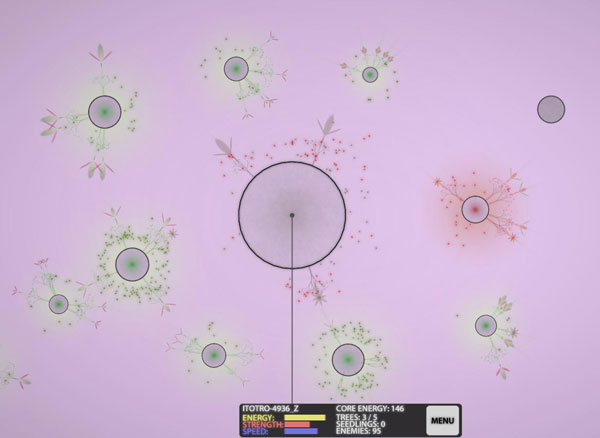
You have no chance to survive, make your time
Eufloria is an ambient indie strategy/puzzle game that blurs the line between strategic depth and shallowness. Your goal is to colonize all the asteroids in the playing field using your fleet of organic plant ships called Seedlings. Each asteroid has three characteristics – Strength, Speed, and Energy – and their varying levels determines the qualities of the resulting Seedlings that are grown from the Dyson trees. You see, to control of an uninhabited asteroid, you essentially sacrifice 10 of your Seedlings to grow a Dyson tree, which makes more Seedlings indefinitely. If said asteroid is inhabited by the enemy, your forces must attack any enemy Seedlings there, blow up one of their Dyson trees, and then kamikaze themselves through the root system to sap the core. Once the core is sapped, the asteroid is yours and any surviving Dyson trees are automatically converted to your side.
While all of this undoubtedly sounds strategic and exciting, the actual core gameplay can best be summed up by sitting around until you zerg the ever-living hell out of the enemy. There are actually additional strategic elements involved such as Defensive trees, tree-boosting flowers, and Death Star-esque multi-laser flower ships… but, again, all of them are problems that can be solved with the hammer of the zerg swarm.
The interface is clean, the ambient music relaxing, and the overall experience is somewhat refreshing in a distilled water sort of way. The last group of missions actually does require some strategic elements, but even then the issue ultimately comes down to surviving against the swarm long enough for your swarm to outnumber their swarm. Ultimately, I believe Eufloria to be one of those games that would unequivocally be better suited to the iPad or the Touch rather than computer proper.
Game: Kane & Lynch: Dead Men
Recommended price: $5
Metacritic Score: 67
Completion Time: ~4 hours
Buy If You Like: Controlling a dark, over-the-top revenge movie
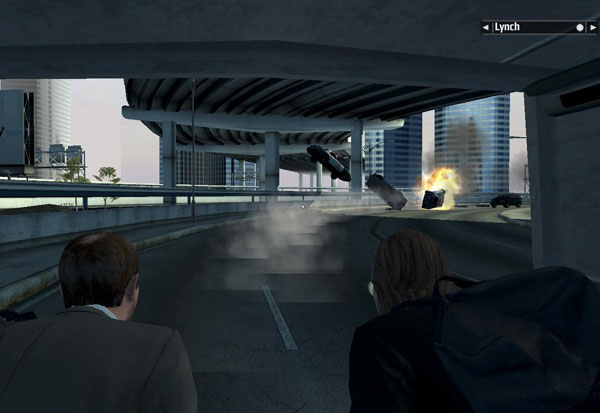
One grenade, half a dozen crimes against humanity.
I actually played Kane & Lynch 2 before the original, so my experience with the series is somewhat disjointed. This game follows Kane, an ex-mercenary in prison on his way to being executed. Along the way, he is “rescued” by Lynch along with the surviving members of The7, a mysterious organization that Kane betrayed in the past presumably because he believed them to have been killed in a botched mission. Actually, the whole convoluted backstory remains largely unexplained to the extent that it feels like you walked into a movie halfway over.
The game itself is an over-the-shoulder shooting spree as you navigate Kane through areas of cover and increasingly ridiculous scenarios. The7 has kidnapped your wife and daughter, and to get them back you rob a bank, escape by murdering half the police force in the western United States, fly (!) to Tokyo, fly (!!) back to the US, kill some more people, fly (!!!) back to Tokyo, and fly (!!?!) back to the US and other locales, as if there is no such thing as a no-fly list in the year two thousand and goddamn seven.
Despite the over-the-top ridiculousness of the entire scenario, despite the somewhat clumsy game mechanics, and despite everything else that I should objectively dislike about the game… the Kane & Lynch series is one that I actually enjoyed. For $5, but still. Both Kane and Lynch are completely unlikable characters, until you start finding their chemistry (if nothing else) rubbing off on you. To that end the voice acting is excellent to the point that you really do feel like you are playing a movie. Perhaps a bad movie, but by the end you want it so much to be a good one that you meet it halfway.
Game: Kane & Lynch 2: Dog Days
Recommended price: $5
Metacritic Score: 66
Completion Time: ~4 hours
Buy If You Like: Controlling a dark, over-the-top handycam revenge movie
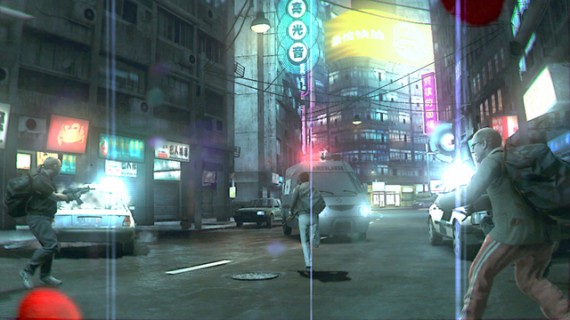
Now with 100% more lens flare.
Much like the original, Kane & Lynch 2 is an over-the-shoulder cover shooting spree that sees you playing as Lynch, the self-medicated psychopath, rather than the ex-mercenary Kane. One of the notorious aspects of the game is the camera system, which was definitely designed to give the impression that a drunk guy with a handycam is the one filming yet another outlandish slaughter by this dastardly duo.
Although this game actually has a lower Metacritic score than its predecessor, it is actually far superior than the original in many key ways. For one thing, Kane & Lynch 2 has a much more reasonable escalation of violence. Starting out with a botched mission in Shanghai, you move through the Chinese underground being chased by the gang you wronged, followed by who they were working for, then eventually the police and military. Compare that with the original in which you kill American police officers and hostages in the opening acts and freely take international flights multiple times later on. So from a narrative perspective, one of series’ strong points, the sequel out-shines the original quite nicely. Plus, in how many other games are the main characters brutally tortured only to escape and run around shooting people while completely naked and covered in box-cutter scars?
This is not to say that, strictly speaking, Kane & Lynch is a good game. You are not likely to play the game again, and you may have trouble even completing a single play-through if the first 5-10 minutes does not grab you (as that represents pretty much what you’ll be doing the entire time). Personally, I enjoyed myself quite a bit even though I developed a headache from the rather punishing lack of lulls in the action. Ultimately, I am glad that games like Kane & Lynch exist, because they definitely explored directions that few (if any) other games have ever dared. Even if those dank, dark corners of interactive fiction proved ultimately fruitless, at least we finally explored them.
Game: Osmos
Recommended price: $5 / Bundle
Metacritic Score: 80
Completion Time: ~5 hours
Buy If You Like: Elegant, ambient indie puzzle games
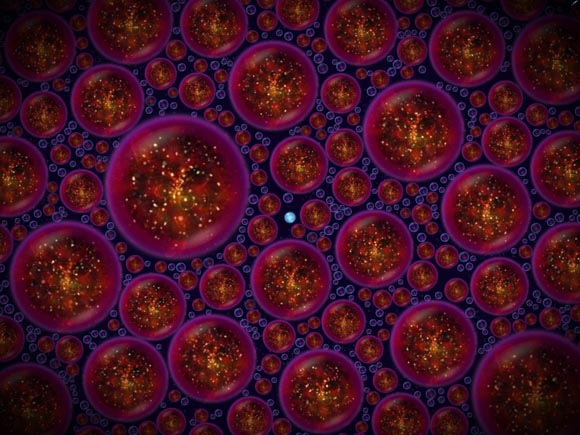
You are the blue orb, red orbs will kill you, good luck.
Osmos is a deceptively simple, intuitive puzzle game that turns out to be extraordinarily complex in many ways. The premise is that you control a blue orb, and you are tasked with absorbing those orbs smaller than you while avoiding being absorbed yourself. Movement is accomplished by ejecting small bits of yourself, which causes your orb to not only shrink, but also causes other orbs to grow if they end up absorbing the launched matter. You are aware at all times which orbs are smaller than you (e.g. capable of being safely absorbed) by their color: blue is safe, while red is not. Indeed, this elegant “scoring” has been one of the most psychologically satisfying mechanisms I have ever seen in a game – there is nothing quite analogous to finally absorbing a target orb and watching the rest of the playing field suddenly turn blue.
Honestly, “elegant” is simply the best way to describe the game period. The background, the ambient soundtrack, the visuals, the gameplay… everything about the game simply fits.
Once you complete the starting missions, the game branches out in three “gametypes” which you can complete in any order. One branch is Sentient, where all the levels feature, well, sentient orbs that will move around and attempt to absorb you. Sentient levels becomes somewhat a race against time as your opponents gobble up orbs and each other while you try and do the same. The second branch is Ambient, where all the levels feature massive amounts of stationary orbs all over the level. In these, you typically start out completely surrounded by orbs that will kill you if you bump them, and the idea is to push them into each other without letting one get too big to absorb yourself once you clear a path. The last branch is Force, in which the levels literally revolve around a sort of “star” with a gravitational pull. The later Force missions are simply diabolical, and require a level of patience and skill that I simply was not able to possess.
Overall, if you are able to simply let go of those levels/branches that you do not enjoy, Osmos is a mentally stimulating game that happens to also be deeply relaxing as well. When I think of indie games that push the genre/medium in general forward and have no AAA analogy, Osmos ranks towards the top of that list.
Game: Trine
Recommended price: $10
Metacritic Score: 80
Completion Time: ~6 hours
Buy If You Like: Gorgeous indie physics puzzle-platformers
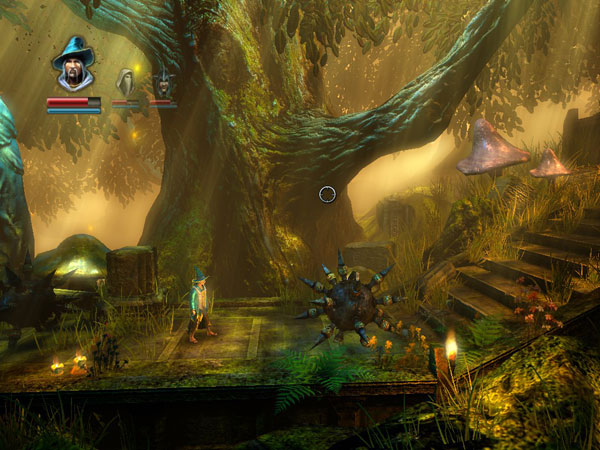
God this game is gorgeous.
Trine is one of those rare games that you forget isn’t some AAA title in the midst of playing it; an indie game that pushes the genre and medium as a whole forward when so many big studios are cashing in on derivative sequels.
The premise of the game is that a mage, a thief, and a knight walk into a bar end up touching the Trine, a plot object that explains why you can instantly swap out one character for another one at the touch of a button. The mage is able to conjure into being steampunk-esque cubes, planks, and eventually floating triangular platforms, in addition to being able to manipulate said objects (and others) by moving them around telekinetically. The thief is extremely agile, shoots arrows, is able to perform a limited wall-jump, and has a grappling hook that allows her to swing around. Finally, the knight has a sword and shield, can lift heavy objects, and can break barriers down with a giant hammer.
The plot itself is fairly generic fantasy storybook fair, but the lack of its depth is easily compensated by the puzzle platformer aspect of the rest of the game. See, you’ll come across “puzzles” like a pit with a bunch of spikes in it that is too far to jump over. You can “solve” it as the mage by conjuring cubes to drop onto the spikes, conjuring planks to lay over the spikes/across the cubes, build a cube tower to give you enough height to jump across, and so on. Alternatively, you can use the thief’s grappling hook to grab onto any overhanging wooden branches and swing across. Or you can have the mage conjure a floating platform, and then have the thief grapple the platform to swing across. Or just have the mage conjure multiple floating platforms. Or… you get the idea.
I put “puzzles” in scare quotes because they are never really presented as puzzles per se. Some are, sure, but many are not. What’s great about the system is that each of your three characters level up and get to choose where to spend “talent” points, for lack of a better term. For example, I may decide that I want the mage to be able to conjure three cubes instead of just two (at the expense of two planks, or upgrading the floating platform to be wooden, so the thief can grapple onto it). That choice has a profound impact on how you end up getting past certain areas, as you can imagine.
Even though the characters do not end up being terribly balanced against one another – the thief can generally complete 99% of the game by herself, if you have quick enough reflexes – the game as a whole is delightful, absolutely gorgeous, and ends far, far too quickly. I would have easily been entertained for another 20 hours had there been that many more levels.
Bean Counters
So once again, Gevlon accidentally makes a compelling argument in the midst of a pompous rant:
“Work ethic”, “hamstering”, “completionalism”: I don’t have a good name for this skill, but I’m completely sure it exists. The lack of it provides the lazy bum, and we all know the good feeling of “Well done!”. The ancient hunter who went out hunting when he wasn’t hungry had better chance of survival than the guy who started hunting when he was starving. The guy who felt fun from watching his pot filling up with beans had much better chances during winter than the guy who foraged just for today. We are descendants of hard working people and we inherited the genes that give the fun feeling when we see our stockpiles filling. The traditional MMO use this form of fun. […]
Now let’s analyze the glorious rise and then the shameful stagnation and fall of WoW. Vanilla WoW was a pure “hard working” game. Your progress depended on how much and how effectively you worked. There were action in the game, but due to the GCD and cast times, it demanded dexterity that vast majority of people easily had. Of course you had to understand the game, but for non-retards it wasn’t a challenge. So you could concentrate on one form of skill: “hard working”.
People completely wrongfully assume that WoW beaten EverQuest because it was “less grindy” or because it had smaller death penalty. No. It won because EverQuest had forced grouping, making the game mixed “hard working”-“social skills”. WoW was pure “hard working” until the endgame, where raid organization needed social skills which did not belong to the game. No wonder everyone referred it as “the organizational nightmare”.
As someone who still has a Light of Elune in his paladin‘s bags, I really enjoy the bean counter metaphor. It is a concept I was musing on while playing hour 37 of The Witcher. Why was I looting every house and making several trips across town to the one vendor I know will buy damn near everything in my bags? The gold is undoubtedly superfluous at this point, especially as I now how enough ingredients and in-game knowledge to steam-roll whatever is coming my way. Then I peeled one more layer down, and wondered why gaining experience points was still fun, when The Witcher is likely my 75th+ RPG. If gaining XP is fun, then why am I not just playing Xenogears forever? It was with that thought in mind that I commented a rebuttal to Gevlon:
The “shameful stagnation and fall of WoW” has nothing to do with undermining the hardworking element, which is alive and well even now; it has everything to do with the natural reduction in the novelty of the experience.
The guy having fun “watching his pot filling up with beans” will NOT have fun filling up an infinitely large pot. There has to be an end-point – the reward of a survived winter – in order for the fun of collecting beans to be realized. Those beans also meant he could relax in his tent instead of scrounging around in the snow. The guy would have less fun filling up a pot with beans as a slave, even if the survival benefit of a full pot is the same. Why? For this guy knows that, as a slave, his task is never-ending.
As Morhaime has commented, the WoW market is saturated: there are more ex-WoW players than WoW players. The people who enjoy hardworking in games have picked up WoW, enjoyed it for many winters, and are now moving on to pick beans in new fields. It has nothing to do with anything WoW has or hasn’t done. Frequent gear resets, at most, act as more frequent winters. After so many winters in one place, it is time to move on regardless of whatever other claims of quality the game has. The novelty of gathering beans fade, and slave-like, rote gathering sets in.
In any case, a WoW that was simply building on vanilla for the last seven years would still experience a “shameful stagnation and fall.” Unlike sports/chess/etc, which have the benefits of tens of thousands of years of iteration, there will always be better, more novel iterations of videogames on the horizon.
 In An Age
Community Aspects
Oct 11
Posted by Azuriel
Nils is reaching the end of his WoW rope in his latest experiment, and my response probably fits better in a post than comment. Nils says:
WoW has NEVER put you in a community. At all. The most you could say is that in the early days people had somewhat of an incentive to seek out strangers because it would be impossible for them to complete (group) content otherwise – something that sounds more like Facebook games now that I think about it. The “community” could be summed up the sort of proto-typical “LF1M tank H Ramps” spam, where the alternative was having nothing to do. But if Nils doesn’t feel like joining a guild, he probably would not feel like joining a random Trade chat pug either. Or perhaps he is saying that since you can press the LFD button, one has no incentive to join Trade pugs?
Honestly, there was as much community when I finally quit as there has ever been, and I saw people trending towards tighter guild/social bonds than ever before. In TBC, the only way to see content was to “trade up,” leap-frogging Kara guilds into SSC/TK guilds into BT guilds into Sunwell guilds. Choosing friendship and sociality meant you simply dead-ended, unless you won the guild lottery and got into one that progressed. Incidentally, this was my fundamental problem with articles like the one I talked about yesterday, insofar as those never seem to be written from the majority standpoint of raiders whose expansions just end mid-tier because the guild is not good enough to progress (be it skill, drama, or other).
Nowadays, at least pre-Cata, you could have your cake and eat it too, progressing with friends at relatively your own pace without having to worry about people trading up. Yes, solo players have no “real” incentive to join guilds/groups since they can get groups formed for them. Then again… well, as we’ve seen from LFD, some of the groups you get are so horrible that there is every incentive to do LFD runs with as many people you know as possible.
Posted in Commentary, WoW
11 Comments
Tags: Difficulty, LFD