Category Archives: Commentary
Hitting a Nerve
Tobold wants me off his lawn. He has a history of political posts that claim “centrism” despite being wrapped in the language of right-wing culture wars, and the recent Races are racist post is no exception. In it, he laments:
It is a sign of the times in which artists live in constant fear of being attacked for slights they never intended that Wizards of the Coast in the first playtest material for One D&D removes stat modifiers from races. In the new version of Dungeons & Dragons, choosing your race is mostly cosmetic. Orcs aren’t strong anymore, instead they “count as one Size larger when determining your carrying capacity and the weight you can push, drag, or lift.”. And to avoid comparative negative stat discrimination, positive stat bonuses are gone as well. The “2-3 feet tall” halflings are now just as strong as the “6-7 feet tall” orcs, in order to avoid racial discrimination. We will have gnomish barbarians and orc wizards.
Gnome barbarians and orc wizards, oh no!
Let’s take a moment to talk about the game design topic though.
This change just reflects what modern multiplayer game design figured out a decade ago: prescriptive racial modifiers only encourage min-maxing and otherwise limit design space. Look at the state of endgame World of Warcraft. Does anyone still think it is a good idea that the race you chose on the character select screen should have such an impact on raiding or M+ or PvP 15 years later? Maybe you say “yes.” Well, the end result of that is a faction imbalance so massive Blizzard finally buckled, and is making most activities of the game cross-faction in the upcoming Dragonflight expansion to prevent the entire edifice from collapsing.
Which is good idea, by the way, because factions are dumb too. “Let’s divide our playerbase and foster different and hostile identities.” Oh, now people are quitting in droves because they are stranded on dead servers/factions and none of our world PvP systems are viable. *Surprised Pikachu face*
Compare all that with, say, Guild Wars 2. I think technically each race has a special ability, but they are irrelevant at all stages of play, which allows players to pick a race based on aesthetics or fantasy. Want to be an Asuran Warrior instead of Charr or Norn? Go for it. One of my first characters 10 years ago was a Sylvari Engineer, because the thought of a plant-person running around with a flamethrower was hilarious to me. Still is, actually. If GW2 was more “traditional” fantasy surely I would have negative modifiers for being around flames, if I were allowed to be an Engineer at all.
Was any of that what Tobold really wanted to talk about? Nope:
I am not sure what purpose races serve in a fantasy role-playing game if there isn’t actually any difference between them. If they are all the same and lack profile, races have been effectively removed in order to appease the thought police. But races remain nominally in the game, because a much bigger part of the D&D customer base would be deeply offended if you’d just remove all fantasy races. It is a bad compromise that will make nobody happy. The thought police will still be triggered by the mere existence of the word “race” in the rulebook. And the players will have lost interesting options in character creation. Can’t we just admit that the real world is complicated, and be allowed some refuge in much simpler fantasy worlds?
You would think that a centrist is all for “bad compromises that make nobody happy,” but the follow-up comments demonstrate that is not the case. When I pointed out that, historically, CRPGs gave female characters Strength penalties for similarly dubious reasons, he replied with:
So you are saying that god is sexist, because (s)he made women less strong than men? I don’t understand your objection to a game rule that reflects reality.
Well, there it is. A Rogue can make a successful Reflex Save in a broom closet hit by a Fireball (which also sets nothing on fire) to avoid all damage, but it’s important for reasons that fantasy game rules reflect “reality.” But only certain “realities.” And those certain reflections of reality are more important to a game’s design than, I dunno, any consideration of what the design leads to, e.g. prescriptive race/class combos that force players to choose between their own fantasy and numerical success. Nevermind the extra social pressure to be helpful that inherently comes from being a part of a group.
While I had been trying to avoid the bait, the third time was not the charm. In an unnecessary paragraph, I threw in this at the end:
“Of course, that’s not the real issue here, is it? I guess you’ve traded your armchair game designer hat for an imitation MAGA one so you can fill your retirement with Boomer culture wars. Which… OK, I guess. Perhaps you can make a little safe space around the D&D table where you can’t get triggered when the “thought police” removes your +2 modifier.
In retrospect, not my proudest moment. However, it certainly hit a nerve, with Tobold going off quoting “They came for the socialists…” and how evil triumphs when good men do nothing.
Here’s the thing though: if you use the word “woke” as a pejorative and talk about the “thought police” being “triggered” while also apparently defending gender-based modifiers as being a justified reflection of (fantasy!) reality… you may want to take a moment and ponder on what “left of center” even is. This is not neutral language. Unless it was being used ironically in a way I did not detect, it hits about the same as Ron DeSantis’ victory speech wherein he used the word “woke” 5 times in 19 seconds:
“At the end of the day, we were not going to let this state be overrun by woke ideology,” DeSantis said. “We will fight the woke in the businesses, in government agencies, fight the woke in our schools, and never surrender to the woke agenda. Florida is the state where woke goes to die.”
Perhaps even pointing that out is ipso facto thought policing, in which case… weewoo weewoo, I guess.
I understand the desire to keep politics separate from one’s hobby. Although, that sort of presupposes politics weren’t already deeply ingrained from inception – art is usually a product of its time. What I do not understand is how or why this particular hill is the one to die on. Not only does it make no practical difference to the experience of D&D – you literally can make up whatever rules you wish or use any edition to run your game – it is not particularly interesting game design in the first place.
Indeed, here is a quote from the Principle Rules Designer for D&D, Jeremy Crawford:
“For quite some time, we have not liked how the choice of race in the game had often too much weight on the player’s choice of class,” Crawford admitted. “Fans often talk about this—that connection between race and class is not something we as designers actually desire. We want players to pick those two critical components of their character and choose the two that really sing to them so they don’t feel like they’re pigeonholed. [In Monsters of the Multiverse] people will get the floating bonuses we introduced in Tasha’s Cauldron. If somebody is making a character, and wants to recreate the bonuses that existed previously, the advantage of the floating bonus system is they can do exactly that.”
Here is another one:
“Contrary to what many people might think,” said Crawford, “those ability score increases that are in those different options, they’re not there for game balance purposes. They are there strictly to reinforce the different archetypes that have been in D&D going all the way back to the ’70s. […] It really has been just about archetype reinforcement, and because it’s not there for game balance reasons we give people the option in Tasha’s Cauldron to take whatever those bonuses are […] put them in any ability score you want.”
If you want a traditional, archetype-driven high-fantasy campaign wherein Orc babies light up when the Paladin casts Detect Evil, go right ahead. I personally ran D&D campaigns for six years that featured nary a dungeon nor a dragon. Do what you want!
But if you are insistent on being outraged by this change, irrespective of your ability to articulate a game design counter-argument, cloaked in the language of far-right cultural wars, maybe some introspection is in order. And if the notion of introspection itself feels like self-censorship to be fought with the strength of Niemöller… well, you kind of got your answer right there, eh?
Out of this RimWorld
After hitting a lull in Final Fantasy 7 Remake motivation, I did the most logical thing possible with a $1800 prebuilt PC: reinstalled RimWorld. Admittedly, it had been a while.
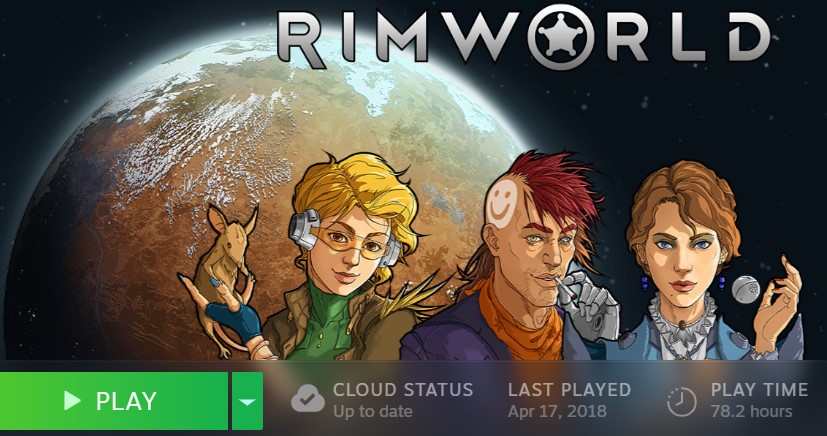
While there has been two expansions released, the core experience has largely remained intact. I think the biggest thing that threw me for a loop was needing to build a wooden pen for animals. Previously, you could just “paint” an Allow zone for animals in an area, and herd them elsewhere by moving the zone. Probably a bit too abstract, sure, but it’s not as though the rest of the game is super intuitive.
The other aspect of the game that returned quickly was the demotivating sense of inevitability. And I don’t just mean those unfortunate events where the dice don’t land your way and your best sniper gets shot in the eye by a tribal with an arrow from 50m away. I mean when you hit Spacer tech and you’re starting down the charged barrel of endgame Civilization Conquest next-turning for the next dozen hours. Don’t get me wrong, there is nothing certain about Randy RNG beyond your tears… but, also, kinda yeah there is. There is a point where all you’re doing is pulling the handle, and seeing if you’ve successfully installed a bionic spine into colonist #6, or if everyone gets muscle parasites an hour before a mechanoid cluster lands inside your base.
I’m currently on the fence regarding whether I believe the expansions would help. The prevailing wisdom is that the Royalty DLC adds a lot of new content, while Ideology adds more roleplay elements. Either or both could possibly help with that inevitable feeling. I certainly have no desire to caravan across the planet and/or DIY a spaceship – I did both years ago and that was enough.
But… we’ll see. It was a craving for a survival experience that led me to reinstalling in the first place, and RimWorld isn’t that. It’s adjacent, in a way. But once you’ve had your fill, that’s that.
Too Early to Access
Early Access games are such a double-edged sword, right?
Conceptually, they are pretty brilliant. Games are risky projects that typically only give you a chance at profits years after development. With Early Access, you can release whatever you have handy – “Minimum Viable Product” in the gaming parlance – and gain money while you finish building out the rest of the game. Plus, sometimes you might actually get a piece of actionable feedback from the customers that changes the direction of the game. Win-win for the developer.
For me personally, Early Access games are Lose-Win at best.
I do not typically replay games. Between Humble Bundles and Epic Store giveaways and being a periodic MMO player, I have accumulated a largely insurmountable stockpile of games that makes it difficult to “justify” playing even ones I like a second time. So when I do buckle down and play an Early Access title, whatever stage of development it is in is typically the only version I experience. Which can sometimes be fine – not every game makes it out of Early Access. But many times I recognize that things are not fine, as I end up experiencing a worse version of an incomplete game that would have been a lot more fun had I waited.
There are a few exceptions to the rule. Well, one and a half: roguelikes and survival titles. Roguelikes, by their very nature, are “replayed” many times. I started playing Slay the Spire back when there were just two characters, for example, and continue(d) to play it now that there are four. Oxygen Not Included, RimWorld, and 7 Days to Die are in similar boats… that encourage or at least don’t punish re-boating.
Some survival games land further away from the roguelike spectrum and otherwise do not necessarily lend themselves towards repeated play. I have zero desire to play Valheim again, for example, until it is much closer to final release. Is there much of a practical difference between Valheim and 7 Days to Die? It’s hard to articulate, but the latter is more viscerally entertaining and a more varied experience. Both have procedurally-generated maps and such, but how many different bases are you going to create in Valheim really?
I bring all this up because a really, really want to play My Time at Sandrock. Which, you guessed it, just hit Early Access last week. A sequel of sorts to the original My Time at Portia, it has everything I want: basically being a sequel to a game I already put 108 hours into. Everything except… not being done.
What is the current state of the Early Access version?
“Early Access will begin with the single-player story model: players will be able to play some of the first act of the game’s story and have access to romance and friendship missions as we implement them.”
I can’t do it. Even if I imagined that I would pick one of the townsfolk to romance that had already been implemented, the “risk” is too great. “Risk” being uncharitably defined as making a choice that could result in a less satisfy gaming experience in the likely-only opportunity to play the game. Which is neurotic, I know, considering developers add choices to games to allow the opportunity for more people to enjoy themselves. But this brain meat is what I’m working with, so… yeah.
Incidentally, the other reason I’m bringing up this topic is because I was clued into a pre-Early Access game called Life Not Supported that’s basically Raft in space. As in, floating around and picking up space trash to build a space boat. Which reminded me that I spent 8 hours in Raft and enjoyed it and got the itch to play some more only to find that it is still in Early Access itself. And there’s a dev blog from January saying that Chapter 3 is delayed and they’ll be retooling the whole game once it comes out and I’d be better off not playing it until that occurs. At least, that’s the implication. Sigh.
The Wishlist, part Welp
I was expecting the Epic Sale to be weeks away still, but apparently it started today. Also, apparently inflation (or lawsuit fees?) come for us all:

Instead of getting a flat $10 off any game at $14.99 and above, you get 25% extra off.
This is technically a better deal when the baseline game you are buying is more than $40. Everything else is a worse deal. For example, Rogue Lords is on sale for $16.24. With the historical coupon scheme, it would be $6.24, but this new scheme means it is $12.18. The one extra nuance though is apparently the new scheme will allow you to get the 25% discount as long as your entire cart is above $14.99 rather than individual items. Risk of Rain 2 is discounted to $12.49, for example, which normally would not receive any extra discount. In the same cart as Rogue Lords, you save… $3.12.
Hey, I’ve done dumber shit for, well, not less but not much more than that.
In any case, it’s extremely disappointing that basically every game on my wishlist is $2.49 more expensive than it was six months ago during the Winter version of this sale. Two-fiddy many not seem like a lot, and perhaps it isn’t in the grand scheme of things, but in my head I turn those numbers into other games I could have bought.
Anyway, this is how my wishlist breaks down in this sale:
- [$37.26] Final Fantasy 7: Remake Intergrade
- [$22.49] Cyberpunk 2077
- [$22.49] Red Dead Redemption 2
- [$18.74] Horizon: Zero Dawn Complete
- [$15.74] Satisfactory
- [$9.37] Risk of Rain 2
- [$37.49*] God of War
- [$40.49*] Dying Light 2
- [$18.74*] Wildermyth
- [not listed] Sekiro: Shadows Die Twice
- [not listed] Elden Ring
- [not listed] NeiR: Replicant
The prices with an asterisk are games not on sale aside from the bonus 25% (Dying Light 2 is 10% off, I guess). I’m actually rather surprised about the bottom three games simply not existing on Epic. I’m not aware of any exclusivity agreements with Steam, and part of Epic’s whole deal was supposed to be a better dev cut of the action, so… what? How is something like Elden Ring not on here?
After some sticker shock at the “buy all the things” total, I pared it down to the four horsemen:
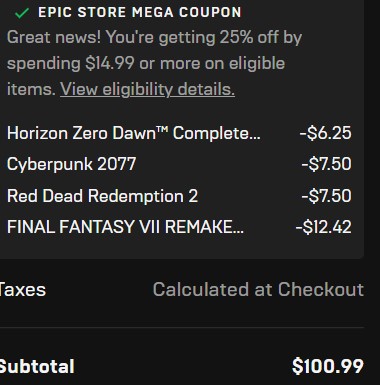
So, Final Fantasy 7 Remake, Cyberpunk 2077, Red Dead Redemption 2, and Horizon: Zero Dawn.
I had things like Risk of Rain 2 and Satisfactory in there and some other off-wishlist games like Days Gone and Far Cry 6, but I had to face reality a bit. Given those main four games (and nevermind my existing library), when would I have the time to be playing anything else? I suppose it’s possible that Epic’s next sale is an even worse deal than this one, but that is a risk I am just going to take. This way, I can see where things stand by the end of quad-AAA production experiences, not feel guilty for occasionally tooling around in random indie games, and see what ends up popping up in Game Pass.
And that’s it. See you in six months.
Interlude
When it comes to music, I have a System.
Stage 1 is Acquisition. My ability to discover new music is very limited, as I did not have much of a commute even pre-pandemic for radio, and I typically listen to NPR besides. Therefore, I pretty much only hear snippets of songs from random Youtube clips, memes, or Indie-Rock playlists. Once I do hear something I like, I immediately try to locate the entire discography of the group “just in case” there are other songs I may enjoy. The amount of times this has worked out for me is small in the aggregate, but when it has worked out, I ended up finding some of my favorite songs of all time, so it’s worth it.
Stage 2 is Sifting. I have a dynamic playlist called Unrated that will display every song in my library that does not have a 1-5 Star rating. Once a rating is decided, it drops from the playlist and I continue down the list until my queue is empty. Roughly speaking, ratings mean:
- 1 Star – To be deleted
- 2 Star – Song is “useful” for some other purpose (e.g. memes, D&D, comedy clips)
- 3 Star – Baseline level of good, would enjoy this randomly being played
- 4 Star – Very good song, catchy, meaningful
- 5 Star – Devasting emotional payload
To give an idea about distribution, I have 3270 songs in the 3-Star category (80%), 721 in 4-Star (18%), and just 100 in 5-Star (2%).
Stage 3 is Assignment. Once everything has a Star rating, it goes into my Group Work dynamic playlist. It is here that I assign it a “Grouping” category. I base these off of colors that correspond to mood:
- Clear – no particular mood
- Blue – melancholy, pathos
- Green – mellow, unobtrusive
- Red – songs that make you drive faster on the freeway
- Yellow – Up-tempo, driving beats
- Rose – relationship songs
Once this last piece of metadata is complete, songs that have survived the gauntlet are automatically sorted into dynamic playlists. If I want to chill and do some work? Open the Green playlist and hit Random. Roadtrip? Load up Red and press Play. Want to just feel sad for a while? Blue. This has worked out much better for me than traditional playlists, as sometimes I forgot to add new songs to old playlists. Plus, some songs fit into multiple moods, which I can handle by giving them multiple Grouping labels (“Green, Blue”).
To be honest, I have no idea if this is convoluted or not. My default assumption is… Yes. But I haven’t really heard how other people tackle this sort of thing. Surely everyone has playlists of some kind, yeah? Do people just use Spotify these days? What is your System? Partially because I’m curious, and partially so I can determine what improvements (if any) can be assimilated into my own.
Addendum: Program-wise, I am using MusicBee as the player on PC, and Rocket Player on my phone. I used to use iTunes on PC and synced things easily with Rocket Player, but at some point that method failed and I could never figure out why. So these days I just bulk copy/replace files on the phone periodically.
Acquisition-wise, TPB used to be good enough, but these days I just rip from Youtube.
Misadventures
You didn’t think buying a premade PC would be easy did you?

Well, it was pretty easy, actually. What has not been easy is the business of migrating my life.
The thought process was that the prebuilt came with a 1TB NVMe SSD and then I would just move my two existing SSDs from my current machine over into the new one. Since they are already labeled as “Data” and “Games,” with corresponding contents, it would make for what I imagined to be an easy move. The first thing that tripped me up was the fact that my C:\ drive (a third SSD) had games installed on it too. So, I spent most of the afternoon copying over ~90 GB worth of files to the Data drive with the intention of moving them back to the C:\ drive of the new computer.
Once I cracked open the case of the new PC though, I became very confused.
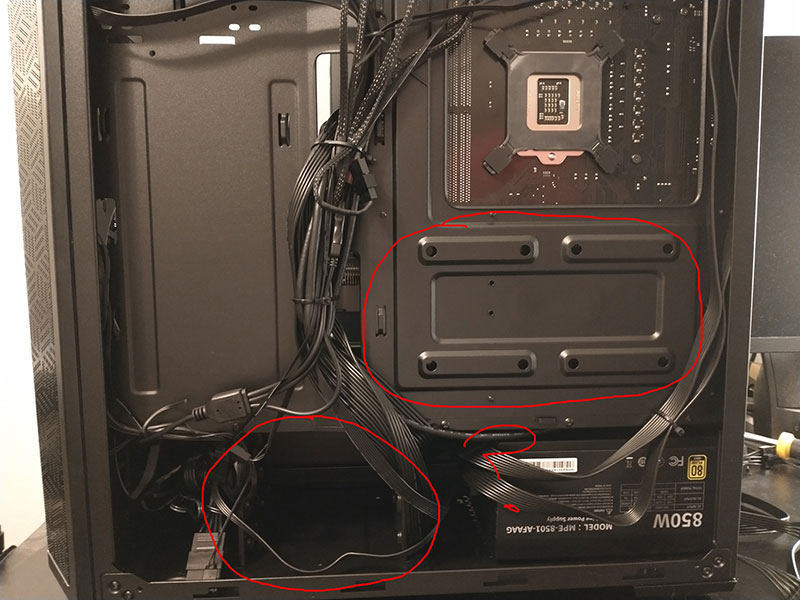
In short, there really didn’t seem to be any obvious bay drives or cages or whatever the fuck you call “place where you stick SSDs.” I mean, there were places where I could kinda sorta maybe see an SSD fitting, but not how it was supposed to fit. The internet was fairly useless in this regard, as was/is Cyberpower tech support who, as of the time of this writing, has still not responding to the ticket I submitted. All I wanted to know was A) where are SSDs supposed to go, B) what the shit these plastic things are supposed to be (presumably related to affixing SSDs), and C) is it true that there is only one SATA port on this motherboard?
That last apparent fact really threw my plans into disarray, as I wouldn’t be able to bring over two SSDs like I planned. The subsequent surprise that the Data drive was, in fact, an old-school HDD this whole time barely registered.
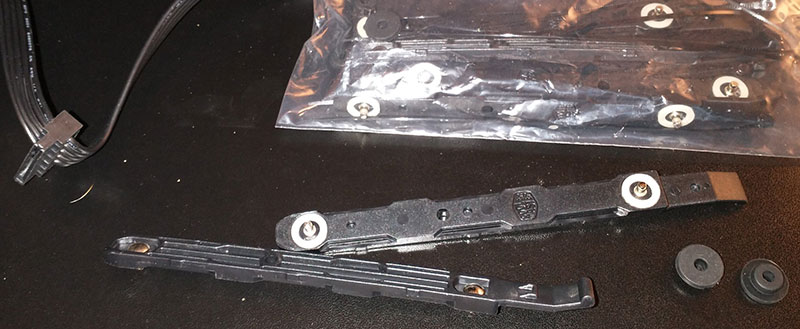
So, Lesson 1: it’s actually very important to pay attention to what the motherboard of your PC looks like, even if that seems like the least exciting piece of the machine.
Lesson 2: Likewise, pay attention to your case. Every damn one seems to have a window on the side these days, which means everything else is getting stuffed out of sight or miniaturized out of existence.
Incidentally, both are lessons I should have already learned from a prior misadventure a few years ago with buying a washer & dryer. Our old top-loading washer stopped working, and the issue was fried electronics that would have cost $200 to replace just in parts. Considering the dryer took 2-3 cycles to dry towels anyway, we opted for a new washer & dryer combo. We did our research, we compared prices, we shopped around, we got a good deal. The thing that we didn’t account for? Which ways the goddamn doors open. They are both front-loading machines and the doors open towards each other. Huge pain in the ass moving clothes around. Can’t really swap positions because of the drain pipes and the dryer vent, and the washer door is not reversible so… yeah. The little stuff matters.
In any case, I reexamined my available options for the PC. The motherboard technically has three NVMe slots, but one of them is behind the huge, honking RTX 3080. So, maximum, I could have one SATA SSD and one additional NVMe SSD. Decision? Throwing my hands (and cash) in the air and purchasing a 2TB NVMe SSD for about $200. Getting a 1TB version would have saved some money and put me on par with my current setup, but… well, my current setup is one without a lot of AAA games installed. And what this experience has taught me thus far is that I don’t really have a deep desire to be spending my precious free time fiddling around with computer components.
Seriously, how could I have not known I still had a HDD installed after all these years? That was where Guild Wars 2 was installed! I never questioned the loading times, but now it all makes sense.
As for the digital migration, that is still ongoing. Several years ago, I bought an external hard drive “docking station” thing in an effort to try and save my wife’s data when her laptop died. Basically, you can chuck any hard drive in the plastic cage, SSD or HDD, and then connect it to another computer via a USB 3.0 cable. It worked. So, that’s the play: install the NVMe SSD into the new computer, unplug the old computer, plug in the new computer, and then (temporarily) remove all the hard drives from the old one and transfer their contents via the docking station.
And because I like doing things the hard way, I am first making a fresh backup of my Data drive to an external SSD that I have around the house for exactly this purpose. Well, that, and because I am vaguely concerned about this 11+ year old surprise HDD dying mid-migration.
So that’s where I’m at. Hopefully the next update will be about how everything went perfectly, and that I was finally able to see a game, any game, at max settings and that it was all worth it.
 In An Age
Commercialization of Evil
Oct 27
Posted by Azuriel
I have to admit, when I first read the article title “Dreamlight Valley is a waking nightmare and Disney must be stopped,” I thought both that clickbait is getting out of control and… yeah, that’s some quality clickbait that deserves a click. What I discovered is a pretty legit, punchy article that brings up an increasingly odious problem when it comes to Disney and their commercialization of evil.
The TL;DR is that Disney is populating Dreamlight Valley – aka Stardew Valley meets Animal Crossing – with whitewashed villains. For reasons. Probably commercial ones. As the article states:
Is this really a problem endemic of the moral failings of society? Probably not. But I was a bit surprised to learn that Disney also has a mobile gacha game called Disney Twisted Wonderland that turns all their villains into anime-inspired versions of themselves. The latest addition is one based on Claude Frollo, whose cartoon bigotry in The Hunchback of Notre Dame has only become more relevant over time, and would probably precipitate a “woke backlash” if it had not already been released 25 years ago.
In principle, I do not have anything against people dressing up as Stormtroopers or whatever. People do that not because they were space Nazis, but because the designs are iconic and, yes, cool-looking. That’s just a win for the Art department. And so I can see the draw for Disney to tap into these hitherto untapped wells of marketing material in the form of villains – demeanor/war crimes aside, they are just as iconic if not more so than the heroes of the films they serve to foil.
So… what’s the big deal? I dunno. Maybe nothing.
Nevertheless, I do feel like something gets lost over time. We probably should not be relying on Disney movies to teach morality to children in the first place, but whatever cautionary tale might have existed in these characters’ stories becomes muddled and unrecognizable through the commercialization process. And what was gained? This is not a Wicked-style introspective on possibly misunderstood villains. It’s just… business cashing in on cachet. Which is what they do, I guess.
Posted in Commentary
5 Comments
Tags: Commercialization of Evil, Disney, Disney Twisted Wonderland, Dreamlight Valley, Villain