Category Archives: Commentary
Badass
I have been playing Borderlands 2 quite a bit lately.
At one point, I had a mission to rescue a dude at the top of this dam. I fought my way through several rooms, saw some interesting stuff, solved some pseudo-puzzles, killed all the things. As I bust out of the final door onto the dam proper, everything goes to hell: the orbiting space station starts launching artillery shells, armed robots start landing, bullets start flying everywhere in this now-three-way battle royale. I take down a few more enemies with my corrosive sniper rifle, and then crouch behind some cover while I reload.
Then this music started playing.
I emerge from cover while tossing a holographic decoy out, stealthing to the first robot and meleeing it in the goddamn face. As robotic limbs fly everywhere, I switch to a ridiculously large shotgun, aim, and fire at a second robot. The shotgun shoots 17 pellets that each individually explode on contact, and firing it sounds like God slamming a car door shut.
Whump. Chik-Chik. Whump. Chik-Chik.
As I stroll down the middle of the ramparts like I own the place (and I do), I am suffused with a feeling of Badass. This whole sequence is staged, minus the explosive shotgun; the designers specifically put this music, with these enemies, in this order. It is the definition of themepark content, as single-player games are wont to be. But that doesn’t matter. I had been having fun before, but this was on its own elevated level. And after the sequence is over and I move on to the next (decidedly less cool) quest it occurs to me to ask: when was the last time I felt this way while playing a game?
I had to go back, waaaay back to my guild’s first Mimiron kill¹ in WoW. Like I said, I have had fun in plenty of games in the past three years. I have done some crazy moves in Deus Ex, there are some epic moments in the Mass Effect trilogy, and double-dagger Elementalist in GW2 was great fun originally. But the specific feeling I had owning faces up on Bloodshot Ramparts? Very fleeting, very rare, but much appreciated.
If you guys have experienced something similar in a game lately, feel free to share below.
¹ Please excuse the editing and the decidedly non-epic music accompaniment. 2009 was a long time ago.
Zombie Guilds
Have you ever found yourself stuck in a zombie guild?
When I started playing GW2, I joined the 5-6 remaining members of my ex-WoW guild. Saying “5-6” is a bit charitable consider only three of us were still playing by the time I turned off the sub last year. In any case, we started a GW2 guild and… one month later it is back to 3-4 “active” members. “Active” in quotation marks because we have different schedules most of the time, different levels¹, and different goals.
We have not recruited any more people because… why would we? It is a guild of friends! Just like with relationships, it also seems rather irresponsible getting other people involved if we don’t have a clear idea what we want. After being a guild leader for 3+ years, I just don’t have the stomach for recruitment or the trappings of obligation anymore. And as is the usual case, if I don’t do it myself, it doesn’t get done.
We have been discussing joining a zerg guild or at least an active one. But how? How would I know what guilds exist on my server, what the social environment consists of, what kind of people they are looking for? Should we just keep joining one randomly? I got into Invictus 4+ years ago by pure happenstance: I tanked a Scarlet Monastery run back in TBC. It was a leveling guild that beat the odds and turned into a raiding guild under my benevolent dictatorship. I never handled recruitment, leaving that to the members with the proven ability to somehow be at the right place at the right time picking up the right people.
So… I feel trapped in a zombie guild. If I didn’t know my friends, chances are I would have let myself get absorbed into whatever guild blob I ran into first. But since I do know them, I care about getting absorbed into a hypothetical guild I’m fine with but they dislike. Or vice versa. There is also a residual social guilt knowing that we would be joining as a premade clique, something I hated with a passion when I was a guildmaster.
Maybe in the zerg, none of it will matter. Maybe once I take the initial plunge back into the “social pool,” so to speak, the water will feel fine. I just know the status quo is unsustainable, but it can be worse.
Ugh. I’m going to play some Steam games.
¹ I will talk more about this in the 1-month GW2 post, but suffice it to say, running low-level content with my main character actually feels worse than the traditional system of you just one-shotting everything for them. I had been under the impression that XP/Karma/rewards would be scaled up to your own level, but obviously that is not the case. So you exist in a pseudo-OP mode where you are powerful enough to make mobs trivial until they suddenly aren’t, all the while earning less than you could be. Nevermind if you have already completed those same zones.
One Year
A year ago today, I made my introductory In An Age post.

And it was all downhill from there.
The archives technically go back to December 2010, as I had imported my Player Vs Auction House posts over here when I moved from Blogspot to WordPress and broadened my scope. Looking back, the beginnings of that transition happened when I wrote OT: Firelands, Difficulty, and Cataclysmic Malaise back in March 2011, which remains one of my favorite posts… especially when I established the conjecture as fact nearly a year later.
That is somewhat of a joke.
Incidentally, up until my Guild Wars 2 prediction post last week, the Established Fact one back in January was the most-viewed page on the site. Posting the GW2 predictions and the TSW subscription numbers (#3 highest) in the same week did fun things to my graph:
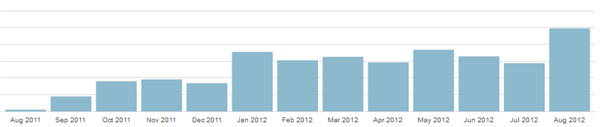
Numbers removed to protect the innocent, e.g. my ego.
Not that I write for the pageviews or anything.
To be honest, this website is pretty much my sole outlet to talk about dubious patch notes, tone-deaf dev chats, post funny pictures, and wax philosophical about gaming in general. So if you were wondering whether I had some special Plans for next year and beyond, it is basically going to be exactly what you’ve got thus far.
I enjoy what I do here, and hopefully you do as well. But even if you don’t, well, stick around anyway and maybe you’ll learn something. Or possibly the other way around.
___________
By the way, the Guild Wars 2 headstart went live as I was typing this. My original intention was to jump on the Jade Quarry server because other bloggers seemed to be going there, but it was Full after approximately two minutes of being online. Four hours later, it appears to be merely High, but I wanted to go ahead and jump into the game. So if you want to watch me gleefully man the cannons in WvW, feel free to join me on the Northern Shiverpeaks server.
I picked that server because it was the next largest in terms of guilds that wasn’t Full, or an “unofficial RP server.” According to this page, it may end up being the #6 server in terms of players. I will have more to say about all this later, but suffice it to say, I did not want a repeat of my low-pop Recommended server ghost town WoW experience. We’ll see what happens.
Where Are All the Bodies?
WoW subscriber losses since Q1 2011: 2,900,000.
SWTOR subscriber losses since Q1 2012: ~700,001.
Aion subscriber losses since 2011: ~600,000¹.
RIFT subscriber losses since 2011: 350,000¹.
LoTRO subscriber losses since 2011: 300,000¹.
EVE subscriber losses since Q2 2011: ~20,000¹.
Where are all the bodies?

Talk about fiscal cliffs…
It is seductively easy to imagine the MMO landscape as a zero-sum, closed universe. One developer’s bone-headed design mistake is another MMO’s gain. “Guild Wars 2 is going to nail the coffin shut on SWTOR/steal another million from WoW.” But it is fact that there are less people playing “traditional” MMOs today than there were in mid-2009. And there were fewer game options back then!
The graph up there is somewhat misleading in two ways. It does not represent the entire MMO market (browser-based games, etc), so it is entirely possible that in the journalistic sense the “MMO” market is doing perfectly fine. But it is misleading in the other direction too: do you really care how Second Life and Dofus and Asian MMOs are doing? There are a lot of games you will never play and/or people you cannot possibly play with that are propping up those numbers. The Truth™ is liable to paint a much bleaker picture.
I think we may need to start entertaining the notion that the entire genre – as we know it – has peaked. Not just the hot topic of F2P vs Subs, but the whole damn shebang. Classical arguments like “WoW lost subs because grinds/attunements/etc are good” become embarrassingly moot (if they were not already). Where are the bodies?
Whoever is leaving does not appear to be coming back for a second date, or even meeting new people; they have simply vanished back into the ether. Speculation on the whys seems moot as well, because there is zero indication the ex-pats transition anywhere else. Rather than go to the alternative MMOs that offer grinding/feature no grinding, they simply go away.
On a tangentially related subject, yesterday was my one-year WoW anti-anniversary:
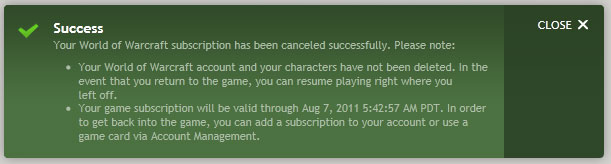
A year ago yesterday I was doing Firelands dailies.
So… we have located at least one body. A body with an extra $179.88 in its pocket at that.
Where are the rest?
¹ Based on eyeballing this chart, which hasn’t been updated in a while.
Slow News Day
Man. If only there was, like, something interesting going on the world of gaming. You know, some tidbit of under-reported MMO news or some noteworthy announcement that happened in the last 24 hours or so. If it could demonstrate my somewhat embarrassing lack of forecasting abilities, that would be great too.
So, yeah, SWTOR going F2P.
Less than 1 million subs now, but totally “well over” 500k, aka the event horizon of the money hole. There is not much else to say that has not been said in a dozen other blogs in your RSS, although I am inclined to point to Green Armadillo’s analysis over at Player Vs Developer for one-stop shopping; I agree with basically everything the dasypodidae said. Especially the confusion as to how a F2P model is supposed to work when the stuff being pay-gated is probably what the vast majority of players don’t care about, e.g. endgame.
My contribution to the discussion, such as it is, will be the following:

A fine company with a long history of good decision-making.
In other news, I finished Dead Island over the weekend, and just completed Orcs Must Die 2 mere hours ago, having played the entire Story-mode in co-op. Official reviews of both and others will be forthcoming. Then again… maybe not. The recent Steam Summer Sale haul included the following:
- Crusader Kings 2
- The Walking Dead
- Prince of Persia Complete Pack
- The Longest Journey + Dreamfall
- Arma 2 (aka DayZ)
- 2K Collection (aka Spec Ops: the Line, Civ5, Darkness 2)
- …and a truly embarrassing amount of indie games
I almost pre-purchased Borderlands 2 since it was $40 via Dealzon, before I realized that I am addicted to the thought of getting deals on videogames more than the actual playing thereof. At least, that is the only possible conclusion looking at my (digital) library. I was feeling kinda bummed out at letting the Borderlands 2 deal slip away though – while it was never supposed to be a sort of Day 1 purchase to me, I was definitely looking forward to it sooner rather than later – until my friend said “Steam Winter Sale.” God dammit.
I am looking forward to hitting up SWTOR once it goes F2P though, assuming GW2 plays out as I expect and I don’t do a full relapse with MoP. Throwing down $15 for the box a week or so from now is not asking much, but like I mentioned earlier, it is all about the dealz. And it is hard to argue with “free several months from now” when there is plenty to do in the midterm.
Can There Be Too Many Zombie Sandboxes?
Nope.
In fact, the default answer to any question of “Can there be too many X games” is No.
A game does not magically get worse because there are a lot of similar titles on the market; you might get tired of playing the same theme/setting multiple times in a row, but whose fault is that? I will take a thoroughly unoriginal knockoff game that is actually fun over the groundbreaking original snoozefest any day. The key is that each otherwise copycat game that comes after needs to be better than the one before. Do that, and you’re golden in my book.
I bring all this up because I just read Keen’s brief write-up of a zombie sandbox pseudo-MMO called The War Z. Not to be confused with World War Z, the bestselling 2006 book, of course. Or DayZ, the zombie sandbox mod that caused me to purchase ArmaII during the most recent Steam sale. Or The Dead Linger, the fairly recent zombie sandbox pseudo-MMO Kickstarter that I originally thought was what Keen was talking about. Or Dead Island, of which I have logged 30 hours playing in the last 10 days. Or Left 4 Dead 2. Or…
…well, there have been a lot of zombie games, eh? Technically even Minecraft.
But you know what? Zombies still have some life in them. If these upcoming games are actually fun, I say bring them on. I just signed up for The War Z’s beta, so we’ll see how that goes.
Spin Doctors: The Secret World Edition
Do you know what I like more than an MMO being treated as a single-player game in nearly 100% of its (blogged) reporting? An MMO with an official State of the Game developer post seven (7) days after launch.
I know that developers of The Secret World are not the first to write the following, but I was especially amused this time around (emphasis added):
We’re going to be releasing fresh and tasty new content FREE to our subscribers on a regular, monthly basis. The first update is due on Tuesday, July 31st, and we will be releasing more details about that particular update later this week — including a couple of fun surprises. (You’re going to love it.)
[…]
* Mission packs on a monthly basis! The first few packs will contain new investigations for every adventure zone in the game — but we also have more action and sabotage missions planned for the near future. These missions will feature fully voiced cut-scenes and new media pop-ups, and will match the quality of the missions currently in the game. Oh, and like everything else in our monthly updates, these packs are FREE for our subscribers!
Allow me to summarize my feelings with the following:

MMO Logic.
I have, of course, been cheerleading the concept of single-player MMOs for quite some time now. But I almost wonder if The Secret World has gone too far, and otherwise fallen into the Uncanny Valley abyss between the two (*ahem*) worlds.
Instead of being interested in an MMO that is going the incredibly novel route of monthly updates, my very first thought was “$15 DLC packs each month.” In the abstract, all subscription MMOs function in this manner, right? And companies like Blizzard certainly are not doing anyone any favors by letting 6+ months lapse between content updates.
But… it’s not just me, is it?
I am not playing the game, but I would rather FunCom put out twice the content every two months even if they end up sitting on the completed work. It feels too fast. And weird, like an MMO with a $13.84/month subscription. Or a doctor who keeps insisting on showing me his medical license. It bespeaks a curious lack of faith in the product itself.
P.S. I smirk every time I see the following patch note in any MMO:
* And speaking of dungeons, we’re also working on a dungeon finder tool, allowing players to more easily put together a team to handle the instanced content
Does that make me a bad person?
2007 Called
…and it said attunements are still a bad idea.
I was not going to write on this subject, given how much of it is ancient history. Indeed, even now I am not going to spend a lot of words detailing how and why everyone is wrong. Only 7 words are really needed:
Attunements were unnecessary in accomplishing their goals.
In other words, every single thing attunements set out to accomplish can be achieved by doing something else. Epic quest lines? Those can still happen. Gating content? That is what the bosses themselves are supposed to do, but you can still go the Sunwell/ICC or gear check route if you like. Encouraging the spirit of cooperation (no seriously, Klep said this)? Since most attunements were for raids, this implies one is already in a raiding guild, presumably to raid, and thus cooperation is already secured. Alternative advancement at endgame? Achievements et tal, or the EQ2 method would be fine.
In the course of pontificating on this subject in the comment sections of three different blogs, the one attunement argument that I actually enjoyed was the “checking to see if you are ready to raid” one. You see, my primary umbrage towards attunements like the Karazhan key quest was how many components required a group. I tanked my way to attunement on my paladin main with the officer core no problem. And then, over the proceeding 37 weeks of raiding Karazhan, I had to make 15 additional Karazhan attunement runs for various people in the guild. People that had no problem being terrible raiders, or otherwise expecting the guild to provide them with endless dungeon runs so that they could guild-hop/get poached three days later. Who was getting attuned here? New DPS recruit #13? They aren’t being challenged by having Karazhan-geared raiders carry them through dungeon runs.
The one sort of attunement that I would consent to return would be personal attunements. The example I gave in a comment reply was:
Hell, if attunements were something that had to be completed solo (or at least could be) I would have zero problem with them. Sure, why not? Have one of the steps be “equip socketed, enchanted gear appropriate to your spec and deal 4000 DPS” and endgame WoW would be in a much better place.
I would 100% be behind that, not out of some kind of desire to demean casuals or new players, but out of an earnest desire to educate them. Where in WoW does it suggest to fill in sockets with gems, or that gear enchants exist? The Ready for Raiding achievement was amusing (less so for how few raiders probably have it), but imagine if it were a required attunement before zoning in to any raid content. Have it be some kind of solo instance tailored to spec/class and filled with fire that needs not be stood in, CC not to be broken, and a final mob that needs to be killed with some minimum level of DPS (that even a tank/healer could achieve). Hell, normalize the gear too.
Bam. I have just created an attunement with an actual, useful purpose related to the thing it is serving as an obstacle for. You know, unlike every other attunement in the history of the game.
So, About Those Extended Endings
Three months to the day ago, I decided to write a post called What I Want to See from Bioware, vis-a-vis the proposed Extend Cut of Mass Effect 3.
And now I have seen those endings. All four of them.
That is your warning, kiddos. Spoilers dead ahead.

In that prior post, there were a number of things I was looking for from Bioware, in Best Case/Worst Case scenarios. The biggest one was the Normandy scene at the end, which made no goddamn sense whatsoever – it essentially ruined the endings for me all by itself. What I wanted to see in the Extended Cut was:
What I want to see from Bioware:
- Best Case: an explanation of how the crew (EDI and Liara, in my case) got back on-board the Normandy, what the Normandy was doing while I was on the Citadel, if they knew/suspected Shepard was alive or dead, and why they were running away.
- Worst Case: ensure that the crew with you on the final mission don’t show up in the final scene.
Mission accomplished. In a big way.

Yes. Yes he did.
In the interests of being somewhat objective, the “answer” they gave to where your crew members were at was… a bit hard to swallow. With Harbinger easily knocking out tanks and fighters left and right, it seemed quite out of character for him to let the Normandy land, for people to be evacuated, for there to be time enough for one last tearful goodbye, and then an escape back into orbit. If the Normandy was capable of landing, why not just drop off a bunch of people at the beam itself?
I am willing to entertain the notion that Harbinger would not care about Normandy picking people back up, as long as they were not being moved closer to the beam, although that seems a bit weak.
Outside of that gripe? Smashing success on the other points. I laughed out loud when Hackett said what he did in the screenshot above; partly from the unexpected bluntness, and partly from the beginnings of a catharsis I had been missing for the last three months.
The next section of that prior post was about Indoctrination:
What I want to see from Bioware:
- Best case: Settle the Indoctrination debate once and for all. If Indoctrination is real, include a true final battle scene, potentially followed by the same sort of choices.
- Worst case: Remove the breath scene.
As far as I am concerned, the Indoctrination theory is kaput. It was actually kaput months ago, but the mini-epilogues following each ending serves as final nails. In the scheme of things, Indoctrination was a better ending than what we were originally given, but these new ones supersede the old in a good way.
The breath scene is unfortunately still in the game, but since March I have come to understand that the Destroy ending is actually truly Renegade. Ironically, all those Indoctrination videos had led me to believe that Control was bad and Destroy good, (i.e. the real ending), when that really was not the case. It is true that “nuking the site from orbit is the only way to be sure,” so to speak, but condemning all synthetics to death, including EDI, when other options are available is undeniably Renegade. Control may not seem like the way the Reaper threat should be handled, but a Paragon Shepard would take that chance. The consensus says: these units do have souls.
The final section was general plot holes:
What I want to see from Bioware:
- Best case: Shore up these plot holes via Codex entries, FAQs, or at least acknowledge they exist.
- Worst case: leave everything vague and unsettled.
Many of the points I raised regarding the Citadel were answered by the expanded Catalyst dialog, if a bit weakly. Not the biggest one, though. Why the Reapers did not simply reassert control of the Citadel immediately upon emerging from dark space is probably one of those “Why didn’t the Eagles just fly Frodo to Mount Doom?” questions for the ages.
The Endings Themselves
Talk about night and day compared to the previous ones, eh?

Should have shipped like this.
The amusing thing to me, is how my very first extended ending was the new one.
Unintentionally.
After slogging through the Cerberus base and the London battle and the unskippable post-beam dialog, the very first thing I did when I regained control over Shepard was shoot the Catalyst in the face. His Harbinger-esque “So be it” response took me aback, as did the unexpectedly poignant “Failure” ending. I remembered that time-capsule scene with Liara, and was even touched by the knowledge that though we had failed, the cycle was eventually broken by the next generation of intelligent species. Whom, while still looking suspiciously like asari, nevertheless had the gumption to actually take Reaper threat goddamn seriously. “Was that so hard?” I asked the monitor afterwards.
I played through all three of the other main ones, and was immensely satisfied. It is still Synthesis – aka the Green Cupcake – all the way for me, but I felt that Bioware did an excellent job at handling the Control ending as well. They all felt a bit… Deus Ex. In a good way. I have no idea how they will rationalize additional post-ME3 games in the Mass Effect universe, at least without holding Destroy up as canon, but I suppose we will all jump off that bridge when we come to it.
Months ago, a friend asked me as to whether I would purchase any future ME3 DLC. At the time, I replied “It will depend on how Bioware handles the Extended Cut.” Although I am extraordinarily happier with the series now than I was back in March, I am not sure that I want to revisit Shepard and crew again. Say what you will about the writing or “cheap emotional tricks” or whatever else, but this series truly has affected me in ways few games (or books, or movies) have.

I forgive you, Joker.
I am thankful for the experience, of course. I just know that the longer I stay in Manse de la Shepard, the less likely I am to enjoy all the other experiences out there. It is hard enough handling regular post-game depression, without also having to question why I am not a better man in real life.
I am only half-way joking.


Counter-Intuitive Insights
Oct 24
Posted by Azuriel
At first, I could not help but laugh. There is context for the quote, sure, but it struck me as funny regardless to take what would normally be a negative quality (few people are playing your game) and spin it as a positive. Especially when it is an MMO one is talking about, where the whole idea is the “a lot of people” part.
But… hmm.
It is undoubtedly true that an MMO “community,” such as it is, has an impact on one’s enjoyment of a game. I read threads like these on the Guild Wars 2 forums, and the sort of hyper-competitiveness inherent to the dungeon-running culture presented there makes me not want to bother at all. The people running these dungeons are getting them done in 20 minutes, whereas it will take me hours to get a similar level of competency all while I slow them down (assuming I am not kicked to begin with).
Incidentally, this is why you have LFD tools: there will always be abrasive social encounters when grouping with strangers, but at least with LFD you are not dependent on their goodwill to zone in at all. As long as you have reasonable expectations (i.e. not expect four strangers to wait while you soak up the atmosphere), you will be fine.
I believe that Keen is probably correct that Rift’s smaller community is a positive, assuming you are into that sort of thing. Fewer people means less of an audience for trolling, more reliance on social contacts to get things done, which probably all contributes to a Cheers-esque atmosphere. Or at least a “we’re in this foxhole together” atmosphere. So… yeah. The fewer people that like your MMO, the more you will like it. And the converse – the more popular your MMO gets, the less you enjoy it – is probably true for many as well.
All of which means you can never say bad things about hipsters ever again.
Posted in Commentary
12 Comments
Tags: Community, Counter-Intuitive, Guild Wars 2, Keen, LFD