Category Archives: Commentary
Shooting the Moon
As you may have heard, the companies behind Kingdoms of Amalur and the followup MMO are basically out of business. While I am sensitive to the dangers of schadenfreude, and loath to quote the same guy twice in three days, there was something about Keen’s final good-luck paragraph that struck me oddly:
[…] Following games closely and being so excited for something, just to have it shut down at a moment’s notice, is the hardest part of being such eager gaming enthusiasts. Such potential for something fresh or new is destroyed, but we’ll continue to see a new Call of Duty game released every year and a horrible MMO will see the light of day simply because it has a huge publisher. So frustrating.
Kotaku is reporting that 38 Studios only would have been saved if Amalur sold 3 million copies.
Let that sink in. Three million copies or bust. Depending on who you ask, Amalur sold between 400k and 1 million.
I dunno, I am of two minds on the implicit lament in Keen’s quote. I do consider it a serious problem that the barrier to entry for RPGs (and games in general) has gotten so high as to choke out all but the biggest studios. Remember the thousands of garbage NES games on the shelves back in the early 90s? Most were bad, but at least it appeared as though someone with a good game concept had a realistic chance of getting their cartridge on store shelves.
On the other hand? I feel like it is a bit unrealistic. It is easy to hate on Call of Duty when a “new” one is pumped out every year… but Black Ops sold 25 million copies. MW3 made $1 billion in 16 days, and that was seven months ago; god only knows how much it’s up to now.
Desiring fresh and new things is fine, but it’s code for “I’m not getting catered to.” At some point, you have to ask “Who can afford to cater to me?” If Amalur’s direction was your thing, good for you, but the market clearly couldn’t support it. So… Curt Schilling should have settled for less, designing a less expensive game with a lower break-even point. But would any of us have been satisfied with that? Would you be fine playing an indie-level MMO or other game? Would you be willing to lower your (obviously high) standards to meet the developers making the actual games you’re talking about?
I am probably not coming across very clear; in fact, if any of that makes sense to you, let me know, because it kinda doesn’t make sense to me. It is just that whenever I see a lament about how a “horrible MMO will see the light of day” as compared to presumably a good one on the cutting-room floor, I cannot help but shake the “Whose fault is that?” retort. The publisher? The fans? Or our own unreasonable expectations?
Whatever the case, I always a respect for those who attempt to shoot the moon. Win or lose, you always leave with a story – which is more than most.
The Mass Effect 3 Extended Cut
What can fans expect from the Extended Cut DLC?
- For fans who want more closure in Mass Effect 3, the DLC will offer extended scenes that provide additional context and deeper insight to the conclusion of Commander Shepard’s journey.
Are there going to be more/different endings or ending DLCs in the future?
- No. BioWare strongly believes in the team’s artistic vision for the end of this arc of the Mass Effect franchise. The extended cut DLC will expand on the existing endings, but no further ending DLC is planned.
What is BioWare adding to the ending with the Extended Cut DLC?
- BioWare will expanding on the ending to Mass Effect 3 by creating additional cinematics and epilogue scenes to the existing ending sequences. The goal of these new scenes is to provide additional clarity and closure to Mass Effect 3.
It is coming out this summer, and it’s free. Mission Accomplished.
Also of note is that there is some free multiplayer DLC that should be launching on Tuesday. I have officially spent more hours playing ME3 multiplayer than ME3 single-player, so this is of interest to me. It is pretty clever of EA/Bioware though, in that undoubtedly all of the new content (other than maps) will likely be need to be unlocked via the random packs purchased via in-game credits… or Bioware Points. All of the goodwill of free DLC, along with all the subsidization of microtransactions.
Regarding the nature of the Extended Cut, Kotaku dug a little deeper, and provided some more details. Namely, that A) Bioware is shifting its DLC plans to make sure this comes out first, B) it will include cinematic sequences (!) and epilogue scenes, C) Command Shepard isn’t (likely) to have any new/revised lines of dialog, D) “‘should be able to grab a save file before the endgame and experience the new content from there.’ (Keep a pre-endgame savefile, folks!)” E) Indoctrination theory is probably kaput.

Some general endgame details.
Regarding the latter, it was Liveblogged that they said:
“The indoctrination theory illustrates again how, um, committed the fanbase is…” don’t want to comment either way. Don’t want to be prescriprive — fans interpret their own way, plus DLC coming. “We want the content to speak for itself, and we’ll let it do so”
That does not particularly sound like a response from people who intentionally wanted it all to be a dream. Ironically, since Bioware will essentially be designing the epilogue based on fan feedback/questions, it is entirely possible that they may fit in Indoctrination-y wiggle room. I hope not, but we’ll see.
This exchange was also interesting, for different reasons:
[…] His question – when citadel is moved, what happens to everyone on it?
Answer: One of the things in the citadel codex is that anyplace -inside- the citadel has emergency seals, and some exterior areas have emergency seals that can keep atmosphere in. Even if the Citadel is destroyed (which it may or may not be in ending), “is not like the entire things blow up.” People on (in) the arms may well still be alive. No reason to assume 100% casualties
Err… okay. Not exactly sure how it makes a lot of sense for the Reapers to be in control of the Citadel for X length of time and not handle all the armed civilians (my Shepard encouraged the formation of a militia), but perhaps that goes a ways towards this making sense. Incidentally, I actually have a serious problem with the breath scene being “canon,” but I suppose we will have to see how things pan out this summer.
P.S. This comparison between Mass Effect and Lord of the Rings highlights why all this was necessary to begin with. You know, if my writing about it constantly for the last three weeks wasn’t enough.
The Gray Moral Morass
You may or may not have been following the whole EVE cyberbullying thing.
Syncaine being Syncaine, he is both morally repugnant and technically correct in his deconstruction of the argument. What exactly can one do in defense against the emotional blackmail of “I’m suicidal?” Is that not carte blanche acquiescence to every situation, including purely PvE concerns of “loot didn’t drop, so I might as well”? And what about the in-game incentives CCP purposely built into EVE to encourage competition, subterfuge, and retribution?
So, on a whim, I decided to check EVE’s Terms of Service. And I don’t even recognize what game they believe it’s for (emphasis mine):
As an Eve Online subscriber, you must observe and abide by the rules of conduct and policies outlined below, as well as the End User License Agreement. Failure to comply with these regulations can result in the immediate termination of your account and you will forfeit all unused access time to the game. No refunds will be given.
1. You may not abuse, harass or threaten another player or authorized representative of CCP, including customer service personnel and volunteers. This includes, but is not limited to: petitioning with false information in an attempt to gain from it or have someone else suffer from it; sending excessive e-mails, EVE-mails or petitions; obstructing CCP Employees from doing their jobs; refusal to follow the instructions of a CCP Employee; or implying favoritism by a CCP Employee.
2.You may not use any abusive, defamatory, ethnically or racially offensive, harassing, harmful, hateful, obscene, offensive, sexually explicit, threatening or vulgar language. (Alternate spelling or partial masking of such words will be reprimanded in the same manner as the actual use of such words.)
3.You may not organize nor be a member of any corporation or group within EVE Online that is based on or advocates any anti-ethnic, anti-gay, anti-religious, racist, sexist or other hate-mongering philosophies.
4.You may not use “role-playing” as an excuse to violate these rules. While EVE Online is a persistent world, fantasy role-playing game, the claim of role-playing is not an acceptable defense for anti-social behavior. Role-playing is encouraged, but not at the expense of other player. You may not create or participate in a corporation or group that habitually violates this policy.

Did I pick the wrong ToS? This is for EVE – EVE – right?
There was also Rule 9:
9.You may not advertise, employ, market, or promote any form of solicitation – including pyramid schemes and chain letters – in the EVE Online game world or on the website.
…but after some thought, it was probably intended to prevent IRL pyramid scheme spam.
So, assuming that CCP enforces their own ToS, there clearly are lines in-game actions can cross, the people behind the pixels are protected to an extent, and it is not the exact free-for-all that it is made out to be. That said, I do wonder about the degree of dissonance between the “no harassment” policy and in-game bounties, war-decs, and general grief potential. Is there any evidence that CCP has acted on this policy before? Is it harassment if I get shot down by a Goon ship every time I enter Goon territory? They just won’t leave me alone!
Incidentally, here is Blizzard’s stance on harassment on PvP realms:
Ongoing Harassment
The Ongoing Harassment policy does not apply when there is a PvP resolution available on a PvP realm, as physical confrontations are considered a facet of PvP combat and players in opposing factions are unable to communicate verbally. Characters have the ability to address their conflicts through combat and GMs will only involve themselves in extreme circumstances.
In related news, the deal will probably be over by the time this post goes up, but did you know this happens:

Cheaper than most F2P games!
That’s… almost tempting. And kinda ridiculous at the same time.
Bioware “Addressing” Mass Effect 3’s Ending(s) via DLC
Dr. Ray Muzyka, co-founder of BioWare, has a blog post up regarding Mass Effect 3’s ending and resulting controversy. The money-shot (literally), is this paragraph:
Building on their research, Exec Producer Casey Hudson and the team are hard at work on a number of game content initiatives that will help answer the questions, providing more clarity for those seeking further closure to their journey. You’ll hear more on this in April. We’re working hard to maintain the right balance between the artistic integrity of the original story while addressing the fan feedback we’ve received. This is in addition to our existing plan to continue providing new Mass Effect content and new full games, so rest assured that your journey in the Mass Effect universe can, and will, continue.
My first, immediate reaction? Summed up by this picture I saw on the Kotaku forums:
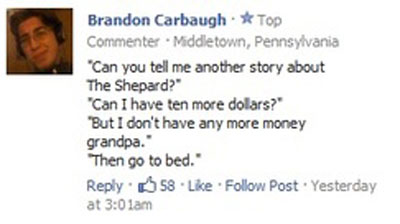
Burn Level: Legendary
Between the wording of that paragraph and the extent to which he stresses that the team was “surprised” at the “passionate reaction of Bioware’s most loyal fans,” this news does not exactly inspire confidence. Implicitly, it sort of disproves Indoctrination Theory, yeah? And even more depressingly, it implies that the team of writers who had crafted this brilliant narrative up to that point felt like the Normandy bit at the end made a single goddamn piece of sense.
I think I need to make a post dedicated to narrative/artistic integrity at some point, if for no other reason than to try and hammer out my own feelings on the subject. I felt post-ending DLC worked well in Fallout 3 (regardless of whether it was based on fan reaction or not), but at what point does this become indistinguishable from game companies selling us the final chapter to incomplete products? If Bioware changes the ending, is that them “caving to pressure?” Is a revised ending still the inviolate artistic expression it was before? And what if the new ending is actually good? Will you be able to, as a player, re-immerse yourself without the nagging feeling of patronization?
While I do some soul gerrymandering on the subject, don’t miss Kotaku’s “Why I’m Glad Bioware Might Change Mass Effect 3’s Ending for the Fans” article, or Forbes’ awesome “Mass Effect 3 And The Pernicious Myth Of Gamer ‘Entitlement’” take-down (thanks to Liore for pointing it out). They sum up my general feelings on the subject, although… well, suffice it to say, I’m the kinda guy that got annoyed that the Oracle was played by a different actress in Matrix 3 (and how they handled the transition) even though the first actress died IRL.
Moving Past Mass Effect
First, I apologize in advance for another “blank” entry.
As someone who typically plays games that are old and on Steam sales, I can appreciate the frustration of people who are waiting on ME3 and yet are inundated by spoiler-laden posts on their Readers/blogrolls. In fact, I do not even like friends telling me they liked or disliked an ending to anything – my mind immediately starts analyzing the kinds of things my friend likes/dislikes (“Hmm, he wasn’t a fan of FF7’s ending…”), and extrapolates possible ending scenarios from there.
If you are such a person, or don’t want ME3 spoilers generally, last chance to bail.
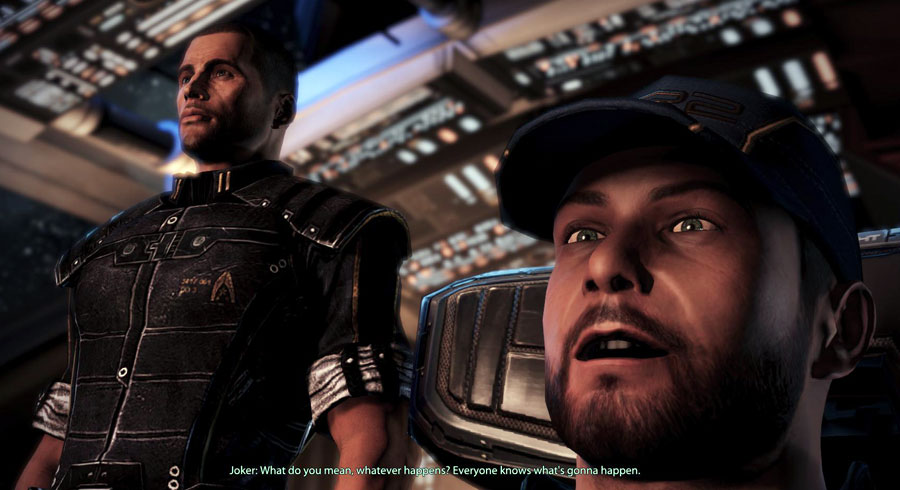
Yeah, we kinda do.
“I think we ought to read only the kind of books that wound and stab us… We need the books that affect us like a disaster, that grieve us deeply, like the death of someone we loved more than ourselves, like being banished into forests far from everyone, like a suicide. A book must be the axe for the frozen sea inside us.”
–Franz Kafka
Since finishing Mass Effect 3 Monday night, I have been in turmoil. Post-game depression is fairly typical for me, and endings like this one are a sort of double-whammy.
Rohan described the break as being “pre-beam” and “post-beam,” but it actually started earlier for me. The invasion of Earth itself was curiously… off. What should have been a momentous emotional occasion was, well, not. Where was the stirring music? Fires and Reapers and silence. For a while, I was actually worried that there was a bug preventing any music from playing.
Once back aboard the Normandy, things started feeling right again. This was Mass Effect, this was what it was about. In fact, it was not until ME3 specifically that I even felt I knew what the series was about. Interstellar war was one thing, but what I cared about was landing in a situation, and being the right man at the right time. Shepard was not setting out to dictate galactic policy, Shepard was not some god-figure who arbitrates which species lives and which dies. He (or she) simply happened to find himself in that position, at that turning point in history, and does the best that he can.
It is in that context that I felt the post-beam sequence was fine, for what it was.
Through the prism of the ending, I felt that Shepard the character got the closure he needed in the hours leading up to the end. The romance section put it in sharp relief: I was so worried about getting “locked-in” too soon that I accidentally past the point of no return without anyone at all. When I reloaded and made my choice, the stark difference between my feelings of the game – based simply upon those two scenes, one alone and the other with Liara (sorry, Tali) – drove home the fact that I love this series, no matter what happened.
Ever read The Wheel of Time series by Robert Jordan? As of today, the series is one book away from completion, and I have become so invested in the final outcome that I can barely stand it. But… what kind of ending should there be? The one I want, or the one I deserve? What if the ending is simply terrible, like how I felt ME3’s was at the time I was experiencing it?
With Wheel of Time, that answer is largely moot. There was one point in Winter’s Heart (book 9), one perfect moment, when everything in the narrative came together for me; a great character catharsis, independent of any kind of grand action event. I remember sighing, and a tension I did not even know existed, releasing. No matter what happens in Book 13, no matter what the Wheel weaves, they can never take that moment away or cheapen it.
I am coming to understand the same with Mass Effect.
Bioware cannot take away the feeling of immense depth with Mordin, when the Salarian stereotype fell away to reveal a reservoir of guilt for necessary evils; a doctor moved to inflict harm, faced with impossible choices. Bioware cannot take away my own feeling of guilt when I heard Kaiden’s “Belay that order!” command repeated in the forest dream sequence; a sacrifice I readily accepted at the time to save a woman I had feelings toward and ultimately passed over. Bioware cannot take away EDI and Joker and all the other hilariously poignant moments in the entire series, but ME2 in particular. Bioware cannot take away the bromance with Garrus, or the absolute struggle I had in choosing whether to intentionally miss that shot or not.
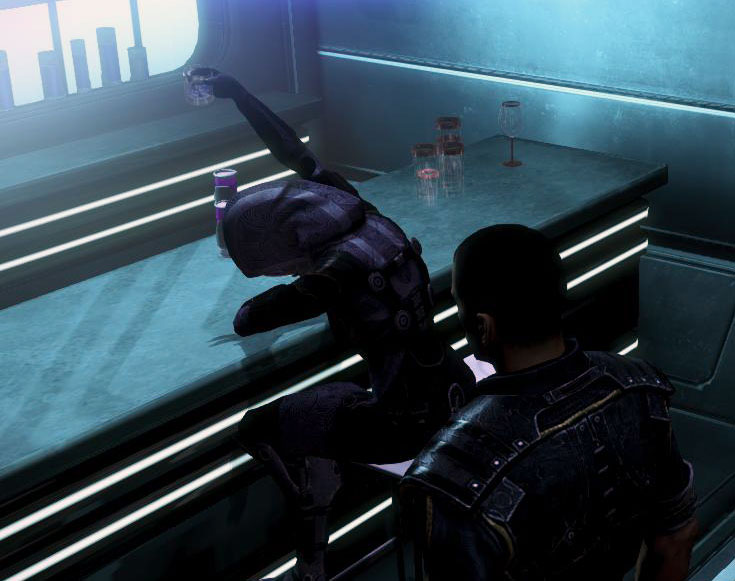
Here, here.
So, if you struggled as I have, or struggle still, I have a recommendation. Listen to To Build a Home by The Cinematic Orchestra. Listen to it again. Then read this Kotaku article. Then remember every time you felt this way before – maybe Cowboy Bebop, maybe End of Evangelion, maybe Saving Private Ryan – and try to remember the last time you have felt so wounded by a video game. Have wanted something different so bad you could taste it.
And then… try to let go. If you are anything like me, I am having an exceedingly difficult time wanting to.
Good game, Bioware. Good game.
P.S. Epilogue: For what it’s worth, I still believe Bioware should have handled the ending better (and I am aware of the “secret ending”). The tone and recycled outcomes were one thing, but the incongruent Normandy bit was quite another. At first, I railed against the notion that Bioware was planning on going the “if you want the true ending, it’ll be $9.99 DLC” route, and the implicit dream/indoctrination sequence that implies. But the precedent already exists: Bethesda did just that in the Fallout 3 “Broken Steel” DLC.
The difference being, of course, that Fallout 3 was immensely cathartic in wrapping things up at the end, straight out of the box.
Enthusiasm Tax
As a general rule, I try not to get too excited by anything.
Part of this is due to the standard sort of defense mechanism against disappointment. As the saying goes, a pessimist is either right, or pleasantly surprised. Of course, that often leads to pretty dreary life experiences, so there are certain realms in which I let it all hang out.
But the main reason I strive to keep skepticism high is out of simple and repeated experience: you are always punished for your enthusiasm.
Case in point:
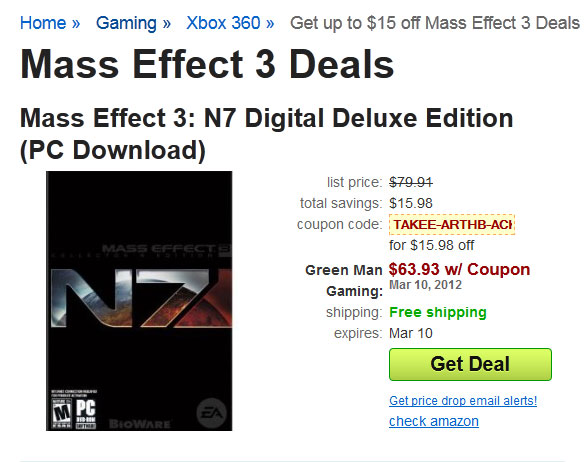
Never again.
If you will recall, I ended up paying ~$85 for Mass Effect 3: Digital Deluxe Edition about two days ago. Had I waited those two days, I could have spent $16 somewhere, anywhere else. I am not in a financial situation in which the $16 necessarily matters, but it matters to me that I essentially paid an Enthusiasm Tax.
The deal was via Dealzon, and I was made aware of that via Kotaku’s The Moneysaver article. It expires today (March 10), in case you are interested. Then again, I have little doubt that you could wait a month or two and get an even better deal.
Incidentally, based on my ME3 experiences thus far, it is worth waiting for the price drop.
Specialization is Key
I was reading Syl’s Monday post on GW2 when a particular section leaped off the page:
Some people still doubt that GW2 will manage without any holy trinity, but I actually do – and if there’s ever going to be more “dedicated” healing or tanking going on in a specific encounter, it will probably be a situation in which everyone must take turns or decides on a random player.
If you have attempted group content in WoW at any point in the last two years, you probably recoiled in horror as I did at the thought of looking forward to shared group responsibility. We have a term for that now – The Dance – and every indication that it was the principle cause of the nearly 2 million subscriber exodus.
After all, by making every player vital to the group’s success (e.g. everyone must Dance correctly), the strength of the group is reduced to that of its weakest member. And if we follow the “down with the holy trinity!” argument to its inevitable conclusion, we end up in Dance Dance Central.
When I asked whether Syl really wanted shared responsibility, the response was:
You mean, would I rather have groups share the responsibility of control or be flexible about it, rather than putting the entire responsibility and blame on just one person? of course I would. I think this is one big reason why WoW pugs were so horrible.
The sentiment is interesting to me, because I approach it from the 100% opposite direction.
There are some responsibilities that I do not trust other people to accomplish. I was the guy in school/college that would do all of the heavy lifting in the group project – picking the topic, doing the research, writing the paper – while you sailed to an easy A by reading two (of 10) paragraphs in front of the class.
Actually, “trust” is not even the operating word I am looking for, as that implies an uncertainty of contribution. It wasn’t a question of whether you would perform, or even how. It was a matter of your capacity for performance, and whether the final outcome would be better or worse with said contribution.
Is that arrogant? No.¹ Ability brooks no morality. Being better at the “game of school” did not/does not make me a better person, or someone else worse for their lack. The unilateral determination of the value of the contribution might be construed as arrogant, but the final grade was always a true arbiter. Just as the death of the boss is an arbiter of a raid strategy.
Which segues me back to raiding and the following claim: specialization is better for group-based activities.
People are NOT experts at everything, nor should they have to be. If the content requires precise movement at specified times, who do you want in that position? Probably a person meeting the following criteria: A) best internet connection, B) the most experience, and C) someone who wants the responsibility. Maybe you’re thinking long-term and want to get another guy trained and battle-tested. Maybe someone wants to branch out and test the tanking waters. That’s fine! Do what works for your team.
What no one wants is for the person chosen to randomly be the easily excitable, newbie friend raiding on WiFi. It’s not fun for him, it’s not fun for you, it’s not fun for anyone. It creates friction in group scenarios, even when you are raiding with good friends.
This brings me to Guild Wars 2, and two conditional claims/predictions.
1) Trinity specialization will be required to succeed at endgame content; or
2) Endgame content will be mostly trivial.
The “everyone can pitch in” group content philosophy is simply zerging. The “trinity should die” desire is the desire for Dance 2.0.
Syl goes on to mention:
combat that revolves around tanking and aggro, is different from combat that revolves about shared control and therefore needs less dedicated healing, too. tactically speaking it’s an interesting approach you can already find in many FPS online games where every player is carrying some type of rifle and team strategy, self-sufficiency, quick reactions and improvisation are where it’s at. okay, you can distrust the average MMO players currently out there to be any use at this type of cooperative game – a fair point, but not exactly a good argument against improving combat design. to ME the current combat is boring.
Putting aside the question of the actual value of teammates in CoD/BF/TF2 games (and the fact that a lot of FPSs are in fact class/role-based), I want to talk about improvisation. The ability to change strategies, to adapt to changing conditions, to snatch victory from the jaws of defeat… that was actually my favorite part of raiding in WoW. The Mimiron kill video was one of the most epic experiences in the game for me. Same with our first Yogg-Saron kill.
The rub is that improvisation requires room to screw up and not fail. In other words, improvisation requires a lower difficulty. It requires mistakes to not matter as much. I am not at all a fan of pass/fail mechanics, so I actually DO hope there is room for improvisation in GW2. But if a group of 5 Necromancers can clear all the content, chain rezzing each other, swapping weapons to “be the tank” when they are randomly the target of the boss, requiring no specialization at all (or worse, requiring everyone to “specialize” in everything)… well, have fun with that.
A certain continuum exists between the two extremes, but it is not as wide as many believe. The only way to reliably hit that mark, IMO, is to require specialization in tasks – specifically being able to choose the 1-2 people around which an encounter pivots – and extend the margins of victory for everyone else. Think the ooze-kiter in the Rotface encounter, or the two portal healers in Dreamwalker.
Allowing those 1-2 people to be anyone (tanks/healer/DPS) would be an amazing innovation, but I’m not entirely convinced that is what will be going on in GW2.
¹ Although it’s probably arrogant saying it.
Post-Interview, and Diablo 3
The interview went… more or less okay.
For the curious, my interview in Chicago was for the JET Program; basically applying to teach English in Japan for a year (or more). I spent a semester in Japan during college, I want to go back, and we will all have to wait to see how it shakes out because results aren’t announced until April. If selected, I’d be in Japan by August. If not, it will be business as usual. In fact, considering this blog (and commenting on other blogs) is my only outlet for gaming discussion, it’d be business as usual anyway.
…okay, maybe business as usual. Let’s jump off that bridge when we come to it.
In other news, in catching up on Diablo 3 blue posts, I wanted to highlight two things:
In the near future, we’ll be implementing several changes to the posting limits and fees related to the beta version of the Diablo III auction house. Here’s a quick summary of what’s in store:
- Listing fee is being removed.
- Transaction fee is being increased to 1.25 Beta Bucks.
- Minimum listing price is being raised to 1.50 Beta Bucks.
- You will be limited to 10 active auctions per auction house.
With the removal of the listing fee, players will no longer need to worry about whether they’re going to run out of free listings for the week. In addition, introducing a limit on the number of active auctions means players won’t feel as though they should be trying to sell everything they find, potentially flooding the auction house with unwanted items. Under this new system, players will only pay an auction house fee if and when an item actually sells. This has the main advantage of allowing players to try to sell their items risk-free. In addition, because the transaction fee is already baked into the price when an item is listed (as part of the minimum listing price), it’s no longer possible to be in a situation where you don’t have enough Battle.net Balance to list an item, forcing you to have to charge up your Balance just to attempt a sale. We think this will be a much cleaner process for selling items and will ultimately lead to a better experience when using the currency-based auction house. (source)
What I am finding curious is A) such fairly radical RMAH changes are being iterated on so late in development, and B) how there is now an effective floor price of (presumably) $1.50 for any given item, and C) holy shit, an 83% Blizzard cut of the profits on said floor prices. Even if you sell things at $5 or $10 a pop, that’s still 25% and 12.5% respectively.
I am beginning to wonder if these margins won’t start creating a space for the gray markets to move in – if you broker a “10 items for $10” outside the game, the customer saves $5 and the seller gets $7.50 more than they would have. Perhaps Blizzard doesn’t feel like people would bother with small sales? Easy typically trumps cheap, so who knows.
The other bit was this… unfortunate analogy by Cashiok Bashiok:
On a more serious note, I too worry that we won’t be able to meet the expectations people have built up for themselves. Part of my job is managing people’s expectations, so… eh… stop it. Stop thinking about how awesome this game could be. Just imagine it’s a new M. Night Shyamalan movie. Sure Sixth Sense was amazing and Unbreakable had it’s moments, but this right here is the sequel to The Village … or The Happening … or Signs … or any of the movies besides the two I first mentioned. So just like, lower those expectations, but still definitely buy the game please, and everything will be just fine. K? (source)
Now, there is certainly a tongue-in-cheek context to the quote and the thread it was responding to. Is Blizzard seriously trying to lower expectations as they scramble with radical 11th hour changes? I guess we will know for sure when it releases.
What is unfortunate is that I use Sixth Sense as a go-to example of why developer/director/artist worship is a bad idea. You see, Sixth Sense was a brilliant, brilliant film. It was also, based on the movies that proceeded it, a complete fluke. There simply is no reason to believe that a beloved whatever will continue creating quality content. I read bloggers casually throwing out “We will have to wait on Titan to move the genre forward” and arch an eyebrow. What makes you think Blizzard even knows why WoW was so popular? There isn’t some secret formula for quality gaming, and even if there were, what worked in 2004 doesn’t work the same in 2012.
Just ask Nintendo and the company that sold me Chess on my flip-phone for $5.99 how mobile gaming is treating them these days. Oh how things change.
Bold and Spectacular… Server Merges?
This news is technically more than a week old, but there was a blue post made by Zarhym that really struck me as… well, read for yourself:
Having said all that, yesterday we discussed low-population and faction-imbalanced realms with our developers. They have some pretty bold and spectacular plans for addressing this in anticipation of implementing some of the features we plan to in Mists. I just don’t have a lot of information to share with you at this stage of programming and development.
My first reaction is in the title: bold and spectacular… server mergers? Assuming that is not what they are doing, well, what are they doing? What could they be doing?
I believe it was in a recent episode of The Instance that the hosts were talking about the concept of moving towards a server-less solution, or perhaps more accurately a “dynamic server” solution. We can imagine that instead of always logging onto Auchindoun or Earthen Ring or wherever, you simply log into a server. Once that server starts to fill towards capacity, people will start logging into a new server. This essentially eliminates low-pop and/or faction imbalanced servers entirely, aside from very last server booted up.
There are several obvious downsides to such a method. First, everything will be like LFD for servers; the likelihood of you making friends “in the wild” is severely diminished since you probably won’t ever see them again. A possible counter-measure would be to weight the system so that you are nearly guaranteed to be placed in the same “server” as people on your Friends List. Think that DK was a pretty cool guy when you were doing dailies? Add him to Friends, maybe see him again. What happens, though, if your Friends List network splits off to different servers based on their Friends Lists? Even if you make it possible to change servers through the UI or whatever, other issues crop up. For example, how will the AH be handled? One mega-AH, ruled by botters?
Aside from the dynamic server idea, I had the thought about simply moving towards LFR-ifying everything – not with queues, but with phasing. Imagine the following: you’re on a low-pop ghost town (i.e. Auchindoun), and you walk into Westfall for some alt questing. Instead of the place simply being dead, it is fairly vibrant… with people from other low-pop servers. Instead of an empty Auchindoun Westfall and an empty Dragonmaw Westfall, there is a kind of meta-Westfall that both servers share. Their AHs would remain separate, their Stormwinds would remain separate, their Tol Barads would remain separate, but any kind of dead zone would be shared. If a bunch of people congregated in Westfall for some reason, the servers could simply phase out the other side.
Or maybe “bold and spectacular plans” is simply LFD scenarios, or LFR Tol Barads.
All I know is that low-pop and/or imbalanced realms is a huge, systemic problem in two-faction games. In my four years, I never played on anything other than low-pop realms; any time I heard excitement over Sunwell-esque unlocking of vendors or world raid bosses or WG/TB-based PvP objectives, I always rolled my eyes. Those things do not work on Auchindoun, nor on many other servers. Fundamentally, you and I may as well be playing entirely different games.
If Mists is really focused on getting people out of cities and back into the world, Blizzard is going to have a big problem in low-pop realms when everyone is outside and they still can’t see each other.


Mass Effect 3’s Ending DLC Coming Tomorrow
Jun 25
Posted by Azuriel
I do not want to sound ungrateful or anything (at least until I see the expository scenes for myself), but… err, Bioware? Telling us on Friday that the ME3 Extended Cut DLC will be out on Tuesday comes across as somewhat guilty. You know, when you were a kid and tried to sneak in the one bad thing you just did into a stream of all the other random things in the hopes that Mom wouldn’t notice.
“AND THEN I PLAYED WITH BOBBY IN THE BACKYARD, AND THEN WE WENT TO THE CREEK, AND I CAUGHT A FROG BUT IT HOPPED AWAY, and I broke Mr. Wilson’s window, AND WE RODE BIKES TO THE PARK BUT IT WAS GETTING DARK SO WE CAME BACK, AND WE PLAYED POGS AND I TOTALLY WON THREE TIMES.”
I haven’t been giving the ending DLC much thought beyond casually musing how, at this point, Bioware could probably get away with not releasing anything¹. It has been more than three months, after all, which is the equivalent of 10 years in the modern news cycle. Mass Effect really isn’t A Thing to me anymore, especially after I sort of capped out of interest in the multiplayer.
Listening to this (low-budget) PR interview though…
Have you ever started dating an ex again? You remember how much fun you had together, how much everything just clicked. And then you also remember how (badly) things ended last time, getting a little steamed all over again with events long since past. The video basically evokes that, to me.
Anyway, the scab is coming off tomorrow, or whenever it is I am able to sit down
and make outwith ME3 again. Maybe never. Realistically, as soon as humanly possible.¹ I don’t actually believe they could get away without addressing the ending. Not because fans “deserve” a better one, but rather because I have no doubt Bioware would like to sell some actual story DLC. I imagine that the market for story DLC to a 3+ month old RPG is likely limited to the very people most pissed off by the ending.
Posted in Commentary
1 Comment
Tags: Bioware, Dating an Ex, DLC, Ending, Extended Cut, Mass Effect 3, Scabs