Category Archives: Commentary
Shadowverse: Worlds Beyond… your wallet
I have not played Shadowverse in… whoa, about eight years. So, while it affects me personally very little, it did still come as a shock recently when I found out that Shadowverse had been put on maintenance mode last year while Cygames rolls out a sequel called Shadowverse: Worlds Beyond.
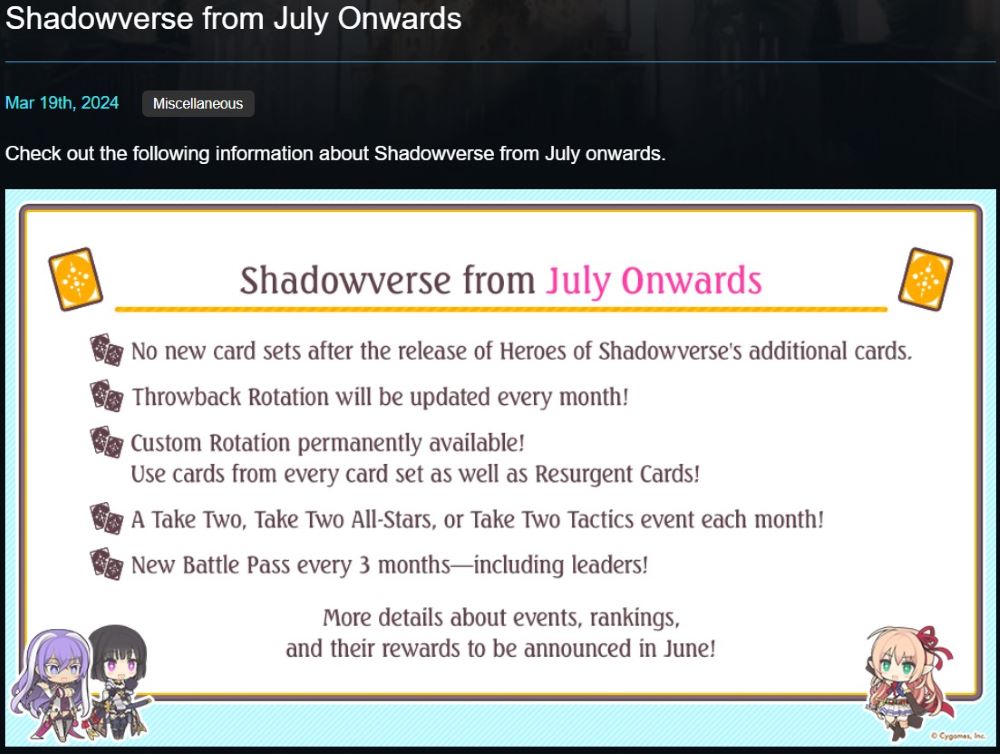
Of course, this is not the first time a game company has released a direct sequel to a Live Service game while hoping everyone migrates to the new one. EverQuest immediately comes to mind as a classic example, along with the original Guild Wars. But I haven’t quite heard about this happening in the CCG space before. Maybe Magic Online vs Magic Arena counts? Anyway, I suppose maintenance mode is better than oblivion (see SolForge, Hex, Artifact, etc), but there is an extra bit of salt in the wound when there’s a sequel being developed with only the barest of cosmetic carryovers and zero of the, you know, potentially purchased cards.
Which sort of begs the question of why there is a “sequel” in the first place. I mean, I’m assuming the answer isn’t simply cash cash money. Technical debt? The new game does look very slightly flashier, and would offer the opportunity to switch up game engines. Also, there is a “metaverse” looking lobby with chibi avatars, fishing, mahjong, and more for… reasons. Presumably Cygames knows what their audience wants.
…or perhaps they are looking for a new audience. In which case, caveat emptor.
The Hopes of the Game Industry
In short: they hope GTA 6 will cost $100 so they can raise their own prices.
As reported by VGC, Epyllion’s Matthew Ball just released a report focusing on the “State of Video Gaming in 2025”, which shares his thoughts on what might happen within the industry this year. Of course, a lot of that focus is out on GTA 6 which is primed to be one of the biggest game releases of all time, with some analysts predicting that it’ll make more than $1 billion in pre-orders alone.
Within the report, Ball claims that there is “hope” within the industry between publishers and developers that Take-Two will respond to all of the excitement and hype surrounding GTA 6 by raising the default price of the game to $100. Considering the fact that GTA 6 is going to sell well no matter how much it costs, the industry is reportedly hoping the price gets raised so that others can follow suit.
There is a ridiculous sort of myopia associated with seeing (and/or experiencing) high-profile commercial failures and escalating production costs, only to come to the conclusion everything would be better with higher unit prices. How about… *checks notes* … lower production costs? “But players demand AAAA-quality graphics!” Do they? I can appreciate the dilemma faced by developers, wherein the last game cost $400m and not wanting to gamble with a $350m (or lower) sequel. But if the acknowledgement is that the status quo of ever-increasing production costs is unsustainable, higher prices at best stems the bleed temporarily. At some point you need to address the root cause.
I was curious at this point as to what “the industry” actually thought about things, and if GTA 6 selling for $100 was all of it. So, the article I linked to above points to this VGC article, which then points to a 222-slide presentation by Matthew Ball, whom appears to be a “strategy advisor” to, presumably, the games industry (and others). If you have the time, I do very much encourage you to take a look yourself, as it is surprisingly straight-forward and facts-based. A summary:
- 2011-2021 saw the game industry grow at 150% annually
- However, in 2022 revenue fell -3.5% and remained flat in 2023-2024
- This mismatch in prior projections has dried up VC pipelines and investments
- The growth of the prior decade was due to multiple “innovations” that has since exhausted themselves
- Think microtransactions, mobile gaming, Battlepasses, etc
- Assumed new innovations are not bearing out (AR/VR, etc)
- Worse, rise of social video (TikTok) is actually eating into mobile leisure-time in a significant way
- PC and Steam growth appears to be bright spot… but all because of China
- Chinese game companies are exporting and directly (and successfully) competing with Western devs
- Game industry has unique struggles in variable pricing, and cannot easily pass on inflation
- Overall engagement is decreasing in gamers, including the hardcore ones
- Most of all gamers’ playtime is with existing titles – only 12% is spent on new games
- Network effects mean players stay playing the games their friends are playing
The final section of the presentation includes thoughts on potential new growth engines. And it does include GTA 6, but also several others.
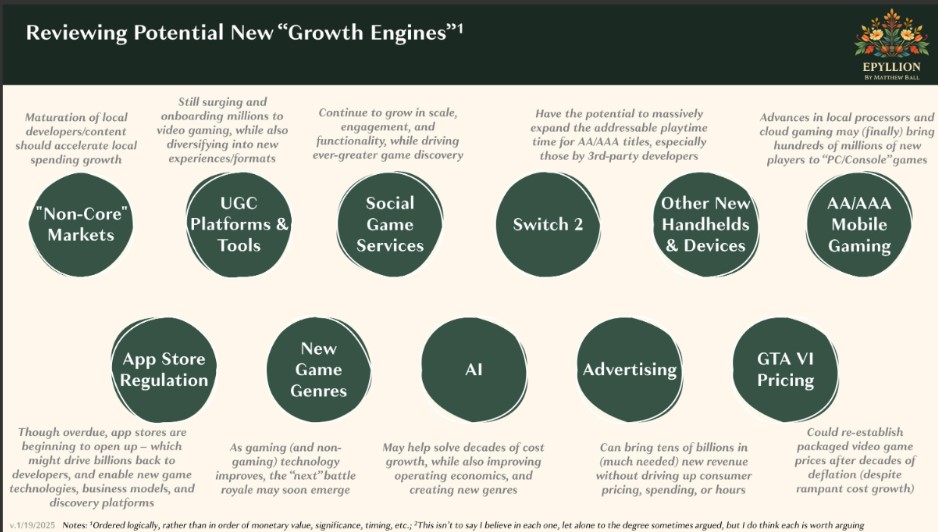
Again, I think it is worth looking at the presentation yourself, as each of the 11 bubbles there get multiple slides that introduce, justify, and even caution about the “solution.” Well, aside from GTA 6, which is noted would be the cheapest GTA ever (in real terms) if it comes out at $70. GTA 5 was released in 2013 at $60, which would be over $80 today, for example. Notwithstanding the billions of dollars GTA Online brought in, of course.
Overall, I did come away a bit more sympathetic to the plight of the games industry. Some of the headwinds I can personally attest to. For example, there have been multiple nights in which I found 2-3 hours of my “gaming time” consumed by Youtube Shorts scrolling. The network effect or “black hole” games are certainly a challenge as well, as anyone who has spent years playing MMOs can attest to. How do you compete against Fortnite, Minecraft, Roblox, and/or all the others?
“Raise prices,” of course!
Unfortunately, the actual solution is both pithy and hard to achieve: make fun games. Note how that solution did not include the words “spend 8 years painstakingly rendering every blade of grass.” Also note that I’m not saying that coming up with a fun game is easy either. But the industry seems stuck in this death loop of hiring more artists, programmers, marketers, and greenlighting enormously long development times… only for the game to fall flat because the fun wasn’t there. You can’t just hire more people to increase the fun quotient. And sometimes the fun that is achievable is only experienced by a narrow slice of the market, too small to be sustainable for the larger companies.
I don’t know the solution. If I did, I certainly wouldn’t be giving it out for free. But it might well be… decimation for the industry. I think a lot of publishers are just going to go bankrupt trying to spend their way out of the tailspin. AI could be a big disrupter, but disruption favors small indie shops, not the big guys. And while I do feel like longer development times is the obvious root issue for ballooning costs, I don’t see how the industry moves towards shorter development times and… then what? More releases? I mean, I wouldn’t be mad about a new Fallout every 2 years. If they keep the releases the same with a shorter development time though, that just means an implosion in the game jobs market. Not ideal.
…or maybe it is?
I dunno. I’m just a dude looking for fun games to play with my ever-decreasing amount of free time and eroding consumer surplus. When I look at my most-played games though, what I don’t see is full-priced titles with photo-realistic graphics and 8+ years in development. Well, I guess some Early Access titles were being worked on for that long, but it was like with three guys, not three hundred.
Anyway, Take Two can try and take $100 if they want and everyone raise prices as a result. Maybe it works, maybe it doesn’t. Nevertheless, my parsimony will abide.
7 Days to Die – Rebirth
I’ve recently taken the plunge in playing Rebirth (v1.1 b14), a total overhaul mod for 7 Days to Die. There are a number of such overhaul mods out there, including Darkness Falls, Afterlife, Undead Legacy, and more. I’ve only played Darkness Falls before this, aside of course vanilla for a few hundred hours.
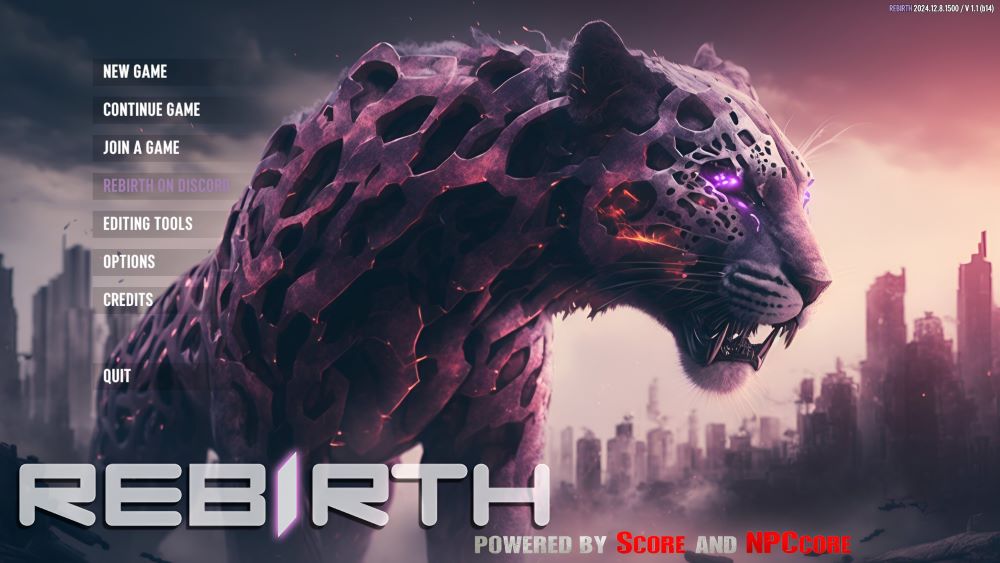
Verdict: it’s got some great concepts, but… there’s some foundational concerns.
One of the biggest draws to Rebirth is the companion system. You start out with a dog companion that both warns about and fights enemies. You can eventually expand your fighting group with more dogs (or other beasts), NPCs, and temporary help. This does a lot to make the game feel less lonely in single player, and the companions are actually very handy in a fight. And don’t worry: if the dog dies, it just respawns back at your bed.
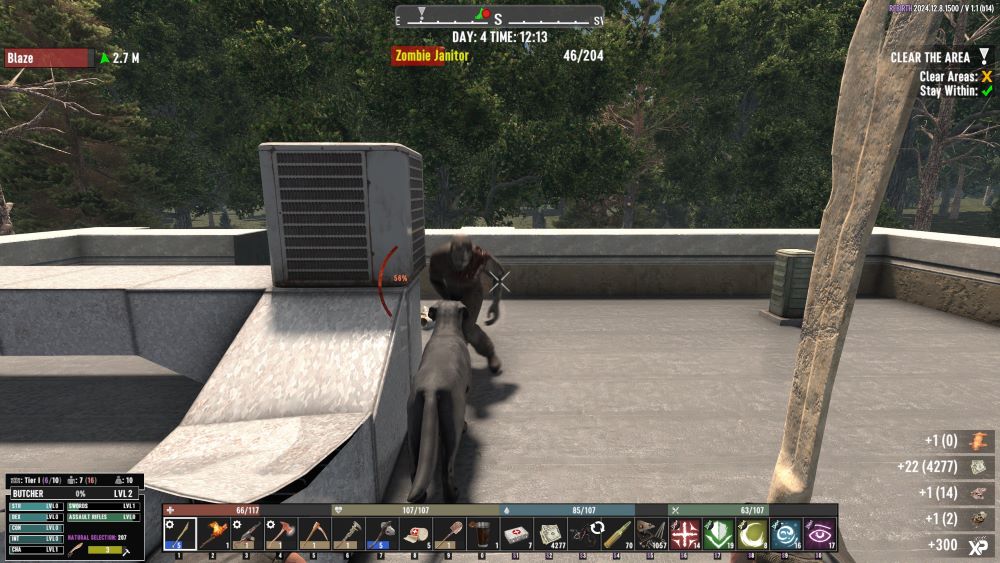
Another of the “draws” is a return of Learn By Doing and overall reimagining (and slowing) of progression in general. While there is character XP in the game, it does nothing by itself. Instead, to progress your character – including in one of 10 classes! – you need to use specific weapons, gaining extra progress for headshots. By itself, the system is OK for what it is, and you certainly have more opportunity for progression as zombie density has skyrocketed.
The problem is that the mod’s difficulty progression is also tied to zombie kills. Once you hit certain thresholds, zombies have a chance to spawn with random buffs, including a RNG roll to revive in a stronger state. This “works” on a conceptual level, but it feels bad in practice. The name of the game is still scavenging, so while killing a huge wandering horde might give you +2.5% weapon speed or whatever your class does, it makes getting food, crafting components, and everything else actually meaningful harder.
I want to really reemphasize how badly you are punished for killing zombies here. You slowly level your primary Attributes by performing certain tasks, and there are specific Perks that you can then put points in once you hit certain thresholds. For example, you need Dexterity 1 in order to put a point into Cardio. How do you get points for Cardio? You buy them from a vendor for cash. How do you get cash? Scavenging, primarily. You can get some from Questing, but keep in mind Questing gives a lot of XP which then levels you and makes the game harder. If that is the mod author’s intention – to discourage the chain-questing that is (still) meta in vanilla – it should be more explicit, IMO.
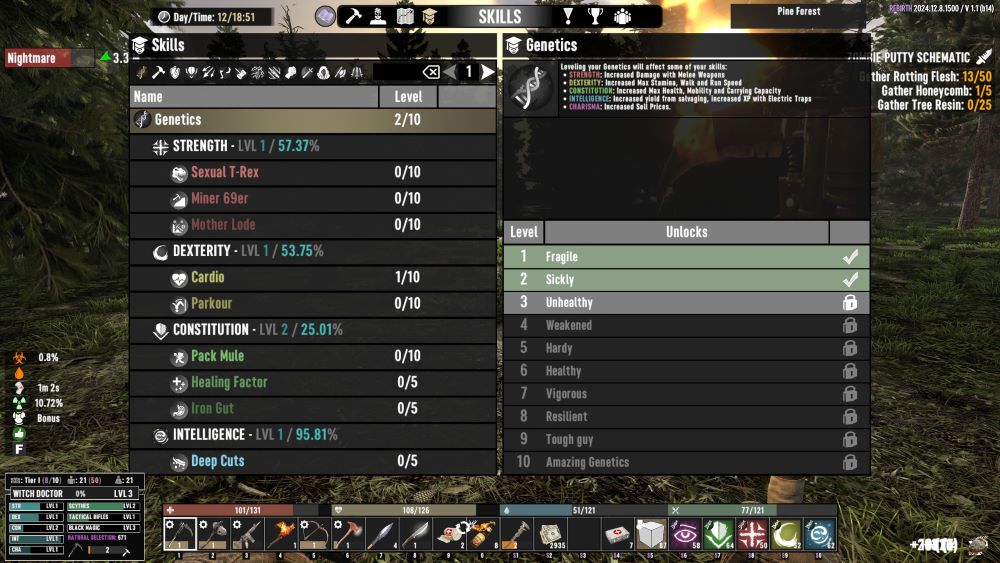
The overall increased difficulty is another “draw” but similarly falls flat. The mod is hard, but difficulty in practically all 7 Days to Die iterations is predicated on HP sponges and/or ridiculous mob counts. Rebirth has both. Once you hit a certain level threshold, periodically a boss zombie will spawn in your immediate location along with ~30 of their best friends. For the most part, especially early, you will just die and drop all your stuff. But, hey, don’t worry, the boss and mobs will still be there waiting for you! If you somehow whittle down the horde with your non-existent bullets and take down the 6000+ HP boss, you get a loot chest that will give you maybe 15% progression towards one Attribute point. Yay! Also, get used to this shit, as to unlock certain crafting tables you have to purchase quests from a vendor that spawns these types of hordes. I’m not sure if the intention is to build a nearby cheese base or just kite them around for hours or what.
By the way, you still have to contend with the 7 day hordes on default settings.
I suppose that is worth mentioning as a positive to Rebirth: the large amount of settings you can tweak. Turning off Horde Night is one first things I did, once I realized that I was still struggling to stay hydrated on Day 6, let alone figuring out how I would ever survive the night. There may be other knobs that can be turned to address a few of the other complaints I already voiced, including turning them off. On the other hand, most people are likely to roll into Rebirth under default settings and get run over, so… yeah.
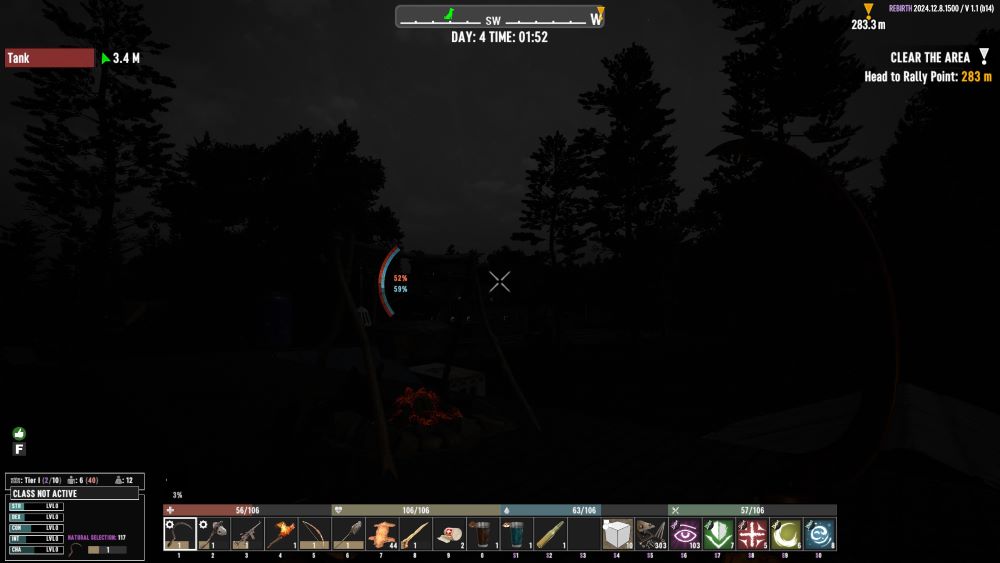
If you have squeezed all the fun out of vanilla 7 Days to Die and are looking for more, I recommend… Darkness Falls. Although I haven’t played it lately, it had a completely new look and feel with increased difficulty that, at the same time, did not feel punishing. Sure, you could encounter a few high-level zeds outside normal progression, but that is the spice of life. Combined with the extra tiers, it felt like 7D2D++ rather than a whole new game. Rebirth has some neat concepts I would like expanded on (companion system, bandits), but it feels more like a punishment simulator than anything else. As a player, I should never feel like I have to metagame killing less zombies in a zombie-killing game.
[Fake Edit] Since my primary character is already screwed, I started a second character and revamped a lot of the settings. For example, I turned Character XP down to 75% considering levels only serve to punish you. Conversely, I turned Class XP levels to 150% to improve the speed of getting abilities and such. Between those settings and a better understanding of the mod’s flow, I have had a somewhat better experience.
However. It’s still not that good, honestly. I’m going to give it a bit more time to cook to see if things improve once I progress a bit further, but it kind of feels like a slog still. And not in a “sense of pride and accomplishment” way, but more in a “nothing feels rewarding and I’m punished for playing the game.”
Steam Mod Supremacy
It has long been my opinion that Steam being the premier PC gaming storefront is not a problem for consumers. Indeed, I would argue that when Steam had a higher market share years ago, it was even better – more deals, more enhancements, and the same smooth experience. Monopolies are never ideal, but with Valve (and it being a non-public company) we seemed to have lucked into one of those Philosopher-King situations that ended up better than the alternatives.
What I am slowly discovering though, is Steam’s crushing presence in the game mod department.
Project Zomboid recently came out with a new build, and seeing a spate of Youtube clips of it has renewed my interest in the game (after 6ish years). However, a lot of those clips also talked about all of the mods that are still “required” to fix some of the rough edges to the game. Seeing as I had bought the game on GOG all those years ago, I naturally headed over to Nexusmods and… huh. Definitely not the same options available on Steam. Maybe there is just not a lot of updates yet? Went to the official forums to see if mods are listed there, but that was useless. Finally, I started Googling around to see how I could download Steam Workshop mods and use them with GOG. Short answer: don’t bother.
I’m not saying this is an impossible situation. I could probably just, you know, play the game as-is. If I dedicated more time to the endeavor, I could also probably figure out a solution to how to get Steam mods working with my GOG version of the game. For a moment, I did actually consider purchasing Project Zomboid on Steam, “subscribing” to a bunch of the mods to get them to download, copying the files when they show up in my Steam folder, and then refunding the game. Or just take the L and purchase the game on Steam and start using it from there. It’s even on sale at the moment for like $14.
Here’s the thing: it’s incredibly clear to me now that if you EVER suspect you may want to mod a game, you need to buy it on Steam. Do all games have Steam Workshops? No. Are there games in which Nexusmods is the definitive place to be? Yes. But there will never be a situation in which the Steam version of the game is penalized from a modding perspective, whereas the opposite is true.
And that sucks.
Prior to this moment, I preferred having all my games on Steam because it was convenient, and easy to track time played. However, I was not opposed to taking advantage of those Epic Game Store coupons they used to have, or when something only launched on GOG or whatever. Now? I do feel trapped within the ecosystem. Well, “trapped,” with golden handcuffs and all. But I’m starting to realize that perhaps I was only looking at first-order monopoly effects, and blind to the second-order ones.
Of course, the ideal solution here would be for Steam to make it easier to download Steam Workshop mods without having to own the game. Or at least making it more straight-forward.
In the absence of that though… well, full Steam ahead.
End of Year: 2024 Edition
Just like 2023, except with more oligarchy.
Workwise, I remain one of the most-senior members of my overall department. In the coming months, I am going to have to get a pretty difficult certification to maintain my present job title, likely to detriment of my organization. After all, once I have the official certification, I can officially… just go anywhere else. On the other hand, the job market isn’t all that great and not slated to look any better. Also, at this point, I’m kinda all-in on the pension. Theoretically, I could retire at 57 with full benefits!
Family is doing well. Wife is trying to get student loan forgiveness before the regime change fucks everyone over, and we should be successful. Kiddo is in kindergarten at a private school, because school shooting fears. No, seriously. Welcome to America!
Anyway, let’s talk videogames. Ones in bold have been completed.
Steam (514.5h)
- Satisfactory [123h]
- V Rising [56h]
- Zero Sievert [40.4h]
- Nightingale [40.3h]
- Planet Crafter [34.5h]
- Core Keeper [31.1h]
- Cobalt Core [26.6h]
- Dungeon Drafters [26h]
- Astrea: Six-Sided Oracles [23h]
- Icarus [21.5h]
- Abiotic Factor [18.7h]
- Once Human [14.6h]
- Dave the Diver [14.3h]
- 1000xRESIST [13.3h]
- Kynseed [7.6h]
- The Bloodline [7.3h]
- Enshrouded [6.3h]
- Smalland [5.5h]
- Wall World [2.8h]
- Luck be a Landlord [1.2h]
- Tails of Iron [0.5h]
As in prior years, I am not including games I played significantly in the past. This omission really only effects Stardew Valley and Sun Haven, when I started new & modded saves of both about mid-year. Both games ended up getting their total playtime doubled as a result, actually, but ironically I never made past Year 1 Winter in either. Truly a testament to how poorly I pace myself in life-sim games.
Baldur’s Gate 3 was not omitted – I played zero minutes of it in 2024. It’s kinda embarrassing at this point, but also Patch 8 is going to coming out Soon™ and will include a dozen additional sub-classes. Waited this long, what’s another indeterminable amount of time?
Epic Game Store (118h)
- Cyberpunk 2077 [86h]
- Dead Island 2 [32h]
I just said that I don’t include previously-played games, but I think +86h on Cyberpunk 2077 deserves a mention. Aside from that, Dead Island 2 was the only other Epic game I played this year. which makes things all the more ridiculous that I have rather religiously acquired every free game offered each week.
Epic still has most of the heavy-hitting AAA games I have yet to start and/or complete. Alan Wake 2, Red Dead Redemption 2, and Death Stranding, specifically.
Xbox Game Pass (104.5h)
- Keplerth (26.5h)
- Control (19h)
- Frostpunk 2 (17h)
- Dyson Sphere Program (14h)
- Orcs Must Die! 3 (9.5h)
- Palworld (8h)
- Jusant (4.5h)
- Bramble: the Mountain King (4h)
- Nine Sols (2h)
- Diablo 4 (?h)
- Starcraft 2 (?h)
Game Pass has mostly been a pass for me this year. I stayed subscribed for the entire year, which is foolish, although the majority of that time was had at an absurd discount from stacking codes from last year. On the other hand, I can’t really blame Microsoft here. My “Play Later” queue includes Dead Space Remake, Lies of P, Tales of Arise, Persona 3 Reload, Octopath Traveler 2, ARK: Survival Ascended, Stalker 2, COD #whatever, and so on. Nevermind however many games arrived and then departed throughout the year that I have forgotten about.
Still, now that I’m back on a month-to-month plan, it may be worth taking a closer look at where I’m spending my time (and money). I think Avowed is the biggest title I’m looking forward to, and that’s in February. On the other hand, Game Pass continues to have the uncanny ability to push in surprise games I already purchased. Dead Island 2 showing up recently was particularly vexing to me.
Other Unmentionables
Yeah, I still play Hearthstone. Sometimes a lot. In fact, I would probably be embarrassed if there was any way to actually track the time spent throughout the year. One should never feel “embarrassed” for playing a game, of course, but in my particular situation, it is always at the expense of anything else I could be playing instead. Like, I would be sitting in my chair, staring at the list of titles unplayed, and then… close Steam and boot up Hearthstone as a sort of unthinking default.
It doesn’t help that Hearthstone itself is in a pretty miserable state right now. The latest expansion was a total flop, set intentionally weak presumably to help reign in power creep. But that only works when sets rotate, so everyone is still playing powerful cards from two years ago. There is a Starcraft-themed mini-set coming in January that may shake things up, but not if they want to keep power creep under control. In Battlegrounds, a new season meant they removed Quests/Buddies/Trinkets, which makes games less variable and more boring.
Another recent game without hour-tracking I’ve been playing a lot is Balatro (mobile). Again, not sure how long I’ve played, but I have unlocked all the decks and unlocked all the stakes on one of the decks (e.g. highest ascension). I started to do the same on another deck, and going from Orange Stake down to the basic one was eye-opening to me. Was it always this easy? Sure… probably after 100 hours.
What’s Next
I am going to largely rehash my goals from last year, with a caveat: I no longer care about “finishing” games and absolve myself from any guilt surrounding it. I go back and forth on this, of course, but at the same time I am realizing that I feel better about life when “done” games are no longer visible in my library. Did I beat V Rising? Nope. But I did play until I could derive no more enjoyment from it, so why let it keep taking up space? I’ve been good on this front already, just need to stay strong in 2025.
Games I would like to complete this coming year:
- Baldur’s Gate 3 (after Patch 8)
- Death Stranding (for real)
- Red Dead Redemption 2
- Alan Wake 2
Basically… you know, all those AAA games I have in my library.
In any case, I hope everyone gets everything they voted for in 2025.
(AI)Moral Hazard
There are a lot of strong feelings out there regarding the use of AI to generate artwork or other assets for videogames. Regardless of where you fall on the “training” aspect of AI, it seems clear that a game developer opting for AI art is taking away an employment possibility for a human artists.
One possibility I had not previously imagined though, is when a paid human artist themselves (allegedly) uses AI to generate the art:
Released as part of [Project Zomboid] build 42, these new images for the survival game seemingly contain some visual anomalies that may be attributable to AI generation tools. In the picture of the person using the radio, for example, the handle of the radio is misaligned with its main casing, the wire on the headphones seems to merge into the character’s hair, and there is an odd number of lines on the stand-up microphone – on one side of the microphone there are five indentations, but on the other side, which ought to be symmetrical, there are six.
It is worth noting that this is all forum speculation – AI has not been proven, although it certainly seems suspicious. Moreover, the “AAA concept artist” commissioned is not some rando, but the very one that did the still-used cover art of Project Zomboid from back in 2011. So this particular controversy is literally the worst of all possible worlds: game developer did the right thing by hiring a professional artist with proven track record for thousands of dollars, and received either AI-assisted artwork (bad), or non-AI artwork with human error that is now assumed to be because of AI (worse).
All of which is a complete distraction to another otherwise commendable game update (worst).
“Either way, they are gone for now – likely forever, as frankly after two years of hard work from our entire team in getting build 42 done, it would break my heart if discussion as to whether we’d used AI on a few loading screens that were produced externally to the company pretty recently was to completely overshadow all that effort and passion and hard work the team put into getting B42 out there.”
Truly, it is an unenviable time to be an artist. AI technology is only going to improve, and as it does, you will be increasingly competing against both “Prompt Engineers” and anonymous internet sleuths hunting for clues to “expose” you for Reddit karma. Eventually, AI-generated content will be so prevalent that none of it will matter; I could imagine ads that are dynamically drawn in, say, anime-style because it noticed you had CrunchyRoll open in another tab, or with the realistic likeness of a TV star from your most-watched Netflix show.
Right now, utilizing AI as a business is a sign of being cheap and invites controversy. Perhaps it remains so, presuming the ad-based hellscape imagined above. But at a certain point, AI will probably figure out symmetry and how many Rs are in strawberry and we will likely be none the wiser.
Or we will just assume everything is AI-generated and it won’t matter. Same difference.
Winter Sale Radar
There is zero reason why I should be thinking about new videogames for myself. But if I were, here is my list of current deals, snipped from IsThereAnyDeal:
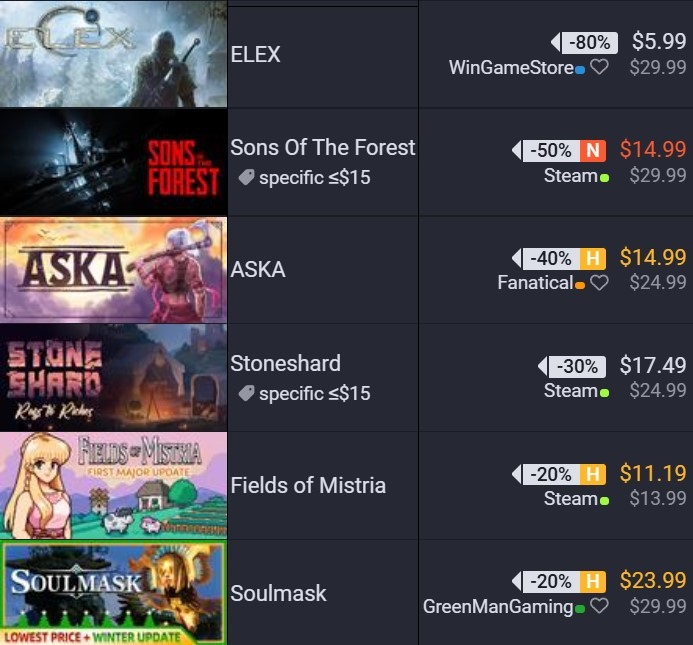
Sons of the Forest, ASKA, and Soulmask are all in there because survival-crafting. I never actually got around to finishing the original Forest though, as horror is not really my jam as it turns out. A sequel that probably doubles-down on the same thing probably isn’t the best idea, but… well, I did get ~25 hours out of the original. I’m hesitating on ASKA because it seems more of a colony sim than survival per the user reviews. Soulmask is more solidly in the strike-zone, if only it was more than 20% off.
Not much to say about Fields of Mistria. It has a Overwhelmingly Positive rating on Steam (10k+ reviews), it’s cute, and a farming sim. It is also very much one of the situations where you’d be better off waiting until it’s out of Early Access and the rest of the game is implemented before diving in.
Stoneshard is one I’m really debating. It is apparently a very punishing game, including having a dumb save system in which you can lose a lot of progress. At the same time, sometimes you feel like being punished, you know? I enjoyed Zero Sievert and its own “lose everything if you die” schtick, so maybe it would be enjoyable too.
Elex is a weird one to include, as I have never played a “Gothic” game or really have any sort of idea why they’re famous. In fact, all of the videos I have watched on the subject lead me to believe it has terrible combat, jank galore, a mid story, and few redeeming features. One of said features is the “freedom to do anything,” but that doesn’t seem especially well-defined. Like, more freedom than any Elder Scrolls or Fallout game? Still, Gothic-likes get talked about and I did notice a few overhaul mods on Nexus that appear to smooth some of the rough gameplay edges.
Not listed above, but Guild Wars 2 is having an expansion sale. I have literally not played in over a year, I believe, certainly not since the latest expansion Secrets of the Obscure came out. The sale makes the latest expansion cost $20, which isn’t terrible. The challenge is always that you end up playing GW2 again, e.g. consume the story content, then farm metas for pocket change to convert into gems to play dress-up. That’s… probably every MMO, to be fair. The problem with GW2 though is that it’s a bit harder to avoid the whole “log into 8 alts to open chests every day before you really start playing” time sink. Plus, you know, I missed months and months of cheap Legendary goodie bags from when the expansion first came out. Feelsbadman.
In any case, I’m going to be sitting on these deals for a bit. The Steam sale continues until January 2nd, so that gives me about a week and a half to see if Epic or Amazon ends up giving the games away for free, or if they appear in a Fanatical bundle, or if I just lose interest altogether.
Time and Place
Wildstar is one of those failed MMOs I have a bit of (perhaps misguided) nostalgia for. Granted, it’s a lot easier to remember only the good parts of something when the thing no longer exists to remind you of the bad. Wildstar’s terrible combat system, banal questing, radically tone-deaf developers pushing a hardcore experience for no one all seems to fade away with time. Meanwhile, the evocative art design, hoverboards, and astounding home building/decoration options springs right to mind.
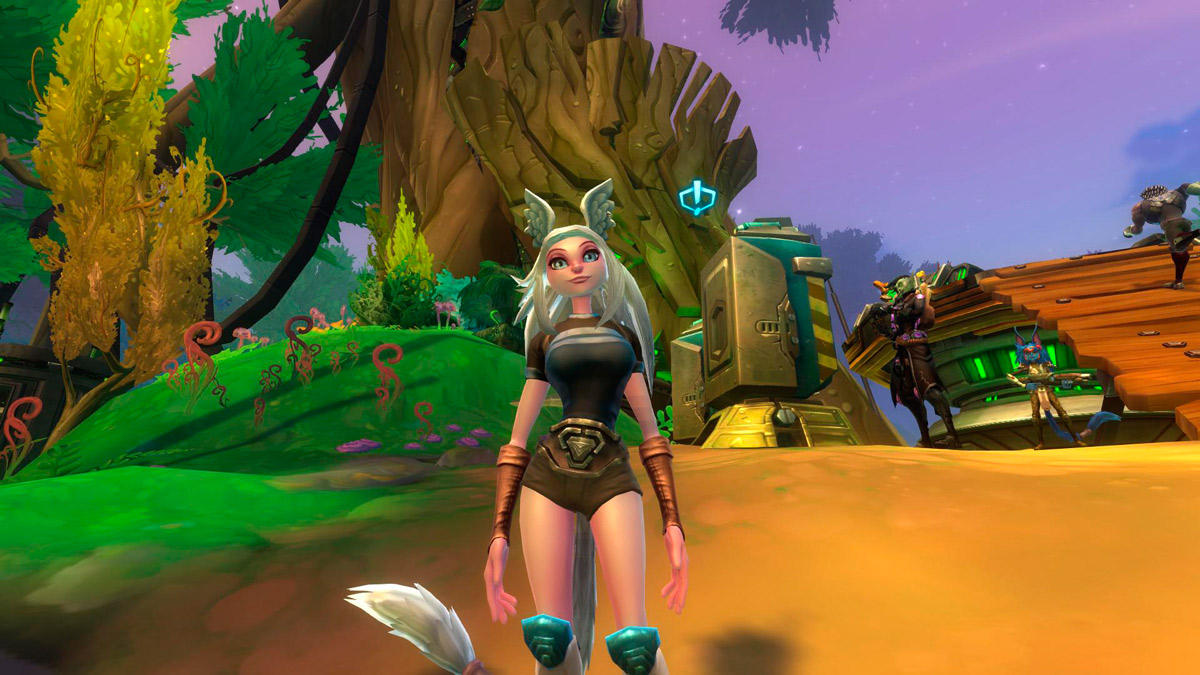
I bring this all up because of an interesting article I read the other day about Tim Cain spending 6 years working on Wildstar. And that wasn’t even all of it, as the game took another three years to release from there. Then the author drops this bomb:
To put it into perspective, when work began on WildStar, World of Warcraft was still in its vanilla era. When WildStar finally launched, we’d seen The Burning Crusade, Wrath of the Lich King, Cataclysm and Mists of Pandaria, and Warlords of Draenor was just around the corner.
No fucking wonder, dude. I had really never understood why the Wildstar devs believed the hardcore angle was a winning strategy in an MMO. Yeah, the original MMOs had that hardcore element to them and were successful. Were they successful because of the hardcore-ness? I would argue “clearly not.” But if the Wildstar devs were laying the groundwork for the game back in the age of vanilla WoW, their stubbornness nine years later makes perfect sense. That level of difficulty was what they were familiar with and wanted to “compete” against. Or perhaps even bring back.
Alas, the zeitgeist had since moved on.
Broken FOMOmeter
It’s really sad to see games at 40%+ discounts still end up being almost $40.

I guess it’s not that much of a difference back (in my day) when games MSRP’d for $60, but psychologically… nope. Not doing it. Dragon’s Dogma 2 is probably not the best example either.
Even with all the other sales going on, it was ironically Satisfactory that most recently broke my internal FOMOmeter. I typically try to stock up on cheap games to assuage my ephemeral gaming moods, as not doing so can lead to ruining an experience by forcing myself to play something else. In the depths of mainlining Satisfactory though, I would throw some discounted games in my Steam cart… and leave them there. A few days later, I would check back and realize they were no longer on sale. *Empty cart*.
A few cycles of that and the spell was broken.
We’ll see how long it lasts, but so far, so good. If nothing else, the fact that Satisfactory is an indie game that consumed my life for 120+ hours whereas I have a literal graveyard of half-finished AAA titles should give me pause. Or maybe I’m just fully into survival-crafting/deckbuilding/roguelike/automation territory now. It can go either way.
 In An Age
Stars’ Rug-Pull
Feb 25
Posted by Azuriel
Stars Reach is the Raph Koster moonshot that, as far as I can tell, has immediately shot itself in the head. The official Kickstarter will be active at the time of this post, but some of the pertinent details have become clear in a fireside chat with Koster (emphasis added):
Let’s review for a second. Stars Reach is a game about exploration, gathering resources, fighting mobs, all with an entirely player-based economy. It is being billed on the official website as a “massively multiplayer sandbox RPG” meant to “immersing yourself into an alternative world of adventure.” And it will be Free-to-Play!
…unless perhaps you want live anywhere you will be playing. That will cost you a $10/month subscription.
But it potentially get worse! I was taking it as a given that players would have some base-level ability to set up crafting stations inside a spaceship or whatever, even if you weren’t paying space-rent. You know, like in Starbound or No Man’s Sky. But according to the preview on homesteading:
Combine that with this other Reddit AMA thread:
Neither of which indicates to me that the space hobo way of life is especially supported. By which I mean any F2P player. Because what are you going to be able to do on a foundational level? All items decay and have to be replaced with player-produced ones. Lugging around resources is apparently going to be painful. I’m taking it as a given that players will be able to craft basic items without needing a homestead, but who even fucking knows at this point? There’s a flowchart on the “Stars Reach Tour” that I have helpfully annotated with the latest information regarding the property pass:
It truly boggles the mind. Or would, if these “industry veterans” were not a font of dumbass ideas.
I have less than zero interest in Stars Reach at this point. It was already conceptually hostile to solo players, but I still had it in the back of my mind as a sort of “challenge” to engage with down the road. But paywalling the one aspect of the game that is remotely sticky enough to get players to stay? No thank you. It’s almost as bad as the devs from Forever Winter with their real-time water mechanic.
Posted in Commentary
2 Comments
Tags: Paywall, Raph Koster, Space Rent, Stars Reach, Subscription, What Could Possibly Go Wrong?