(Virtual) Friends
Zubon has a post up musing on Time to Effectiveness, in regards to how long it takes between starting the game and being at the point where your bullet hits for as much damage as a veteran’s bullet. You can contribute in EVE on Day 1 whereas a level 1 WoW character would be worse than useless in a raid of a capital city (via guard aggro).
The thing that interested me the most was when Zubon mentioned this:
For MMOs, this is indicative of the larger problem that you need to grind to play with your friends. MMOs are bad for playing with your friends. Their character advancement systems make it difficult to find a span within which you can bring veterans, newbies, alts, etc. together, and it only gets worse over time as the power differential between day one and the level cap grows. I played a bit of World of Warcraft but it never really caught me because I spent almost my entire time in that vast, lonely wasteland between level 1 and the cap.
If I play these games to play with my friends, I want to play with my friends. If I play these games to compete with other people, I want to compete on a level playing field.
I would immediately agree that playing progression-based games is difficult with your friends, even if you happen to live in the same house as them. Everyone has their different schedules and obligations; sometimes you feel like watching Game of Thrones instead of running another dungeon tonight, or whatever. Even if you have specific characters you use when in a group, you are essentially committing to leveling up twice, and basically consigning that friend-alt to progression limbo.
But do you know who it’s pretty easy to play with? “Friends,” i.e. the people you befriend in-game. I have been talking with the same handful of people I “met” in WoW pretty consistently for the last five years. And why would that be surprising? We all were playing the same MMO on basically the same schedule in the same manner, which is how we met in the first place; you couldn’t design a better friend/compatible person-sorting algorithm if you tried. Meanwhile, I only ever talk with my best friend IRL every few months. I met that best friend in Middle School by complete coincidence, and even though we are supremely compatible personality-wise, he just isn’t into PC gaming. With that plus distance plus schedules, the opportunities to play together would be pretty low.
All of which makes for rather conflicting design structures in many games. Friends and guilds are the social glue that keeps people playing games long after the novelty has worn out. If you start playing a game with friends, you might end up overlooking the deal-breakers that would otherwise cause you to abandon a game before the social hooks had time to sink in. On the other hand, the opposite problem can occur: if your friends don’t like the game but you do, you might end up either spending less time playing with them or quit the game to play whatever they’re playing.
So, objectively, the best outcome is quite possibly coming into the game with no friends and making some in-game instead. That way, the friends you are playing with are tailor-made to correspond with your playstyle, level of interest, and long-term goals. Plus, there is the added bonus of this particular game being “sticky,” insofar as it might be the only context in which you will get to enjoy your new friends’ company. Although I still talk with my former WoW guildmates, we really don’t have many other game preferences in common; the desire to re-subscribe to WoW to spend some non-Vent time with them is pretty strong.
In any case, as I have argued in the comments to Zubon’s post, this is pretty much a systemic problem inherent to RPGs and other games with character progression. The moment you commit to XP and levels is pretty much the same moment you commit to stratification, which by definition drives wedges between players. Unless, of course, you go ahead and make friends with those you find in your strata.
Fake Edit: Zubon and a few others have pointed out that other MMORPGs have solved this issue with scaling levels. The examples used were GW2, EVE, and City of Heroes. While I agree that the first two allow you to play together, they do not allow you to play together on the same level. Your Day 1 friend can tackle spaceships, but he/she is still stuck in a frigate while you’re flying around a supercarrier. It’s perfectly true that two friends can play the GW2 equivalent of BGs together (instant cap, full gear), but I really consider GW2’s sPvP system to be a completely separate game tacked on; it’s entirely possibly it’s changed in the last year, but unless there’s overlap between the two systems (e.g. you get XP/etc for doing sPvP) then I don’t see that as a solution. Chances are good that you bought GW2 in the first place to play the “real” game, e.g. the ones with levels and XP and such.
As for City of Heroes, I’ll have to take your word on it that there was meaningful character progression in an environment that perfectly scaled up and down. Because honestly that sounds like a complete contradiction in terms.
All of this is somewhat besides the point of this post though. It kinda doesn’t matter if you can play with the friends you brought into a game in a perfectly scaled environment, if they don’t match your own playing habits and level of interest in the new game. If you like City of Heroes and they don’t, then it really doesn’t matter how good the game is – your options are basically to quit, divide your time, or make new friends. Stratification makes the situation worse, of course, but it’s more of a symptom of a larger problem IMO.
Wildstar AMA
There was an AMA by Jeremy Gaffney (Executive Producer) regarding Wildstar on Friday. Here were some of the interesting notes:
As someone who has left the MMO scene for quite some time now, do you think WildStar could pull me back in? (ex WoW player)
Our #1 market is probably ex-MMO players, truth be told. That’s many of us as well :) (source)
Subtle and straight-forward. I like it.
Your stand on “catch-up gear” content? Like if I want to get into raiding say about year after release and I of course need to get proper gear to get into raiding. So are you planning to do 5man dungeons with some godly gear or other catch-up mechanics?
We’ll want some catch-up mechanics that are also fair to the long-term raiders; I know the econ guys have thought but thank heavens that’s a ways out yet. (source)
Given the Wildstar team’s commitment to to anachronisms like attunements, I have to wonder about how exactly “catch-up gear mechanics” would even work. Blizzard is heading towards making all of Warlord’s LFR gear be non-tier, so I could see “ghetto-tier” gear as a means to help newer players catch up… but what about those attunements? Is it “fair to long-term raiders” for attunements to be relaxed after the content is no longer current? How is that any different than the traditional cry that content is being obsoleted?
By the way, attunements were dumb, are dumb, and will always be dumb.
Will it be possible to purchase high end gear or tier equivalent gear via the Auction House? In other words, given the existence of the CREDD system, will it be possible to buy power in this game with cash?
In general, nope. In practice, there may be a few BOE pieces of appropriate rarity/difficulty to acquire that spice up the mix, but buying power is a dangerous thing to systemize. (source)
Fair enough.
The questing experience levels 1-6 is terrible (especially on Dominion side), why do your tutorials areas have so many quests that are not interactive for the player?
Mostly through focus testing with players of a variety of experience levels; you’ve probably played too many MMOs to want your hand held for long and don’t value the world and character introductions we do there (and why should you? You don’t know if those will pay off later and just want to check out the gameplay, which is rational).
We will likely add an option down the road for you to opt out. (source)
This is a subject that could almost be an entire series of blog posts by itself. Namely, the tension between clearly going after competitor’s subscribers (e.g. “Not in Azeroth anymore!”) and needing to be accessible for first-time MMO players. Because let’s be honest, the only real way you’re going to build word-of-mouth is by exciting the already-existing base, unless your base is already established via IP. Quite frankly, I’m a bit surprised that we haven’t seen more MMO companies come out with mid-range or even end-game gameplay in their beta right from the start. I mean, I guess even veterans will need a little bit of time to acclimate to the new environment, but you need them to be excited about the long-term future, not forcing them to spam-run tutorials every beta weekend.
Many people have had a really bad first impression of the game (usually first few hours of play), what would you say to these people to sway them into trying the game again?
Getting people back into the game is tricky (you form an impression and stick with it) – we change so much month to month that I don’t expect to re-earn the eyeballs of many folks who played in the past and left (even if we fixed some of what bothered them).
My plan personally is that you play what your friends are playing; the one thing more than any other email/ad/PR campaign we can do is get people liking the game itself and convincing their friends to come back in – thus Friend Passes, etc. (source)
That… is astonishingly honest and straight-forward. I have a few friends that pre-ordered Wildstar already, and they will pretty much be the only reason I purchase the game given my previous beta impressions.
Class balance is on going but their seems to be a mostly agreed tier list, with Spellslingers and Medics at the bottom in terms of DPS, and by a fair margin. What approach are you taking to get classes more in line with each other? Nerfing the top classes, or buffing the lower ones?
We err on the side of buffing rather than nerfing, but not to the point of insane mudflation. We’ll pretty regularly rebalance classes so that none is too gimped or OP (some drops are slated around this directly, while some will happen in each drop for higher priority stuff). (source)
I would say that erring on the side of buffing is the opposite of the WoW approach, but I don’t think classes ever got OP when someone else got nerfed, so… yeah.
Currently WildStars PVE Group Content ins linear, like in vanilla wow or tbc (the good times). With Wotlk and multilayer-content, problems like content skipping occured. Are you aware of that and are your gonna stick with the linear system? How will you ensure, that the linear system will work successfull on longterm for all different kind of raidguilds (casual, average, hardcore).
Adventures are intended to be heavily NON-linear, and raids are intended to have a fair amount of weekly variation (room ordering, sub-bosses, etc.) for just such reasons – if what we have is well received at launch, we’ll add more. (source)
I’m pretty sure they were talking about two different things here. I’m not sure about anyone else’s guild, but I absolutely hated the random variables in boss ordering (e.g. which drakes were in the cage, which bosses activated first, etc) as it required explaining the entire fight and every variation every time to everyone.
Q: In most MMO’s the crafted gear/items don’t have any real impact on endgame… What’s WildStar’s stance on this?
Our goal is that crafted items are competitive with the best items, but usually need to be earned through those same activities (either by the wearer or by the crafter) to keep things balanced. (source)
I have a difficult time trying to determine if this sort of thing would work for me. If I can’t craft the epic sword before being able to kill the guy who drops an epic sword, there doesn’t seem to be much of a point to crafting (beyond playing the AH). On the other hand, I could sorta see this working if the raid boss had a much higher chance to drop the crafting component necessary to craft the epic sword, such that my profession had value in reducing the randomness of drops. This would require the crafting component to be personal loot though, I think.
I currently play GW2. what’s one good reason I should stop and start playing your game?
Don’t! Guild Wars 2 is an excellent game as well; respect to MO and the other arena.net devs. (source)
If I was less of a cynical bastard, I would be pretty impressed with this response. Alas, both MMOs are from NCSoft, so…
FFXII
In the midterm period inbetween steady access to the internet, I decided now was as good a time as any to actually get around to playing some of the PlayStation games I own but never bothered turn on. My first choice? As the title suggests: Final Fantasy XII.
All I can say is… yikes.
To say that I was a Squaresoft fanboy growing up is an understatement of the decade(s). Indeed, Final Fantasy 7 remains my #2 game of all time – and that is despite having first played FF6 on the SNES when it came out. While the “back to the roots” FF9 nearly derailed my fanboism outright, FFX quickly set things back on the right track. Sadly, when I heard that FFXI was going to be an online-only MMO, I pretty much cut ties with the company; I stayed long enough to pick up FFX-2, but that had the dubious distinction of being the only FF game I ever sold back to a video game shop for store credit (after beating it, of course). Looking back, I think my lack of engagement with the series had more to do with college and life changes than feelings of “betrayal,” but regardless FFX-2 was the last FF game I played.
Now, I’m not saying anything necessarily about the gameplay of FFXII. To be honest, in the 30 minutes I’ve been “playing” I haven’t seen all that much of it. And if I recall correctly, FFXII was widely criticized as being non-interactive. But a more pressing concern right now is how awful the game looks on my TV. The default view is double-letterboxed such that it easily loses 15″ off the TV screen. And even then the pixelation is horrendous.
I technically bought FF7 on a Steam sale a while back (because, you know, FF7) and it’s entirely possible I will encounter similar graphical issues. But to an extent I almost see this as an existential threat to older games. Or, rather, older games that were straddling the cutting-edge for their time. Things that seemed ground-breaking for its time in comparison to more sprite-based games have looped around into barely-playable nonsense graphics in less than 10 years.
It kinda makes you wonder though, whether or not this will be a recurring issue as time goes by or if it was a specific moment in computer graphics history. Personally, I’m leaning towards the latter. After all, the original Crysis has held up exceptionally well and even the original Far Cry wasn’t that bad. But have you tried playing KotOR lately? I muscled through that a few years ago, and it left me sore with the effort. It wasn’t even the graphics really, but little things like not being able to pan the camera upwards. It’s Star Wars and you got huge alien cities and you can’t look much farther than the main character’s low-polygon ass.
Dust, Draenor, Destiny
The one bit of news out of CCP’s Fanfest 2014 that peaked my interest was Project Legion. Which is, for all intents and purposes, a rebooting of Dust 514 on the platform it should have been released on in the first place: the PC. I’m not actually sure a sandbox PvP/PvE hybrid shooter MMO is what I’m looking for anymore, but given I have continued to grudgingly slink back to PlanetSide 2 for my FPS urges, let’s just say that I’m not exactly opposed to new experiences. It should be noted that in that article, CCP basically states that Dust still has 100,000 active daily players, which is around 100k more than it seemed to have any reason to have last time I played.
Incidentally, NoizyGamer believes that this year or the last one might have marked the last year of consecutive EVE subscriber growth. That’s noteworthy specifically because the ~10 consecutive years of growth itself was noteworthy. And rather annoying to argue against with my MMO market saturation theories.
Speaking of bodies, WoW lost another 200k of them since last quarter, bringing the total to a mere 7.6 million. I’m not really sure what to think about this sort of thing anymore; at the moment, I’m leaning towards simple incredulity that there are 7.6 million people paying a subscription to a game that will be going on a full year without any new content. I mean, I too was that guy years ago, but that sort of shit doesn’t fly with me these days.
Speaking of questionable Activision Blizzard moves, the console-only FPS MMO Destiny is reportedly going to cost $500 million:
To put some perspective on this, the money being spent on Destiny is more than twice the amount EA reportedly spent on Star Wars: The Old Republic and a little less than double the $265,000,000 Rockstar paid to get GTA V made. The Reuters article cites analysts saying that Destiny will have to sell 15-16 million copies at $60 to break even. So, the final game has to make a very, very good first impression.
For reference, Borderlands 2 cost ~$35 million and sold 8.5 million copies as of February 2014. It’s worth noting that the first link estimates Destiny at $140 million, so it’s entirely possible that the $500 million is in reference to the entire 10-year franchise run that Activision Blizzard purchased from Bungie rather than the BorderHaloLands game we have on display.
Still… goddamn. This doesn’t even seem like the same ultra-conservative game company of a year ago, who didn’t want to branch out into the mobile space simply because the Top 10 games change every year. I’d like to imagine those executives with a fat Hearthstone egg on their face, but great handfuls of money make for surprisingly effective yolk removal.
Proprietary Hardware
This weekend got me thinking about proprietary hardware and how much of a total loss of value it is to consumers.
As I mentioned earlier, I spent most of this weekend moving to a new apartment. While I never double-checked the validity of the claim, the housing company stated that the only internet that could be provided would be from AT&T, e.g. U-Verse. Okay, fine. AT&T ended up mailing me their modem/router combo and was going to add $100 deposit + a monthly lease for equipment, which I attempted to decline (since I already own a modem & router). AT&T mailed one anyway, which I slapped a return sticker on and sent back Friday. When I went to hook up my modem on Sunday, a growing sense of horror enveloped me as I realized that a CAT5 cable would not fit into the installed plug. Uh oh.
Thank god for smartphones, eh?
After several fruitless Google searches for, in retrospect, impossible things like phone jack -> Coaxial cable adapters, I came to understand that AT&T utilizes their own proprietary internet hardware. This was further confirmed at Best Buy (hey, I was desperate) when the DSL modem I was looking at stated that it would work with AT&T DSL but not U-Verse. I ended up going to a AT&T store but they didn’t carry any of the U-Verse equipment with them and would have to order it to be re-shipped. Lesson learned: make sure your shit works before sending anything back.
What this reminded me of though is memory cards.
Any time I kinda sorta maybe get the urge to bite on a PlayStation Vita sale, the reality of proprietary memory cards that damn near cost the same as the system itself always shocks me back to reality. Right now, a 32gb Vita memory card is $69.81 on Amazon. Do you know how much a 32gb MicroSD card is? $20.22. Shit, you can get a 64gb for $38.60. Is there anything extra you get for buying Sony? Nope. It is a total fucking loss for you to purchase a Vita memory card other than the fact that Sony forces you to buy into their bullshit proprietary technology, which is itself just a more-expensive version of ineffectual DRM.
And just let me say how much a regret buying a Google Nexus smartphone these days. At the time, getting an unlocked $250 smartphone was my overriding concern, but the biggest model I bought is clocking in at… 16gb. Of which you can use 12.92gb. And hey, I’m sure it’s just a huge coincidence that the majority of these phone manufacturers don’t have expandable storage options and yet multiple models with differing levels of internal storage. I mean, seriously, how much space/weight/battery juice does a phone actually lose by having the MicroSD slot? Shit, is it too much to ask for a $20.22 32gb MicroSD card to be built into the damn thing? Proprietary hardware strikes again, at zero benefit to the consumer.
I understand the logic, to an extent. Proprietary hardware is sort of an enforced patent, the sort of difference between a brand-name pharmaceutical drug and the later generic version. But in electronics and gaming, we hardly ever get non-proprietary hardware (controllers and Game Genies aside). Talking myself out of a Vita purchase the other day almost resulted in talking myself into a PSP purchase solely on the basis of ROMs, at which point I started to wonder why Nintendo (or anyone, really) never bothered with a handheld that could officially play SNES (etc) games. Or did they and I haven’t noticed? I know about the Wii’s virtual console and Sony’s PS+ deal with some older PSX games, but it almost seems like a no-brainer for some company to swoop in with a fully open-source, Vita-like handheld that can load ROMs and be an otherwise premier ROM target. I mean, it certainly seems like the smartphone market never quite got there all the way.
Anime Micro-Reviews: Strike the Blood, Kill la Kill, Anohana
Strike the Blood
Episodes: 24
Genre: Harem, Supernatural, Action
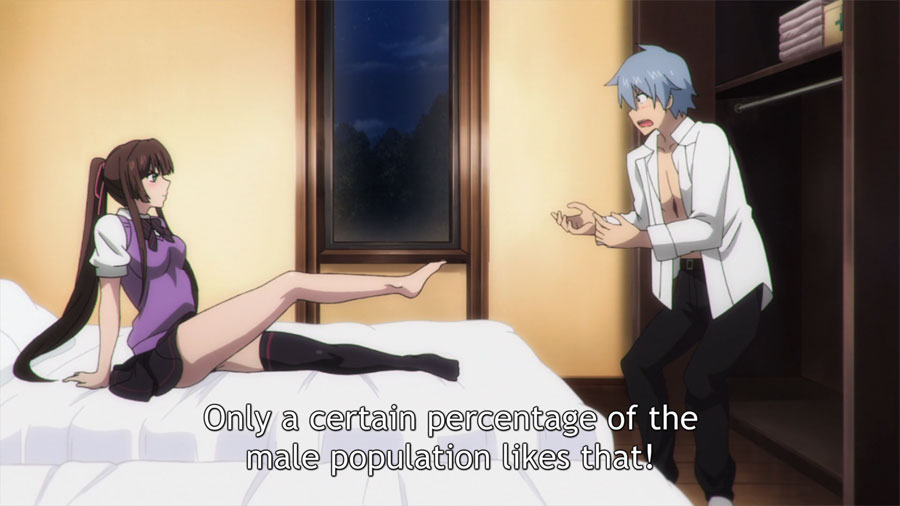
Strike the Blood is a sort of disguised, supernatural harem action anime. The main character is a high school student, Kojou, who has been transformed into the “4th Progenitor,” a sort of super-vampire who could upset the balance of the other three super-vampires. In response, various human and supernatural parties try to court his attention, keep an eye on him, and/or try and kill him. Did I mention this all this takes place on a man-made island way out in the ocean, made structurally sound by magic and ancient relics? And a significant portion of the population are pseudo-demons?
While there were quite a few particularly hilarious scenes/situations, the bottom line is that this really was as I described it: an action harem anime. If it annoys you when 4-5 girls compete for the male lead’s attention in just about everything they do, then you’re not likely to have a good time. If instead you’re looking for something funny with angst and drama all the traditional harem trimmings, this is likely worth your time.
Kill la Kill
Episodes: 24
Genre: Action, Fast-Paced
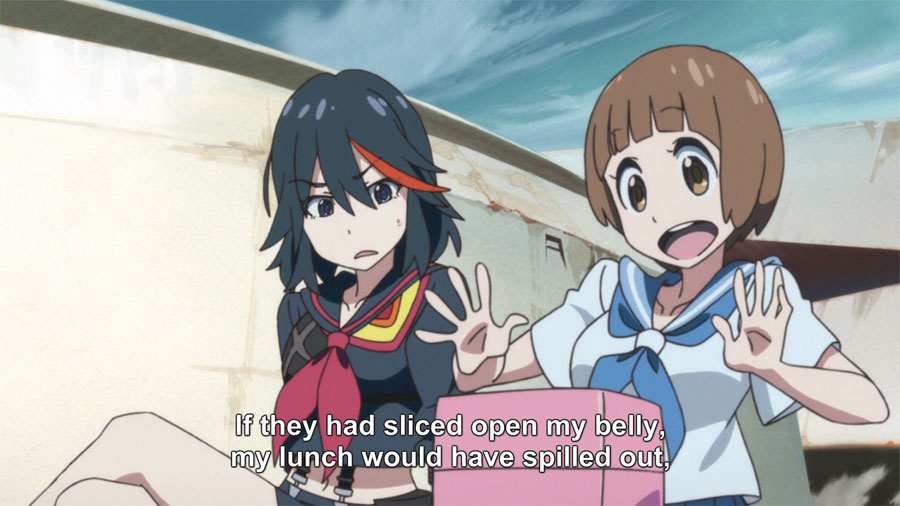
Kill la Kill is a fast-paced action anime from the creators of Gurren Lagann. In this regard, I sort of view a parallel between it and FLCL; both are less-serious, more-manic derivatives of what came before while still holding ground on their own merits. The premise is that a particular Japanese high school is crafting school uniforms with “Life Fibers,” which grant the wearer immense power. Ryuuko recently transfers to this school to seek revenge for the death of her father at the hands of a mysterious assailant. What follows is a huge assortment of duels, explosions, and Sailor Moon-esque transformation sequences as Ryuuko dispatches her foes with one half of a pair of scissors. The show only gets crazier as time goes on.
This anime does many things particular well. For example, while the heroine (and most female foes) dons a fairly fanservice costume, there is at least an attempt at a rational explanation for it on top of the anime not dwelling too much on it… outside of some jokes at the anime’s own expense, of course. The pacing of the show is also extremely well done, with just enough breaks in the action to catch one’s breath. In this regard, the episodes seemed to fly right by and always leave you hungry for more. I recommend a watch if you enjoy zany action anime.
Anohana: the Flower We Saw that Day
Episodes: 11
Genre: Everyday Life, Ghost, Drama
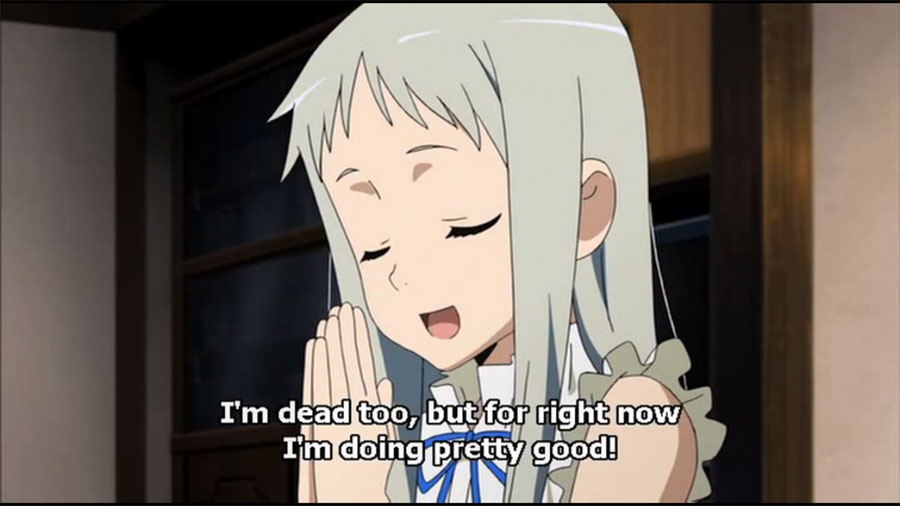
Are you in the mood to be depressed? Homesick? Want to feel like you need to call your friends right now? Then, boy do I have the anime for you! Anohana is an anime that follows a small group of friends, several years after the accidental death of one of their members. After a year or so of social withdraw, Jinta suddenly begins to see what he believes to be a hallucination of Menma, the member of the group that had died years prior. After interacting with her over a series of weeks and months, he comes to believe that perhaps she is a spirit trapped on Earth until her final wish is granted. From there, he begins to try and recruit his old friends to help figure out Menma’s last wish and fulfill it.
I’m not going to lie – this can sometimes be a hard anime to watch, for reasons that have nothing to do with it’s otherwise outstanding quality. In fact, this is perhaps the best anime I have ever seen in its examinations of how much impact a death can have on a circle of friends. There’s survivor’s guilt, jealousy, feelings of failure, love triangles, mental health issues, and more all in 11 short episodes. Still, if you are in the market for an anime that will make you feel something, Anohana is an easy recommendation.
Destiny Unfulfilled
Remember BorderHaloLands, more commonly known as Destiny? You might recall I have mentioned it before. Well, yesterday was the first day of a press junket and the overarching narrative is… not good, with Kotaku and Destructoid basically calling it boring. They also called it rather amazingly detailed and lush and beautiful. And barren. And lifeless. And populated with level 2 mobs with health bars that you shoot to power your rechargable super-skills. Yeeeeaaahh.
There is a mega-thread on Reddit if you want more sources and commentary.
What’s kinda funny to me are the understated dangers of game design, at least when you let the hype train roll along just a tad too long and it misses it’s station. In just about every article I’ve read on Destiny, unfavorable comparisons are being drawn between Destiny and Titanfall. And why not? Both are next-gen sci-fi shooters trying to establish new IPs. The problem is that, like it or not, Titanfall pretty much ate Destiny’s lunch before he even got to the cashier. Just look at these developer quotes in the Polygon article:
“The way we like to think about it, is not everybody is going to want to play Destiny, but everybody is going to be able to play Destiny if they want to,” Parsons added. “We’ve made significant improvements to the way players are going to play. People are surprised at how quickly they master the controls and get up to speed and having a great time.”
“It might not feel new compared to some of the other things that have come out recently, like Titanfall,” said design lead Lars Bakken, who added that there are changes, like free-floating double-jumps that can last for a long time. “But we’ve been prototyping for a long time and we’ve created experiences that you’ve never been able to experience before in the previous games that we’ve made, especially because it’s inherent to your character.”
I mean, I laughed at the design lead sheepishly trying to draw a parallel between the now-genre-defining wall-running parkour of Titanfall and his own game’s “long-lasting double jumps.” And then I felt sad for them. Because how were they supposed to know? As I mention in the comments yesterday, I was all gung-ho for Hex to the tune of an $85 Kickstarter pledge right up until Hearthstone came out of nowhere – 3 short months later – and pretty much flipped the proverbial design table. Now I feel like anyone coming out with a digital TCG that requires you to spam-click “Pass Priority” a dozen times a turn is basically Dead On Arrival. Hex has moved on to beta recently, but I’m not even sure I have the alpha client still installed. Why bother?
In any case, the word on the street is still that there won’t be any PC version of Destiny. The reason?
Parsons also said creating and releasing a PC version of Bungie’s shared world shooter would not be as easy as many believe, because all versions of the game connect to the same persistent video game world, which itself extends to multiple platforms.
“It is not nearly as simple as you think,” he said. “It is one central world no matter what the platform, and so that requires lots of intensive thought.
Err… okay. It sorta sounds like they’re implying that people on a Xbone can play with people on a PS4, but I’m relatively certain that that’s not actually going to happen. Just like the chances of me considering a purchase of this game. But good luck, Bungie, all the same. You’re going to need it in this new environment, especially considering you’ve already got the next 10 years of this IP all planned out. If Destiny 2 doesn’t have wall-running, you’re going to be in for a bad time.
Payment Model Perspective
I was browsing Kotaku the other day, and came across an article/review of a mobile game called Wayward Souls. Truthfully, I only read it because the byline mentioned Secret of Mana, which is relevant to my interests; it is, incidentally, probably my second-most played game of all time right behind A Link to the Past. Did you realize that SoM came out in the US 20 years ago this past October? Two decades.
Anyway, Wayward Souls is whatever – doesn’t seem to capture much of SoM’s magic beyond the pixel and music style based on the video alone. What was interesting to me though, was when they mentioned in the video that they’re going with the MineCraftian business model, e.g. selling it for $5 at first, and increasing the cost as time goes by. To me, this raises a number of interesting questions. First… is there a term for this payment model? I use MineCraft as perhaps the most well-known example, but surely it was tried beforehand.
Second, does it feel bad to anyone else?
I mean, I understand the logic behind it. Traditionally, game companies are going to want to charge full MSRP at release to capture the dollars of whom we now term “whales,” e.g. the people who would have paid $100 for the game, if they had charged that much. As time goes by, the price comes down via sales and whatnot to capture the players who would have bought it for less than MSRP. The MineCraft model seems like it should never work, but actually makes a lot of sense when you realize that the traditional model relies on a well-informed and excited playerbase for your game – in an ocean of crappy mobile games, you’re not going to have the whales spending money out of the game. This alternative model lets you build buzz somewhat organically, and then try and capture the big spenders as you ride the wave home. Plus, it sort of short-circuits the “wait until the Humble Bundle sale” strategy insofar as it will supposedly be more expensive the longer you wait (which ironically sorta is how Humble Bundles work).
Like I mentioned though, the MineCraft model doesn’t particularly work for me. It grates, like a piano out of tune. But I can’t fully articulate why though, especially when you consider nearly all games do this via cheaper preorders. Damn near everything is 20% off on GreenManGaming before it comes out. Sometimes a game will drop in price within the first three months (and sometimes faster these days, if they miss the forecasts), but it’s usually quite some time before it drops below the preorder price. So… what’s the difference, really? I can’t even claim that it’s because of psychological manipulation, because that’s pretty much behind all sales strategy. It just feels… bad, somehow. And causes me to mentally dig my heels in and wait for the Humble Bundle because screw you for defying the natural order of things. Or something.
Stuff, and Other Things
So, there are a lot of things going on in the next few weeks, and it has impacted (and may continue doing so) my posting schedule. Basically, I’m moving to a new apartment, applying for a Grad School scholarship in Japan (all expenses paid, if I get it), getting ready for a completely unrelated vacation in Japan this August, and playing videogames like a madman in effort to unpack the stress of all of that. I might start doing shorter posts of my various digital escapades rather than attempt to forward some kind of thesis every time I write something, but we’ll see. Hell, there’s been a decent amount of juicy gaming news, but sometimes it’s tough to write without a narrative.
By the way, if you have suggestions for good blogs that you read that are not already listed on the sidebar, by all means let me know in the comments below (or email); I might not directly add them to the sidebar, but I promise to take a look. My Feedly app keeps me sane during breaks at work, and my normal dealers seem to be on vacation lately. Or, you know, they might be in similar situations to myself. Nevertheless, this dry spell couldn’t have come at a worse time. Feed me your words/arguments.
 In An Age
Coastal Wizards Indict Cryptic Hex
May 16
Posted by Azuriel
In a move that should not have been so surprising in retrospect, Wizards of the Coast – makers of Magic: the Gathering – are suing Cryptozoic‘s Hex for copyright and patent infringement. Browsing through the actual complaint is actually fairly eye-opening. For example, if you turn to page 14, paragraph 30, lines 18-21:
Think about that for a second. Some random comment of yours on a forum from a year ago could be cited in a copyright/patent lawsuit used to bankrupt a multimillion dollar company.
Going back over my Hex posts, I just realized that I practically wrote the complaint myself a year ago (bolded for prophesy):
I have some concerns with Hex. First, while I am frankly excited about the unique opportunities involved with an all-digital TCG – cards that buff your creatures do so for the rest of the match, you can put tokens on cards that get shuffled into your library, and all sorts of crazy nonsense that physical card games couldn’t pull off – this game skews so heavily towards Magic Online that I’m surprised Wizards of the Coast hasn’t issued a takedown notice.
Seriously, look at this video.
I’m not talking about Apple’s “rounded corners” copyright bullshit, I’m talking about Grand Theft Mechanics. Creatures have summoning sickness, there is First Strike, Haste, seven cards in the opening hand, 20 life per player, four copy limit on individual cards, 60 cards per deck, land cards, instants, discrete turn phases (Draw phase, main phase, declaring attackers/blockers/combat damage, end step), and even the goddamn Stack.
Indeed, Wizards has a table outlining all those same similarities and more starting on page 16, paragraph 34. What ultimately got me the most though, were the excessively blatant clonings. “Flying” vs “Flight” is like, you know, whatever. Coming across the following card comparisons though?
Err… totally an homage, guys.
Okay, maybe you can overlook the 7-mana casting cost, the fact that you become a dragon, can only be attacked by flying creatures, and so on. Maybe the Hex version doesn’t put you at 5 HP. Also, one is an Enchantment that can be removed, whereas the other is a spell that’s otherwise permanent. I can see giving this a pass. But then…
Uh oh.
It’s like they weren’t even trying. There are literally dozens of these sorts of cards floating around.
If you’re interested, I came across a Magic-playing lawyer’s blog post examining the lawsuit in plain language. In short, Wizards is bullshitting in some respects, reaching in others, but likely has a pretty solid case overall. Also, Richard Garfield’s patent on tapping cards, e.g. turning them sideways, expires in June 2014. That seems almost like someone patenting gaining XP and leveling up, but hey, someone had to invent intermittent windshield wipers; sometimes there is no more elegant a solution to a problem than the first one.
In any case, I might spend some time this weekend reinstalling the Hex beta and playing around a bit while I still can. Given how I
wasted $85paid $85 for an expensive lesson on the wisdom of Kickstarting pre-alpha projects, it’s the least I can do. Or I could watch other people play Hearthstone on Twitch, which I am sadly starting to find more entertaining than Hearthstone itself, at least in this metagame.Posted in Commentary
7 Comments
Tags: Copyright, Cryptozoic, Hex, Lawsuit, Magic Online, Wizards of the Coast