Duels Out
Blizzard put out a surprising notice that the Duels game mode in Hearthstone is getting axed.
As we think about the future of Hearthstone and where the team can best focus their efforts, we’ve made the difficult decision to discontinue support for the Duels Mode. We do not have plans for any further scheduled updates for Duels, and the Mode itself is scheduled to be removed from the Hearthstone client in April 2024.
This change will allow us to shift our resources to where we feel they will have the most impact, including Traditional Hearthstone, Battlegrounds, and more. To that end, Battlegrounds Duos is scheduled for an upcoming Battlegrounds patch, and we’re trying out some Duels Treasures in our next Arena season—more details soon.
My feelings on this are… complicated.
First, the introduction of Duels was the deathknell of the content I actually enjoyed the most in Hearthstone: the Dungeon Runs. Those were repeatable PvE solo content largely on par with Slay the Spire in fun. It would not surprise me, if it were possible to calculate specifically, that I spent 200+ hours playing Dalaran Heist alone. But when Blizzard rolled out the Duels game mode and marketed it as PvP Dungeon Runs, the writing was on the wall. We ended up getting shit like “Book of Heroes” PvE content, but you couldn’t craft your decks or have much agency in completing it.
Also, Duels as originally monetized, was incredibly malicious. You were offered a random selection of heroes when first entering, then offered three hero powers for that hero, but two of those hero powers were locked behind “achievements” within your collection, like having 20 epics unlocked from a recent expansion. Then there was a third choice of signature treasure card, which most were again locked behind achievements. While there was mercifully an option to play Casual for free, the primary mode cost gold/cash just like an Arena run (with similar prizes). And, yeah, even though I always played Duels for free, I did also spend dust crafting otherwise useless epic cards to unlock some of the hero powers/other cards, so Blizzard did get cash out of the economy in a roundabout way.
For the record, Blizzard did end up changing things within Duels and unlocking everything for everyone eventually. Whether that was for marketing reasons or the simple fact that they’d have riots on their hands if players had to craft cards from 3+ expansions ago to stay current within the game mode, who can say.
What we can say though is that Blizzard is apparently in a period of… consolidation. Classic? Removed. Duels? Removed. Mercenaries? Still exists, but has been sunsetted permanently. Twist? It is on a “scheduled” hiatus, but it is difficult to imagine the thought process behind introducing a completely new competitive format, selling literally brand new cards and decks, and then going on a break three months later.
Well, maybe it’s easier after seeing graphs like this:
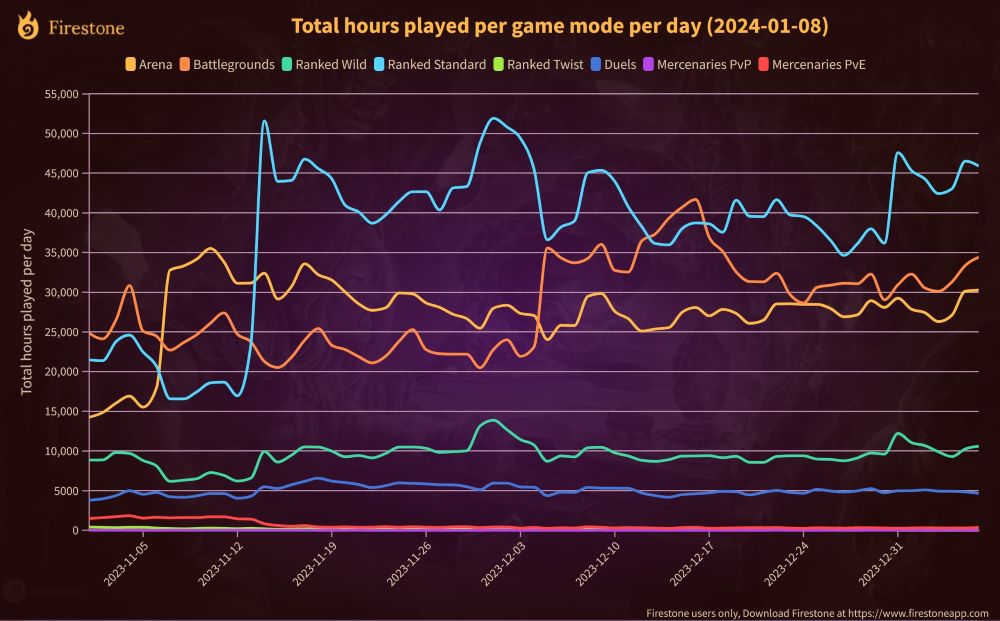
Caveats abound here, of course. These are not “official” numbers and since the data comes exclusively from players with the Firestone overlay mod installed, it’s not representative of the overall playerbase. Hell, I don’t even use Firestone (Hearthstone Deck Tracker for me). But… yeah. There’s Standard, Battlegrounds, and Arena up at the top, an enormous gap down to Wild – a format that Blizzard literally can’t kill without total collapse – and then, well, all the rest. Duels has a respectful showing there, but it’s also a format that requires constant upkeep and maintenance since every expansion set could radically imbalance the mode based on off-the-wall interactions. Twist basically doesn’t exist, and this was before the hiatus. Not a great look.
Look, we all get it. Corporations goin’ to corporate. It’s fun to imagine Bobby Kotick personally flushing these modes and now that he’s gone it’ll be rainbows and sunshine. But I doubt it. There has apparently been a lot of shuffling of designers over on the Hearthstone team, and whomever is still in charge is no Ben Brode or Ghostcrawler in the communication/hype-man department. And that makes me suspect that we may end up getting less spaghetti on the wall instead of more. Reminds me of the Google graveyard of apps in how they axed things like Reader (RIP) and now seem to exclusively focus on inserting four ads in my Gmail account instead. Classic enshitification.
So, yeah, kinda sad about Duels. If this allowed them to get back to Dungeons Runs or similar PvE content, that’d be great, but it won’t. I’m playing a lot of Battlegrounds actually, so I’m still in the ecosystem, and I do enjoy certain Brawl weeks, but the end of my interest may be nigh.
Which may be just as well – after more than 10 years, I have other shit I need to do.
End of Year: 2023 Edition
Tangentially related to 2022, with n+1.
Workwise, I ended up receiving a significant “market adjustment” raise on top of higher-than-normal raise at the beginning of the year. Both were sort of defensive moves intended to stem the bleeding/poaching of staff, and it largely seemed to have worked. I certainly stopped looking for other positions… for the time being. Truth be told, I’m a bit of a big fish in a small pond. With golden handcuffs. On the, er, fins. Excellent health coverage, 99.99% work from home, substantial pension, the job is both intellectually fulfilling and easy, and I don’t actively hate anyone I work with. It would take a lot of money to make me roll the dice on something else.
Family continues to do great as well. Kiddo will be in kindergarten (!) next year.
For this look-back, I’m going to list out the new (to me) games I played along with the hours logged.
Steam (425h)
- Dark Souls [62.9h]
- Baldur’s Gate 3 [61h]
- Dark Souls 2 [44.5h]
- Across the Obelisk [44.1h]
- Against the Storm [40.8h]
- Sun Haven [36.2h]
- Warhammer 40K: Mechanicus [28.3h]
- Elden Ring [28h]
- Green Hell [15.7h]
- Arcanium [15h]
- Craftopia [9h]
- Cult of the Lamb [8.3h]
- Days Gone [6.7h]
- Wildermyth [5.3h]
- Rune Factory 4 Special [4.9h]
- Littlewood [3.7h]
- Necesse [3.1h]
- Tunguska: the Visitation [2.7h]
- God of Weapons [1h 37m]
- Cryptark [1h 34m]
- Her Story [1h 25m]
- Barony [1h 17m]
- Blasphemous [1h]
- Paint the Town Red [41m]
- Survivalist: Invisible Strain [35m]
- The Planet Crafter [34m]
- Dead Estate [25m]
- Die in the Dungeon: Origins [17m]
Looking up the /played time and putting them in order really puts things in perspective. As ordering things tend to do. Hadn’t quite realized how much time I spent with Dark Souls 1 & 2, for example.
I have every expectation on returning to Baldur’s Gate 3… someday. Originally, I was slowing down because of what I heard about Act 3 being buggy. But the reality is probably closer to what happened with me in Divinity: Original Sin 2: being too thorough. It’s how I could still be in the Underdark after 61 hours (!). Also, knowing that I would immediately turn around at the Act 2 prompt and go explore the Mountain Pass alternate route was a bit too much me. I mean, if you aren’t uncovering the fog on every square inch of isometric CRPGs, are you really playing them?
Epic Game Store (106h)
- Cyberpunk 2077 (Phantom Liberty) [62h]
- My Time at Sandrock [38.5h]
- Disco Elysium [4h]
- Surviving the Aftermath [1.5h]
Once again, can I just say how idiotic the Epic launcher is when it comes to gathering meaningful information from your games? I sort by “Recently Played” and it sorts by Recently Installed which is obviously not the same thing! And there’s no way to sort by install size. In any case, Epic has been doing better in the price department and will result in a few more purchases before the Winter sale is done. Still, not a whole lot of games played in comparison to Steam.
As you may have heard in the gaming press, Cyberpunk is indeed in the No Man’s Sky redemption club between the expansion release and the more-important 2.0 Skill rework. I actually started a brand new character to play through the expansion, and enjoyed myself thoroughly (as evident from the /played time). Still haven’t gotten around to finishing the game’s main plot though. The situation reminds me of Witcher 3 wherein the primary plot device is the least interesting thing going on.
Xbox Game Pass (302h):
- Wartales [76h 28m]
- Starfield [64h 54m]
- Coral Island [46h 18m]
- Far Cry 6 [20h]
- Everspace 2 [17h 47m]
- Potion Craft [12h 23m]
- Ori and the Will of the Wisps [11h 34m]
- Weird West [11h 33m]
- Farworld Pioneers [9h 20m]
- Common’hood [7h]
- Chained Echoes [4h 25m]
- Skul: the Hero Slayer [3h 41m]
- Atomic Heart [3h 38m]
- Redfall [2h 58m]
- Eiyuden Chronical: Rising [2h 51m]
- Remnant 2 [2h 3m]
- High on Life [1h 56m]
- Disney Dreamlight Valley [1h 32m]
- Homestead Arcana [1h 12m]
- Cocoon [52m]
- Death’s Door [45m]
- Dungeons 4 [30m]
- Eastern Exorcist [22m]
- Techtonica [??]
I, uh, really liked Wartales, huh? Hearthstone probably absorbed more time overall, but Wartales very clearly exceeds the total game time of any other item on the list. But guess what? If you said “I bet you didn’t finish the game” then you would be correct! It’s starting (ending?) to be a problem.
As for Starfield… man. What a disappointment. Bethesda was teasing some updates with “new ways to travel,” which is kind of a funny way of saying “new loading screens.” But seriously, what’s the point? Even if they added some kind of rover or fun new traversal mechanic, all that will do is get you over the nondescript terrain and into the copy/pasted POIs faster. Are they adding new Abandoned Mines, or is it the same one I saw on 13 different planets and our own goddamn Moon? It boggles my mind how these designers could experience the wild successes of the Elder Scrolls and Fallout series and then completely forget why those games are any good. “What if we took our dense environmental storytelling and, like, divided it into loading screens lightyears apart?” What a waste.
On a different note, Game Pass itself provided 302 hours of gameplay for me over the course of the year, at an approximate cost of $120. That’s a pretty decent >2.5:1 ratio for entertainment by itself. In September though, I snagged three 3-month membership cards for $22.56 apiece, each one granting me a bonus month when I redeemed them. So, $67.78 for as much Game Pass as I can stand through most of 2024. Not sure if the “trick” will still work for others, but it certainly beat buying Starfield or Redfall for full (or any) price.
What’s Next
Playing more games, of course. Just not the correct ones, or finishing anything.
For real though, I am actually running out of space on my 2TB game drive and thus have an external motivation to complete (or delete) these games. Specifically, in 2024 I’d like to finish:
- Cyberpunk 2077 (for real)
- Baldur’s Gate 3
- Death Stranding
- Red Dead Redemption 2
- Starfield (sigh)
I’ve already picked up a few other games during the Winter sale (not listed), so there will be some competition to my clearly limited attention span. Or maybe its just a healthy reaction to something in my life no longer sparking joy. After all, I did officially become Old™️ this year. Well, middle-aged, anyway. Which certainly feels pretty damn old (apologies to those bloggers with 20+ years on me).
Here’s to hoping we all get older in 2024.
They Know Me Too Well
Steam put together a summary of games you’ve played over the year, and this was my result:
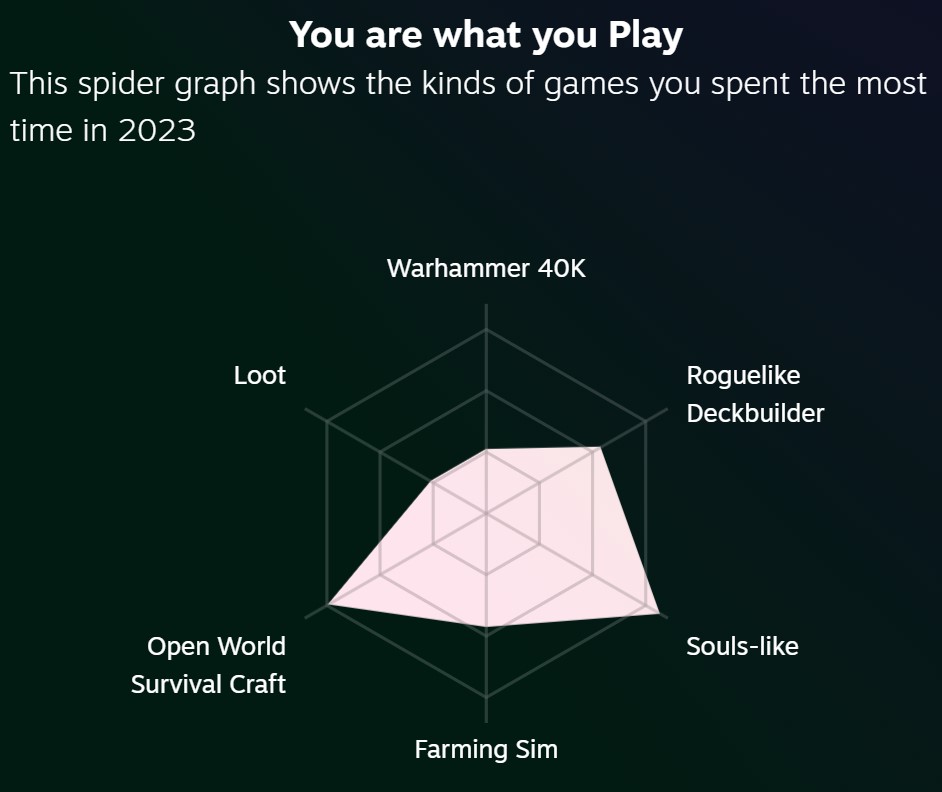
My favorite part is the random “Warhammer 40k” among the other genres.
Nevertheless, they ain’t wrong. If you had to gift me a game knowing nothing else, you’d have a good chance of getting something I’d like somewhere on those axes. Of course, I already have most games on those axes, so you’re better off just getting me a gift card.
Impressions: My Time at Sandrock
Seeing My Time at Sandrock in the latest Epic Games sale, I decided to snatch it up and get to scratching the itch. The result is about what you would expect: relief… followed by some abrasion.

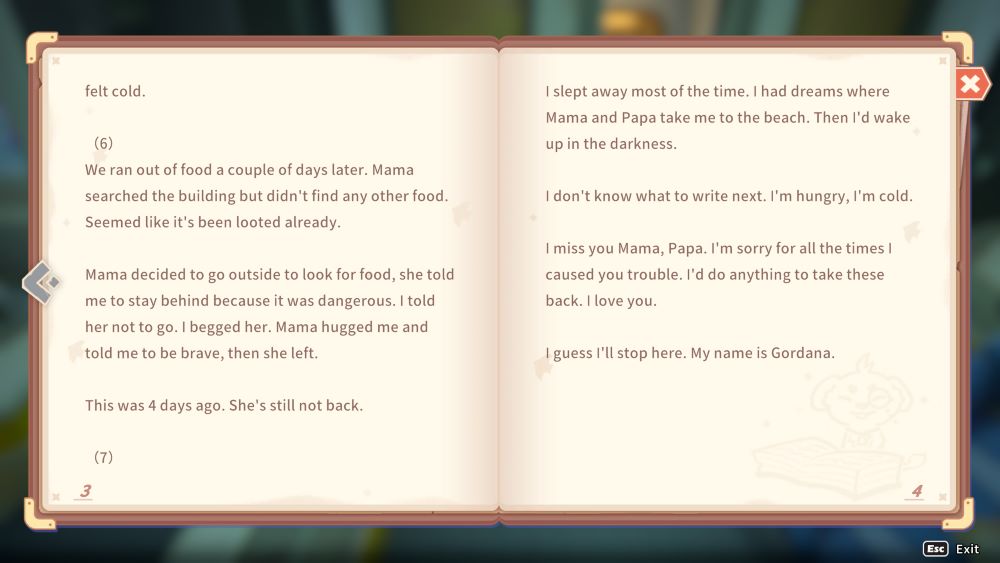
My Time at Sandrock is a sort of “sequel” to My Time at Portia, continuing the general world progress but in a different area and with new characters. This has so far included the same tonal whiplash where everything is jolly and cartoonish but you discover journals from people who sank into depression and ultimately starved to death in the apocalypse’s immediate aftermath. Originally intended to be a DLC to the first game, the devs apparently felt limited by Portia’ game engine and decided to formally release it as a different game. Or, perhaps, you know… they did it for other rea$on$.
The game engine changes were noticeable immediately, and not necessarily in a good way. The camera swings around with a bit too much gusto, the lock-on mechanic for fighting enemies is very useless when there is more than one in the area, and resource gathering is unsatisfying.
Actually, let me clarify that last bit. The act of chopping trees and smashing rocks is extremely satisfying; I cannot exactly articulate why, but your character really gets into the smashing/chopping and it feels great. Then the resources pop out around you as tiny, spinning polygons and sloooooooowly absorb into your person. So slow, in fact, that you can almost outrun them on your way to the next node. And they legit have to be absorbed before appearing on the left-side of the screen and into your inventory. Like… why? If I could turn that part off and just have the resources appear in my backpack like every other game, my enjoyment would literally increase two times, minimum.
As for the rest of the game thus far, I can’t help but compare it to my, er, time with Portia. And Sandrock, concerningly, is coming up a bit short. The game’s overall flow is beat-for-beat the same: you’re a new Builder, meet the townsfolk, take commissions from the job board, research new technology, gather relics while digging in Abandoned Ruins, fight some monsters in the overworld and/or in dungeons, complete world/town quests that unlock new areas and improve the town. And that’s all fine – in fact, that is kinda what you want in a sequel to a game you spent 108 hours playing.
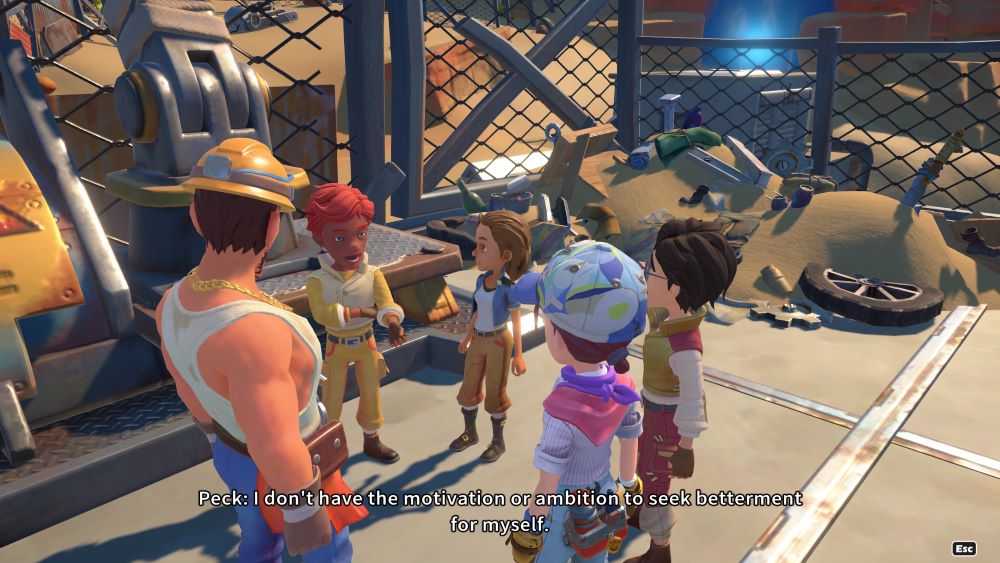
The problem is that Sandrock as a location is kinda boring. It’s a desert town with a Wild West motif. I can appreciate the uniqueness of not being able to chop trees for wood (it’s against the law!), and having to worry about water for your machines, and the bizarre “sandfishing” analog to regular fishing. But Portia felt… bigger, more interesting. It’s possible that was due to Portia simply having more empty space, although that’s kinda how that works. More concerningly from the whole cozy life-sim angle though, is how I don’t really like the people. They’re fine, but mostly Wild West caricatures. There is still time for me to be surprised – barely anyone is past two hearts at the moment – but relying on the hope of something getting better doesn’t really cut it in 2023.
So, yeah. I’m going to stick with Sandrock for a bit longer because the same gameplay/planning bits that were compelling in Portia are still compelling here. However, when Portia became less compelling as a result of my completion of the tech tree, I was able to fall back on the relatively interesting world story and neighbor relationships. With Sandrock, I don’t even know if I want to romance any of the options. Not a particularly great situation to be in for this genre.
Winter Epic Sale – 2023 Edition
It’s that time of year again: contributing to the financial instability of the Epic Game Store. And this time around, Sweeny is extra committed to going deeper into the red with an endless 33%-off coupon that stacks with existing sales + 10% “cash back” that you get unlocked 10 days later. While the 33%-off only applies to purchases $14.99 and above, you can get the discount by adding more than one cheap game together in the same cart.
I’m being a bit flippant here, but I’m actually pretty surprised at the deals at hand. Here is what is on my wishlist (prices do not include the 10% cash back):
- Untitled Goose Game – $6.69
Assassins Creed Odyssey: Standard Edition – $8.09(Game Pass)- Assassins Creed Valhalla: Standard Edition – $10.04
- Lord of the Rings: Return to Moria – $13.39
- Tiny Tina’s Wonderlands: Chaotic Edition – $13.39
- God of War – $16.74
- Far Cry 6: Gold Edition – $16.74
- My Time at Sandrock – $21.46
- Dying Light 2: Winter Tales Edition – $24.11
- Alan Wake 2 – $26.79
- Dead Island 2: Gold Edition – $32.15
Steam’s Winter Sale will not be kicking off for another week, but I would be very surprised if it beat any of these prices. For example, I don’t anticipate that My Time at Sandrock will go from 20% off at Thanksgiving to 50% during Christmas. And even if it did for some reason, that will basically just achieve price parity.
In any case, I’m not about to just purchase everything on that list. At a certain point, it’s less about Patient Gamer and/or Wait Until Game Pass and more about not setting oneself up for failure. I like the Assassins Creed games, but I haven’t played the last five or them, and it’s doubtful I would jump in and plow through the ones that take 100 hours to complete or whatever. Same with God of War. I played the first two way back in the day, and nothing since. Would I enjoy my time? Sure. But I still haven’t gotten around to Red Dead Redemption 2 after a year and a half.
Of course, none of that really matters. What matters is: what do I want to play right now. Sometimes it is bullshit farming sims to mindlessly pass the time, and other times it is Serious Business Games. More so the former than the latter these days, honestly.
The Waiting Place: December 2023
A non-exhaustive list of things I am waiting on for one reason or another.
Waiting on Sales
- My Time at Sandrock
- Dave the Diver
- Zero Sievert
- Vintage Story
- Dead Island 2
- Dying Light 2
I’ve really been kicking myself over passing on Sandrock during the Thanksgiving sales. I was busy playing other games at the time, but I got the itch really bad after playing Coral Island and now anything else I play feels like, well, that I’m trying to distract myself from itching. Aside from that, Dead Island 2 was almost good enough of a deal during Thanksgiving, but there was some kind of fuckery going on with the base game versus game + DLCs or something that made me pause.
Waiting on Updates/1.0 Releases
- Stardew Valley – v1.6 with major changes
- Kynseed – Out now, but needs updates/fixes
- Sons of the Forest – February 2024
- Smalland: Survive the Wilds – Q1 2024
- Once Human – Q3 2024
- The Planet Crafter – sometime 2024?
- Core Keeper – Summer 2024
- Valheim – sometime 2025?
I thought about booting up Stardew Valley again with some of the expanded mods to give that a whirl, but the looming 1.6 release gave me pause. Updates that big will probably impact the mods too, so that will take some time to sort out. I’ve had an eye on Kynseed for a while, and there is some developer drama I’m not keen on, but the lack of sales (and needed updates) make that easier to wait for. Just looked at the roadmap for Valheim and they are expecting 2 more years in Early Access so… yeah. Already been 2 years, what’s 2 more? There will be plenty of other games releasing into Early Access (and possibly out of) in the meantime.
Early Access Launches
- Enshrouded – January 2024
- Palworld – January 2024
- Nightingale – February 2024
- Light No Fire – TBD
- Rooted – TBD
- Under a Rock – TBD
I’m pretty excited about all of these, honestly. The release date trailer for Enshrouded was pretty great, and I’ve watched enough of the “demo” streams to feel pretty confident it will have an enjoyable Early Access experience. Palworld is Palworld. Nightingale is one where I’m worried about how the idea of it might end up better than the finished project. We shall see.
Light Some Fires
There were some interesting reveals coming out of the recent Games Awards, but Light No Fire was one that immediately piqued my interest. Here is the release trailer:
In case it was not obvious by the trailer style or esoteric title or the logo with a mysterious red thing in the middle, this is Hello Games studio’s upcoming follow-up release to No Man’s Sky. Sean Murray was back onstage to give a sort of intro to the reveal, and history sort of repeated itself with some amazing claims. “[We’ve been working on] something very different, something maybe more ambitious.” Something more ambitious… than a goddamn procedurally-generated galaxy? Even the host chimed in with a “Ha, here we go.”
Indeed, the jokes started coming in from all corners afterwards:
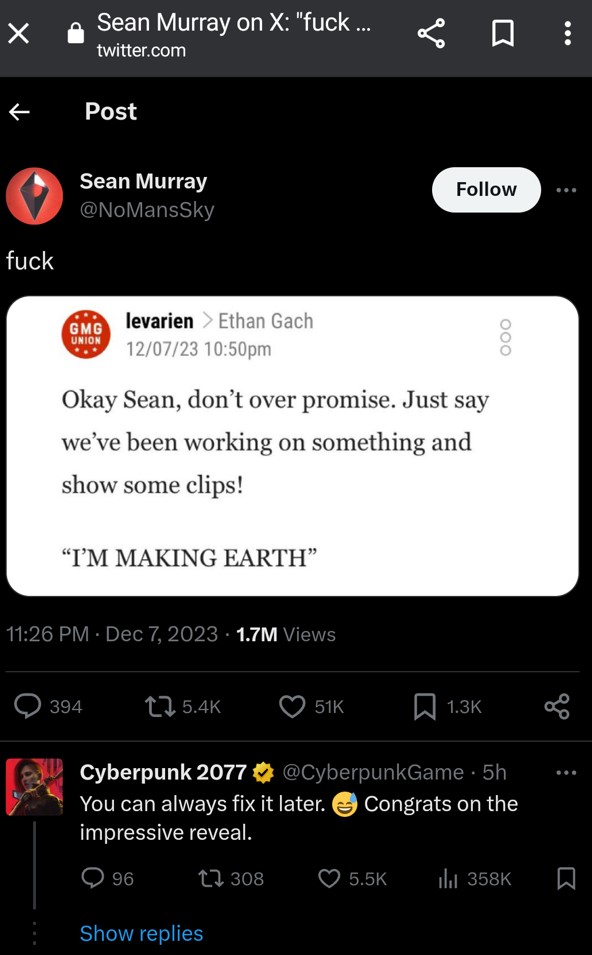
Now, you can certainly take some umbrage with how both the Cyberpunk and Hello Games devs are making light of releasing broken games that took multiple years (or longer) to fix. You are well within your rights to be screaming from the rooftops about Sean Murray in general, and warn about the dangers of hype. Hell, we don’t even have a release timeframe or hints that it will come out this decade.
But. But!
…I’m excited for Light No Fire. For two reasons.
First, it’s a survival-crafting sandbox. You might think there are dozens of these sort of games on the market already, and you would be correct. And I played them. Pretty much most of them, actually. So, I’m excited that another one is coming out from a team that I trust*.
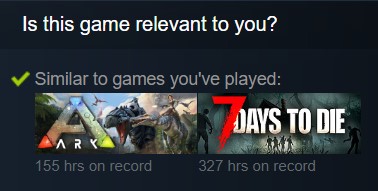
That leads me to the second reason: trust. Do I trust that Hello Games will deliver everything Sean Murray said at the Game Awards? No. Do I trust all the things written on the Steam page? No. But what I do trust is the No Man’s Sky that exists already. And when I saw that Light No Fire trailer, what I saw was mostly stuff that you can already do in No Man’s Sky.
Climb mountains? Check. Go underwater? Check. Build stuff? Check. Fly around? Check. Ride creatures? Check. Survival elements, collect rare resources, care about environmental dangers, build persistent buildings, explore things with friends, fight big monsters? Check ^ 6. About the only thing you can see in this trailer that you don’t already see in NMS are trees swaying in the breeze and a world with more than one biome. We can imagine them stitching together a bunch of planets onto one larger planet, and that is solved straight away.
The “danger” is getting hyped on what a game could be. Will there be dungeons, will there be raid bosses, will there be a “reason” to go to the tallest mountain, will there be PvP? I suppose there is also danger in assuming that when they say “one world” that it will actually be one, non-instanced world. I actually hope there isn’t one world because, if ARK has taught us nothing, it’s that prime gameplay for many people includes obstructing all available real-estate with pillars and/or phalluses. I don’t care if the world is larger than our own 197 million square miles – if you build it, people will come take a shit on it, if possible. If there are no building limitations, I give it six months, max.
Anyway, that’s Light No Fire. I will be closely following this one.
Impressions: Coral Island
Coral Island is a farming/life-sim straight from the Stardew Valley vein, and recently came out of Early Access. I have spent about 30 hours playing on Game Pass and the verdict is… acceptable. Pretty good, even. But the whole time I have been playing, all I can think about is that I want to play My Time at Sandrock instead.

Which to be fair, is, well, an unfair comparison. Sandrock (and My Time at Portia) at not the same kind of life-sim. But what kept striking me while playing Coral Island is how low the stakes are. That’s also an unfair criticism given that all of these life-sims are meant more for relaxation purposes but… I dunno. Sandrock/Portia have an overall narrative, Sun Haven has plot plus a combat system that is a smidge more serious, and Stardew Valley kind of sets the bar. It’s tough for Coral Island to stand on its own with those kind of peers.
Coral Island does have some things going for it. The (non-rotating) pseudo-3D graphics set it apart from the typical pixelated style in this genre. The anime-esque portraits are extremely well done, with villagers having different outfits per season, per certain cutscenes, and even bathing suits. The map allows you to both see where everyone is located in real-time, and even search for specific villagers. The diving activity where you clean up trash on the ocean floor is satisfying.
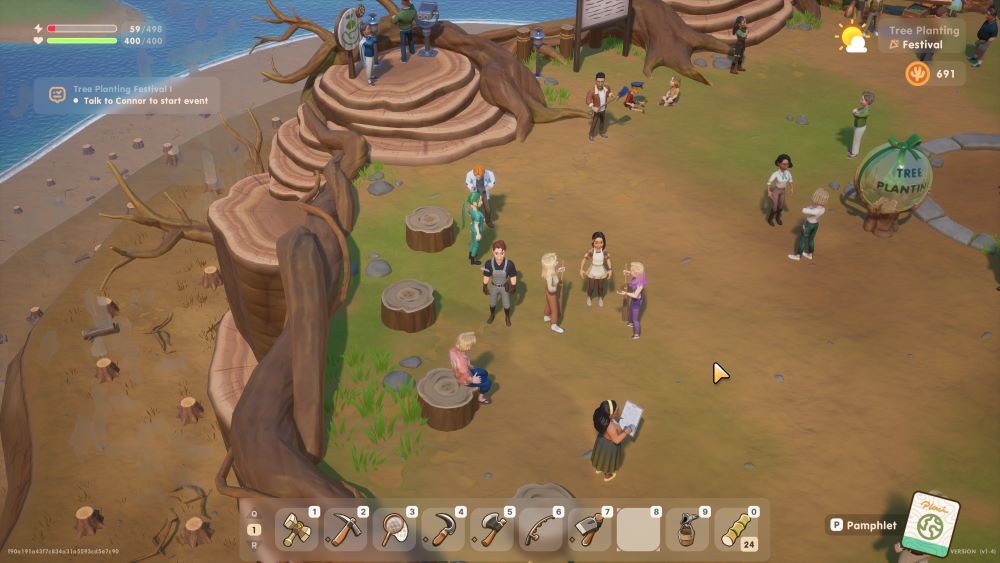
Overall, like I said, Coral Island is just fine. If you’re looking for a chill life-sim with extremely genre-typical activities, this is your stop. It did capture my attention for 30 hours and scratches some optimization itches. But if you’re looking for anything more than that, e.g. some adrenaline hit or unfolding mystery, you will have to keep on looking elsewhere.
Fallout TV
A new teaser trailer was released for the upcoming Amazon-funded Fallout TV show, and it looks… good? Possibly amazing?
Show is starting April 14th, 2024.
To be fair, I have watched pretty much zero TV adaptions. Not Halo, not Wheel of Time, not The Last of Us, not Twisted Metal (?!). I guess I did watch two seasons of The Witcher and thought it was pretty good. Yeah, yeah, and I guess Game of Thrones.
Anyway, what I like about the Fallout trailer is that it hits on the irreverence of the game. Cool scene of the Brotherhood of Steel flying away in vertibirds… and it ends with the goofy bobbly head of a Power Armor suit. You’re left wondering if the armor is supposed to be impressive or obviously impractical or what. (Answer: Yes) Then you got some shots of the ultra-violence, some comedic timing, older music playing over nuclear explosions. That’s Fallout.
Can’t wait.
 In An Age
The Haul
Jan 5
Posted by Azuriel
I purchased a number of games over the holiday break:
The (potentially) interesting thing is how four of them were from the Epic store and only one from Steam. As it turns out, throwing an additional 33% discount on top of the holiday sale discount is enough to get me to switch storefronts. Well, “switch storefronts,” with air-quotes. And, shit, I would’ve done it for like a $5 discount; I’m a cheap date. I do fully anticipate Epic to eventually stop with the free games and outrageous deals because they’re just hemorrhaging money, but for now I’ll soak up as much as I can and just assume them going bankrupt won’t lose my library.
I started writing about why I chose the five games above and not any of the other ones on my wishlist(s), but it started to feel a bit weird. Which has hardly ever stopped me before, mind you.
I dunno. My inclination to drop a game when it becomes less fun than something else I could be playing, is starting to run into guilt of a veritable landfill of half-chewed titles. I shouldn’t care – there is no one keeping score at home – but I’m also thinking about how silly it gets when talking about games to other human beings. “Oh, yeah, Baldur’s Gate 3 is amazing. I got 61 hours into Act 1 and then… stopped playing. Since August.” “Yep, 120+ hours in Cyberpunk 2077. Never finished.” “Elden Ring was beautiful, I agree. About 30 hours in, but haven’t touched it in 6 months.” WTF, mate?
Don’t get me wrong, there are still titles I’m very interested in that will be releasing in 2024. But at some point I hit a critical mass of straw such that my cognitive back can no longer sustain the dissonance. I need to get my shit together. Or abandoned shit. It’s getting a little ridiculous.
Welcome to 2024.
Posted in Commentary
4 Comments
Tags: Epic Sale, Haul, Spark Joy, What Am I Doing With My Life?