Blog Archives
Impressions: Abiotic Factor
Short version: Highly impressive survival crafting game in Early Access.
The overall vibe Abiotic Factor has going for it is the original Half-Life (complete with polygon counts from 1998) from the perspective of the scientists. You play as a new recruit to a secret Australian (?) underground laboratory doing SCIENCE… on things from another dimension. Something happens literally during your first day of orientation, the base goes on lockdown, and you are basically on your own to escape.
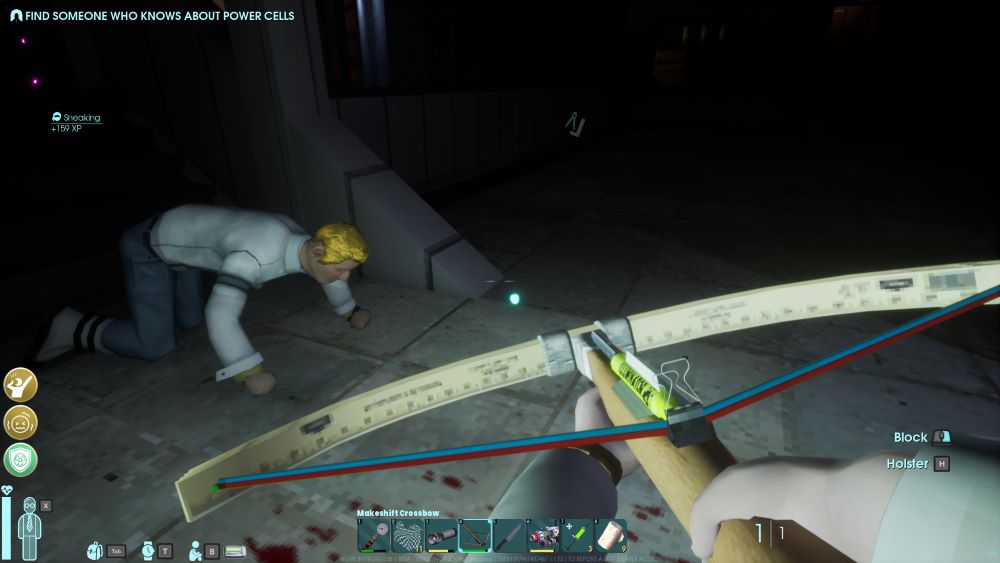
One thing I loved immediately was the novelty of the survival experience. Playing this game reminded me of playing Subnautica for the first time when none of my “punch trees” experience applied. Sure, the wooden crates give wood, but you’re mostly in an office setting at first, and wood isn’t even really what you need to craft the basic items. You might not think slinking through cubicles, snatching keyboards and breaking monitors for their sweet, sweet coils while hiding from alien monsters would be fun… or maybe you would. Because it is. There was some primal pillow fort energy when I set up my base in the gym area, hiding in terror from the rampaging night bots, and then making forays into the break rooms for literal supplies – including buying food from the vending machines to tide me over! – while getting my in-game bearings.
Are there some rough edges? Sure. One of those edges is, in fact, somewhat systemic: being a survival crafting game at all in a relatively linear, plot-driven narrative. While you can possibly spend in-game weeks in the first area, the fact of the matter is that you need to specifically craft X using resources from Y to open the next area Z. Once in that new area, you will encounter new obstacles, new crafting material, and new things to take into account, which is good. What wasn’t immediately clear to me though is that I should have packed up everything I built in the first zone and carted it with me rather than starting from scratch in the new zone. It certainly feels lame leaving an upgraded workbench that can auto-heal and warm you by proximity and going somewhere with a dearth of the more basic building materials. It especially felt super lame when I got locked into an extended journey sequence that resulted in my entire plant farm dying from lack of water while I was gone. So much for utilizing the more advanced cooking options, eh?
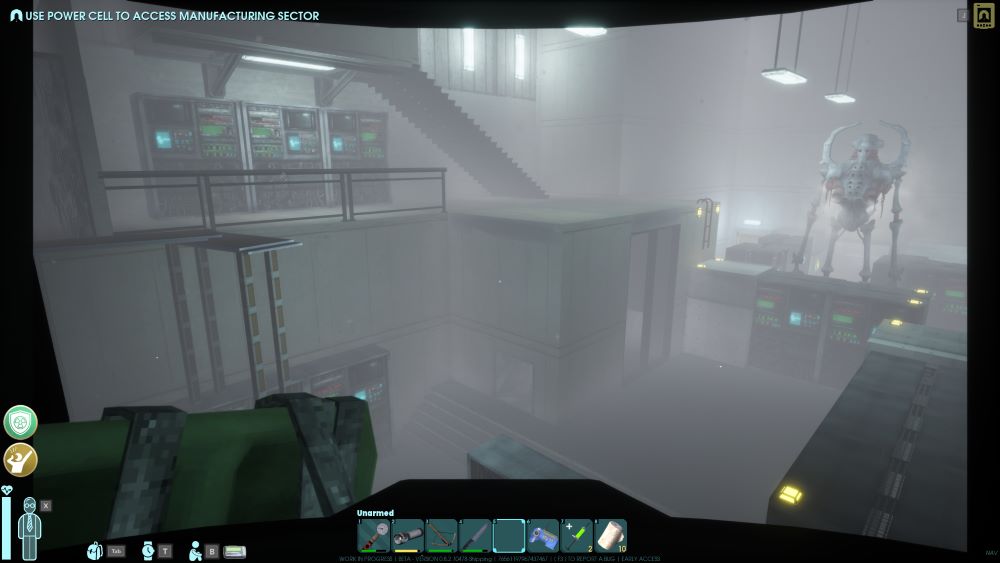
Aside from those sour grapes though, Abiotic Factor nevertheless gets high marks from me. While most workbenches require power and thus need to be located near power outlets, everything else can be placed just about anywhere. Which includes literal ramps and platforms that allow you to skip certain areas entirely. Now, whether you actually want to skip any opportunity to hoard bundles of pens, deconstructed file cabinets, and other debris is up to you. Personally, I tend to steal everything not nailed down and sometimes even that stuff too. You just never know what may come in handy.
What I do know is that I liked Abiotic Factor enough to stop playing, so the devs can finish cooking.
Impressions: Icarus
TL;DR: Empty wildlife murder simulator.
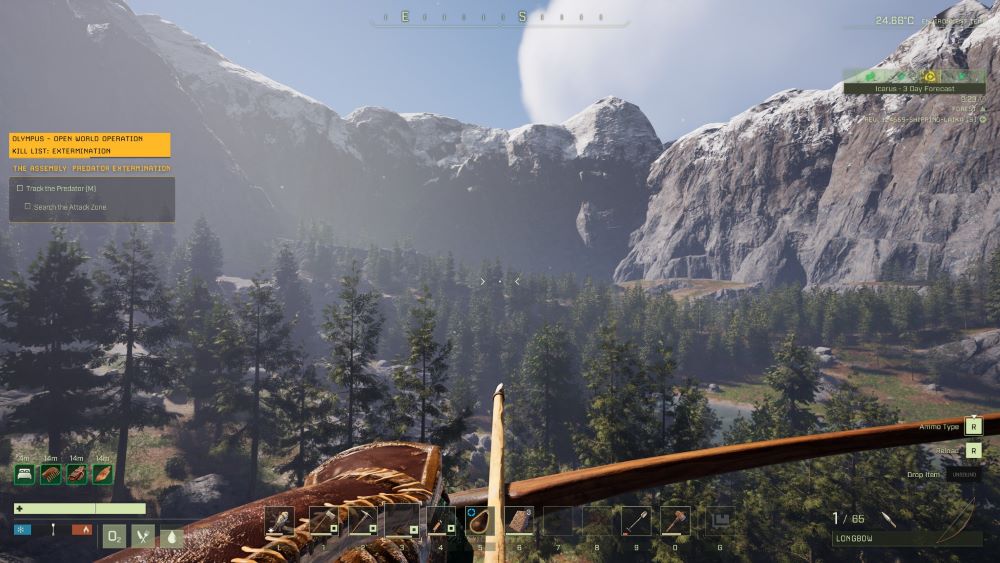
To understand what Icarus is all about, you need to know what it was about. At release, Icarus was intended to be a sort of survival roguelike, where you are dropped off at a location, fulfill a mission before the timer expired, and then bailed on the world (including anything you built) within a few days. In fact, it was originally so hardcore that if the timer expired before you left – and it counted down even with the game turned off! – your character would straight-up be deleted. Successful missions granted you a currency that could be used to both research and then later buy items that you could then bring with you planetside in the future. For example, instead of starting at zero every time, you could start with an upgraded spacesuit, a backpack with bonuses, weapons, etc.
As you may imagine, that novel approach didn’t sit well with many people. Indeed, it’s difficult to imagine a worse genre mashup… although I suppose 7 Days to Die somewhat pulls it off (e.g. eventually enemies get too tough). But generally, the beginning stages of punching trees is the least interesting part of survival games, and losing progress is the worst. Icarus had both. The developers suddenly had to pivot, and so they eventually released a more traditional open-world survival mode.
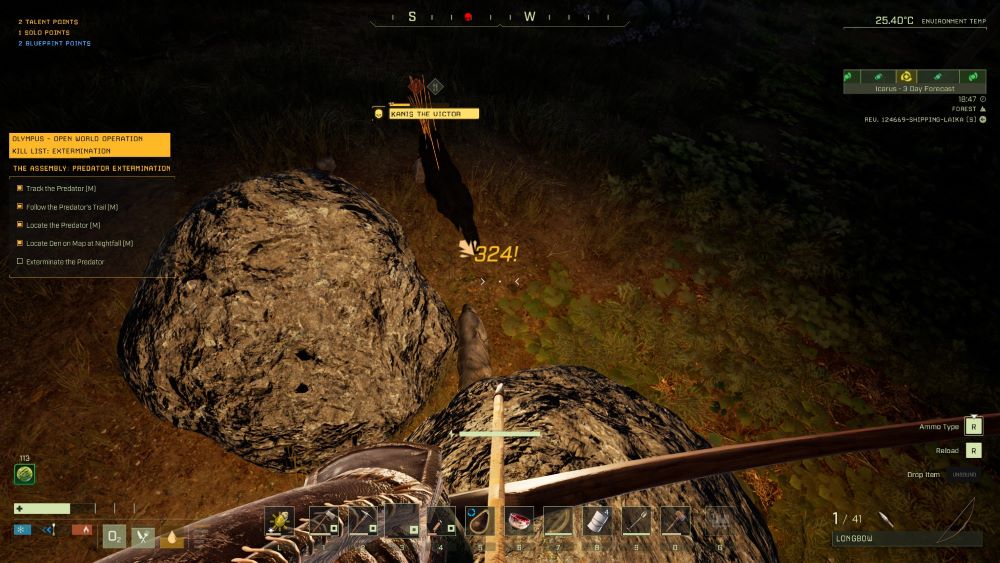
The pivot has taken some time, although the developers have sustained a weekly update schedule for over two years now, which is impressive. Or would be, if the game was fun or interesting at all.
The fundamental issue with Icarus is that there isn’t much going on. There is a relatively solid survival crafting framework in place, with XP and levels and recipe unlocks and talent points and such. The world is gorgeous and thick with trees, bushes, rocks. There is even a semi-voxel thing going, with fallen trees being satisfyingly split into logs, and ore/rock nodes deforming exactly where you are hitting them. All of which will sustain genre fans for a few hours past the refund window.
But after a while, you start to realize what you have in Icarus is basically the window dressing of other games. A forest with deer, rabbits, wolves, goats, moas, bears? A desert with hyenas and scorpions? Snow biome with polar bears and mammoths? Other titles like 7 Days to Die, The Forest, ARK, etc, have those things… aaaaand the rest of the game game. Without the parameters (and timers) of Missions, the Open World aspect falls flat. Technically, you can craft a radio that opens up both short and longer-form Missions even in the Open World, but you still run into the issue of “why.”
“Why do anything at all in any game, eh?” Because shooting zombies and looting things is fun? Because delving into caves and uncovering mysteries while running from mutants is (supposedly) fun? Because dinosaurs are fun? With Icarus, what you see is literally what you get. Kill thousands of animals to farm XP and unlock more crafting benches so you can kill more animals efficiently. Or build a quaint little abode in the woods. Which is fine for the people that want to do that, but you can also do that in (cheaper!) games that have more meat than potatoes.
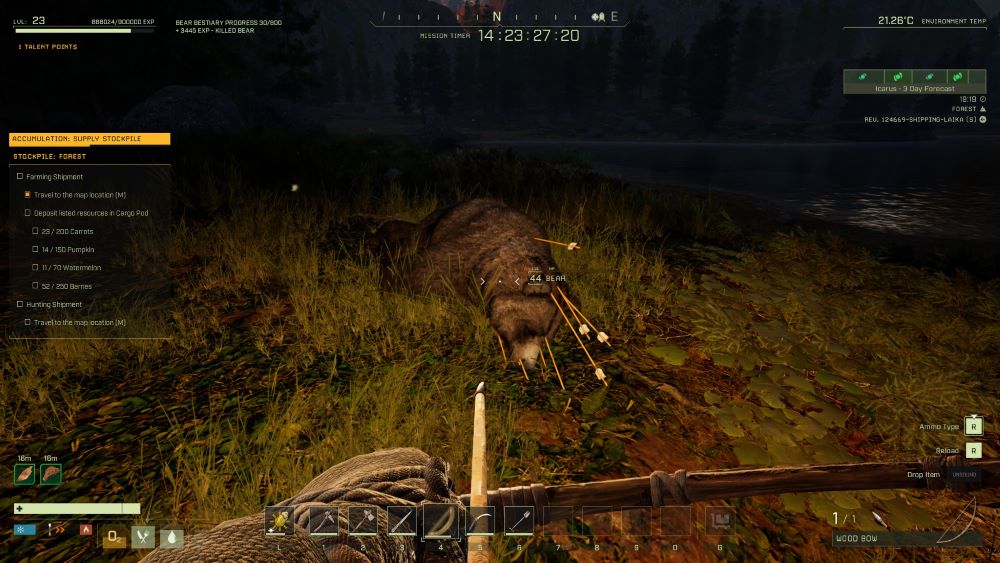
In an effort to be totally fair, I did go ahead and run a few Missions, e.g. the way the game was designed to be played, once the open-world lost its luster. And… it was pretty much as bad as it seemed. After the tutorial one, the next Mission was to collect up meat and vegetables into two different drop pods. Cool. What they neglected to mention was the fact it was going to be like 150 Pumpkins, 200 Carrots, and so on. The only possible way of gathering that much was going to be setting up a farm, and then hanging out for a while. Which I did. Next was the meat, which was something absurd like 300 meat, 400 hide, and 300 fur or whatever. I got about halfway through murdering literally every single mammal that moved before the tedium overtook me and I uninstalled.
Having said all that… is there anything good going on in Icarus? Sure. Although it is a limiting factor, the existence of oxygen as a necessary meter to watch gave texture to the survival experience. It helps that Oxite Ore is in most places, so you aren’t as constrained as in, say, Breathedge. The storms in Icarus are also interesting. Staying outside in one fills up an Exposure meter that begins hurting you when full, and the storms themselves do damage to most buildings. Now, you usually just spend the storm inside your base running around and smack-repairing things with a hammer, but it elevated “weather” from a pure, ambiance detail in most games to one that you must account for. And you do have to account for it: your walls will collapse if they take too much damage from the weather or anything else.
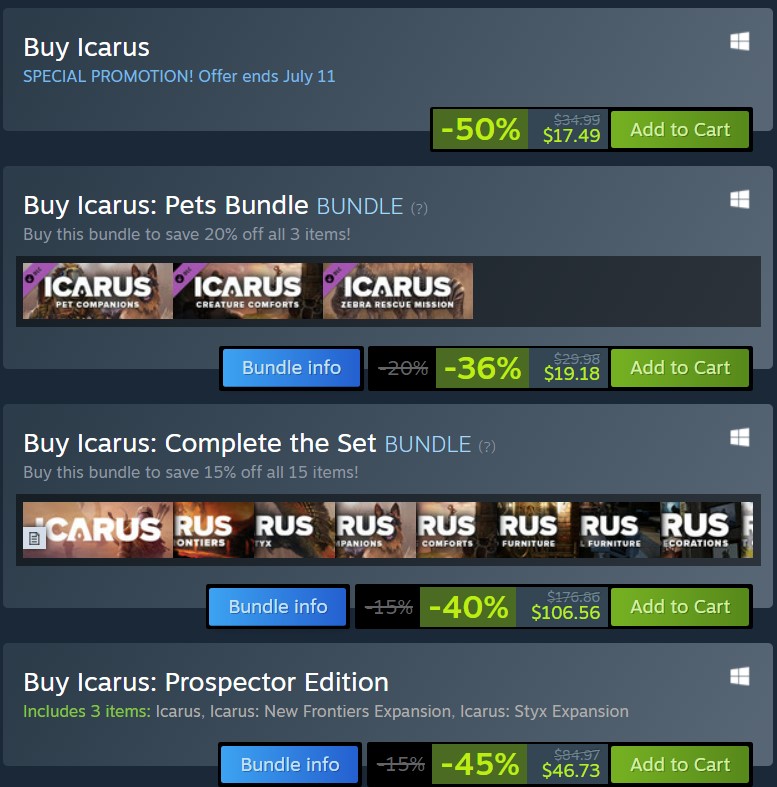
That’s about it, though. Part of me feels bad for the devs since they likely had to scrap a lot of their post-release plans when they pivoted to a more traditional open-world structure. But then I look at how much they are charging for the game + DLCs in its current state and those feeling go away.
Impressions: Once Human
Once Human is an open-world survival crafting MMO whose Beta details I mostly received filtered through the amusing lens of Bhagpuss. Based on those posts, I wishlisted the game and promptly forgot all about it. Then Tuesday came along and now its officially released. I played for almost six hours straight on that first evening, and not because it was, as my 5-year old terms it, a “stay day.”
Nor, incidentally, because the game necessarily deserves it.

Let’s start with the Pros, I guess. First, the game is free to play and not obnoxious about it. By that I mean I did not seem to get prompted to buy the Battle Pass every time I opened a menu, or had a red exclamation mark on my UI until I opened the shop, or the myriad of similar design disasters. Indeed, there is a Wish lottery mechanic (for cosmetics) somewhere in the game, but I was not actually able to find it. Maybe it unlocks later? I found a few vendors who require obscure currencies for vague items, but near as I can tell, none of them were extra bag slots, carrying capacity, or the like.
Second, Once Human does seem to support a rather robust survival crafting experience. You are encouraged to build a base immediately once out of the tutorial, and you can do so almost anywhere not already occupied by other players and/or the pre-existing set pieces. I also really appreciated the ability to go into “flight” mode when building, rather than having to awkwardly maneuver your character every which way. Collecting resources from trees/ore nodes is not too onerous at this early point, and you are overall encouraged to revisit points of interest to collect junk items that you then break down into smaller components to craft new items.
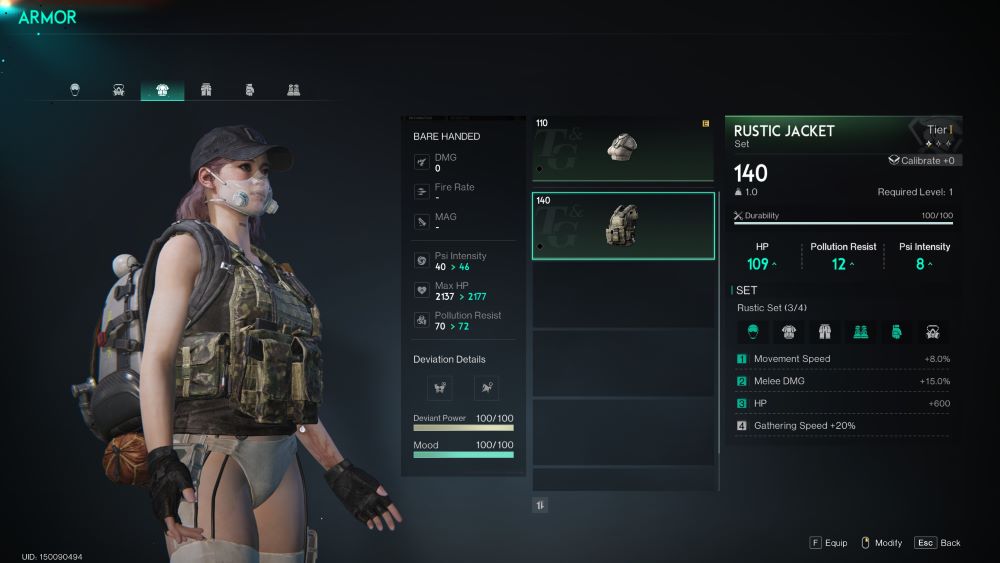
Then it struck me: Once Human is basically Asian Fallout 76.
Viewed from that lens, the veneer started to peel. Is the base-building better than Fallout 76? Absolutely not. Crafting? No. Quests? Nope. Environmental storytelling? Nonexistent thus far. The feeling of collecting and hoarding resources? Not even close. Both are post-apocalyptic, both have cryptids, and Sanity is basically Radiation – both reduce your maximum HP until healed and, hilariously, grant you special abilities if you accumulate too much (Whim vs Mutation).
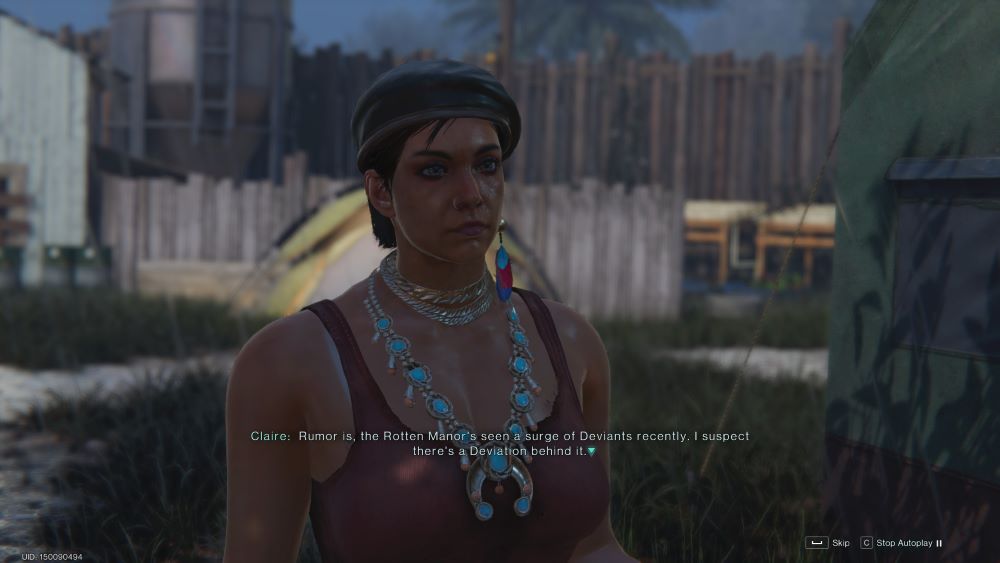
I originally didn’t want to complain about the Once Human combat system in these early stages – tutorials going to tutorial – but it’s… trivial. Every creature died to 2-3 hits with a torch, and having access to guns makes it even more ridiculous. Presumably mobs will sponge more bullets later on, and there is a dodge-roll button, but the fact that Once Human will be releasing on mobile phones in two months does not inspire confidence. The boss (or mini-boss?) fights were more interesting, and seem to be where the devs spent most of their imagination capital. Not saying that Fallout 76’s combat system is groundbreaking or anything, but it nevertheless has a heft to it even early on that is definitely lacking in Once Human.
Again, it’s possible this is all a bit unfair this early in the experience. The map looks huge, they give you a motorcycle within the first few quests, the Deviation (pet-ish) mechanic seems akin to Pals from Palworld, which could be interesting. The notion of Seasonal world resets and ever-changing “scenarios” is fairly unique in the survival space, and could go a long way in keeping the experience fresh. Time will tell.
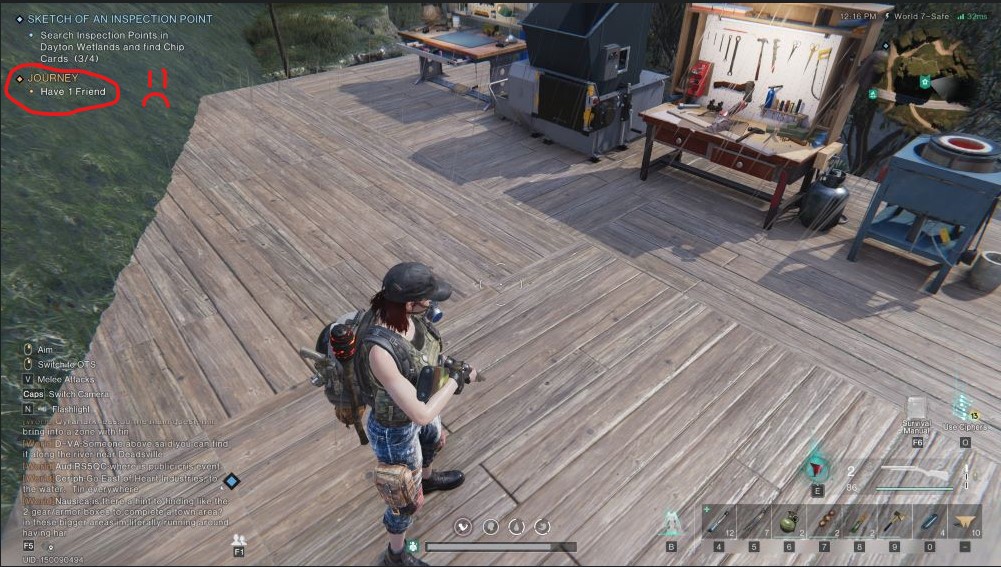
Time will also tell if I don’t just end up reinstalling Fallout 76 and playing that instead.
V Rising: All Done
I’m done with V Rising after about 56 hours.

I technically did not “beat” the game, but I am done. All bosses have been defeated aside from the last two: Adam and Dracula. I have maxed my gear and spells, acquired a Legendary weapon, and was otherwise facing down 5-6 additional hours of “gitting gud” before seeing… I don’t think there’s even credits screen here. There have been tough bosses leading up to this point, but these last two have multiple phases and Adam even requires the crafting of a special consumable to even access him for an hour. I think I could eventually take down Adam by investing in crafting a different endgame weapon, or swapping out spells during a fight transition, but honestly fuck that.
Overall, I stand by my earlier assessment of the game, e.g. it’s OK. I did develop a deeper appreciation of the visuals though and the overall art direction. Running around the map during daytime became an interesting game unto itself, as you tried collecting resources or fighting mobs only to have the shading tree collapse from an errand attack. The sound that accompanied increasing exposure to sunlight was also very satisfying (if not deadly). The moment-to-moment gameplay was satisfying.
What is less satisfying is the grind on the macro level. As stated before, there is no XP here, and mobs themselves rarely drop anything of value, so there’s really no point to combat. The whole vampire fantasy takes a bit of a hit when you rush from house to house rummaging through dressers for bits of cloth and paper. A lot of that has to do with some of the absurd recipes.

Here is an example of what I’m taking about. I need Power Cores to craft an item. Crafting them requires 18 Radium Bars + 9 Charged Batteries for 2 Power Cores. I’m just going to ignore the Charged Batteries, because you basically just farm Depleted Batteries from certain enemies and then have to juice them up out in the world. The Radium Bars on the other hand… oh boy.
- Power Core x2 = 18 Radium Bars + 9 Charged Batteries
- Radium Bars x4 = 135 Tech Scrap + 9 Sulfur + 3 Sludge-Filled Container
- Tech Scrap = mob drop and/or mining resource
- Sulfur x1 = Sulfur Ore x45
- Sludge-Filled Container x1 = 9 Glass + 9 Mutant Grease + 3 Iron Ingot
- Glass x1 = 45 Quartz
- Mutant Grease = mob drop*
- Iron Ingot x1 = 45 Iron Ore
- Radium Bars x4 = 135 Tech Scrap + 9 Sulfur + 3 Sludge-Filled Container
Again, all of that for two (2) Power Cores. You need 9 Power Cores to craft the highest tier of necklace. So that’s 90 Radium Bars. Which might not have been as bad as it felt if there was a reliable way of farming for Radium Bars directly. Instead, at best you are running around 1-2 areas breaking all the boxes in a desperate hope that you can get 5-10 Radium Bars from drops. That shit immediately reminded me of Warframe, and it feels outrageously dumb for the same reasons. I can sorta maybe get behind mining for ore as a fledgling vampire, but endgame Dracula-esque vampire overlord reduced to breaking open boxes for loot is too much. Farming enemies? Good. Breaking background clutter? Bad.
One thing that made it better/worse were servants. These are people you capture and then turn into vampires, who then can be sent on resource-gathering missions. While it takes a bit to set them up – they have to basically be equipped with the same gear you have, which means grinding some more – they can return fantastic amounts of resources on a real-time basis. To a point. There are several time increments you can dispatch servants on, such as 4h, 8h, 16h, and 24h, but the difference between 8h and 16h is not 2x the loot. Which means you are better off logging on, dispatching servants for 4h or 8h, then logging off. Sometimes they get injured, so they cannot be immediately be sent back out.

So, anyway, there I was, logging onto V Rising three times a day to dispatch servants because I no longer wanted to spend time manually farm resources. And remember, I’m already on +100% global loot. Once I realized that I could only play more of the parts of the game I enjoyed by playing it less… I did so. And then discovered that the other games I was playing instead were actually kind of fun and rewarded me for playing them more. Imagine that!
Arguably, none of this is how V Rising is “meant” to be played in the first place. You’re supposed to be out in the world with your chums, farming some mobs, attacking (or being attacked by) other vampires and stealing their loot, defending your castle from destruction, and so on. Theoretically, it would feel like less of a grind if there was more grind, insofar as you wouldn’t be hitting the endgame wall as early. Or something. But by the time I got there, I kept asking myself: why this over Diablo 4 or whatever? At least there I had something to potentially look forward to from killing all these random mobs.
That’s V Rising. I give it props for melding the survival crafting and ARPG genres in an innovative way, and overall being a very slick game. I can see how other people might play it for hundreds of hours with friends and/or internet strangers. But it doesn’t really deliver a better experience in any individual one of the categories compared to other offerings. And while it does offer most of the trappings of a good vampire fantasy, it shrivels up in the sweaty heat of an unnecessarily grindy endgame.
Impressions: V Rising
V Rising is a hybrid ARPG with survival-crafting elements, sorta like Diablo meets Age of Conan. The approach is pretty novel, but there are some awkward elements that diminish the experience a little bit.
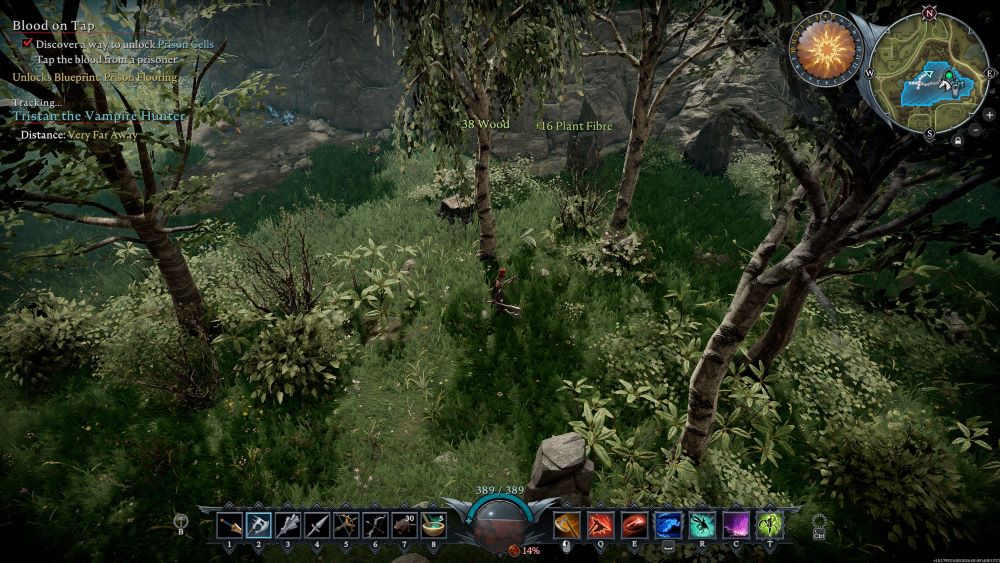
To start, I am playing solo on a “private server,” which is basically just single-player (like with ARK, Conan, etc). However, it is very, very obvious that the game is centered around and balanced on a more public, multiplayer and even PvP experience. For example, by default, you cannot use any of the Waypoint portals if you have ANY resources in your inventory. This option can mercifully be changed in the server settings, but the map itself consists of lanes, specific camps of NPCs, and then dozens and dozens of nondescript castle areas. Which is great for multiplayer servers (options!) and PvP (lanes forces players into channels for encounters), sure. But there really aren’t any exploration aspects, no map secrets, no particular reason to go to out of the way areas. Unless, of course, you were hiding from/laying in wait for other players.
The progression system is also a bit weird. First, there is no XP. Instead, your character’s power is based on Gear Score – you deal/receive damage based on the difference in Gear Score between you and your foe. Increasing one’s Gear Score is achieved by unlocking technology via killing bosses and consuming their “V Blood.” This is not necessarily a linear process though. Killing the boss that gives you a Workbench to craft better weapons results in a huge power boost. Other bosses might just give you ability to turn into spider, or upgrade gems into better ones, or similar. You can tackle the bosses in any order (provided you have a decent Gear Score), but nevertheless there are times when things end up… uneven. For example, I just upgraded all my armor and now find myself ~10 Gear Score higher than like eight bosses I have yet to kill. And none of those bosses will see me improve my Gear Score at all.
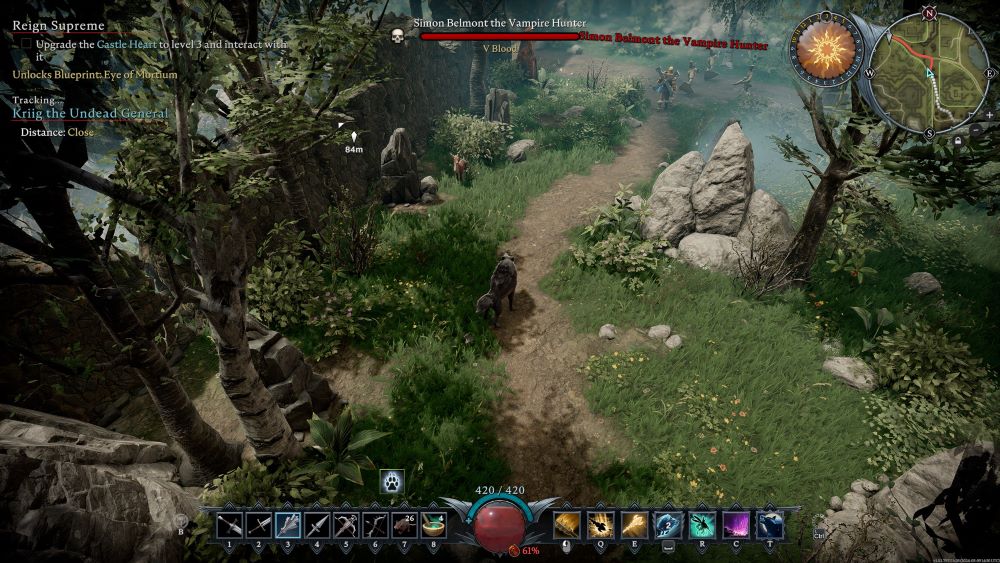
Progression-wise, it is also worth mentioning that there is a recipe/research component as well. You can unlock Copper weapons by killing the appropriate boss, but getting the next “Merciless Copper” tier requires the recipe to drop from random loot. Sometimes you can purchase the recipe from a vendor’s random stock, and other times you can randomly learn it by consuming Paper or whatever at a Research Desk. So, random, but with grindable guardrails.
Having said all that, is the game even fun?
I guess. I mean… probably? Sure.
At the time of this writing, I show ~22 hours /played. My solo server has loot bumped up 2x, item stacks 3x, Waypoint access on, Durability and Castle decay basically turned off (25% of normal). I don’t feel “bad” about these custom settings because, just like with my time with ARK, the “normal” settings are absurd nonsense. You can dispatch vampire servants to collect resources for you, but they take real-world hours (2h min, 24h max) to return. Considering you have to grind resources to craft equipment for them to wear so they can… err… help you skip grinding resources, they are of questionable merit. Of course, the servants could help defend your castle from other players trying to break it down and steal your resources, if you were into that sort of thing.
From a strict, gameplay-only sense, V Rising is OK. It’s a kind of Diablo-lite where you can hotswap weapons to mix and match abilities (which share cooldowns), while also tailoring your two spell slots and one ultimate move to your preferences and/or the boss’ tactics. Enemies are fairly straight-forward where I’m at in the game, but the environmental factors add layers to strategy. For example, there are patrols of NPCs not just within each camp, but also throughout the lanes in the world. These patrols can include bosses, sometimes ones way beyond the difficulty of the area too. This brings opportunities as well though, as sometimes patrols can be lured into attacking other factions or even having two bosses attack each other! This makes the world feel a lot more interesting than what I normally see in the genre.
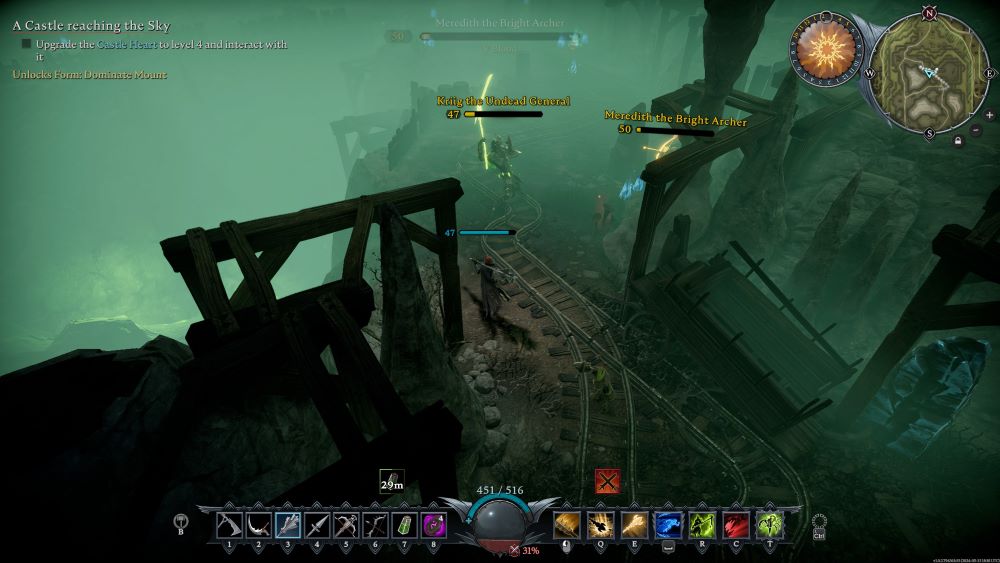
Anyway, I’m still playing V Rising and have every expectation to keep playing for now. Whether that is due to the underlying gameplay being better than I am giving it credit for, or because I am starved for new survival-crafting experiences, I cannot say. What I can say is that if you expect a Diablo experience, you will be disappointed. I definitely spend more time hitting rocks with a mace than I do hitting enemies for loot. But don’t expect something akin to Terraria/Starbound either, because the crafting is prescriptive and environment static. So… yeah. V Rising is its own thing and it’s fun enough for now.
Review: Planet Crafter
Planet Crafter really surprised me by keeping my attention all the way to… just before the very end.

The premise of the game is that you are dumped onto a barren, hostile world and tasked to terraform it into something more hospitable to life. The “twist” is that there is no combat. At all. The planet is barren, after all, so what would even attack you? But what intrigued me was precisely how intrigued I stayed for the 35 hours I played. And that’s quite the trick considering I am not much of an Explorer type nor someone typically into Factorio-style automation games.
The secret sauce is probably the sense of progression.
When you first start out, you have an extremely tiny oxygen meter and will be doing some desperate loops around your starting capsule to gather raw materials. Eventually, you will start building a rudimentary base and start stockpiling supplies. However, almost all crafting recipes and upgrades are gated around one’s Terraforming Index (Ti) score. Improving this score is only possible by creating machines to generate Heat, Pressure, Oxygen, etc, to first form an atmosphere, and so on. Certain resources to build these machines are not located on the ground like most everything else, so you will need to go explore deeper afield – including inside the wrecks of spaceships – to gather what you need.

And so a cadence is formed: build up machines to improve Ti, go exploring for new material, come back and build new machines that got unlocked while you were exploring. Each loop will increase your ability to travel further as you expand oxygen capabilities, movement speed, and inventory space, and start fostering a sense of curiosity about what’s over the next ridge or inside that cave.
It’s also worth mentioning the more visual sense of progression as you improve Ti: watching the planet bloom. Glaciers recede, opening new travel and resource opportunities. Liquid water starts to form. Weather occurs. You start building Flower Spreaders, grass starts generating, then you upgrade to Tree Spreaders. By the time endgame rolls around, you are flying around searching for the last remnants of secrets left behind, occasionally stopping to gaze at the previously lifeless stone arch now covered in an explosion of color and growth. It’s a real treat.
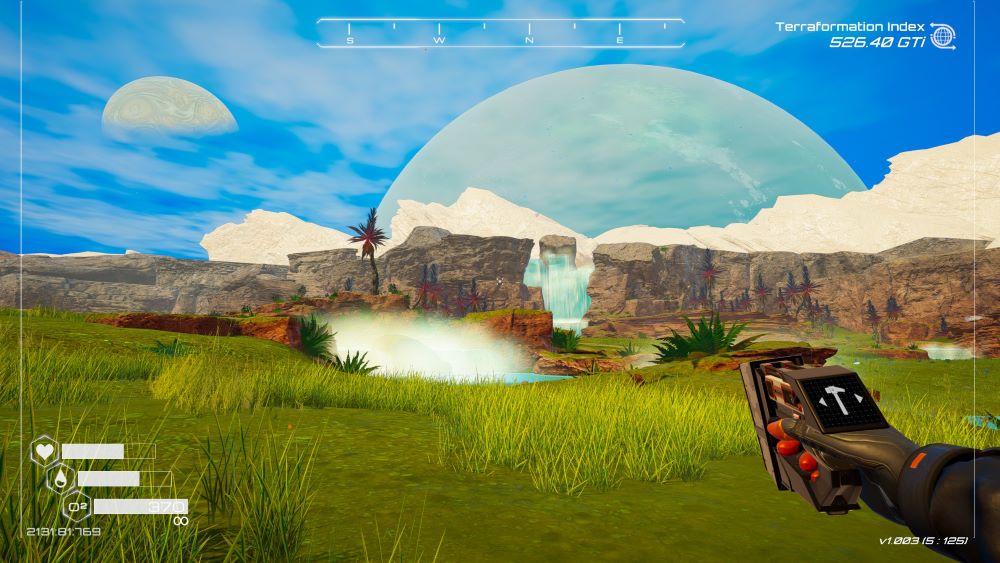
The only shame then is the final stumble. I have unlocked every technology except the final one to end the game. I have explored procedurally-generated wrecks, I have optimized my automation, I have uncovered every mystery on the planet, consumed every bit of novelty. My score is sitting at 1.43 TTi and 5 TTi is the end. After timing it, I would need to leave the game running for 5.5 real-world hours to get to that number.
Could I speed it up? I mean, hopefully. I’ve already built 6+ T5 generators of various types (Pressure, etc), overlapping Optimizers fitted with boosters, dozens of satellites that further juice the numbers by 1000% a pop. Each added machine makes the overall number increase by what feels like an insignificant amount. I spent the entire game waiting for the “Spam End Turn in Civilization” inevitability to kick in, and was surprised every time Planet Crafter bobbed and weaved out of the way. But, alas, it did come after all.
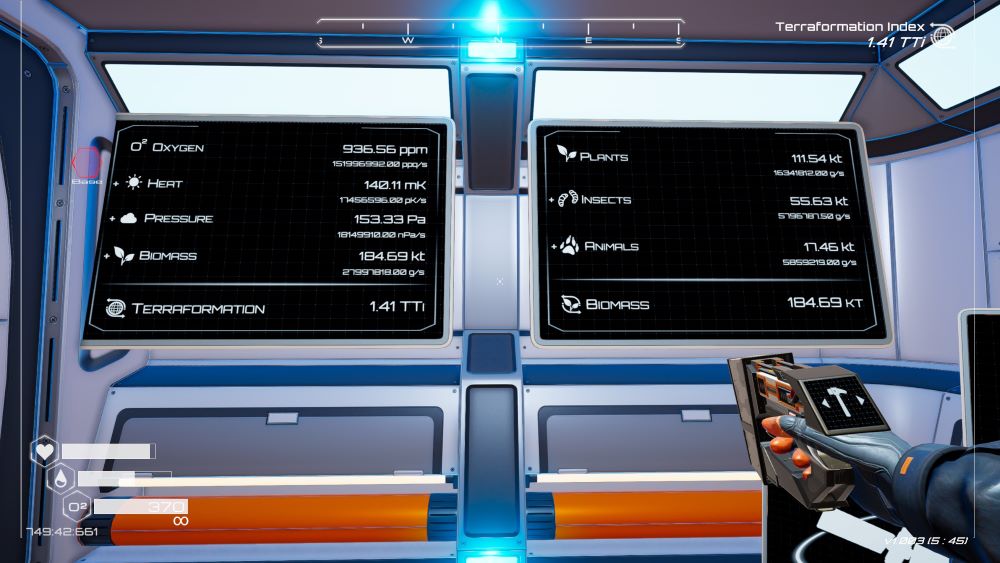
Nevertheless, Planet Crafter did deliver an extremely solid 20-30 hours of entertainment without once leaning into combat or contrivances. If you’re looking for Subnautica minus the thalassophobia, or the first half of Breathedge minus the chatty sidekick, then Planet Crafter is your game.
Impressions: Craftopia
A lot of developers, even in the indie space, like to play things safe. Even if the genre is something out of left field, a lot of the basic game design still feels like +10% skill bonus here, clearly defined tutorial there. Early Access is treated as a soft launch – which it definitely is – of the final product instead of an opportunity to just go nuts.
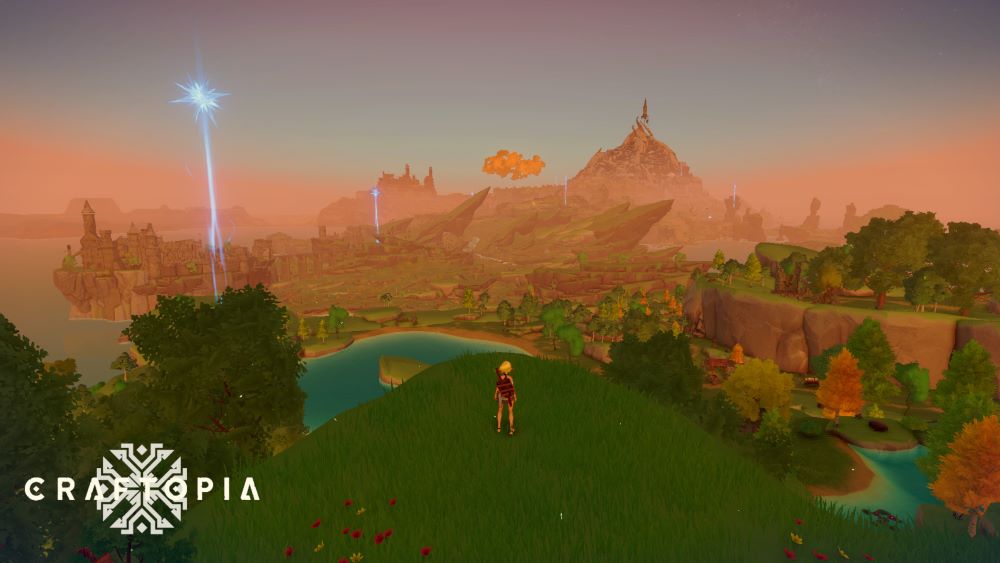
Meanwhile, Craftopia is the nuts. I don’t remember the last time I played something where you could just feel the devs sitting around a whiteboard saying “That sounds cool, let’s try it out.” And since the team is from Japan, they are already coming at design from sometimes extra weird angles.
On the face of it, Craftopia is… well, let me just post this from the Steam store page:
Craftopia is the brand new multiplayer open-world survival action game.
We have imagined what would happen when we combine our favorite video games altogether.
Chop trees and mine stones as in Sandbox,
Explore the world as in Open-world,
Fight the hunger as in Survival,
Cultivate and harvest as in Farming,
Collect loots in dungeons as in Hack-and-slash,
Automate activities as in Factory management,
Hunt monsters and creatures as in Hunting action,
Cast magical spells as in Fantasy RPG.Now we have a utopia for all of us. That is Craftopia.
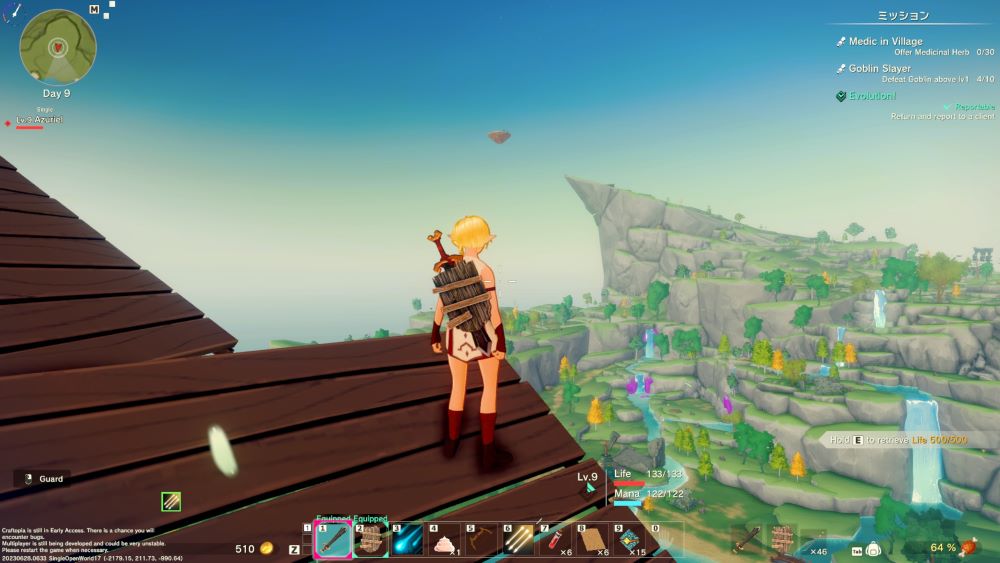
After destroying the world in the opening credits, your character emerges from a tutorial cave and you can basically do whatever you want. The game looks like Breath of the Wild and/or Genshin Impact, including the ability to gecko-climb up every surface from the get-go (and build a glider soon after). Following the breadcrumb quests will take you to some NPCs and a small town where you can get acquainted to the crafting. The thing to know is that you can basically build anywhere, which will be important later.
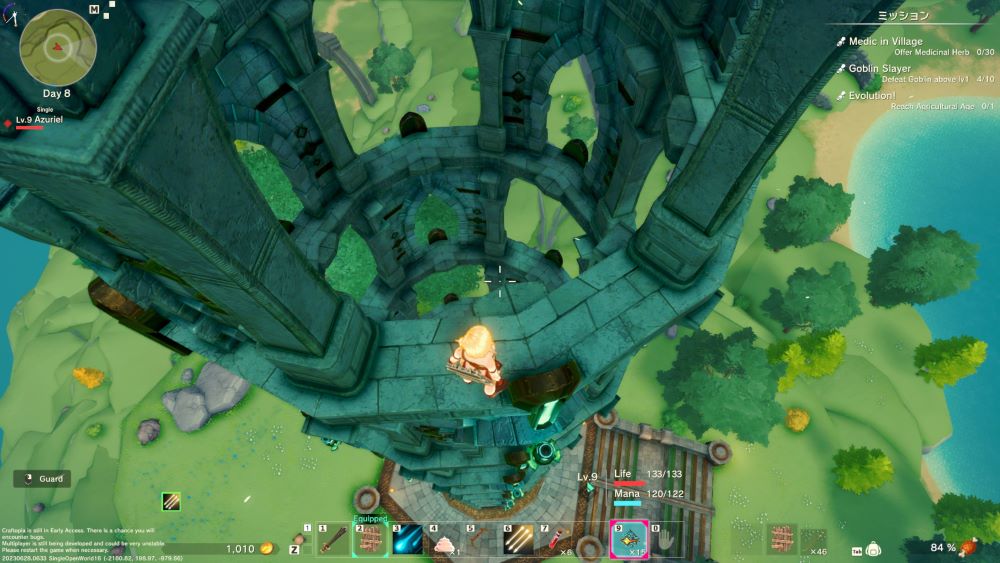
Before the big Seamless World update in late June, the game was basically a series of instanced islands and you needed to unlock things to open portals to other places. Now, you can basically go anywhere you want right off the bat, although you will of course encounter higher-level enemies the farther afield you explore. One of the principle progression mechanics is unlocking special pillars across the landscape using crafted goods. Once you supply the necessary ingredients and then press the button at the top of the resulting pillar, you progress the “Age” and unlock new crafting possibilities.
Let me talk about the pillar for a second though, because it was amazing to me. I supplied the ingredients and then it shot up into the sky. I started climbing the pillar, which is something you can just do, but I started getting nervous halfway up because the ledges were very tiny and, admittedly, the game has a lot of jank. So I threw down a wood platform so I wouldn’t fall off. And then I slapped my forehead with the realization that I could have just built a spiral staircase to reach the top. Which I then did. There’s a floating island you need to reach to get some upgrades, and I presumably would have learned that lesson had I done that earlier, but whatever.
Aside from the crafting aspect, there is a lot of experimentation in the Skill trees as well. You can choose to use Magic of various flavors, enhance your normal weapon attacks, unlock basic movement skills like double-jump, and more. When I played, a large portion was simply unselectable placeholders, but what exists is plenty inventive and makes me feel excited for the possibilities. One Skill lets you throw a knife and then teleport to that location. I was a tad disappointed that its range is limited, but it reminded me how much fun I had with Rogues in WoW with Grappling Hook and Shadowstep.
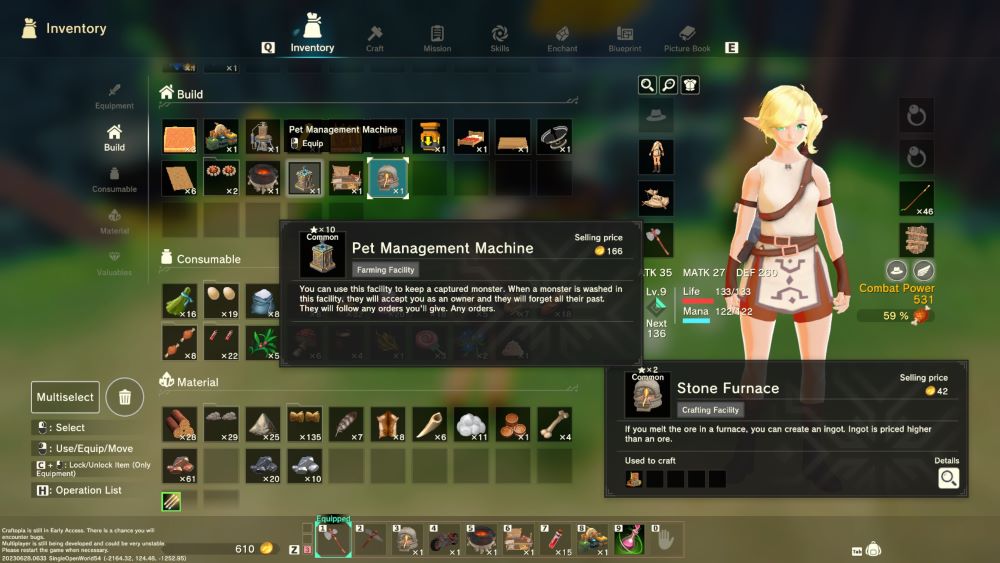
Also, apparently there is an entire Pokemon element in the game wherein you can capture and breed anything in the game, including NPCs (!!), and ride them into battle (!?!). Actually, I haven’t tried to see if you can ride the NPCs, but I have ridden a cow and what looked like a Shy Guy from Mario 2, so I wouldn’t be surprised.
Also also, there are dungeons with traps and boss fights. Building is more limited inside, but there was a sequence where you had to come up with something to avoid fireball turrets and infinitely falling giant iron balls that roll down the main ramp. I hesitate to call the boss combat Soulslike, but you do need to dodge and counter-attack at precise moments to avoid damage. Or summon a bunch of pets/NPCs and spam attacks? Didn’t try that, personally, but maybe it would work.
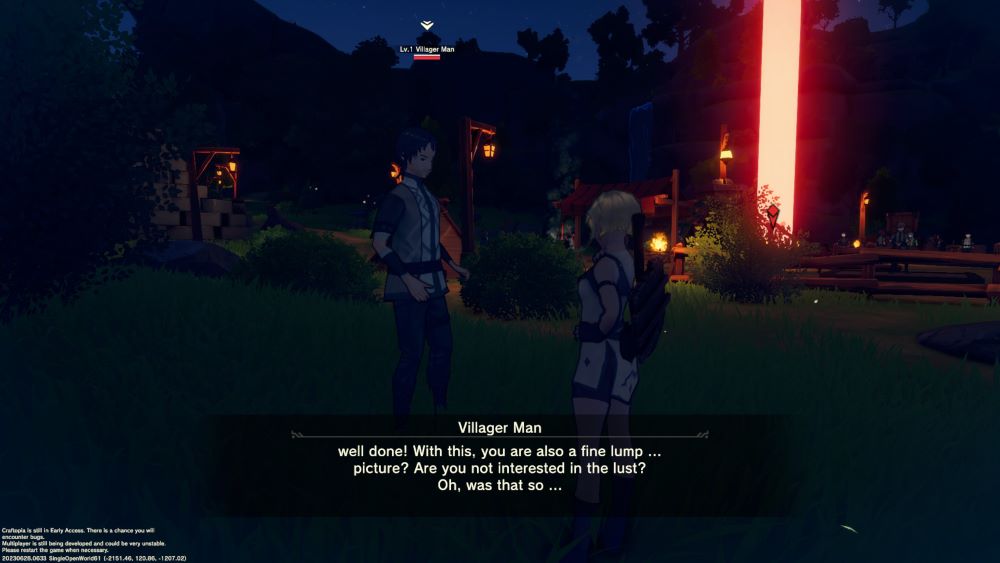
What I will say though, is that currently Craftopia has a lot of jank. Like, a lot a alot. When I played, damn near half of the NPC dialog was in untranslated Japanese, and what was in English was very clearly machine-translated. According to one patch note the untranslated dialog was due to a bug, but let’s just say that this isn’t exactly an AA game experience at the moment. It certainly is A game experience, and definitely a BBB game if I ever saw one.
And that’s fine. What I love about Craftopia already is that it can improve in so many different ways and directions from here. That sounds like a backhanded compliment, perhaps, but my point is that these guys threw the entire box of spaghetti at the wall, instead of just a normal amount. With what they got going on so far, I am not worried about them necessarily cutting features and/or nerfing certain builds into the ground. Which means we could just have fun for once in completely unique ways. How many times does that happen?
The one negative I’ll say is that it’s difficult to justify playing exactly right now. For one thing, there is apparently some kind of critical Save Game bug, which is about the worst thing that can happen with a survival-crafting game. But more than that, I worry about playing through things, getting my fill with the novelty, and then them releasing a whole bunch of new elements that I don’t get to experience because I’ve moved on. That’s a Me problem, 100%, but it’s there. The roadmap suggests that an official release may come in or after September, which isn’t too far away, and may be just as well considering that’s when Starfield comes out.
But overall, if you want to experience a game where it feels like almost anything can happen, Craftopia is where it’s at.
7 Days to Die, Again
7 Days to Die (7DTD) received a new patch a few weeks ago. So I had to boot it up.

If you haven’t heard of it, or read any of my posts, 7DTD is a zombie survival-crafting game that has been in an alpha state for almost 10 years. It has survived this long because A) it’s a fun, more realistic zombie Minecraft, and B) it continues to receive updates, albeit on a more yearly cadence. I came in around Alpha 15 or so, and this most recent release is Alpha 21. Supposedly the game will go gold with Alpha 23, but the dev team never had anyone with project management skills, and it kind of shows.
Case in point: the devs have spent a majority of A21 overhauling the leveling system and mucking with the early game. Again. For the 3rd/4th Alpha in a row. When I started playing, the skill system was a “learn by doing” sort of Oblivion system, wherein you crafted hundreds of stone axes to increase the potency of future stone axes. Then they moved towards a Skill Point system, so you needed to focus on leveling up and assigning points into Skills that improved your crafting ability. With A21, you now need to find and consume skill magazines in order to level each of dozens and dozens of skills. The Skill Points are still there, but are more focused on 10% (etc) bonuses, although you will find more corresponding skill magazines by spending points in specific areas, e.g. Spears, Shotguns, etc.
Are these changes bad? Yes and no.
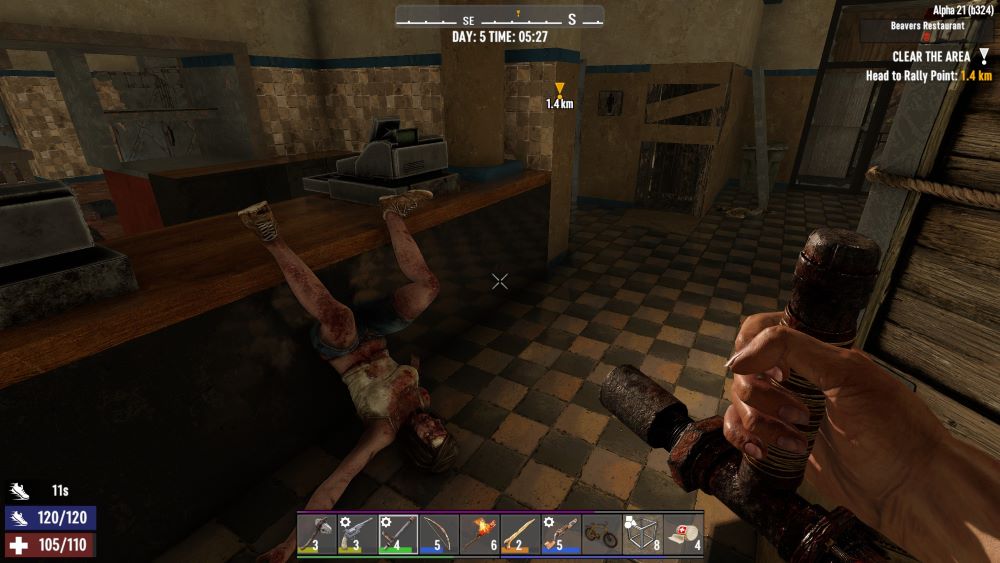
In principle, I am fine with devs trying to figure out their preferred method of player progression. This is what Alpha states are supposed to be about, after all. The problem with the Fun Police Pimps (their actual studio name) is that they are almost actively hostile to the way most people play their game. Over the years, the Minecraft elements have been nerfed into oblivion because they didn’t like players just basically digging into the ground and smelting iron and crafting all corresponding items (guns, etc). So, they nerfed the XP gains from digging and tied blueprints to either levels or loot (Skill books). When players still Minecrafted their way to castles, the devs started adding things like “gun parts” as uncraftable items you had to loot. Which, fine, whatever, but that also leads to ridiculous situations like how you need “baseball bat parts” to make a wooden bat, but can engineer a working gyrocopter out of scrap metal just fine.
Meanwhile, over the years the devs started adding “dungeon” Points of Interest (PoIs) into the game. Whereas existing homes and shops were set up in a logical manner, these new PoIs were designed around players going along set pathways and encountering zombies in scripted ways, with extra loot at the end. These are cool… the first time you encounter them. Unfortunately, the devs has since turned every PoI into a dungeon, making looting a bit of a slog. Until/unless you have memorized where the main loot in located and can just break through doors/walls/ceilings to bypass everything.
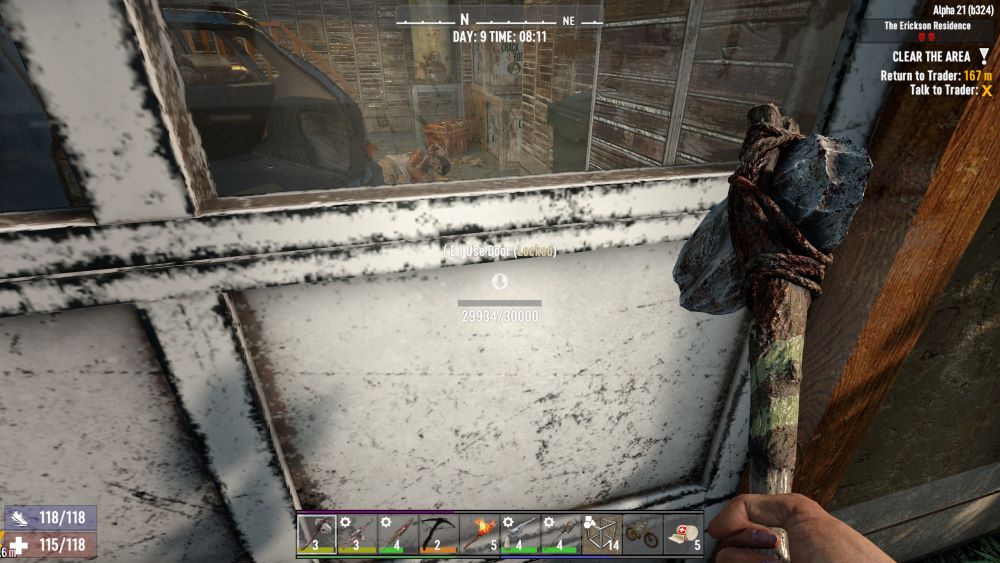
Meanwhile meanwhile, the devs have also been tweaking zombie AI over the years to counteract players. The eponymous 7 Days horde is a bunch of zombies who attack at a sprint, always knowing your exact location. When I started playing, they couldn’t dig straight down, so if you found or built a bunker, you were basically immune. Clearly, that was a bit too easy. Zombies were then allowed to dig, making underground bases problematic. Players then started just driving around all horde night on motorcycles, so devs made zombie vultures move at 300% speed when you’re in a vehicle. People then started making zombie mazes. Devs wildly overcorrected and gave all zombies perfect omniscience as to the block HP of everything between you and them, so that they make a direct beeline towards the weakest part of your base. Not only was this nonsensical – how does a zombie know this concrete block has 495 HP instead of that one? – but it invalided all “real-world” defense strategies like installing spiked walls everywhere. Players then made zombie obstacle courses that end in impossible-for-AI jumps, so the devs reduced zombie fall damage and made them “rage” a bit, attacking any nearby blocks (e.g. support pillars).
Oh, and new to A21: glass jars and tin cups have been removed from the game. The stated goal was to make water a more important concern in the early game, as otherwise you could craft/find tons of containers, fill them up at a nearby lake, and boil your way to eliminate thirst. I mean… sigh. Maybe being able to craft glass jars in a Forge with just sand is a bit much. But that just makes bodies of water useless, throwing out another element of rational post-apocalypsing in favor of abstract game design. Instead, we must imagine you drinking bottles of water and throwing the container away, while you desperately collect enough coins to purchase a Water Filter from vendors, which you use to craft Dew Collectors, which generously grant you 3 Water (containers!) per day… from the aether.
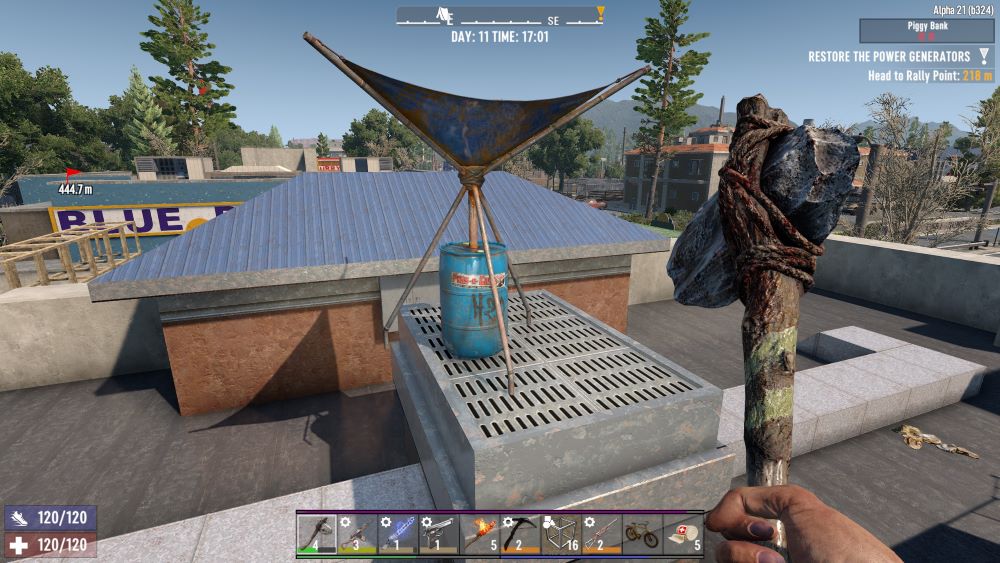
Games change over the course of Alphas, especially when they have gone on for ten years. But at a certain point, you have to question whether the devs even want to finishing make the game they started. One of the leads once admitted on the forums that if they could go back in time, they would not have allowed players to dig into the ground. Which… is kind of a big deal for a voxel-based game.
All of the changes mentioned above though make digging immaterial to begin with. There used to be a tension between looting buildings and still saving enough time to build your own base to survive horde night. Now the optimal, dev-directed course is to spam quests from vendors – oh yeah, quests were introduced a few Alphas ago – to get PoI loot + quest loot, and just camp on the roof of a bank or whatever for the hordes. The zombies will eventually tear down the building after a few weeks of hordes, but by that time you will have enough high-level loot to kill them with ease, especially after creating a little obstacle course.
The good news is that 7 Days to Die has already attracted some quality mod authors over the years that have put out some transformative overhauls. So even if the Fun Pimps continue to go all-in on making the game just a series of scripted zombie encounters, there is still hope for an experience more akin to the game it used to be. Which is more than can be said for many titles out there.
Back to Frackin’
I have returned from vacation. Pro-tip: don’t go to the beach in early June and expect to get in the ocean or pool. It’s cold. Was seriously considering booking 1 night at a resort just for the indoor pool.
My disappointment with Farworld Pioneers left a Starbound-shaped hole in my heart that I prompted filled with Starbound. Again. More specifically with the Frackin’ Universe (FU) mod reinstalled.
I was pleased to see that the expansive mod had embiggened itself over the last three years, pretty much to the point where everything felt new. Yeah, many of the craftable items are the same as is the general sense of gear progression that comes from mining new ores on new planets to build things that help you mine newer ores on newer planets. But there was a clever implementation of a new Research system that ties it together in a (slightly) coherent package.
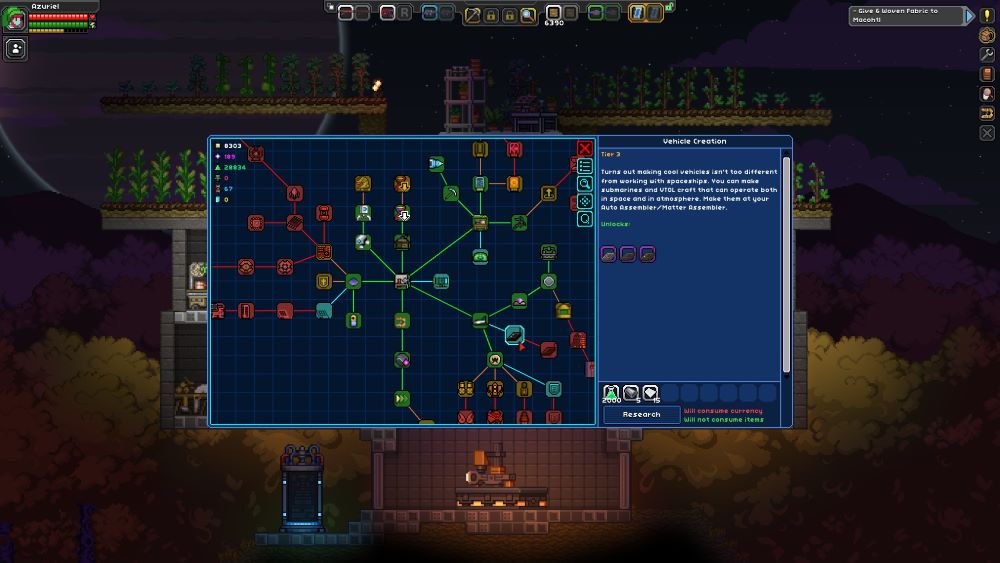
All technologies in FU are unlocked by spending Research points to purchase nodes in various categories. The primary way to accumulate Research is… playing the game. Which is a fancy way of saying “passively in real-time,” at the rate of +1/second. A system like this would typically feel stifling, but the innovation here are the modifiers. Play a long session? Bonus +1/second every 60 minutes. Land on a higher-tier world with more dangerous enemies? Bonus +1/second based on the tier. You can also get +1/second by hiring an NPC Researcher to follow you around, by wearing a special armor set, and by hoarding an endgame resource. Plus, there are some consumable rewards that will give you a dollop here and there.
For the most part, Research doesn’t get in your way too much, as certain nodes also require you to craft (or at least own) milestone materials in addition to the purchase price. Indeed, pretty much the only thing the system really changes is the encouragement of building a planet-bound base as your ship always counts as a “tier 1 planet.” And planet-bound bases were really already encouraged by the simple mechanics of buildings needing power that more easily came from solar/wind sources.
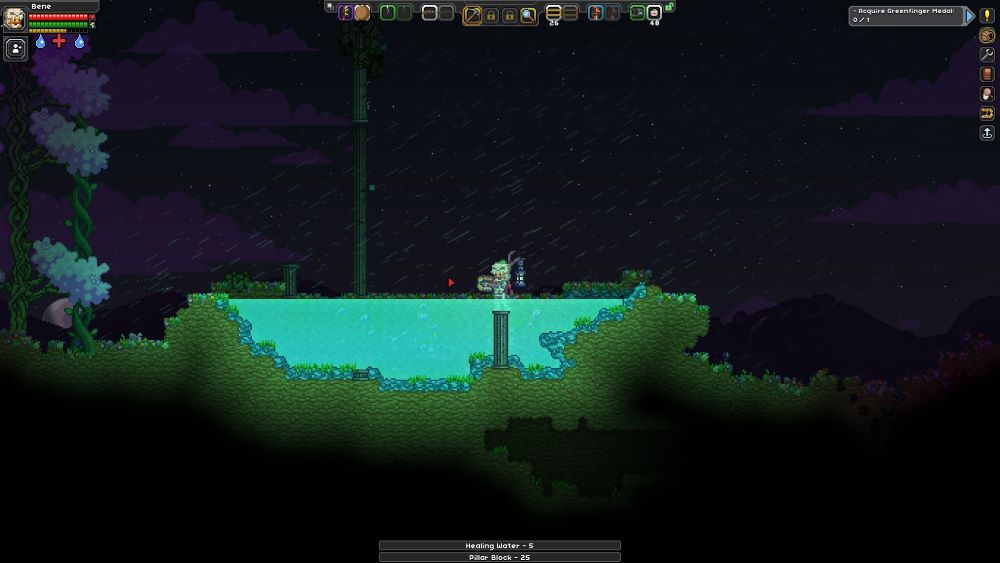
Well, I suppose Research also serves as a sanity check on players trying to leapfrog progression by getting lucky on high-tier planets. Before, if you could dodge getting one-shot by hostile fauna, it was sometimes worth landing somewhere long enough to get lucky with chest drops or some endgame ore close to the surface. With the Research system in place, you won’t be able to even smelt any ore you find without spending an appropriate amount. High-tier weapon drops could still make suicide runs worth it though.
Anyway, I’m back to being obsessed with Frackin Universe. For now.
 In An Age
Light Some Fires
Dec 12
Posted by Azuriel
There were some interesting reveals coming out of the recent Games Awards, but Light No Fire was one that immediately piqued my interest. Here is the release trailer:
In case it was not obvious by the trailer style or esoteric title or the logo with a mysterious red thing in the middle, this is Hello Games studio’s upcoming follow-up release to No Man’s Sky. Sean Murray was back onstage to give a sort of intro to the reveal, and history sort of repeated itself with some amazing claims. “[We’ve been working on] something very different, something maybe more ambitious.” Something more ambitious… than a goddamn procedurally-generated galaxy? Even the host chimed in with a “Ha, here we go.”
Indeed, the jokes started coming in from all corners afterwards:
Now, you can certainly take some umbrage with how both the Cyberpunk and Hello Games devs are making light of releasing broken games that took multiple years (or longer) to fix. You are well within your rights to be screaming from the rooftops about Sean Murray in general, and warn about the dangers of hype. Hell, we don’t even have a release timeframe or hints that it will come out this decade.
But. But!
…I’m excited for Light No Fire. For two reasons.
First, it’s a survival-crafting sandbox. You might think there are dozens of these sort of games on the market already, and you would be correct. And I played them. Pretty much most of them, actually. So, I’m excited that another one is coming out from a team that I trust*.
That leads me to the second reason: trust. Do I trust that Hello Games will deliver everything Sean Murray said at the Game Awards? No. Do I trust all the things written on the Steam page? No. But what I do trust is the No Man’s Sky that exists already. And when I saw that Light No Fire trailer, what I saw was mostly stuff that you can already do in No Man’s Sky.
Climb mountains? Check. Go underwater? Check. Build stuff? Check. Fly around? Check. Ride creatures? Check. Survival elements, collect rare resources, care about environmental dangers, build persistent buildings, explore things with friends, fight big monsters? Check ^ 6. About the only thing you can see in this trailer that you don’t already see in NMS are trees swaying in the breeze and a world with more than one biome. We can imagine them stitching together a bunch of planets onto one larger planet, and that is solved straight away.
The “danger” is getting hyped on what a game could be. Will there be dungeons, will there be raid bosses, will there be a “reason” to go to the tallest mountain, will there be PvP? I suppose there is also danger in assuming that when they say “one world” that it will actually be one, non-instanced world. I actually hope there isn’t one world because, if ARK has taught us nothing, it’s that prime gameplay for many people includes obstructing all available real-estate with pillars and/or phalluses. I don’t care if the world is larger than our own 197 million square miles – if you build it, people will come take a shit on it, if possible. If there are no building limitations, I give it six months, max.
Anyway, that’s Light No Fire. I will be closely following this one.
Posted in Commentary
Comments Off on Light Some Fires
Tags: Crafting, Hype, Light No Fire, No Man's Sky, Open-world, Survival