Blog Archives
[Baldur’s Gate 3] Random Tips
The internet is replete with Baldur’s Gate 3 (BG3) tips, but most of them seem to be the same sort of obvious nonsense you pick up in the first 10 minutes of pushing buttons. I am… also probably going to give you a few of those too. However. Tip #3 may surprise you!
Transferring items across characters is instant, even in battle. If one of your party members is taking an unfortunate amount of damage in combat, but you just now realized they don’t have any healing potions, don’t fret. Just click on whomever has the potions, go into their inventory, right-click said potions, and choose Send To –> X. Viola! This works with anything, actually, including Alchemist Fire, Blunt weapons to give to your Barbarian to take advantage of vulnerabilities, and so on. You can also send Camp supplies out of your inventory at any time, freeing up a lot of weight.
Seize your potential (energy). Everyone finds out pretty quick that attacking from higher ground confers Advantage. What you might not know is that Throwing weapons/objects from higher ground introduces Crushing Damage to the (F=m*a) equation. And there’s no damage roll for Crushing Damage – your enemies just get slapped by science and that’s it. For example, one character threw a Javelin and dealt 10 damage from dice, and dealt an additional 9 Crushing damage for hitting someone with a 0.9kg object from a 10.2m drop. That’s a lot of extra damage not normally accounted for on the preview pane. Also, if your character gets 2 attacks, they get two throws as well. You don’t need to go full Barrelmancy here, but just understand that the lowly Javelin and similar tools/objects can pump out some serious numbers when you have the high ground.
Do not sleep on Sleep. The text: “Put creatures into a magical slumber. Select targets up to a combined 24 hit points. 18m range.” Now, you may be asking why anyone would bother with this spell over something a bit more direct, like Chromatic Orb or whatever. But here’s the thing: there is no saving throw for Sleep. If the target(s) have less than 24 HP, they just lose their next two turns… unless you hit them first, which is automatically a critical hit. Even better, the effect can be split between multiple enemies. Three 7 HP goblins giving you grief? Not anymore!
Is Sleep better than Fireball? No. Also, that’s a level 1 spell vs level 3. But it’s a great follow-up to Fireball to ensure problematic enemies (including bosses!) don’t get a chance to turn things around. It’s just as powerful on your weakest character as the strongest. And bonus tip: the Warlock version of Sleep is always automatically upcasted, letting you knock out higher HP totals for the same Short-Rest slot.
Hello Darkness, my old friend. There is a classic cheese strategy involving using the spell Darkness combined with the Devil’s Sight invocation option granted via Warlock 2: cast Darkness, stay in Darkness, ???, Profit! Basically, you can attack as normal and everyone else cannot. The cheesiness doesn’t end at combat though, as Darkness comes in real handy when doing nefarious things… like stealing. Specifically, Darkness will give you cover to pocket anything not nailed down in the environment, with relative impunity. Just note that shopkeepers will positive ID you 100% of the time if you fail a Sleight of Hand check, even fully engulfed in Darkness.
Spirit Guardians is better than you think. When I read the text, I assumed the spell would cast like a stationary whatever in a 3m range, blah blah, who cares about 3d8 damage when Wizards have Fireball? What actually happens is that the Cleric gains a 3m aura effect that deals 3d8 damage to enemies you walk by. Emphasis on walk by. Since your team is immune, your Cleric can spend all their movement walking in a straight line, zig zagging, or whatever movement set brings one or more enemies 0.1m past the edge of the aura. While you unfortunately cannot just dance back and forth to hit the same enemy multiple times (it only deals damage once per round per target), the aura will stick around an deal additional damage next turn as long as you maintain Concentration. It also reduces enemy movement speed, which generally keeps them close by.
Glyph of Warding is also better than you think. You wouldn’t know if from the awful tooltip, but Glyph of Warding is an amazing spell with seven distinct features, which can be used as traps or just straight-up fired off (if an enemy is inside). Five different flavors of 5d8 elemental damage, a large AoE pushback effect, or a no-HP cap Sleep effect. Granted, the Sleep effect (and others) provide a DEX save which is not always ideal, but it’s hard to argue with how powerful a CC that can be.
One time, at (band) Camp. I’ve talked about this before, but you can rather easily leverage the fact that you have both a large roster of party members and a means to instantly interact with them from anywhere (Camp button). More specifically, you can designate a few members (including the generic hirelings) to be buff bots to the A Team. For example, suppose your main character is a Sorcerer. Should you spend one of your limited slots on Mage Armor? No need! Smash that Camp button, add the buff bot to your party, and have them cast Mage Armor on you and/or any other companions waiting around the camp, then sit them back on the bench where they belong. Some relevant spells:
- Mage Armor
- Light
- Goodberry
- Longstrider
- Aid
- Darkvision
- Warding Bond
- Protection from Poison
- Daylight
- Death Ward
- Freedom of Movement
If you drop a character out of your party, they get super sad and automatically lose Concentration on any spells, so don’t bother trying that.
My Ward is my Bond. Just to highlight this hilarious interaction from the previous list a bit more: you can get a Hireling to cast Warding Bond on your character and then keep the hireling in camp. This will give your character +1 AC, +1 Saving Throws, and only take half damage. Granted, the hireling back in camp will be the one taking the other half of your damage, but who cares about them?
You are not Prepared… but can be! In a big departure from tabletop rules (and general balance), spellcasters with Prepared spell slots can change those slots at any time. Like, any time any time, aside from during combat. As a practical example, a Wizard could cast Mage Armor on themselves and then switch that spell out for something else. Where things get goofy is when the spells in question are Rituals. Casting a Ritual spell (outside combat) means you can get the benefit of the spell without using up a spell slot. So, to put two plus two together, simply knowing these Ritual spells at all means you can effectively cast them at will as long as you play with the UI a bit. A list:
- Disguise Self
- Feather Fall
- Find Familiar
- Enhance Leap
- Speak with Animals
- Speak with Dead
- Detect Thoughts
- Silence (weirdly)
For the most part, this perk is primarily a benefit to Wizards. But, honestly, they deserve it for how much the other spellscasters eat their lunch.
[Baldur’s Gate 3] (Un)Intuitive
I continue to play a lot of Baldur’s Gate 3. Indeed, I’m at 40 hours and still in Act 1.
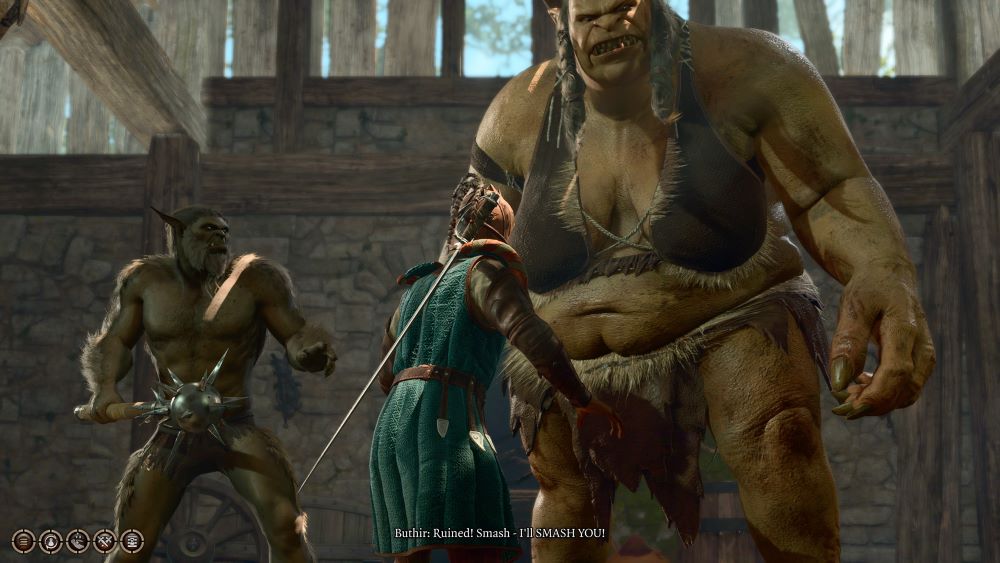
Some of the problems I have with the game are my own fault. I was super into 3.5e D&D way back in the day, and a lot of my “intuitive” understanding of such systems are still based on that clearly superior ruleset. Just kidding – stuff like Short/Long Rests and similar refinements over the years are definitely welcome. But it did come as a bit of a shock that, say, Rogues are only able to get one Sneak Attack per round in 5e (and BG3). Back in my day, the only way a Rogue could keep up with spellcaster DPS output was being able to poke someone three times in one round and get a pile of d6s each poke.
Okay, that’s clearly my bad. But then the line starts getting a little blurry.
For example: Mage Armor says to increase a target’s AC to 13 + DEX modifier, as long as the target isn’t wearing armor. This sounds like a great bonus for a Barbarian who is already encouraged to not wear armor… but it doesn’t “stack” with their own Unarmored Defense ability (Add CON and DEX modifier to AC when unarmored). Like, I get that it would probably be a bit overpowered, but I had to reread the text several times to understand why it didn’t work – Mage Armor specifically puts AC to “13 + DEX” instead of simply increasing the base AC of 10 to 13.
Of course, that’s just the classical Mage Armor gotcha, that apparently has been getting people for 8+ years. Worked in 3.5e, by the way, but clearly if you read page 14 of the 5e Player’s Handbook: “if you have multiple features that give you different ways to calculate your AC, you choose which one to use.” Okay, Rules As Written, got it. But riddle me this, Batman… what does the BG3 spell Warding Bond do?
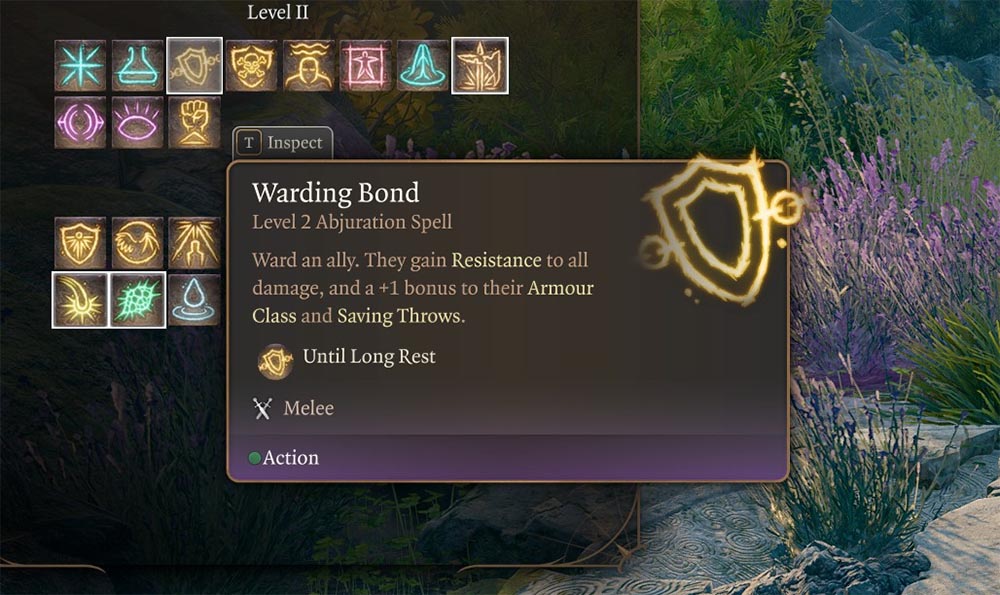
If you answered “create an unstoppable priesthood of clerics that only take half damage from everything,” you would obviously be wrong. Conspicuously absent from the BG3 description of Warding Bond is that the missing half of the damage you take can be found on the casting Cleric. Imagine my chagrin when I found that out, only after reading the “buff” that appeared on Shadowheart. But this is again a case of “just read the 5e Player Handbook to know how this 2023 CRPG works.”
Oh, hey, did you know that in BG3 prepared spells can actually be changed at any time outside combat? This is a big change from traditional (and 5e!) D&D rules that otherwise force you to, well, prepare which spells you can cast that day. What this means is that you can cast Mage Armor on yourself (which lasts until a Long Rest), and then drop it out of your list and put something else more useful in its place. You still use up one “casting” for the day, but now you get more options.
You can take things a bit further than that though, by having characters you’re not actively using cast things like Mage Armor while in camp. For example, you can have Gale cast Mage Armor on whomever, then swap Gale out for someone else. I had already been building my party in such a way that one person took utility spells and everyone else took offensive options, but knowing I could basically press the Camp button to essentially hotswap anyone at a moment’s notice took things to the next level. Now you can have your very own early-WoW era buffbot paladin, whose sole purpose is to stay at camp and buff your team.
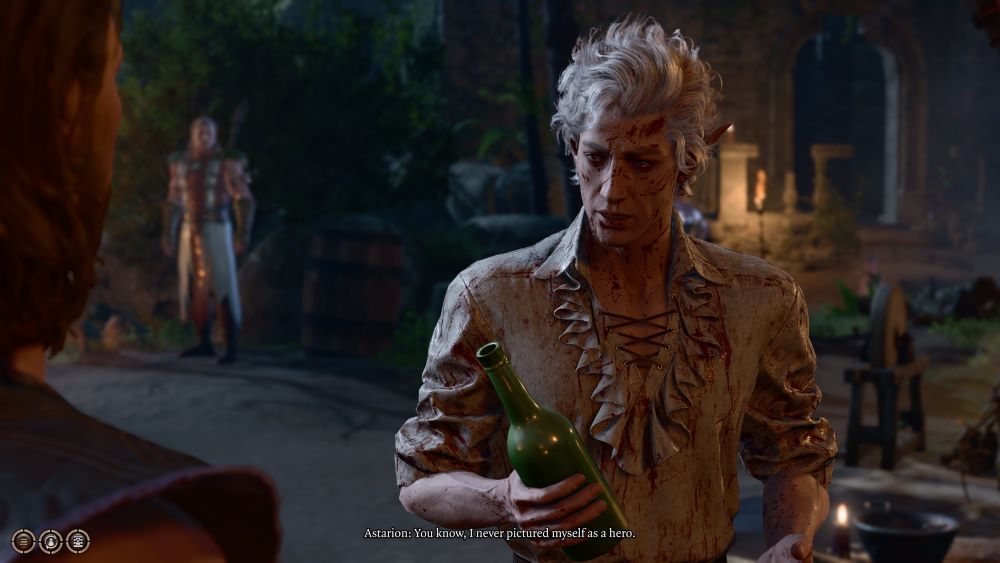
A lot of this highlights perhaps the biggest issue I have with BG3 at the moment: its inscrutability. A lot of the media praise thus far as been for the exact opposite, that the game is making 5e D&D or CRPGs in general more approachable. And that could certainly be technically accurate. But consider this: there’s no in-game way to determine what your characters will get at the next level up… until you level up. You can’t browse a list of magic spells. There’s a staff you pick up that gives you +1 to unarmed attacks and I have no idea how that works. Do staff attacks count as unarmed? Do you hold it in your off-hand and then make unarmed attacks with your on-hand? Does it only work with Flurry of Blows? I don’t even have a Monk character for which this would be relevant, but it vexes me.
And who knows, I might well turn Gale into a Monk next time I gain a level.
Perhaps the “average” player doesn’t care about any of this and will just take their character to level 12 just as they are. But that doesn’t mean Larian shouldn’t also include some kind of indexed in-game encyclopedia or something. If you have time for a Show Genitals button, surely you can have a Preview Level button. I would settle for a Wiki worth a single god damn, because the Fextralife one is near unusable and filled to the brim with outdated Early Access nonsense.
Anyway. Larian has indicated that they are working towards a Patch 1 with a “gigantic list of tweaks and changes.” Here’s to hoping that a little more clarity and intuitiveness is amongst them.
First Impressions: Card Hunter (beta)
I got into the Card Hunter beta last Thursday.
It is rare anymore for me to spend a lengthy amount of time playing the same game. Game developers these days front-load their daily bonuses in such a way that the most “efficient” way to maximize your playtime is to switch between 3-4 titles. And yet I spent ten hours playing Card Hunter on Saturday, and another six on Sunday. So, spoiler alert: I really like this game.
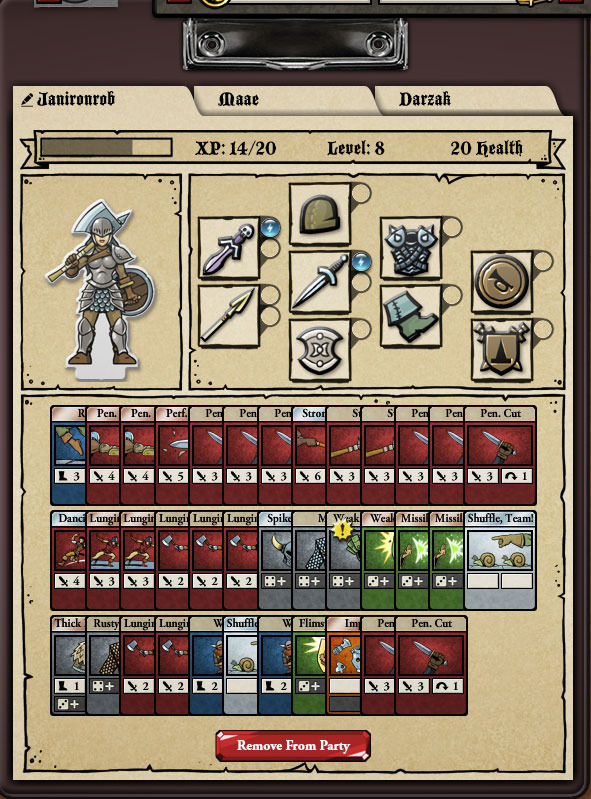
Card Hunter grabbed me from the word Go. In essence, this F2P browser-based game is a tactical, turn-based RPG where your abilities come in the form of random cards. Instead of building an entire deck on your own, a character’s game deck is actually the sum total of the cards associated with that character’s equipped items. This might sound complicated, but it is the exact opposite – after about 5 minutes of looking at the screen, the system becomes immediately grokkable and engaging. For example, here is a character sheet:
I have an immediate urge to go play right now.
All of the cards along the bottom are the sum total of the deck. When you look at a specific item…
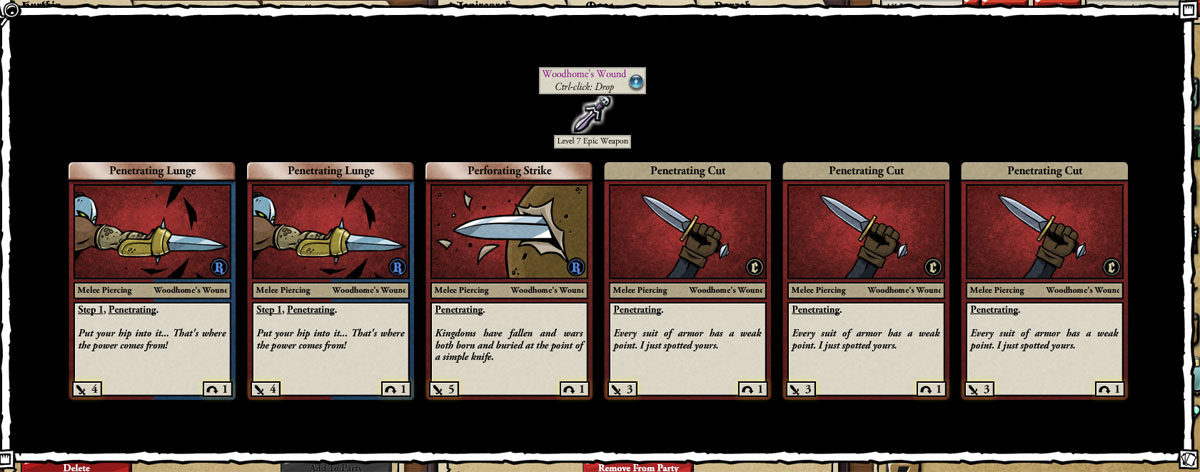
Kinda funny how it’s pretty much always going to be purple = epic from now on.
…you can see what cards it contributes to the overall deck. As you might imagine, weapons usually contribute attack cards, armor contributes armor cards, and so on. Occasionally though, you will have some items that contribute cards from outside their “theme.” Most items are limited to certain classes, of which there are three: fighter, cleric, and wizard. You can have either human, elf, or dwarf versions of any of those classes, with the differences being the typical D&D tropes; elves have low HP and fast movement, dwarves have the opposite, and humans are in the middle.
How does the game play? Fabulously.
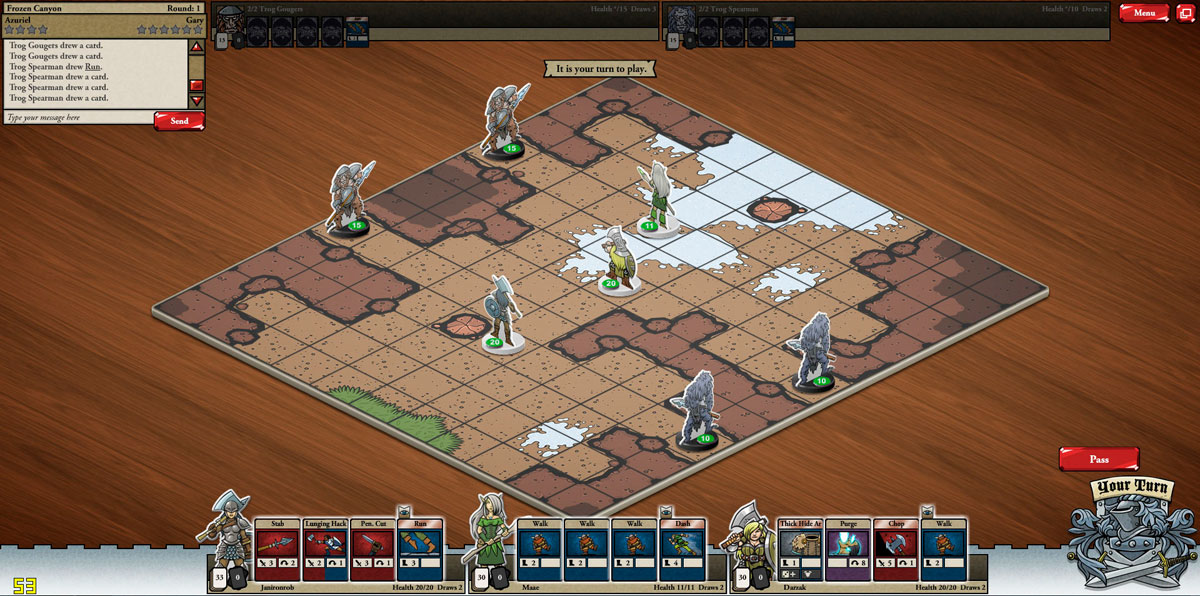
Yes. YES!
As you can see, the “setting/lore” of the game is retro-D&D, and it is adhered to from start to finish. All characters are represented with those figurines, and all the maps are exactly like this one (with different terrain and such, of course). The game’s F2P currency are slices of pizza, the battles are all prefaced with D&D-module write-ups, and there is clearly some tension going on inbetween the new DM Gary and his rules-lawyer brother Melvin in campaign mode – not to mention Gary’s awkward crush on the pizza delivery girl. Change some names around, add in two more teenagers, and Card Hunter could have described my high school D&D experience to a T.
As far as the game flow goes, it is pretty intuitive. You and your opponent take turns playing one card from any of your characters’ hands. You don’t have to alternate which character’s cards you play – if your warrior has 3 attack cards and someone within reach during each of his/her turns, you can wail on them 3 times. When you and your opponent pass turns in sequence, the Round ends, everyone discards down to two cards, three cards are drawn (one of which is always a movement card), and any Round triggers fire (e.g. players starting their turn in lava take 10 damage, etc).
The strategic brilliance of this combat system simply cannot be praised enough. Yes, the card-based nature of abilities can lead to immensely frustrating, if not outright impossible scenarios. In the screenshot above, for example, my elven mage has drawn all movement cards, severely crippling any initial attack I could muster. Defeat can (and will) be drawn from the jaws of victory even if you are careful. Here was a moment I exclaimed “You have got to be shitting me” out loud:
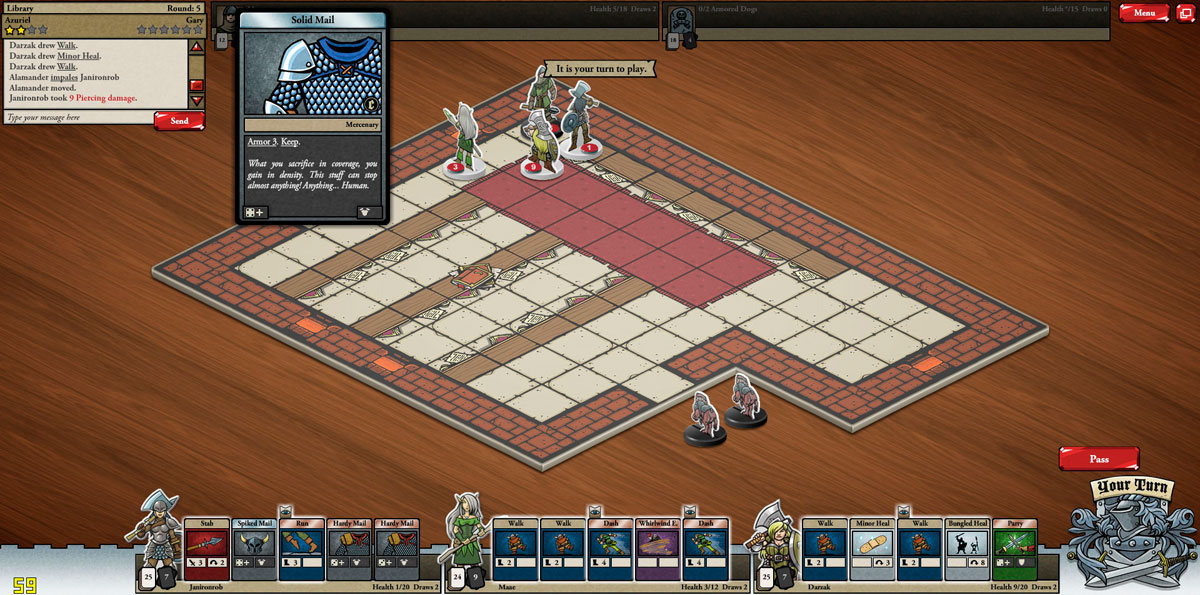
I mean, come on!
The above screenshot was taken from the dreaded Compass of Fucking Xorr level, right from where you might imagine is an insurmountable advantage. The armored dogs are dead, I have the last mercenary backed into a corner with 5 HP, and all my dudes are (barely) alive. It’s a new Round, my turn, and… look at the bottom. Don’t see many red cards, do you?
In fact, I drew exactly one attack card, and it only deals 3 damage. That larger card in the screenshot is a “seen” card that I know is in the merc’s hand, and it’s a doozy. Basically, any time you would deal damage to the merc, he rolls a d6: on a 4 or higher, the damage is reduced by 3. Like many Armor cards, it also has the Keep quality, which means it stays in his hand after triggering, ready for the next reduction in damage. And from fighting this guy, let me just tell you that his attack cards all deal 6+ damage from two squares away.
I did kill the merc on the turn after this one, as he just happened to draw a “drawback” card that caused him to discard all his armor cards. But it was a close one either way.
In any event, I am having a blast with Card Hunter thus far. That might sound strange after I just dedicated a few paragraphs to describing what could have been a terrible RNG-based wipe, but that kinda goes with the TCG territory. Who hasn’t been mana-screwed in Magic: the Gathering before? Part of tactical thinking should include the possibility of things going wrong – if games like Frozen Synapse taught me anything, it would be that. If nothing else, it keeps you on your toes.
I’ll go over the other elements of Card Hunter, including the ever-important F2P bits, next time.
Instant Gratification vs Fun Investment
All this talk about Magic: the Gathering makes me want to revisit a topic I briefly touched on last week, in the comments here and elsewhere. Namely, the sort of denigration of “instant gratification” and the elevation of investing in “long-term fun,” which is presumably shorthand for “doing a series of boring things for a reward later.”
The choice between instant gratification versus an investment in long-term fun is a false dichotomy. Gaming is an instance in which you can have your cake and eat it too.
One of the examples activities that was used to illustrate how “boring gameplay” can lead to bigger returns in fun was painting figurines in a tabletop game like Warhammer. Simply purchasing already-painted figurines would just not be the same despite having no direct gameplay relevance. I agree. I also agree with the notion that, say, using cheat codes to become immortal, having infinite money, and so on right at the start of the game likely diminishes the overall amount of fun you can derive from it.
But here’s the thing: someone who paints their Warhammer figures probably finds the act of painting them fun.
I used to play a lot of Magic: the Gathering back in high school. The games were nothing serious, just some 3-5 person chaos multiplayer amongst friends. However I would routinely spend about 10 hours crafting decks for every 1 hour a given deck would actually see play. In fact, if any of my decks began to routinely win, I stopped using them and built new ones.¹ And I had fun!
Deck-building was almost better than playing the actual game for me. There is something deeply satisfying in seeing a complicated scheme all fall into place, top-decking the one perfect counter that changes the game right when you need it to. But running all those scenarios through my head, pouring over all my available options, whittling down a pile of 250 cards I wanted to use into a perfectly-tuned 60-card machine was pure entertainment in of itself.
Another example: D&D. I ran a 4-year campaign throughout all of college, and a little beyond. As a DM, I let my players have ample freedom, but I made sure the world they inhabited was scaffolded in lore such that they had a place in it. In other words, I wanted to give them the ability to take the world as serious as they wanted to. Of course, most sessions started and ended with them starting a bar fight rather than the existential pondering I secretly wanted them to do. But it is not much of a stretch to say that I spent 20 hours per week in preparation of one 3-6 hour session. Never once did I consider those 20 hours a chore. I was excited to DM those games because it gave me the opportunity (and justification) to spend all that time world-building.
Now, clearly, what an individual finds fun is going to be subjective, and possibly something that changes over time and circumstance. But my point here is that the sort of activities necessary for long-term enjoyment – figure-painting, deck-building, world-creation – can be fun in of themselves. Not only can, but should. This extends to all in-game activities.
I do not buy the argument that something like Darkfall/EVE’s AFK resource-gathering systems is fun “because it gives you the time to do something else.” An activity doesn’t become fun by adding in a separate fun thing; an activity is either fun in of itself or it isn’t.² An unfun thing can become tolerable when mixed, but that is not a point in the base activity’s favor. Being punched in the face is alright if you give me $1,000, but I would rather just have the $1,000. Is desiring just the money considered “instant gratification,” or is that simply rational?
You can rightly question why I am not currently building Magic decks or constructing D&D campaigns if they are so fun in of themselves. The truth is that without the payout, without the destination at the end of the journey, these (investment) activities are not as fun to me. However, while they might not be as fun – that is, they are less fun than other things I could be doing instead – keep in mind that they still are fun. An actual destination acts as a force multiplier, if you will, to the entertainment of the journey. Contrast that with many of the in-game “investments” we are tasked to complete which make no sense to perform at all without reward, e.g. they are the punch to the face.
The distinction is important, because I feel it is far too easy to for us gamers to fall into the cognitive dissonance trap of “retroactive fun” and Sunk Cost fallacy. “I spent 5 hours farming herbs, it must have all been worth it!” Even if there is no real difference between actual fun and retroactive fun in practice (and isn’t that a depressing thought?), it does matter when comparing games mechanics in the moment.
All things considered, you should desire the mechanics that are both fun now and even more fun later. We simultaneously can and deserve to have both.
¹ A successful deck was a sort of “proof of concept” for me. Could my infinite damage combo reliably work in an actual hostile environment? Coming up with combos was a lot easier than constructing a deck capable of pulling them off, after all. Plus, my goal was never to craft a (P2W) deck that beat my friends 100% of the time; that sort of thing is never fun to play against anyway.
² It’s probably more accurate to say fun is a gradient rather than a binary distinction, one that can shift from one moment to the next. But I still believe that the unfun half of the scale hits zero right near the border.
Resistance is… Probably Not a Good Idea.
My (probably futile) attempts at conquering the Gratuitous Space Battle campaign mode continues. After looking at the available ship options, I decided to change races to the Empire. Some of the different races get access to unique weapons or ship layouts, but for the most part everything is the same. Except maybe not for the Empire. Most of their ships look like space stations, and come with a ridiculous number of standard module slots to match.
That and basically everything else likely means nothing to you, but just roll with it for now.
So my fleet composition looks something like this. First, the I-Point, which is essentially a damage-soaker featuring multiple shield generators and power plants to match. Under most circumstances, a ship will likely have ~200 shield HP, but the I-Point has 800+. It has a few weapons, but it’s orders are simply to close to EMP range and otherwise take the hits. Stuck in rigid formation behind it is at least one I-Help, which is a Frigate whose sole purpose is to use the Empire-specific shield-mending beam on the I-Point and on anyone else nearby. Tank and heals old-school style.
The big surprise, at least as far as effectiveness goes, came from the I-Battery. This ship design is fairly unique in what I have seen thus far, with it capable of housing 8 weapons in a Frigate hull. As tempted as I was to put missile launchers in every slot, I decided that I would instead go with the almost-as-good ranged Plasma Cannons. Cost-wise, the I-Battery were surprisingly cheap, which gives me leave to build 1-2 of them each turn.
Finally, rather than replace any of my Plasma Cannons with anti-fighter laser weapons, I decided to simply field a bunch of fighters myself, flying Escort mode around my I-Point. They are not as powerful as the fighters of other races, but they are the fastest in the game.
I was undefeated for a while, conquering planets at a pretty good clip under my balanced doctrine… until disaster.
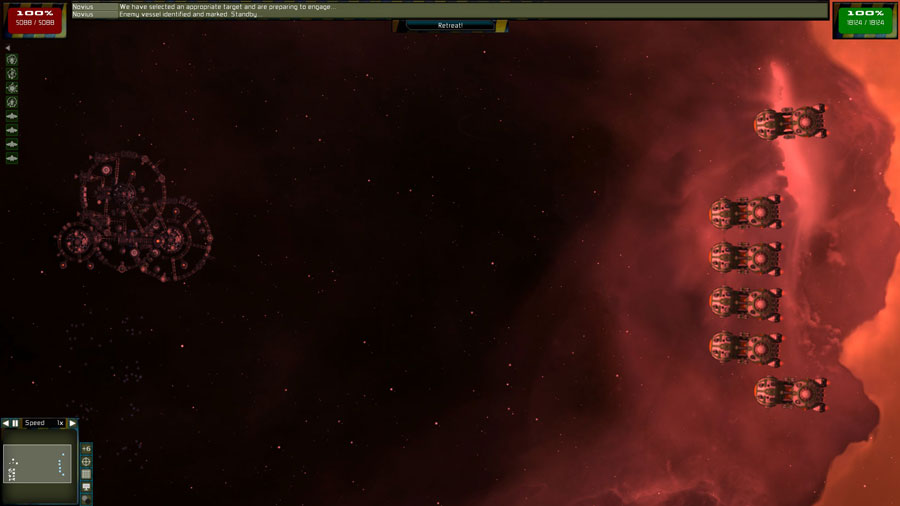
Hey, this looks familiar.
With a full fleet that was poised to take over a few isolated systems, I was instead attacked by a six cruiser complement of one of the DLC race ships. Their loadout? Missiles. ALL the missiles. I took special care in putting at least one Guidance Scrambler on each one of my ships, and their combined effort up to this point was usually enough to clear the sky. Not these missiles though, and not in this volume. I was annihilated by a specialized force – a missile force – and thus came full circle.
I did not give up yet though. Oh, no. I made an I-Screen ship, with Point Defense Mk 2 in every weapon slot to shoot down enemy missiles and nothing else. Remembering my failure with the fighters last time, I nevertheless fielded four squadrons of 16. And this time, I also made special orders for all ships to follow Vulture orders, e.g. always target the most damaged ship in range.
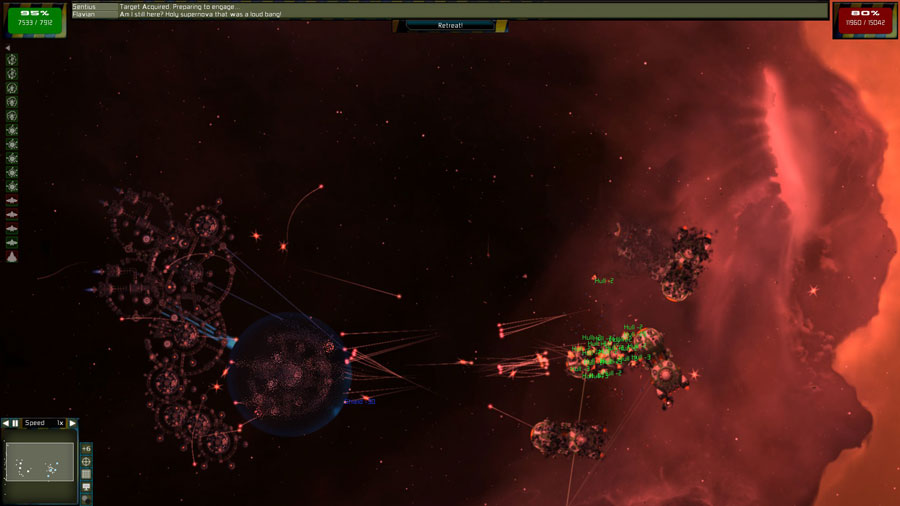
Remember me now?
The result was almost comical. I don’t know whether it was the Vulture orders or the extra squadron or something else, but my fighters blew two of the ships up and crippled two more before my cruisers even got within range. The I-Screen largely turned out to be useless, as the range of its anti-missile guns was too short to prevent them damaging the shields of the I-Point, and yet it was too fragile to place in front (defeating the purpose of the tank). In any case, the revenge was sweet.
But it would not last.

Misty day, remains of Judgment.
Riding high on my prior victories, I was complacent until a nest of vipers landed in my lap in the form of five Parasite cruisers. It almost didn’t seem fair… for them. I had a slightly bigger fleet than before, after all. As it turns out, the Parasite race has access to an AoE flak cannon that simply shredded my fighters like so much tissue paper. Even with the combined might of my fleet, I was not able to collapse even one shield amongst their ships. Instead of the normal Guidance Scramblers that deflect missiles, they have a version that turns the missile around and causes it to hit you, all with a greater range.
My fleet destroyed once again, I attempted to mount a counter-offensive with a new fleet after 10 turns. The result was even worse than before. Then, they captured my only planet with a shipyard, effectively ending the game.
There is no reloading saved games in GSB. One’s failure is absolute.
_____________________
I should note, in passing, that the most frustrating aspect of GSB campaign mode is also one of its most novel. You see, 100% of those fleet compositions I talked about are player-generated. In the vanilla game, you could submit your own fleet as a sort of “puzzle” (aka Challenges) that other players could battle and then rate. I played a few of these maps, but it all felt a bit pointless after a while, especially when it didn’t reward Honor (the in-game currency for unlocks). Wrapping this all up in a cloak of purpose via campaign mode though, did indeed breathe life into the concept as evidenced by my repeated head-banging.
Of course, this also means campaign mode operates with no rhyme or reason, as you charge headlong into truly random and insipid battles that you cannot hope to prepare against. Specialization beats Generalization every time, but the player is never afforded the luxury of anything else. It reminds me of the great debate of Critical Hits in paper D&D. On the one hand, rolling a 20 and getting double-damage feels awesome. On the other hand, the players will always face hundreds more dice rolls against them than they ever will roll against individual mobs. Ergo, players are more penalized by critical hits than they benefit, increasing the chances of a Total Party Kill… unless the DM fudges the rolls behind the screen.
 In An Age
Hitting a Nerve
Aug 26
Posted by Azuriel
Tobold wants me off his lawn. He has a history of political posts that claim “centrism” despite being wrapped in the language of right-wing culture wars, and the recent Races are racist post is no exception. In it, he laments:
Gnome barbarians and orc wizards, oh no!
Let’s take a moment to talk about the game design topic though.
This change just reflects what modern multiplayer game design figured out a decade ago: prescriptive racial modifiers only encourage min-maxing and otherwise limit design space. Look at the state of endgame World of Warcraft. Does anyone still think it is a good idea that the race you chose on the character select screen should have such an impact on raiding or M+ or PvP 15 years later? Maybe you say “yes.” Well, the end result of that is a faction imbalance so massive Blizzard finally buckled, and is making most activities of the game cross-faction in the upcoming Dragonflight expansion to prevent the entire edifice from collapsing.
Which is good idea, by the way, because factions are dumb too. “Let’s divide our playerbase and foster different and hostile identities.” Oh, now people are quitting in droves because they are stranded on dead servers/factions and none of our world PvP systems are viable. *Surprised Pikachu face*
Compare all that with, say, Guild Wars 2. I think technically each race has a special ability, but they are irrelevant at all stages of play, which allows players to pick a race based on aesthetics or fantasy. Want to be an Asuran Warrior instead of Charr or Norn? Go for it. One of my first characters 10 years ago was a Sylvari Engineer, because the thought of a plant-person running around with a flamethrower was hilarious to me. Still is, actually. If GW2 was more “traditional” fantasy surely I would have negative modifiers for being around flames, if I were allowed to be an Engineer at all.
Was any of that what Tobold really wanted to talk about? Nope:
You would think that a centrist is all for “bad compromises that make nobody happy,” but the follow-up comments demonstrate that is not the case. When I pointed out that, historically, CRPGs gave female characters Strength penalties for similarly dubious reasons, he replied with:
Well, there it is. A Rogue can make a successful Reflex Save in a broom closet hit by a Fireball (which also sets nothing on fire) to avoid all damage, but it’s important for reasons that fantasy game rules reflect “reality.” But only certain “realities.” And those certain reflections of reality are more important to a game’s design than, I dunno, any consideration of what the design leads to, e.g. prescriptive race/class combos that force players to choose between their own fantasy and numerical success. Nevermind the extra social pressure to be helpful that inherently comes from being a part of a group.
While I had been trying to avoid the bait, the third time was not the charm. In an unnecessary paragraph, I threw in this at the end:
In retrospect, not my proudest moment. However, it certainly hit a nerve, with Tobold going off quoting “They came for the socialists…” and how evil triumphs when good men do nothing.
Here’s the thing though: if you use the word “woke” as a pejorative and talk about the “thought police” being “triggered” while also apparently defending gender-based modifiers as being a justified reflection of (fantasy!) reality… you may want to take a moment and ponder on what “left of center” even is. This is not neutral language. Unless it was being used ironically in a way I did not detect, it hits about the same as Ron DeSantis’ victory speech wherein he used the word “woke” 5 times in 19 seconds:
Perhaps even pointing that out is ipso facto thought policing, in which case… weewoo weewoo, I guess.
I understand the desire to keep politics separate from one’s hobby. Although, that sort of presupposes politics weren’t already deeply ingrained from inception – art is usually a product of its time. What I do not understand is how or why this particular hill is the one to die on. Not only does it make no practical difference to the experience of D&D – you literally can make up whatever rules you wish or use any edition to run your game – it is not particularly interesting game design in the first place.
Indeed, here is a quote from the Principle Rules Designer for D&D, Jeremy Crawford:
Here is another one:
If you want a traditional, archetype-driven high-fantasy campaign wherein Orc babies light up when the Paladin casts Detect Evil, go right ahead. I personally ran D&D campaigns for six years that featured nary a dungeon nor a dragon. Do what you want!
But if you are insistent on being outraged by this change, irrespective of your ability to articulate a game design counter-argument, cloaked in the language of far-right cultural wars, maybe some introspection is in order. And if the notion of introspection itself feels like self-censorship to be fought with the strength of Niemöller… well, you kind of got your answer right there, eh?
Posted in Commentary
11 Comments
Tags: "Reflects Reality", Culture Wars, D&D, Game Design, Racials, Tobold