Blog Archives
Diablo Annual Pass Challenge
Tobold forced my hand a bit, so without further ado… I formally present:
The Diablo Annual Pass Challenge
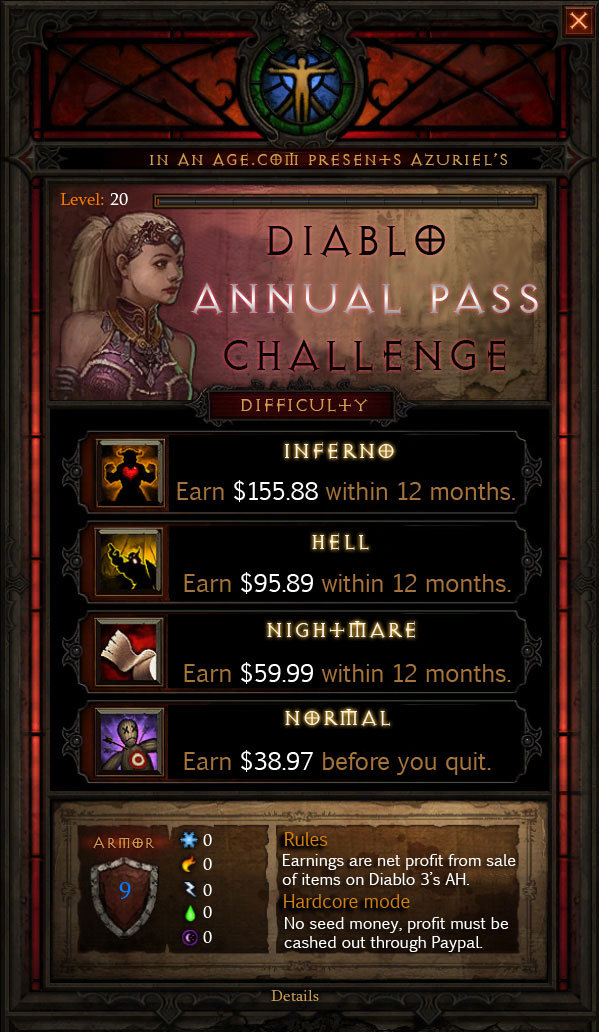
For the the visually impaired, the four difficulties are as follows:
- Inferno – Earn $155.88 within 12 months.
- Hell – Earn $95.89 within 12 months.
- Nightmare – Earn $59.99 within 12 months.
- Normal – Earn $38.97 before you quit.
Completing Inferno will mean you financed both Diablo 3 and a year of WoW (with associated perks) entirely through Diablo 3’s real-money Auction House. The step below that, Hell, means you financed an entire year of WoW through the purchase of a $59.99 game. Meanwhile, Nightmare demonstrates that you got Diablo 3 for free after paying for a year of reduced-price WoW time. Finally, completing the Diablo Annual Pass Challenge on Normal difficulty means you managed to pay for 3 of the 12 required months via Diablo 3 gameplay.
A Hardcore mode can apply to any of the above difficulties, and requires two things: 1) no seed money, e.g. putting $20 on your account to get started, and 2) net profit only counts when cashed out via Paypal.
Death is (unfortunately) permanent in all difficulties and modes. We are working on a hot fix.
For the purpose of this Challenge, “earnings” refers to net profit from the sale of items in Diablo 3’s AH. If you spent $50 and made $160 flipping items, you have only actually achieved Hell difficulty, not Inferno. “Items” refer to anything sellable on the RMAH, whether it is gear, gold, gems, characters, etc. Any money spent in the satisfaction of your Annual Pass obligation, i.e. buying game time, will still “count” as long as it came as a result of AH profit. In other words, you don’t have to just sit on the money until you reach your desired difficulty.
For those Challenge participants not using USD, simply use the relevant cost of two 6-month WoW time cards (Inferno), two 6-month WoW time cards minus the cost of Diablo 3 (Hell), the cost of Diablo 3 (Nightmare), and the cost of three months of the reduced-priced WoW Annual Pass subscription in whatever your local currency happens to be (Normal).
Good luck everyone, and don’t you dare undercut my shit.
The Underplayed Piece of D3 News
You can buy and sell characters.
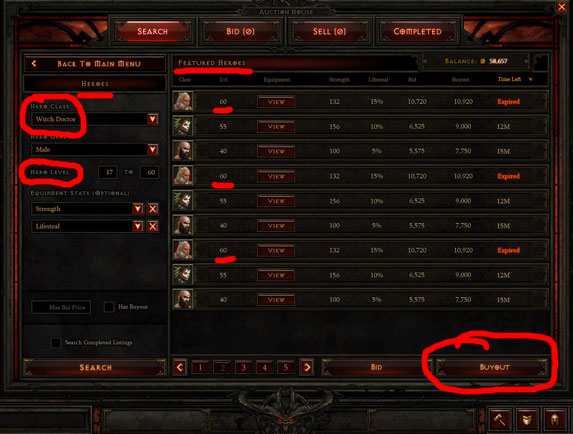
The screenshots (from MMO Champ) are fairly low resolution, but it does clearly show Featured Heroes results, the drop-down box for the class, narrowing your search to level ranges and, of course, three listings of level-capped toons for sale. Apparently the market price for a level-capped Witch Doctor is 10,000g. I would recommend buying out all three and relisting for $20 apiece.
…things are going to get fun, aren’t they?
One quick item of note (that may be old news to some):
- Personal loot. I was planning on making a post about how the whole RMT value of gear would make grouping and co-op loot rolling bizarre, but hey, this appears to have been settled over three years ago. In effect, each player gets loot from bosses/kills individually. In WoW terms, imagine killing 10m Magmaw or whatever and each person getting a (random) piece of gear instead of two pieces of random gear that has to be divvied up between 10 people. The funny thing is that this works in Diablo because loot is truly randomly generated, but absolutely doesn’t work in WoW judging by most peoples’ reactions to the random-stat loot in Throne of the 4 Winds, etc.
- Of course, grouping can still get weird assuming you are playing with friends. If a cool Barbarian axe drops that you can’t use on your Wizard, do you give it to your Barbarian friend… or sell for $5?
- Making things worse, few (if any) items in the game are BoP. This means you can swap with your friends (passing down a good item), but also that if you agree to mix-n-match loot in co-op, your friend can sell that Barbarian axe you gave him for cash later and you would never know (especially if he replaced it with a legit upgrade). Might sound petty or too goblin’ish right now, but believe me, this is a Diablo game; eventually there will be some 0.001% chance item drop that could easily sell for $100+ on eBay without even considering a Blizzard-sanctioned RMT system.
I would say that this will be the last post about Diablo 3, but honestly Diablo 3 is the most interesting thing that has happened in weeks. Other than Limbo being released on Steam.

Talk About Free Publicity (Diablo 3)
Diablo 3 will let you sell pixels for dollars, in-game, and vice versa.
My first thought, along similar lines to Alto, was: can you imagine the number of gold guides for Diablo 3? WoW alone supported one costing $47 for the majority of the game’s lifespan, and that is discounting the other, cheaper ones of the last few years. And you couldn’t even really cash your gold out! In a game where you could presumably spend $47 and make $100 in-game using the tips, it might be foolish to not do so. Unless you could get those same tips from anyone with a blog, of course.
My second thought was self-reflection on why I instinctually despised this news. If you never use a cash shop, and if you don’t care that other people do… then why hate it? There are two reasons why.
- Number 1: It removes, or diminishes the value of time.
When you drill it down, by “value” I really mean “advantage.” If I can play five hours a day and you can only play two, all other things being equal, I will have an advantage over you in an MMO. Especially in MMOs, where the design is to throttle content to ensure monthly subscriptions. I will reach the level-cap sooner, I will level more alts, I will have access to more professions, I will have more attempts on raid bosses, I will be geared to the teeth while you are still struggling for your two-piece bonus. Skill can overcome Time in many areas (Arenas, raiding, etc) and obviously a complete moron would be incapable of any number of activities no matter how much time they spent playing.
Most people, grudgingly, can accept when their Time was beaten by an opponent’s Skill. In RPGs, people are more forgiving of when Time beat Skill – the premise being that Time is something that acquires value in only one specific way (“earning” it) that is available to anyone*. Cash Shops, RMT, and so on radically change the calculus. Time, which hitherto was “priceless” in-game, now has a price. If we are equally skilled, I can win by either Time or Cash whereas you may be limited (literally or philosophically) to Time alone. If the game makes Time capable of beating Skill, and Cash = Time, then Cash > Skill becomes possible. This is where the whole “Pay-To-Win” (Golden Ammo, etc) pejorative comes from. As a gamer, you have to start asking yourself why you would “invest” in Time in a game where anyone with more Cash could stomp you at any moment. If Time is all you have, there are other games without Cash Shops which would give you a better return.
Blizzard has thus far avoided the Pay-To-Win scenario in WoW by keeping the Cash Shop limited to cosmetic items and preventing gold from being (legitimately) purchased. Meanwhile, Diablo 3 is balls-deep in Pay-To-Win by every available measure. From their FAQ:
Will players be at a disadvantage in the game if they do not purchase items in the auction house?
All of the items available in the auction house can be obtained in the game. The auction house system is designed to facilitate the exchange of items (items can also be exchanged through character-to-character trades). Diablo III is primarily a cooperative game; while the game will offer some highly entertaining player-vs.-player options, we don’t intend to balance items for player-vs.-player gameplay. We feel that a robust and powerful item-trading system will make the co-op experience more enjoyable.
The question after that is equally hilarious.
Can I just buy the most powerful items and breeze through the game?
Items will be level-restricted, meaning your character won’t be able to use an item until he or she is at the appropriate level for that item.
Read: you can purchase the most powerful items for your level to breeze through the game with, until you hit the level cap of 60 where uber-gear** will likely make or break your character just like in WoW. For the low, low player price of $100 per slot, if we are lucky. And we may actually see sales that high or higher, given that it would be “affordable” after the sale of a bunch of $5 auctions. Keep in mind that while Blizzard is providing a “cash out” advanced feature, it is actually pretty misleading:
How do I cash out from the currency-based auction house?
As an advanced feature, players will have the option of attaching an account with an approved third-party payment service to their Battle.net account. Once this has been completed, proceeds from the sale of items in the currency-based auction house can be deposited into their third-party payment service account. “Cashing out” would then be handled through the third-party payment service. Note that this process will be subject to applicable fees charged by Blizzard and the third-party payment service. Also, any proceeds from the sale of items in the currency-based auction house that have been deposited into the Battle.net account will not be transferrable to the third-party payment service account. Not all regions will support this advanced feature at launch. Region-specific details, as well as details regarding which third-party payment services will be supported and the fee that Blizzard will charge for the cash-out process, will all be provided at a later date.
In other words, any dollars that actually reach your Battle.net account essentially become carnival tickets – non-refundable currency that performs as pseudo-cash, buying you the big fuzzy bear, Disco Lion, or 30 days of WoW. The “cashing-out” only occurs if you tweak your Battle.net settings so that AH proceeds never actually touch your Battle.net account, but get directly deposited into your Paypal account or whatever. Considering you can’t actually buy anything with dollars until said dollars are loaded into your Battle.net account (thereby making them non-refundable), I have little doubt there will be quite a few surprised AH goblins out there who find that their $1000 nest egg will, at best, keep them subscribed to Titan or whatever for the next half-decade.
- Number 2: It threatens design integrity.
This is decidedly a gray area, especially in a post where I already said “[…] the design [of MMOs] is to throttle content to ensure monthly subscriptions.” What design integrity means to me is asking yourself whether what you are about to do is going to make for a better game (story, simulation, etc). I intentionally did not say “makes your game better” because typically gaining more subscriptions or selling more boxes makes a game with a multiplayer component better. Instead, design integrity is about making the game in of itself better at what it is. If a game can only be better if it had more people playing it, that is a job for the marketing department, not game designers.
One of the clearest, most easily recognizable breaches of design integrity to me would be the Firelands daily quests. There is nothing about this series of quests that gets better for them having been spread out over 30+ days. Nothing. Even if your argument is that the number of days serves to simulate the long struggle of a dangerous military campaign, I would counter that the same feeling could be accomplished by doubling the number of actual quests, and allowing a choice few to be repeatable once complete. An example could be, I dunno… the entire Hyjal zone itself?
Obviously the Firelands dailies were not the first incident of intentional content throttling (there were reputation grinds, etc, from Day 1), but it is particularly galling to me insofar as the way it was hyped and presented. Seriously, they came out and said…
Rather than these stages only becoming available after a certain period of time or at the end of a long quest series, players will instead get to use a new alternate currency called Marks of the World Tree to unlock them at their own pace.
…as if stages were not available until after a certain period of time (weeks) or at the end of a long (daily) quest series. Again, the Argent Tournament et tal did this years ago, but in that particular preview they merely state exactly what was going on: new dailies.
How this relates to Diablo 3 is simple. Does a currency-based AH make Diablo 3 a better game? I do not think it does. What it seems to be aimed at is what Blizzard mentions in the FAQ, along the lines of “since you guys are going to do crack anyway, we may as well supply it.” If getting the perfect item or set is the motivator for playing the game (after finishing the story), does the inclusion of an AH at all make Diablo 3 better than, say, some profession/item/etc that could randomly turn items into a different version of itself? Such a thing would perhaps be distracting from the Skinner Box lever that is grinding bosses for loot (e.g. spend more time randomizing one item than simply killing things for a random shot at another), but it is a question worth asking anyway.
The fear here is Cash Shops and RMT lead to F2P-esque games that sacrifice the fun of the game for monetization of the game. Tobold has talked about the World of Tanks model many times, but it is most succinctly described in the opening paragraphs of his Payslope post:
Even Free2Play games need to make money to be sustainable. Many have some sort of paywall, reserving certain content for people who pay. World of Tanks doesn’t have such a wall, everybody has access to all the maps and tech tree tanks in the game. Instead WoT has something I’d rather describe as a payslope: The high-level game becomes very tedious if you don’t pay.
The effect is first noticeable around level 7 (out of 10): Starting from this level regular tanks on regular accounts tend to spend more credits on ammo and repair than they get as credit reward at the end of the battle. There are some variables there, winning earns you more than losing, and dealing a lot of damage also earns you more. But with level 8+ tanks costing millions of credits, money definitely is getting tight at the higher levels.
I am not opposed to game designers being paid for their quality products. I am, however, opposed to intentionally hobbling the player’s game experience to “trick” them into paying to continue playing a game they found fun. If World of Tanks did not have a Cash Shop or RMT, do you think they would still have a point in the leveling curve where it became extremely tedious to play? Maybe. You would rightly call that bad game design however. Same deal with MMOs and systems designed to take weeks of repeated content to complete.
Blizzard stated that Diablo 3’s loot system was developed before they decided to add an AH with RMT options. I have no choice but to accept that statement on face value. But given the carnival ticket structure of money in Battle.net accounts, it is abundantly clear Blizzard stands to make an absolute killing by implementing RMT even without considering the Blizzard cut on both listing and successful auctions. Even if you are a pro AH goblin and amass $10,000 without yourself ever paying anything into the system, that is $10,000 (+X% of whatever Blizzard cut) sitting in a Blizzard escrow account earning interest, all of which would have been “left on the table” otherwise. They repeatedly said they will not be selling anything or setting prices, but it would be incredibly naive to believe that future Diablo 3 balance decisions (drop rate, etc) will not directly affect Blizzard RMT profits, and/or Blizzard would not ever make changes with such things in mind.
Bottom line: you can only really trust someone who makes you pay everything up front. Provided they actually deliver the product you bought, you will know that they had no incentive make an inconsistent experience. And inconsistent experiences make for the worst videogames.
*In reality, Time as an advantage is just as “unfair” as Cash could ever be. Just ask anyone who has typed the phrase “no-lifers” or “you just live in your mom’s basement.”
**Even more interesting to ponder is whether Blizzard intends to limit the gear from Nightmare and Hell difficulties to only being wearable by players of those difficulties. I mean, I can only assume gear dropped from Hell difficulty would be better than Normal mob drops. It is possible they intend the level cap of 60 to only be achievable on Hell difficulty, although I imagine it would be almost as tough a sell as the opposite – not everyone can/wants to play on that level, but do you simply not give the average player access to the coolest spells? Or are the gaming veterans stuck with merely upgraded spell stats instead of abilities?
The Problem With F2P and Microtransactions
Are you someone who almost never engages in microtransactions, has no real issue with people that do, but nevertheless feel like you are losing something whenever a game company starts to embrace them? Do you get the sensation that the purchasing power of your money is decreasing the longer a game goes on, seemingly for no real reason? Do you think cash shops are just plain wrong but have difficulty expressing it in words? The good news is I finally remembered the name of the economic concept behind the sensation: consumer surplus. The bad news is… so have game companies.
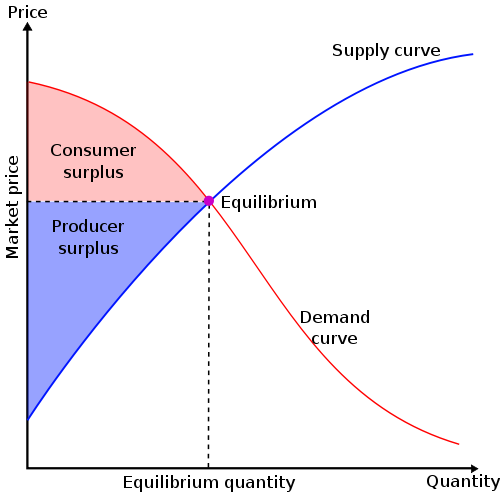
Consumer surplus is the difference between the maximum price a consumer is willing to pay and the actual price they do pay. If a consumer would be willing to pay more than the current asking price, then they are getting more benefit from the purchased product than they spent to buy it. An example of a good with generally high consumer surplus is drinking water. People would pay very high prices for drinking water, as they need it to survive. The difference in the price that they would pay, if they had to, and the amount that they pay now is their consumer surplus. Note that the utility of the first few liters of drinking water is very high (as it prevents death), so the first few liters would likely have more consumer surplus than subsequent liters.
The description is pretty self-explanatory, but I think the graph is a bit more useful.
And why not, here is a Greek college professor talking about it.
Do you want some videogame examples? Think back to multiplayer Diablo 2 and Warcraft 3. When I bought Diablo 2, it was because I wanted a quality dungeon-crawler experience similar to Diablo 1 – that there was an entire multiplayer experience attached was pure consumer surplus for me. Same with thing with Warcraft 3. Would I have paid an extra $5 for access to multiplayer? Probably. That $5 that I would have paid but did not have to amounted to Blizzard “leaving money on the table.”* Non-game examples includes Netflix Streaming, where you can access hundreds of movies at any time for $7.99. In spite of the “controversy” surrounding them raising prices of dual streaming/DVD plans, I think it is rather obvious that most Netflix customers would actually pay $10, $15, or even $20 a month for the service, especially since Movies On Demand-style services can cost upwards of $4.99 per movie.
The entire premise of microtransactions is dividing your content into smaller chunks to (re)capture and monetize every ounce of consumer surplus. While it is true that overall the game and it’s various monetized components are still worth buying – it falls within the bounds of the Demand Curve, which by definition means you value the game more than the money used to purchase it – it is equally true that literal value has been extracted from you. In other words, microtransactions remove value from games by reducing your consumer surplus.
Now, there may be the open question of whether the sort of microtransactions Blizzard is doing “counts” as consumer surplus mining. If Blizzard could/did not charge $25 for a mount, for example, would they have made the mounts at all? Would Blizzard have never made the Mobile Armory and/or the premium RealID grouping features if those did not tack on an extra subscription fee? I think they might not have developed those features and mounts, but that is more of an issue with the lack of credible competition** Blizzard faces than anything else. Indeed, competition generally engenders the greatest amount “value-added” consumer surplus since direct price wars are untenable. Then again, I might also bring up the Red Queen argument in that, much like raiding content, Blizzard has to continually be moving forward to maintain its present position. The artists that made and animated the Disco Lion would have been working on something either way, so if not adding that mount in as a PvE/PvP reward of some type, the effort might have been directed into a Titan or Diablo 3 model instead (increasing consumer surplus in those games).
In any case, I find the F2P and microtransaction model somewhat disturbing, yet inevitable. It obviously has the power to save games that would not exist otherwise (e.g. LotRO, APB, etc), and thereby opens the possibility of radical innovation in the types of games we play. Similarly, the rise of Steam and iTunes (and Facebook for that matter) as content delivery services makes indie games/music possible that could not exist in a typical retail box store. That said, the existence of that hitherto unexploited consumer surplus also leads to worse games, like Tiny Tower***. Meanwhile, instead of growing the industry, we have the major players pumping out sequals and squeezing the blood from what rocks are left instead of, well, mining for new rocks. This same phenominom is going on in the movie industry, with parallels like making movies 3D not because that adds value, but because A) they get to charge more, and B) it makes the movies nearly impossible to pirate.
The way I see it, the more game companies fall over themselves trying to monetize every corner of our consumer surplus, the less they fall over themselves giving us quality entertainment. Eventually, there will be some break-point beyond which lies an Era of Subsistence Gaming where we get exactly what we pay for and not one whit more. And those will be very bleak times indeed.
*Except Blizzard did not actually “leave any money on the table,” since that implies there was no value to Blizzard for giving consumer surplus. As we all know, it is the exact opposite: we as players give that value back to Blizzard in the form of brand loyalty and positive word-of-mouth recommendations. Part of that comes from the (historic) quality and polish of their games, but the feeling that we are getting more plays a non-zero part in the calculus.
**Blah, blah, Rift, LotRO, etc. Rift peaked at 600k subs and is now hovering around ~480k. LotRO peaked at 560k and is now at 360k. If you add both Rift and LotRO numbers at their peak, and then multiplied that by two, WoW would still have had more players than that in just North America… in 2008. Lost subs are lost subs, but I bet the Disco Lion made more money in the opening day it was released to cover a year’s worth of lost subs.
***Worse as in psychologically designed to exploit your nucleus accumbens, and essentially disprove the economic theory of rational consumers single-handedly.
 In An Age

Always Online: Missing the Point
Aug 9
Posted by Azuriel
I still have a problem with the always-online trend, but it actually comes from the other direction. Fundamentally, I am always connected to the internet… but that does not mean I always have a connection capable of running a client/server game without lag.
Spotty Wi-Fi? It happens. ISP having issues with Blizzard’s servers? Been there, done that. Indeed, Time Warner (the only cable internet provider in my area) frequently has intermittent disconnects in the 11pm-3am time period when I am most active (I work 2nd shift). And obviously playing multiplayer games like FPS and WoW is impossible when, I dunno, I am downloading torrents, Steam/iTunes/antivirus programs decide to update, someone on the same connection boots up Netflix, and so on and so forth. Any of those other things are about 1000% more likely than lugging a laptop onto airplanes, trains, or buses.
So please don’t construe this always-online DRM as a value-added feature when it is nothing but movie executives futilely pushing 3D movies because it eliminates the majority of piracy. There are better ways of eliminating that kind of piracy, but the movie industry is choosing the one that makes them more money.
Speaking of choosing the option that makes them more money. Tobold mentions that the cash AH in Diablo 3 necessitates a constant connection, but cheating prevention is honestly a red herring as Tycho from Penny-Arcade divines:
Diablo 3 was going to spawn a black market(place) if Blizzard did not do anything, but there were other options available. Flagging items as being offline-only, having separate offline characters*, or hell, even turn item/gold duplication into a (somewhat hidden) feature, preemptively destroying that market. If you choose to log onto some epic’d-out guy’s server, it is indistinguishable to you whether said guy hacked the items into existence or bought them all from the AH. Don’t group with that guy. This is Bashiok:
I have a hard time reading that and accepting the premise that cheating harms anything, especially under the Diablo model of a co-op dungeon grinder. Hell, I have a hard time accepting the premise of a co-op anything that you play with total strangers all the time as opposed to with people you know, but that might just be me. I would never open up a public Minecraft or Magicka or Portal 2 or Dawn of War 2 server, for example. Competitive game modes like TF2 or Counter-Strike or WoW BGs are one thing, “intimate” team projects you cannot quickly exit are quite another.
*Blizzard did address this by saying they did not want someone leveling up to the cap, eventually coming around to the whole online idea, and then realizing that they would have to reroll completely. To which I reply: you are allowing the buying and selling of characters. Throw down $20 and you can have a fully epic’d, level-capped character to play around with online. Problem solved.
Posted in Commentary, Diablo
Comments Off on Always Online: Missing the Point
Tags: Always Online, Diablo 3