Blog Archives
Review: The Outer Worlds 2
As mentioned, I recently completed The Outer Worlds 2 (TOW2) after about 70 hours of playing. There is a lot of like about TOW2, especially in comparison to the original game, but there is an equal (or greater) amount of terrible game design. Moreover, for all the news articles extolling Obsidian’s return to Fallout: New Vegas form with this title, I see regression at best. And, seriously guys, it’s been 15 years.
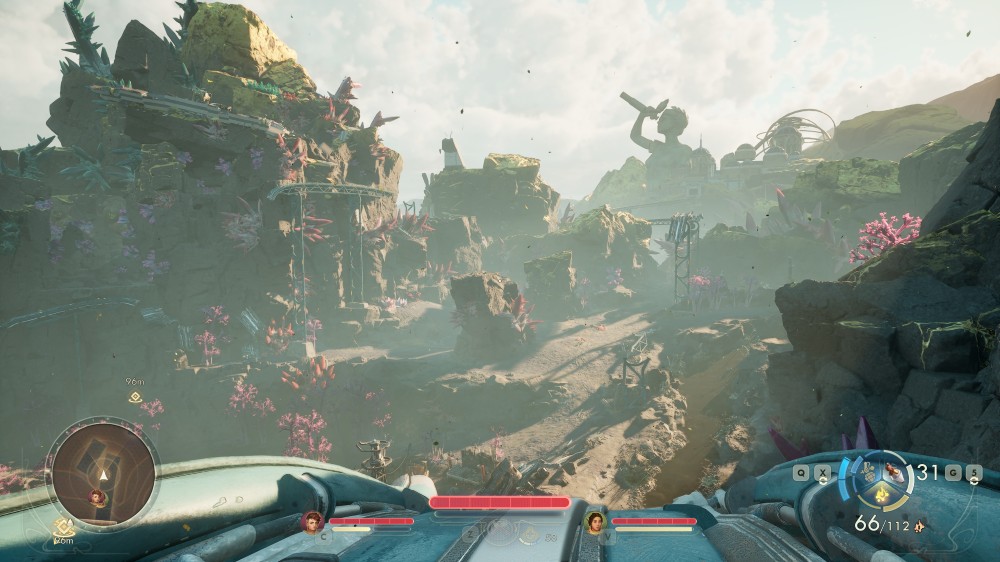
First, the good stuff. The game is gorgeous, maps are large, the skyboxes interesting. One of my criticisms from the first game was that interior spaces felt generic and cut & paste in the “let’s pretend it was on purpose because modular sci-fi habitats” kind of way. Thankfully, TOW2 feels much more diverse and detailed. There is still a definite lack of something that the aging Bethesda Gameybro Engine is able to evoke, but it is worlds better than before. Also, the act of traversing the landscape itself feels great, with double-jumping and auto-vaulting on par or better than with Avowed.
Gunplay and collecting bits and bobs out in the world is also much improved. There are baseball-esque cards sprinkled around everywhere that grant you +1% critical hit chance (etc), which makes exploration more exciting. The world is populated with many junk items that can be broken down into crafting components and then turned into ammo or mods. The original game featured a punishing repair/tinker system that drained you of resources; this one lets you use whatever guns or armor you want (for the most part) straight into the endgame.
Where the game falls apart for me is with the Skill Checks, and a broader fetishization of “choices matter” when they really do not.

Before I begin, there is one aspect of Skills I do want to give Obsidian credit for: they solved the combat vs social skills dilemma. In almost every RPG I have played, allocating a limited amount of points into something like Speech meant you were radically weaker than someone who put them in Guns. Broadly speaking, that is not the case in TOW2. Each point is Speech gives you a +10% damage bonus against Human targets. There is further a Perk called Space Ranger that gives you a 2.5% damage bonus against all targets for every level of Speech you have. While that is not as good as an unconditional 10% per Guns level, it no longer feels as though you need to gimp your character in order to talk to characters in an RPG.
But, see… that’s just the thing. This is a game of “choices” which is governed almost exclusively by Skill checks. In the original game, you could respec, wear gear with Skill bonuses, or even take certain companions with you to achieve certain Skill thresholds. Not anymore. You are hard-capped at level 30, meaning you can have three Skills at 20 with maybe two points elsewhere; two Skills at 20 with a few more at scattered about; or a single 20 Skill and a more even distribution across a few interesting ones. Obsidian devs have said they wanted players’ “choices to matter” and for players to commit to mistakes. Choices made… where? On the character page, prior to knowing anything about the rest of the game? Something like the very meaningful choice between Lockpicking 5 and Lockpicking 6?
The end result is this nonsense:

I spent the last third of the game with 17 unallocated Skill points, and 5 unchosen Perks. This is an epic game design fail on all sorts of levels. For a start, it illustrates how easily I was able to forgo 170% extra gun damage and still breeze through the game (on Normal). Indeed, my “build” was capable of one-shotting every non-boss enemy in the game from stealth… with zero points in Sneak. Second, it makes a mockery of “commitment and/or consequence” seeing as how I was easily able to pop into the character menu and become an expert of any relevant Skill as needed. Finally, it demonstrates how boring the capstone Perks (ones requiring 20 points in X) were, that I was completely unmoved to commit the Skills points needed to get there. As a matter of fact, almost none of the Perks were especially relevant or impactful, which is crazy considering there are 90 of them.
Now, as pointed out in my Tips post, you don’t actually have to max out Skills to avail yourself of all the most meaningful options. You wouldn’t know that while playing the game though, which is part of the problem. A lack of meaningful information precludes a meaningful choice. Would you still choose to get to Speech 20 if you knew Speech 9 was good enough for the kumbaya ending? Or, honestly, Speech 5 considering how odious one of the factions ends up being. And if Speech 5 is good enough, why do we need Speech to be the determining factor in the decisions our character makes at all?
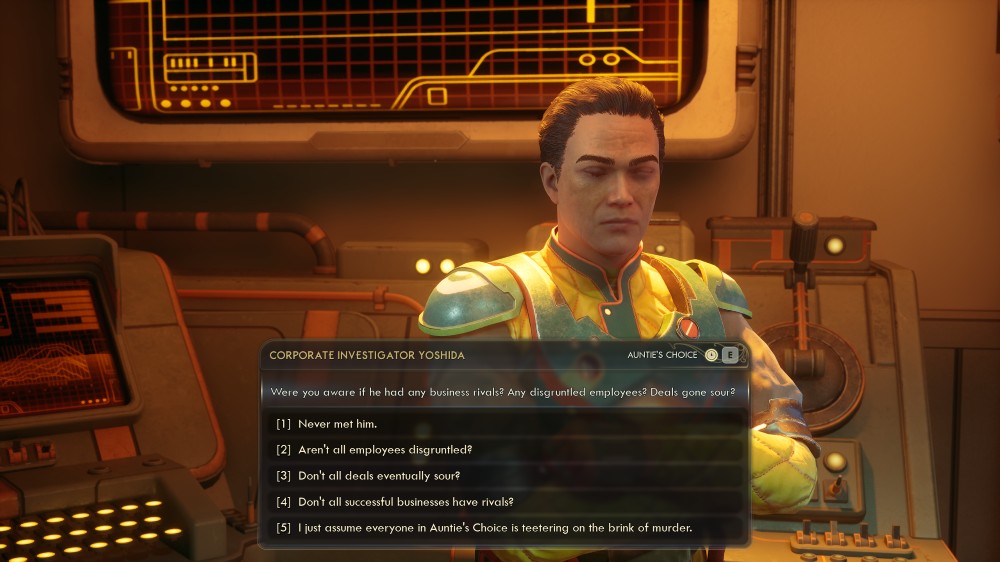
“It’s an RPG.” So are Mass Effect and Dragon Age: Origins. Is a game only an RPG if you have to put points in a Speech skill in order to make decisions? That sounds more like a Roll-playing game, amirite.
Having said all that, a lot of this is moot because the overall narrative of TOW2 is weak. The game starts off fairly strong with a much more consistent tone than the original. You learn about Auntie’s Choice, the ultra-capitalistic caricature of corporations from the first game, and then interact with the Protectorate, the ultra-authoritarian, brainwashing, jobs-assigned-at-birth and report-your-family-members bad guys. Later, you meet the Order, who represent scientists who use math and probability to predict the future. But then the Protectorate becomes generic antagonists and you just have Auntie’s Choice and the Order to play off one another and I could not be less interested. The vaunted, hard-hitting choices from the makers of Fallout: New Vegas boil down to who you want to attack you on sight for not taking them to prom. With a high enough Speech skill, you can take them both. Whee.
Maybe that is reductionist. All I know is that I played through all the faction quests and did not once feel a spec of moral gravity. Compare that to interacting with Caesar’s Legion, NCR, House, or going it alone in New Vegas. The companion quests in TOW2 did fare better than the main story, but it is one of those situations in which you sort of question why the writers are hiding the light under the bushel of characters you technically don’t even have to recruit. Maybe that’s what they mean by choice? Then again, that’s sort of like saying you’re making meaningful choices by not playing the game.
…which I may ultimately recommend.
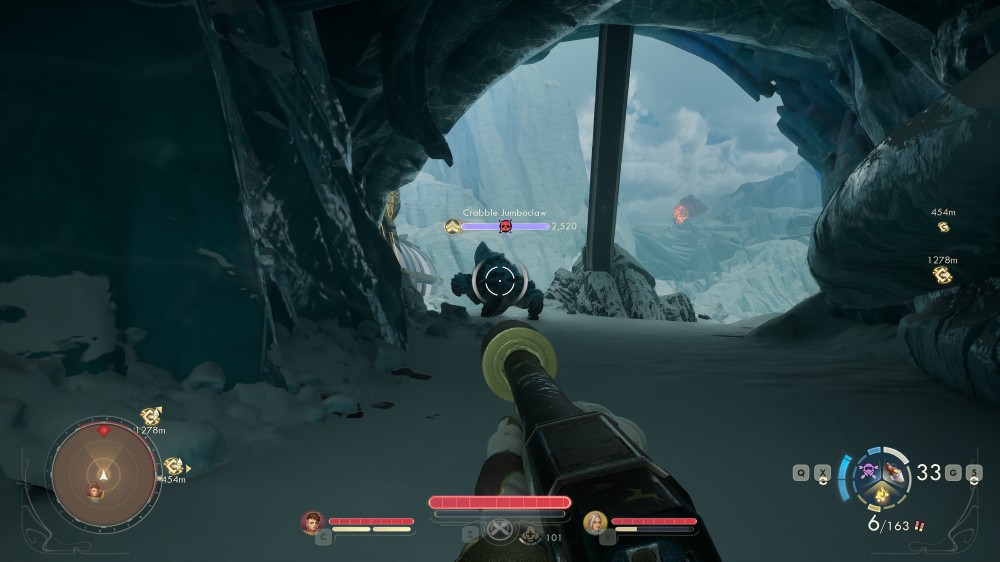
In the final analysis, I did end up playing The Outer Worlds 2 to conclusion after 70 hours, so there’s something there. By the end of the utter slog that is the third act though – especially when Obsidian goes full Starfield with forcing you to fast travel across planets via 10 loading screens to talk to NPCs – all I could really think about is how much better Avowed was in comparison.
And I didn’t really like Avowed. At least it had respecs though.
What’s In A Game?
Dragon Age: the Veilguard is coming out on October 31st. How I feel about it is… complicated. Veilguard’s first trailer received a lot of flak, but there have been a few subsequent ones that show a more a traditional Dragon Age vibe, as opposed to what felt sort of Fortnite/Borderlands-ish irreverence. Besides, what’s not to love about it being more Dragon Age, featuring a romanceable Scout Harding, and the fact that it’s a BioWare game.
…or is it?
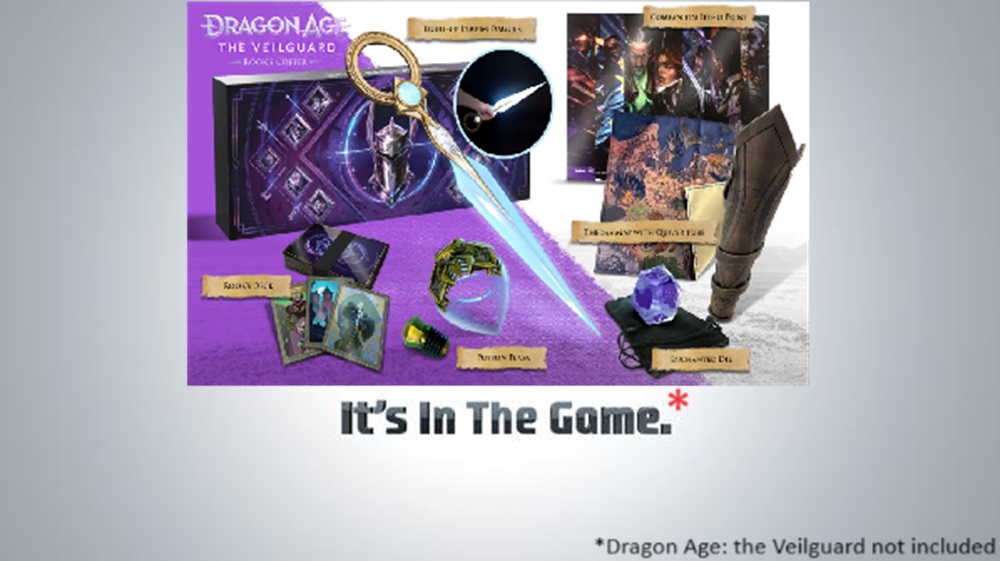
I mean, yes, it’s a BioWare game. It’s also an EA game, proven by the fact that it has a deluxe edition, pre-order bonuses, and a $150 Collector’s Edition with a physical LED dagger and other items that hilariously doesn’t come with a copy of the game. You seriously can’t make this shit up.
But what is a “BioWare game,” or any game for that matter? Not in an existential sense, but what is meant when we say these things? When I say BioWare game, emotionally I’m referring to a nebulous sort of companion-focused, squad-based RPGs with branching endings based on player dialog choices. Basically, the Mass Effect and Dragon Age series. Which I have historically enjoyed, including even (eventually) Mass Effect: Andromeda. It’s a type of game with a particular vibe to it.
Having said that, being a “BioWare Game” is really just branding and marketing. BioWare also released Anthem, which was a commercial failure; Andromeda wasn’t that hot either, considering how all DLC and follow-up expansions were canceled. Rationally, there should be no expectation that just because BioWare is releasing Veilguard, that it will be of the same quality of [insert favorite Dragon Age game here], especially after the franchise’s 10-year hiatus. But that touch of skepticism should still be the case even if Anthem and Andromeda were smash hits.
I have long cautioned against the sort of hero worship that game developers sometimes generate, especially when it comes to “rockstar” designers. There are people who fall to their knees at the altar of Fallout: New Vegas and Chris Avellone. To which I say: why? Even if New Vegas is your favorite game, there were a lot of cooks in that kitchen. In fact, you probably should be worshiping at the feet of John Gonzalez instead. Or, preferably, worshiping no one, including the companies themselves.
Game design is a collaborative endeavor – solo indie titles aside – and it’s a nigh-impossible task to nail down exactly who did what to make the game as compelling an experience as it was. Especially including the very staff who did it. Back in the day, there was an argument that Blizzard was sending in their B-Team for the Wrath of the Lich King expansion, and that is why subscriptions started to decline for the first time (notwithstanding the 12 million sub peak). As it turns out, that wasn’t the case – most everyone from vanilla and TBC ended up working on Wrath and subsequent expansions. Hell, the most controversial addition to the game (Looking for Dungeon tool) was something the original “rockstars” devs wanted to release in vanilla. It wasn’t the bean counters or the C-Suites or whatever design boogeyman you want to define; the calls were coming from inside the house.
There are times where it appears one very visible person seems to make a difference. Hideo Kojima immediately comes to mind. It is also difficult to argue against the apparent influence of, say, Yoshi-P when it comes to FF14. Or Hidetaka Miyazaki of FromSoftware fame. They could not build their games alone, of course, but leadership can and does set expectations and gives direction in these endeavors. There is a level of consistency – or consistent craziness in Kojima’s case – that is pretty rare in gaming.
By and large, though? Every game is a gumbo and no knows what went into it or why it tastes the way it does. That’s… a pretty strong nihilistic take, I admit, but riddle me this: if someone figured it all out, why is it so hard to bottle the lightning again? Boredom? Fear? Ever-changing audience mores? There are so many moving parts, between the game designers coming and going from the company, to the gaming zeitgeist of the time, to competing game releases, all of which can influence a title’s success. You can’t just say “Obsidian should just make New Vegas 2 and it will be a smash hit” because A) most everyone from the original team has left, B) none of the people who left appear to have taken the secret sauce with them, and C) New Vegas was massively outsold by Fallout 4 in any case.
So, am I still looking forward to Veilguard? Well, two words: Scout Harding.
Seriously though, I don’t want the takeaway to be that you shouldn’t look forward to anything. I have no idea what the plans are for Mass Effect 5, but I still want to find out. Just not on Day 1 (probably), and not with any sort of expectations that because Company A or Game Dev B made it that the end result will be C. If you’re going to base your hype on anything, base it on what the game is promising, not the people who made it. After all, the best games end up taking on a life of their own.
Scaffold
Official reviews are coming in regarding Fallout 76, and almost all of them are universally bad. Like, real bad. In reading them though, it’s very clear that Bethesda did not live up to games these people invented in their head:
The collision of Fallout and multiplayer sparks all sorts of exciting ideas in my mind, most of which have to do with post-apocalyptic role-playing. What if I ran a town, hosting elections and keeping the peace? What if I opened a shop, selling exotic items to other players in a desperate bid to raise enough caps to survive the harsh wasteland? What if I worked behind a bar, serving drinks to other players, passing on gossip and words of wisdom? What if I was the head honcho of a group of raiders, ordering other players to attack camps and loot the corpses of our enemies? What if I founded my own faction, something like Caesar’s Legion from Fallout New Vegas, perhaps? What if I wanted to infiltrate a player-run faction I didn’t get on with, befriending their leader before stabbing them in the back?
Unfortunately, Fallout 76 does not facilitate any of those fantasies. What it does instead is facilitate boredom, frustration and game-breaking bugs.
Like, what the shit, Eurogamer? “Bethesda didn’t make EVE/Star Wars Galaxy mashup, 0/10 stars.”
The rest of that review is slightly less ridiculous. There are complaints about the tutorial quests that ask you to boil water and pick up bottles:
Most missions are little more than fetch quests. Go here, get the thing, bring it back, interact with a robot, job done. It’s mind-numbing in the extreme. It’s Fallout at its worst: basic, monotonous and lacking nuance.
Of course, that had me trying to reach back and remember the quests in Fallout 4, New Vegas, 3, and so on. Replace “interact with a robot” with “talk with an NPC” and… does that not describe basically everything, in any game? A lot of people post memes about how Fallout 3 was finding your daddy and Fallout 4 was about finding your son, and yet here we are lamenting about being free from such mundane burdens.
To an extent, that’s an unfair comparison. Fallout’s best stories were always side-quests, with the main narrative basically acting as a vehicle to drive you around the wasteland looking for them. While holo tapes can be poignant, they just aren’t the same when you can never affect the world.
At the same time… I don’t know that I miss any of that.
I want you to remember all the things you did in Fallout 3, New Vegas, and Fallout 4. Think about what was fun for you. Was it…
- Striking out and going wherever you wanted to go
- Exploring ruins, caves, and cities
- Collecting junk to craft gear
- Leveling up skills, getting Perks
- Shooting things in the face
- Solving moral dilemmas among various NPC groups
Hey, what do you know, Fallout 76 has five out of those six things! And arguably does those five better than any Fallout has before.
I am not trying to denigrate story and narrative here. I’m just saying that I don’t miss it in Fallout 76. In fact, the whole thing is making me question the cohesiveness of the prior games. For example, how much does the ability to strike out and roam around really improve, say, New Vegas’ narrative? Back when I played, I didn’t give two shits about finding Benny beyond the fact that I had a quest entry that wouldn’t go away otherwise. As I wrote back in 2013:
But the overarching narrative of revenge never felt personally compelling, and the coming clash between NCR and Caesar’s Legion seemed a digression. This game was Fallout when I was just wandering around, eager to scavenge what I can out of crumbling ruins I see just on the horizon. When I was the Courier just trying to make a final delivery for no particular reason? Not so much. […] I wasn’t protecting my home, my family, nor was I my own person. I was… the Courier, a stranger in familiar skin, following a past everyone knows about but me.
This is the same problem I had with Witcher 3 – the setting and the story were at complete odds at each other. Your motivation is to find Ciri before the Wild Hunt can, but oh hey, look, there are 40 hours of sidequests you can do over here first. All of which are a hundred times more interesting and immersive than the main, ostensibly racing against time one.
I appreciate the fact that you could kill just about anyone in New Vegas. Or kill next to no one. It is fairly uncommon in gaming to be able to resolve conflict in many different ways. But you don’t need the Fallout scaffolding to do that. By which I mean the wandering around, the looting abandoned buildings, the Power Armor, the Fast Travel ferrying of dozens of pipe rifles to sell to vendors for Caps to buy new shit. I was not “the Courier” when I was hunting for Wonderglue in a half-collapsed shack. I did that for gameplay reasons and because it physically felt good to do so.
So when I hear people say things like this:
To be fair what the hell is Fallout without the story and the player options/personalised quests/interesting world side of things beyond a clunky shooter.
…I feel like I’m going crazy. Open the map, walk over there, kill something along the way in an alternative-history post-apocalyptic 1950s. THAT’S FALLOUT (since 2008). You sure as shit aren’t playing New Vegas for 300+ hours for the storyline alone, son. You play it for that long because it’s fun walking around in that world, fun interacting with things, fun immersing yourself in the wasteland life.
Fallout 76 has systemic problems. The main one being the random server system, from which all other problems follow. All that glorious made-up shit Eurogamer was pining for could become a reality if there is a Moonguard-esque server that people specifically sought out and congregated on. Always-on PvP servers could also be a thing, with forced respawn areas and such. Pretty much everything is solved with servers, actually.
But all these people talking about the gunplay and the “emptiness” of the world? Clunky compared to what? New Vegas? Empty compared to what? Human NPCs with relatable human stories are fantastic, I agree. I just don’t need them to push me over the horizon and into the ruins – the hunt for Gears and Ballistic Fiber is motivation enough. There is still map to see, still ever-stronger enemies to face, and more guns to shoot them in the face with.
Fallout 76 is like when you finish (or ignore) the main story in a Fallout game but you just keep playing anyway. If you don’t do that sort of thing, then yeah, this game is not for you.
Review: Fallout: New Vegas
Game: Fallout: New Vegas
Recommended price: Full Price ($20)
Metacritic Score: 84
Completion Time: 70+ hours
Buy If You Like: Fallout 3, Oblivion
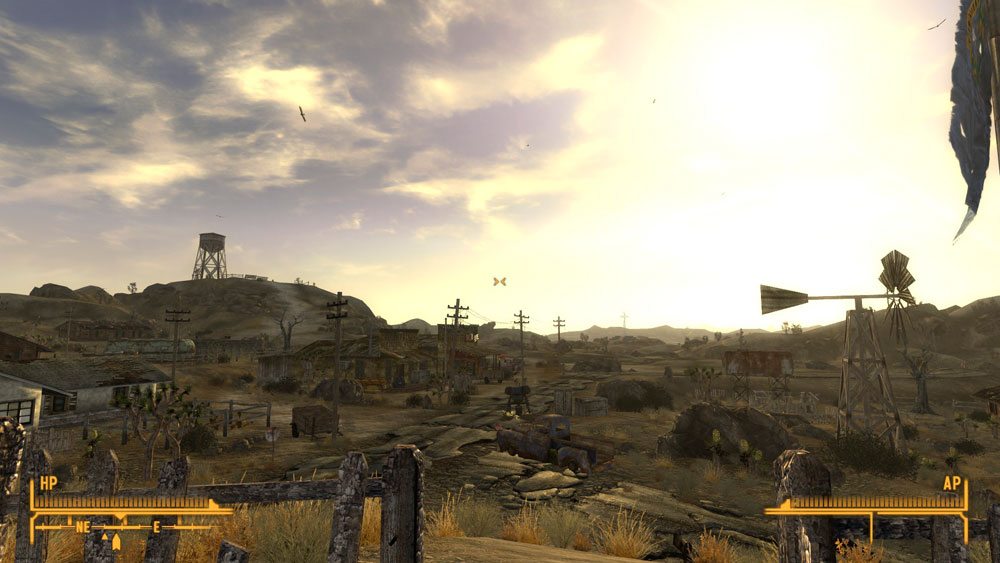
The ever-important first vista shot.
When I played Fallout 3, it completely revolutionized the series to me. A storied veteran of the original Fallout, Fallout 2, and Fallout Tactics, the idea of a first-person non-grid-based combat game filled me with dread. Would it feel like Fallout? Why turn this series into a FPS?
By the end of the first hour, my fears (and free time) melted away in the vast furnace of Fallout 3’s immersive, brilliant post-apocalyptic world. I had already played games like Oblivion, but it was not until Fallout 3 that I truly appreciated the depths in Bethesda games; the ability to just strike out and roam. While it lacked the brilliant storytelling of the prior games, I felt it made up for it in all the unspoken narratives of the world around you. Suffice it to say, Fallout 3 remains in my top 5 games of all time.
This is not, of course, a Fallout 3 review.
Fallout: New Vegas is a noble attempt at having it both ways: the exploration and the narrative. You start not as a fresh-faced Vault Dweller, but as a middling Courier, shot in the head in media res ala Uma Thurman in Kill Bill. And in typical narrative-driven fashion, your quest for revenge starts at Point A and leads inexorably to Point B.
This is roaming on rails, at least for the first few dozen hours, with the slightest deviation leading to certain death. Strike North from the starting city and you will face level 20 Giant Radscorpions. Stray too far West outside the plot-directed Southerly route and Super Ghouls will eat your face off. Cut through the mountains to the East and you will inexplicably face the Blind Deathclaw guarding the path, conveniently immune to the effects of even your Stealth Boy invisibility cloak.
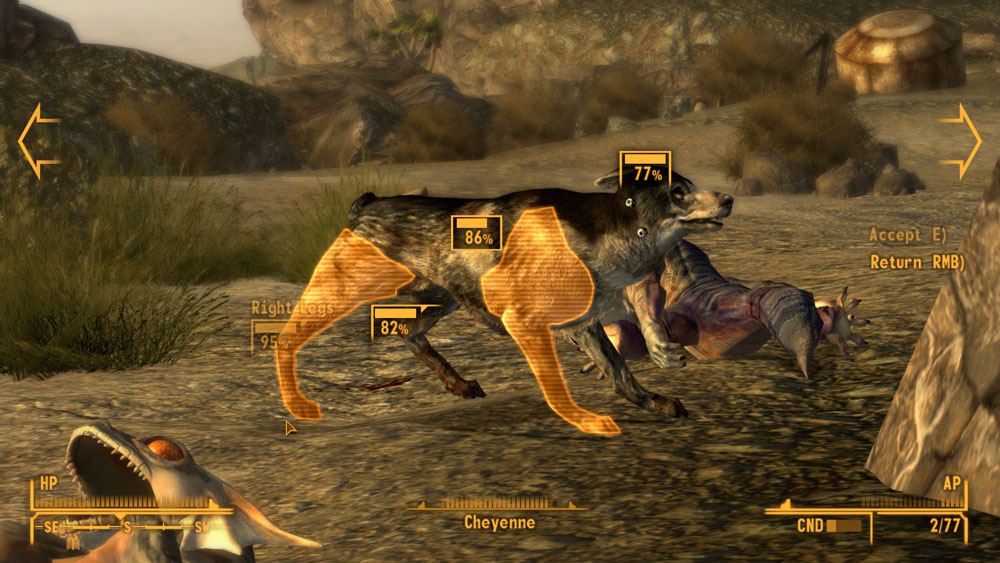
Decisions, decisions.
Between the visible fences of high-level monsters and being able to see New Vegas’s Lucky 38 tower from any vantage point in the game, F:NV starts off by feeling microscopic in comparison to Fallout 3. But a curious thing happens as you finally reach the Southern reaches of I-15 and turn East. “Tutorial Mode” over, the game suddenly opens up, blooming with hidden depth and density like some desert flower. There is still the highlighted yellow-brick plot road to follow, but you can actually strike out on your own at this point with less risk of instant death. I decided to plow my way to New Vegas proper at this point, stopping only at the various locations within sight along the way.
It ended up taking me over 40 hours just to reach the gates.
Combat in F:NV is more or less identical to Fallout 3: you can still treat the entire game as a normal FPS or you can pause the action in VATS mode to specifically target enemy extremities. Weapons skew a lot more towards traditional Spaghetti Western fare as befits the motif, but classic laser/plasma guns are not too far behind.
F:NV does feature some interesting innovations compared with its predecessor, including the use of Factions with mostly independent reputations. Don’t like the New California Republic? Join Caesar’s Legion. Or vice versa. Or screw them both and embrace Mr. House’s vision of the future. Or screw him too and embrace your own brand of justice. While the burgeoning complexities of the midgame collapses into an endgame constant, fundamentally the ending is one you can choose. Classic Fallout.
Well… mostly. While all of the set pieces are in place, including many of the same (recycled) posters last seen around the D.C. area, I could not help but feel that F:NV was… missing something. Something ephemeral, something intangible. F:NV is set in the same Fallout universe with the same people and the same post-apocalyptic problems. And perhaps that is what felt off. If this were the 1990s, F:NV would have been an expansion pack to Fallout 3, not a spiritual sequel.
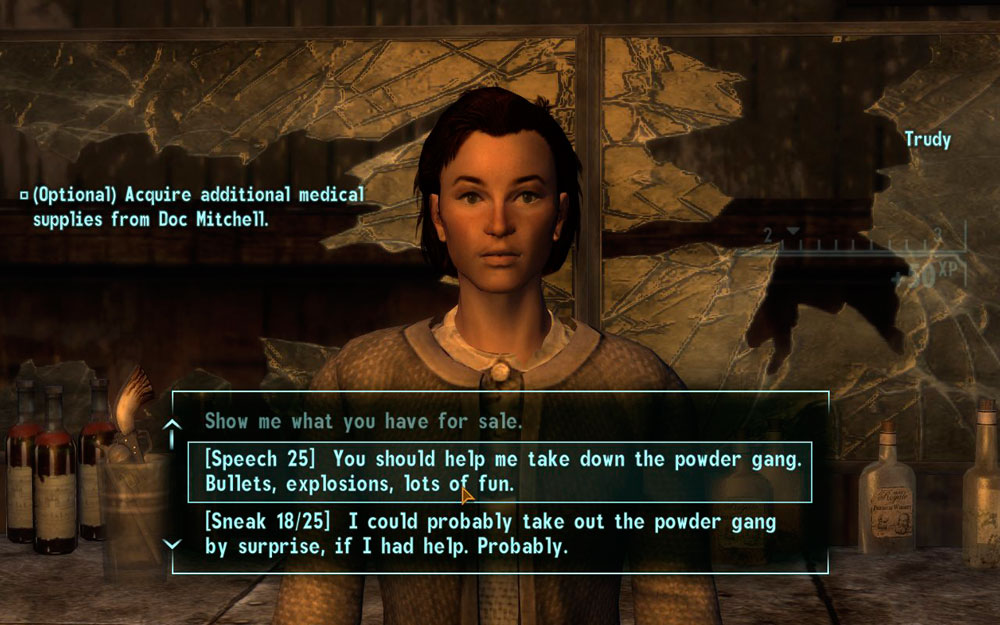
I do kinda miss the Fallout 1 & 2-style depth to responses.
Don’t get me wrong, there is more than enough to do in F:NV to justify its own existence. But it felt more like Fallout 3.5 than its own game. And yet, at the same time, F:NV feels like it didn’t have to be a Fallout game at all. Sure, there are Vaults and Nuka-Cola and Super Mutants aplenty. But the overarching narrative of revenge never felt personally compelling, and the coming clash between NCR and Caesar’s Legion seemed a digression. This game was Fallout when I was just wandering around, eager to scavenge what I can out of crumbling ruins I see just on the horizon. When I was the Courier just trying to make a final delivery for no particular reason? Not so much. The Platinum Chip is not too different from the Water Chip when it comes to plot McGuffins, but it felt different just the same. I wasn’t protecting my home, my family, nor was I my own person. I was… the Courier, a stranger in familiar skin, following a past everyone knows about but me.
Ultimately, Fallout: New Vegas is not Fallout 3. For some people, that will be a relief; for others, a deficiency. But it is important to keep in mind the scale of this particular comparison. I am pulling out the microscope and judging the relative merits of Mt. Everest versus the Grand Canyon. I am quantifying and comparing the love felt for a firstborn son with that for a granddaughter. Fallout: New Vegas cannot be fairly judged by a jury of its peers because it has no peers other than Fallout 3… and possibly Skyrim/Oblivion. So while I still feel that Fallout 3 is better than Fallout: New Vegas, the latter is better than damn near every other videogame I have played. I am being so critical not because Fallout: New Vegas is a bad game, but precisely because it is so good.
DLC
There are four main pieces of DLC for Fallout: New Vegas, although at this point they will all likely be bundled with any Game of the Year copy you will buy. Briefly though, I will describe them for posterity.
Honest Hearts: Technically speaking, this was my least favorite of the DLCs. Heading into the outskirts of New Caanan, the Courier gets to interact with Burning Man, the hitherto presumed-dead former leader of Caesar’s armies. While there is a main plot concerning the story of revenge/redemption, it simply does not flow too well, in my opinion. I never really cared about the plights of the tribes or the lands they occupied.
Conversely, the sort of understated plot line of “The Father in the Cave” revealed via in-game computer archives was one of the more poignant mini-narratives I have seen in Fallout, if not in games period. If you’ve chosen to never play F:NV (and are still reading this review for some reason), go read the transcript here; it is presented in the Wiki exactly as you see it in-game, aside from actually exploring some of the locations (and seeing the traps) mentioned in the text.
Outside of that, the Hearts DLC does feature a lot more plant materials for use in homemade stimpacks, and an abundance of clean drinking water for those doing a Hardcore run.
Old World Blues: Modeled on 1950s-era space dramas, I found this DLC to be exceptionally fun and funny both. The premises push the boundaries of believability even in the Fallout universe (your brain is scooped out right at the start), but after a while it ceases to be particularly relevant as you blast giant mechanical radscorpions and other ridiculous enemies. As a sort of bonus, by the end of the DLC you essentially receive a remote mountain base with all sorts of crafting stations and other amenities that you can teleport to at any time.
Dead Money: While this DLC opens up with my least favorite gaming trope – the sort of Metroid-esque “remove all your gear” mechanic – it does sort of ratchet up the tension and make the rest of the storyline work. Collared with explosives, you are forced to try and open up a vault underneath one of the few surviving casinos outside of the New Vegas area. The limited weapon selection and deadly dust clouds skews the DLC more towards survival-horror than Fallout sidequest, but I was pleased with the plot, imagery, and ultimate payoff.
Lonesome Road: Out of the four, this DLC most fits the narrative of the game proper. I felt it a smidge too linear for my liking (although not as linear as Dead Money) and a bit too ridiculous in other places (trigger nuclear bombs to move wooden debris out of your way, what?), but out of the four this most fit the tone of Fallout games.
 In An Age
Avowed – Veneer Off
Mar 3
Posted by Azuriel
I have added another 16 hours into Avowed (total: 32), clearing the entire second zone. And while some of what I reported earlier is still accurate – traversal is fun! – the game’s veneer is definitely rubbing off.
Combat, which hitherto has been fun, is now very rote. For the first half of the second zone, I respecced into a Ranger gun build and almost ended up abandoning the game entirely. There was… just no buttons to press. Sure, Ranger has a sort of vines CC ability, but aside from that, it was power attacks from pistols and nothing else to actively press. Technically I could have grabbed some more active buttons from Wizard as well, but Ranger is the only real splash-class, and trying to elevate your Intellect stat to the point where spells are relevant is a fool’s errand without just being a Wizard.
During the last half of the zone, I went into Fighter, first with a 2H weapon focus and then 1H with shield. Fighter had some more buttons to press – including a very satisfying Charge – and was a more dynamic experience overall with the Parry mechanic and blocking. The issue is that the DPS was just not really there. Avowed loves to throw groups of 5+ enemies at you, which is understandable considering Rangers/Wizards will nearly one-shot most of them from range in the opening salvo. As a Fighter, it’s not satisfying at all spending all your Stamina trying to block/dodge so many enemies. Although you do have two squad mates to help spread aggro around, the reality is that so do Rangers/Wizards, and those classes can actually eliminate enemies quickly. Which technically goes against the “gameplay” of Fighter, as if things die before you get into Parry chains or full attack combos, a lot of the Fighter-based weapons are useless. Which they are anyway, since they don’t kill quickly.
The other major issue that I glossed over previously was the world in general and interactivity in particular. Avowed is not Skyrim. Which is fine, most games aren’t. But as a first-person fantasy game that came out 14 years after Skyrim, Avowed is incredibly static. NPCs barely move (if ever), there is no world reactivity, there is no “stealing,” and every object out in the world is bolted onto the floor, aside from some breakable crates. To be fair, this is more an intellectual criticism, as I hardly noticed anything amiss in-game. But now that I have, I see signs of a Hollywood set everywhere. Which might have been fine, if this were not a fantasy RPG released in 2025 for $70 MSRP.
The final thing that is really dragging me down is the upgrade system and Unique weapons. I have been playing the game “as intended” when it comes to looting and experimenting, but have come to find out that the devs punish that playstyle. For one thing, all the respeccing I have done required me to upgrade several weapons that, oops, I am no longer using. Then I found out that all unique weapons in the world scale to the highest upgraded weapon you own at the time of pickup. What this means is that if the best weapon you have is Fine (blue quality), all the uniques you discover will be Fine. However, if you funnel all your upgrades into one particular weapon and get it to Exceptional (purple), those same uniques would have been Exceptional. And this works all the way into Superb (red) and Legendary.
Do you like exploring the map and picking up things organically, doing a few upgrades here and there? Punished! Because now if you decide to go with another weapon or playstyle, you will need to double (or more) the upgrade materials required to level them up. Which, let me remind you, is very necessary because weapons and armor get a debuff if they are more than a few “tiers” below the enemies you are facing. Also, remember that enemies and money is finite in this game, so it is very possible to just screw yourself and be locked into something that is no longer fun.
Which might just be the entire game itself for me, at the moment.
I don’t know, guys. Not everything I play needs to be Game of the Year material; lord knows I play plenty of trashy survival games for hundreds of hours. But, truly, Avowed feels like a game that would have been really great… in 2015. Or maybe 2010. Obsidian is not Bethesda, yes. But this also ain’t New Vegas. And between this and Outer Worlds, I’m thinking that Obsidian needs to stick to what they do best: iterating on the shoulders of better games, rather than trying to make their own.
Grounded was great though, so… ¯\_(ツ)_/¯
Posted in Commentary, Impressions
1 Comment
Tags: Avowed, Fallout: New Vegas, Game Design, Interactivity, Obsidian, Skyrim