Blog Archives
Need-Based Socialization
Keen has a rather curious post asking “Should Everyone Craft Everything?” The premise of his argument is that specialization is the root of socialization, and as such, a proper MMO would not allow everyone to craft everything. In fact, anyone who suggests that they should be allowed to have some level of self-sufficiency is “an entitled xenophobe” better left to single-player games, and the catering to whom is a “dumbing down” of a MMO to the “lowest common denominator.”
Which, along with the Free Space, is a full Bitter MMO Vet Bingo.
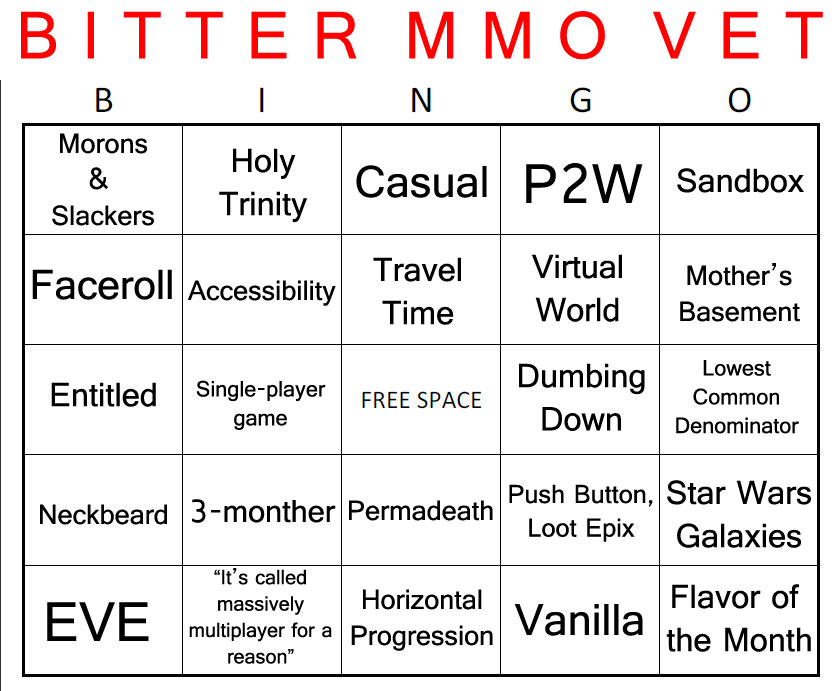
Special thanks to Keen, SynCaine, Tobold, and their commenters for the inspiration.
The fig leaf proffered is that perhaps everyone can make all the basic recipes, but that only specialists can make the best items. However, the whole notion is ridiculous, for a number of reasons.
First, you cannot “force” specialization in any game that allows alts. It wasn’t even much of a commitment on my part to develop a full stable of crafting alts in WoW because I wanted the ability to switch up my endgame play-style anyway. Even if you imagine that your perfect MMO limited you solely to one character per account, people could bypass the restriction via multiple accounts. That is, after all, exactly what EVE players do when they circumnavigate the restrictions of real-time skill gains (itself a way of forcing specialization). I suppose on the plus side, this makes your subscriber numbers look pretty peachy.
Second, you don’t actually need mutually-exclusive specializations in order to have a robust economy, as Keen claims. Within the beginning chapters of every Economics 101 textbook is an explanation of comparative advantage. The simple version is that two villages can produce both rice and fish, but at differing ratios: Island A can produce 10 units of rice or 5 units of fish in a day, and Island B can produce 10 units of fish or 5 units of rice. The ideal proposition is for Island A to produce rice, Island B to produce fish, and then trade half for half with one another, leaving both the richer for it. In fact, an economy between the two islands works even if Island A can produce everything more efficiently than Island B.
Or, perhaps more simply put, there is an opportunity cost to every action, regardless of whether or not you can do everything yourself. Any in-game economy will continue humming at full speed as long as one person is willing to mine ore and another more willing to farm gold than ore. Even though I could make everything myself in WoW, I still bought huge sums of materials and even finished goods because it was faster than doing it myself. Indeed, the existence of an AH at all will typically create entire economies by itself (barring ghost town populations).
Finally, there is a curious sort of bluntness to the dispassionate thought that people need to be forced to interact with one another via extreme limitations. Don’t get me wrong, I am someone who is thoroughly behind the idea of Divine Trinity and other forms of implicit specialization. But I feel like these sort of roles should be arrived at organically, rather than at the character select screen. I am a tank because I enjoy being a tank, not because I happened to pick “Paladin” in 2008. If I had stuck with Warlock, my first WoW character, how much less value would I have brought to the game, to the friends I made, and to my own game experience? As WoW has proven time and again, and even in the largely role-less GW2, just because everyone can be a tank (or tank-like), doesn’t mean they are willing to step into that role. So what possible good can come from shackling a potential tank to a dreary DPS-only experience? “So specialization matters”?
Further, the days in which I am inclined to make new friends out of perfect virtual strangers is largely in the past, and no amount of cumbersome game mechanics will get me back to that place. Even if extreme specialization is for the next generation of MMO player’s sake, I’m rather skeptical that such methods would at all work out the way people imagine they would. As Tobold recently pointed out, our generation of gamers were playing MMOs before the advent of Facebook and other social media – our games were our social media, our place to meet like-minded individuals. MMOs these days are 3-monthers not because they lack in content or design, but because we’re unwilling or unable to invest the social capital necessary to maintain our interest. And why would we? Either we brought along all the friends we already have, or they didn’t make the jump with us. In both cases, we’re full-up on social interaction, thanks.
So, essentially, I say let people do what they want, and they will sort themselves out according to their predilections.
Review: The Witcher 2
Game: The Witcher 2
Recommended price: $5
Metacritic Score: 88
Completion Time: ~36 hours
Buy If You Like: The Witcher, atmospheric and political fantasy gobbledegook
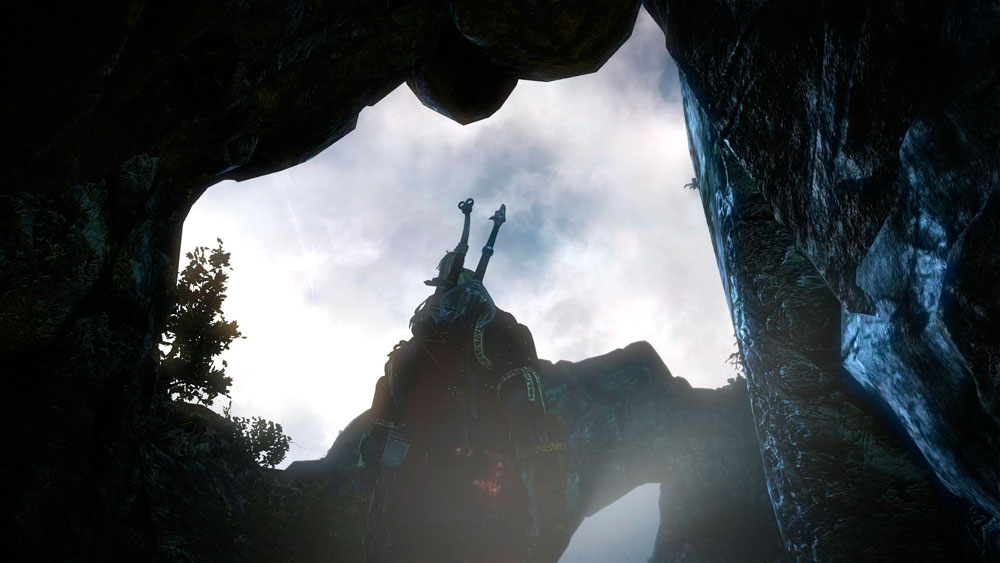
The atmosphere is almost – almost – enough to carry the entire game.
The Witcher 2 (TW2) is a sequel to the original, fairly ground-breaking game following the travails of Geralt of Rivia. Geralt’s profession is a Witcher, a human who has mutated his own genes in order to more effectively fight the monsters that spontaneously appeared in the world many years ago. After the events in the original game, Geralt was playing bodyguard to a king only to see his charge assassinated in his presence and then framed for the crime. TW2 takes place immediately following those events, and the wider ramifications and intrigue surrounding a recent batch of regicide.
I am going to be completely honest here at the beginning by saying that I finished playing TW2 only grudgingly, and after several months-long breaks inbetween. The game features a decently robust journaling system that will allow you to read up on what you are supposed to be doing and the general lore of the entire game world, but the litany of nonsense fantasy pronouns and references to the original game events (and the books they are predicated on) is truly unending. While I am willing to admit that the breaks I took inbetween playing certainly contributed to my general confusion, I do not absolve the game from what I feel was a profound lack of engagement. “Why was I doing this again?” “So I’m fighting this guy, but it’s important I don’t kill him, because I want this valley to become independent, so that… err?”
One of the major strengths of the first Witcher was its creation of what felt like a distinctly authentic atmosphere. Most fantasy games have a sort of whitewashed, Disney quality to them at odds with the historical reality of peasantry who bathed infrequently, had access to few paved roads, and a general unconcern with hygiene. The Witcher felt dirty, gritty, and real. I am happy to report TW2 continues in that praise-worthy tradition. Hovels look like hovels, trolls like like trolls, and you can practically smell the NPCs through the screen. The casual race discrimination (in terms of humans vs nonhumans) and ease in which people’s lives are upended or destroyed feels correct in a way practically unique to the genre.
Layered on top of this “fantasy realism” are the most banal, discordant, gamey quests and mechanics that I’ve ever seen.
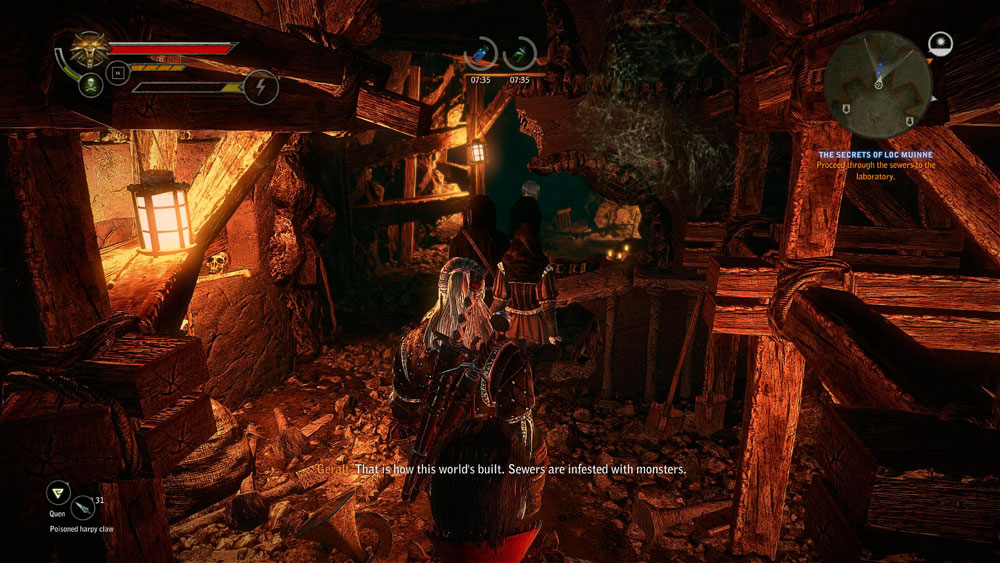
Good ole meta-humor.
We are talking about completely shameless fetch quests, kill 20 monster quests, and boomerang quests that shatter any sense of immersion in the fictional world. In fact, by the end, I hated the game world for its perfectly realistic twisted pathways and obstacles, as I was forced to circumvent them dozens of times as I did quests A, B, and C in sequence. And can I talk about the map for a second here? Literally the worst, most useless map in any videogame I have ever played. Shit made no sense, and zooming out gives you a view of the overworld that had zero to do with anything given how you were actually trapped in small zones around the one main location of the Chapter.
The combat in the first Witcher was not particularly deep or complicated. Combat in TW2 has actually devolved to the point where I was feeling nostalgic for the timed button pressed of the original as a measure of skill. All you do here is left-click for a quick attack and right-click for a strong attack. You can block, cast a Sign, roll-Dodge, or use an item too, but combat never felt integrated into the game world at all. Maybe the devs were intentionally trying to ensure you didn’t feel like a badass playing as a Witcher. Well… mission accomplished.
By far the worst aspect of the game though (map aside), is the direction that they took potions. See, potions are an important part of the game’s fiction; Witchers mutate themselves almost solely so they can brew potions that let them regenerate health, have extra power, and so on. In the first game, you could drink potions at any time, but could only meditate (e.g. sleep off the toxic potion side-effects) at certain locations. Which was dumb. However, TW2 decided to let you meditate almost anywhere, but you must be meditating before you can drink a potion. When can you not meditate? In combat, near combat, or somewhere where combat is implied to be occurring. The issue is that your abilities are balanced around potion use but potions only last for 10 real-time minutes. So you spend the entire goddamn game quicksaving every 30-seconds because getting into combat without having potions up is suicide, but you can’t exactly be running around with potions up the whole time, especially when you are exploring.
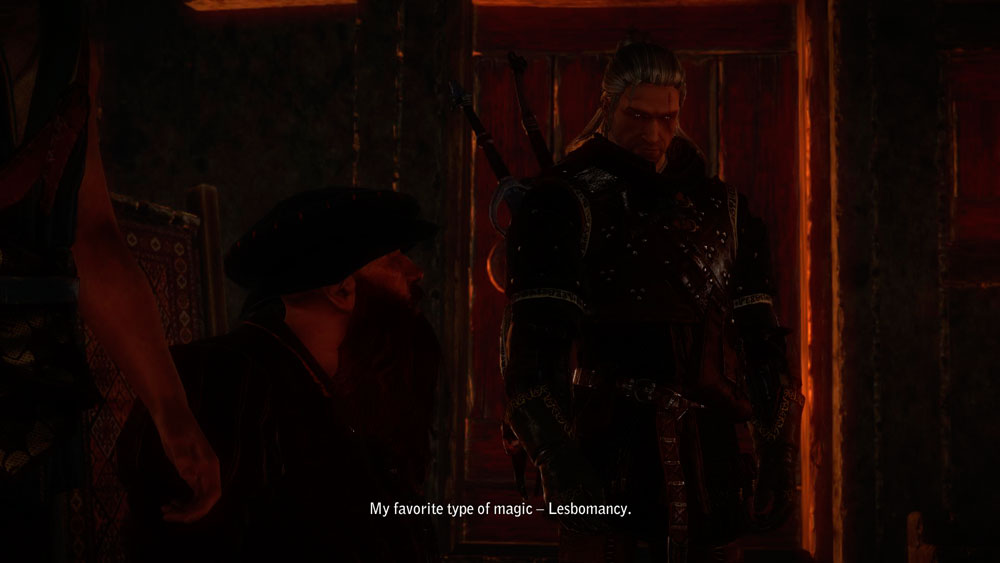
Only in The Witcher series…
I am belaboring the utter travesty of the combat system because I’m at a point in my life where this shit just doesn’t fly any more. I used to suffer through all kinds of JRPG combat systems for the fruit that was their (quirky) plots. You can’t really even say that TW2 would have been a better Adventure game though, because the physicality of fighting is important to understanding the world Geralt and friends inhabit. You can’t cut-scene every battle, after all.
Ultimately, I think what killed The Witcher 2 for me was the simple fact that the rest of the gaming world continued moving. Yeah, this is a game that came out in 2011, so a certain amount of slack should be given. But… I can’t. If you have played Skyrim, for example, coming into this game will be physically painful – you will chafe at not being able to hop off the wall where you want, not being able to attack when you want, not being able to go where you want, not being able to drink goddamn potions when you want. All of which is a real shame, because The Witcher 2 features a wide array of morally grey choices that actually change large portions of the game, rather than being “mere” emotional placebos.
But, you know what? I kinda want to have fun when I’m playing video games and The Witcher 2 offered me the opposite of that. I’m keeping an eye on The Witcher 3 because I enjoy the game world they have created and the choices you can make inside of it, but I am oh so wary. And oh so tired of poorly implemented game features/design.
Old Skool
In my continuing efforts to reclaim hard drive space and knock out some more of my Steam backlog, I booted up MINERVA: Metastasis. For some reason I thought this was the user mod for Bioshock I remember hearing about back in the day, so I was quite surprised to find it was a Half-Life 2 mod. Still, at 5+ gigs, I figured it was about time to see what’s what.
And that what seems to be old fucking school.
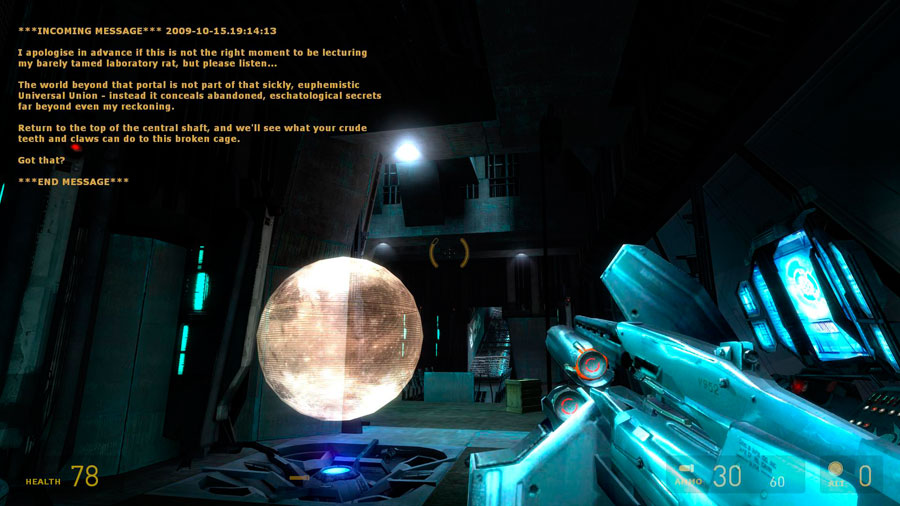
More than anything, the sound FX is what took me back.
As I turned the first corner into some Combine while armed with the machine gun, the first thing I did was hold the right mouse button and prepare to aim for the head. Instead, I shot an under-barrel grenade which damn near instantly killed me. “Oh. Oh my.” The machine gun clearly has a holographic targeting reticule, but in this circumstantial trip down nostalgia lane, aiming-down-sights hasn’t been invented yet. “Am I supposed to be hip-firing like some kind of animal?!” Yes. The answer is yes.
Also, your bullet spread pattern will always random, no matter whether you squeeze one round off or empty the clip. That is some Bronze-Age shit right there.
Game design evolution is a funny thing – very rarely is there ever any going back. For example, remember when you just had 100 HP, maybe 100 shields, and neither regenerated at all no matter how long you cowered in the corner with 17 HP remaining? It seems like just yesterday to me, because it literally was. I pooh-poohed Bioshock Infinite for having CoD- (and now Battlefield-) style regeneration, but now I’m not entirely sure what to think. I mean, is regeneration worse than spamming QuickSave every 30 seconds? Going to a CheckPoint system sounds even worse, as designers rarely hit the sweet-spot between The Last of Us’s one-enemy-filled room or Far Cry 1’s “hope you brought a sandwich, because the CheckPoint is on another island.”
I think that the first two Bioshocks got it right, insofar as there was no regeneration but you could stockpile medkits and the like up to a certain point. I felt no reason to explore in MINERVA when I was at full health, as there was literally no reason to; without hidden upgrades or things to stockpile, frequently there existed many rooms completely void of any reason to exist (beyond verisimilitude, I suppose).
In any case, the mod was worthwhile for the nostalgia and game design lesson alone. I just talked about having arrows over quest objectives the other day, but there were probably half a dozen spots in MINERVA where I had no idea where to go, or what the game expected me to be doing. And as is usually the case, the answer was staring me in the face. Then again, I did have to look up how to get past the room with the shield generators because, for some ungodly reason, we were just supposed to know that two grenades were necessary to destroy them. I tossed a grenade into each of the four generators, alarms went off, and once they recovered I went “Aha! They must need to be disabled in a specific pattern!” Nope. Just a dev’s modder’s Gotcha! moment.
Or maybe we were just all smarter in the olden days.
Language of Action
This amusing comparison was posted on Reddit the other day under “Morrowind vs Skyrim vs Dark Souls”:
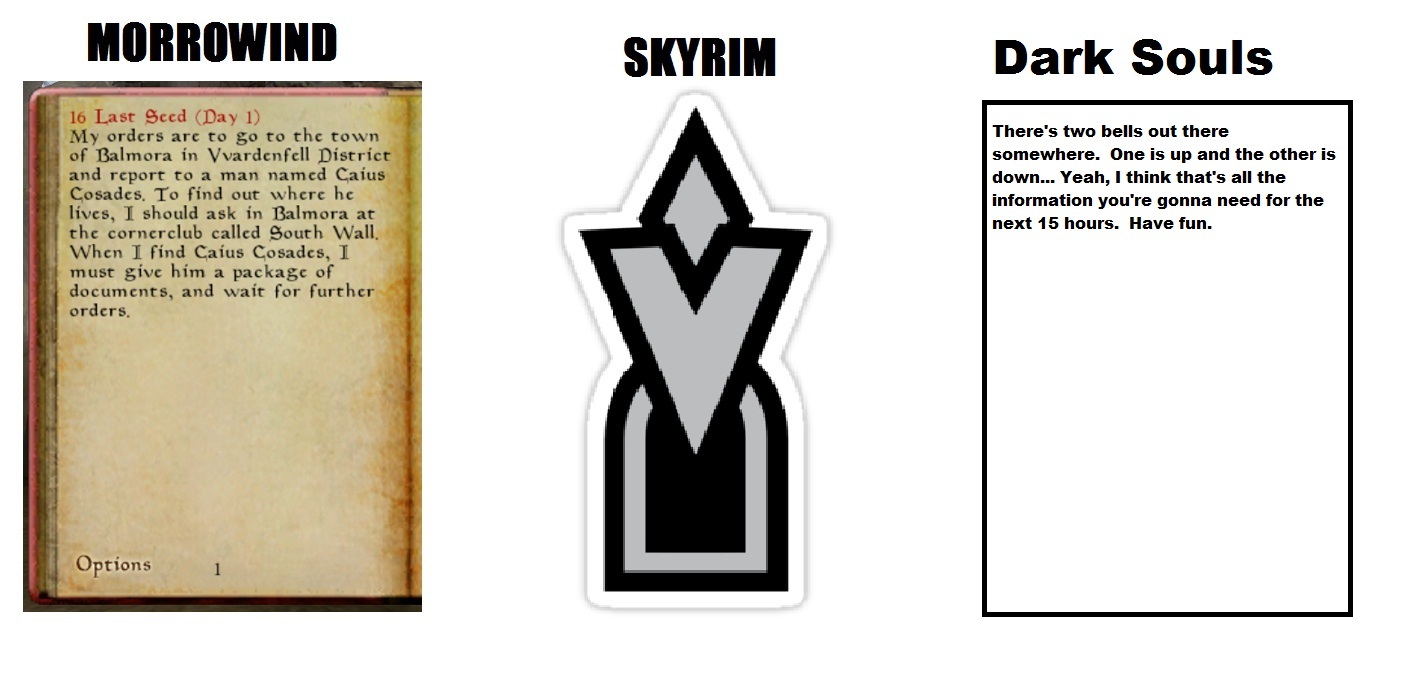
/slowclap
The implication here is (presumably) that games these days are being dumbed down, or at least are not being made as challenging as their predecessors (Dark Souls aside). This sort of “hand holding” is pretty much the de facto standard in MMOs as well, in the form of highlighting of the questing areas and the like. ¹
To which I say: “Good.”
If there is one particular scenario I despise more than anything else in videogames, it is when I sit down to play one and then can’t. I do not mean that I try and fail and am unable to progress – that part is good! It’s gameplay, it’s doing things, it’s actively engaging my faculties. Rather, I mean when the game is not even allowing me to try anything because I am missing something and don’t even know it. Or maybe I am not missing anything and the game is at fault. Indeed, whenever I get stuck in a game, these are the usual possibilities:
- I cannot solve the puzzle.
- I missed an invisible quest trigger.
- I cannot locate the quest objective.
- I do not know where to go next.
In all those scenarios aside from #1, we can entertain the possibility that it is the game designer’s fault. And that’s the problem! Sure, occasionally it is my own damn fault for not reading the quest text correctly or I didn’t pan the camera 110° to the right or whatever. But after 20+ years of playing videogames, I can assure you that my default assumption is not that these designers do everything on purpose. Games are art, but if you set out to evoke a particular emotion with a piece and it generates the exact opposite, we can say that that piece of art failed in its goal. Sometimes mistakes can make a game better (like… Gandhi in Civilization), but an equal or greater amount of time they are simply mistakes.
Things can go too far the other way, of course. In the opening scenes of The Witcher 2, as you approach the ominously empty bridge, you get a prompt telling you which buttons to press to avoid dragon fire. “What dragon? Oh.” Quests in Skyrim which ask you to find the artifact that has been hidden for centuries… and there’s a very visible quest marker that appears directly over it. I can concede that something like this other Reddit picture is too much:
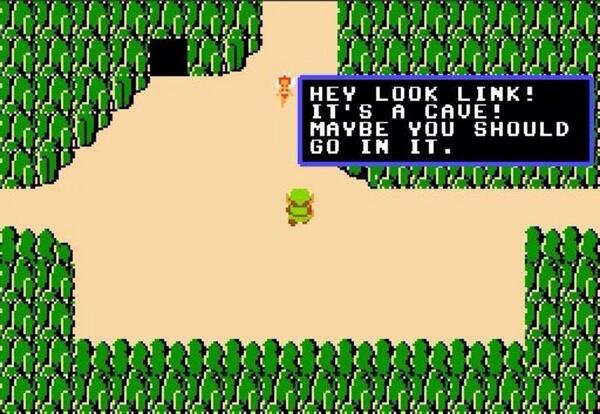
I hated Navi anyway.
At the end of the day, though? I am playing videogames to do things. I do not consider walking around a room pressing the Interact button every few steps as doing something. There is a place for games in which the “doing” is figuring out where to go or what to do next. And that place is “Pile of Games I’m (Literally) Not Playing.”
¹ I still remember the river of tears that resulted from WoW adding quest givers to the minimap back in Patch 2.3. Yes, seriously, tears.
Maybe Too Much Verisimilitude
So, I guess the devs from FFXIV just released the prices for in-game housing and no one is happy. The pushback from the devs was phrased this way from Massively:
Yoshida said that the high cost in intended to prevent wealthy players from snapping up all of the plots and that all players will be earning more money with patch 2.1. “I understand that, in taking these measures to ensure even distribution of land, we are asking for considerable patience from those players who are eager to enjoy housing right away,” he said. “While I sympathize with players concerns, we believe that this is in the best long-term interests of the game.”
In other words, the concern was that the wealthy players would go around and snatch up all the land before the average player/guild could do so, Monopoly-style. Considering that the housing area is already going to be instanced away from the game world, which is itself already segregated into identical servers, this seems like an Extraordinarily Dumb Problem to Have.
In fairness, I have never thought that “in the world” player housing was ever a good idea, in any game. I’m sure that it “worked” (for very narrow definitions of the word) in various games, but the whole thing strikes me as a kind of bizarre pyramid scheme. What’s the content? Where’s the gameplay? If you are first in line, congratulations, you have an exclusive advantage on into perpetuity and everyone behind you is screwed all in the name of… what? Some vague sense of permanent ownership in a virtual world? Don’t get me wrong, I fully support player housing in general. I just don’t see the point in finite plots of land in a game ostensibly being played by hundreds of thousands of players. This sort of nonsense is why I never got into playing multiplayer Minecraft – where is the fun in traveling to the shit ends of the world because all the prime real estate is taken?
But hey, Square Enix, good job with that heavy, capitalistic dose of realism in your escapist fantasy MMO. Maybe you could add some adjustable-rate mortgages in the next patch, or just allow the rich players to become landlords and rent out property.
Gaming Verisimilitude
On Thursday, I popped The Last of Us (TLoU) into the PS3 just to see if I needed to do some sort of lengthy install, but ended up playing for 5 hours straight. The game, simply put, is quite amazing thus far. However, I am experiencing some game design tropes that are grating on me to a higher degree than normal, perhaps precisely because everything else is so good.
Early on, you are basically told that while you can treat the game like a cover-based shooter to some extent, sneaking around is likely the best method given the chronic lack of supplies. That’s fine, sure. What is less fine is when you silently take down an entire warehouse full of guys very clearly armed with guns, and only happen to scrounge up 3 bullets of ammo from nearly a dozen corpses. Were the guns just for show? The last two guys were fine with shooting the conveniently-placed, waist-high obstruction I was hiding behind for almost a full minute, but in a moment of extreme bad luck, must have been killed right after they fired their last bullet.
I understand that this is One of Those Things in gaming in which we are supposed to suspend disbelief. I remember running a D&D campaign a few years ago in which I decided early on that I was going to rebel against gaming tropes and having the party’s human opponents drop everything they were carrying. In retrospect, it ended up being a perfectly foretold disaster: the party became understandably obsessed with looting each body clean and making frequent trips to Ye Olde Item Shoppe to peddle their warez. If I were able to loot full clips of ammo from each enemy I downed in TLoU, it would likely ruin the resource-tight mood by the end of the first hour of gameplay.
I am finding myself less sympathetic towards two other semi-related aspects that are not exactly TLoU’s fault but nevertheless somewhat jarring. First, the game is not and has never appeared to be an open-world sandbox or anything of the sort, which is fine. However, I feel subtly punished for exploring when the designers take the time to add in secret caches of goods in off-the-path locations. See, the issue is that I do not ever know if this “secret” door I’m opening isn’t actually the trigger for a cutscene or the path to the next area. I want to explore every nook and cranny of the game world! And yet I feel like I can’t, because I’m paranoid about inadvertently moving the story forward and being unable to backtrack. I’m seriously starting to miss the “Chrono Footsteps” feature from Singularity which highlighted the exact path you should take, so you know for certain which areas you could explore safely.
Compounding this issue is when I’m in the opposite scenario in which the game is clearly telling me where those story triggers are. “Oh, you want me to hurry up and walk over to that door? Good, now I know I can explore this whole half of the city instead.” The game is not Fallout, has never pretended to be Fallout, but I simply can’t help myself from treating every open building as an opportunity to scavenge for supplies. It’s the post-apocalypse! Let me spend hours combing the area for scrap metal and duct tape! I do this shit for fun.
Finally, Naughty Dog, really? I have a hunting rifle, shotgun, bow, two pistols, three Med Kits, a metal pipe with scissors taped to the end, three Molotov cocktails, a few proximity mine-like explosives, and a goddamn brick in my backpack… but I can’t carry more than 7 rifle rounds? Or more than four pairs of scissors? Inventory management is one thing, but limiting ammo to this degree is so overtly gamey that it sucks me right out of the narrative and back into optimization mode. “Hmm, if I use the shotgun to clear this next room instead of sneaking through, I can double-back and pick up those shells I left behind.”
Although I am complaining quite a bit, I need you to understand that it is only because these (ultimately minor) issues stand out in brilliant contrast to an otherwise amazing game. This isn’t so much a fly in the ointment as it is a hangnail the day after a big promotion. You know, minor, almost trivial annoyances that you nevertheless can’t quite stop thinking about.
Unleash the Rage
How was my Hearthstone weekend? I’m glad you asked. See, I was playing a 3-star Masters game when this happened:
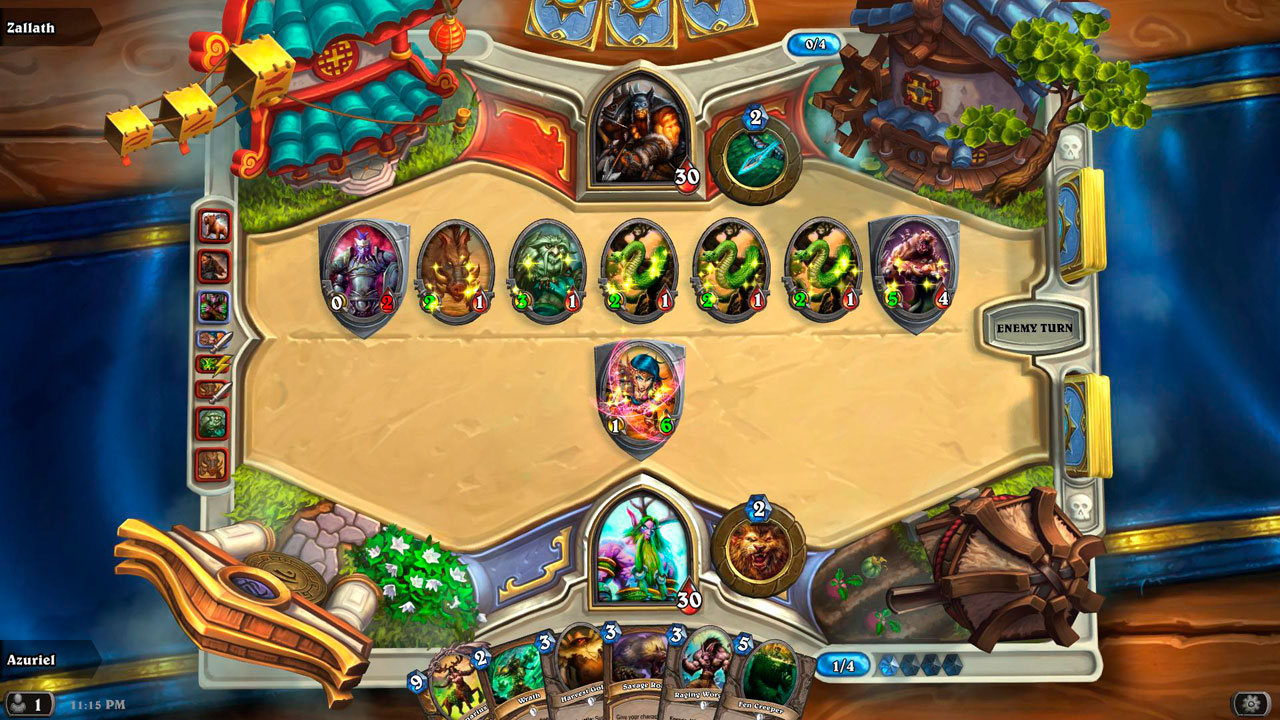
Balance!
…nah, just playing. This was in my last Arena game. I wish I would have taken more screenshots of the setup, but how the fuck was I supposed to know there would be 16 damage on the field on Turn 4? Well, now I will. And in the off-chance you think you might have a better series of plays, let’s recreate it at home:
- Turn 1 (me): Nothing.
- Turn 1 (him): Shieldbearer (0/4 with Taunt).
- Turn 2 (me): Hero power, hit Shieldbearer for 1.
- Turn 2 (him): Secret (i.e. Snake Trap)
- Turn 3 (me): Draw and play Novice Engineer.
- Turn 3 (him): Stonetusk Boar + Ironbeak Owl.
- Turn 4 (me): Attack with Engineer, trigger Snake Trap. Cast Mark of Nature (+0/+4 and Taunt).
- Turn 4 (him): Animal Companion (Misha 4/4 and Taunt) + Unleash the Hounds.
The only real decision I had at any point there was on Turn 3, when I drew the Novice Engineer. Ideally, I wanted to play Raging Worgen, but I was concerned that the Secret the Hunter played a turn prior was a Snipe (deal 4 damage to next minion opponent plays). Given that, I figured Engineer was the safer bet, considering the Harvest Golem would have died immediately to a Snipe and wouldn’t have enough attack to kill the Shieldbearer either. Ultimately, none of that mattered.
It just… boggles the mind, you know? Whoever is designing class cards for the Hunter over in Blizzard HQ just really shit the bed when they imagined things like this:

Balanced!!
…is anything approaching good design. The +1 Attack is even permanent! The worst part though, is that Unleash the Hounds is literally the only shtick that Hunters even have. Shaman have it pretty ugly too with an over-reliance on Bloodlust (which is itself a “I suddenly win!” card), but theoretically you could go some kind of +Spellpower route and then stack your deck with all the (Rare!) AoE and Lava Bursts and such. Hunters are just Bears, Bears Bears beasts, beasts, beasts, plus removal and (Common!) Unleash the Hounds. Snake Trap is an Epic (!) “trap” which is exceedingly useless at anything at all other than being Unleash the Hounds bait. And… that’s it. GG.
Blizzard has already committed to “fixing” Unleash the Hounds, but no matter what they do, it will essentially be a completely different card. Unless the devs punt and make it cost 2 mana or something, of course. If they increase the cost any further than that, the Attack boost will need to be higher, which transforms it into Bloodlust-lite. Anyway, the funny part is the explanation for why Blizzard will be changing Unleash the Hounds:
All of our changes are done with the utmost care. We don’t change a card simply because the community says it should be so. In the case of Unleash the Hounds, it was promoting a rather un-fun play environment in this particular type of deck. I believe we touched on this at BlizzCon, but games of Hearthstone should be like a puzzle, where decisions you make are important and have an impact on the game. Even if you made an incorrect choice when deducing the “puzzle”, you still end up learning something in the end and growing as a player by experience. With Unleash the Hounds, it went against that philosophy and left the opponent feeling more or less helpless when suddenly it’s BEASTS, BEASTS EVERYWHERE. While it’s an effective strategy of sorts, that feeling isn’t fun, and we want Hearthstone to be fun for both players.
I agree that the “puzzle” aspect of Hearthstone is by far my favorite part. And while there aren’t always many moving parts, when you hit one of those make-or-break turns, your internal clockwork will be spinning pretty fast indeed. For example:

Holy decisions, Batman!
What’s the right call, here? Arcane Missile and hope 2 or 3 of them hit the Injured Blademaster? If all three missiles hit the Priest, you could hypothetically Coin into the Counterspell and then trade your one lone creature for the Blademaster and then watch as the Lightwell erases all your damage. Or do you Coin into a Fireball targeting… well, it’d have to be the Blademaster unless you wanted to trade right away (the risk of the Priest healing the Blademaster and then just killing your dude is too high) and clear the board. Personally, I went with the Arcane Missiles, two of which did hit the Blademaster, allowing me to ping him dead with my Hero Power.
Of course, next turn, the Priest cast Divine Spirit + Inner Fire, turning his Lightwell into a 10/10 healing monster. But, hey, puzzles!
Incidentally, one of the exciting bits of news out of BlizzCon was that Hearthstone is going to feature Adventures, which are a single-player PvE-style experience against “boss” mobs. This Polygon article gives more details from the panel:
During the Hearthstone Fireside Chat panel, Dodds said an Adventure will be a “focused, single-player, PvE experience” where players will face off against a boss or series of bosses and earn cards associated with the Adventure. He expects there to be 20-30 cards associated with each.
“They are going to be cards that absolutely change the meta game, because we’re paying attention to that a lot and will make sure that these cards are going to shift the meta game,” Dodds said, “but they’re not going to be cards that specifically have crazy new mechanics in them just yet. Those we’re saving for the expansion side.”
Though he said Blizzard is “still figuring our way,” he said players could expect to see a series of alternating Adventures and expansions.
Good news for those who finally tire of the #AllSkill wins that frequently occur. Plus, the fact that you can actually keep/use the cards you earn in PvE-mode against other players (and perhaps the existence of PvE mode at all) is likely a dig at the upcoming Hex… whose Alpha test is something I’m going to be talking about soon. Pretty clever of Blizzard though, to give themselves the ability to release cards outside of an expansion in order to stabilize/upset a degenerative metagame. We’ll have to see if they have the gumption and card design chops to pull it off.
Based on Unleash the Hounds and Mind Control though… I dunno.
Going Home Again
Tobold is by no means the first person to point out that Warlords of Draenor’s free level 90 character is a “doubling-down” on vertical progression. I mean, I don’t see why anyone would claim that even vanilla WoW was anything other than vertical progression given how you couldn’t grind your way to max level via the Westfall boars, South Park-style, but whatever. The thing that profoundly bothers me in these sort of debates though, is this sort of nonsense:
So we are being told that when the expansion comes out, World of Warcraft will be all about levels 90 to 100. You will play nearly exclusively on the new continent, maybe sometimes visit the capital cities for some features, but will have no reason whatsoever to enter over 90% of the zones of World of Warcraft. If by some server glitch the old zones ceased to exist, most players wouldn’t even notice. I find that rather sad, so much wasted space and potential.
I literally cannot understand this line of reasoning. I understand what is attempting to be said here, but it seems so far removed from reality as to be unintelligible.
First of all, the post-Cataclysm world still exists. Even if we are going to assume that there will be a lot of brand new WoW players coming into the expansion – which we have no reason to believe there will be, at least in comparison to returning players – the fact remains that the world and all of its quests will still be there for that new player’s alts, at a minimum. Assuming, of course, that this hypothetical new person even enjoys questing in the first place. And if they do, there is nothing stopping them from questing from level 1 to 100 while saving the instant 90 for some other purpose. Meanwhile, the returning veterans who quit in the middle of an expansion they presumably didn’t like are being asked to… what? Spend a few dozen hours slogging through 2+ year old content to get to the stuff they were actually excited enough to resubscribe to see?
Secondly, how can the old content ever be considered “wasted?” All of those zones and quests have been utilized, extensively, by millions of players for years. How much more utilized does it need to be? And how? And why? Even in horizontal progression MMOs, where do you find people? Where the new things are. The odds of you finding someone running around the mid-level zones in Guild Wars 2 is approximately zero, unless there happens to be some kind of 2-week patch dragon dropping off a treasure chest every three hours. You’re not going to find an EVE veteran mining Veldspar even if Veldspar remains a critical component of crafting spaceships.
Content obsoletes itself. That is not a problem, that’s linear time working as intended. Novelty only ever decreases, at least in terms of crafted content. Hell, how long can you experience interest in even procedurally-generated content like in Minecraft? At a certain point, even the weirdest terrain formation is reduced to its constituent parts at a glance – it sure as hell isn’t as impressive as the first time you laid eyes on your future mountain fortress location.
Time marches on. Just because you don’t hang out at the playground or swing from monkey bars anymore does not mean they are now wasted content, even if no one else ever uses them again. They existed in a time and a place and served their purpose well. Is that not enough? Were you not entertained?
It always seems the greatest irony in MMOs are those players who wish for living, breathing virtual worlds that never change.
Hearthstone’s Future
SynCaine brought up an interesting point about the future of Hearthstone:
“situation in Hearthstone only ever improves”
Until the the first expansion is released, and what do you think is going to be the revenue driver for the game?
At least with MtG:O, it was understood you were stepping into a P2W arena, where you could pay X to compete with Y. What level you wanted to compete at was up to you and your wallet.
Here, I feel as though Blizzard is trying to hide the P2W aspect (especially in beta), but ultimately that’s what the model demands. Without new cards you don’t keep people interested, and for those new cards to be interesting, they have to be worthwhile (aka; stronger/better).
I think the heavy class-based gameplay is also a balance nightmare as we are already seeing, and I expect it to get worse as the better players create more gimmick decks. Woe is the free player if the FOTM gimmick requires an epic or ten.
While the game isn’t even in Open Beta at this point, I think it is reasonable to start thinking about where Hearthstone goes from here. At the moment, I am sort of worried about the “depth” of the game, although it’s possible that it’s current shallowness accessibility is a feature, not a bug. Then again, I’m not entirely sure.
There are several things working against Hearthstone’s future. The biggest is it’s class system. In a card game like Magic: the Gathering, you can have a robust metagame arising from even the “generic” Core Set (which come out once a year and forms a “base” upon which the near-quarterly expansion sets build upon) because you can conceivably play any card you want; the five colors of Magic have their own class-like themes and mechanics, but you can mix and match to your heart’s desire. Thus, a Black/White deck can play totally different from an all-Black or all-White deck. With Hearthstone, a Paladin’s cards are exclusive to Paladins. You can’t choose to play, say, Avenging Wrath in your Mage deck, for example. Or Divine Favor in your Shaman deck.
A related long-term problem is expandability. I am not talking about running out of mechanics or creatures to reference from WoW or Warcraft lore (although that’s sort of a concern, honestly), I am talking about how many new cards can actually be coherently added. In short, Blizzard is going to have to either create a ton of new cards each expansion, or barely any. For example, an expansion that adds just one common, rare, and epic card to each class will require 30 new cards (9 classes + neutral). While that may or may not sound like a lot of cards, unless these new cards are above the curve or enable entirely new strategies, it’s possible that an expansion could be a total dud for you and the class you enjoy playing despite increasing the total card pool by 10% or more.
Third, as I have mentioned before, the class balance is on a razor’s edge even in a perfect scenario. It is pretty much a given that we will see a Death Knight and Monk class added in an expansion, and they will need to have at least 15 additional, class-exclusive cards and unique Hero Powers. While that can certainly shake up the overall balance structure, it’s not as though your specific metagame will likely change all that much. Because, again, your Mage deck is limited to Mage cards plus Neutral cards; there is no DK “splash” to provide additional depth.
Fourth, it is worth considering how many different mechanics Blizzard is A) willing to implement in this game, and B) can implement in this game. One of the most basic creature abilities in Magic is Flying: a creature with Flying cannot be blocked except by other creatures with Flying, although it can choose to block non-Flying creatures. In the context of Hearthstone, this ability doesn’t make a whole lot of sense, as you have complete control (barring Taunt) to choose whether your creatures attack your opponent or a specific creature. Now, Blizzard could certainly shoehorn it in there – perhaps making the flying creature untargetable by other creatures – but that’s when the devs start to go against their (presumed) mandate towards simplicity.
And that’s just with Flying.
Lastly, SynCaine’s cynicism regarding Blizzard making overpowered cards to sell future expansions is not without merit, even if I would argue that it’s largely unavoidable and not inherently malicious. Power creep happens. Even when “the rules” about costs are nailed down, some options are more powerful/relevant than others. In Magic, a First Strike 2/2 is better than a Trample 2/2 even if they both cost the same amount of mana. A Flying 2/2 is arguably better than either. I have pointed this out before:
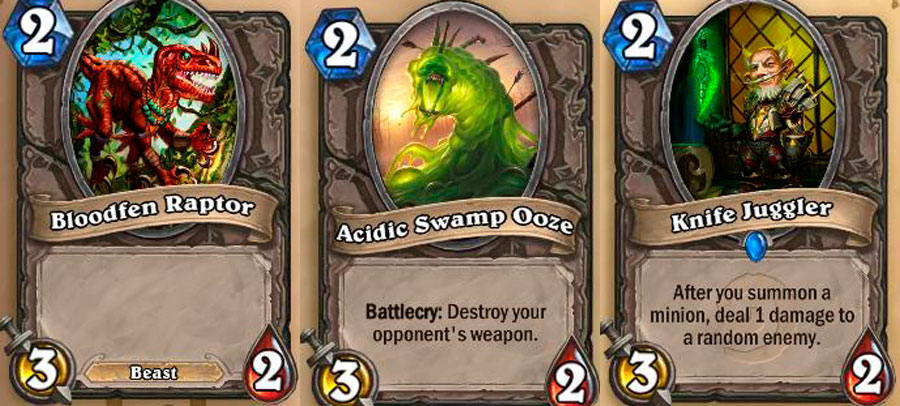
Balance!
Being a Beast is not as powerful as the other two cards, unless you are playing a Hunter Beast deck. But the more damning implication, IMO, is how the above cards sort of imply that a 1/4 for 2 would be balanced. Or a 2/4 for 2 mana, even. We already have 3/2s with an ability, 2/3s with an ability, 1/3s with a huge ability for 1 mana (Priests, seriously), so a 2/4 for 2 isn’t outlandish rules-wise. And yet it would be crazy OP, invalidating a huge swath of two-drops. The context of the environment is as important and possibly more so than the strict card power rules.
All that being the case, I don’t actually agree with SynCaine that the new player is screwed, as my prior declaration remains accurate: your situation in Hearthstone only ever improves. Six expansions later, assuming no structural changes, you will still be able to Disenchant the cards you don’t want to directly create the cards you do. That’s unbelievably huge in the CCG world. Even if you take the stance that your likelihood of opening one of the “ten or so required Epics” is necessarily diminished (assuming new cards are stuffed into the same virtual booster pack), your ability to guarantee a card is not – you will always get 40 Dust per pack, minimum. Ten packs is an Epic of your choice. You’ll get enough gold in two days of daily quests to buy a pack straight-up, or three if you want to go the Arena route. So, unless expansions are coming out every 1-2 months, you’ll have plenty of time to get whatever cards you need to be/stay competitive without spending a dime.
Spending dimes gets you there faster, of course. But in this context, I’m okay with it.
 In An Age
Far Cry 3 #GameLogic
Jan 17
Posted by Azuriel
I recently started to play Far Cry 3, and have come to realize that it features a whole new level of bizarre #GameLogic. I mean, there is some nominal amount of disbelief suspension going on in every game, sure. How does sleeping in a tent regain health? Why can I get shot and regenerate by ducking behind cover, for that matter? Why do I have to pay hundreds of thousands of currency units to purchase weapons from a store that will cease to exist if I fail to kill the world-destroying evil guy?
Some invisible line felt crossed in Far Cry 3 though, about the time I realized I was hunting and skinning goats to increase my wallet size. I can buy a flamethrower from the corner drug store, but can’t buy a wallet with my (then maximum) $1000?
Step 1: Drive over there. Step 2: Skin some goats.
That goofiness aside, Far Cry 3 has been… interesting, thus far. The minute I realized that unlocking additional weapon slots and ammo storage was bound by killing/skinning animals and not level, was the minute I ignored the story altogether and went on a Buffalo Bill safari. You might think that the easy, beginning recipes would belong to animals populated around the beginning areas, but you would be wrong – I had to travel quite a distance across the map to find some goats to offer to Mammon, the dark deity of larger wallets.
Speaking of questionable design philosophies, Far Cry 3 is reminding me a bit about why Skill Trees are usually a dumb idea. Right now, most of the three trees are locked until I complete more story missions, but the “root” of one of the trees was, I kid you not, the ability to “cook” grenades. As in, I needed experience points and adding a tattoo to my arm to unlock the ability to pull the pin of the grenade and not immediately throw it. And you have to unlock this ability in order to choose anything else in that tree. This reminded me of TBC WoW, where Affliction warlocks had to put five (!) talent points in the 1st tier to lower Corruption’s casting speed down to instant-cast; I think the first talent point was a 0.2 second reduction, or something.
Character customization is great, don’t get me wrong. But, seriously, if you have that much filler in your talent trees, you are probably better off not having any at all.
Posted in Commentary
Comments Off on Far Cry 3 #GameLogic
Tags: #GameLogic, Crafting, Far Cry 3, Game Design, Talent Tree