Blog Archives
Interview Overload
Ever read about an hour’s worth of interview transcripts about a game you’re not even technically playing anymore? I have! [emphasis added throughout]
- “However, mounts are sacred–one of the only things left that’s visual prestige. So we do want to make sure we give them out for the right things, like the Challenge Mode achievements Tom spoke about.”
- Re: Guild Leveling. Blizzard isn’t sure they will be increasing the level cap; they may just be swapping out abilities (i.e. Have Group, Will Travel is getting axed). Other big news here is that no daily/weekly XP or Reputation caps anymore.
- “LFR has been huge for us–one of the most successful features in the game, similar to when we implemented the Dungeon Finder. We can watch the numbers exponentially grow–the number of people that are raiding now, compared to before 4.3, is incredibly dramatic–it’s so much more. We can’t tell you the exact percentage, but it’s massively larger. And not only that, they’ve continued to raid, and these are players that have never raided before.”
- Re: Firelands dailies: “What didn’t work is that it’s staged out to take too long for the number of quests you need to do. I think that to get all the marks you needed to get was excessive amount of time.”
- Blizzard doesn’t actually seem to know how the Beta will actually pan out, given that over 1 million people will be getting in.
- You can (i.e. will) farm tokens to buy a consumable item that gives you, personally, an extra shot at getting gear from a boss. It works in LFR, Normal, and Heroic versions of raids. Yes, an extra shot at heroic raid loot. Yes, every heroic raiding guild will require it.
- Blizzard nixed the whole “monks don’t auto-attack” thing. Called that one.
File under Missing the Point:
Q: In addition to the linear nature of Cataclysm questing zones, many players felt that it was hard to feel completely engaged in a zone due to heirloom/guild xp bonuses. They’d outlevel a zone before completing a lot of the major plot arcs. The revamped 1-60 content is complete, but was there anything to learn from this in designing future zones? Especially now that Pandaria has more zones than we first heard about at BlizzCon.
A: Well, actually, we are very deliberately trying to set it up so you can skip some amount of content on the way to 90. We feel those decisions make the World of Warcraft seem like a world. If you look back to original WoW, we had Eastern Kingdoms and Kalimdor, for players to quest in at any given time. There was an amount of choice in what you did–sometimes that choice diminished somewhat, but generally speaking, there were different options.
We’d like to capture that as much as possible, so not only is the quest flow itself a bit less linear, but also your zone choices is a bit less linear. That inherently means you won’t get to do all the quests on the way to 90, but it does mean that if you play the game on an alt, you have an option to do something new.
I think the problems you’ve described with heirlooms or guild xp bonuses and everything stacking becomes worse when it’s linear, because when you end that linear experience before you’re supposed to, it’s a lot more noticeable.
Actually… is Tom Chilton missing the point at all? Reading the response over again, it seems to me he wants WoW questing to get away from zones even having “major plot arcs” for heirlooms and leveling bonuses to trivialize. After all, isn’t the complaint that a person out-levels, say, Duskwood before finishing all the quests in the area? That is only a “problem” if one views the zone as something to be completed. If the zone is instead looked upon as a playground with different equipment – Raven Hill as a Merry-Go-Round, Darkshire as the swing-set, the southern portion as a series of muddy sandboxes – then “out-leveling” it does not make a whole lot of sense.
On the other hand, Chilton cannot have it both ways, right? Players are funneled into Duskwood from Westfall, and thus they encounter Raven Hill first; Darkshire’s issues are as much a part of Raven Hill as the other parts of the zone. Less linear is fine in theory, but there is a meta-narrative that has to glue these quests together in some way. And what about the people who come to enjoy a given zone’s zeitgeist? I love the idea of being able to skip entire zones (Wetlands and Arathi Basin are terrible for Alliance), but the issue at hand is not being able to stick with the zones you actually like. Non-linearity does not fix the issue of quests going gray.
Re: ZA/ZG
With Zul’Aman and Zul’Gurub, they got a worse reputation than they deserved. A big mistake was going from a tier of content that had 9 instances to run, down to a tier of content where you only have 2 instances to run and no raids. If you run people through the grinder of the same two instances over and over, it ends up feeling much worse. If you take any instance and say ‘these are the only two instances you get to run for many months,’ then that ends up feeling pretty bad.
Re: Community
Q: Last question–about community in WoW. There’s been a lot of changes with people coming back and playing together, and using tools like Real ID and Looking for Raid across servers. How do you balance player-created communities across servers with pre-existing raiding guilds, that are facing challenges now like downsizing from 25s to 10s or dealing with real life and scheduling conflicts among older members?
A: I think that is an important balance to try to achieve. Over time, we’ve gone in the direction of making the game accessible to a lot of different people, such as queueing up for dungeons and raids with friends–which have impacted these guild ties and such. So I think that for us, one thing we’re hoping to do is get guild community back with challenge modes, without excluding your average player from content. Certainly with challenge modes, we don’t plan for you to queue up. We feel that if you queued for a challenge mode in Dungeon Finder, that would cause a lot of problems. That guy being yelled at by his wife for 15 seconds will make everyone else pull their hair out and panic that they’re going to miss a medal. It’s an interesting opportunity for us to really emphasize both playing with your guild and friends without it feeling like the average player is missing out on seeing an instance.
Re: Raiding
Q: So you are in discussions about possibly changing how the raid lockouts work?
A: Sure. I think we’re gonna look at how the 10/25 person lockout worked as a shared cooldown. Was that the right decision, or do we want to do something different? I don’t really know what the right answer is yet. We haven’t decided.
And then we get to the Ghostcrawler interview…
Q: So I was playing the Monk a little bit, and I noticed a couple things that were different from Blizzcon. There’s no more dark Chi.
A: <some debate about how to actually pronounce “Chi”>
Q: So there’s no more dark Chi…
A: Dark balls.
Q: There’s no more dark balls, yeah. What prompted that sort of change?
A: [snip]
I am not sure if I mentioned it before, but I genuinely enjoy having Ghostcrawler around. He may be the face of the B Team, he may be a straight-up design troll in some respects, but hey… at least he has a face, yeah? In a world of Bobby Koticks and David Reids and faceless community managers, I am all for more Greg Streets and Curt Schillings, even if they get things wrong.
Q: […] Glyphs was one system I was looking at and trying to wrap my head around the changes. I think you guys had said something about this somewhere, but prime glyphs are basically gone now.
A: Yeah. We apologize for prime glyphs. They were a bad idea. At the time, we were worried that, say, a Paladin who didn’t have a glyph for Crusader Strike would be like, “What the hell? This is my most important ability! I need to glyph Crusader Strike! I don’t want to glyph… I don’t know, Turn Evil or something like that, because I want a glyph for Crusader Strike.” So we did that, and it ended up just complicating everything because now we have to imagine that, “Oh yeah, everyone has stupid prime glyphs that give them 5% damage or crit or something like that.”
See? After talking about a new glyph for Prot paladins that lets you aim Consecration (ala Death & Decay, but shut up), the followup is:
Q: <grinning> See the grin on my face?
A: <laughs> The Glyph of Divine Plea, which Divine Plea is Holy only now, changes it from a “for the next X seconds you’re a bad healer” to a cast time, and then at the end of that cast time you get all the mana right away. So you have to pay the cast time, and while you’re casting you’re not doing anything, but at the end of the cast time you get all the mana and there’s no self Mortal Strike that a lot of Paladins hate.
Want some more? Here was a show-stopper of an admission, from the answer to the problems with Legendaries:
I think part of that is because almost every raiding Rogue had an expectation of getting a legendary. That’s something I’ve talked about a little bit recently. So, one dark secret that players have probably all figured out by now is that Blizzard designers tend to careen from one extreme to the other, and so, when we decide something doesn’t work out, we go to the complete opposite, illogical extreme, and then we reel it back in a little bit. So, we were kind of reacting against the Warglaives model where, “You have a tiny percent chance of getting a legendary! Congrats!” to trying to make it a little more predictable, and the way we did that was with the style where you need so many parts, and the parts have a fairly predictable droprate, and eventually you’ll have your legendary, which then led to the opposite problem of they’re super predictable, people could point to a calendar day and say, “April 20th! That’s when I get my legendary!”
What sort of designer admits that? Bad ones? Good ones? Final quote:
Q: Interesting. So you did a blog post a while ago about the “Great Item Squish (Or Not) of Mists of Pandaria.” I noticed that the combat text was popping up and saying things like “14K” instead of 14,000 or whatever. Is that the route you decided to go with, like the “mega damage” approach?
A: Yeah, we went with the “not.” Mega Damage, here to stay. So we had this all in and working. We squished everything, and it was working. We had the whole thing implemented, and we sat down and tried it out, and, you know, Mortal Strike hit for 200, and Fireball hit for 150, and we were like, “This feels wrong.” We knew exactly how it would feel like, and we knew that our damage as a percentage didn’t go down, but it felt terrible. And we were like, “Okay, this is now super risky”, because we’re going to change talent trees on players, and even though we think it’s a great design, and we think players will love it, it’s a hard sell. And to do that, and have them hit really wimpy, I think even if players understood why we did it, deep down they wouldn’t like it.
So we decided to back off of that. We’re trying the solution with commas, and K’s, and M’s, and to be honest, it helps a lot, and our hope is, by 6.0 or 7.0, players are demanding the item squish, and by then it’s not controversial at all. It’s like a celebration when we finally do it.
Okay, so that is a lot to digest.
Instead, I think I’m going to play some more Mass Effect 3 multiplayer.
I May Be Ruined
I am about ~15 hours into Mass Effect 2.
Everything is going swimmingly, although I am beginning to suspect (all) other games have been ruined for me in two very specific ways.
First, I am not sure I can go back to text boxes in RPGs anymore. It is not just about BioWare’s penchant for fully-voiced stories, it is about the equally gripping body language. Everyone has heard about the whole “93% of communication is nonverbal,” right? We are now at a point in game design when at least one company is capable of delivering on that 93% and I do not know if I can go back.
It isn’t just about the smiles, the winks, the nods, or the scare quotes by characters with only three fingers either. It is about the more subtle touches that keep my eyeballs glued to the story exposition. For example:
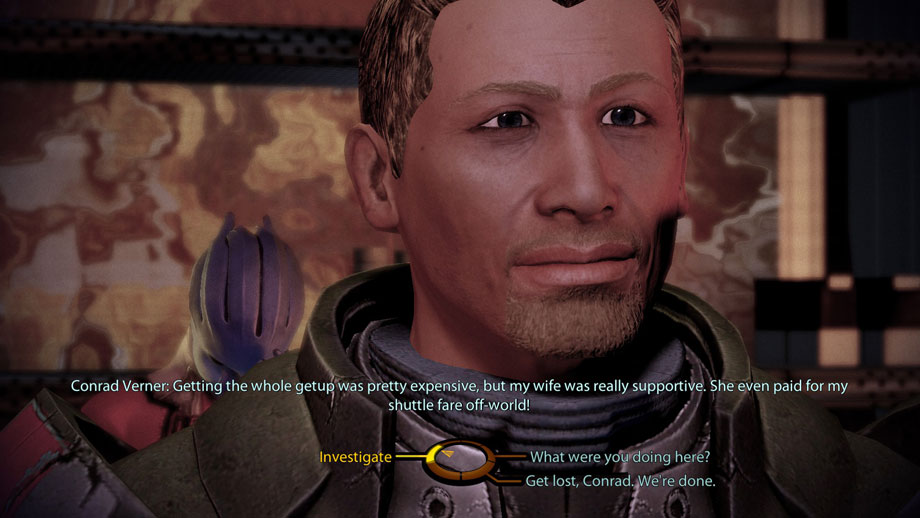
I should have shot him in the foot when I had the chance.
The asari bartender in the background facepalms when Conrad speaks the part about his wife buying the ticket. I actually had some difficulty taking that screenshot because the time between the background facepalm and the camera switching back to Shepard is less than a second – I had to redo that part of the conversation twice to get the shot.
Think about that for a moment. Someone actually went through the trouble of programming a facepalm into a (presumably) throwaway, non-required dialog option, with less than a second of screentime. Understated is an… er, understatement.
Going back to strict text and using my imagination to fill in the blanks? I am not quite sure it will feel the same knowing that the blanks are literal blanks; unless the developers clearly make up for it in other areas of the game, I suspect I will recognize the gaps as deficiencies rather than “imagination opportunities.”
The second way I have been ruined actually came via The Witcher, and is very clearly manifesting itself in Mass Effect 2. Specifically, I now believe I can and should be able to romance anyone and everyone, simultaneously.

Romance All the Things!
I first noticed this tendency when I was flirting with the ship psychiatrist – whom should really know better – and became nervous that things might get out of hand before the entire playing field became available, so to speak. This was not a problem in The Witcher; in fact, you typically only had a single opportunity for “romance” at any given time, so it was a series of all or nothing encounters.
To be honest, this probably has more to do with my methodical nature in gaming than anything else. The baseline assumption I operate on is that I will only ever play a game once – I am looking to maximize my fun, not fill time, and 2nd playthroughs almost always lose out to the dozens of other games available. Ironically, this leads to counter-intuitive game behavior wherein I suck the very marrow out of a game’s bones, completing every sidequest and bonus mission long after such things have ceased being fun and/or make sense to do. Exploring every planet in every system cluster in Mass Effect 1, running Miscellaneous quests in Skyrim as a level 54 character with 100k+ gold, and so on.
As you might suspect, mutually exclusive romance options present a certain difficulty to me.
I do have a residual desire to play ME1&2 again as FemShep, which I would have done originally if not for the availability of romance options at all (that’s another post). The ideal romance scenario would be the “Deus Ex ending” one, wherein you could save right before the critical choice and I could reload to see each outcome. I am getting the impression that this is not how things will shake out.
Youtube exists, but it is just not the same.
Skyrim is a Bad MMO
Skyrim, of course, is not intended to be an MMO.
That said, as I sailed past 100 hours played and started finally running out of the “named quests,” I started thinking back to when a lot of bloggers were musing on a hypothetical Skyrim Online and how great that would be. As it turns out, there is not much imagination necessary: Skyrim really already emulates a lot of the standard sort of MMO tropes. And, perhaps ironically, some of Skyrim’s other qualities sort of demonstrate why such mechanics generally do not really work in MMOs.
Questing
Quests range from “Talk to this guy,” to “Collect 20 Nirnroot,” to “Kill the Bandit Leader in a nation with an inexplicable 10,000:1 bandit to honest citizen ratio.” While there are no exclamation points over peoples’ heads, each city is so densely packed with quest-givers that your minimap – if such thing existed – would be lit up like a Christmas tree. And just like with every quest in an MMO, you never get a sense that you are actually solving anything. Give the Blacksmith 10 Fire Salts to reheat his forge? He may greet you a little differently, but his “secret technique” results in no higher quality merchandise, no larger gold cap, no discounts.
Sidequests are sidequests, though, right? Well, to an extent. The problem is when there are more sidequests than main quests, or when the main quest is boring. At some point, you give the player enough freedom to hang themselves… and they do.
See, I have completely lost the Skyrim narrative. “What am I doing? Why do I care?” Helping a dude steal a horse is supposed to enrich the game world’s verisimilitude, I guess? If that is the case, it failed. The quests are so disjointed and arbitrary that I end up feeling like a dyslexic, ADD-addled coke-fiend with Tourettes, sputtering along countryside with an ever-increasing laundry list of chores. The situation really makes me appreciate all those otherwise lame zones in WoW, insofar as the quests actually lead somewhere or enriched the background of the zone.
Crafting
I have heard a lot of people lament the state of player crafting in MMOs, but again, Skyrim is a good case-in-point about where strong player crafting can lead to. Basically, I have not upgraded a single piece of gear in the last 40 hours of gameplay. Considering there is no such thing as quest XP, and I have more gold than I could ever possibly spend, the lack of possible gear upgrades essentially boils questing down to its base narrative components. Some hold up, most do not.
Short of the sandbox-esque nuclear option of destroying gear and/or permanent durability loss, I do not see a worthy payout for the costs of strong player crafting. I just completed a long questline to reconstruct a 1,000+ year old amulet whose power started a war and led to it being split into three parts and sealed away; the names of amulet keepers were to be forgotten under the pain of death. After finally reforging it, I held it in my hands and… oh, +30 to Health/Mana/Stamina? I created an amulet with +67 to Health and +40% extra Bow damage nearly 50 hours ago.
/vendor
While some of this can be mitigated in MMOs by making recipes rare, requiring special crafting materials from higher-level content (which is different than normal loot… how?), and so on, strong player crafting still seems to boil down to reducing or eliminating much of the incentive to quest. Perhaps that is indeed the entire point, eh? Moving away from designer quests and into “Spam Trade chat for an hour” player quests? That is fine to do, with the assumption that the game itself is either going full quest-less, or the quests that do exist are so ridiculously fun and exciting that they are intrinsically worth doing.
Pacing
Although this is not a formal review, if I had to sum up all of my problems with Skyrim in a single word, it would be “pacing.” There simply isn’t any. Even if the game revolves around doing what you want, pacing is important. I am level 51 and I can 2-shot dragons with my bow from stealth – the game is essentially over for me. And yet the main questline is not remotely near complete, nevermind the handful of other quests remaining. Yes, “I did this to myself.” If EVE gave every new player a Titan for completing the tutorial, those players would also be “doing it to themselves” for (ab)using it too.
Point being, it is the designers’ jobs to craft a well-paced game. I don’t care how sandbox your design is, I shouldn’t be allowed to break the game for myself. One of the great strengths of the themepark experience is exactly the derided “on rails” component: it will take you X days of Y quests to get Z gear. The bosses you face tomorrow will be stronger than the ones faced today. There will be a quantifiable reason to collect 10 bear asses.
After 100 hours of gameplay, clearly Skyrim is doing some things right. I have never taken more screenshots in my entire life, for example. Despite my character being completely broken, I still treat the world seriously (sneaking around when I could simply kill things straight-up) because it projects seriousness in most every scenario. But instead of making me pine for Skyrim Online, it does the opposite. I miss the strong narratives of Fallout 3 and New Vegas. I hated having to level through Burning Crusade content in WoW, but I hate tracking down 20 Nirnroots more.
Pacing is something to keep in mind when constructing your hypothetical sandbox or Impossible MMO. More options, more things to do, can actually result in less meaningful gameplay. Skyrim deserves its accolades, but it makes for a pretty bad MMO. And the changes necessary for Skyrim to be ported into the MMO world would, in fact, make it resemble nothing like its present state.
Skyrim Design Nettles
Skyrim thus far has been as amazing an experience as everyone says. There is something to be said about how the fidelity of an experience engenders instant immersion in ways videogaming might not have achieved even five years ago. I already posted the screenshot of what I saw exiting the tutorial dungeon for the first time, and I was immediately struck by the same awe and infinite possibility I felt leaving the Vault in Fallout 3.
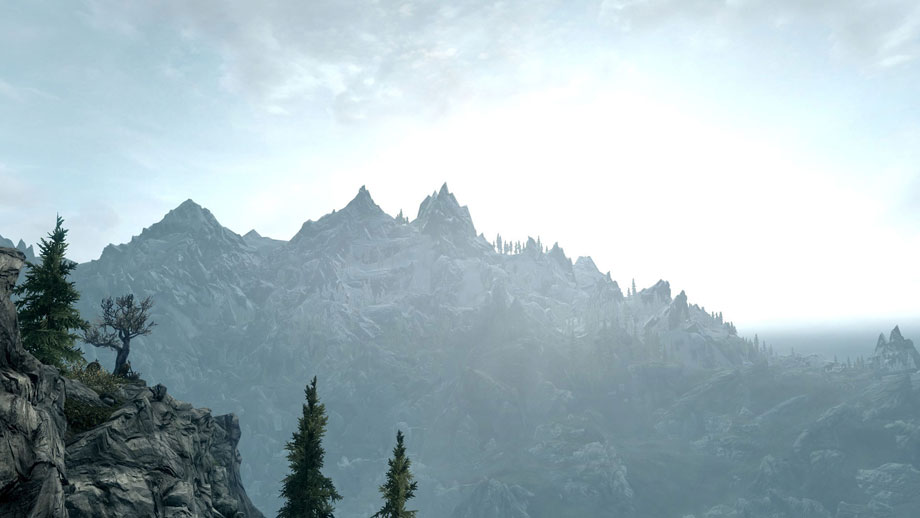
My current desktop background. Well, at +1000 resolution.
What I want to talk about today though, are the Design Nettles in Skyrim. These are the little things that take me out of the experience with their sting, no matter how much I try and ignore them. Every game has its idiosyncrasies, but what elevates these particular annoyances is either how out of place they seem within the context of a fidelitous experience, or how much they are artifacts of a bygone design era.
Imbalanced Skill Gains
Raising one’s Sneak level by auto-running into the wall for an hour has been a staple of Bethesda design since at least Morrowind. Why they choose not to fix that isn’t the problem. The problem is simply the imbalanced skill gains generally.
I gained two entire character levels in the first town from simply pickpocketing; going from level 6 to level 8 within the same house, in fact. Indeed, I gained 5 skill points for pickpocketing ONE ITEM, a magic ring from a sleeping guy. My pickpocketing skill is currently north of 70, I am level 21, and I haven’t even seen a 3rd city or a dragon yet. Meanwhile, I have probably picked 30 locks in the same time period and received ~4 skill ups. Same with Blacksmithing, Alchemy, Enchanting, Sneaking, Archery, and so on and so forth.
This is more of a problem in Skyrim than it was in Oblivion, because gaining any skill points increases one’s level, which in turn increases the level of all enemies in the game world. More insidiously, you can go hours (or specifically 18 hours in my case) before the problem even begins to manifest itself. I ran into some bandits on a bridge who were immune to my normal tactics which had hitherto worked in every encounter, and I only succeeded by “gaming” the system in rather ridiculous ways – playing Ring-Around-the-Cookpot and ladeling myself 16 servings of Apple Cabbage Stew in Matrix-esque bullet-time.
Enemies on Minimap
I can appreciate the design challenge that comes from choosing to have enemies appear on the minimap. Specifically, once you do that, you cede the ability to create tension via unknown enemy placement without resorting to dumb gimmicks. I like to call this the Silent Hill effect – unlike Resident Evil or other survival horror games where monsters can jump out at you at any moment, Silent Hill gives the player a radio that plays static whenever enemies are about. No static, no monsters.
Silent Hill as a series gets around this “limitation” by being fucking scary even when there aren’t enemies around (and by segmenting the game into rooms), but Fallout 3 and Fallout New Vegas fall into the trap of essentially lying to the player; “You can see enemies, and even raise stats to see them from farther away, unless we need to generate tension in which case your abilities will be useless.”
Skyrim attempts to have it both ways, while simultaneously stepping into one of my biggest pet peeves in “realistic” games.
In Skyrim, enemies that have aggro’d to your presence appear as red dots on the map-bar. You can even track the movement of these enemies through walls and barriers. Other than that, nothing appears on the map-bar other than locations. Which is… fine, right? Resident Evil, Half-Life, etc, don’t have minimaps with enemies on them either. My peeve though, relates to how high-fidelity games play out as if my highly skilled avatar is as clueless as me, the player.
Look. It’s clear the Skyrim designers decided not to put animals/people/etc on the minimap in order to increase realism. If I’m chasing butterflies to eat their delicious wings, it’s fair play that the tiger I wasn’t even looking for gets its turn too. But if I’m specifically hunting that tiger, or I’m sneaking up on the bandit camp, it simply feels dumb to be surprised due to lack of information. I can’t hear the guy in full plate walking around because the designers refused to give me that input; or if they did, they made audio-only to the point where I’d blow out my desktop speakers trying to hear it.
You can’t ask me to put myself in that field, and deny me access to my normal senses. And you can’t pretend that my normal senses are adequately represented in your arbitrary, game design way.
In other words, Christ, I want NPCs on that minimap. It obviously changed my behavior in the Fallout series knowing where people are even through walls and such, but removing it and pretending my character is as careless as I am playing the game is worse. Indoors? Yes, it works well to force people to be careful. Outdoors? Completely ruins any semblance of stealth-ish gameplay. At least, until I “beat the system” by Quick-Saving every 30 seconds and simply reloading if I stumble into a bandit camp without the opportunity to sneak attack someone.
Massive Effect
Having completed Torchlight, I decided to move onward to Mass Effect. Why not Skyrim, which is literally burning a hole through my Steam library? As Liam O’Brian might say, the status of my preparations is in doubt. I prefer one meaty title with a helping of indie garnish along the side – with something like Skyrim, I’m getting the impression that I’ll still be eating turkey sandwiches for months later.
About 5 hours into Mass Effect, all I can say is holy shit.
One of the most groundbreaking things occurred in the city after the first “dungeon.” In talking with a receptionist to the Consort, she winked at me.
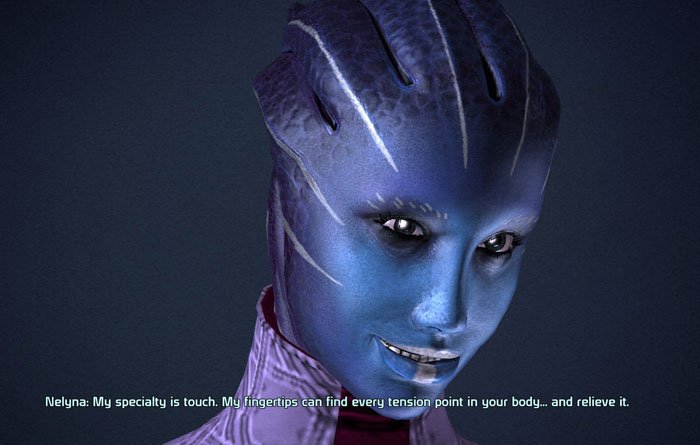
She also said that, but nevermind.
My incredulity may sound facetious, but I am actually very, very impressed.
See, I have been thinking about the problems with storytelling in videogames for quite some time. How is one supposed to convey subtle nuance in a game? In purely written works, it is somewhat easy to evoke the emotion you want to get across, provided you massage the language a bit. For example, consider the following:
‘Look, I can explain,’ he said.
Lord Vetinari lifted an eyebrow with the care of one who, having found a piece of caterpillar in his salad, raises the rest of the lettuce.
How could someone ever translate that in game form? Nevermind Vetinari’s specific sentiment here, think generally: there is an entire genus of expression that the format is preventing designers from expressing.
Games have some pretty unique qualities that cannot be replicated by other mediums too – Far Cry 2’s plot wouldn’t work without player interaction – but many times it feels as though designers simply give up. Game narratives are written in the language of action because of these restrictions on expression. Why are we always killing 10 [%local_wildlife]? Or killing everything, period? Well, how else are you supposed to convey conflict when reduced to crude avatars with clubs? Even though all games have access to written dialog, at some level we do expect everything to be translated into the language of action. And until the last few years, it was functionally impossible to express more than a rudimentary emotional gesture anyway.
There are pitfalls too, of course. Blink during the wink, and you’ll have missed it. Or, hell, focus on the subtitles and miss it too. It is also arguable about whether games should try and be more like the other mediums, instead of focusing on its own unique strengths.
To that last charge, I say “Watch that scene in FF7 again.” Pay close attention at 1:19. More than the murder itself, it was Sephiroth’s smirk that drove home how irredeemably evil the man was. Without the CG movie we would never have saw it; calling attention to smirk in-game via text would have ruined its subtle gravity. While story can certainly be a crutch to prop up forgettable gameplay, story can also be a pole that vaults a game into the classics.
So, Mass Effect, you have my full attention. I just hope you do a little more winking a little less of this:
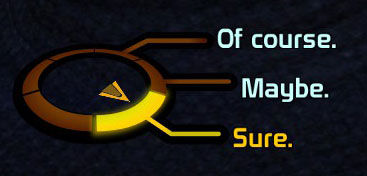
Decisions, decisions.
Reviews: Torchlight, Orcs Must Die!
Game: Torchlight
Recommended price: $0
Metacritic Score: 83
Completion Time: ~17 hours
Buy If You Like: Bad, bad dungeon crawlers
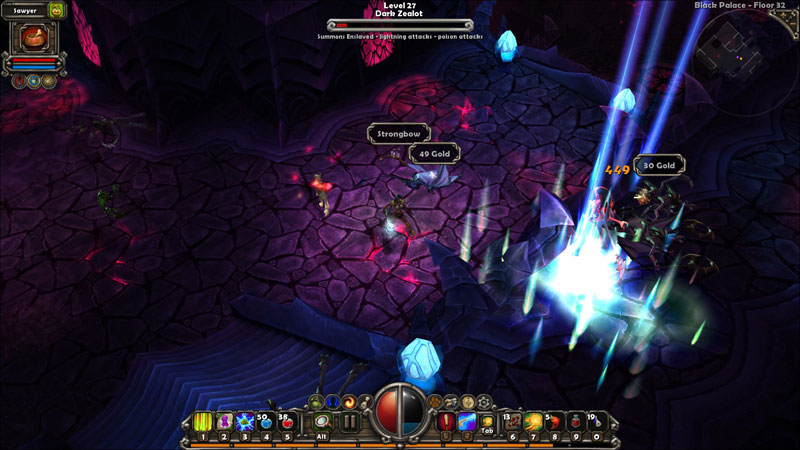
Four enemy types, 20 different skins. *Yawn*
According to Wikipedia, the Uncanny Valley is a hypothesis in robotics and 3D animation which holds that when human replicas look and act almost, but not perfectly, like actual human beings, it causes a response of revulsion among human observers. In other words, humans respond positively to human-like robots up to a point, after which our reaction to its failings is far more negative than would be towards a clearly non-human machine. Based on my overall experience with Torchlight, I firmly believe there is an Uncanny Valley of Game Design, which Torchlight cratered into face-first.
To call Torchlight a Diablo-clone is misleading; I would term it more a Diablo-mockery, although that implies Torchlight was intentional in its failings rather than simply being a cheap knockoff, like Chinese powdered milk laced with industrial solvents.
At first, everything is classical Diablo in a Warcraft 3 skin: isometric, dungeon-delving gameplay, hordes of monsters, loads of loot. There even appears to be a lot of improvements to the formula. The dog/cat companion makes the delving feel more homely. The three classes are actually modular archetypes, such as being able to make the “archer” into a rogue, the “mage” into a tank, and even the “barbarian” into a ranged magic-user. Four generic spell slots for your character and two for the pet let you do some interesting things to complement your own class abilities. I thought the Fame mechanic (Fame is like a second XP bar that only gives you extra talent points) was a clever way of making the killing of named mobs important without necessarily making you overpowered.
It was around hour six though, that I realized that Torchlight had not yet blinked its glassy, vacuous eyes.
There is no real gear progression in Torchlight. Let that sink in for a moment. I received an orange-text Unique neck item around level 4 that I was unable to replace for the duration of the entire game. Random stats are random, but when a random level 10 green is as powerful as a random level 30 green, the entire loot-centric nature of this particular genre collapses. The consolation prize mechanic is Enchanting, where you put an item in a box and have about even-odds that you paid someone 10% of your wealth to destroy said item. No, seriously. Find a decent weapon, put it in a box, pay ~1200 gold for a chance to add a random stat upgrade on it, a chance that nothing happens other than your gold evaporating, or an increasing chance your item gets disenchanted, completely wiping all its stats. The first item I tested this on got disenchanted on a 4% chance, and the second was an Unique-quality bow that was disenchanted on the first, 2% attempt.
I got an achievement for it. No, seriously.

Bum Luck: You installed this game.
Now it did occur to me that perhaps they were attempting something novel, a kind of re-imagining of the transitory nature of loot in Diablo-esque games. An upgrade isn’t an upgrade off the ground, but only after you “win it” from the Enchanter, or something. The problem is that whoever balanced this garbage was a goddamn moron. Enchanting costs gold. A lot of gold. The items you pick up off the ground never really increase in value the deeper you dungeon delve, such that each time you unload your haul in town you get the same ~2500g at level 10 that you do at level 30. Even Epic or Unique items sell for complete peanuts; the highest price I got for a sale was 1,809g for the level 4 Unique necklace I mentioned earlier, which the vendor turned around and was trying to sell for 82,432g. That’s right, instead of the typical 1/3rd or 1/5th cut you see in normal games, Torchlight is operating on GameStop levels of Fuck You resale value. If something could be worse than selling at 1/45th value, it would have to be the necessity of Transmuting four pieces of magic gear to turn into a random crappy gem, which needs to be transmuted with ~12 more crappy gems to get a mildly useful gem, to have something to put into the sockets of the level 8 shoulders you are otherwise never going to replace.
I am spending all this time talking about loot because loot matters in these games. Once you cease expecting any upgrades, the endless, nondescript corridors are filled not with opportunity or excitement, but are instead arteries clogged with the fatty plaque deposits of meaningless mobs. The original Diablo did not have much of a plot beyond “save us from evil” that I can recall, but the setting of gritty evil provided its own sense of gravitas. Conversely, Torchlight does not even bother. “Sidequests” are perversions of the term, and amount to simply killing mobs you were going to kill anyway slogging towards the stairs. Even worse, the “quest rewards” for these things are randomized green items. Look at this shit:
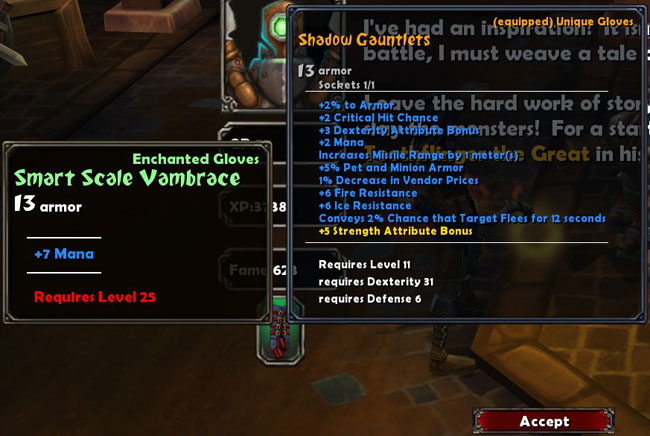
Equipped item on right, "Quest Reward" on left. Note the Required Levels.
The thing I kept hearing regarding Torchlight was that former Diablo 1 & Diablo 2 designers worked on it. If their contribution to that series is at all representative of what I experienced in Torchlight, then all I can say is good goddamn riddance.
Well, that, and I have never looked forward to Diablo 3 more than I have now.
Game: Orcs Must Die! + DLC
Recommended price: $10 (DLC included)
Metacritic Score: 84
Completion Time: ~11 hours
Buy If You Like: More trap-based Sanctum tower defense
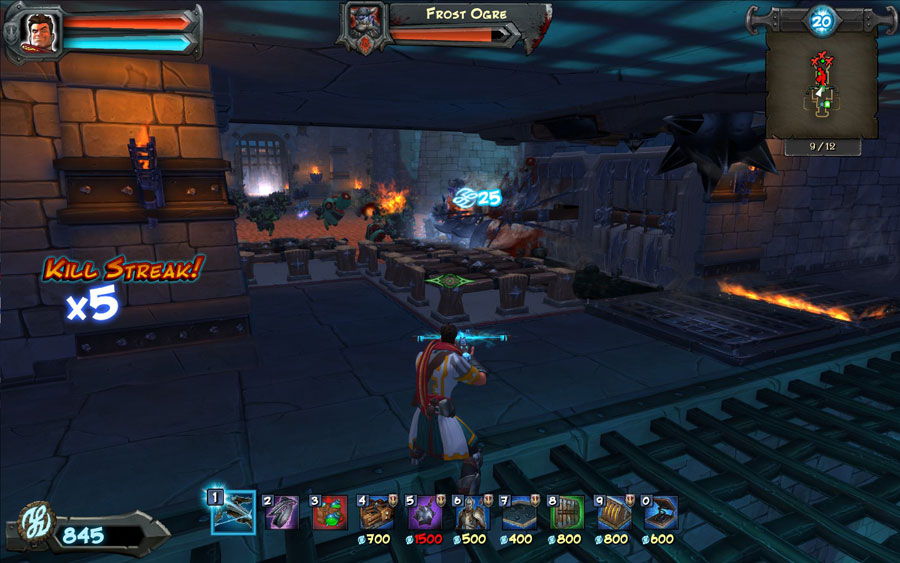
Few things feel better than killing orcs. Maybe Nazis. Or maybe Nazi zombie orcs.
Orcs Must Die (hereafter OMD) is one of the best, purest non-Tower Defense… Tower Defense games I have played. The premise is simple: the orcs are at the gates, and you must stop them. The rest of the game follows a simple elegance undermined only by the limitations of genre conventions.
To be honest, OMD felt like it had more in common with the brilliant PS1 Deception series than it does with Tower Defense. You start off each level by choosing a limited number of traps from your collection, in addition to personal weapons/spells that you will be using to kill the orcs. Traps range from spikes that impale from the the floor, to arrows that shoot from the wall, to mechanized swinging maces from the ceiling, to archer guardians; weapons include Fire/Ice/Lightning/Wind rings, to melee battlemage staves, to your trusty magic repeating crossbow. Later on, you can further select from 1 of 3 “Weavers” for that level, whom act as mini-talent trees that boost your effectiveness in different ways. Once your arsenal is selected, setting up traps costs a set amount of currency from a limited pool that grows between waves and from your merciless slaughter of orcish hordes.
And yet OMD deviates from the standard Tower Defense genre in many key, innovative ways. The most obvious is the fact that your Ash-from-Evil-Dead character can (and must!) get down and dirty in the fighting himself. While certain trap setups essentially make victory guaranteed, you typically won’t have enough currency to set them up in the early waves, and certain levels contain too many chokepoints to trust to traps alone. The standard orcs will actually chase you around if you are nearby, which can buy you some time for allow for traps to reset. Moreover, there are some enemy types like the ogres (fire, ice, and armored varieties) whom are too tough for typical traps to kill outright, and the downright scary Gnoll Hunters who leap over your orc-stopping waist-high barriers and hunt specifically for you.
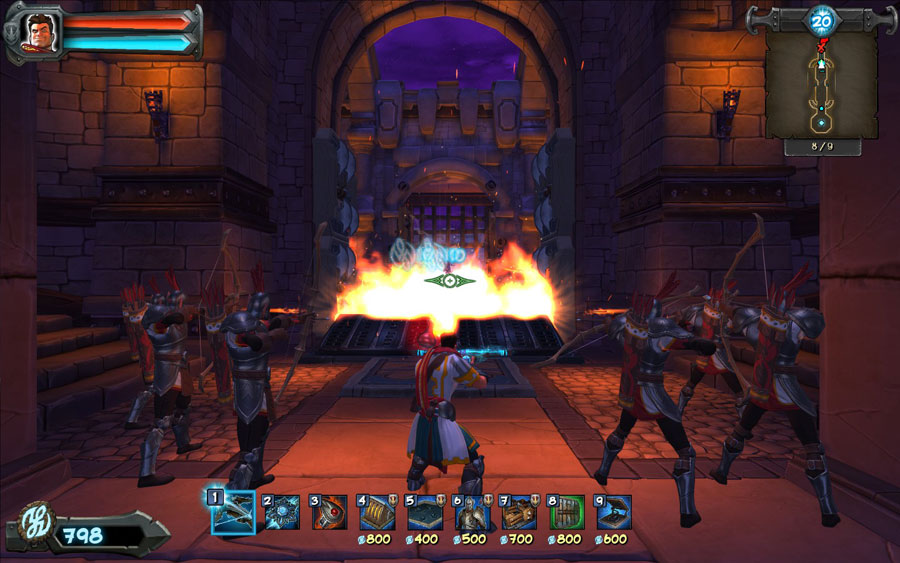
Ain't no one going home tonight.
The other area in which OMD forges ahead is in its rather brilliant, non-standard level design. In typical Tower Defense, everything is gridded out in neat, orderly squares. While traps require certain precise placement, I never got the impression from any of the levels that they were build specifically to place your traps “just so.” Fluted columns and flying buttresses foil wall and ceiling traps respectively, while floor traps cannot be placed on stairs. Any time I actually saw a 2-3 “square-trap-wide” corridor, I would get excited, like I won the goddamn architectural lottery rather than feeling this was exactly where the designers wanted my traps to go.
While there are some additional innovations like permanently upgrading traps by spending the orc skulls you earn based on level performance, OMD is unfortunately limited by genre conventions. I applaud OMD for not falling into the Tower Defense trap (har har) of simply increasing the HP of the enemies as a crutch for increased difficulty among waves, but after a while you will come up with trap setups that are essentially unbeatable. Much like in every Tower Defense game I have ever played, the slow traps (e.g. Sticky Tar Trap) are fairly overpowered; similarly, some traps and weapons feel too good, especially compared to others that don’t seem to have a place. I almost feel as though the game would have been improved if there was a mode or option to where you get a randomized list of traps, rather than entirely relying on level design to inform your decision. Or if there was some kind of incentive to utilize the “bad traps” in unique ways – since the Leaderboards are based entirely on points, I could imagine some kind of score multiplier for trying to use the Steam Trap or Push Wall Trap effectively.
Ultimately, OMD provides for some very enjoyable orc-killing and trap-setting Tower Defense gameplay. There is a Nightmare mode available for the masochists out there that hate more than 3 seconds inbetween waves, or you can try and top the Leaderboards on the traditional levels; the latter is actually fairly addicting when you have Steam friends who have the game, since their scores are highlighted in comparison to your own. Even if you are not interesting in replay value, the general play value of OMD is exceptionally high for what amounts to an inexpensive indie game.
DLC – Artifacts of Power
This pack comes with two weapons and two traps. The Alchemist Satchel lets you toss down a sort of glass caltrop which you can detonate at any time with a right-click, by shooting it, or letting a trap trigger it for you; the explosion is huge and will one-shot every orc in range, making this a fairly overpowered weapon for the early game (before the later rings). The Vampiric Gauntlets essentially lets you drain health from whomever you are aiming at, while the right-click turns your own health into mana; overall, the effect is pretty weak compared to your other options. The Shock Zapper ceiling trap is ostensively for killing flying enemies, but considering it only triggers from enemies flying directly beneath it and the fact that flyers usually path nowhere near ceilings (nevermind that even if they did, there would be better traps for that) makes this damn near the most useless trap in the game. Finally, the Floor Scorcher is a combination mini-springboard/flamethrower that has made itself a staple of all of my setups. If you set a Floor Scorcher near a ledge but facing away, it will burn everyone in a horizontal line while launching whoever is standing on top off the edge. More importantly though, it is a floor trap with a ~3-square range, which allows you to layer on the pain.
I would never buy this DLC for the $2.49 normal price, but on a deep discount the Floor Scorcher alone might make it worth a purchase.
DLC – Lost Adventures
This pack gives you 5 new levels, at least one of which is a remake of a prior level (just in reverse), and the Mana Well. The Mana Well is a fairly expensive “trap” that essentially recharges your own mana bar when you get close to it. The extra levels allows you to get additional skulls if you want to upgrade more of your traps, but overall I was not entirely impressed with them. There is no additional story behind the levels or extra dialog, which kind of makes them feel extraneous. With a default price of $3.99, or over 25% of the cost of the entire game, you would have to be crazy to purchase this DLC outside of a 75% off Steam sale.
Chilton and Audiences
From a NYTimes article:
“What we’re trying to do now is figure out what our current audience wants,” Tom Chilton, World of Warcraft’s game director, told me by phone last week. “It became clear that it wasn’t realistic to try to get the audience back to being more hard core, as it had been in the past.”
As someone returning to World of Warcraft after a long absence, I find the current direction of the game eminently engaging. As Mr. Chilton said, “We hear from a lot people who used to play a lot that they’re just not at that point in their life anymore, and they want to play, and they want to see the content. But they can’t make the same time commitment they used to.”
What is interesting to me is how they felt that it was realistic in the first place. And the use of “current” audience, with the implication that a prior audience existed but no longer does today. The debate over whether the “more hardcore prior audience” hollowing out was due to lack of attention or was inevitable seems almost academic at this point.
The same MMO with a new community is a different MMO, period.
Deus Ex: Cardboard Box Revolution
Been playing DE: HR for about 11 hours now, and I have come to some early conclusions.
- Many of the design incentives are all screwed up.
It is one thing for your reward scheme to be rote enough that a player can earn XP for knocking out a guard, and then earn even more XP for killing the unconscious guard. Or that there are obviously invisible XP triggers in the duct-work, that encourage players to actually wander around up there long after there was a need to. Those are fine, whatever.
Where I begin to draw the line is the differences between hacking a computer and using the known passcode for the same computer. It is not just the XP that you get for doing the former: the hacking bit is actually fun and rewards its own loot. Not getting the hacking loot might be considered an acceptable “cost” for someone who never bothers to upgrade those skills, sure. But the game design in regards to hackers doesn’t make sense on two levels. 1) Using the passcode prevents you from playing the fun minigame, and 2) it makes no goddamn sense that you couldn’t unlock those secret files with full administrative access to the computer. If I can find secret files while hacking, why can’t I find secret files when I enter the password?
Of course, many people have commented on the above inconsistencies months ago. While I haven’t gone around killing the guards I knock unconscious or running around in the duct-work unnecessarily for the XP, I find the hacking bit to be especially jarring. That could be a sign of my atrophied “simulation is important” organ lurching back to life, but I prefer to think of it as the principal of the thing. If I’m a hacker-type and get your password, I should automatically get all the goodies on your computer. It’s only fair.
- I’m getting nervous about my computer investment.
Perhaps its unrealistic expectations, but I honestly thought I’d boot up the game and play on the highest settings at 60+ FPS. That… is not the case. I turned some settings down, usually the ones with the acronyms that they don’t bother explaining, and am at a point where everything still looks good and plays smoothly. Considering Kotaku pointed out a deal today on a laptop with a i5-2430M, GeForce GT 555M for $695.20… I’m concerned I may not have got $500 more oomph for my money. Ultimately, it will come down to how BF3 plays, since that was my primary impetus for the purchase.
- Did this game begin as a cardboard box simulator?
Seriously, you cannot walk 15 feet in-game without half a dozen cardboard boxes being highlighted in helpful yellow. At first I was confused about all this seemingly pointless interactivity. But that was before I got to the basement of the police station…
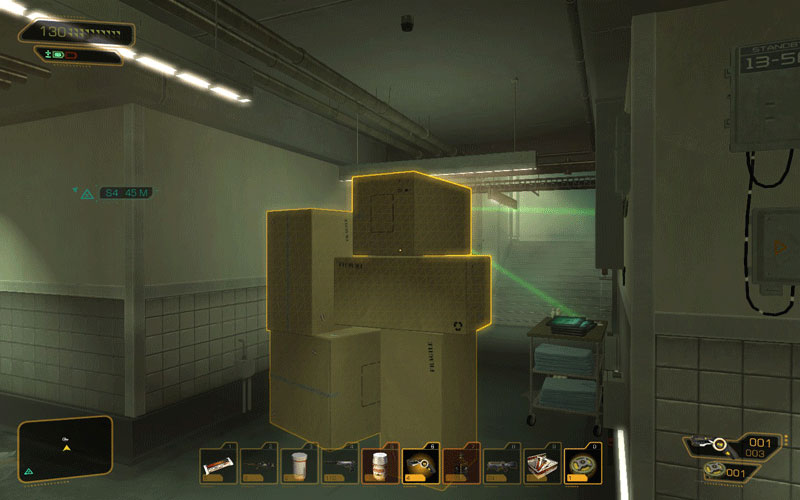
Nothing out of the ordinary here, Mr. Camera.
Directly behind me was a keycard reader I was hacking; behind the boxes is an oscillating video camera with its helpful green beams. In a break from FPS tradition (Bioshock, et tal), hacking in DE:HR forces you to stand up and do so in real time. After some close calls with attempting to disable the camera with my stun gun and hack my way through the door while getting all the goodies, I came upon the more… practical solution.
 In An Age
Grains of Salt
Jan 19
Posted by Azuriel
In the course of researching EVE’s current subscription numbers (did they in fact break 400k?), I came across the PDF detailing the minutes from the last CSM meeting. In my Crtl-F’ing down the page, I came across this passage:
CSM continued to the point of how does risk versus reward scale? “Badly” (followed by laughter) was the response from some of the people in the meeting. The CSM suggested that rebalancing prices of modules so that average cost of modules versus cost of hull would be reasonably constant. Right now looting a frigate wreck gives you a good fraction of the value of the ship (because most of the value is in the modules), vs. larger ships where this isn’t true. Right now T2 is so cheap that it’s a no brainer, if you can use T2, you use T2. Following this train of thought, the CSM said it’s hard to make money by PVP’ing, most people now grind money so they can PVP. By adjusting somehow the drops from PvP, it could be possible to make it viable to only PvP, ISK vice. PvP-ing in a frigate means that you only need to kill a few ships to break even, flying in a Vagabond means that a player needs to kill 100 (in the ballpark at least) to pay for that ship. One CSM member pointed out that that buying a ship to fight in is not an investment in making more ISK (like when a player invests in his mission running ship), it is an investment in fun. CCP asked in turn whether it wasn’t a bit depressing to have to run content in the game that a player doesn’t necessarily wants to run, in order to be able to have fun. The CSM responded that all activity added to the game, there wouldn’t be ganking of helpless miners if there was no one mining.
Consider my eyebrow raised.
Now, I have been thoroughly warned about the propaganda and lies and how “everything these reps are saying has been vetted by PR people.” But taken on face value, it interests me that designers could be “depressed” about forcing players to grind before they have fun, and then the players (or the group representing them) defending the practice.
One of the big justifications in WoW for requiring Badges of Justice for the PvP cloaks back in TBC (and requiring raiders to cap Valor with heroics since then) was exactly that sort of cross-pollination. It is a sticky design issue, for sure.
Of course, this paragraph also happened:
A side-discussion ensued about why people try EVE. CSM pointed out that the unique attraction of EVE was “you can grief people” and “it’s not a game for wusses”. It was also pointed out that the broad scope of the sandbox was both a selling-point but also a negative — it was easy to get lost.
My particular deal-breaker is arguably a reason why I should not be in MMOs anymore: EVE seems particularly hostile to single-player gameplay. Carebear
guildsCorps aside, I have little desire to reenter a position of social obligation, having driven that particular nail deep enough already. If I’m logging on at 9pm, it will be because I wanted to, not because I seek to avoid awkward, passive-aggressive guild drama.Now, if I find like-minded people later? Sure, let’s go destroy something beautiful together.
Posted in Commentary
6 Comments
Tags: CSM, EVE, Game Design