Blog Archives
On Sidequests
Syp over at Biobreak recently suggested a bold move: killing the MMO sidequest.
While I can certainly defend main story quests — such as zone/planet-wide chains or a personal story arc that goes through most of the game — side missions lack positive qualities that make them desirable. Let’s call them for what they really are: busy work. Side quests are small tasks that offer no real story, no significant reward, and only serve to pad out your quest log and allow dev teams to be able to boast ridiculously high quest tallies for patches and expansions (“200 new quests! Of which only 15 are memorable in any way!”).
[…]
Let’s think about it. If your favorite MMO one day yanked all of its side quests, leaving only factional, zone, dungeon, and overarching story arcs intact, would it really suffer for it? Would you bemoan their loss? Players are forever asking to be able to just play through the main storylines without all of these diversions down rabbit trails, so why not give it to them? Just increase XP for the main quests and work on providing other forms of much more meaningful content that can serve as a focus for players’ time.
Following the post, there were a dozen or so commenters who were in favor of the proposal. Which got me thinking… are they on to something?
Not really.
Sidequests are vitally important to any MMO, or single-player RPG for that matter. Or, at least, they should be. See, one of the primary purposes of sidequests is pacing. Which is absolutely different from filler. Filler is the pointless busywork that a designer adds to pad the game’s playtime. I am all for the death of filler, which is bad pretty much by definition.
Pacing, meanwhile, is all about enhancing the main story. How do you enhance a story? By fleshing it out. Giving context to its development. Allowing breathing room in which to digest the latest narrative bombshell. Bringing the world in which the story exists to life.
For example, Lord of the Rings is a 1178-page story about [spoiler alert] destroying a magic ring. Frodo’s travails towards and around Mount Doom are the Main Story Quest (MSQ). Hell, I’ll even concede that all that business with Aragorn and Helm’s Deep and the throne of Gondor and all of those pitched battles are a part of that same MSQ, despite them being a literal distraction so that Frodo could complete the only quest that actually mattered.
Having said that, the reason why we care about Frodo destroying the ring in the first place is because of the rest of it. We care about the supporting characters, we care about the Shire, we care about the world in which these people inhabit. MSQs are good at driving action forward, but they are terrible at world-building. That is sort of by design: there is an expectation that details included in a MSQ will be relevant to the future of the MSQ, Chekhov Gun-style. You cannot have the MSQ examine the life of an average farmer toiling under the weight of an oppressive regime without expecting said farmer eventually being executed/liberated in a later chapter.
Sidequests are the mechanism by which imaginary worlds are built. Bad, filler sidequests do not tell you anything about the world other than its inability to kill ten rats. Good sidequests create minor characters and story hooks and introduce you to the world which you are trying to save… even if you are still killing ten rats to do so. The MSQ asks you to save the world, and sidequests tell you why.
Then there are the mechanical, game design aspects of sidequests. In an MMO, there is often considerably more physical world built than strictly necessary to drive the MSQ forward. Indeed, a MSQ that somehow forced you to explore every inch of every zone in sequence would feel forced and arbitrary (see: FF14). Sidequests, meanwhile, provide optional incentives to explore all four corners of the map, to face different enemy types in different areas, and so on. Well, “optional” unless the XP from sidequests are required in order to level up enough to fight in the next zone. However, again, that would be an example of bad sidequests.
About two months ago, I was less bullish on sidequests than this post. At the time, I was playing FF14, which is exceptionally bad in the boring, vapid sidequest department. In fact, FF14 is exceptionally bad in the MSQ department, with nearly everyone stating that the story really starts getting good… once you reach the original endgame. In the meantime, I suppose I’m just expected to endure these pointless, trivial tasks like flying around to the various capitals and deliver letters?
On the other hand, I have also been playing Mass Effect: Andromeda. While not as good as the original trilogy, Andromeda absolutely has engaged me in even the most repetitive of sidequests. Why? Because I like it there. I like the world Bioware has created, I like the characters and the amusing banter they get involved in. I could listen to Peebee and Drack talk about shit all day. In fact, I have, inbetween sidequests to scan minerals and other “busy work.” Work that required me to explore every corner of each planet and have an “excuse” to engage in one of the best iterations of a Mass Effect combat system yet.
If you do not care about the game world, or do not care for the combat system, then yes, there isn’t much distinguishing legit sidequests from filler. But in a well-crafted game, the sidequests shouldn’t be mandatory to begin with. In which case, there isn’t a reason to kill them; just ignore them and move on with the story.
Impression: Darkest Dungeon
As I alluded to before, I ended up refunding my purchase of Isaac: Rebirth. Deciding I was still in the mood for a roguelike, I put that $10 into purchasing Darkest Dungeon instead. Now more than dozen hours in, I myself feel like a character succumbing to mania over the experience.
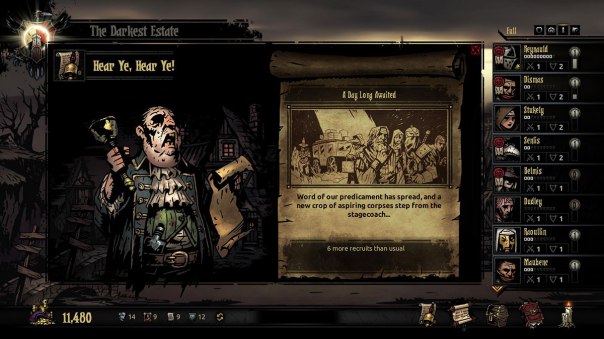
The art style and tone are an acquired taste, but I have acquired it.
The core gameplay loop of Darkest Dungeon is simply superb. Pick a group of four adventurers, buy them supplies for a dungeon delve, and then crawl through said dungeon killing and looting. Successful completion or not, those four particular adventurers are likely going to need a break to recover from the ordeal, so spend a bunch of your gold on (mentally) healing them. For the rest of the profits, use heirlooms to build up the Hamlet, then spend gold to upgrade the gear of another set of four adventurers… who then will need provisions for their own expedition. Wash, rinse, and repeat.
That might sound boring or perhaps grindy, but there are so many considerations and decisions to be made on a micro level that I find the hours melting away in a Civilization “One more turn” kind of way. For example, you can’t recruit just anyone: you get a small pool of recruits to choose from each “week.” Even if it’s a class that you wanted, out of the 8 possible Skills that class has, they will have 4 random ones. You can spend gold training the specific ones you desire, of course, but that’s 1000g less you have to spend on something else. Other times you have exactly the class and spec you want for your particular dungeon strategy, but they end up accumulating too many Diseases or negative Quirks such that it’s easier/cheaper to just let them go than keep them. Finally, even if you upgrade the Stagecoach such that you get higher-level recruits hand-delivered to you with full upgrades out of the box, they might not have enough positive Quirks to justify the limited roster space.
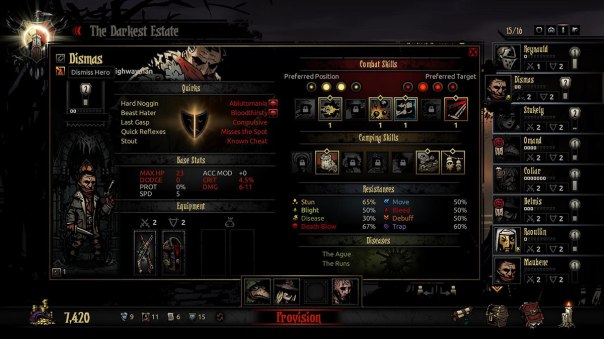
Even if I liked Highwaymen (I don’t), this hero is too expensive to treat.
None of this even gets into the combat and dungeon exploring parts of the game.
At the beginning, I thought the combat system was kinda dumb. Each character has the ability to do one thing each round in a turn-based manner. There are priest-esque classes and others with healing abilities, but they can only perform these actions in combat. Yeah, that’s a particular “gamey” limitation, but the longer I played, the more I realized how the entire point of this game is resource management. A turn spent healing is a turn not spent attacking.
However, considering that HP is only a concern in a dungeon, whereas Stress carries over into town and future dungeons, you have to start considering the relative merits of either. Leaving up the weak spellcaster who “only” inflicts Stress on your team so that you can spend multiple rounds healing your team to full HP might not be worth (literally) the trouble. Then again, if you have to end up Retreating from a battle/quest because everyone is about to die, well, they end up getting penalized with Stress/quirks regardless.
Then you have the boss fights, which possibly toss aside all your carefully laid plans. I defeated an Apprentice Necromancer with barely an issue already. Fighting the Wizened Hag though? I have faced her three times thus far, and retreated each time, nevermind the three other attempts that were aborted before even reaching her chambers.
The Hag has a Cookpot that takes up the first two “positions” on the field, with herself in the last two. Invariably, one of your team members gets thrown in the Cookpot and takes damage each individual turn until released. Thus, not only do you lose the actions of that team member, but your remaining members are usually out of their normal position (most abilities have position limitations), and then you have to consider whether to attempt to free the person or attack the Hag. Freeing the person is fine… but the Hag will throw someone else in the pot almost immediately afterwards.
Which can be the same person. /sigh
Having been defeated by this encounter so many times before, I am now in a holding pattern of leveling up my lower-level people to get a pool of acceptable candidates to try and kamikaze my way through the encounter, or perhaps overwhelm her with higher-level gear. Repeated dungeon clears of the other locations unlock additional bosses though, so perhaps I ignore her for now. And, oh, this other quest offers a pretty good trinket for that one class, so perhaps I grab that first.
Around and round I go… loving every single minute of it.
So, yeah. I’ll be curious to see how I end up towards the endgame; if this gameplay loop still entertains or if I get ground down by the repetition/familiarity. I ended up choosing Radiant difficulty based on the, ahem, horror stories from others who played originally. Indeed, some of the original mechanics sounded outright dumb: the inability to take characters back into the final dungeon more than once, for example. Some of those have been address since the game’s launch, but it’s a bit sobering to read that Radiant was designed to bring down the play-time “from 80 hours to about 40.”
Fake Edit: took down the Hag with this handsome group of characters:
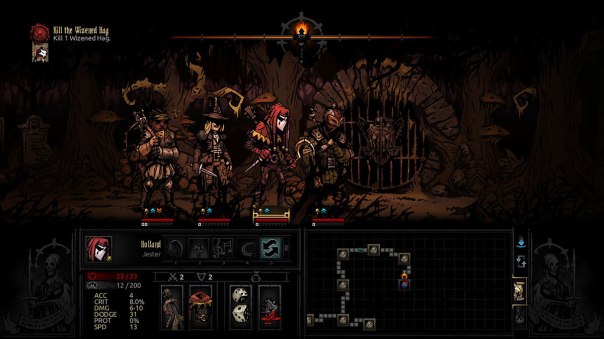
What does not kill you, stresses you out.
7DTD: Alpha 16 Impressions
The experimental version of Alpha 16 for 7 Days to Die (7DTD) came out over the weekend, and I have sunk close to a dozen hours into it already. Much as I was hoping before, the changes have revitalized my interest in the game generally. However, some of the same changes exacerbate underlying design problems with character progression.
Character progression in 7DTD has never really been smooth. Starting from Stone tools, you eventually craft a bow, some arrows, and a wooden club for defense. From there, the next “tier” requires the creation of a Forge, which requires a Bellows, which requires Leather and a Short Iron Pipe. The Leather can be collected by skinning animals you kill or breaking down leather couches in buildings. The Short Iron Pipe though, is either found as random loot or crafted. In a Forge. That you are trying to build.
The game is actually riddled with these regressive, bootstrap requirements. The Workbench is a necessary structure to craft mid-to-late tier items, and requires a Wrench to be consumed in the construction. Meanwhile, the Wrench can only be constructed with Forged Steel, which is an endgame resource material that requires a high player level. Oh, and a Workbench. You need a Workbench to create a Wrench so you can craft a Workbench. But hey, sometimes you can find a Workbench out in the world, so you can dismantle it and place it back at your base… provided you have a Wrench.
[Fake Edit: Just kidding, Workbenches in the world can’t be dismantled anymore.]
These problems already existed in Alpha 15, but it’s kinda worse now. The devs introduced “Sleeper” zombies, which basically means they seeded every corner and basement of every building with zombies that can wake up while you’re trying to loot. This makes looting houses much more tense and exciting, for sure. However, they also reduced zombie loot without actually increasing it elsewhere. Ergo, you end up having to do more fighting with less rewards, while stuck with worse tools for longer.
Another example of regressive design? The devs reduced the amount of Wood gathered with Stone Axes, and eliminated the Last-Hit bonus (generally +20 Wood when a tree is finally felled). “Better tools result in better yields” makes sense, right? Sure, conceptually. The problem is that by the time you have a Forge up and running to craft an Iron Fireaxe, your need for Wood has considerably decreased. In fact, considering the rate that even a Stone Shovel gives you Small Stone and Clay, it’s actually easier to create a base out of Cobblestone than Wood.
Alpha is Alpha, of course. That said, I think there is a lot that the devs can do to bridge the progression gap and otherwise tighten up with the core gameplay loops. Some suggestions:
Introduce a Scrap Iron tier of weapons/tools.
The current progression path is Stone –> Forged Iron. That is quite the jump, especially with such considerable gaps in coverage in some areas. For example, your first knife is a Bone Shiv, and the next requires Forged Iron AND a Blueprint (Hunting Knife). You can craft Iron Arrowheads all day, no problem, but a sharp piece of a iron? Impossible.
I would also suggest making the Cooking Pot craftable with general Iron, rather than requiring a Forge. The Cooking Pot is just too integral to basic survival given that there are zero non-loot sources of fresh water in the game otherwise. Well, you can create Yucca Juice from harvesting cacti in a pinch, but you can’t cook/craft with that.
Perform a general sanity check on existing Blueprints
I am hoping that the current Blueprint system is a placeholder that eventually gets revisited, because it really makes zero sense sometimes. For example, the general progression of clubs is Wood Club, Iron Reinforced Club, and Spiked Club. You can craft the first two without Blueprints (although the Iron Reinforced Club requires a whopping 100 Iron), but the Spiked Club requires both Forged Iron and a specific Blueprint. For a piece of wood with spikes on it.
What makes the Spiked Club even more ridiculous is that you can craft Barbed Wire with simple Iron right from the beginning of the game. And Barbed Wire Fence for that matter. Barbed Wire + Wood is fine, but Barbed Wire wrapped around a piece of wood is way too complicated. Or using the Claw Hammer and some Nails on a piece of wood.
Reduce the Bootstrap Gating
I mean, I kinda get the thought process here. In crafting games like Terraria, Minecraft, and others, the limiting factor that gets you out the door of your base is resources: you need that Platinum/Diamond/Magic Ore/etc. Resources are needed in 7DTD too, but the overwhelming impetus to scavenge is the simple fact that you can’t just slowly work your way up the crafting tree. You need Short Iron Pipes to craft the Forge that makes Short Iron Pipes, and you need a Wrench to build a Workbench that can make Wrenches.
At the same time, the difference between finding a Wrench/Cooking Pot/etc on Day 1 and not finding anything for 7+ in-game days is enormous. Random loot is exciting, and there is absolutely still a place for that. But I think there should at least be the possibility of a bridge between Nothing and Everything. Perhaps a Crude Wrench, or Makeshift Cooking Pot. Make them have the chance for failure or ruined ingredients so that the Real Deal is still desirable, if no longer strictly required.
In any case, I still find the game to be quite entertaining, although I’m unlikely to derive the same 60+ hours of fun I did when everything was new. Which is likely good news to the people more interested in my potential thoughts on the upcoming FFXIV and Guild Wars 2 expansions.
Inflection Points
In Divinity: Original Sin, I have definitively hit an inflection point in terms of character power. And that is kind of a shame.
Basically, once you hit level 15 you can start learning “Master” level skills/spells. As one might expect, these can be extremely powerful. For example, one of them is Meteor Shower, which drops 30 little fireballs in a specific area, each of which can deal a few hundred points of damage apiece in addition to spread fire in the area. These powerful spells cost a lot of Action Points – generally meaning needing to wait around multiple turns to save up enough AP – and are limited to One-Per-Battle in terms of cooldowns.
The issue is that you can game the hell out of the system. The AP cost is entirely irrelevant if you happen to spot a group of enemies before engaging in combat, for example – AP only exists within combat, so go nuts for the alpha strike. Hell, I bring down the stars on even one dude, because why not? It’s always been powerful to initiate combat with a “free” spell, but up till now those spells didn’t necessarily gib your target.
Another of the Master level skills allows an Archer to fire 16 arrows in a 45-degree arc. Great for groups… or, you know, if you want to effectively one(16?)-shot bosses from point-blank range. Oh, and hey, there’s a low-level Ranged Power Shot skill that increases damage by 20% at the cost of accuracy. Which would normally be an issue if not for the fact that Arrow skills auto-hit as long as the target is in range.
MMO players will recognize this phenomenon as “Optimizing the fun out of the game.” As I have mentioned previously though, the optimizing process itself is what I find fun to begin with. And it has been pretty fun figuring this out. The problem is that the game is now “solved,” and I am in one of those positions at the end of a Civilization match where winning is a foregone conclusion, but for the long, tedious march to an official win condition.
I said this situation is a shame because I’m not so sure it was necessary. Up until this point, effective AoE in Divinity was actually decently limited. Yeah, there were combos and such that you could set up, e.g. dropping Oil in an area and then lighting it on fire. But none of it was enough to one-shot groups by itself. Hell, often those combos ended up being counter-productive. The Oil+Fire combo was good for setting people on fire, but the resulting smoke prevented targeted follow-up attacks until they moved out of the area.
This scenario sort of reminds me of Final Fantasy Tactics, when you are suddenly given an excessively OP party member (Orlandu) for basically no reason. The game was challenging up to that point, and considerably less so afterwards. Why? What was the designer reasoning?
Sometimes inflection points are inevitable. At the beginning of a game, your character’s options for skills and magic items are likely limited, so there might be less room for synergies. More options means more combos means more opportunities for OP results. Simply not giving anything new past a certain level isn’t a particularly good design, so the devs might actually be trapped in that regard.
And, hey, I’m not blind to the fact that it probably feels good, both as a player and as a designer, to reach the endgame and feel like a total badass. Every wizard dreams of the moment they go from shooting Magic Missiles into the darkness to altering the fabric of reality itself. This is why games like WoW end up giving you +5% upgrades each tier instead of a more measured 1% – anything less feels unrewarding.
The fundamental problem is that I found the Divinity combat system rewarding as-is. Even with good equipment, things felt dicey all the time. I’m sure that someone out there had a lot of fun going from dicey fights to forgone conclusion ones, but that person is not me. And I cannot help but wonder if it was necessary at all. If super-skills are necessary, do they need to be this particularly powerful? Why 30 meteors instead of, say, 10? That would still be a huge improvement over the standard Fireball spell.
In any case, I am continuing to play Divinity and hopefully wrap things up soon.
CraftCraft
A few weeks ago, Gevlon had an interesting post on how crafting in MMOs is fundamentally broken:
If you fight monsters or players, you must constantly cast spells. If you gather, you must move between spawn points. Both needs you to sit at the computer and press buttons (unless botting). But to craft, you just press a button and maybe wait and you are done.
Basically, crafting is broken because all other options available to get in-game currency take keyboard effort (gathering, grinding mobs) whereas crafting does not. And, having reflected on that, it is 100% true. Just as in real life, the people making bank aren’t those doing the work, but the ones working the bank.
Gevlon concedes that there really isn’t a solution to this problem, mainly because “active crafting” would essentially be a grindy minigame. Well, he says the solution is to make it so that everyone can craft everything, thereby hopefully making the crafter-class irrelevant. I’m not so sure, considering how much gold people already make from selling vendor mats in WoW. Any knowledge gap is enough space for the Bourgeoisie to pop up like mushrooms.
Would a minigame really be that bad though?
Maybe. I remember getting pretty frustrated with Wildstar’s crafting system, which was essentially a lot of RNG and wasted mats. I did not spend a whole lot of time in FF14, but I recall a similar minigame there that required button presses for optimum results. Based on the comments on Gevlon’s blog post, it seems there might be other, older MMO examples as well.
Still, I’m thinking that that pretty much has to be the “solution.” This is assuming that you believe there is a problem to begin with. But crafting has felt divorced from the general MMO gameplay experience for ages. Even Fishing in WoW feels more interactive than the normal sort of insane grind (or extreme automation via addons) that is, say, prospecting stacks of ore and/or creating Glyphs. Running around Herbing on a toon feels fun. Smelting ore and transmuting it does not. And yet one of those is much, much more lucrative than the other.
A more active crafting overhaul would require a fundamental rebalancing of the sort of boilerplate crafting experience though. Most crafting systems are predicated on you crafting hundreds of redundant items, for example. Skill-ups – assuming they still exist – would perhaps need to come from successful strikes on the anvil, rather than just one for the finished product. Or perhaps simply an offline system ala EVE.
In any case, I do feel like active crafting is the way forward. There would still be a goblin-esque master class, as I find it unlikely A) even an active system would be slower at gold generation than grinding mobs, and B) a good 80% of the player population is too lazy to craft their own gear. Maybe the right system hasn’t been found yet. Or perhaps the right system is trapped on an older MMO?
Inventory Junk
Sometimes it takes a game to start doing something mundane before you appreciate how every other game doesn’t bother you with that crap. Case in point: Divinity: Original Sin doesn’t automatically remove anything from your inventory.
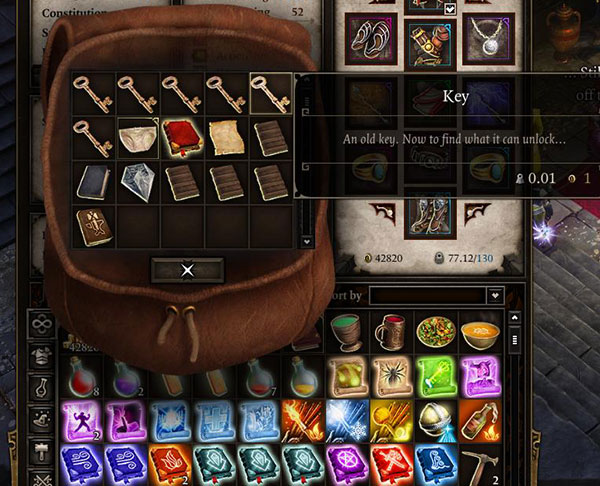
Nothing. The answer is nothing.
In pretty much any other RPG ever made, introducing lock to key causes the key itself to disappear. It is not as though the key will work on any other lock, so why keep it around? “Why not?” muses the D:OS designers. “Because it’s dumb,” says I. My inventory is filled with keys (which you can’t sell), books that no longer serve a quest or skill gain purpose, and other kitchen drawer debris. There isn’t any special glowing inventory effects either, so sometimes it gets difficult to realize that you actually have picked up something worth clicking on.
Can I manually go through my whole inventory? Of course. But why exactly do I need to? What is the underlying gameplay purpose? As far as I can tell… well, I can’t. I don’t actually know if this is a “old-school” throwback, as I don’t remember if Baldur’s Gate had anything similar. Probably not.
In any case, I’m glad most modern games have moved on. Because ain’t nobody got time for that.
Fuzzy Rules
I have been play a bit of Divinity: Original Sin and continue to enjoy it. Mostly.
One thing that I strongly dislike in games though, are fuzzy rules. By “fuzzy” I mean that the parameters of the rules are either not consistent or not entirely clear within the game itself. Divinity has tons of them that were at first amusing, but now are a bit grating.
For example, sometimes when you attack a target, they bleed on the ground. Fine, right? Well… environment effects are super important in Divinity. There is a talent that actually heals you when standing in blood, for example. Blood puddles also apparently conduct electricity, as I discovered when two of my melee team members got stunned after a third one shot a Lightning Bolt.
Things get real dumb though when you fight zombies. See, zombies are healed by poison effects. Guess what zombies bleed? Poison. So… yeah, hit zombies enough and they will bleed poison on the ground, which then heals them. I can kinda sorta maybe see the logic, if the designers were using this self-regeneration mechanic as an explanation for zombie resilience. But it’s far more likely that this is just sloppy game mechanics. Especially when you set zombies on fire, then the fire makes the poison explode, which ends up dealing fire and poison damage simultaneously, which sometimes cancels out the fire damage entirely.
Are there benefits to fuzzy rules? Sometimes. The real world is full of strange situations, so carrying over some of that uncertainty can make virtual worlds more realistic. Plus, fuzzy rules are a de facto increase in difficulty – if you’re not certain something is going to work, you have to be more cautious. Weird situations also make for good stories.
That said, I don’t like unclear rules very much. It’s tough to determine whether vague interactions are intentionally designed, or just designer incompetence. And when you end up failing because of said interactions, it’s difficult to know what you should have done differently. Did you lose to a dice roll? Strategic blunder? Not leveling up enough?
Growth requires not just knowing what went wrong, but what can be done to avoid it in the future. If the answer is “nothing,” there really isn’t any growth at all.
Shadowverse Gameplay
I have talked around Shadowverse quite a bit over the past month or two. The reason is that I haven’t bothered really playing the competitive aspects of the game; I have instead been clearing the “story” mode against the AI. Oh, and logging in every day, because of the rather generous log-in rewards.
Actually, let’s get that out of the way first: one of the biggest draws of Shadowverse is its generosity in the reward department. New accounts receive the same bonus card packs that were awarded to people when new expansions are released, which means you can expect to crack open 30+ packs right after signing in for the first time. On top of that, there are the aforementioned log-in rewards, which ends up being two free packs, a free Arena run, and increasing amounts of gold on 15-day basis. Maintenance at 3am? Have some more card packs. Then there are also Achievements that reward gold/dust. Oh, and three daily quests a day.
In short, there are a LOT of freebies. Especially compared to the misery Hearthstone.
For the most part though, the freebies are kinda required. Decks in Shadowverse are 40 cards, compared to Hearthstone’s 30. Additionally, instead of there being a 1 Legendary limit, Shadowverse lets you stuff three of the same kind of Legendary into a deck. And just as in Hearthstone, getting a Legendary to a class (or Craft, in this case) that you don’t care about is effectively wasted (you can still dust it though). This is why it is important to reroll, as I talked about before.
In terms of gameplay itself, things are remarkably similar to Hearthstone. Players gain 1 mana crystal per turn. There is no interaction on your opponent’s turn, and they can choose to attack you or your minions. There are 5 slots on the board for creatures/amulets (instead of 7). Creatures can have Taunt (Ward), Deathrattles (Last Word), Battlecry (Fanfare), and so on. One interesting wrinkle is Charge, which Shadowverse splits into Rush vs Storm. Rush allows a creature to attack other creatures (not players) as soon as its played, whereas Storm has no restrictions. Given how many issues Hearthstone has had over the years with OTK (one-turn kill) combos via Charge, I feel like Shadowverse’s dual take it superior.
A lot has been said online about how Shadowverse is a deeper game already than Hearthstone. In some ways this is accurate. Amulets are a type of card that can stick around on the game board (taking up a creature slot), having constant or triggered effects. We really haven’t see that design space explored in Hearthstone beyond Tavern Brawls. And while there are some random effects, there certainly aren’t nearly a fraction of the kind in Hearthstone.

Oh look, even the computer drops 8/8s on Turn 3.
One of the bigger deals in every Shadowverse match is Evolve. Starting around Turn 5/6, players can spend 1 Evolve point per turn to beef up a minion on the board and possibly trigger extra effects. The default bonus is giving the minion +2/+2 stats and Rush. Sometimes it’s those stats plus something else. Sometimes the minion doesn’t get buffed at all, and instead a powerful effect occurs. Regardless, knowing when you must Evolve and when to hold it is a tremendously important part of every game. And given that you can Evolve any creature, the dilemma comes up in each match.
Beyond that though… I’m not actually certain how much deeper Shadowverse’s gameplay actually is in practice. There are certainly way more mechanics than Hearthstone already, including ones that would be “too confusing” for people unable to handle more than 9 deck slots. But when you look at the top meta decks in Shadowverse as of 3rd week of March…
- Daria Tempo Rune 9.54%
- Midrange Sword 9.15%
- D-Shift Rune 7.37%
- Face/Aggro Sword 6.45%
- Aggro Blood 6.28%
Runecraft decks account for nearly 17% of the meta, with Swordcraft bringing up 15.6% (technically 20% in top 10). In other words, nearly a third of the meta consists of two classes, just looking at the top 5 decks. Looking at the top 10, nearly 30% of the meta is made up as aggro/tempo. Is that worse than Hearthstone’s current Pirate meta? Nope. But when you look at these top decks, it is not as though there are particularly deep interactions going on with convoluted cards. Even with D-Shift Rune, you are basically stalling the game long enough to drop a 7/7 and a few “take another turn after this one” spells. The average Renolock in Hearthstone has more turn-to-turn decisions to make.
What you can give credit to the Shadowverse devs for is their dedication to relative balance. Three weeks ago, Daria Tempo Rune was a whopping 19.31% of the entire meta by itself. Roach Tempo Forest was 10.59% by itself. Key cards in those decks were nerfed, and the meta shifted over the past few weeks to its current situation. Compare that to Hearthstone, where Ben Brode and company sit on their asses in the hope that the problem goes away on its own, or that the next expansion (months from now) fixes it. Because… reasons.
In any case, we’ll see how things go. Shadowverse is apparently the #2 digital CCG on the market out there, although it is facing competition from Gwent, the Elder Scrolls one, and other such games. I haven’t played those others, but I will say that at a minimum, Shadowverse is about 1000x times better than Hearthstone on mobile. Which makes sense, as Shadowverse was originally a mobile game that was brought to PC, whereas Hearthstone is the opposite. If you’re just looking for a CCG to play on PC though…
…well, let’s see where Journey to Un’goro goes. If the meta is still pirates/Jade, we’ll have issues.
Cold Open
There have been two games I played recently that have started with a cold open, e.g. one with no tutorial that just sort of throws you into the game. The first was The Long Dark, and the second is a space-sim called Hellion; both are in Early Access and both are survival-based games. So, in a sense, it’s difficult to determine whether either one intentionally set out to have cold opens, or if this simply reflects their current, unfinished states.

Pictured: falling out of the airlock into open space.
There is a lot to be said regarding the power of cold opens. In an age of 24/7 information coming from every angle, it is refreshing to be thrust into an unknown environment without any sort of hand-holding. It absolutely appeals to Explorer-types, and also those looking for more difficulty in their games. Plus, many times it makes thematic sense, say, if you just woke from cryo-sleep in an otherwise abandoned life pod.
Personally, I find cold opens to be exceptionally difficult to pull off well.
The fundamental issue I have is the dissonance between what the player expects and what the designers intend. What ends up happening is that players must essentially “metagame” how the designers actually intended the game to be played.
For example, in Hellion you awake from cryo-sleep inside a life pod without functioning Life Support. While there are a few tablets on the ground which give you a general idea of steps to take, that is basically all the guidance you are given. I searched the area and did not find enough items onboard to repair the Life Support. I found a jetpack without fuel, and supposedly a charging station for said jetpack, but could not determine a way to refuel.
So… what now? Did I miss an item in the search of the ship? Am I supposed to try and space walk without a jetpack? Is it a bug that there weren’t enough items to repair the Life Support? I have mentioned before that I am fine with tough puzzles, as long as I understand where the pieces are. What I absolutely despise is not knowing whether my failures are due to not performing correctly, or because I didn’t trip some programming flag from 10 minutes ago, or some other nonsense.

Somewhat more literal cold open.
I had a similar issue in The Long Dark, of which I played about an hour before turning off. It takes 30 game minutes to break a stick into pieces by hand? Okay, fine. But having found a shelter and tools, I saw no particular way to locate food, or reconcile my exhaustion meter with my temperature meter with the time of day, e.g. how was I to sleep and keep warm in the middle of the day and still survive the night? I understand that perhaps the intention is for the player to be constantly on edge in the quest for survival, but again, I’m not even sure how food really even works in this game yet. I have not seen any flora or fauna beyond sticks and snow.
Flailing around in the darkness is not my idea of quality game time.
I’m not saying game designers should go full Ocarina of Time and have Navi pester you for hours. Minecraft has (had?) a cold open that was relatively straightforward once you got over the intellectual hump of punching trees. Don’t Starve is a much better example of how to do a cold open – there isn’t much of an explanation of anything, but I still felt a sense of agency in being able to interact with things.
And maybe that’s just it: I might not be doing the right things, but being able to do something is important.
I dunno. I think the best compromise would be to have cold opens with a fairly robust PDA/AI Assistant/Crafting Menu. Those that want to wander around blindly can, but those who want to know what they can do… well, can.


Regression Towards the Mean
Jul 11
Posted by Azuriel
I’m sure that 7 Days to Die (7DTD) is a rather niche topic of interest to most people here, much less discussion about experimental Alpha builds of an Early Access titles, but I feel like the things going on with its development are applicable more generally.
When the first Alpha 16 (A16) experimental build arrived, it was transformative. Sleeper zombies seems like a minor change, but it fundamentally changed how you interacted with buildings. Prior to A16, you knew pretty much instantly how many zombies were inside a given structure, and once you killed all of them banging on the doors trying to get out, you were free to loot the place in peace. That is no longer the case – now you must actively sweep each room, and double-tap each body on the floor to ensure it stays where it is. There are still some bugs with these Sleepers suddenly spawning right behind you, but the overall effect is that nowhere is safe until you make it so.
Then came the balance changes.
First, since the Sleeper zombie system necessarily increases the amount of zombies one faces, zombie loot was decreased across the board. This makes sense, as if prior loot rates stayed the same, you might end up getting more loot from the zombies inside a building than the building itself.
In practice though, reducing zombie loot makes fighting zombies considerably less fun, especially on Horde nights. Zombies essentially become resource drains, to be avoided if possible. Which… maybe makes sense. Games like Dying Light featured that model, with zombies that functioned as speed bumps and possible death traps, nothing else. The problem is that Dying Light also featured impenetrable home bases, whereas even a few ignored zombies in 7DTD can bring down the strongest base in time.
Another change? Resource gains were reduced significantly. Up to this point, there was a “last hit” bonus drop of resources when you finally cut down a tree or smashed a boulder. Not only were the bonus resources great, but it was also viscerally satisfying getting that last burst of stuff concurrent with destroying the object you were mining. Apparently it made the early game too easy for the devs’ tastes however, so they got rid of it. Now when you fell a tree, you get the same 2-3 pieces of wood you got from whacking it the first 30 times.
More recently, the devs have also messed around with Stamina gains and losses. Stamina has always been a bit weird in 7DTD. There are a lot of Perks that correspond with Stamina gains – from making Sprinting cost less, to making Stamina recharge faster, and everything inbetween – but none of them really felt necessary. There was even Coffee and Beer items one could craft to recharge Stamina faster, but why bother? You could get into trouble being chased by a bear after cutting down a tree, but Stamina otherwise served the purpose of preventing you from Sprinting across the map 24/7.
Now? Iron/Steel tools will pretty much instantly drain all of your Stamina. Setting aside the more realistic concern of whether a steel shovel would make digging a hole easier than a stone shovel, the change seems rather ham-fisted. Yes, by making it virtually impossible to complete any tasks without Stamina Perks, the devs have made Stamina Perks relevant. But I’m not sure any thought was spared regarding whether Stamina Perks were a good idea to begin with.
Waiting around for Stamina to recharge is boring gameplay. It is literally no gameplay. Even if the idea is for the early game to be more “dangerous” or difficult, even if the goal is to tangibly demonstrate how improved your character gets over time, this is NOT the way to do it. Having Sleeper zombies haunt every house already shoots the difficulty of the early game through the roof. Reduced Wood gain has made crafting your own base impractical for the first few in-game weeks. Making early lucky finds like an Iron Pickaxe practically pointless until well after the point at which you could create one yourself? Mind-bogglingly stupid.
Experimental builds are experimental, and all this could be reverted tomorrow. Still, it remains concerning to me that the devs are placing such a high premium on “older” ideas rather than iterating on what actually feels fun about the game currently. Half a dozen Stamina Perks do not feel fun, nor does funneling skill points into them. They seem committed to keeping them simply because they had them already, in some weird Sunk Cost Fallacy manner.
Hopefully, things will change – if not soon, then by the beta.
Posted in Commentary
Comments Off on Regression Towards the Mean
Tags: 7 Days to Die, Balance, Game Design, Stamina, Zombies