Blog Archives
Missed Effect
Mass Effect: Andromeda was finished over the weekend.
My overall impression? Serviceable. Adequate. My /played time was about 90 hours, so it is a tad difficult to ascertain whether the characters blossomed by the mid-game or if it was a sort of Stockholm Syndrome effect. Well, I can say for sure that I immensely enjoyed Peebee and Drack’s company. Vetra too, perhaps, but she’s no Garrus. Cora can take a hike.
The combat and general environments are easily the best the series has offered. I played the entire game on Hard, which was appropriately named. It has been mentioned before, but a lot has been done to incorporate waist-high barriers into the environment in a logical manner. In fact, a sizable portion of the game have none. Which is real shame given how many enemies have beam laser effects, which effectively melt you outside of cover. Still, Hard is Hard, so it was a welcome challenge (most of the time).
The environments and the Frostbite engine in general were exquisite. I got a little tired of the theme planet trope (Desert planet! Ice planet!), but the terrain overall was varied and the organic vistas were amazing. Indeed, I can see now why such a big deal was made regarding wonky character animations given how outrageously polished the rest of the game looks – it seems so out of place.
What also felt out of place were the poorly-implemented mechanical aspects of the game. Fighting feels great. Switching abilities mid-battle feels less great. Downtime inventory management feels awful. Scanning things give you Research Points, which you then use to buy weapon blueprints, which then take resources collected from driving around to craft, which then take Augments and/or Mods you receive from fighting to improve. I’m sure it sounds like a reasonable way to tie all the player experiences together, at least on a whiteboard. In practice, you end up wasting tons of Research Points because every single gun is available from the start and you don’t know how it feels to shoot till you get one in your hands. By the mid-game though, you’ll have needed to pour all your points into upgrading a specific type of gun (e.g. Black Window) through its various iterations (e.g. III, IV, V, etc) to maintain combat effectiveness. So… either settle on something early, making the multiple pages of menus irrelevant, or try all the things and always wonder whether a specific gun sucks, or if it would have been good at max rank.
I played a little bit of the Andromeda multiplayer, and it was… basically ME3’s multiplayer. ME3’s multiplayer was a hidden gem and significantly extended my playtime of the game well beyond the (original) poor ending. That may have been a time and a place thing though, as I had basically zero drive to continue playing Andromeda’s multiplayer, despite an objectively more refined combat system. For the uninitiated, it is a 4-player Horde game mode where one caps out at level 20, but items/weapons/character options are gated behind lockboxes. Open a Black Widow sniper rifle? Now you can take it with any character. Unlock a second one, and now you have a Black Widow Mk 2 with slightly higher stats. And so on.
So far, most of this has been high praise, so you might be wondering why the game is “serviceable” and “adequate.” It’s relatively simple: Andromeda is not better overall than any of the prior trilogy. Graphics and combat? Better. Characters, plot, themes, cohesive narratives, emotional gravity, witty one-liners? Not better. I find it extraordinarily silly to judge Andromeda “on its own merits” considering it has Mass Effect in the title. Andromeda is better than a whole lot of other single-player RPGs, yes, but better Mass Effects (overall, mind you) exist. If you had to make an exclusive choice between all the titles, I’d recommend one of those other ones instead.
And perhaps that is part of the reason why Andromeda may be the last in the series. At first, I was a bit sad, but it kinda feels like the right move now. The Mass Effect name has a lot of baggage attached and, outside of the various character races, there wasn’t exactly a whole lot tying Andromeda to it. Yes, all these people are from the Milky Way, there are various Easter Eggs and such pointing to Reapers and Shepard, and so on. But there didn’t have to be. The fact that it was tied to the franchise just made the world-building easier – no need to explain five humanoid races tooling around with each other relatively peacefully. Andromeda could have been the story of five human nations from Earth and little would have changed, narratively. Hell, the eponymous “mass effect” was uttered like twice in the whole game, always in reference to shields. Eezo sickness could have been any other miraculous plot disease.
Ultimately… I dunno. Andromeda is certainly better than any random given RPG out there. Andromeda is not better than any given Mass Effect title. It is worth experiencing, but it is not essential to experience right now. Perhaps in another couple of years when we finally get some more concrete idea as to whether Bioware is closing the Mass Effect door for good.
End of Mass Effect
So it is looking more and more like the Mass Effect series is done. Latest word is that Mass Effect: Andromeda will not be getting any single-player DLC. While I do not normally care for DLC – much less story-based DLC – this is not a particularly good sign for the health of the series.
And that’s a damn shame.
Andromeda is not remotely close to being as good as any of the original trilogy titles. But… it’s not bad, either. Animations are still wonky, especially when compared to what came before. At the same time, the actual graphics and alien vistas are phenomenal. Combat too is probably the best it has ever been, in terms of cadence and action. While there are still waist-high barriers around in most areas, it certainly doesn’t feel as forced as it did in prior titles. The side crew can’t hold a candle to the OG team from the Milky Way, but perhaps they could have caught up in the next few games.
The problem seems to have been development run amok. I have seen a lot of people decry those derisive animation memes as the reason for the game’s poor reception, but few people examine why the animations were poor to begin with. Despite being in development for 5 years, the game only really coalesced a year and a half before launch. It boggles my mind that the designers were thinking a No Man’s Sky approach to Mass Effect was ever a good idea, e.g. thousand of procedurally generated random planets. This is a flagship franchise – if you want to screw around with the formula, do it with another property!
To date, I still have not completed the main story in Andromeda. As is custom, I got to a stage in which I felt like the endgame was approaching, so I quickly veered off into sidequest territory. I even completed that stupid sidequest that required 16 mineral readings from every crag of the ass end of the universe. Not because it’s fun, but because I’m cruising around with fun company. I mentioned it elsewhere, but I could listen to Peebee and Drak shoot the shit for hours. And I have.
I will be sad when it is over.
While I am a big believer in finding meaning and purpose in every action one takes, I also hate unfinished stories (Kingkiller Chronicles much?). You can certainly have fun with Andromeda, as I have thus far. But I am weary of encouraging anyone being sucked into an orphaned narrative.
Impressions: ME:A, Supplemental
A few (dozen) more hours in, and things are humming along.
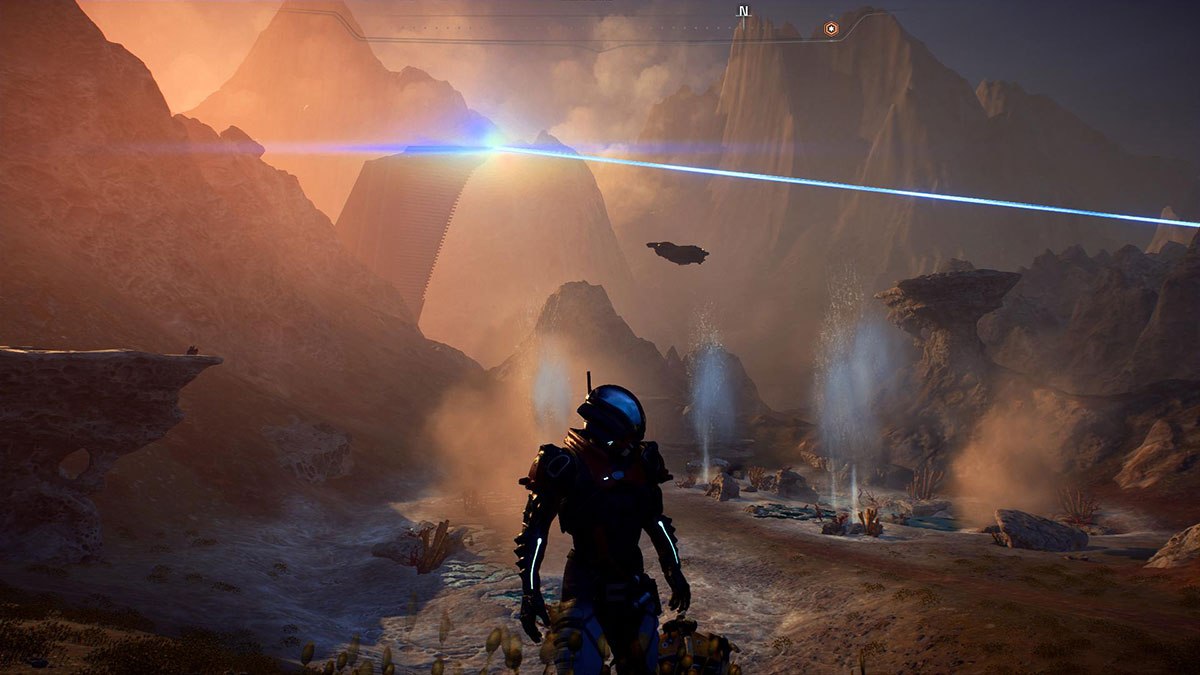
OK, so the game can look REAL good.
In these early stages of the game, three abilities do not feel like nearly enough. I came across a website that suggested that Barricade – a Tech power that constructs cover on demand – was the bee’s knees. After a boss-ish encounter that saw me kiting an armored beast around for 5 minutes, I’d suggest it’s more akin to bee’s ass. Energy Drain and Pull were rather ineffectual with Barricade as the wildcard, and it’s too early in the game for my weapons to have much of an impact on anything.
Indeed, I have talked about uneven difficulty in games before, and Andromeda seems poised to follow the same patterns. In Divinity: Original Sin, the difficulty was uneven in the early game because enemy CC was powerful while you lacked options towards ending encounters quickly, e.g. by blowing up the team with OP spells. In Andromeda, you can specialize yourself into a corner by not selecting all of the abilities, or perhaps not bringing the right kind of weapons. Andromeda allows you to actually change the three abilities you have in the middle of combat, but that won’t help you if you never spared the Skill points to buy them.
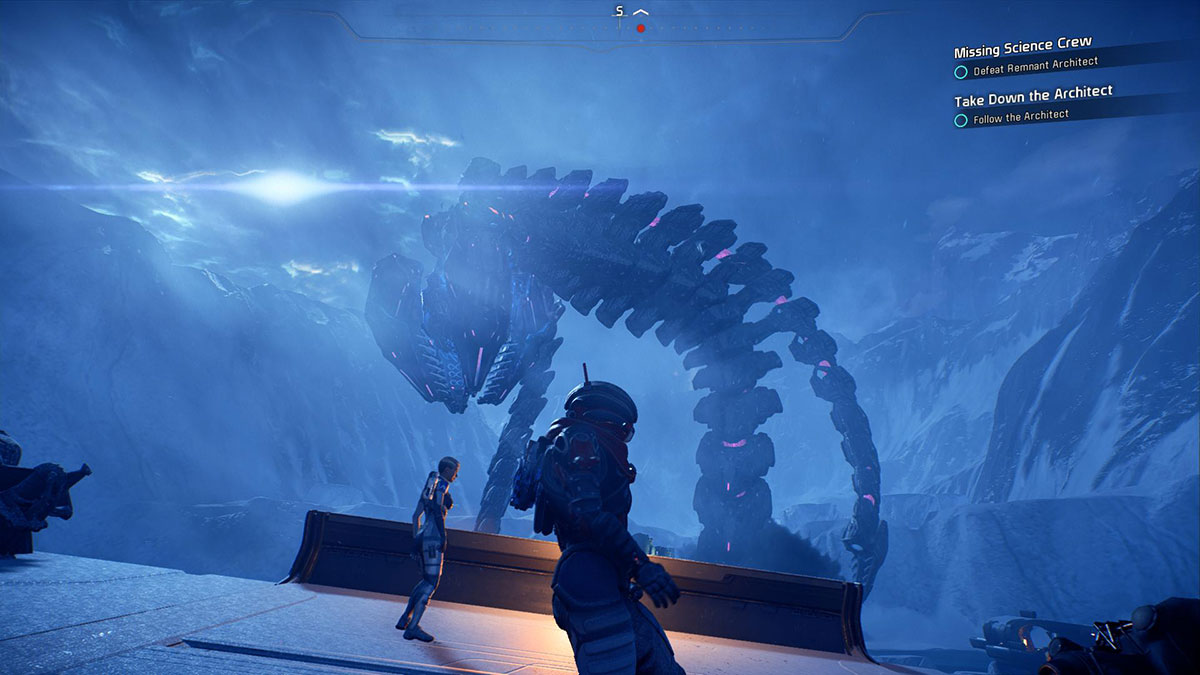
Better bring the right weapons/skills to this fight.
That said, I don’t actually like Andromeda’s swapping Skill system.
While the game goes out of its way to make the process mostly smooth – you can swap Favorite loadouts with a couple clicks – I find the entire process too… metagame-y. Ryder’s ability to switch abilities on the fly is given an in-universe explanation, but that doesn’t prevent the flow of combat from being broken whenever you pause the game to become an entirely different “class.” It’s like… why? I would agree that this is better than being able to paint yourself into an unwinnable corner by choosing the “wrong” abilities, but only barely. Why not allow us to equip more abilities at once?
Ah, right… consoles.
In any event, I will continue chugging right along. I am warming up to the characters a bit more, and going out of my way to complete most of the side-quests in typical Mass Effect style. It is hard to tell how far along in the game I am, but I’m guessing it might be closer to halfway than anything.
Impressions: Mass Effect: Andromeda
Bad facial animations are bad.

Rest of the game? Pretty good.
It is difficult to know whether I would have noticed the details on my own had it not been for the hilarious (and sad) examples spread across the internet. I would like to imagine that I’d notice, but maybe not. The toothpaste is out of that tube though, and straight into the fish-lips of every member of humanity that survived the journey to Andromeda. Maybe cryogenics causes one’s skin to slog off the bone.
Were the “older” (e.g. actual, real) Mass Effects just as bad? (No.) I dunno. All I know is that five years ago I said:
About 5 hours into Mass Effect, all I can say is holy shit.
One of the most groundbreaking things occurred in the city after the first “dungeon.” In talking with a receptionist to the Consort, she winked at me.
… and then a few months later:
My favorite aspect of the original Mass Effect was the integration of non-verbal dialog into the narrative, and the general narrative itself. In ME2, that is kicked up a notch^². Characters smile, nod, gesture, facepalm, wink, and otherwise emote in subtle, natural ways. Indeed, these little actions end up becoming part of the dialog, creating nuance and meaning that words themselves could not convey.
Perhaps the novelty has worn off. Perhaps the Witcher series has ruined facial expressions for other games for me. Or perhaps the animations in ME: Andromeda are really that bad. At the moment, I am leaning towards the latter. Ryder pretty much looks drunk all the time.
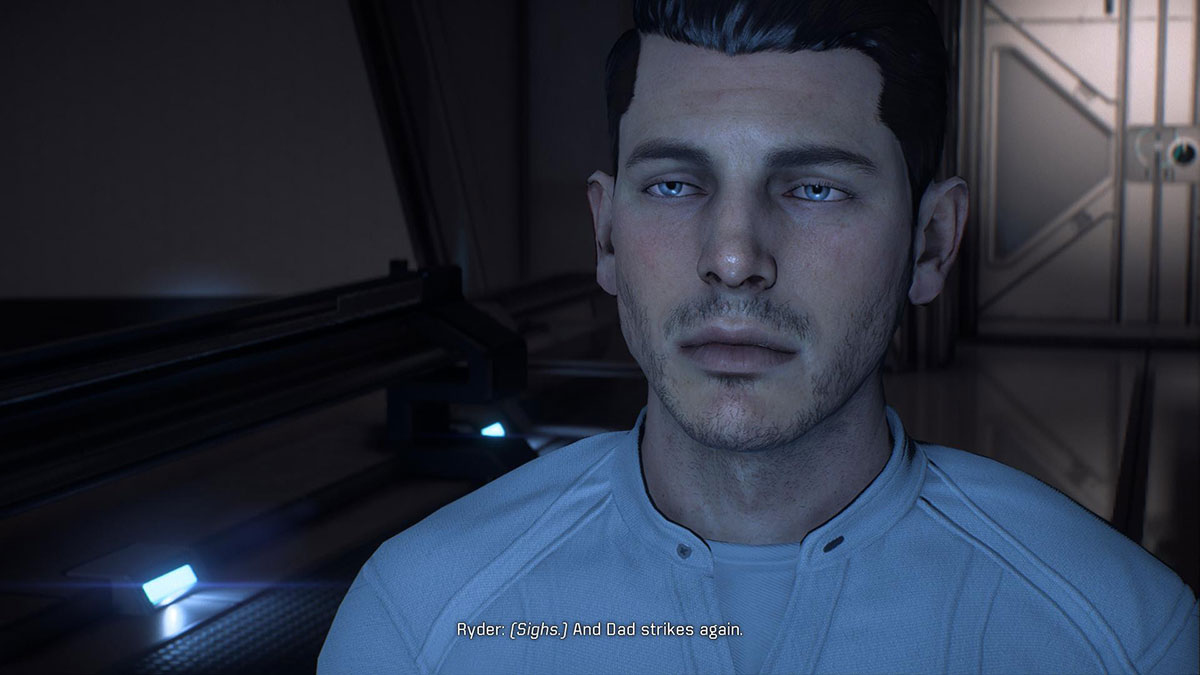
Time to hit the bottle again.
I have only played about an hour or two thus far, but the rest of the game seems okay. The gunplay does not seem as tight, but it could be the learning curve of the Frostbite engine. Or perhaps my low-level guns. I like how you can swap out abilities and such, but don’t like how apparently I’m limited to three abilities at a time. I suppose in the paradigm of quick recharging Biotic skills, it would be too much to be just slinging more mass effect fields than bullets.
Still, I always question whether these sort of decisions are made based on solid design principles, or whether it was to dumb down the game for consoles.
 In An Age
Past is Prologue
Nov 15
Posted by Azuriel
Starfield has been a wild success. Like, objectively: it was the best-selling game in September and has since become the 7th best-selling game for the year. And those stats are based on actual sale figures, unmuddied by Xbox Game Pass numbers. Which is astounding to think about.
[Fake Edit] A success… except in the Game of the Year department. Yikes. It’s at least nominated for Best RPG, along with (checks notes) Lies of P? No more sunlight between RPG-elements and RPG anymore, I guess. Doesn’t matter though, Baldur’s Gate 3 is going to continue drinking that milkshake.
Starfield having so many procedurally-generated planets though, is still a mistake. And its a mistake that Mass Effect: Andromeda took on the chin for all of gamedom a decade ago.
Remember Andromeda? The eagerly-anticipated BioWare follow-up to their cultural phenomenon trilogy? It ended up being a commercial flop, best remembered for terrible facial animations and effectively killing the golden goose. What happened? Procedurally-generated planets. Andromeda didn’t have them, but the (multiple) directors wanted them so badly that they wasted months and years fruitlessly chasing them until there was basically just 18 months left to pump out a game.
You can read the Jason Schreier retrospective (from 2017) for the rest of the story. And in total fairness, the majority of the production issues stemmed from EA forcing BioWare to use the Frostbite engine to create their game. But it is a fact that they spent a lot of time chasing the exploration “dream.”
That’s how it begins. Granted, we wouldn’t see how No Man’s Sky shook out gameplay wise until 2016.
The irony though, is that BioWare started to see it themselves:
And there it is: “it was never fun.” It never is.
I have logged 137 hours in No Man’s Sky, so perhaps it is unfair of me to suggest procedural exploration is never fun. But I would argue that the compelling bits of games like NMS are not the exploration elements – it’s stuff like resource-gathering. Or in games like Starbound, it’s finding a good skybox for your base. No one is walking around these planets wondering what’s over the next hill in the same way one does in Skyrim or Fallout. We know what’s over there: nothing. Or rather, one of six Points of Interest seeded by an algorithm to always be within 2km walking distance of where you land.
Exploring a procedurally generated world is like reading a novel authored by ChatGPT. Yeah, there are words on a page in the correct order, but what’s the point?
Getting back to Starfield though, the arc of its design followed almost the reverse of Andromeda. In this sprawling interview with Bruce Nesmith (lead designer of Skyrim and Bethesda veteran), he talked about how the original scope was limited to the Settled Systems. But then Todd Howard basically pulled “100 star systems” out of thin air and they went with it. And I get it. If you are already committed to using procedural generation on 12 star systems, what’s another 88? A clear waste of time, obviously.
And that’s not just an idle thought. According to this article, as of the end of October, just over 3% of Xbox players have the “Boots on the Ground” achievement that you receive for landing on 100 planets. Just thinking about how many loading screens that would take exhausts me. Undoubtedly, that percentage will creep up over time, but at some point you have to ask yourself what’s the cost. Near-zero if you already have the procedural generation engine tuned, of course. But taking that design path itself excludes things like environmental storytelling and a richer, more tailored gaming experience.
Perhaps the biggest casualty is one more felt than seen: ludonarrative. I talked about this before with Starfield, but one of the main premises of the game is exploring the great unknown. Except everything is already known. To my knowledge, there is not a single planet on any system which doesn’t have Abandoned Mines or some other randomly-placed human settlement somewhere on it. So what are we “exploring” exactly? And why would anyone describe this game as “NASApunk” when it is populated with millions of pirates literally everywhere? Of course, pirates are there so you don’t get too bored exploring the boring the planets, which are only boring because they exist.
Like I said at the top, Starfield has been wildly successful in spite of its procedural nonsense. But I do sincerely hope that, at some point, these AAA studios known for storytelling and/or exploration stop trying to make procedural generation work and just stay in their goddamn lane. Who out here is going “I really liked Baldur’s Gate 3, so I hope Larian’s next game is a roguelike card-battler”? Whatever, I guess Todd Howard gets a pass to make his “dream game” after 25 years. But as we sleepwalk into the AI era, I think it behooves these designers to focus on the things that they are supposedly better at (for now).
We learn from our mistakes eventually, right? Right?
Posted in Commentary, Philosophy
2 Comments
Tags: Exploration, Mass Effect: Andromeda, procedurally-generated, Starfield