Blog Archives
Impressions: Mewgenics
TL;DR: I bought Mewgenics on February 14th, and have 30 hours played after four days.
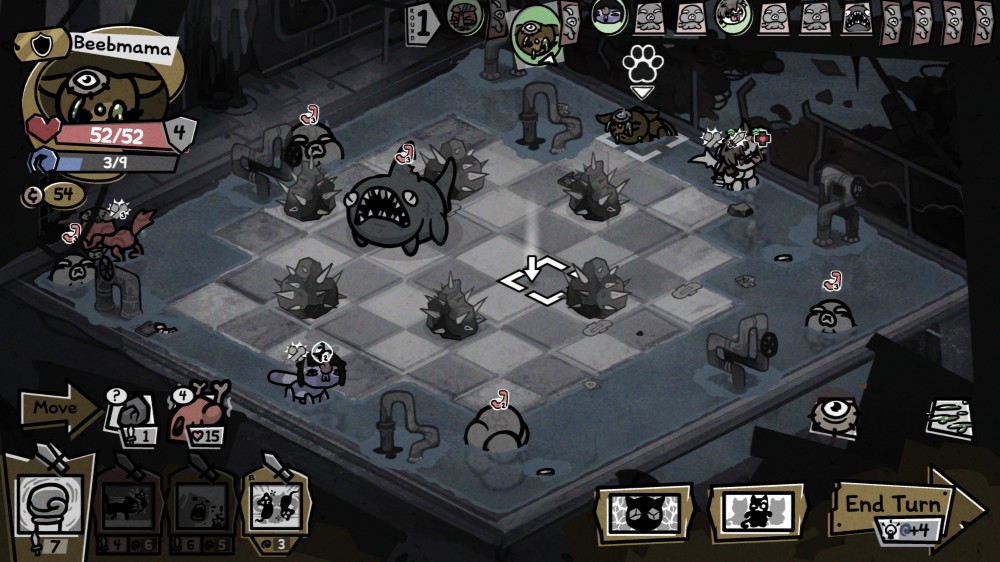
Mewgenics is a tactical roguelite and cat breeding sim from Edmund McMillen, of Binding of Isaac and Super Meat Boy fame. While it does not play like Binding of Isaac, it is absolutely the same kind of brand experience: crude humor, goofy visuals, banging soundtrack, absolutely broken skill/item combos, and a deeply compelling gameplay loop. Well… for the most part.
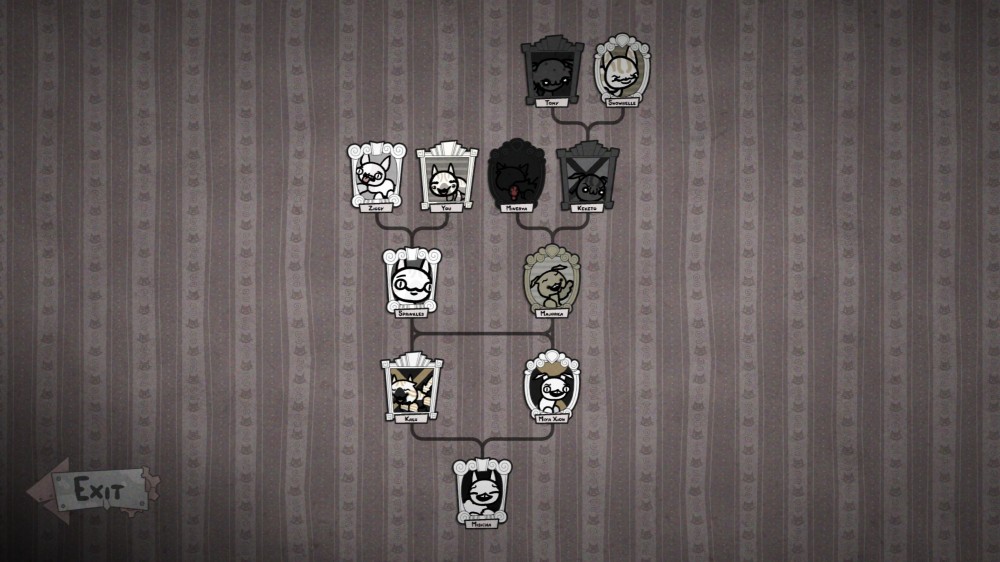
The game is divided in two parts: house and adventure. During the house parts, you are performing the “eugenics” part of the title. At the end of each game day, compatible cats will squirt out 1-2 kittens with some mix of the parents’ stats (and sometimes abilities/mutations), and the kittens themselves will grow into adults an additional day later. There is a lot of RNG involved in breeding into the best stats, but you can mix and match furniture to weigh the odds more in your favor. Or, honestly, you can mostly ignore it and just rely on the daily stray cats that wander onto your property.
When you are ready to adventure, you place up to four cats in a box, give them a class “collar,” and then equip them with any spare items you got from prior runs. After that, you progress through a linear series of nodes that includes battles, events, treasures, mid-bosses, shops, and final bosses.
Hobbes would accurately describe Mewgenic’s combat as “nasty, brutish, and short.” Fights take place in an intimately-sized, randomized board with you generally being way outnumbered. I would classify combat as Fair* with the asterisk emphasized. There is a turn-order ribbon, right-clicking will show you have far a unit can move and subsequently attack, and abilities work as described.
However, no punches are pulled, no mistakes unpunished. There is no move rewind if you didn’t move 1 square far enough, you can absolutely waste attacks by mis-clicking on the ground, and there is built-in punishment for save-scumming battles. Additionally, there are some mechanics that work differently than you may be used to in other games. For example, Tall Grass is terrain that gives the unit a 50% evasion chance… but this also applies to friendly heals and buffs sent your way. Having a Tank character with Thorns or other “on attack” debuffs are great… until an enemy uses a knockback ability and sends your cat bumping into said Tank, dealing massive friendly fire.
It’s also worth noting that if a cat hits zero HP, it goes into a downed state and gets a permanent reduction to one of its stats. If a downed cat takes much more damage though – or gets targeted by a corpse-destroying ability – it dies permanently. While you can occasionally get a mid-run replacement, that new cat won’t have a class and starts at level 1, so it’s barely a warm body.
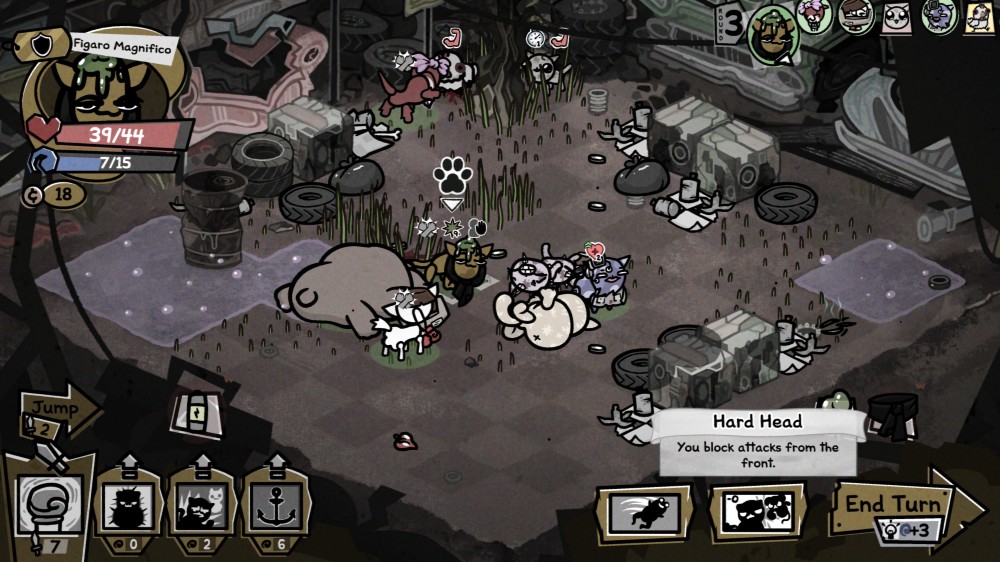
The upshot to this harsh, rules-as-written gameplay is allowing for truly broken shenanigans. Some things are RNG-dependent, such as which items drop and what starting class abilities each cat gets. That said, each level up grants a cat a choice between four options, which can sometimes lead you into interesting directions. In one run, my Tank had a cheap, stackable bodyguard-like ability that automatically caused him to swap places with any other team member that got targeted with anything (attack, spell, etc). He also had a starting ability to give himself Thorns at the cost of not moving during his turn. Not much of a problem since he could protect the team from anywhere. He later got an ability to automatically Block any attack coming from the front. Considering the Bodyguard ability always places the Tank facing the attack… yeah, suddenly my whole team was effectively immune to the first 5-6 attack of every turn.
The balance to all this comes from the fact that cats who survive adventures are “retired” when they come back to the house. They can still stick around a breed and such, but you are going to need an entirely new set of four cats to go on further adventures. Plus, you know, RNG is RNG and you may never receive that same set of skills/items again. Plus plus, the game escalates in difficulty pretty wildly by the end of Act 1, let alone the start of Act 2 where I am. Let’s just say that broken combos can go both ways, if you aren’t careful.
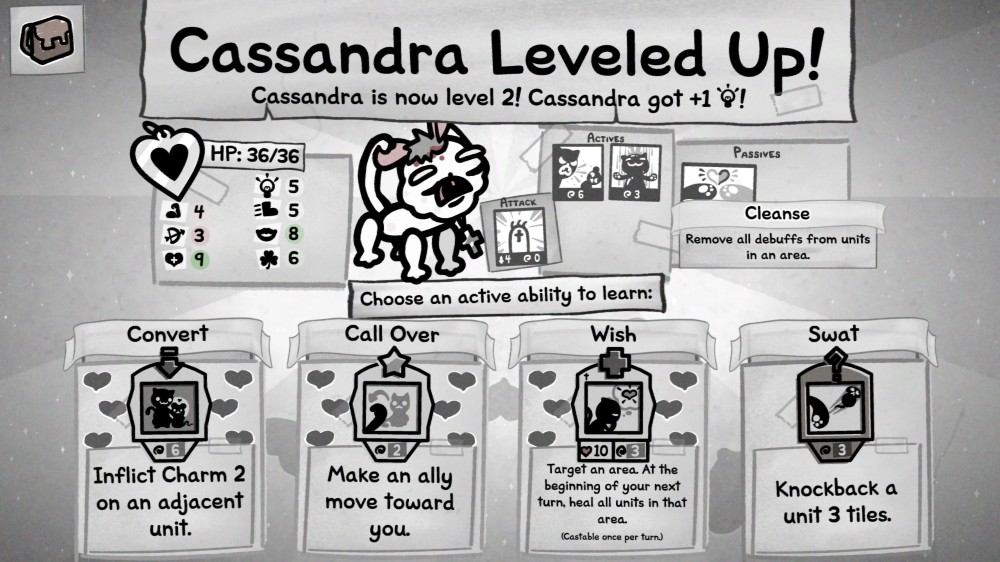
Having said all that, Mewgenics also feels kinda bad sometimes. The house portion of the game feels good, but it keeps getting interrupted by the need to go adventuring, which can often take more than an hour depending on how deep you go. Adventuring by itself usually feels good, but there’s a conflicting desire to play sub-optimally to farm more resources for the house phase rather than do what’s best to ensure success of the run itself. Then there are the house progression unlocks, which are done by “donating” cats to NPCs. One of them wants retired cats, for example, so it’s sometimes tempting to just go on a bunch of first-zone-only runs and try and brute-force the rewards. If you don’t, you’ll be making due with cramped quarters for dozens and dozens of hours.
Also, right now Events in the adventure phase feel half-baked. Random cat is selected, given a small selection of Skill checks, and it’s not entirely clear whether the outcome was due to failing or even succeeding the roll (or what the odds even were). What’s worse, sometimes the best reward is tied to a particular Skill check, not just succeeding on any of them. For example, when given a choice between Eat/Loot/Examine, you might have three different positive outcomes possible, where “positive” might be “just flavor text” or “game-breaking item.” Binding of Isaac was filled with randomness too, sure, but it somehow feels worse in Mewgenics.
So, yeah, that’s the game. If Isaac is any indication (or the 1 million already copies sold), Mewgenics will receive years of support, hopefully addressing things like the Events (etc). Plus, it’s $30 MSRP.
The era of the indie is now.
Balatro
If you haven’t heard about the latest indie darling, Balatro, let me tell you: it’s legit. Balatro is available on both Steam and now on mobile, the latter of which is what I recommend picking up, as there aren’t many non-exploitative mobile games out there.
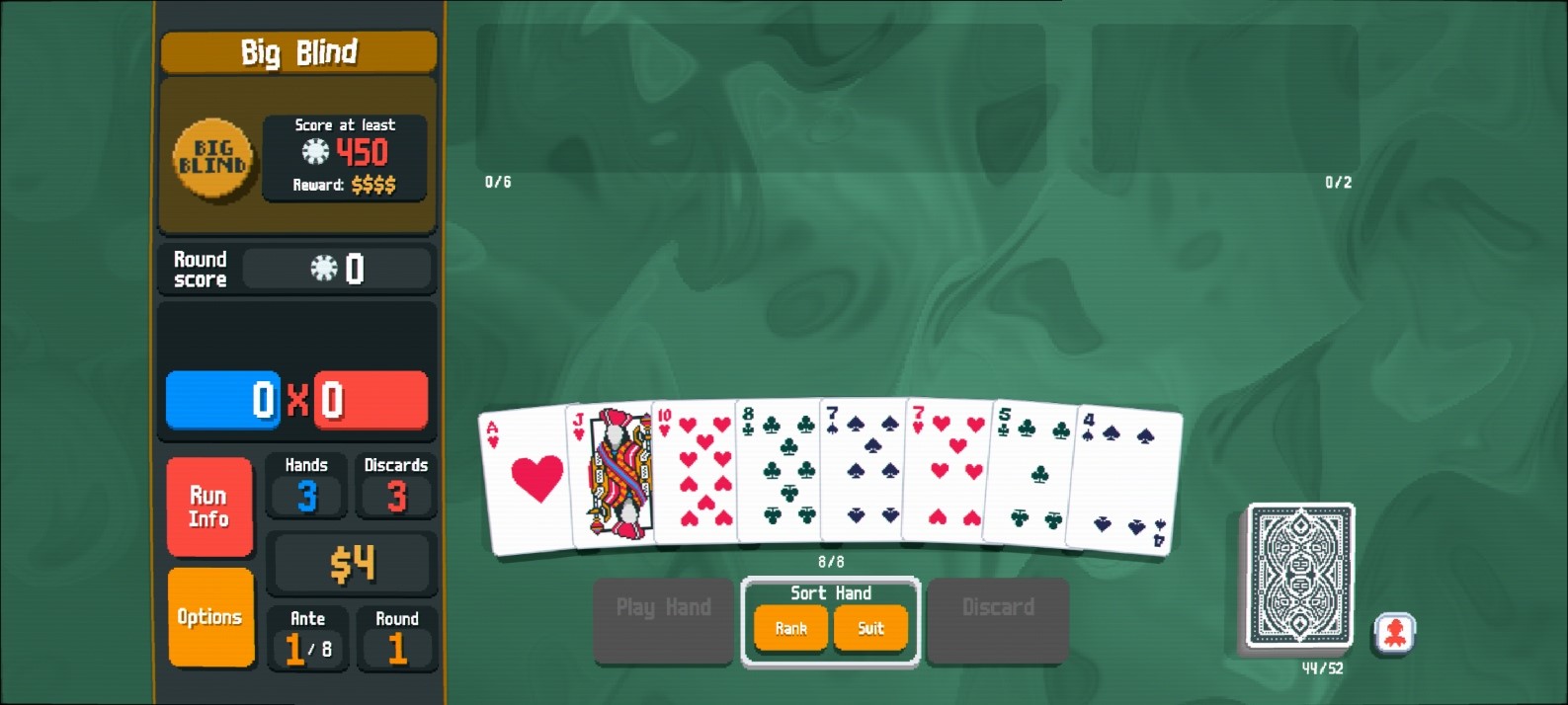
Fundamentally, Balatro is a deckbuilding roguelike based around making poker hands using a standard deck of cards. Your overall goal is to clear eight “levels” (Antes) that consist of three “battles” (Blinds) apiece, one of which is a boss that has negative modifiers. Battles are won by exceeding a score (Chips), which is generated based on the poker hands you play… plus any modifiers. For example, let’s say you have two pairs: a pair of Queens and a pair of 5s. A two pair hand is worth 20 Chips x 2 multiplier by itself. You then add the face value of the cards used to the Chip value, so it ends up being 50 x 2, or 100 Chips. The very first Blind requires 300 Chips or more to beat, so you would be well on your way to success there. Under normal settings, you get to play a total of 4 hands to beat the Blind, and get a total of 4 discards (up to 5 cards each time) in order to make said hands.
Winning battles gives you a base level of money ($3-$5) with bonuses based on unused hands remaining and “interest” on unused cash from prior rounds. You use this money in-between rounds in a shop phase that lets you purchase various things.
The twist with the game comes from the modifiers available.
The Jokers are the most famous elements of the game, and they truly run the gamut. The most basic Joker grants you +4 to your multiplier; if we had that with our earlier two pair hand, the Chips score would have been 300 by itself (50 x 6). Some Jokers give you a scaling buff, some revolve around increasing your economy, some focus on enhancing specific suits or poker hands, some give bonuses to other Jokers, and so on. You get to equip up to five Jokers under default settings. Then there are Planet cards. These are consumables that permanently (for this run) upgrade the scoring of poker hands. Then there are Tarot cards, which are consumables that do a bunch of different things, including giving you more Tarot cards, more Planet cards, changing the suits of specific cards, etc. Oh, and the deck of cards itself can be enhanced or augmented to a variety of ways – cards can be deleted, added, changed to give +4 multiplier when scored, give more points when not played, etc. etc.

As you can probably tell, the dopamine hits come from the combination of regular poker RNG along with Joker RNG, boss RNG, shop RNG, and generally shenanigan RNG. You could be just scraping by, hit an amazing shop, and walk into the next round flush with cash and scaling Jokers. You could be breezing through the game and then hit a boss modifier like “Diamonds are debuffed” and do a ShockedPikachu.jpg when your “turned all the cards into Diamonds” deck is shafted. And, yeah, while I mentioned the word RNG a bunch previously, at the end of the day it is still about poker – there are strategies and probabilities that you can leverage to improve your expected outcomes.
Perhaps the best part of Balatro is the simple fact that it is a complete experience. There are no micro-transactions, no DLC, no real-world money intervention. I purchased it from Google Play for $10 and that’s that. Overall, I would still claim Slay the Spire to be the best deckbuilding roguelike, but Balatro certainly jumped out of nowhere to land in the top-5, if not second place. Not bad for a 1-man team.
Chasing the High
It’s super dumb, but I have pretty much exclusively been playing Hearthstone Battlegrounds for the last 1.5 weeks. I say “super dumb” because this sort of gaming doesn’t mean anything. And, yeah, “does anything really mean anything?” but Battlegrounds is on a whole other level of frivolousness.

If you’re unfamiliar, Battlegrounds is a game mode within the Hearthstone client that is essentially an Auto-Battler. There are two main phases: Tavern and Battle. During the Tavern phase, you spend gold purchasing minions, upgrading the Tavern tier (unlocking higher-tier minions in the pool), refresh available minions, sell minions, use your Hero Power, and/or rearrange your minions. After about 60-90 seconds, you transition into the Battle phase. During Battle, minions take turns attacking from left to right, but their targets are chosen randomly (barring Taunt or other special effects). Whoever has a minion(s) left standing wins and deals X damage to the opponent’s hero.
Battlegrounds has been around for a while, but I didn’t really bother playing it for years. As my interest in Hearthstone proper started to wane though – I don’t care much about ladder ranks – Battlegrounds started to become more appealing. Throughout the seasons, Blizzard started to really shake things up with new, rotating features that added some spicey randomness. Granted, there’s already plenty of randomness in the game mode, but these were on another level. Things like Buddy units (unique to each Hero), Quests (bonus effects if you can complete them), and the latest season introduced Spells as something you can purchase in the shop. All of these things were introduced in a particular season, and then rotated out, keeping things fresh.
And then someone this season went nuts and added all of the things.

Specifically, this current season has Spells and then several weeks later… Quests too. The Quests have been revamped though, and some of them feature crazy effects like “Discover a new Buddy each turn.” That’s not actually the most powerful Quest effect, but I had a few degenerate games where I leveraged it to a massive win. Indeed, the sheer nonsense you can evoke depending on randomness – and the speed in which you must do so – is what is driving me to almost compulsively play Battlegrounds. I’m chasing the high I get from some of these games, or chasing the dream where I was a turn or two away from going nuts before getting wrecked by someone else’s high-roll.
Really though, the randomness cannot be overstated:
- Starting Hero selection is between 2-4 from random pool (94)
- Opponent hero selections are random (for you)
- Overall minion type pool is random (5 out of 9)
- The minions you’re offered in each Tavern are random
- There are only X copies of specific minions in the pool, which opponents can buy
- Getting a “triple” confers a huge bonus, which is a pick 1-of-3 minions from a higher tier
- Minion attacks are random (aside from Taunts or other special conditions)
- HUGE variance can that lead to losing to 5% odds
- Certain spells are random
- Steal a random minion from the tavern, Discover a Battlecry Minion, etc
- Quests are random on top of random
- At a baseline, you are offered a choice of three quests (out of 60)
- Your hero selection impacts which quests are available
- Quest completion methods are randomly assigned (out of 15)
- Play X Battlecry Minions; Speed Y Gold; Kill Z Minions; etc
- Minion types, hero selection, and quest power impact X/Y/Z values
- Some Quest rewards are themselves random
- Cast 5 Random Spells each turn; Discover a Buddy; etc
Sounds like it would be frustrating, yeah? And yet… it usually feels fine.
In Hearthstone, a card that does 3-6 damage is frustrating. Not drawing your combo pieces is frustrating. In Battlegrounds, the randomness is usually just presented as you needing to make the best decision out of available options. Did your minions miss the enemy buff target three times in a row and yet they hit your buff minion right off the bat? OK, that sucks. What’s your next play?
It also helps that losing early just means you can queue into a potentially better game right away.
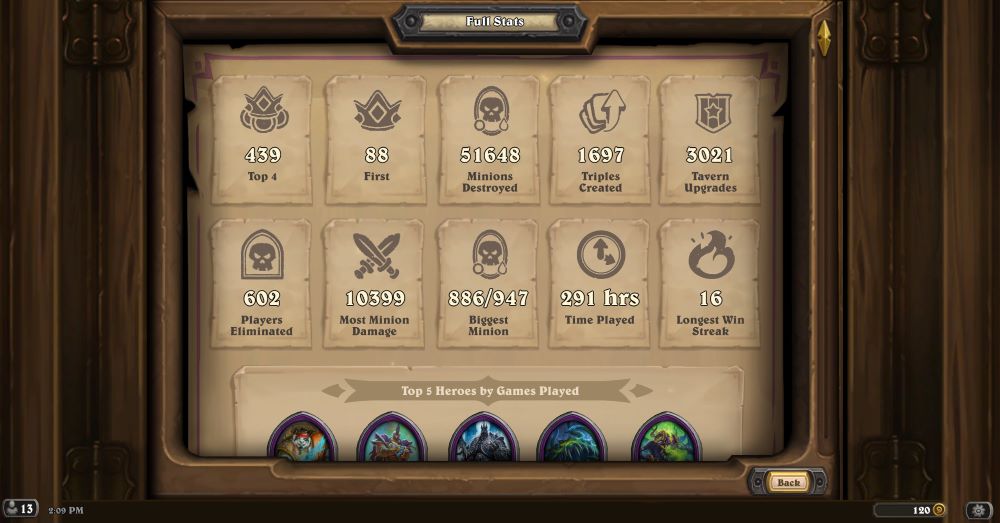
Near as I can tell, whatever reward center in my brain that lights up from deck-building roguelikes (e.g. Slay the Spire) or survival-crafting games has been short-circuited by this season of Battlegrounds. I’m somewhat mad at myself because I should be playing Red Dead Redemption 2 (played one session) or anything else in my extended library. We’re talking like probably 30-40 hours of potential progress spent on otherwise wirehead activity in the past few weeks.
And yet… I need another bump. The next Battlegrounds season gimmick has been teased as being co-op, which honestly sounds pretty awful. I doubt that they keep Quests around for another entire season in any case, but maybe Blizzard will see the spike in (my) gametime and consider keeping it around. The fact that it may go away for a while makes me want to get my fill even more.
Gimmie, gimmie, gimmie! I need it.
Oh, and Hearthstone proper released a new expansion cycle too, I guess. Yawn.
Impressions: Across the Obelisk
Across the Obelisk is a chunky deck-building roguelike that has a lot of overlapping mechanics that… mostly work together.
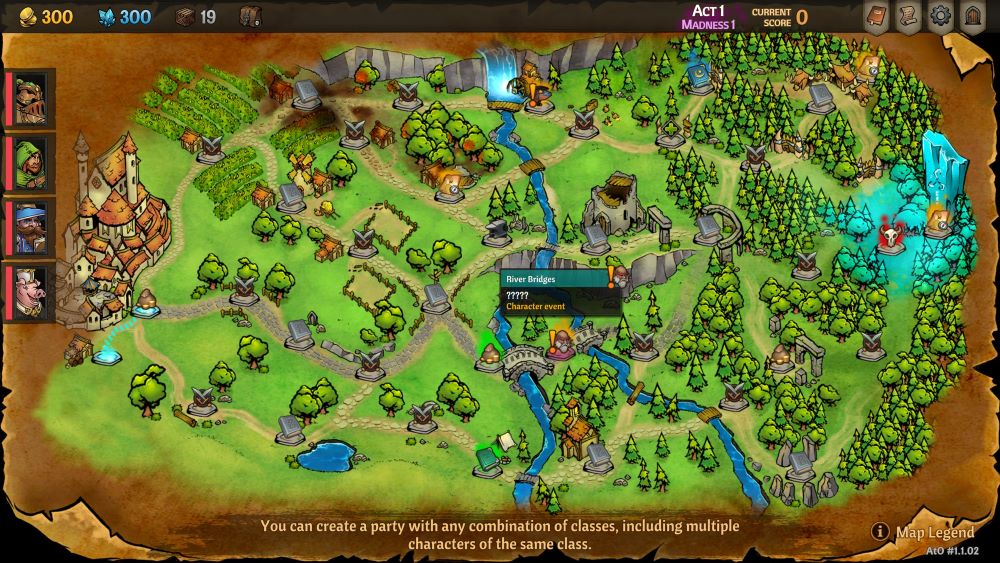
You control four characters each with their own decks. By default, these characters are a warrior, ranger, mage, and cleric, and all have their own unique card pools. Additionally, each character has four equipment slots (and one pet slot) that can be filled with a wide assortment of gear. Additionally additionally, each character can level up five times, getting a binary choice of abilities unique to that specific character (e.g. the four warriors each have different choices). Additionally additionally additionally, you earn Perk points across all characters that allows you more customization options in the form of +1 bonuses to various stats.
Oh, and you accumulate “Supplies” that let’s you upgrade the towns at the beginning of each map. And maps have various lanes and encounters and character unlocks and secrets and general themes.
Like I said, there’s a lot going on.
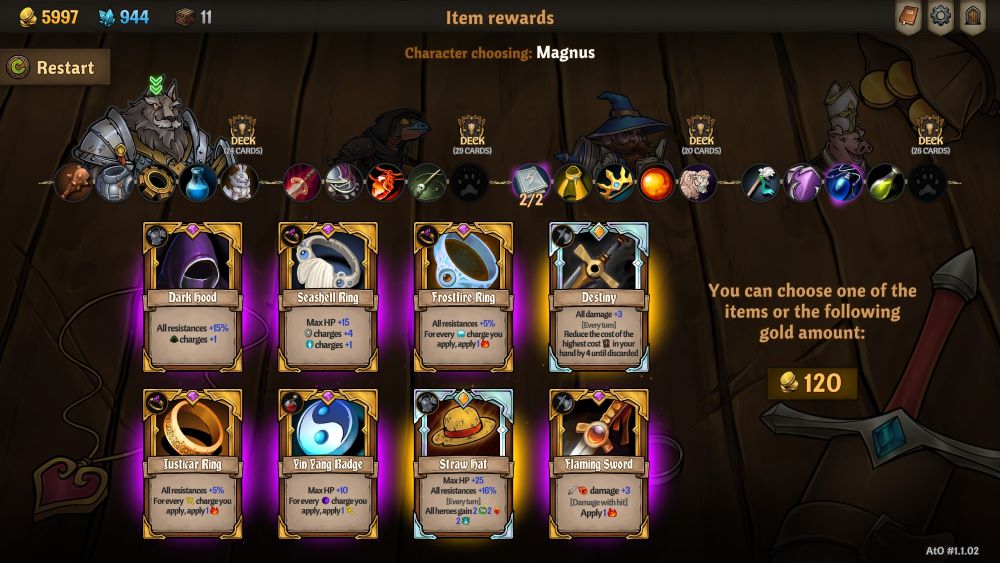
The problem, 25 hours in, is an understanding that a lot of the game just doesn’t matter. In Slay the Spire, you always go first and can see what the enemy is going to do. In this game, enemy actions are hidden by default – you have to debuff them with certain cards to temporarily see – and turns are based on the speed stat… which can be buffed or debuffed. So sometimes the enemy will just do things to your team without you knowing what’s going on. Like all deck-building games though, sometimes you can’t do anything even if you do know what’s coming due to the cards drawn.
Another issue I have is how often what the card says doesn’t matter. Characters have resistances to the various damage types in the game, and it’s often a fact that enemies get 60% resistance or higher. When I first unlocked a high-cost card that said “Deal 60 damage” I was excited… only to find that it actually deals like 20. The game calculates it for you so there’s no surprises, but nevertheless this funnels all successful strategies towards stacking debuffs (which typically lower resistances as a bonus). Which is whatever I guess… until you face enemies immune to that debuff, or can self-dispel, or can transfer (!!) the debuffs back your way. Most of the time, whether a given enemy can do this will be a complete surprise. Fun times.
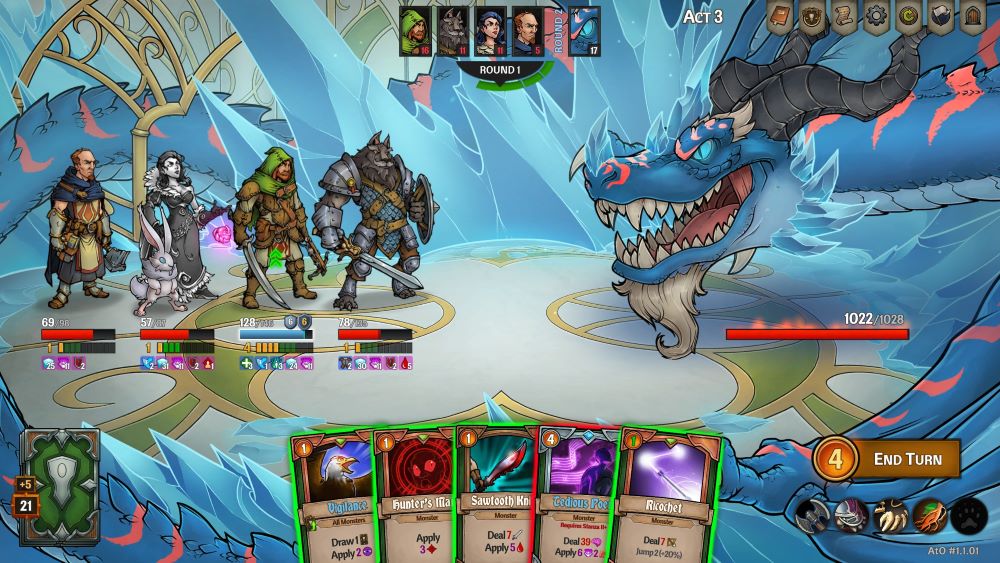
Ultimately, I’m finding the game plenty compelling in an almost unhealthy way. Each run makes the next one that much easier, which is good, but this also means you are set up to fail the first dozen or so runs. I like how you can end up crafting a lot of your favorite cards right at the beginning of the game and thinning your deck out so there is less ramp-up. Figuring out synergies between the classes feels satisfying, and unlocking characters can lead to new ways of playing based on their unique talents.
But if you aren’t into deck-builders, this certainly isn’t going to get you onboard. Not only is there a lot of RNG – moreso than normal deck-builders – each run takes several hours between having to coordinate four different decks and equipment and upgrades and so on.
Mobile Review: Slice & Dice
Slice & Dice is a F2Try dice-based roguelike. You can play the first 12 “levels” for free, but it costs $7 to unlock the rest of the game.
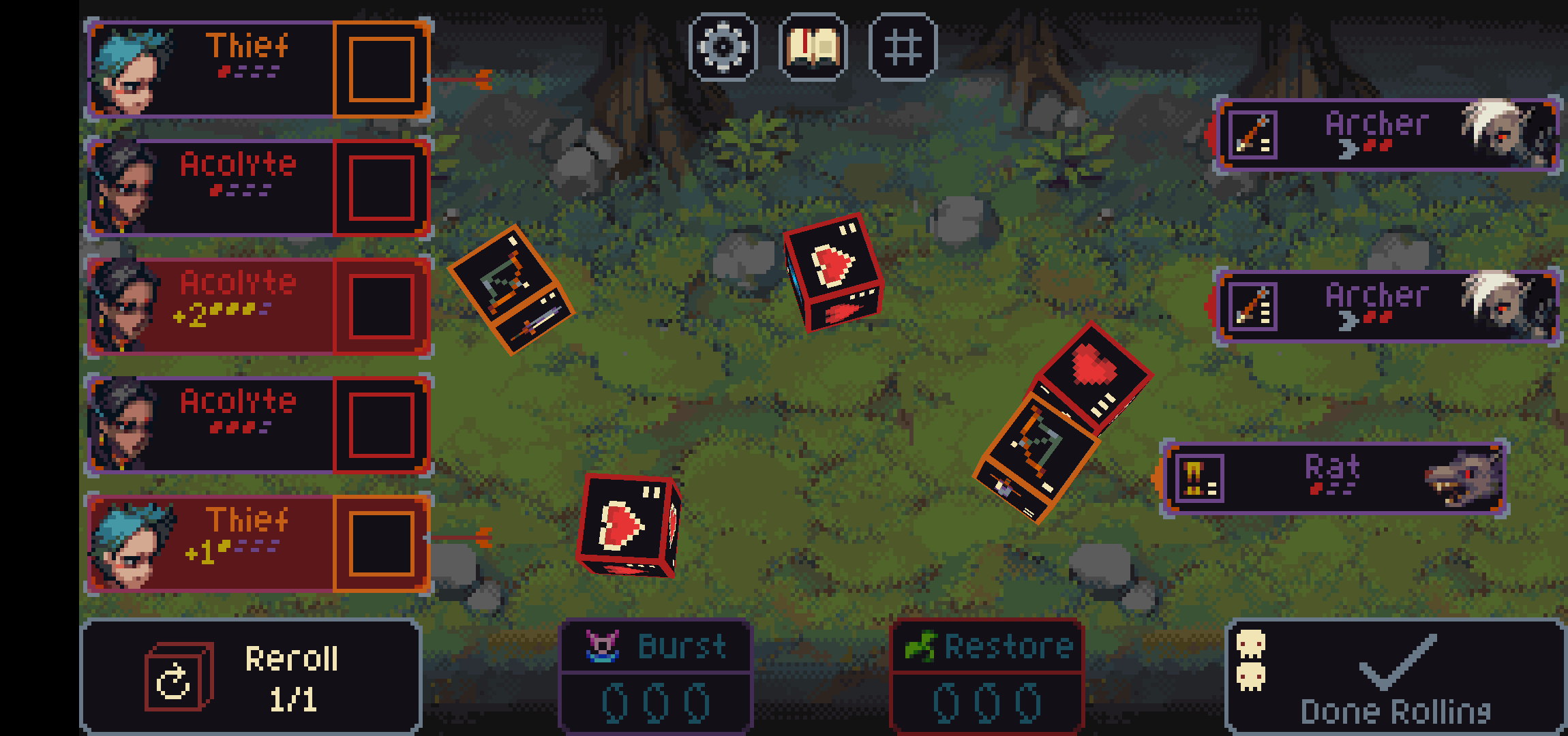
On the face of it (har har), the game appears relatively simple. By default, you control a party of five traditional archetypes – Rogue, Warrior, Defender, Healer, Mage – who face an assortment of enemies. Each round, enemies will roll their dice and indicate who they will be attacking, assuming they survive.
Then your team will roll one die per class. Each six-sided die has different abilities on it as determined by that die’s class and any modifications due to items. If you like a specific die roll, you can “save” it by tapping and then reroll any remaining dice up to two times. After all dice are locked in, you then can use the dice to attack enemies, shield your team, generate mana for Spells, or a number of other unique effects. Any surviving enemies will then attack back. Then everyone gets to do it again.
After each successful battle, surviving heroes are healed to full, any defeated heroes return to life at half-health, and there are alternating rewards of class promotion or random item selection. For class promotion, two heroes are randomly selected to get promoted to one randomly selected option, and you decide which one does. For example, you might be able to choose between your Rogue and Cleric getting promoted to a Tier 2 version of those classes, but not choose for the Warrior to be upgraded instead, or choose between the 5-6 Rogue options. Similarly, with item selection you can choose between two options or go for a mystery roll if neither one works well for your setup.

If that sounds like a lot of randomness, well… it is a dice-based game.
After I understood the general shtick of the game and saw what sort of boss battles were available, I started losing interest. The game seems a bit simple, right? Plus, winning didn’t really seem to offer much progression. But that was when I discovered the Achievements and other unlocks. Basically, the game has 40+ achievements that all unlock something when, uh, achieved. Most of the time these unlocks are additional items that get added to the pool for future runs, but other times there are additional difficulties and new game modes. For example, with Custom Party you can choose to bring 5 Mages or some other mix of heroes, and Shortcut lets you skip the first 8 levels (although you get random items and promotions). The unlocks themselves are not always worth it per se, but they provide something to work towards and potentially discover some fun along the way.
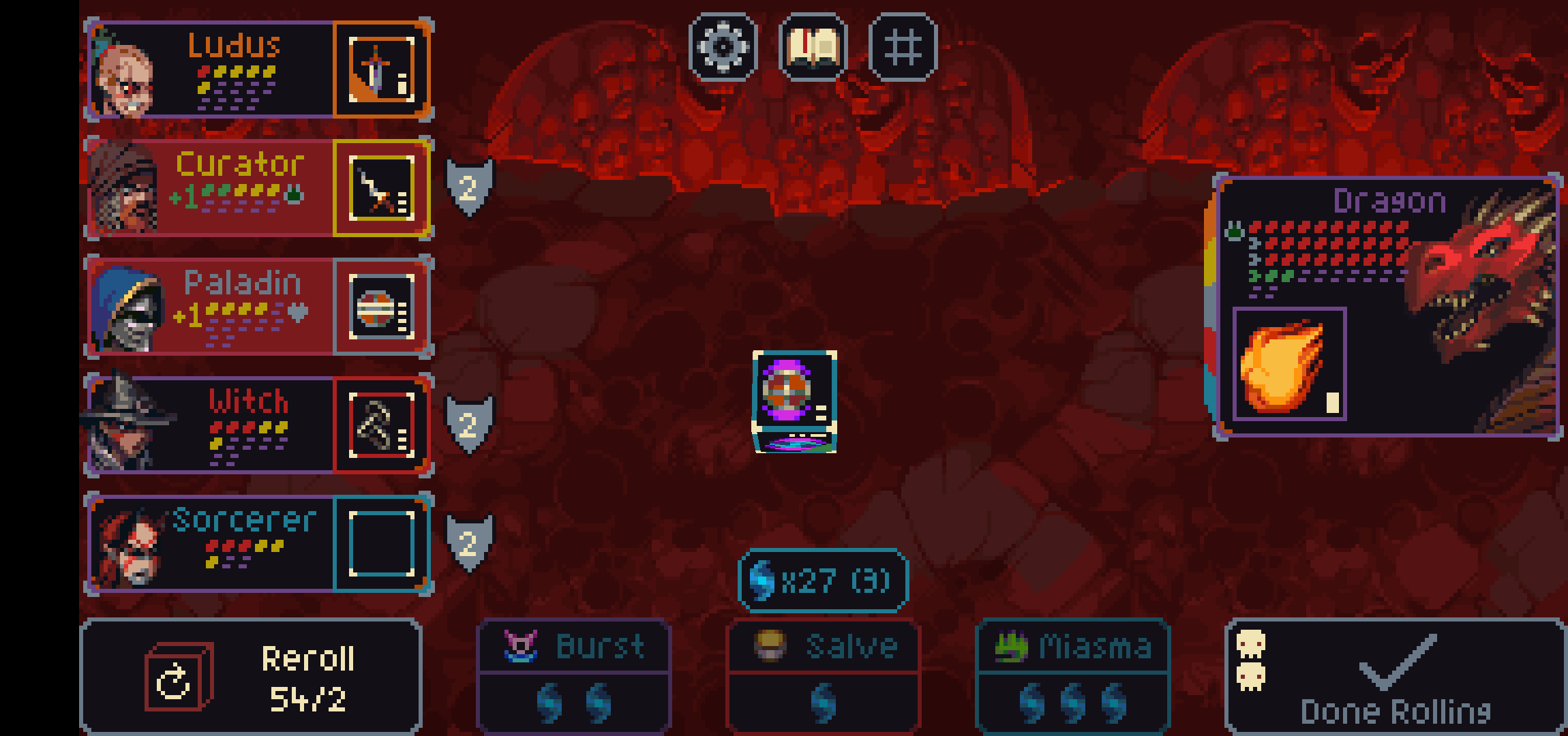
Notwithstanding the progression element, the game feels very satisfying to play in the moment. I often feel the pull of “just one more turn” given how many micro and macro decisions you end up needing to make. Is 2 damage good enough, or do you gamble on a 16.67% chance of getting a blank in order to hit something better? Should you focus-fire the big monster, or take out the small fry first? Do you blow all your mana on trying to save one hero this turn, or let them die to push more damage?
Overall, I am extremely pleased with my $7 purchase and probably have logged 30-40 hours thus far. One of the achievements to unlock Speed Run leaderboards is to win Standard mode in under 45 minutes, to give an idea of average successful run length. I also highly appreciate the fact that the game is short interval-friendly, e.g. there is no real-time component and you can minimize the app without messing anything up. It is no Slay the Spire, but it’s a game that has come closest to scratching the itch.
White Whale, Caught
About a year ago, I beat the Dalaran Heist adventure on heroic difficulty in Hearthstone.
Yesterday, I caught the white whale I had been chasing daily for the last four months: beating Dalaran Heist on heroic with all nine classes. Across all five Acts.
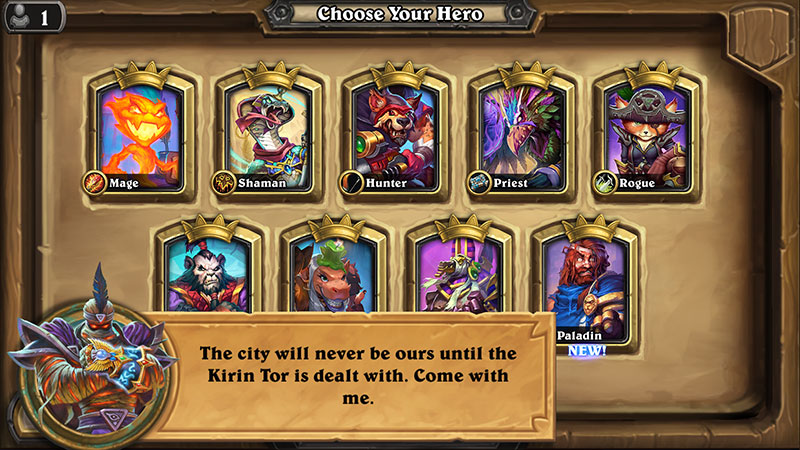
As I have mentioned before, Dalaran Heist constitutes an absurd amount of ideas and RNG. All nine classes are available and there are two extra sets of Hero Powers for each class. And three starter decks per class. With random starting decks being an option. And 15 or so random “Anomalies” that can be turned on. It truly felt as though Blizzard devs had a brainstorming meeting and just took everything that was on the whiteboard at the end and implemented it simultaneously. It seems almost like more of a waste to do that than to leave some on the cutting room floor for next time.
In this age of quarantine and perpetual baby-wrangling though, I came to appreciate the infinite turn-lengths and the dozens and dozens of options. For the most part. See, when I say “four months of daily attempts” I really just meant Act 5. I had cleared everything previous across all classes already, and was two classes deep in Act 5 (Paladin & Warlock) before I started to “be serious” about the endeavor. I was stuck on Druid for the longest time, thinking it was the worst class to get through.
Oh, no. That award goes to Mage.
There are only a few strategies that have much hope of success at the heroic level, and all of them rely on strong creatures and cheating them out early. Or, sometimes, creatures creating infinite value. Mage has some decent options in the latter case, but the issue is that Mage “reward buckets” are diluted with spells. In a normal game, spells can swing games. But in the RNG clown fiesta that is Dalaran Heist, you need cards that continue swinging for more than a turn.
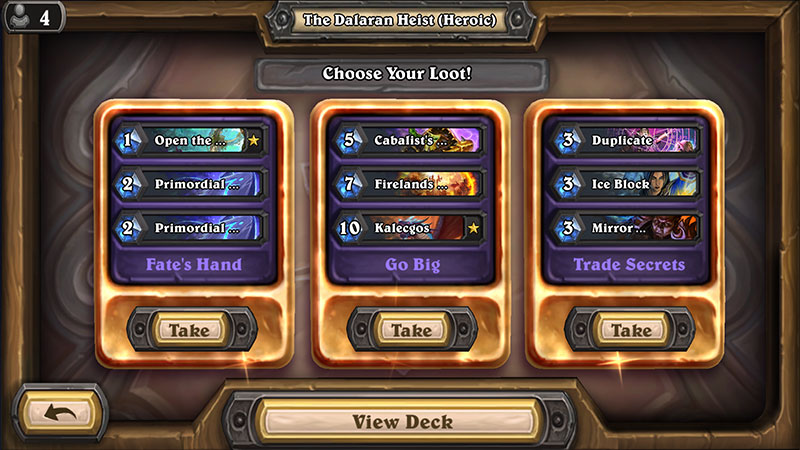
Adding the insult to injury, I discovered that a recent patch actually broke Ethereal Conjurer, a very decent Mage minion. And by “broke” I mean the game basically stalls out and you can do nothing other than concede. Which happened to me twice before I realized it was that specific card that caused it. Then, on the game-winning run, the second-to-last boss played it. Twice. Lucky for me, if you close Hearthstone and reopen it, the bug can be bypassed as long as it was the AI that played it.
In any case, purgatory quest complete, I remain melancholy. There is less than zero desire to “mix it up” and do something insane like beat every Act with every class and every different hero power. I had fun, for given amounts of fun, but it really came down to passing time on a project. I could purchase some more single-player content and unlock some cards via another Hearthstone DLC (Galakrond’s Awakening), but the $20 (!!) price tag seems rather insane. Especially since it is just an Adventure and not the roguelike, Dungeon Run experience I have come to so desire. Surely there is something else on the app market that would offer something similar?
Slay the Spire mobile, when?
Ascension
As you may have heard, I continue to play Slay the Spire.
I have beaten the “normal” game dozens of times with all three default characters, and have unlocked all the cards and relics. When you defeat everything with all three characters, you can unlock a fourth stage with a super-secret boss, and you also unlock Ascension Mode. Each character has their own Ascension Mode tracker, and defeating the standard final boss will increment the Ascension Mode up one digit, to a maximum of 20. What happens on each level is the following:
- Elites spawn more often.
- Normal enemies are deadlier.
- Elites are deadlier.
- Bosses are deadlier.
- Heal less after Boss battles (75% of missing health)
- Start each run damaged (-10% health)
- Normal enemies are tougher.
- Elites are tougher.
- Bosses are tougher.
- Ascender’s Bane
- Start each run with 1 less potion slot.
- Upgraded cards appear less often. (50% less)
- Bosses drop less gold. (25% less)
- Lower max HP. (-5 for Ironclad, -4 for Silent and Defect)
- Unfavorable events.
- Shops are more costly. (10% more)
- Normal enemies have more challenging movesets and abilities.
- Elite enemies have more challenging movesets and abilities.
- Boss enemies have more challenging movesets and abilities.
- Fight 2 bosses at the end of Act 3.
I have been focusing on playing the Silent, the 2nd character, and achieved Ascension 15.
Also, I am so done with this game.
This particular Ascension mode design is rather brilliant in a lot of ways. Many games have harder difficulties, including roguelikes, but most of them are not as granular as this. The first “downside” of more Elites, for example, is not technically a downside for someone skilled with the game – each Elite enemy killed will result in a Relic, which can substantially improve the rest of a run. It’s often advised to target as many Elites as possible in the first Stage, to either wash out a weak deck early, or load up on goodies when the risk to your time is low.
Plus, there is the more mundane benefit to the fact that even if you are a super pro player from the start, you still need to play through and beat the game 20 times before you reach the hardest difficulty. Per character! That’s a lot of gameplay. Or grinding, depending.
I lasted way longer than I thought I would at the beginning (Ascension 15, remember), but the fundamental truth is that each time I succeeded, each subsequent game became less fun. By design. Well, presumably I am supposed to become more and more proud of my ability to overcome challenges, but that doesn’t really happen in practice. Especially in Slay the Spire’s case, where after a while things become more and more RNG-based as the margin for success shrinks.
This is probably for the best. I prefer the discrete finality of a rolling credits screen to the ashes of burning out, but an ending is an ending. Now maybe I can move on to something else.
Opaque RNG is Indistinguishable from Rigging
My patience with enforced 50% win rates is paper graphene-thin.
“A fair game is one in which you win half the time.” It’s hard to argue against such a notion. What is more fair than a coin flip? The problem is that players aren’t equal sides of a coin, nor are the thousands of potential actions reducible to two, easily predictive binary outcomes. Some approximation is required. Or a developer thumb on the scale.
I am still playing Clash Royale despite the disastrous pivot towards blood stone squeezing, and the conceptual breakdown of all progression for long-term players. But some of their shit is driving me up a wall, and will eventually drive me from the game entirely. Specifically, Clan Wars, and even more specifically, a particular game mode with preconstructed decks.
To be sure, there are learning curves involved. Supercell basically took some “top decks” and added them to a pool, from which you are randomly assigned one for a single game. The problem is that some of these decks are just objectively terrible with no redeeming qualities, and still others are straight-up countered by some of the other matchups. For example, these two Classic Decks Battles:
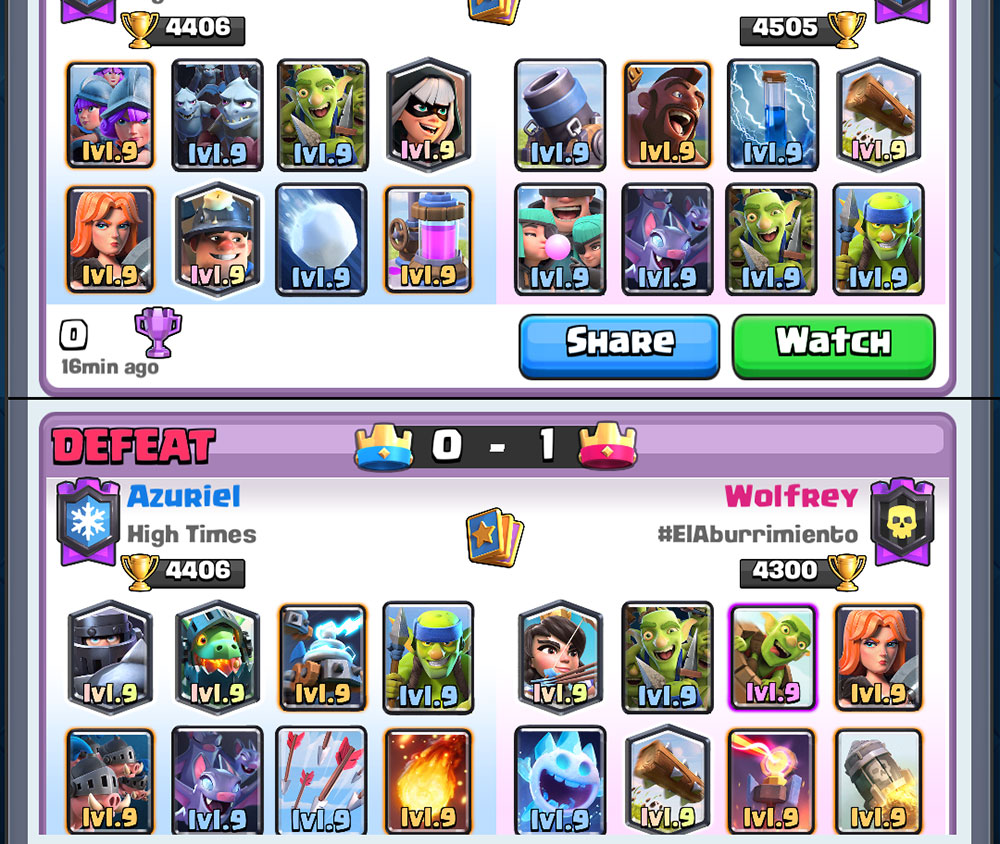
Bullshit on the left, winners on the right.
In the first match (at the bottom), my Royal Hogs are immediately countered by Valkyrie, Mega Knight is immediately countered by Inferno Tower. Amusingly, Royal Hogs are also countered by Inferno Tower and Mega Knight by Valkyrie, assuming my opponent times it right. Meanwhile, while I can counter his Goblin Barrel with Arrows, they both cost 3 Elixir and thus end in a wash… with the slightest error on my part resulting in easily >30% tower damage. Meanwhile, my Zappies are basically useless, my Inferno Dragon even more useless, and I can’t use Arrows to counter his Princess or Goblin Gang because then I become vulnerable to Goblin Barrel. I also can’t hope to Fireball him out because he also has Rocket, which deals way more damage than Fireball. The ONLY way anyone could possibly win with the deck I was given was if the opponent was AFK. 1
For a WoW analogy, think Warrior (me) vs Frost Mage (opponent).
The second matchup wasn’t technically as lopsided, but still awful. Bandit is straight-up countered by pretty much every card in the opponent’s deck. Rascals + Zap took care of Minion Horde every time I threw one down, and Hog Rider/Mortar/Goblin Gang meant I could be punished immediately for dropping Elixir Collector or Three Musketeers. Which is what happened, pretty consistently. If I played better, I might have been able to distract a Mortar with my Valkyrie or Bandit in the other lane, and then split a Three Musketeers or something in the middle, followed by a split Minion Horde. Even then, if he played defensive for 20 seconds, my shit would have been countered.
Were these match-ups truly random? Or “enforced” 50% win rates? There is no direct economic incentive for Supercell to “rig” the Classic Decks Battle mode, but the RNG is opaque and it would certainly be a method to ensure that winrates do not get too lopsided.
The third clan war battle I played was Draft. In this game mode, you are given a choice of one of two cards, four times total; whatever you don’t pick goes to your opponent. I’m not sure if the card pairings are 100% random, but you can absolutely get stuck with some extremely shitty decks and/or matchups. And yet I’m fine with that. You as the player have some agency, even with imperfect information, e.g. choosing Minion Horde when opponent might have chosen Arrows. Indeed, Minion Horde in particular is a classical risky pick because of how many cards can counter it… but if your opponent doesn’t have any of those counters, it can be an overwhelming advantage.
My feelings on enforced winrates have changed over the years. Initially, it seemed fine. Necessary, even. But it is rigging, especially in the methods that many game developers go about it: pairing you with terrible teammates, matching you against strong counters, etc. The end result is that I simply cannot trust game developers with (opaque) RNG anymore. They have no incentive to be actually fair – however fairness is defined – and every incentive to produce favorable (to the devs) results. Even if they showed me the specific game code that chooses the matches, I have no reason to believe it operates in that way. This age of monetization and consumer surplus erosion has pushed me past the Cynicism Horizon, from which no trust can escape.
The only thing that game designers can do, and the thing they should be doing, is increasing player agency in the RNG elements. Drafting feels fair, even when the results are not. Maybe it is just another psychological trick to employ, giving someone the “choice” between a rock or a hard place. But it is an important one for not appearing so nakedly rigged in favor of one particular outcome.
1 If you can produce some videos of pros beating non-AFK people with the decks I was given, I’ll concede that I need to L2P. I typically end the season at 4800 trophies and can acknowledge mistakes, but on paper and in practice, those match-ups felt lopsided as hell.
DimmerRim
I restarted once or twice since my initial post, but now the colony of Pine View is well on its way to getting off this blasted rock. Or die trying. Maybe the latter.

It’s entirely possible that I am ruining RimWorld for myself in the process, however. I ended up choosing a lower difficulty, and have the ability to reload my Save files. My thought process is that enough of the game systems are obtuse and opaque to a ridiculous degree, so I wanted the ability to take them for a test drive. Trying something and failing though, is often the heart and soul of the repeatability of rougelikes (of which RimWorld is one… sorta). Making it all the way to researching a space ship and reloading my first encounter with death bots – who behave very strangely compared to all the other enemies – will make it significantly easier to plan around in future games.
Having said that, the game is seriously addicting in a Civ-esque “one more turn” kind of way. Usually, I leave the game speed on maximum, as what I want to accomplish takes place over several days. Crops take time to grow and harvest, research is usually slow, and wounds take time to heal.
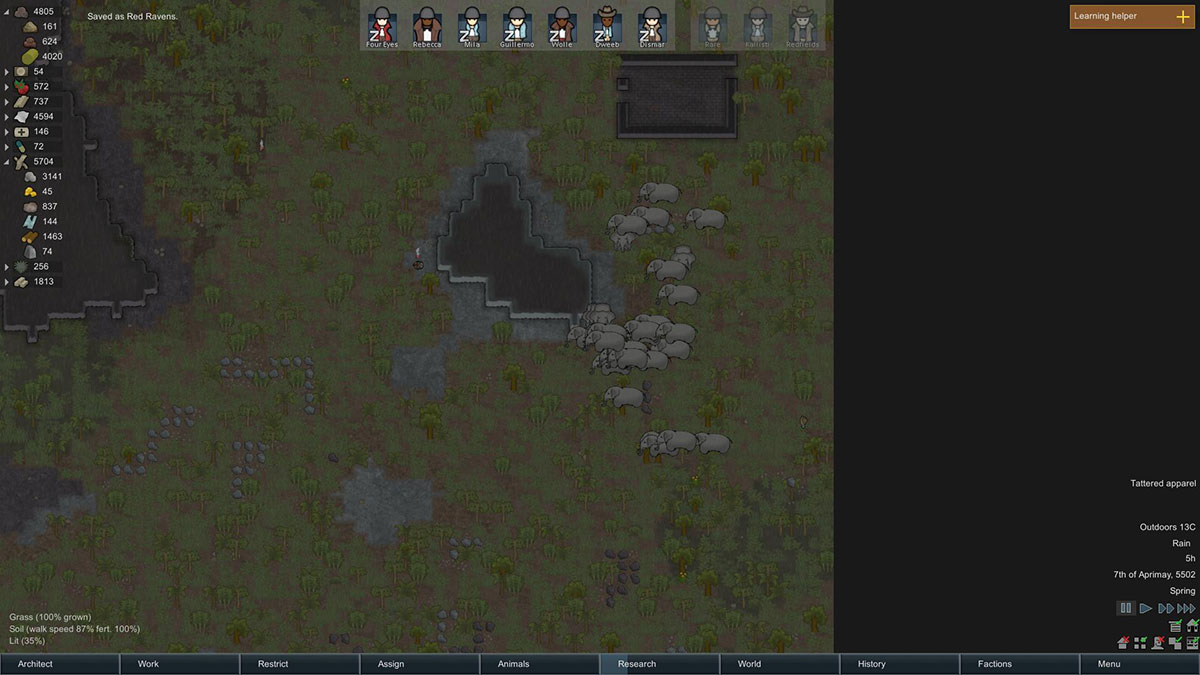
Looks like Elephant is back on the menu, boys!
One thing that I have quickly become inured to is the game’s meme aspect. In other words, I no longer have any idea how interesting a given story can even be anymore.
For example, a common occurrence is having your base attacked by raiders. After the battle, you will very quickly have a dead body problem. If you leave a dead body out, your colonists will get a morale penalty each time they look at it. So, one solution is dig a grave and dump the body inside.
Another solution is to butcher the body into piles of meat and human leather. Aside from cannibals, no one likes human meat, but you can create Kibble for your creatures out of it – much better to use that instead of animal meat, since the latter can be used to create better regular meals. Meanwhile, human leather can be fashioned into clothing and cowboy hats, and is apparently very fashionable.
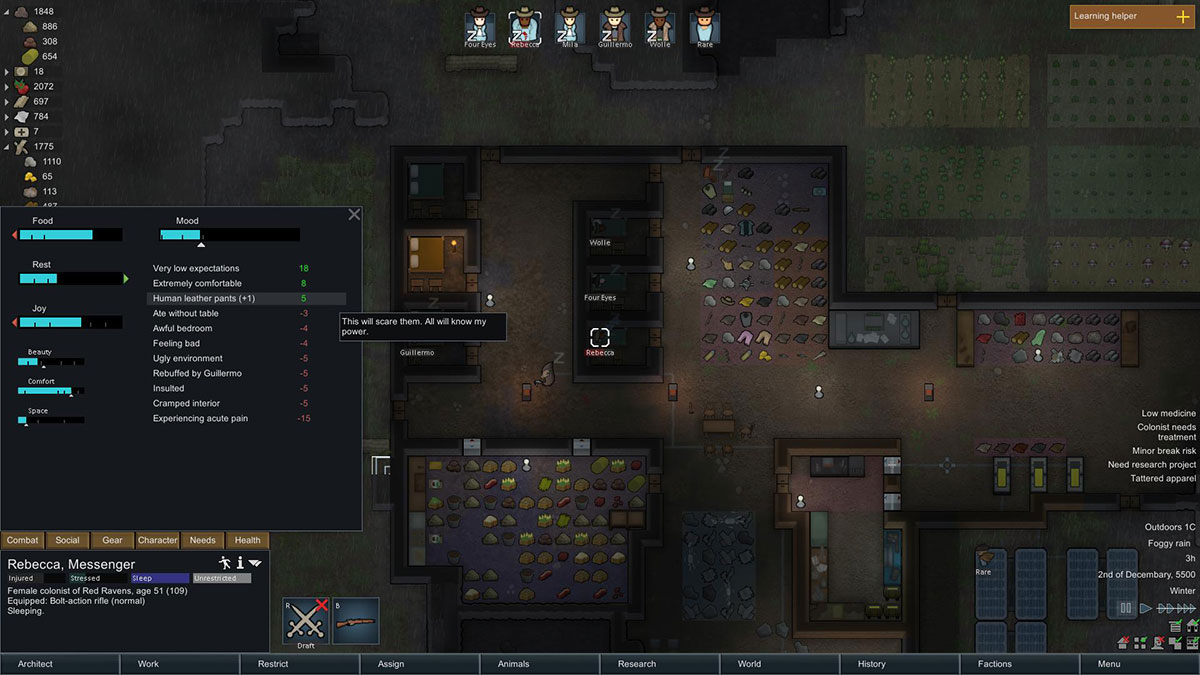
Human Leather pants are IN this year.
There are downsides, of course. The entire colony gets a morale debuff that lasts several days when a human body is butchered, and the actual butcher gets another debuff on top of that. In these situations, it’s helpful to have a Psychopath butcher, as they tend to be immune to these sort of penalties. Alternatively, you can simply increase the leisure hours of your colonists, and likely mitigate that sort of thing. Recreational drug use helps too.
Oh, and when you capture raiders alive, you can convert them into joining your colony. Or you can harvest their organs for later use and/or cash. And then turn their bodies into hats.
At some point though, the ridiculousness becomes rote. Sure, part of this is likely because of the difficulty level I chose, and the possibility of save scumming. But even in a complex emergent system, how many truly compelling narratives occur? It’s amusing the first time a colonist dies while trying to tame an Alpaca, but thereafter does angering a turkey hold the same amount of charm? It’s hard to tell anymore. And there can only be so many human hat stories.
In any case, I’m going to start over soon on a higher difficulty and see what happens. I will also try and investigate a few mods too, because there are some elements of the base game that are unfathomably dumb. The Research tab having zero useful information, for example, or the fact that I cannot mass-select my animals and designate them to a different Allowed Zone. There are workarounds the latter issue, as for many others, but it still feels kinda dumb.
 In An Age
Procedural Dilemma
Sep 27
Posted by Azuriel
One of the promises of procedural generation in gaming is that each experience will be unique, because it was randomly generated. The irony is that the opposite is almost always the case, as designers seem to lack the courage to commit. Or perhaps they recognize that true randomness makes for bad gameplay experiences and thus put in guardrails that render the “procedural” bits moot.
Both Starfield and No Man’s Sky feature procedurally generated planets with randomized terrain, resources, flora, and fauna. Both games allow you to land anywhere on a given planet. But neither1 game allows there to be nothing on it. There are desolate moons with no atmosphere, yes, but in both games there will be some Point of Interest (PoI) within 2 km of your landing location in any direction. Sometimes several. And the real kicker is that there are always more PoIs everywhere you look.
There is not one inch of the universe in these games that doesn’t already have monuments or outposts on it, and the ludonarrative dissonance of that fact is never resolved.
The dilemma is that true procedural generation probably leads to even worse outcomes.
Imagine that the next eight planets you land on have zero PoIs. No quest markers, no resources of note, no outposts, no nothing. How interested are you in landing on a ninth planet? Okay, but imagine you can use a scanner from orbit to determine there are no PoIs or whatever. So… the first eight planet scans come up with nothing, are you scanning the ninth planet? At some point players are going to want some indication of where the gameplay is located, so they know where to point their ship. Fine, scanners indicate one planet in this system has two “anomalies.” Great, let’s go check it out.
But hold up… what was the point of procedural generation in that scenario? There isn’t much of a practical difference between hand-crafted planets and procedurally-generated-as-interesting planets surrounded of hundreds of lifeless ones. Well, other than the fact that those random PoIs in the latter case better be damn interesting lest players get bored and bounce off your game due to bad RNG.
Minecraft comes up as an example of procedural generation done right, and I largely agree. However, it is “one world” and you are not expected to hop from one map to the next. The closest space game to resolve the dilemma for me has been Starbound + Frackin’ Universe mod – some planets had “dungeon” PoIs and/or NPCs and many did not. Each star system has at least one space station though, so it’s not completely random, but it’s very possible to, for example, land on a bunch of Eden planets or whatever and not find an exact configuration that you want for a base.
As I mentioned more than ten years ago (!!), procedural generation is the solution to exactly one problem: metagaming. If you don’t want a Youtube video detailing how to “get OP within the first 10 minutes of playing” your game, you need to randomize stuff. But a decade later, I think game designers have yet to fully complete the horseshoe of leaning all the way into procedural generation until you come right back around to hopping from a few hand-crafted planets and ignoring the vast reaches of uninteresting space.
Posted in Commentary, Philosophy
5 Comments
Tags: Game Design, No Man's Sky, procedurally-generated, RNG, Starfield