Blog Archives
Mobile Review: Slice & Dice
Slice & Dice is a F2Try dice-based roguelike. You can play the first 12 “levels” for free, but it costs $7 to unlock the rest of the game.
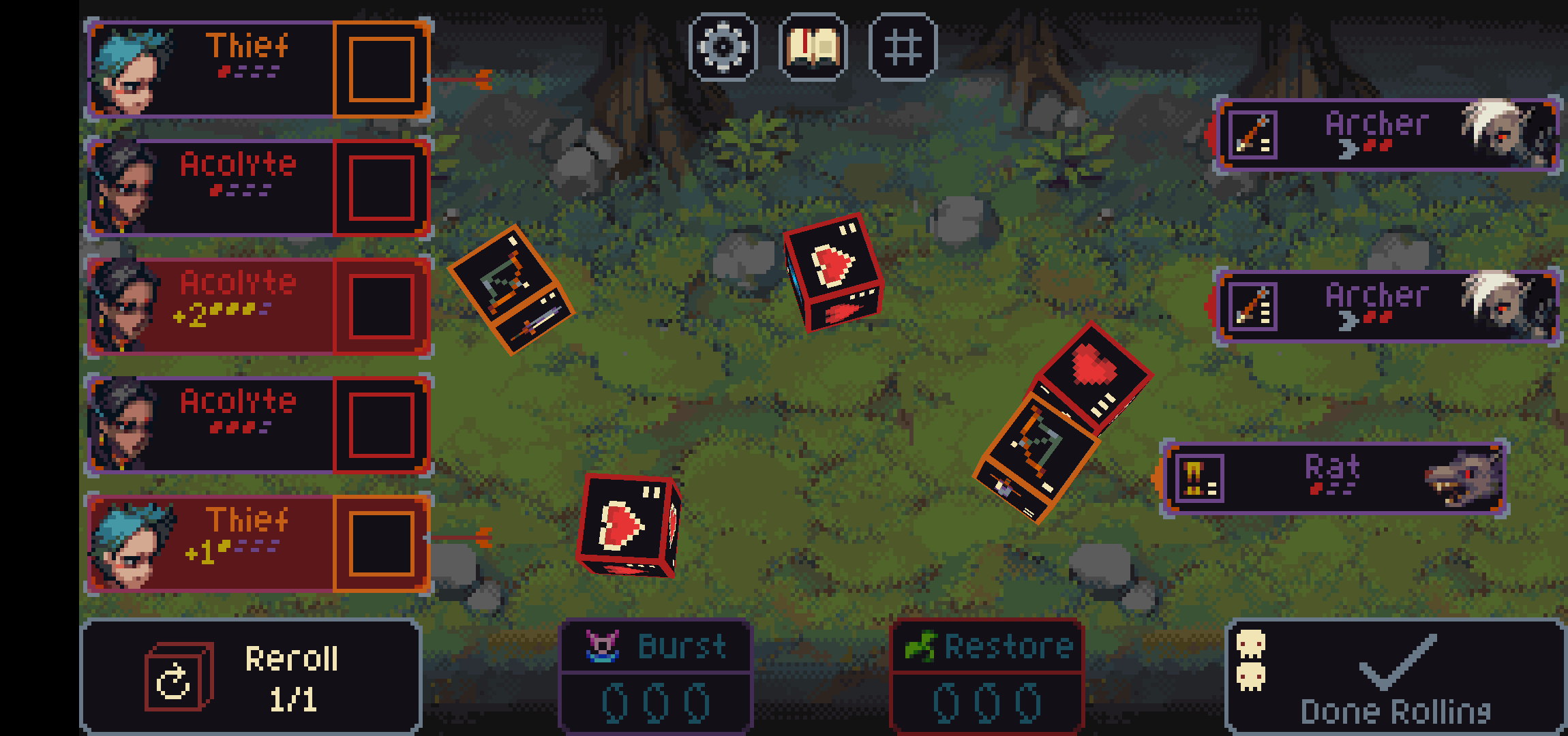
On the face of it (har har), the game appears relatively simple. By default, you control a party of five traditional archetypes – Rogue, Warrior, Defender, Healer, Mage – who face an assortment of enemies. Each round, enemies will roll their dice and indicate who they will be attacking, assuming they survive.
Then your team will roll one die per class. Each six-sided die has different abilities on it as determined by that die’s class and any modifications due to items. If you like a specific die roll, you can “save” it by tapping and then reroll any remaining dice up to two times. After all dice are locked in, you then can use the dice to attack enemies, shield your team, generate mana for Spells, or a number of other unique effects. Any surviving enemies will then attack back. Then everyone gets to do it again.
After each successful battle, surviving heroes are healed to full, any defeated heroes return to life at half-health, and there are alternating rewards of class promotion or random item selection. For class promotion, two heroes are randomly selected to get promoted to one randomly selected option, and you decide which one does. For example, you might be able to choose between your Rogue and Cleric getting promoted to a Tier 2 version of those classes, but not choose for the Warrior to be upgraded instead, or choose between the 5-6 Rogue options. Similarly, with item selection you can choose between two options or go for a mystery roll if neither one works well for your setup.

If that sounds like a lot of randomness, well… it is a dice-based game.
After I understood the general shtick of the game and saw what sort of boss battles were available, I started losing interest. The game seems a bit simple, right? Plus, winning didn’t really seem to offer much progression. But that was when I discovered the Achievements and other unlocks. Basically, the game has 40+ achievements that all unlock something when, uh, achieved. Most of the time these unlocks are additional items that get added to the pool for future runs, but other times there are additional difficulties and new game modes. For example, with Custom Party you can choose to bring 5 Mages or some other mix of heroes, and Shortcut lets you skip the first 8 levels (although you get random items and promotions). The unlocks themselves are not always worth it per se, but they provide something to work towards and potentially discover some fun along the way.
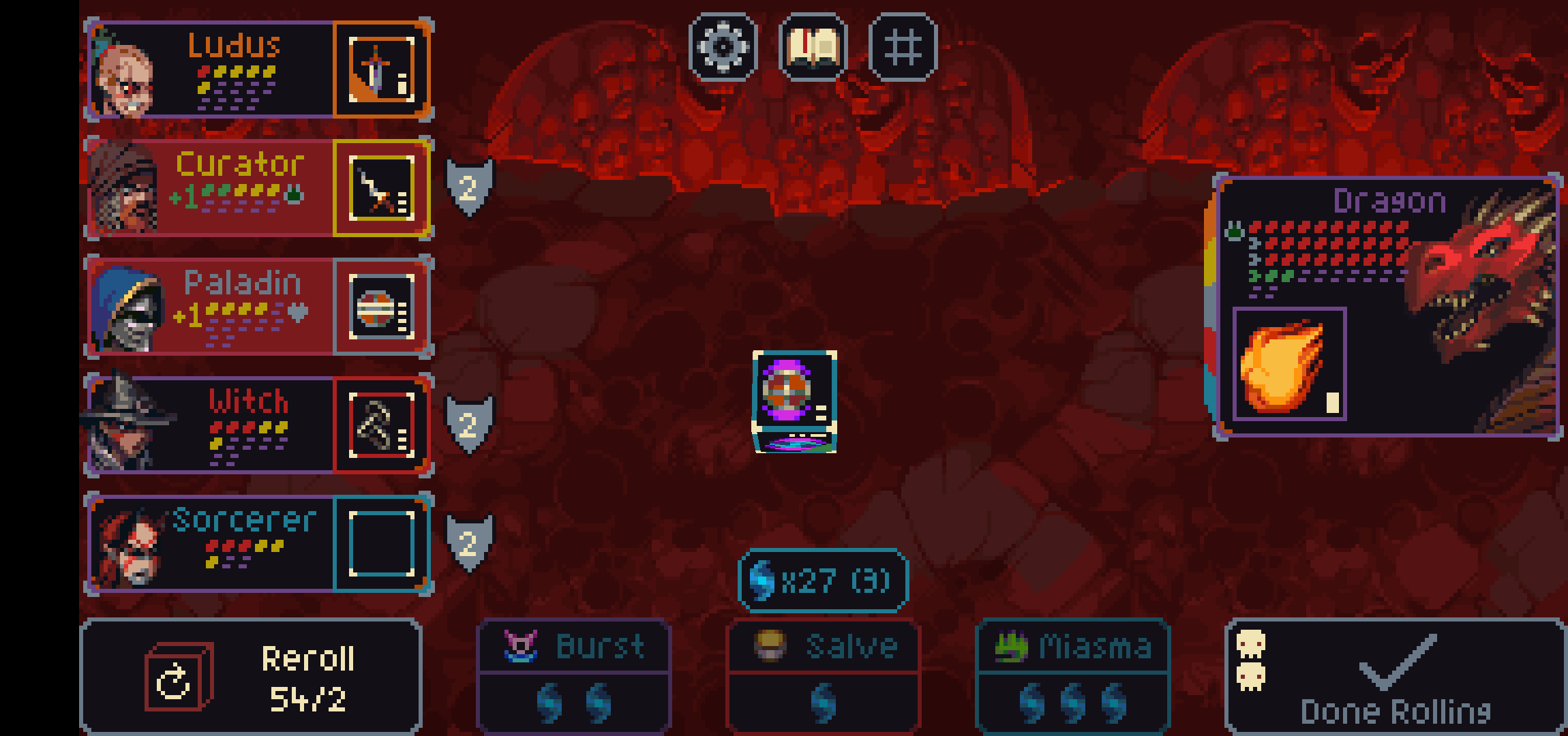
Notwithstanding the progression element, the game feels very satisfying to play in the moment. I often feel the pull of “just one more turn” given how many micro and macro decisions you end up needing to make. Is 2 damage good enough, or do you gamble on a 16.67% chance of getting a blank in order to hit something better? Should you focus-fire the big monster, or take out the small fry first? Do you blow all your mana on trying to save one hero this turn, or let them die to push more damage?
Overall, I am extremely pleased with my $7 purchase and probably have logged 30-40 hours thus far. One of the achievements to unlock Speed Run leaderboards is to win Standard mode in under 45 minutes, to give an idea of average successful run length. I also highly appreciate the fact that the game is short interval-friendly, e.g. there is no real-time component and you can minimize the app without messing anything up. It is no Slay the Spire, but it’s a game that has come closest to scratching the itch.


Vacation Over
Aug 31
Posted by Azuriel
I have survived another vacation.
As part of the packing for the trip, I brought the Switch 2, the Retroid Pocket 6, the RG35XXSP, and of course our phones. A full week away from my PC and typical setup would be a perfect use-case scenario for all these retro machines, right? And I would have been very happy to report how much use they had gotten given how much money was spent on their purchases.
…if I they had gotten much use.
In reality, what happened during the copious amount of downtime was… playing games on my phone. Specifically, a game called Slice & Dice, which I reviewed four years ago . It’s basically a dice-rolling roguelike where you have a selection of party members facing a variety of enemies, you have a choice between a few random items or class upgrade after each fight, and yeah, that’s basically it. I had “beaten” most everything a few years ago, but apparently the devs had released some more content since then, so I spent some considerable hours going through it again.
The other game I played the most of was actually Pokémon Pokopia on the Switch 2. This was purchased by my wife just prior to the trip, as she had a hankering for something similar to her Harvest Moon nostalgia of yore. To be clear, Pokopia is nothing like Harvest Moon, aside from the vibe. Anyway, I started up my own save – we have separate Switch profiles already – and played two longish sessions.
Pokopia a very weird game. You are actually a Ditto pokemon who becomes the image of the human you loved, in a sort of post-apocalyptic wasteland area devoid of both humans and pokemon, aside from a “professor”-looking one. Another pokemon appears in a near-death state (implied), you gain the ability to copy a sort of watering can-like ability to save them, and things start improving. As you heal the environment with the water, you can help start setting up specific pokemon habitats (four squares of tall grass, four squares of tall grass near a tree, etc) that will cause certain pokemon to spontaneously appear. The more pokemon, the more abilities you can copy, the more lively the world gets, the more building options open up, and so on and so forth.
The whole setup sorta reminded me of My Time at Portia, wherein there was certainly a cataclysmic event in the past that resulted in widespread death and destruction, but the event itself is not the focus. You can see the effects, but no one is especially dwelling on what was lost. That is a surprisingly ripe narrative juxtaposition, and I’m for it.
With Pokopia though, the childlike angle makes it particularly grim, IMO. The professor pokemon asks you to help restore the environment and destroyed human houses because, as evidenced by the returning pokemon, maybe the humans will come back too if only you restore their “habitat.” Maybe this will be played straight, with the humans emerging from underground bunkers or whatever once the entire wasteland is green once more or whatever. I could also imagine it not being directly resolved at all in a sort of Hachikō situation, because Japanese devs sometimes like crushing melancholy.
We shall see.
I did boot up the RP6 a few times, but only actually got into any games one time. I’ve talked about it before, but one of the problems with these retro machines is the fact that you have to be prepared to play them. In my case, that means headphones and the desire of solitude to put them on. For example, I got past the title screen of Final Fantasy Tactics and Chrono Trigger on two occasions, and turned them off because what is the point if you aren’t listening to the music too? It’s like eating without a sense of smell. Slice & Dice can easily be played without sound, turned off at a moment’s notice and easily gotten back into. These other games were never designed for quick, silent sessions.
Anyway, the two games on the RP6 I gave an honest college try with was Thomas Was Alone and Donut County. The former was utterly unplayable via GameNative despite being “compatible,” but the latter was perfectly fine. I got through some levels, which involves moving a hole around the map to swallow increasingly-large items, had some laughs at the dialog, and then turned it off. If shit really does hit the fan, I’ll be glad I can game on something that draws 6 watts instead of 600, but until then? Maybe not the most prudent purchases I have ever done.
I’m banking on Little Man eventually wanting his own console in his own room eventually, and maybe they’ll get a second (or first) life then.
Posted in Commentary
2 Comments
Tags: Little Man, Pokemon Pokopia, Retroid Pocket 6, Slice & Dice, Switch 2, Vacation