Blog Archives
Impressions: Slay the Spire 2
For something that only happened due to a coin flip, I’d say the folks at Mega Crit have scored another, ahem, mega crit with Slay the Spire 2. And this is with it being Early Access!
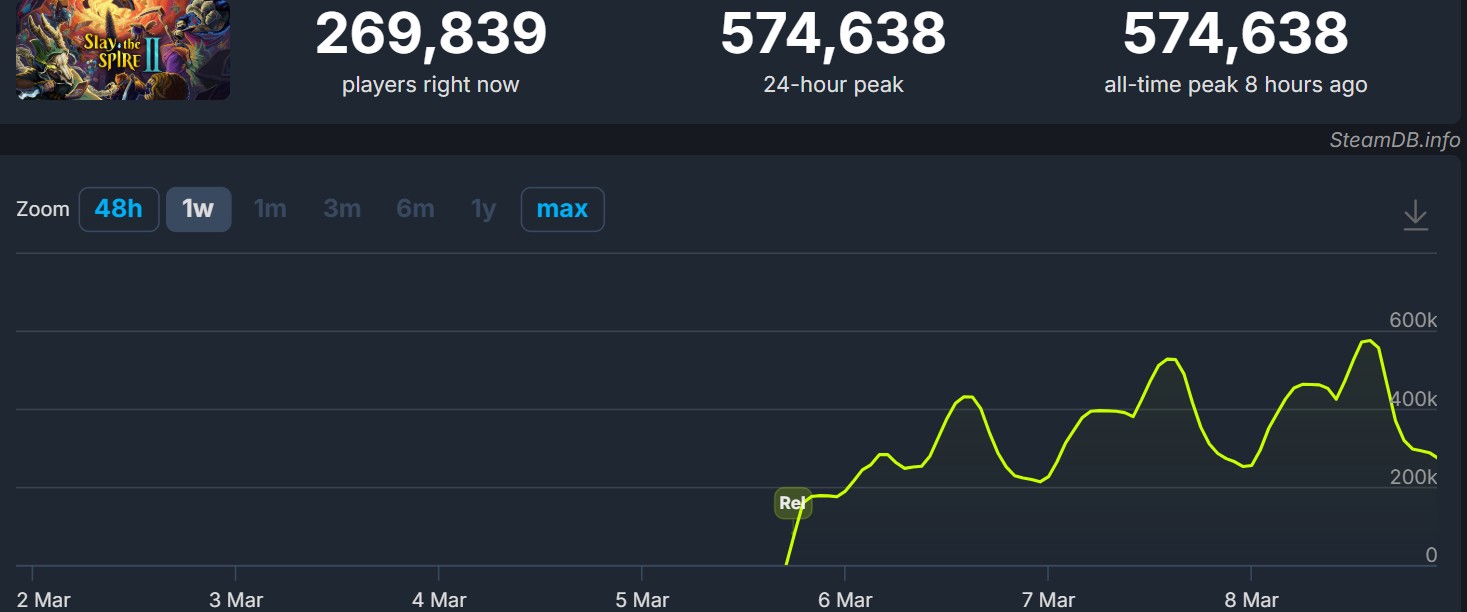
As a veteran of slain spires myself though – 235 hours in Steam, likely 4x on mobile, A20 clears on all characters – my first impressions over eight hours in the sequel has been… weird. Strange, even.
Perhaps I should say: whelmed. I am very, very whelmed.
For starters, three of the original classes have made a return, along with the majority of their original cards. On the one hand, this is good. Why mess with success, especially when the theming and power fantasies were such a hit the first time around? On the other hand, as an OG fan, a lot of the novelty is already pre-digested. There are certainly new cards, and some of the original cards have been tweaked in different ways. But things don’t quite hit the same walking into your first Silent run knowing that you’re going to see Shivs, Poison, and Discard as primary synergies.
The other off-putting things at the moment is balance. Now, this is literally the first few days of an Early Access launch, and there will likely be (bi)weekly balance passes for the next year or longer before StS2 hits 1.0. My concern at this stage though, is that things certainly feel tuned to the level of infinite and/or bomb combos. It was always fun to stumbled into good combos in the original game, but it never felt completely necessary outside of an A20 Heart run; you could still feel reasonably confident heading into most encounters with merely a pile of mostly-good cards. Here in the sequel though, the average (non-Ascension!) encounter will be ready to deal like 35 damage to you right off the bat.
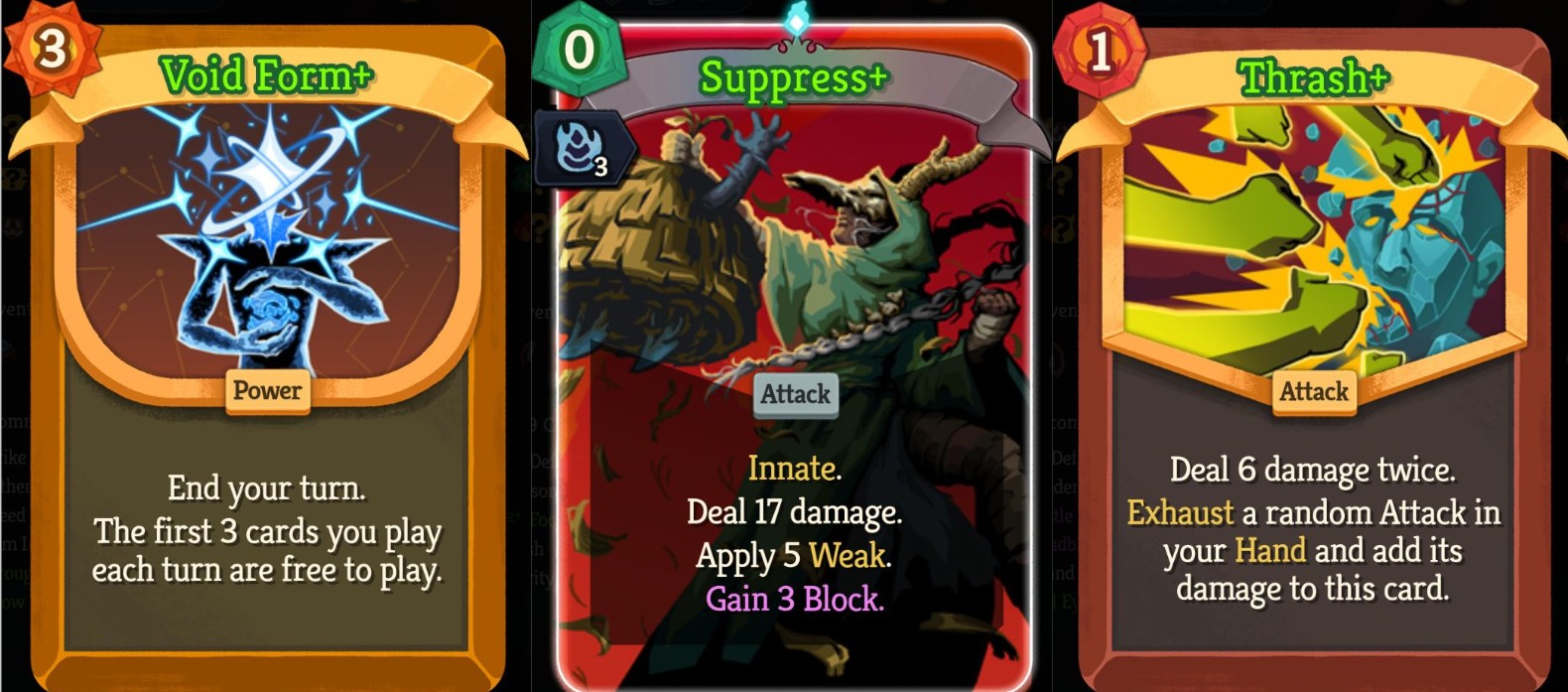
Again, we can imagine a world in which the devs tone down the overall enemy damage and player damage in tandem. But are they going to leave in the bombs? Look at Thrash+ in the picture above. By default, it will deal 6 + 6 damage, and then exhausts an Attack in hand. If that Attack was a standard Strike, not only is it doing you a favor by (temporarily) removing a bad card from your deck, the next time you draw Thrash+ you will be dealing 12 + 12 damage. Imagine instead it removed one that normally dealt 32 damage. How do you tone that down? Make Thrash deal 1 + 1 damage by default? Only add half the attack’s damage? It’s still a run-defining card.
…and maybe that’s OK? Getting the ole Corruption + Dead Branch was a (hilariously fun) run-defining combo in the original as well. All I’m saying is that I’ve scrubbed out on the first boss – and sometimes before then! – on some characters at zero Ascension by virtue of not seeing any bombs/combos. I’m just hoping that once things are tuned appropriately, the game doesn’t still feel so swingy.
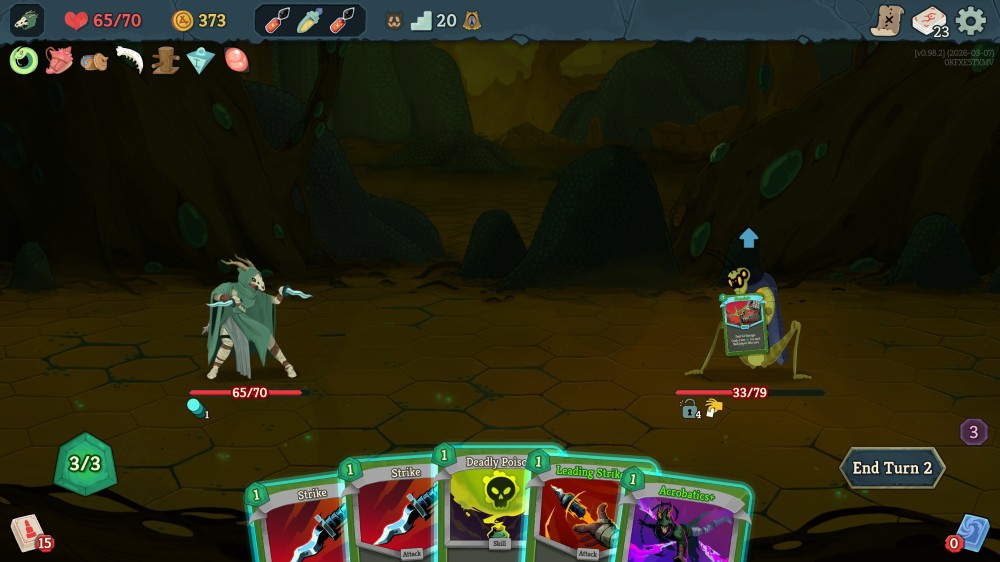
Aside from all that, the rest of the game looks very impressive. Some of the card art, in particular, is amazing. Unlocks are governed by an “Epoch” system which are basically achievements plus some worldbuilding elements. Speaking of worldbuilding… well… yeah. Less is more, and more is less. Some elements felt cool to read about (Silent taking back a piece of the Heart) and other bits kind of made the world feel less cool. I didn’t need to know the world is named Preon and is “that which tells stories,” for example. This could be placeholder text too, who knows.
Anyway, I suppose a lot has changed in the last eight years. Would Slay the Spire 2 have blown me away in 2018? Of course. Is it blowing me away right now? Ehh. I’ll do a few more runs with the characters that haven’t beaten Act 3 yet, and give the devs some more time to cook.
Time Deletion
Guys… I’m up to 77 hours in Mewgenics. It hasn’t even been two full weeks yet.
That’s not even the worst/best part: Slay the Spire 2 is hitting Early Access on March 5th. It has one of the best trailers I’ve ever seen for a roguelike deckbuilder:
Granted, I don’t really know of many other roguelike deckbuilding trailers.
In any case, yeah, pour one out for my gaming backlog. And frontlog, for that matter. I certainly haven’t been spending any time thinking about Expedition 33 (etc) in the last two weeks. Too busy drinking from the firehose. Perhaps I can circle back in April… no, let’s say May. End of Q2, for sure.
(Heh, I didn’t say of which year)
Balatro
If you haven’t heard about the latest indie darling, Balatro, let me tell you: it’s legit. Balatro is available on both Steam and now on mobile, the latter of which is what I recommend picking up, as there aren’t many non-exploitative mobile games out there.
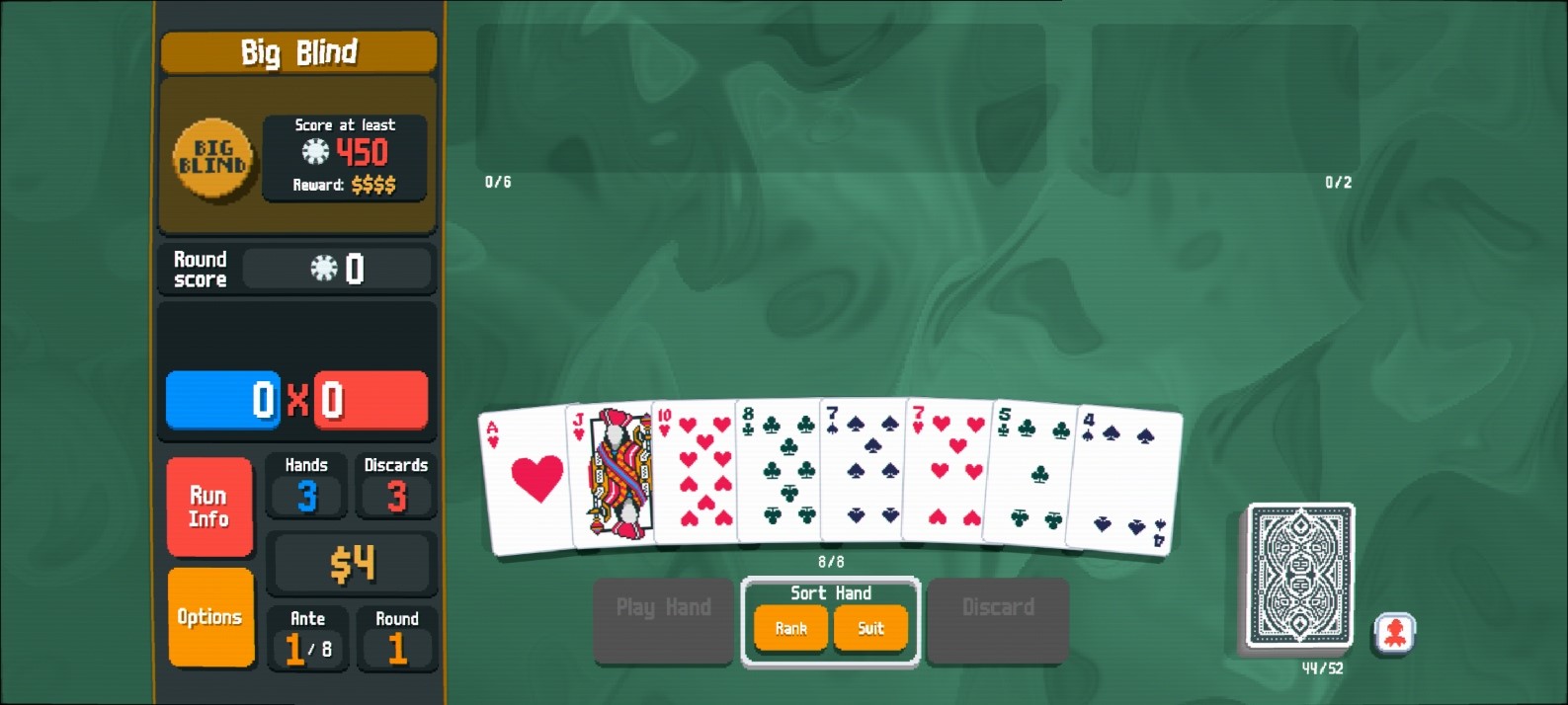
Fundamentally, Balatro is a deckbuilding roguelike based around making poker hands using a standard deck of cards. Your overall goal is to clear eight “levels” (Antes) that consist of three “battles” (Blinds) apiece, one of which is a boss that has negative modifiers. Battles are won by exceeding a score (Chips), which is generated based on the poker hands you play… plus any modifiers. For example, let’s say you have two pairs: a pair of Queens and a pair of 5s. A two pair hand is worth 20 Chips x 2 multiplier by itself. You then add the face value of the cards used to the Chip value, so it ends up being 50 x 2, or 100 Chips. The very first Blind requires 300 Chips or more to beat, so you would be well on your way to success there. Under normal settings, you get to play a total of 4 hands to beat the Blind, and get a total of 4 discards (up to 5 cards each time) in order to make said hands.
Winning battles gives you a base level of money ($3-$5) with bonuses based on unused hands remaining and “interest” on unused cash from prior rounds. You use this money in-between rounds in a shop phase that lets you purchase various things.
The twist with the game comes from the modifiers available.
The Jokers are the most famous elements of the game, and they truly run the gamut. The most basic Joker grants you +4 to your multiplier; if we had that with our earlier two pair hand, the Chips score would have been 300 by itself (50 x 6). Some Jokers give you a scaling buff, some revolve around increasing your economy, some focus on enhancing specific suits or poker hands, some give bonuses to other Jokers, and so on. You get to equip up to five Jokers under default settings. Then there are Planet cards. These are consumables that permanently (for this run) upgrade the scoring of poker hands. Then there are Tarot cards, which are consumables that do a bunch of different things, including giving you more Tarot cards, more Planet cards, changing the suits of specific cards, etc. Oh, and the deck of cards itself can be enhanced or augmented to a variety of ways – cards can be deleted, added, changed to give +4 multiplier when scored, give more points when not played, etc. etc.

As you can probably tell, the dopamine hits come from the combination of regular poker RNG along with Joker RNG, boss RNG, shop RNG, and generally shenanigan RNG. You could be just scraping by, hit an amazing shop, and walk into the next round flush with cash and scaling Jokers. You could be breezing through the game and then hit a boss modifier like “Diamonds are debuffed” and do a ShockedPikachu.jpg when your “turned all the cards into Diamonds” deck is shafted. And, yeah, while I mentioned the word RNG a bunch previously, at the end of the day it is still about poker – there are strategies and probabilities that you can leverage to improve your expected outcomes.
Perhaps the best part of Balatro is the simple fact that it is a complete experience. There are no micro-transactions, no DLC, no real-world money intervention. I purchased it from Google Play for $10 and that’s that. Overall, I would still claim Slay the Spire to be the best deckbuilding roguelike, but Balatro certainly jumped out of nowhere to land in the top-5, if not second place. Not bad for a 1-man team.
Impressions: Against the Storm
Against the Storm (AtS) is a roguelike city-builder, and may very well be the first of its kind. Each game feels like the early to midgame turns of a Civilization match as you explore the foggy forest in pursuit of randomized resources that will force you to adapt your builds in new ways every time. And right as the combination of production synergies and passive abilities make your base amazing… the match is over, and you prepare to do it all over again somewhere else.

Random really is the name of the game. The win condition is raising your Reputation bar to maximum before the Queen’s Ire bar fills up. To raise your Reputation, you complete randomized Orders (quests), solve randomized Events/Caches strewn in glades on the map, leverage randomized Cornerstone abilities (passives), or raise the Resolve (happiness) meter of one or more of your races past a certain point to earn a steady trickle. You’ll do all of these things by collecting resources randomly distributed on the map, with buildings that were chosen from, you guessed it, a random assortment.
If all that randomness sounds a bit off-putting, well, it is. At first.
The genius of the game’s design is how it leans into adaptability. For example, if you wanted to make Beer, it’s very possible for there to be no Wheat on your map and no Farm building offered to grow Wheat. That sucks. But Beer can be made from Wheat or Roots. Or maybe you get offered a series of choices that leads you towards Wine or something else instead, which you trade for Wheat. Damn near every production building in the game has 3+ alternative inputs available, and since some buildings are more efficient than others, you are passively steered in certain directions that might be out of your comfort zone. I’ve had maps where I was just never offered something fundamental, like Planks or complex foods, and had to radically alter my gameplan to survive.
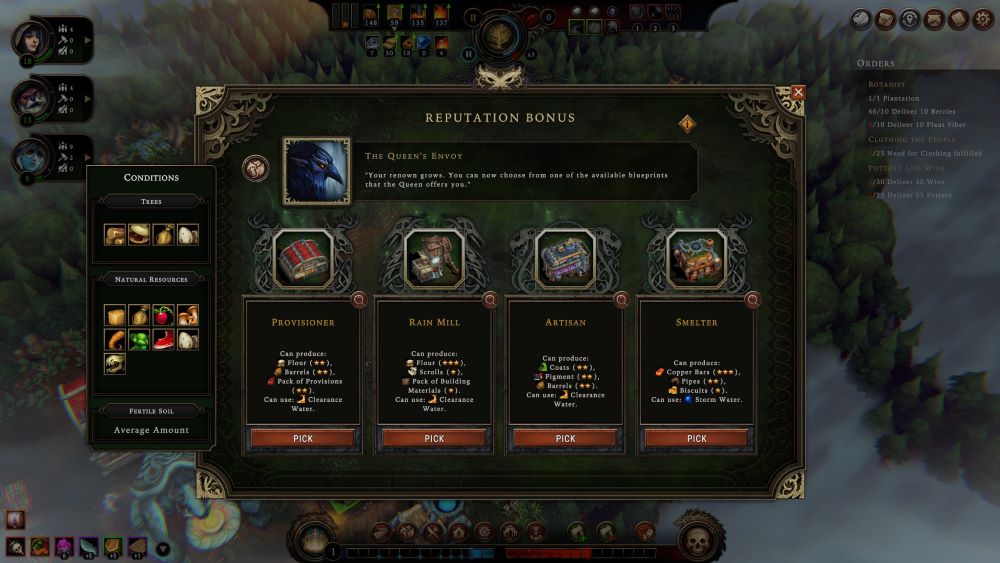
Remember Sid Meier saying games are a series of interesting decisions? That’s Against the Storm.
Successfully completing a map gains you progression currency you spend unlocking passive bonuses and other goodies back at the Smoldering City. After that, it is back to the world map and selecting the next hex to tackle. Each possible biome has a general theme and resources that appear more frequently. Select your randomized starting party, add some specific resources of your choosing, and then spend the next 5 minutes with the game paused to study the randomized buffs/debuffs you have received, and choose your randomized starting three building blueprints. You will repeat this cycle 5-6 times until the entire world gets reset (except for meta-progression) and you start everything again.
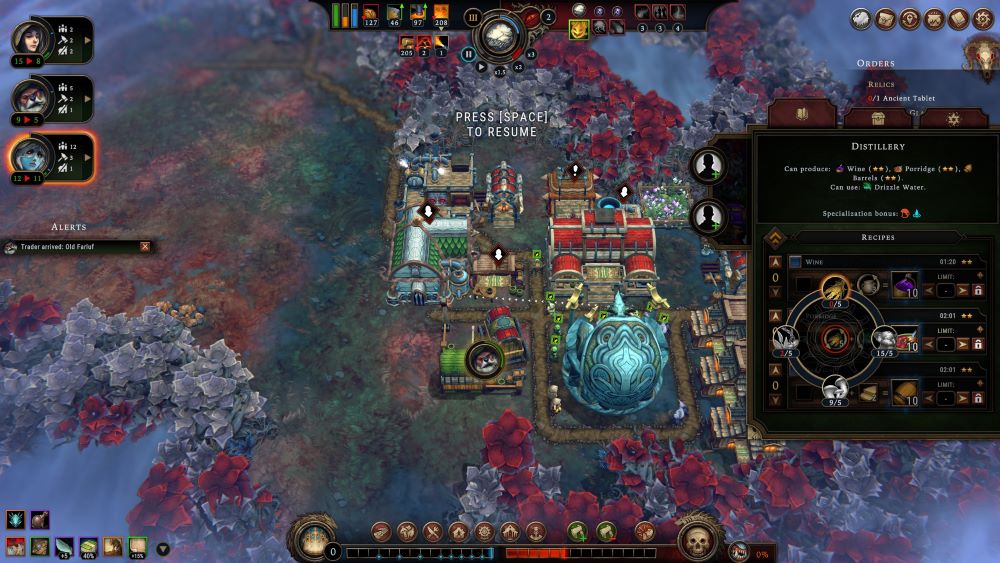
It is worth noting here that I don’t actually like city-builders all that much. I played SimCity 2000 for hundreds of hours ages ago and Frostpunk was okay, but I’m not especially a fan of games where you alternate between Pause and 3x speed. AtS is especially egregious in this regard because of all the interlocking parts with production buildings and various, randomized resources. That very randomness though, is precisely what has kept be playing for the last 25 hours – specifically the desire to optimize the madness. Each map will take you 1.5-2 hours to beat and then you are given a clean slate, so don’t come in thinking you will be making a self-sustaining colony or anything.
Overall, I am very impressed.
The game is starting to wind down for me though, as I have noticed my desire to win just for the upgrade currency to unlock new passives… that will make wining again easier. The offset for that are higher difficulties, including “Prestige” (aka Ascension) ranks that have ever-increasing maluses, but that’s not exactly what I’m looking for. And if I was, I would just play Slay the Spire.
Impressions: Arcanium
Arcanium is a lane-based, multi-character deckbuilding roguelike. You control the actions of three different furry characters with their own distinct card pools, passive abilities, and equipment. There are always three different enemies in the opposing lanes, although you can spend resources to get them to retarget other lanes (Taunt cards) or swap lanes with your own characters to distribute damage and/or fire off attacks. Defeating foes grants you rewards, new cards to add to your deck, and all the sort of things you would expect from a deckbuilding roguelike.
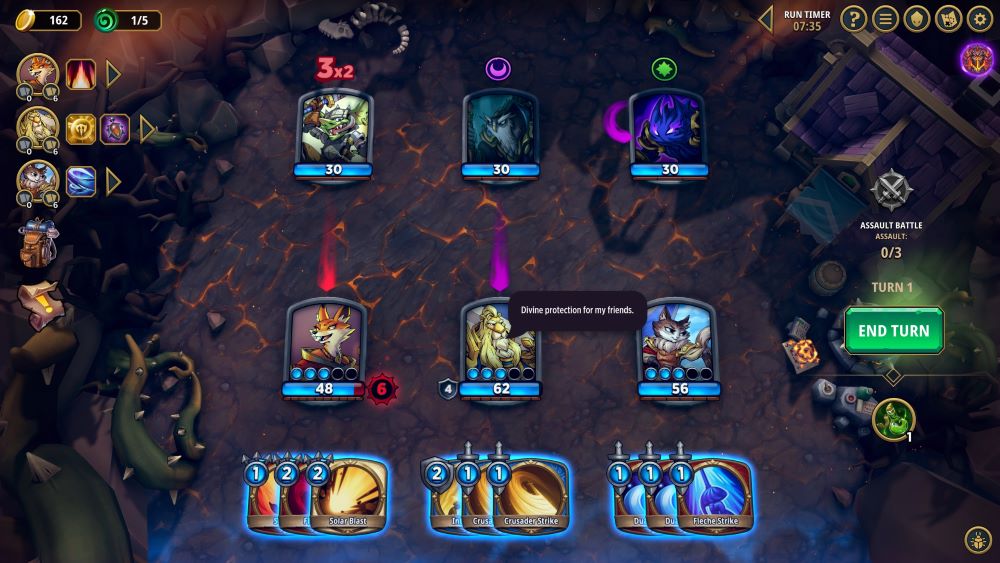
And, uh… that basically sums it all up.
I’ve played a lot of deckbuilding roguelikes over the years and Arcanium is OK. Fine, even. What it reminded me most of was Roguebook, in that you have multiple characters with their own decks, traverse a hex-based map trying to uncover new nodes, and there being incentives to maximize deck size. I also appreciate the new trend (?) for these games to allow banked energy – you start with 3/turn, but can carry up to 5 over to your next turn, if you don’t have a use for it. That part, along with the equipment, reminded me of Across the Obelisk.
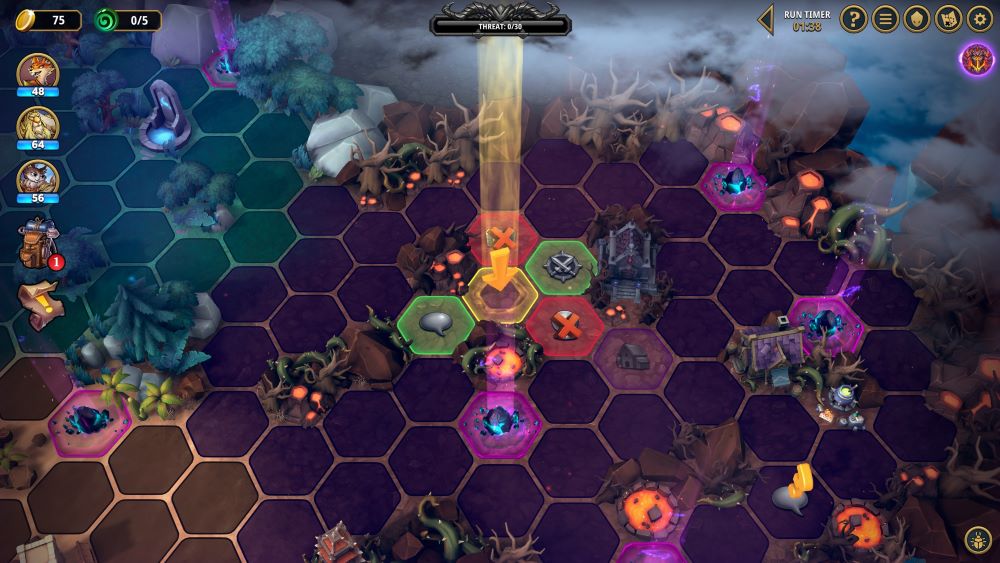
I do have some issues with the game, although they are difficult to articulate. For example, a lot of the enemies feel the same: they attack for X amount, deal a debuff, perform an area attack for Y amount, or gain armor. That sort of reductionism can be made for Slay the Spire too, right? Perhaps it feels worse in Arcanium due to the lane-based nature of the game. After all, enemies always target down their lane, and you cannot target things more than one lane away.
Another issue I have is that the sort of highest-difficulty fights reward you with Heirloom Equipment, which are character-specific items that synergize with their passive abilities/cards in various ways. Getting all three characters their Heirlooms is very important… but once that’s done, those hard battles thereafter become mostly pointless, as you’d rather get regular equipment for the other slots. Technically you get an already-upgraded card choice from the rewards and closer to unlocking character upgrades (more energy/cards per turn), but again, it just feels bad doing these fights with the Heirlooms being wasted. I wish there was a way to scrap them or trade for regular equipment.
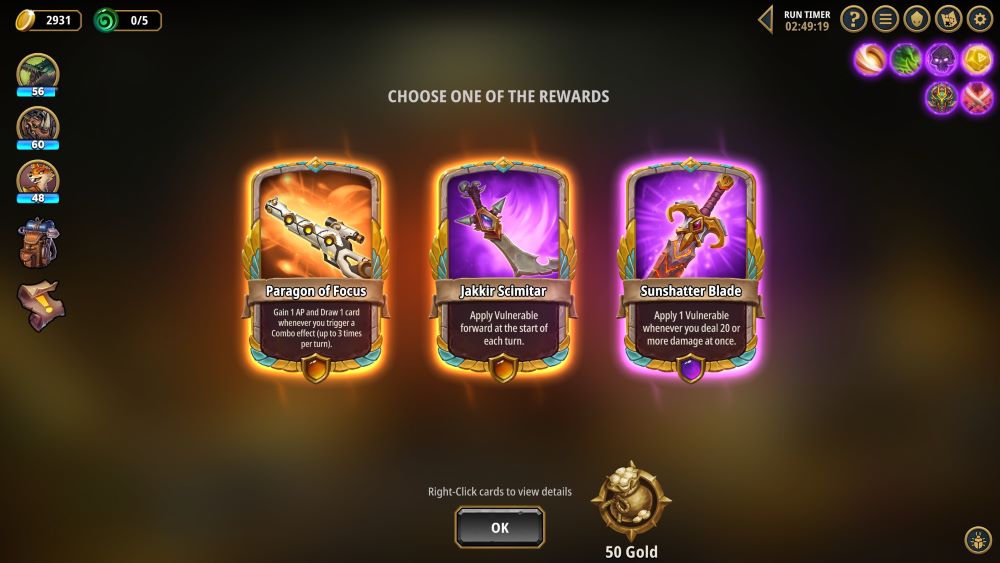
Overall, Arcanium is a perfectly serviceable deckbuilding roguelike. Unlocking new characters by doing specific things during each run feels rewarding, and cards are similarly unlocked and added to the pool all the time. Each character and their card pools feels unique, and you can be rewarded for discovering synergies between them. Having said that, I have played Arcanium for 15 hours and feel like I’ve seen all that I want to, whereas most deckbuilders taper off after 40 hours for me. Take that for what you will.
Impressions: Across the Obelisk
Across the Obelisk is a chunky deck-building roguelike that has a lot of overlapping mechanics that… mostly work together.
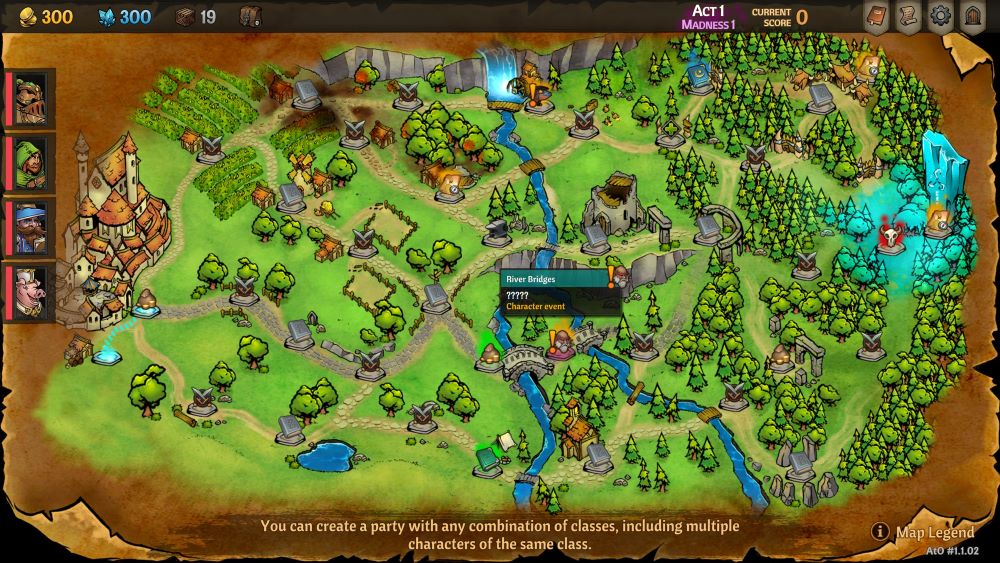
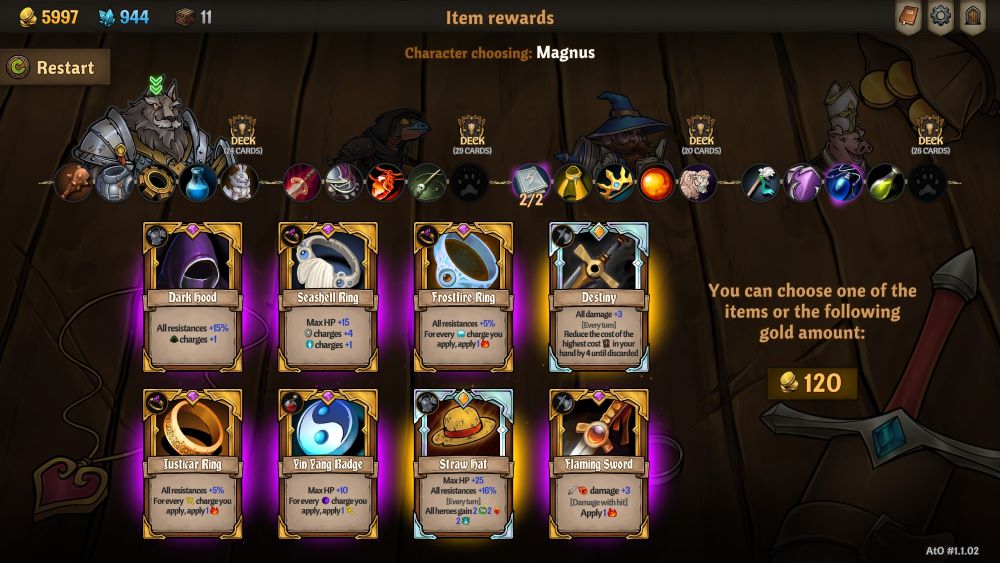
You control four characters each with their own decks. By default, these characters are a warrior, ranger, mage, and cleric, and all have their own unique card pools. Additionally, each character has four equipment slots (and one pet slot) that can be filled with a wide assortment of gear. Additionally additionally, each character can level up five times, getting a binary choice of abilities unique to that specific character (e.g. the four warriors each have different choices). Additionally additionally additionally, you earn Perk points across all characters that allows you more customization options in the form of +1 bonuses to various stats.
Oh, and you accumulate “Supplies” that let’s you upgrade the towns at the beginning of each map. And maps have various lanes and encounters and character unlocks and secrets and general themes.
Like I said, there’s a lot going on.
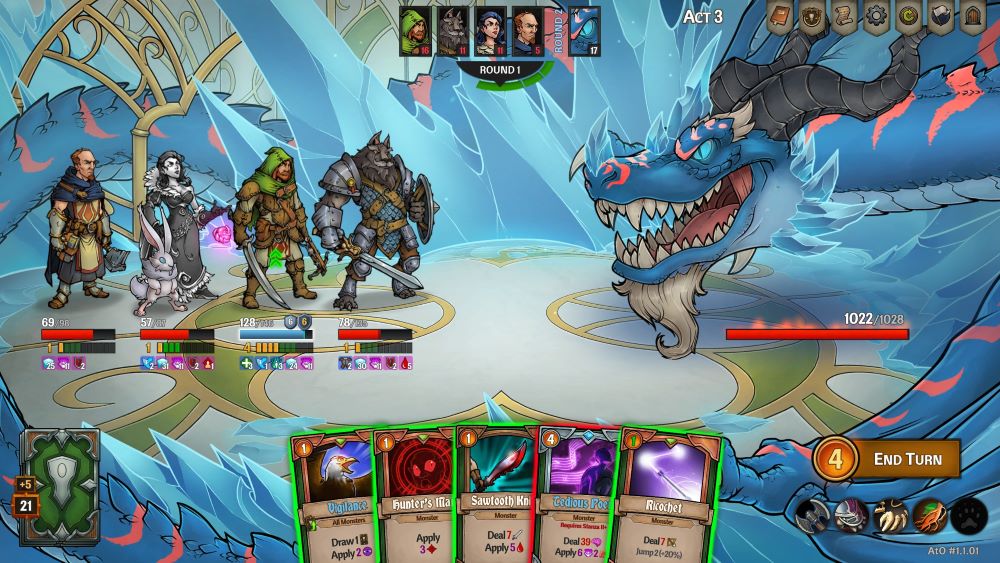
The problem, 25 hours in, is an understanding that a lot of the game just doesn’t matter. In Slay the Spire, you always go first and can see what the enemy is going to do. In this game, enemy actions are hidden by default – you have to debuff them with certain cards to temporarily see – and turns are based on the speed stat… which can be buffed or debuffed. So sometimes the enemy will just do things to your team without you knowing what’s going on. Like all deck-building games though, sometimes you can’t do anything even if you do know what’s coming due to the cards drawn.
Another issue I have is how often what the card says doesn’t matter. Characters have resistances to the various damage types in the game, and it’s often a fact that enemies get 60% resistance or higher. When I first unlocked a high-cost card that said “Deal 60 damage” I was excited… only to find that it actually deals like 20. The game calculates it for you so there’s no surprises, but nevertheless this funnels all successful strategies towards stacking debuffs (which typically lower resistances as a bonus). Which is whatever I guess… until you face enemies immune to that debuff, or can self-dispel, or can transfer (!!) the debuffs back your way. Most of the time, whether a given enemy can do this will be a complete surprise. Fun times.
Ultimately, I’m finding the game plenty compelling in an almost unhealthy way. Each run makes the next one that much easier, which is good, but this also means you are set up to fail the first dozen or so runs. I like how you can end up crafting a lot of your favorite cards right at the beginning of the game and thinning your deck out so there is less ramp-up. Figuring out synergies between the classes feels satisfying, and unlocking characters can lead to new ways of playing based on their unique talents.
But if you aren’t into deck-builders, this certainly isn’t going to get you onboard. Not only is there a lot of RNG – moreso than normal deck-builders – each run takes several hours between having to coordinate four different decks and equipment and upgrades and so on.
Impressions: Sigil of the Magi
Sigil of the Magi is a deck-building roguelike ala Slay the Spire with some Into the Breach vibes. It is currently in Early Access, and I was given an early peak by way of a review copy.
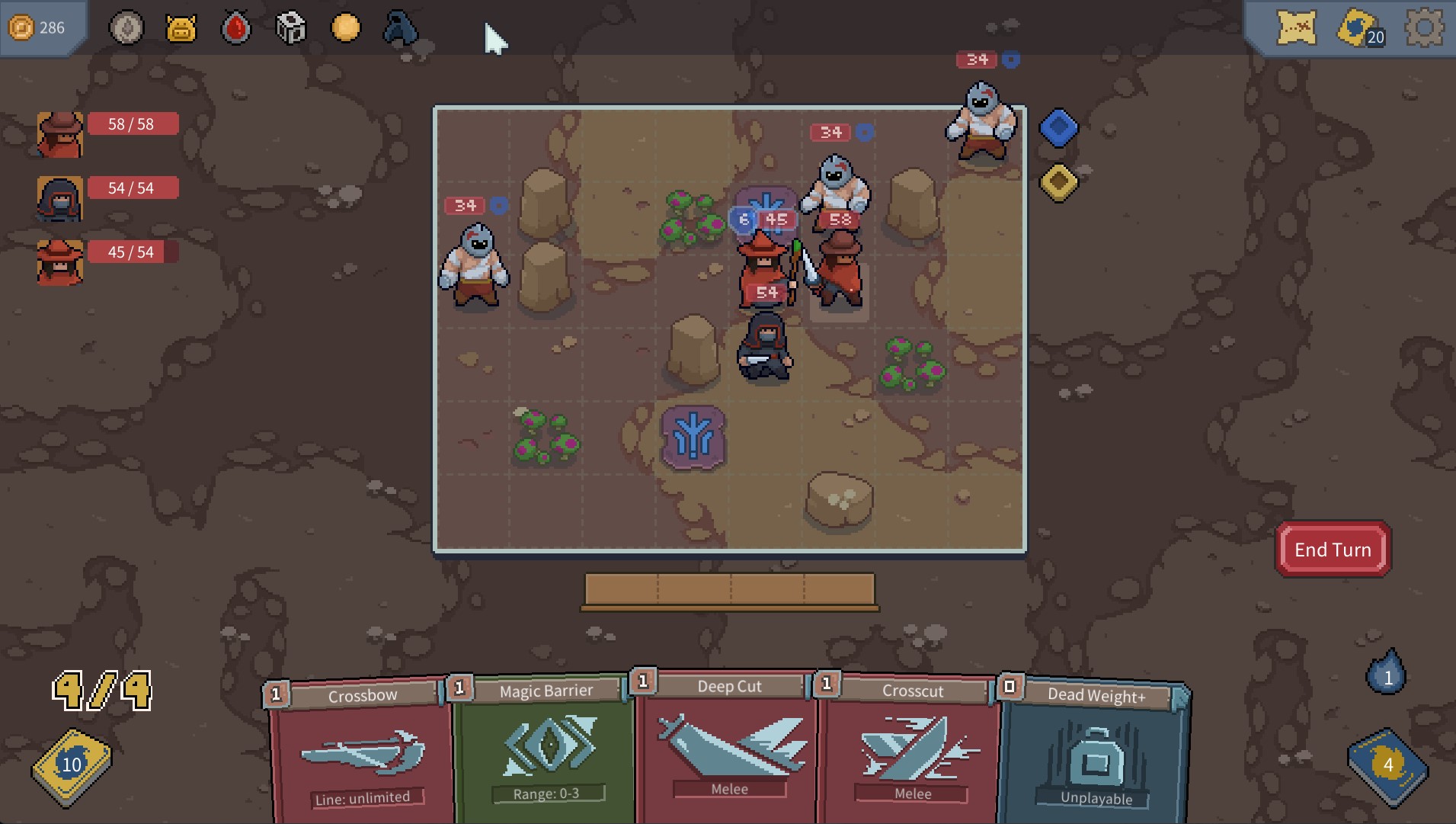
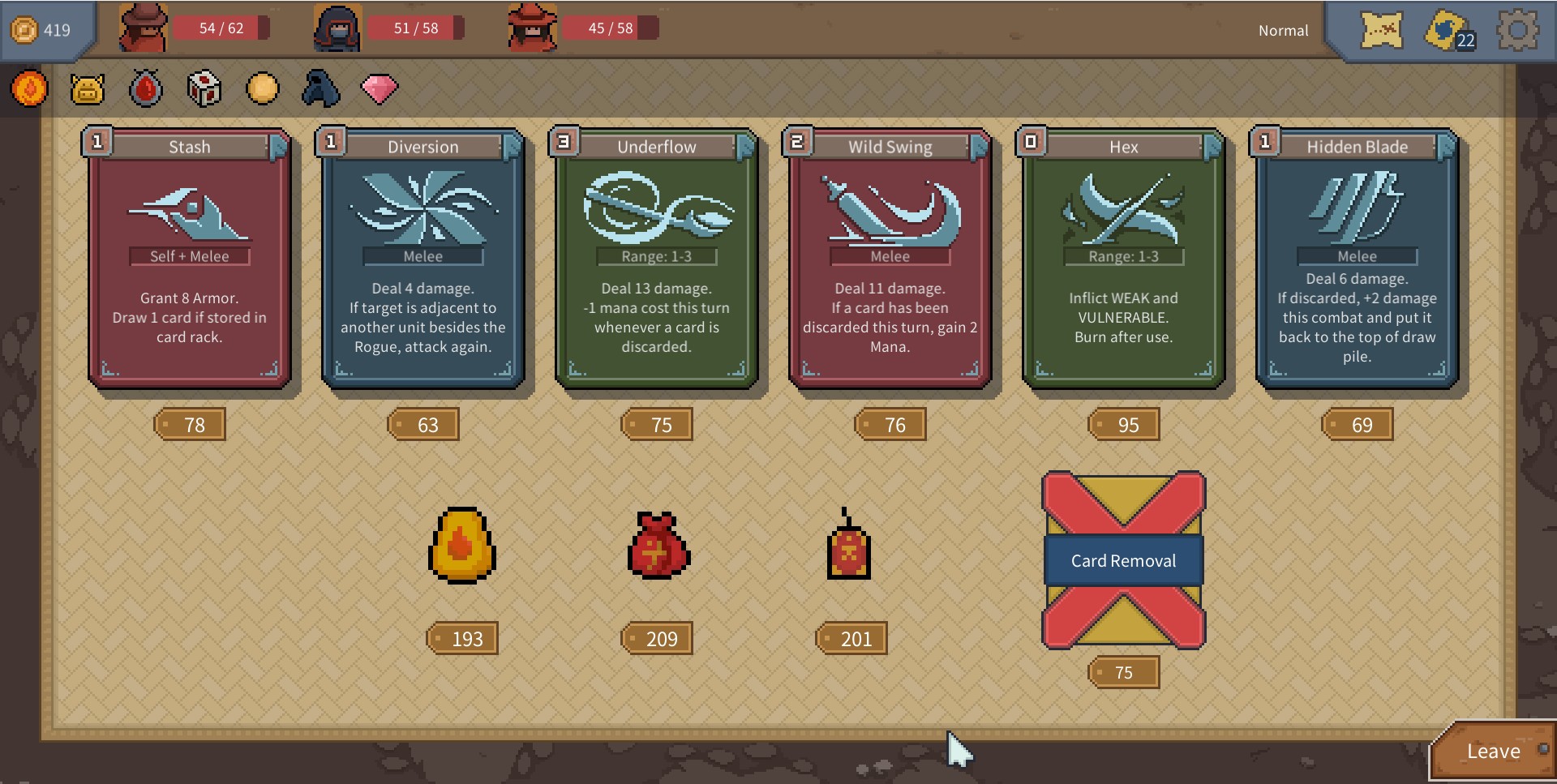
The Slay the Spire influences are front and center with the types of cards available, the pathways, and especially the shops. Basically, if you are at all familiar with Slay the Spire, chances are good that you will immediately recognize which cards are going to be good, which ones are noob traps, and what “relics” are going to pull their weight through a run.
That said, Sigil of the Magi does have a number of other interesting things going on.
First, you actually control a party of three separate characters, each with their own cards and card pools. Second, you literally control them in that you can move them around a very small map. While the UI needs some iteration to make things more clear, you can currently see what actions enemy units will take, and their attack preferences. That is where the Into the Breach vibes come in: if an enemy is set on attacking someone but you move all your characters out of range, the enemy will close the distance but then do nothing. Unfortunately, this sort of turn manipulation only goes so far, as enemies will settle for their 2nd or 3rd choice targets if they are within reach instead. Additionally, many of the enemies in the game have some sort of scaling mechanism that makes delay tactics unwise.
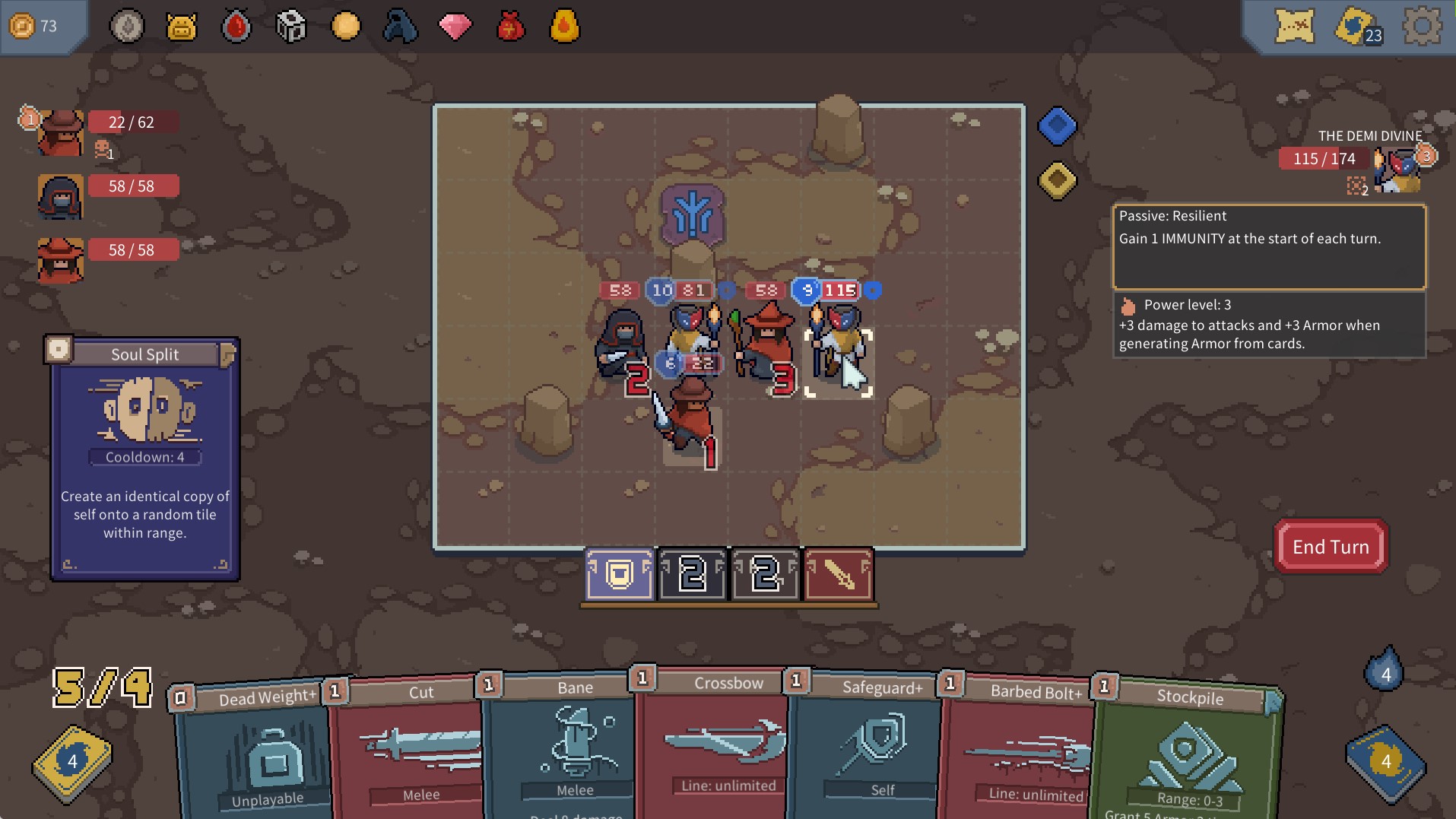
The third feature is what really sets Sigil of the Magi apart though: the Tray. This is a four-slot area under the map where you can pre-cast any card in hand for use in future turns. At first, this really just feels like a consolation prize for not being able to do much in the first turn of battle, before many of the enemies are within range. And since you only get 3 energy to play cards (at first), you typically don’t have anything left over to store for future turns once the melee is joined.
That said, the Tray becomes very interesting once you hit 4 energy and start getting cards that interact with it. For example, there is a card that give +4 Armor twice, but gets +1 Armor each time it is stored. Or maybe you get some discard synergies going, but don’t have a payoff card in hand, so you just bank the enabler. The cards in the Tray also are no longer in your deck when it is shuffled, so sometimes it might be worth keeping the generic damage cards in there to keep them out of your hand.
Is Sigil of the Magi good? Right now… kinda, sorta. The tough thing about Early Access for deck-building games is how so much hinges on card/enemy/relic balance, which can change at any time all the way past post-release. For example, right now, you have to choose a card after each combat encounter. This is literally the first deck-builder I have played that didn’t allow you to skip a card choice, and having to slot in whatever the least-bad, anti-synergy card you get offered feels like a punishment for winning battles. Is this an intentional design, like a sort of auto-difficulty balancing mechanism? I hope not. Conversely, abusing Taunt cards to force the end boss to skip all his mechanics and uselessly attack a very armored Knight was a lot of fun. Probably a bit imbalanced, but fun.
Overall, this is one game that I will keep an eye on as it makes its way through Early Access. The bones are good, and they definitely have things set up to allow for a lot of balancing methods. There are only two parties available at the moment, for example, but I can easily imagine varied combinations or even a sort of random mixing to add flavor to future runs. Plus, I really like the Tray conceptually.
We shall see how the balance goes though.
Mobile Review: Slice & Dice
Slice & Dice is a F2Try dice-based roguelike. You can play the first 12 “levels” for free, but it costs $7 to unlock the rest of the game.
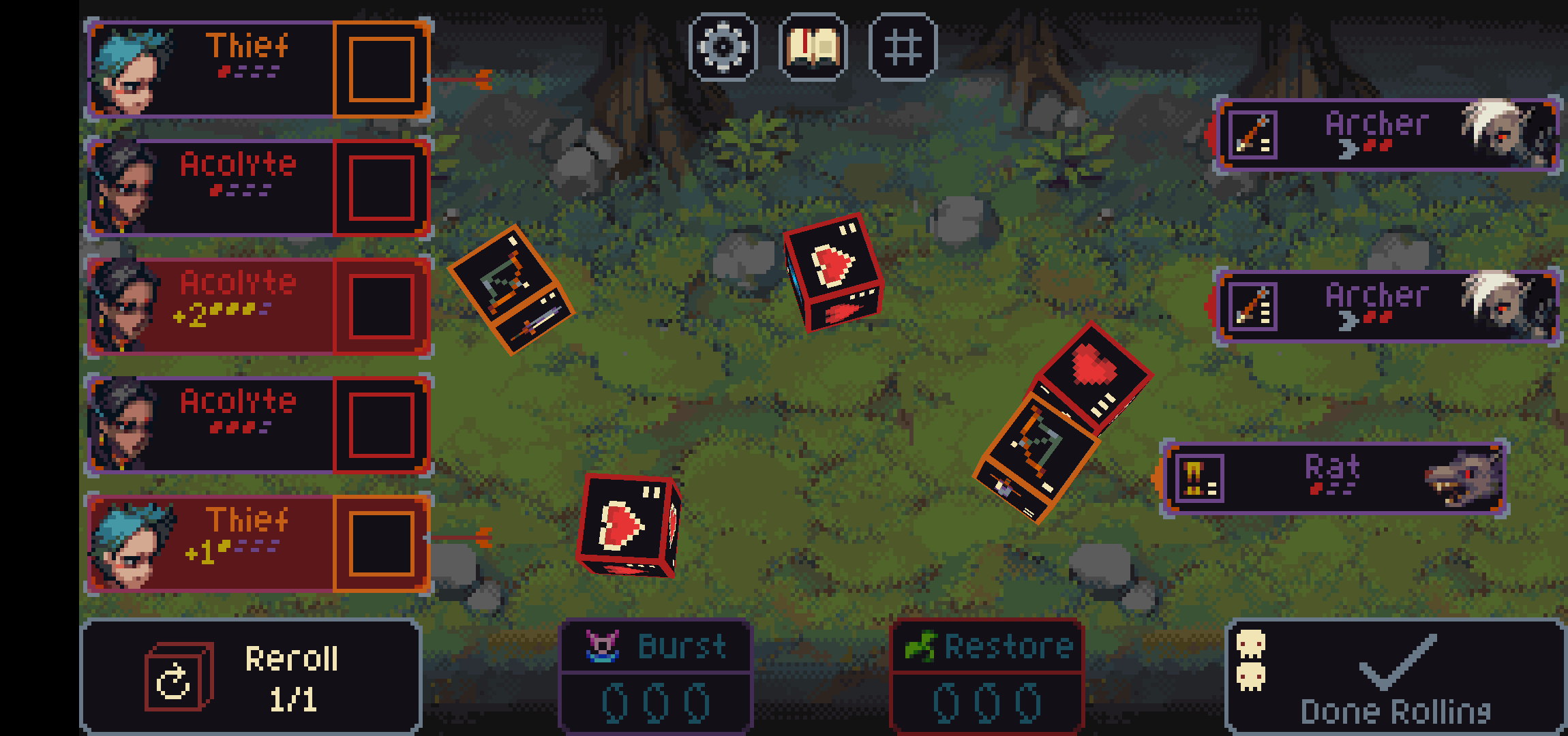
On the face of it (har har), the game appears relatively simple. By default, you control a party of five traditional archetypes – Rogue, Warrior, Defender, Healer, Mage – who face an assortment of enemies. Each round, enemies will roll their dice and indicate who they will be attacking, assuming they survive.
Then your team will roll one die per class. Each six-sided die has different abilities on it as determined by that die’s class and any modifications due to items. If you like a specific die roll, you can “save” it by tapping and then reroll any remaining dice up to two times. After all dice are locked in, you then can use the dice to attack enemies, shield your team, generate mana for Spells, or a number of other unique effects. Any surviving enemies will then attack back. Then everyone gets to do it again.
After each successful battle, surviving heroes are healed to full, any defeated heroes return to life at half-health, and there are alternating rewards of class promotion or random item selection. For class promotion, two heroes are randomly selected to get promoted to one randomly selected option, and you decide which one does. For example, you might be able to choose between your Rogue and Cleric getting promoted to a Tier 2 version of those classes, but not choose for the Warrior to be upgraded instead, or choose between the 5-6 Rogue options. Similarly, with item selection you can choose between two options or go for a mystery roll if neither one works well for your setup.

If that sounds like a lot of randomness, well… it is a dice-based game.
After I understood the general shtick of the game and saw what sort of boss battles were available, I started losing interest. The game seems a bit simple, right? Plus, winning didn’t really seem to offer much progression. But that was when I discovered the Achievements and other unlocks. Basically, the game has 40+ achievements that all unlock something when, uh, achieved. Most of the time these unlocks are additional items that get added to the pool for future runs, but other times there are additional difficulties and new game modes. For example, with Custom Party you can choose to bring 5 Mages or some other mix of heroes, and Shortcut lets you skip the first 8 levels (although you get random items and promotions). The unlocks themselves are not always worth it per se, but they provide something to work towards and potentially discover some fun along the way.
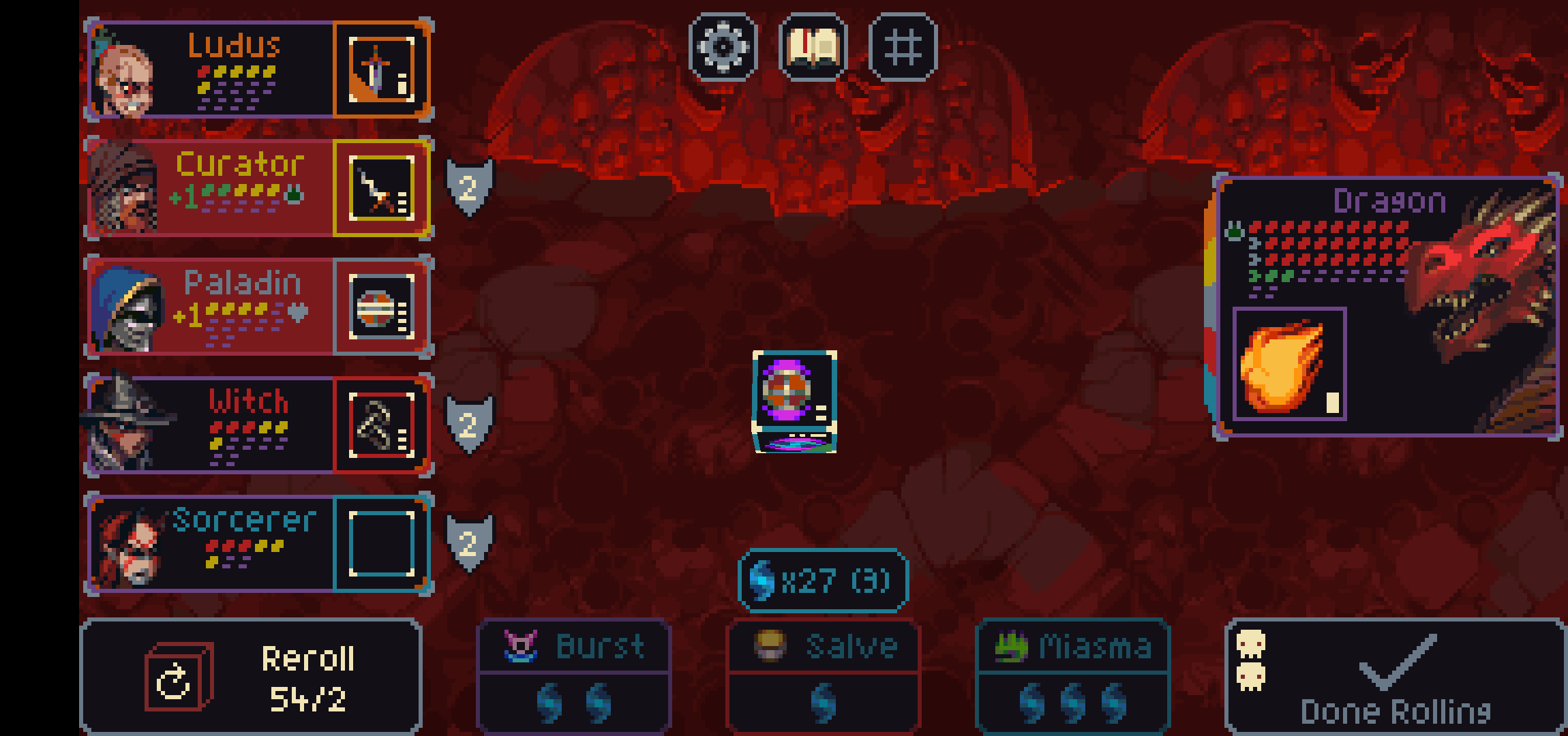
Notwithstanding the progression element, the game feels very satisfying to play in the moment. I often feel the pull of “just one more turn” given how many micro and macro decisions you end up needing to make. Is 2 damage good enough, or do you gamble on a 16.67% chance of getting a blank in order to hit something better? Should you focus-fire the big monster, or take out the small fry first? Do you blow all your mana on trying to save one hero this turn, or let them die to push more damage?
Overall, I am extremely pleased with my $7 purchase and probably have logged 30-40 hours thus far. One of the achievements to unlock Speed Run leaderboards is to win Standard mode in under 45 minutes, to give an idea of average successful run length. I also highly appreciate the fact that the game is short interval-friendly, e.g. there is no real-time component and you can minimize the app without messing anything up. It is no Slay the Spire, but it’s a game that has come closest to scratching the itch.
Impressions: Gordian Quest
Ever wonder what would happen if designers just added all the things to a game? Wonder no more.
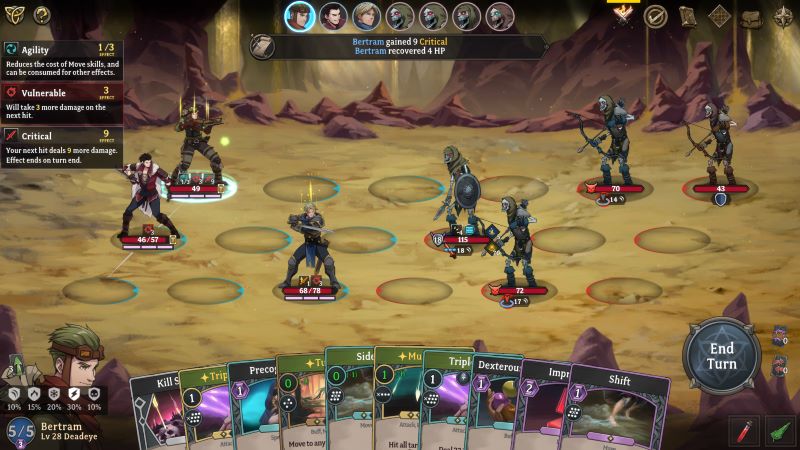
Gordian Quest is a sorta-roguelike tactical turn-based deck-building card game, with a full story campaign along with the more “traditional” roguelike modes. You control up to three characters with their own individual themed decks and battle enemies on a grid. Characters can also equip items that boost their stats or even add special cards into their decks. Those stats are important for the scaling of cards and also because there are D&D-esque skill checks occasionally. Also also, characters gain XP and level up, allowing them to place talent points on a customizable, randomized grid and expand in multiple directions. Have I mentioned there are 10 characters to choose from and each character has three distinct themes of cards that can be mixed and matched? And that items have rarity levels and randomized stats, with Legendary versions possibly opening new synergies? Oh, and items have rune slots too, which can be slotted with additional stats or special effects?
Like I said, the designers really went nuts with this one.
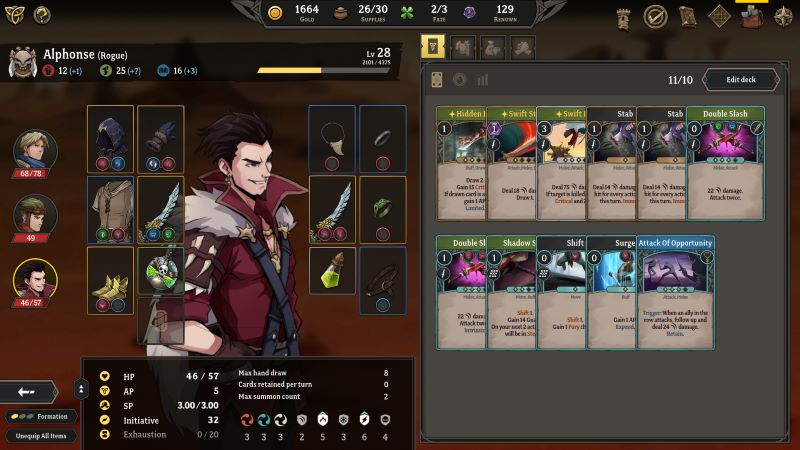
In reality, the game is mostly more coherent than I am implying. If you played Banners of Ruin, this game is basically that with some D&D and Card Hunter and FFX Sphere-Grid sprinkled in. Nothing stands out as being completely unnecessary while you’re playing, but just thinking about it now… goddamn is there a lot.
Is it fun? Yes. For a while.
Unfortunately, I basically broke the game before I finished Act 1 (of 4). Two of my characters are an archer and a rogue, with either one of them being capable of solo-murdering the entire enemy team on the first turn. If for some reason there is a straggler, the other one mops up. My third dude never actually gets to play cards at all, but if he did, he also is fairly stacked in the murder department. I had hoped that perhaps things would change once I hit Act 2 – maybe enemies would have a bunch more HP or have more Initiative to go first – but thus far that has not been the case. The only time enemies even get a turn is when they are bosses with literally 10-20x as many HP as normal, and even then they only ever get that one turn before getting melted.

The double-unfortunate thing is that breaking the game in this way was not particularly difficult. Part of that is undoubtedly due to my overall experience with deck-building games wherein winning strategies are roughly the same: prioritize increasing your per-turn draw, and keeping as few cards in your deck as possible. The other part though largely stems from what I imagine was a designer attempt at keeping things “balanced.” For example, the available talents are… boring. Even the ones all the way at the bottom of the tree. So I basically ignore all the Tier 3 talents and just pick the ones that grant +1 draw per turn and similar.
This “balance” extends to the three themes per character as well. My archer has Sharpshooter, Trapper, and Sentry schools of cards. Sharpshooter is all about damage. Trapper is about setting traps on enemy cells and cards that move enemies around (thereby forcing traps to trigger). Sentry is about setting up turrets on your side of the battlefield, boosting said turrets, and then letting them damage the enemy. You would be forgiven for assuming that Trapper and Sentry cards deal more overall damage, considering that that would make sense given the fact that they require setup. But… that’s not the case. Sharpshooter cards deal the same or more damage with no setup. And since 99% of the Trapper and Sentry cards are useless by themselves, you engineer your way to only choosing Sharpshooter cards when offered a choice, thereby increasing the average power level of your damage cards in a runaway feedback loop.

There is a bard character that is all about building up melody combos and essentially buffing the entire party so that they don’t need to worry about defense on their own turns. There is a warlock character that focuses on Bleed effects and debuffs. There is a golemancer that presumably mances golems. I haven’t even bothered trying those characters out because what’s the point? They would never get a turn. There are so many buffs, debuffs, tactical decisions, etc, that are entirely irrelevant in ways it seems impossible to make relevant without massive nerfs and a complete overhaul.
Sigh. Could this be solved by just avoiding the Archer and Rogue? Sorta. Although the Warrior and Cleric characters also have some gnarly damage cards/combos too. Could all this be addressed in a future patch? Maybe. If this was still Early Access, I would not be as concerned. Given that this is a full 1.0 release though, something tells me that they aren’t going to radically alter the way the card schools are entirely set up. And it is not as though higher difficulties can “solve” the issue either – cranking enemy HP higher and player damage lower is only going to make the currently non-viable (in comparison) strategies even more non-viable.
I suppose I will see if anything changes between now and the final boss. Assuming that I bring myself to slog through the rest of the game, like a Conquest victory in Civilization that was a forgone conclusion fifty turns ago.
Up until this point? Pretty fun though.
Review: Windbound
As a connoisseur of sorts for survival and roguelike games, I had a sideways eye out for the otherwise poorly-reviewed Windbound. After getting the itch to replay Raft only to realize there was a final update coming soon, I decided to play something a least thematically similar. Realizing I got Windbound for free from Epic back in February, I downloaded and booted it up and went sailing.
Overall? The mixed reviews are earned, although I enjoyed my own journey.
The essential premise is that you wake up on an island with nothing to your name, after being attacked by a sea creature. After swimming a short distance to another island, you set off to collect resources, build a boat, and ultimately activate three mysterious pillars scattered across your circular map so you can be transported to the next chapter area. You have a HP and Stamina bar, with the latter decreasing at intervals until you eat food from creatures loath to give you their flesh.
The game is… well, fundamentally really simple. Not easy, mind you, especially if you play on Survival Mode in which a single death means starting back over in Chapter 1 no matter how far you progressed. But there are not a whole lot of different enemy types, or food options, or tech trees, or similar fluff. Enemies have maybe 2-3 moves and become straight-forward to dispatch once you have learned the tells. Later on, you unlock additional combat moves, some of which become required to defeat later enemies, but overall ends up making most combat trivial.
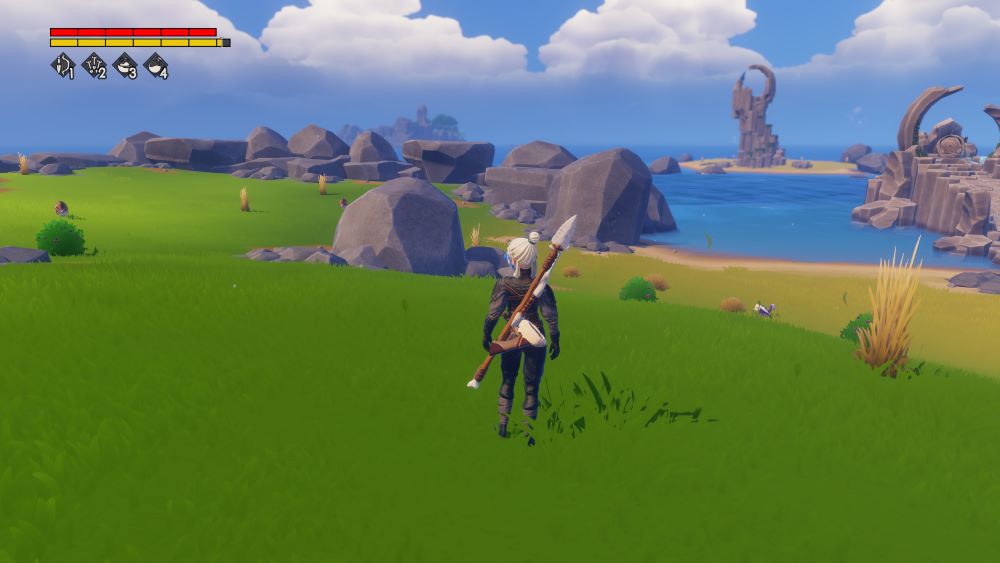
Having said that, combat is frequently very unforgiving. On the very first island, you can face off with a boar that has a standard sort of charge attack which takes off about a third of your HP. While you can dodge-roll, timing is critical, and you can get locked into animations if you aren’t careful. You can craft a sling and bow later on, but ranged damage even with the best gear/ammo is super weak and breaks enemy lock-on, which means Spacebar becomes Jump instead of dodge. The devs clearly intended you to dodge+attack or parry every move.
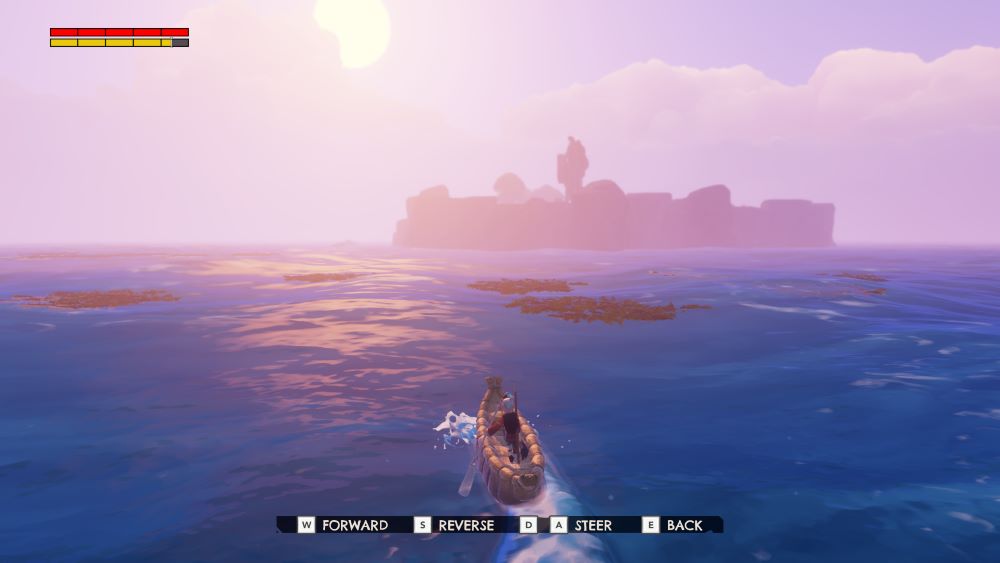
The sailing portion of the game was good fun. You start off building a canoe and paddling around from island to island, but eventually you can get bamboo or wood and construct larger craft with sails and onboard tanning racks and clay ovens and so on. Reminds me of Valheim a bit with wind direction being important, although I think you can be a little fancier in this game with “tightening” your sails and catching some forward movement even while slightly into the wind.
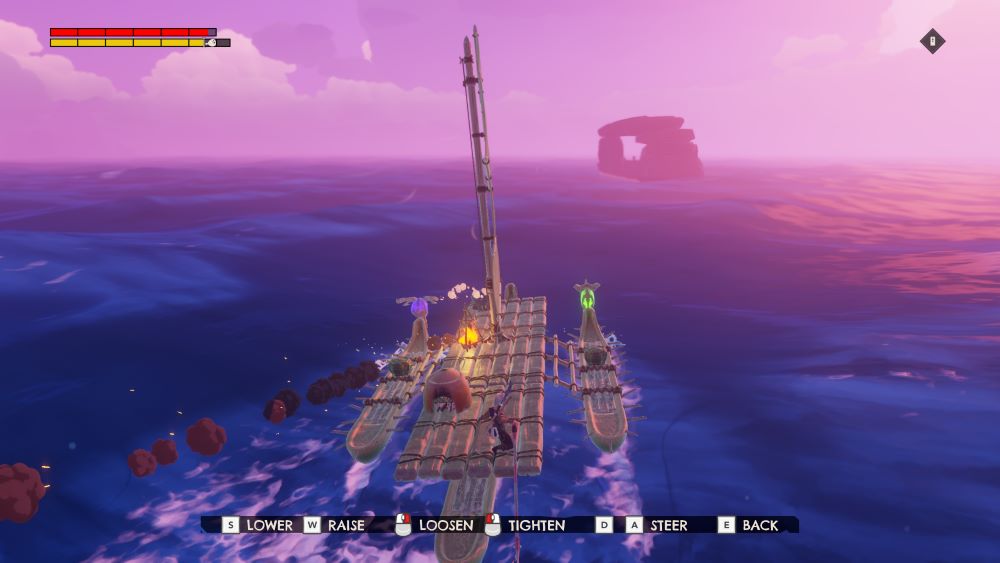
One element of persistent progress comes from collecting Sea Shards. These can be used to purchase Blessings at the end of each chapter, which then can be “slotted” on your character in the same area. Some are wildly more useful than others, and it is largely RNG that determines which ones are available. Early on I was able to purchase Ancestral Spear, for example, which means I always had a spear available that never broke. So, so many resources and inventory slots saved from not having to re-craft spears throughout my journey.
Ultimately, Windbound is an acceptable, free survival appetizer to hold you over for a better meal. It has next to no replayability, and I don’t actually recommend its punishing “survival” mode if you are just interested in progressing through the game. If you didn’t manage to snag the game for free already, there are dozens of better games out there that are of better value for your money.
 In An Age