Blog Archives
Stardew Valley Revisited
For the past few days, I have been playing Stardew Valley again.

The reasoning was due to a recent 1.6 update, plus hearing good things about the “Stardew Valley Expanded” mod (which was recently updated to be compatible), which I never saw when I was playing back in 2018. Also, despite spending 50 hours playing the first time, I never actually made it all the way through a full year, dropping the game during Winter.
Well… they’re right. You can’t go home again.
When Stardew Valley first released, it was a pivotable indie phenomenon almost right away. It obviously did not invent the farming/RPG life-sim – Stardew Valley itself being an homage to Harvest Moon – but the genre itself saw a renewal and resurgence of interest due to its surprising success. Slay the Spire did the same thing with roguelike deckbuilders; not the first, but certainly a wild success that created space in which alternatives to flourish.
But that is precisely my problem with Stardew Valley: alternatives exist. Dare I say… better ones too. Or, perhaps, some amalgamation thereof.

In the years since 2018, I have played My Time at Portia, Sun Haven, Coral Island, and My Time at Sandrock. The first thing I noticed coming back to Stardew? All the Quality of Life “regressions.” For one thing, you have zero control over the length of the day. For another, in a shocking throwback, the game only saves when you sleep. That has always been dumb design with zero redeeming features, and is especially banal considering the mobile version of Stardew does allow you to quicksave. Other games have also realized that a map showing location of NPCs and important buildings is kind of important. That one can be remedied with mods, but it just makes you wonder why. As in, why play Stardew Valley instead of one of these other games?
And that really is the rub, ain’t it? Why play this over that?
I don’t have a good answer at the moment. Many of Stardew’s NPC stories/events have been lauded as being more realistic and/or nuanced than the genre average, but it’s hard to tell if that is even accurate. Sun Haven and the My Time at [X] series certainly have deeper combat and character skills. Coral Island definitely wins the graphics award, along with some very attractive character art. All of them have fishing, farming, Community Center-esque activities, and so on. I don’t particularly have any nostalgia for Stardew either. So… why this one?
For the moment, I will continue to investigate. I’m at that pivotal optimization stage where there are some interesting decisions going on – do I spend money upgrading my pickaxe, saving for a barn, upgrading the house, etc – but I already see an “endgame” of sorts taking shape. Like, I’ll be done with most of the Community bundles by the end of this first year, I already have a horse, and I just hit the bottom of the mines. From here, there doesn’t seem to be a whole lot of new stuff to look forward to other than more passive ways of getting money, to buy something or other. Then again, I never actually got to any endgame the first time around, so perhaps there is more to be seen (and was added in the past 6 years). Plus, you know, there’s probably something expanded in the Expanded mod.
We shall see.
Hurry Up and Wait: March Edition
Since I am already looking stuff up for myself, may as well write it down for others too.
Games – Waiting for Sales
- Nightingale
- Enshrouded
- Sons of the Forest
- Horizon: Zero West
- Dying Light 2
- Kynseed
Nightingale is the blogging topic du jour and I do admit feeling a bit left out of the same conversation everyone else is having. Similar to Enshrouded actually, although I see less posts about that for whatever reason. While I would like to say that I’m waiting for Nightingale to release their offline mode out of principle, the reality is that… surprise! It’s not on sale. That’s literally it.
May not have to wait for too much longer though, because my research indicates the next sales are:
- Steam Spring Sale: March 14th – 21st
- Epic Game Store Spring Sale: April 4th – 28th
It’s not guaranteed that the above games will actually be on sale more than their 10% EA “release” discount, but it’s worth the gamble in my eyes. Either there will be a steeper discount, or I can continue waiting while the games get (presumably) better.
Games – Waiting for Updates/Release
- Stardew Valley (1.6) – March 19th
- Diablo 4 (Game Pass) – March 28th
- Core Keeper (1.0) – Summer 2024
- The Planet Crafter (1.0) – sometime 2024
- Once Human – Q3 2024
- Satisfactory (1.0) – late 2024
- Light No Fire (1.0) – maybe 2024?
- Zero Sievert (1.0) – unlikely 2024
- 7 Days to Die (A22) – ???
- Craftopia (1.0) – ???
- Final Fantasy 7: Rebirth (PC release) – ??? :(
It may seem a bit weird seeing Stardew Valley on there, but at one point last year I had the urge to download the Stardew Valley Expanded mod, only to find out that ConcernedApe decided to put out another update with new stuff 4 year later. Guess the dude is taking a page out of G.R.R. Martin’s book. Anyway, it felt silly to start playing a mod that may or may not immediately work with a new patch.
I was originally excited for Diablo 4 to hit Game Pass, but then I remembered that I hadn’t thought about it at all since it was even announced. Like, zero interest. I’ve played all the other ones though, so may as well keep the streak alive. This time for free*!
As for the Early Access games on the list, I have come to understand and eventually accept that hitting 1.0 releases with them are usually irrelevant. For example, I waited until 1.0 to play Smallands (Impressions post pending), and yet there’s an update coming in April that will rebalance crafting and more patches on the roadmap to enhance the pet/mount system. So… whatever I was waiting for in 1.0 is kinda irrelevant. This problem is especially bad in life-sim games like Coral Island, Sun Haven, etc, which have added post-game/marriage quests material that is pretty important for fans of the genre.
Other Media
- 3-Body Problem (Nextflix) – March 21st
- Fallout (Amazon) – April 12th
- Dune: Part 2 (streaming) – Summer 2024?
Dune: Part was released in theaters March 1st. I have been eagerly awaiting this for a while, but haven’t actually went to any movie theaters for years before COVID, and I’m not about to begin again now. So, optimistically, I’ll be waiting 2-3 months before this comes to a streaming service so I can watch it during the time I should be sleeping.
3 Body Problem is something I’ve already talked about recently. I am wishing it the greatest possible success, because I really want the second book to exists as some kind of Season 2. It would be quite the spectacle. And as for Fallout, I talked about that too. My body is ready… even if it is possibly dumb.
Impressions: Coral Island
Coral Island is a farming/life-sim straight from the Stardew Valley vein, and recently came out of Early Access. I have spent about 30 hours playing on Game Pass and the verdict is… acceptable. Pretty good, even. But the whole time I have been playing, all I can think about is that I want to play My Time at Sandrock instead.

Which to be fair, is, well, an unfair comparison. Sandrock (and My Time at Portia) at not the same kind of life-sim. But what kept striking me while playing Coral Island is how low the stakes are. That’s also an unfair criticism given that all of these life-sims are meant more for relaxation purposes but… I dunno. Sandrock/Portia have an overall narrative, Sun Haven has plot plus a combat system that is a smidge more serious, and Stardew Valley kind of sets the bar. It’s tough for Coral Island to stand on its own with those kind of peers.
Coral Island does have some things going for it. The (non-rotating) pseudo-3D graphics set it apart from the typical pixelated style in this genre. The anime-esque portraits are extremely well done, with villagers having different outfits per season, per certain cutscenes, and even bathing suits. The map allows you to both see where everyone is located in real-time, and even search for specific villagers. The diving activity where you clean up trash on the ocean floor is satisfying.
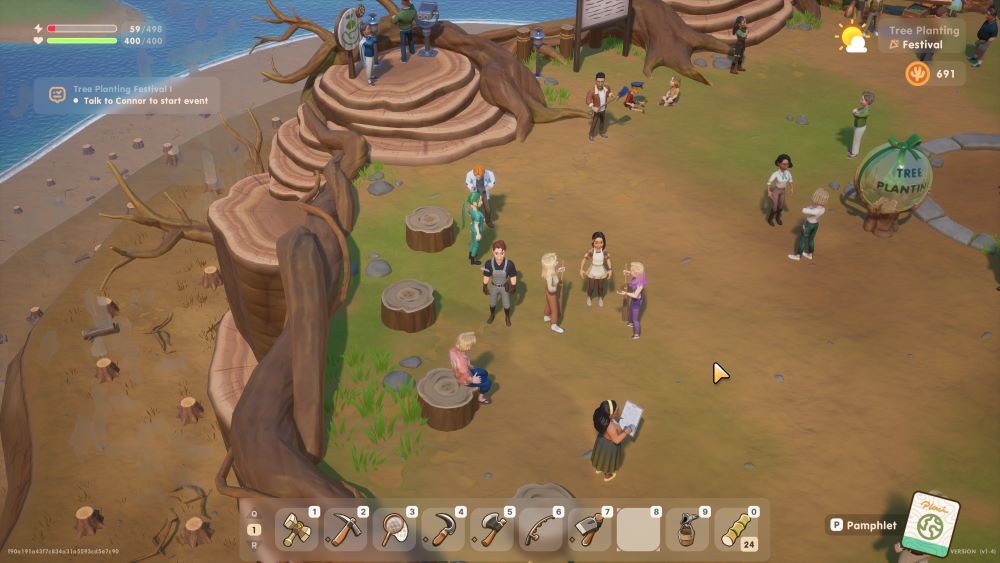
Overall, like I said, Coral Island is just fine. If you’re looking for a chill life-sim with extremely genre-typical activities, this is your stop. It did capture my attention for 30 hours and scratches some optimization itches. But if you’re looking for anything more than that, e.g. some adrenaline hit or unfolding mystery, you will have to keep on looking elsewhere.
Impressions: Sun Haven
I’m currently at around 30 hours played with Sun Haven. I bought it six days ago.
‘Nuff said, yeah?

Sun Haven is a pixel fantasy farming/life sim game in the same vein as Stardew Valley. Like, literally in the same vein. Protagonist arrives in a town, meets a bunch of people, can choose a life of toil via farming, crafting, ranching, fishing, mining, and so on. There is a daily community quest board, a calendar of birthdays and festivals, a pile of romance options. Deja vu, yeah?
The thing is, Sun Haven has a lot of very interesting innovations even within the farm/life sim genre.
For example, Sun Haven has no energy meter. That’s right, you can perform actions for as many minutes there are in the day (and you can make those longer too in the Options menu). It almost feels like cheating, for veterans of this genre. And guess what other sacred cow got slaughtered? The game auto-saves constantly, which means you can safely stop playing at any time, e.g. not just when going to sleep. What the what?! If you thought “one more day” was addicting, wait until you play this.
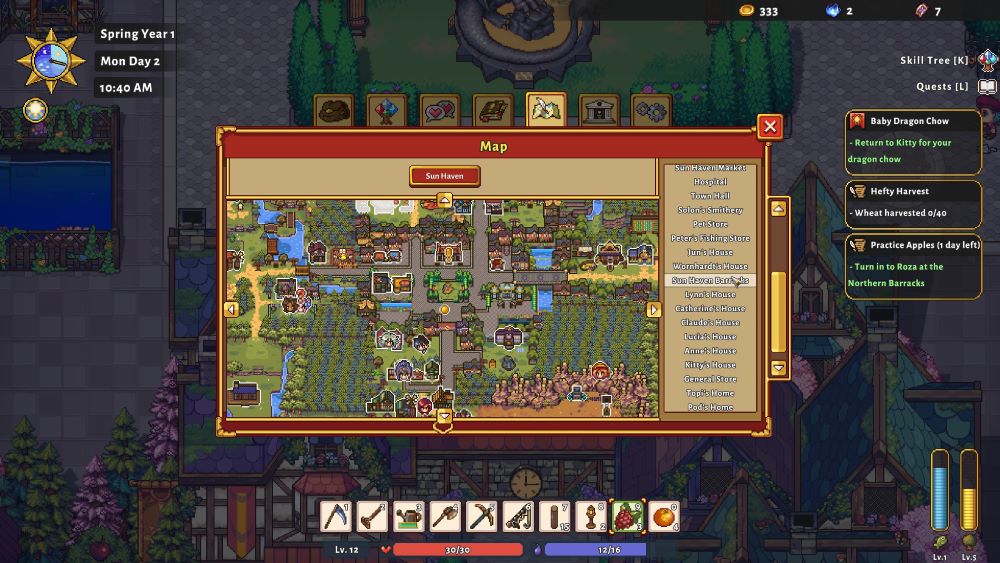
As mentioned before, the setting is fantasy. Your main character can be human… or elf, or angel, devil, and so on. You can also select a starting background, which affects if you arrive in town with some seeds or a fruit tree or farm animals. Magic also features somewhat prominently, with you learning a fireball spell very early on to assist with combat. As you gain XP in Farming, you can eventually get spells that will automatically till a big square via an earthquake, or summon a rain cloud to water your crops in an area.
Another thing that keeps things fresh is the fact that there is a surprisingly large number of Skills you can pick across the Exploration, Farming, Combat, Mining, and Fishing trees. Each one accumulates XP separately, and while the Skills offered generally affects the specific category, sometimes there is synergistic overlap. Also, these are Skill “trees” only insofar as you need to assign 5 Skill points to unlock the next tier of Skills – you are not actually forced to go down one set path.
There is a plot within the game that is unveiled over time via fairly simple questing. I cannot comment much about it at this point, as I have not really seen enough of it to tell what’s going on. What I can say is that additional towns are unlocked (including different farms!) as you progress. I just got to the Elf town and none of the traditional plants you are used to grow there. Indeed, the Elf town doesn’t even use gold as currency, so you can’t just make bank in Sun Haven and waddle your way over to clear out the vendors. I’m guessing that maintaining two or more farms simultaneously will not go over well, but it will be interesting to see if you can effectively abandon your old life and simply start over elsewhere.
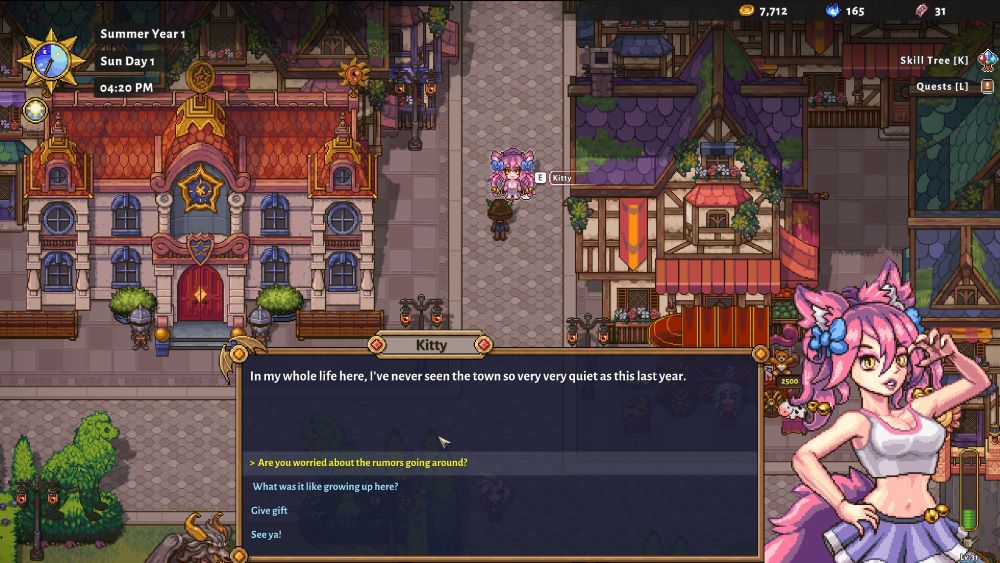
One last piece that I thought was insanely clever was the fact that most foods grant permanent bonuses when eaten, subject to a cap. This encourages you to plant a large variety of crops even after you used Excel to determine the most profitable ones, since each point of extra Mana will save you X amount of seconds by summoning rain clouds instead of using a watering can like a pleb. The bonuses are typically small, like +1 HP and then go down to +0.75 HP for the second serving, but across the dozens or so recipes it all adds up. This can affect HP, MP, Attack, and even movement speed.
My only real criticism so far is that the game is so well-made that I started expecting more out of it. For example, combat is extremely simplistic. Enemy will aggro and try to melee you. You can unlock a Fireball spell early, or you can rely on Crossbows or Sword swings to defeat them. None of this is all that different from other games in the genre. And yet I kept thinking that Sun Haven needed more spells, or enemies with a more interesting attack pattern or something. Exploration feels really good, with a whole pile of useful things to collect off the ground, and yet enemies being so simplistic sort of diminished that somehow. I will say though, that I encountered one boss out in the world that made me flee, and that made things exciting again. Just wish there were more of that in normal enemies.
Overall? Sun Haven gets top marks from me. The genre innovations – mostly in the form of sacred cow slaughters – is a breath of fresh air, and the sense of progression is top-notch. I’m excited to see what the rest of the game has in store for me, even though I’ve already clocked in more than my money’s worth just in the first third of the game.
Impressions: Medieval Dynasty
Stardew Valley meets Crusader Kings.
Okay, maybe it’s a bit early for that. I’ve only played for about two hours, and have no particular idea what’s really going on yet. But there are a few notes I wanted to jot down.
First, I really like the premise, from a mechanical point of view. You are a orphaned peasant told to just grab some empty land and build whatever. The twist here though is that each season is only three game-days long. This acceleration is possible because, you know, dynasty, e.g. you are intended to produce an heir that’s carries on the family business of village-building.
This is both unique in the farming/crafting genre and also helps handwave some of the more traditional gamey bits. Like how one dude can chop down a dozen trees and build a house in an afternoon. I mean, it’s still handwavey due to how hunger/thirst works, but I still appreciated the thought.
Also, you can change the 3-day season to be longer if you want via settings. The devs “strongly suggest” leaving it at 3, and I can see their point even from the start: without the dynasty bit, it’s just a worse Stardew Valley.
Having said that… well… the 3-day season makes all the NPC and questing bits exceedingly silly. One of the starting quests is to find out why a rye shipment hasn’t arrived. To complete this quest, you have to walk 1200m or so to the next town, then halfway back, then back, then return all the way. It took 1.5 in-game days to complete. So, basically my entire Spring. The reward was 300g, for which I have no context whether it’s worth the time I lost. Some of the meals from vendors cost 270g for some porridge, so I’m guessing No.
It was nice to see that the quest had an 18-year time limit though. Especially since one part was locating the courier who was bleeding to death near a river. Would he have just been bones if I waited 5 “years?” I’m guessing No again.
Anyway, there’s that.
OK one more thing: I find it intimidating in these games when they say “build wherever.” I recognize the terror of analysis paralysis, so I end up creating a base camp within earshot of the beginning area. Somewhere along the way though, the base camp hits a tipping point where it would be too onerous to move everything somewhere else, so I keep it in a lame area and just deal with the dissonance.
In this game though? Shit is extra scary. I’m going to have to create and reload several Saves given how it might take in-game years to find a spot where I’m happy settling. Meanwhile, I don’t know which resources are more difficult to find/gather or any sort of late-game concerns.
Which is of course the smartest thing to worry about after playing something for 2 hours.
A Slower Drip: My Time at Portia
My typical gaming M.O. is to choose a different genre of game after focusing on one in particular. So after Forager, I should have picked something that was not another crafting/farming/grinding game. Following that ancient edict just left me with not wanting to play anything at all though. So, realizing that I am an Adult© with the means and opportunity to do Whatever the Hell I Want™ I decided to head right into My Time at Portia.
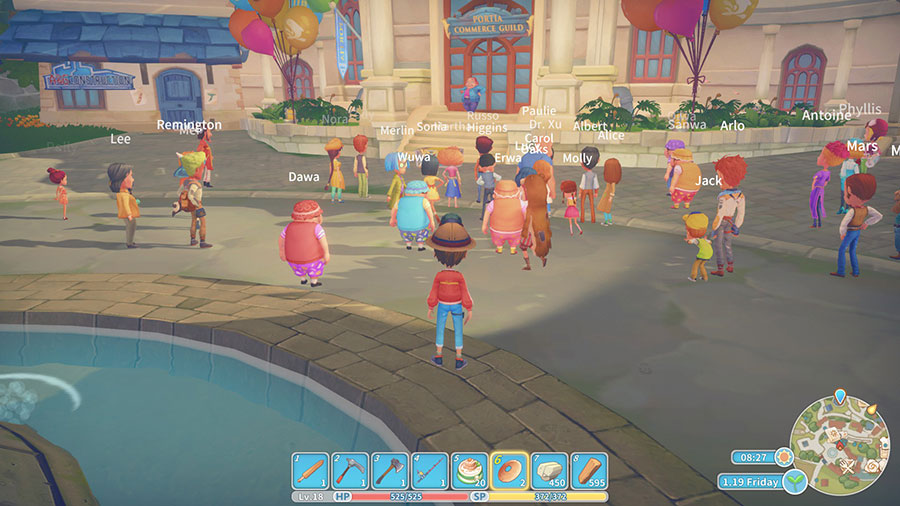
It’s good to be back.
My Time at Portia is a Harvest Moon/Stardew Valley game set in a bizarrely upbeat post-post-apocalypse future. There are ruins and collapsed buildings in the skybox, there are tales of the Age of Corruption, and even a period of darkness in which the skies were blackened for over 300 years. And yet the hero who cleared the skies is a man named Peach, the monsters you fight are things like Panbats (bats with panda faces) and sea urchins that float around with the help of balloons, and similar nonsense. It is all very cartoony and whimsical and doesn’t take itself especially seriously.
One element I do like that shakes the formula up a bit is how your character is a Builder and not a farmer. You can have farm plots and a stable and grow things if you want, but the primary mechanism of advancement is, well, building things. You can take one Commission a day from a posting board (“I need 3 Rubber Belts”), townspeople will occasionally ask you to build an irrigation system for them, some elevator needs repaired so investigations into water supply issues can be resolved, and so on. A lot more crafting than farming, in other words. This solves the sometimes awkward problem of having unlockable crafting tiers of items that you only ever make one of and never use the crafting table again.
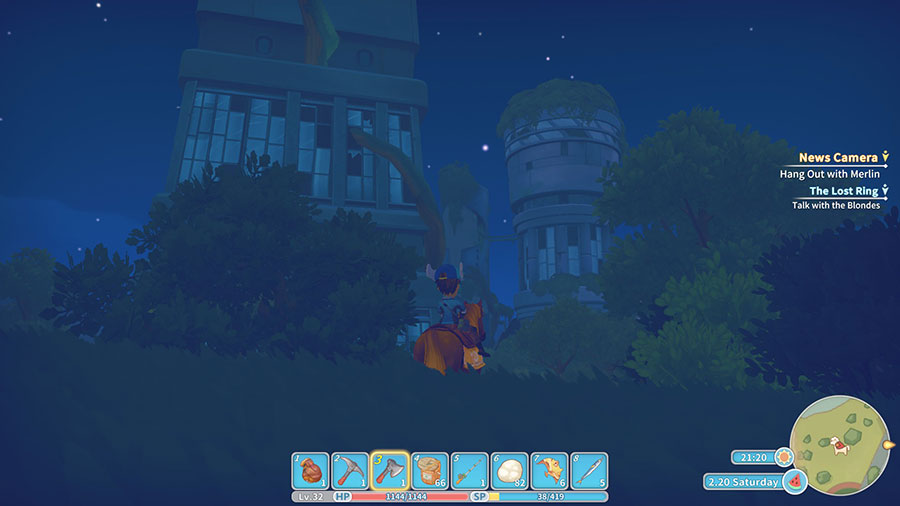
While it has been an enjoyable game thus far, I do think I am over-optimizing the game a tiny bit. I am not even past the second season yet and have already unlocked and am using the highest-tier tools and Workbench. There are still longer-term items to purchase (expanded housing plot, etc) and upgrade, but I am primarily “done” in terms of exciting progression, e.g. needing a specific tool to gather a particular resource. We’ll see how the rest of the game pans out.
Having said all that, I am certainly doing what I enjoy. It is not ARK or 7 Days to Die or more freeform crafting-survival, but My Time at Portia scratches similar itches for the time being. It also feels more relaxing than even Stardew Valley, as you can tweak settings like Day Length to give yourself more time to explore/talk to townsfolk. If this is what you’re looking for, well, you found it.
Mainlining Forager
If you ever need to know what my game type is, look at Forager.

Forager is distilled, crystallized, crafting/collecting. Everything is stripped down to their elemental components. You are on an island with constantly respawning resources… like every 20 seconds. You bash trees and rocks until you build a Furnace, which you use to smelt iron and gold into bars to craft more buildings. You get XP for everything, and on level-up you get Skill Points to unlock new buildings, buffs, and gear. Once you have acquired enough gold currency, you can “purchase” new islands, which you build bridges to reach. Said islands expand your access to resources, including new ones, along with enemies and item drops. Rinse and repeat, until you have unlocked half the world and you have automatic resource gathering (to an extent), banks minting gold for you, while you are off scraping the landscape clean with lightning wands and magic scrolls.
The first time I booted the game up, I played for three hours straight.
What is extra interesting to me is examining the components of Forager in terms of other games I play and enjoy. Stardew Valley, for example. You can technically farm in Forager: there is a shovel tool for digging plots, a Windmill building to create seeds from already-gathered plants, and even sprinklers to automatically water said plants. But plants in Forager bloom in like 30 seconds. And you’re just as likely to get a similar yield just blasting everything on the screen along with piles of other components. So not really like Stardew Valley at all.
Now that I think about it, Forager is kind of like a parody of survival/crafting games. Similar to Progress Quest back in the heavy JRPG days, or Cow Clicker during the rise of Facebook games. As it turns out, sometimes parody becomes more fun than the game it makes fun of.
I will reach a natural satiation point eventually. It may be very soon, as most of the progress I can make at this point is grinding currency for the remaining islands. There is no deeper meaning here, or even particular sense of lasting accomplishment. This is decidedly a wirehead experience. But until my tolerance level reaches its peak, I will continue mainlining this game with no regrets.
Sometimes you just need gratification, instantly. In which case Forager has you covered.
[Fake Edit] Oops, apparently I am done. There is no final boss, I have already completed all the dungeons, bought all the islands, and done all the easy upgrades. No sense grinding for more powerful gear to face non-existent threats. Those 16 hours were a blur.
Graveyard Keeper
In my still-limited free time, I have been playing Graveyard Keeper.
Even before I purchased the game – or got it through a bundle, I forget – Graveyard Keeper had been unfavorably compared to Stardew Valley. Specifically, how the game devolves into an inordinate grind. Having played the game now for about 25 hours, I have to agree. But it is not the grind that is the problem, but the overall disjointed experience.
As you might imagine from the name, the primary task is the maintenance of the graveyard and nearby chapel. Bodies will be delivered periodically, and interring them can not only improve the overall quality of the graveyard, but gives you a Burial Certificate which you can trade for coins. As things progress, you get the ability to perform autopsies to improve the “quality” of the bodies before burial – primarily by removing “sinful” organs – such that higher quality headstones and such can unlock the full potential of a buried corpse.
So, the gameplay loop starts relatively tight. You chop trees and mine stones/ore to build headstones and such to improve the graveyard. Improving the graveyard eventually allows you lead sermons that generate Faith resources, which allow you to research further technology.
Things fall apart in the mid to late game. The ultimate goal of the game is to collect six items from certain NPCs in town and spend 12g on a last item. 12g is 1200 silver and you get 1.5 silver for each buried/burned body. Thus, you need alternative means of making money. Which is fine, because the quests necessary to get the special items are long and involved and require you to do all sorts of tech-tree development, building dozens of workstations, and basically creating a little empire. However… you can’t specialize. The bartender will purchase the wine you make, for example, but each bottle sold will reduce the price of the next bottle, and prices only recover slowly over time. Which means you need to do all the things all the time, when there will never be enough of it to matter.
To me, that is not even the worst part. The worst part is that your time horizon is ever only seven in-game days. In Stardew Valley, you had seasons and yearly events to plan towards. Sometimes that was a massive pain and source of min-maxing, given that you could spend a lot of time on crops only to have them all die a day before harvesting because the calendar changed. But it also gave you a focus. Hell, you could focus on just a few things, e.g. fishing vs animals vs growing crops, depending on your mood. Graveyard Keeper requires a generalized approach of running around all day every day, never really getting a sense that you’re making progress on any particular thing.
I even have some zombies now to assist in automating resource collection, and I still never have time to do all the things I need to do to feel satisfied on my progress. At one point, I just abandoned the whole corpse part of the game for several in-game weeks because I couldn’t be bothered. I was trying to unlock the second-tier Alchemy Bench so that I could actually start using the Embalming techniques I had unlocked 10 hours beforehand, but the convoluted tech tree and components meant I couldn’t do much of anything. Even when there are interesting choices to make, such as removing more organs than necessary to turn them into alchemical ingredients at the cost of corpse quality, all it becomes is just another chore to do on the path to something else.
It is difficult to discern why I still like playing this game. Well, perhaps not too difficult: it’s a game that encourages planning and thinking even when not actively playing. Same with Fallout 76, really, in that even at work I am strategizing on what I plan to do in-game when I get home. But this chronic tension and sense of never making particular headway is also exhausting, and the last thing I need more of in my life.
 In An Age
Farm-Sim Annoyances
Apr 8
Posted by Azuriel
Although I am continuing to play Stardew Valley, this experience is reminding me of design annoyances frustratingly common to the genre at large. Non-exhaustive list:
Challenge/Interesting Decisions are Front-Loaded
When you first begin any farm-sim, you have a mountain of dilemmas to resolve. Which seeds do you buy first? Do you focus on fast-growing crops to maintain cash flow or do you invest in long-term payoffs? Should you spend time clearing the farm, foraging for extra crops, mining for ore, or fishing? Do you spend your first wave of cash on building a Chicken Coop or buying more seeds? Do you focus on trying to complete the Community Center (or equivalent) in Year 1, or save that for later?
As time passes however, an inflection point is reached and things only ever get easier. Early investments in more passive income streams (Beekeeping, Animal Husbandry, etc) and Sprinklers free up all your time to do… nothing much. I mean, you could spend more time foraging/fishing/mining, but those activities were typically required to get you to this point in the first place, so they themselves may not be relevant anymore. While there may be endgame goals that require substantial amounts of cash, its achievement ends up largely a function of pressing the Sleep button over and over.
Robust (but Pointless) Cooking System Locked Behind Midgame+
It boggles my mind how consistently farm-sim games lock Cooking behind expensive home upgrades. Then comes the double-whammy of most recipes being a net-loss of income compared to just selling the ingredients – nevermind the opportunity cost of the home upgrade itself! Even worse, by the time you unlock the ability to cook, have the proper ingredients, and learned the recipes, the buffs (if they even have any) and Energy gained by consuming a cooked meal are largely irrelevant due to farm automation and/or character progression. In the Summer, I would frequently leave my farm with 50% Energy or less from watering crops. By Fall, I would leave with 100% Energy and have nothing to do to meaningfully “spend” it even outside the farm.
My assumption is that these game designers are afraid that making Cooking profitable will turn the farm-sim into basically a cooking-sim. Or perhaps Cooking itself is only intended to be another “Community Center”-esque achievement grind and/or money-sink. Nevertheless, it always just feels bad to be generating hundreds of crops and just throwing them in a bin because there is no reason to, you know, combine resources together.
Intentionally Limited Inventory Space
Managing inventory space is a key activity in several genres, but none feel so much like a punishment than in farm-sims. The primary problem is that you are typically restricted to a small amount backpack space and then given a dozen or more different crops that can have 3-4+ different quality outputs on top of tools, forage items, etc. There might be an argument that this leads to “interesting decisions” in whether to trash one item over another, but considering that this issue often appears even when on the farm, all it amounts to is an incredible annoyance of running back and forth.
Non-Trivial Amount of Trivial Combat
One of my deep-rooted disappointments in the genre is usually how little care is given to the combat side of the game. Now, yes, this is a farm-sim and not an Action RPG. And yet almost all of them feature monsters you must defeat in the Mines while you dig for ore. Presumably this aspect is included to make digging for ore more stimulating, but you know what would be even more stimulating? Supporting what ends up being 40% or more of the gameplay with some character progression.
Maybe getting random gear drops with different stats and abilities would feel a bit out of place in something like Stardew Valley – running around in plate armor isn’t quite the vibe it’s going for. Then again, there are a bunch of different weapons with stats, including weapon speed, crit chance, crit power, defense, rings with powers, and so on. Sophisticated gear systems aren’t necessary in every farm-sim, but if you are going to ask the player to engage in combat for 30+ hours, please make it a bit more meaningful than pressing left-click with the same weapon the entire time.
Tool Upgrade Timeout
The amount of necessary planning that goes into tool upgrades is quite absurd. Like, I’m never excited about upgrading my Watering Can or Axe. Instead, I’m meticulously scanning the calendar and weather report to gauge when I can safely forgo the tool for two days. And, inevitably, the next morning I realize that I needed some extra Hardwood or dig a patch of ground or whatever, and then become sad.
“No big deal. Upgrade the Watering Can the day before rain, go mine while your axe is in the shop, etc.”
Yeah, I get it. But… why have the mechanic in the first place? The verisimilitude of upgrading is too important to compromise, despite the fact that you can otherwise craft complex machinery instantly next to a wood chest? Perhaps it is to engender a sense of anticipation for how much more of the world the upgrade will unlock? I can see that… for the first upgrade tier. After that, the Watering Can becomes useless as you craft Sprinklers all over your farm, and the minute energy-per-swing savings from Axe/Pick upgrades is moot as your increased energy maximum (and ability to actually cook food) makes time-in-day the limiting factor.
I had some more annoyances written out, but I realized that many of them have become mercifully moot over the past few years. Sun Haven, in particular, slaughtered a lot of the sacred cows like only being able to Save the game when the day is over. The My Time at [X] games features a more robust combat system with more incremental gear drops. And so on. I remember reading a few days ago about another farm-sim game (whose name escapes me now) that would allow you to borrow a basic replacement tool while yours is being upgraded in the shop. Brilliant, if true!
There is a case to be made that the player friction created by some of these design decisions are integral to the fun. For example, if you could cook your first wave of crops into tasty Energy food, the entire “Energy economy” is liable to go away. Which it already does in the midgame due to Sprinklers and unlocking the Kitchen, mind you – nevermind how Sun Haven gets by just fine with no Energy bar (!!!) at all. Or how limited inventory space means you have to be more thoughtful about forays into town and/or the mines and develop a system of organizing the 37 different chests on your farm.
If this sort of friction is indeed integral, what does that imply when it all goes away in the midgame?
It could be the case that I’m playing these farm-sims more like survival/automation games than intended. If you just want to relax and farm shit with your bros and hoe, none of this really matters. “Oops, forgot to grow any Melons for the Community Center gift, maybe next year then.” I can’t imagine playing that way myself, but I have heard the same things said about my predilection towards optimization. In any case, I do hope that as the genre continues to evolve (or just iterate) one version will release that maintains the same density of interesting decisions from beginning to end.
Or maybe I should just go farm in Valheim instead.
Posted in Commentary
5 Comments
Tags: Decisions, Farming, Game Design, Life Sim, Stardew Valley, Sun Haven