Blog Archives
Following the Money
Found a news article (via Reddit) with a refreshingly straight-forward headline: Newzoo: North American gamers spend an average of $325 annually The Reddit conversation focused mostly on how inexpensive gaming is as a hobby in dollars-per-hour terms, compared to going to a bar/movie ($20-$80) or even a concert/sporting event ($150-$800+). You know, traditional talking points.
After actually reading the article itself though, that wasn’t what this report is about:
The motivations behind player spending in these regions also differ. 34% of North American players spend money to unlock exclusive content, while 29% do so on personalisation/character customization. […]
The report also found that there’s diversity in player spending patterns between regions. In North America, 27% of players invest in content packs, power-ups, and in-game currencies, 24% buy subscriptions, and 23% purchase battle passes.
What’s conspicuously missing is “percentage spent buying the game.” At least, I assume unlocking exclusive content does not count. And actually, all those percentages are kind of weird. Is character customization not also exclusive content? Are content packs not battle passes? Who knows.
Regardless, the through line is clear:
According to the findings, the West games market is seeing slowing “payer growth,” with a 1.1% compound annual growth rate (CAGR) in North America and 3.1% CAGR in Europe between 2023 and 2027. As such, Newzoo and Tebex recommend studios “shift from acquiring new players to maximizing value from existing ones.”
There’s a tangled web of chicken vs egg speculation about why player growth has slowed. Market saturation? Higher prices and too much “maximizing value” squeezing people out? Shaky economic future? The rise of lifestyle/live-service/forever games like Fortnite, Roblox, etc? (Time) Competition from short-form video content?
Funnily enough, most of these points were covered back in January in the Hopes of the Game Industry. And the answer is… Yes. All of those things, simultaneously. There have been tremendous layoffs in the games industry this year, including high-profile sequels and nearly-complete games thrown in the trash. We mourn the loss of what could have been, but the suits see how only ~12% of gaming hours are spent playing new games. Why risk $100m+ and eight years building a game when you can “maximize value” out of established ones? And if you don’t have any of those games, just buy’em up.
Again, it could be an interesting debate about which happened first. Did escalating prices for new games send players back into the arms of familiar classics? Or did the introduction of microtransactions start making games stickier, as a means of assuaging sunk costs?
True answers, if any exist, are academic at this point. Developers are following the money and it’s hard to blame them. Well, aside from being increasingly incapable of making fun games even after 4-8 years and tens millions of dollars and are now choosing to erode your consumer surplus instead.
You can certainly blame them for that.
Switch 2 Paying Too Much
In the weeks leading up to today, I was actually looking forward to hearing the details about Nintendo’s next console, Switch 2. Which might seem odd, considering I let the entirety of the original Switch lifecycle pass me by. And, actually, the last console of any kind that I purchased was a PS3 and I barely played any of the games I bought on that. I did upgrade my PC in 2022, and that is where I do most of my gaming. But… well, I have recently started being interested in portable gaming and figured that if I were to jump into the waters, maybe the Switch 2 would be as good a place as any.
Except, perhaps, when it costs this fucking much:
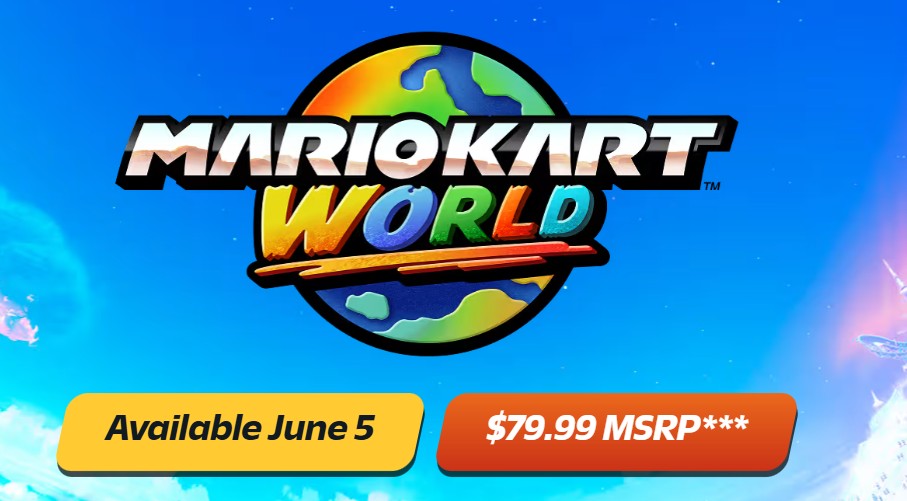
- Switch 2 console – $449.99
- Mario Kart World – $79.99 (!!!)
Leaks were suggesting $399, and it’s “just $50 more” as some say… but look at the game prices now. We were just talking about analysts suggesting (and begging) for Grand Theft Auto 6 to launch at $100, and it seemed like an absurdity. But here’s Nintendo leap-frogging the new $70 “standard” and going right for $80. And since it is Nintendo, these game prices are going to basically be set in stone for the decade – no Summer Sales or discounts for us.
Well, aside from the $500 console bundle with Mario Kart, saving you $30 one time.
The grand irony is that I had started getting interested in the Switch 2 because I developed a renewed interest in handheld emulators. I fell into a deep YouTube rabbit-hole around the explosion of these handhelds, and even picked one up myself on the cheap (Miyoo Mini+). This was technically (even more) unnecessary considering I still have a PSP and even an OG DS which are both set up to be emulators. In my mind though, I wanted something dedicated to emulation specifically, with a smaller formfactor, with the assumption that I may give it to my son once he gets into gaming. With me playing it in the meantime, of course.
After playing around with the Miyoo Mini+ though, I discovered strange sort of nostalgia holes. It will play up to PS1 games no problem, but I started thinking about the N64 games I might want to play again. Or GameCube. But not PS2, for some reason. Anyway, once you start looking into that direction, your options shrink until you start hitting the “Steam Deck” tier which is $400 (or more). At which point, well, here we are again. Although potentially tackling my Steam backlog…
…I wonder how long it will take for the Switch 2 to be cracked? Best of all worlds, potentially.
In any case, god damn, Nintendo. There are plenty of talking heads saying that $70/$80 games are “necessary” to “save” the industry. What’s not often mentioned is how many chairs will be remaining once the music stops. Gamers were already spending 60% of their time playing 6+ year old games back in 2023, so how many new $80 titles do you think they’ll be buying in 2025 in this economy? Nintendo will probably be fine. Other studios? Probably not so much.
The Hopes of the Game Industry
In short: they hope GTA 6 will cost $100 so they can raise their own prices.
As reported by VGC, Epyllion’s Matthew Ball just released a report focusing on the “State of Video Gaming in 2025”, which shares his thoughts on what might happen within the industry this year. Of course, a lot of that focus is out on GTA 6 which is primed to be one of the biggest game releases of all time, with some analysts predicting that it’ll make more than $1 billion in pre-orders alone.
Within the report, Ball claims that there is “hope” within the industry between publishers and developers that Take-Two will respond to all of the excitement and hype surrounding GTA 6 by raising the default price of the game to $100. Considering the fact that GTA 6 is going to sell well no matter how much it costs, the industry is reportedly hoping the price gets raised so that others can follow suit.
There is a ridiculous sort of myopia associated with seeing (and/or experiencing) high-profile commercial failures and escalating production costs, only to come to the conclusion everything would be better with higher unit prices. How about… *checks notes* … lower production costs? “But players demand AAAA-quality graphics!” Do they? I can appreciate the dilemma faced by developers, wherein the last game cost $400m and not wanting to gamble with a $350m (or lower) sequel. But if the acknowledgement is that the status quo of ever-increasing production costs is unsustainable, higher prices at best stems the bleed temporarily. At some point you need to address the root cause.
I was curious at this point as to what “the industry” actually thought about things, and if GTA 6 selling for $100 was all of it. So, the article I linked to above points to this VGC article, which then points to a 222-slide presentation by Matthew Ball, whom appears to be a “strategy advisor” to, presumably, the games industry (and others). If you have the time, I do very much encourage you to take a look yourself, as it is surprisingly straight-forward and facts-based. A summary:
- 2011-2021 saw the game industry grow at 150% annually
- However, in 2022 revenue fell -3.5% and remained flat in 2023-2024
- This mismatch in prior projections has dried up VC pipelines and investments
- The growth of the prior decade was due to multiple “innovations” that has since exhausted themselves
- Think microtransactions, mobile gaming, Battlepasses, etc
- Assumed new innovations are not bearing out (AR/VR, etc)
- Worse, rise of social video (TikTok) is actually eating into mobile leisure-time in a significant way
- PC and Steam growth appears to be bright spot… but all because of China
- Chinese game companies are exporting and directly (and successfully) competing with Western devs
- Game industry has unique struggles in variable pricing, and cannot easily pass on inflation
- Overall engagement is decreasing in gamers, including the hardcore ones
- Most of all gamers’ playtime is with existing titles – only 12% is spent on new games
- Network effects mean players stay playing the games their friends are playing
The final section of the presentation includes thoughts on potential new growth engines. And it does include GTA 6, but also several others.
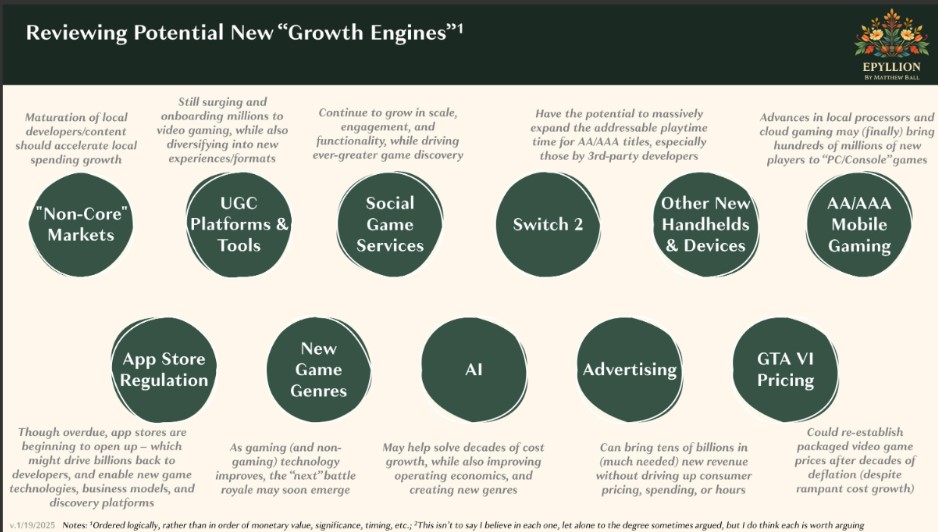
Again, I think it is worth looking at the presentation yourself, as each of the 11 bubbles there get multiple slides that introduce, justify, and even caution about the “solution.” Well, aside from GTA 6, which is noted would be the cheapest GTA ever (in real terms) if it comes out at $70. GTA 5 was released in 2013 at $60, which would be over $80 today, for example. Notwithstanding the billions of dollars GTA Online brought in, of course.
Overall, I did come away a bit more sympathetic to the plight of the games industry. Some of the headwinds I can personally attest to. For example, there have been multiple nights in which I found 2-3 hours of my “gaming time” consumed by Youtube Shorts scrolling. The network effect or “black hole” games are certainly a challenge as well, as anyone who has spent years playing MMOs can attest to. How do you compete against Fortnite, Minecraft, Roblox, and/or all the others?
“Raise prices,” of course!
Unfortunately, the actual solution is both pithy and hard to achieve: make fun games. Note how that solution did not include the words “spend 8 years painstakingly rendering every blade of grass.” Also note that I’m not saying that coming up with a fun game is easy either. But the industry seems stuck in this death loop of hiring more artists, programmers, marketers, and greenlighting enormously long development times… only for the game to fall flat because the fun wasn’t there. You can’t just hire more people to increase the fun quotient. And sometimes the fun that is achievable is only experienced by a narrow slice of the market, too small to be sustainable for the larger companies.
I don’t know the solution. If I did, I certainly wouldn’t be giving it out for free. But it might well be… decimation for the industry. I think a lot of publishers are just going to go bankrupt trying to spend their way out of the tailspin. AI could be a big disrupter, but disruption favors small indie shops, not the big guys. And while I do feel like longer development times is the obvious root issue for ballooning costs, I don’t see how the industry moves towards shorter development times and… then what? More releases? I mean, I wouldn’t be mad about a new Fallout every 2 years. If they keep the releases the same with a shorter development time though, that just means an implosion in the game jobs market. Not ideal.
…or maybe it is?
I dunno. I’m just a dude looking for fun games to play with my ever-decreasing amount of free time and eroding consumer surplus. When I look at my most-played games though, what I don’t see is full-priced titles with photo-realistic graphics and 8+ years in development. Well, I guess some Early Access titles were being worked on for that long, but it was like with three guys, not three hundred.
Anyway, Take Two can try and take $100 if they want and everyone raise prices as a result. Maybe it works, maybe it doesn’t. Nevertheless, my parsimony will abide.
Live Service
In “researching” my Concord post, I came across this IGN article in which analysts were asked why the game failed. One answer in particular was extremely interesting in a state-of-the-industry way:
“Live service games have a high failure rate,” Deane said. […] But while the risks are big, so are the rewards. It’s no secret that many of the highest-earning games in the market today are live service games. According to our data, only about 16% of the total revenue of the games market now comes from traditional full-game sales. Publishers are going to keep chasing that 84%.”
On the one hand, it shouldn’t be that shocking, right? Fortnite, Genshin Impact, GTA Online, Call of Duty, every MMO, and almost every mobile game are all live-service titles. Fortnite by itself generated an estimated $5.7 billion in revenue in 2023, for example. That’s per year. Genshin is another billion per year, GTA Online (aka GTA5) is approaching $9 billion lifetime revenue, and so on. Also, apparently Call of Duty mobile hit $3 billion total revenue in only four years and is now officially where the majority of CoD players are. Oh, and I guess Minecraft is also a live service game too? Another $300 million or so.
On the other hand: Jesus fucking Christ. 16%?! What the goddamn shit? Holy mother of god.

Ahem. Well, there you go. That’s the state of the industry right now. Or I suppose been the state of the industry longer than I’ve been paying attention. If you’re interested in just making like, a game, you’re competing over literal scraps. “Why are there so many live service games these days?” Right now I’m amazed there are still regular games. Of course, 16% of $350 billion is still $56 billion, but that’s much less than, say, $294 billion. And of that much smaller number, you are competing across all the available genres of regular games. Good thing development costs aren’t too prohibitive…
 In An Age
Priced In
Mar 30
Posted by Azuriel
If you haven’t heard the news, Sony announced that they are raising the prices of the PlayStation 5. Again. The disc-less version is now $600, and the Pro costs $900 MSRP. Nine hundred dollars. This comes on top of price increases of last year. As a reminder, the disc-less version launched in 2020 for $4001. Sony isn’t alone with price increases, of course, with Microsoft hiking the price of their lagging console several times in addition to Game Pass Ultimate. It seems inevitable that Nintendo will eventually follow suit with the Switch 2, despite trying to raise peripheral prices to compensate.
Meanwhile, game studios have been shedding workers at breakneck speeds. Just this past week, Epic Games laid off over a thousand people (with $500 million in additional cuts) amidst lower Fortnite engagement. Overall, the industry lost 45,000 jobs in the last four years. Some of this is attributed to a post-COVID correction, when apparently every studio hired anyone they could and greenlit even the dumbest of live-service games (Concord, Highguard, etc), ironically chasing (fewer) Fortnite dollars.
The other part of it is simple economics. If the average budget for a AAA game is $300 million, even with no storefront cuts and a price of $80, it would still require 3.75 million copies to be sold to break even. A more realistic figure would be 70% of a $70 game, putting it at 6.2 million sales. Again, just to get back to $0, let alone show any profit. GTA 5 sold 225 million copies worldwide, so yeah, it’s still possible to make bank on certain bets. I’m also guessing that GTA 6 will make back its $1 billion budget.
On the other hand, if people have to buy a $900 console just to play it… I dunno.
This very well may be the tipping point beyond which AAA no longer becomes economical viable. Think about the PlayStation 6, which is assumed to be coming out in late 2027 or 2028. Do you believe the base model will be coming out for less than $700? And if you’re willing to drop that amount of money for the next-gen system, will you be satisfied with games that do not require the level of graphical fidelity it would provide? At the same time, it’s going to be difficult for game developers to hit those break-even sales figures if the userbase is balking at the price of the console.
One thing that I think about is whether this whole trajectory is already “priced in,” so to speak. Game development cycles are 5-6 years long, so it makes sense how all these live-service games, started in the most irrational of COVID exuberances, are simultaneously returning to Earth at terminal velocity. Concord et tal failing is one thing though; Fortnite eating its own tail is quite another. Remember when everyone started releasing MMOs trying to chase that World of Warcraft subscription money? After that development cycle of failure – during which WoW declined all on its own – we did not see a renewed interest in full-priced subscription MMOs. The industry moved on to F2P and live-service.
Well, the tides are shifting again. But where is the next sandbar? Are there any left? And if there is, can anyone afford to build on it again?
I suppose we’ll find out around, uh *checks calendar*, 2031. Just in time for Fallout 5.
1 Inflation puts $400 in 2020 as being $750 today. Which… holy shit. Nevertheless, that isn’t how it normally works.
Posted in Commentary
2 Comments
Tags: Armchair Game Development, Epic Game Store, Price Hike, Priced In, Sony, State of the Industry