Blog Archives
GameNative
It took me several hours to set up my Retroid Pocket 6 (RP6) with all the emulators and copies of 30+ year-old games. Then I downloaded an app called GameNative, and within minutes had access to over 2000ish of my games across Steam, Epic, Amazon (?!), and GOG. And it is seriously changing the way I look at games and how I play them.
Probably.
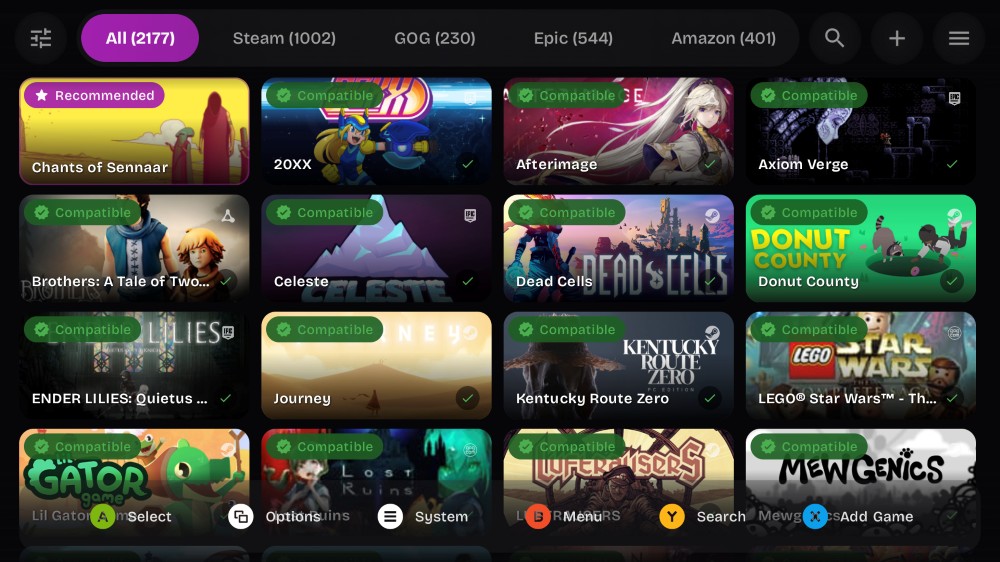
In the likely event you haven’t been watching RetroGameCorps or TechDweeb videos for the last year, the handheld gaming scene is having a Renaissance moment. The nostalgia mining element has always been there – “Here is a $80 GBA-looking thing that plays PlayStation 1 games!” – but there are only so many of those veins to go around. Then the Steam Deck came and kind of blew open the more premium tier of handheld devices. In the last year or so, though, there have been some serious developments on the software side of things that allow for Steam to more easily communicate on Android devices without a lot of workarounds. This includes automatically applying drivers and settings and tweaks to get games to function correctly.
I don’t know all the technical stuff, but as Todd Howard would say: it just works.
…for most games. The RP6 I own has a chipset which is the equivalent to a 1050ti graphics card, for example, and only 8 GB of RAM. I’m not going to be playing Cyberpunk 2077 or Baldur’s Gate 3 on this thing. However, most of the games I have (by volume) aren’t AAA titles. Hell, I spent like 200+ hours in March playing Mewgenics and Slay the Spire 2. And guess what? Both games fully work on the RP6 and include cloud saves. Granted, Mewgenics isn’t as controller-friendly as I’d like, but still!
As mentioned earlier, all this is changing the way I look at games in general. For one thing, it has me reexamining my entire decade+ Steam/Epic/Amazon/GOG libraries to see if there are games that I may have otherwise ignored/missed that could be more fun by virtue of playing on a handheld.

For example, I just played through the entirety of Celeste on the RP6. Was it a better experience than just playing on my PC with a controller? Probably not. In fact, I ended up purchasing a separate grip for the RP6 because I was getting hand cramps after playing more than an hour straight with the RP6. Although that might be more due to Celeste’s control scheme and precision platforming. The fact remains that I did stick with it and beat Celeste in little 15-20 minute increments in-between meetings, while waiting for other games to load, and eventually just in straight-up long sessions. Celeste is certainly more amenable for this sort of gameplay experience than other games might be, but it’s a proof of concept for me. Plus, as an Android device, the software manages to perfectly (thus far) suspend the game at a moment’s notice if something were to come up.
After reviewing my existing catalog, I have begun to pay more attention to all those ancillary (bundle) sales that I may have hitherto ignored. Just this past week, I picked up Journey and Donut County for just over $3 apiece. I haven’t played Journey in just about 13 years and I would probably enjoy it more on a larger screen… but the fact that I could play it (natively!) on a handheld? Yes, please. As for Donut County, that looks precisely like the sort of goofy fun I wish to be able to conjure up to fill in the gaps between moments.
Not everything is sunshine and rainbows, of course. I was initially excited to finally have an excuse to play Rain World, but everything looks tiny on the RP6 and there aren’t any in-game graphical options to correct it. Slay the Spire 2 has controller support already, but not touchscreen support that I can tell. As mentioned, Mewgenics is playable, but there’s no way I’m going to move the mouse cursor around with a thumbstick the entire game when I just want to move a few squares. I anticipate many such idiosyncrasies as I load into various games.
Overall though, I’m finding GameNative to be a game-changer for me. In many ways, this functionality was what I was waiting for the Steam Machine for. The Retroid Pocket 6 has video out capability, so it technically fulfills that portion too, if I were so inclined. All that is left, really, is to check its MineCraft capability. And wouldn’t you know, MineCraft is on Android and this is an Android device.
So, my guess is: “pretty good.” Better than on Switch? We shall see.
Blowing Off Steam (Machine)
We have all the details about Valve’s new PConsole except the only thing that really matters: price.
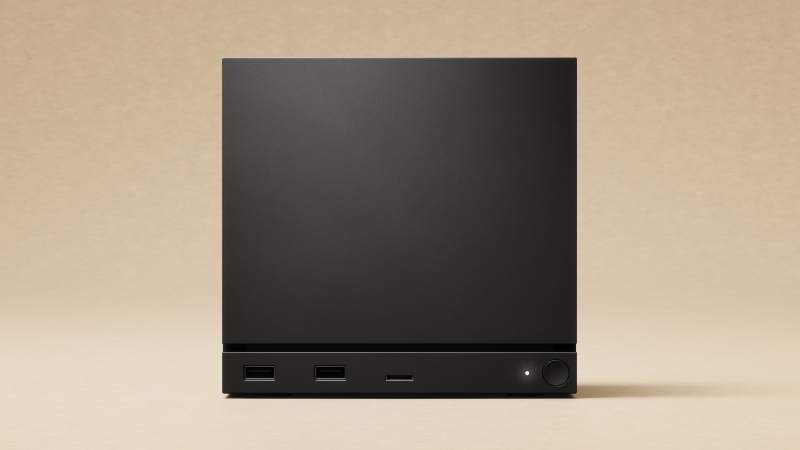
There are a lot of reasons why Valve might be slow-rolling that particular detail. For one thing, the amount of free press being generated by endless videos and news articles (and blog posts, oops) is enormous. Ten thousand TF2 hats off to the Valve marketing department. Or perhaps it’s like a trial balloon to gauge consumer interest at various price-points. Or maybe the answer is dead-ass simple: because nobody knows what prices for components will look like more than two days in advance, let alone a few months from now. RAM prices have almost doubled in the last two months. It certainly wouldn’t be a good look for any company to raise the price of a console three times in a year.
The whole conversation about whether Valve is really trying to squeeze into the console market and compete with Sony and Microsoft is kinda immaterial, IMO. The given specs are not particularly competitive with a PS5, nor is it well positioned to even really play any of the AAA games that drive the majority of consumer spending in the console space. Right now, games like Fortnite, CoD, GTA Online, and similar won’t play at all due to (Linux) incompatibility with anti-cheat software.
What Valve is actually doing is pretty straight-forward: creating a PConsole that is equal to/an upgrade of what 70% of Steam users currently have. And technically 6x more powerful than the Steam Deck.
But they also have a chance to break into the coveted Azuriel market… if they stick the price landing.
See, I’ve talked about it before, but I have a very specific use-case that is not currently being addressed in the market: introducing my kiddo to Minecraft in the living room. We technically have a Switch, which technically can have Minecraft on it, but the reviews have said it sucks on a technical level. Sluggish, buggy, and local co-op is just about unplayable. Meanwhile, I have a perfect PC rig a few rooms down. Up to this point, I had been contemplating rearranging my computer room into a side-by-side setup and going from there, but there’s a lot to like about a potential all-in-one GabeCube solution. Not the least of which is how many hundreds of other games I could share with the little man.
…unless the Steam Machine costs like fucking $800 or something. That would be enormously dumb.
I have dabbled in the burgeoning handheld emulator space, and the ever-present elephant in the room was the Steam Deck. “Is this $250 handheld worth it… or should I just buy a Steam Deck for a few hundred more?” To be clear, there are a lot of reasons why you may not want a Steam Deck. For instance, it’s very large. If all you care about is N64 games, getting something that can (technically) run Cyberpunk 2077 is overkill. But what Valve (unintentionally?) did was create a universal, $400 anchor in the handheld space. And, yeah, the top-tier model retails for $650. However, imagine if the Steam Deck debuted at $650 for the lowest model. Would it have been as popular or been the reference point for this market? No.
So, we don’t know the price for the Steam Machine. We do know that it’s not going to be subsidized like consoles, and it’s going to be priced “like a PC” of similar specs. The reasoning is begrudgingly sound: it’s technically an open Linux PC. The PS3 was subsidized back in the day with the assumption Sony would make back the money in software sales, and yet the Air Force chained 1,760 of them together to build a supercomputer. Thus, outside of bulk discounts of materials, the Steam Machine is likely to cost roughly the same as off-the-shelf components. Which puts it high. Which puts it out of reach for my purposes.
The one positive that may result, regardless of price, is developer focus on their games being “Steam Machine compatible.” Which is somewhat silly to say, given that its already a PC. That said, we have seen an out-sized (compared with units sold) effort to make games playable on the Steam Deck. Part of that is pure marketing math – someone who already shelled out cash for a Steam Deck is likely focused on playing a bunch of games on it – and the other part is likely relief at having a discrete endpoint. A given PC owner could have any number of configurations, and nearly every permutation must be accounted for. Meanwhile, a Steam Machine is a Steam Machine. If it plays well on that, it probably plays well everywhere else. Although perhaps playing on a Steam Deck is good enough.
Which just might be the play, in my case, if the Steam Machine ends up double the price of the Deck.
Portable Steam Machine
[Blaugust Day 15]
Remember when I was complaining about the Vita yesterday, and how I was never play though old games again anyway? I was about to add on a throwaway line to the end of the post about how the first company to make a portal Steam machine would make a lot of cash.
Well, turns out there’s one scheduled for a late 2016 release:
Smach, the company touting the portable Steam OS device, says the handheld will ship out during the fourth quarter of 2016. That $299 price (€299 in Europe) is apparently the device’s pre-sale price only. We’ve reached out to the company for more details on pricing.
The Smach Zero — the Steamboy project’s new name — claims to be “the first handheld console to play Steam games on the go.” The device will play “more than 1,000 games” from Steam’s library on day one, with a hardware spec that will balance performance and cost.
Best part? MicroSD card slot. The rest of the specs are in the article.
To an extent, I almost wish for lower specs and not higher. I don’t want something capable of playing GTA IV on the go – I want something capable of playing the million and a half indie games cluttering up my Steam page. If I could boot this thing up during my lunch break at work, perhaps I would find the time to start playing games like To the Moon, The Walking Dead, and the Legend of Grimrock. The lower the specs, the less expensive the machine, the longer the battery life, and so on.
Incidentally, here is another article about the same handheld, this time with benchmarks:
- The Elder Scrolls V: Skyrim (2011) on Low and 1280×720: 16 FPS
- World of Warcraft (2005) on Medium and 1024×768: 43 FPS
- Diablo III (2012) on Low and 1024×768: 38 FPS
- Assassin’s Creed IV: Black Flag (2013) on Low and 1024×768: 16.5 FPS
Technically those benchmarks are for the Radeon 8400E (or Nvidia GT 740M), which is the equivalent graphics card that this thing has. So, yeah, Skyrim is right out, and Diablo 3 isn’t looking too hot either.
That said, do you know what would play just fine? Civilization 5. And Total War: Shogun 2 (although you’d need at least a 64gb microSD card). And a whole host of other similar titles whose only question marks would be whether they’d be able to run in SteamOS in the first place. Details, details.
So what do you guys think? Would a portable Steam player excite you in any way?


Steam Machine is $1000+
Jun 23
Posted by Azuriel
Remember eight months ago where I imagined a fantasy of the Steam Machine costing $650? Apparently, it was a bargain at nearly twice the price:
I took that screenshot directly from the Steam interface. It’s official. Valve is legitimately selling a 512GB Steam Machine with no controller for $1049. That’s a big yikes. Suffice it to say, Valve will not be capturing the coveted Azuriel market, or arguably any reasonable market whatsoever.
The funny/tragic thing though, is that this pricing is actually pretty spot-on when it comes to off-the-shelf computer components these days. From the various Reddit posts, a few people have been able to use PC Parts Picker to find slightly cheaper configurations. For example, this one clocks in at $971. However, there is a big difference between a 6-inch cube and a bog-standard 17″x8″x17″ case.
That said, once you are in $1,428 territory, you may as well buy a CyberPower or other prebuilt PC.
Ah well. I still anticipate the Steam Machine will sell out, considering how the Steam Deck also sold out despite getting a huge markup. At this price though, I just don’t see it affecting the broader videogame market in the same way that the Steam Deck did. I never bought the Deck, but it absolutely influenced what other companies offered in the handheld space. In this case, the Steam Machine is likely just another grave marker for the AI madness that has gripped the economy.
Posted in Commentary
3 Comments
Tags: Spit Take, Steam Deck, Steam Machine, Too Damn High, Valve