Blog Archives
Beginning Nightingale Tips
Here are some T1 beginning tips on playing Nightingale (post-Realms Rebuilt) that I wish I knew before.

Go Ahead and Build Your House Wherever
Nightingale is a game about portals and traveling to new places all the time. So… where is the best place to build your base? Near the Crossroads? Near a Portal? The actual answer is: wherever you want.
Fast travelling is easier than you think. Press M to bring up your map, and you’ll have two options: Travel to Respite, and Travel to Crossways. Clicking on Respite will take you to wherever you placed your Estate Carine, no matter the realm. That’s fairly straight-forward: porting home, dumping your inventory, and crafting some stuff. But how do you get back to where you were going? That’s where the Crossways comes in. There are portals in the Crossways. Specifically, these portals can only take you to the “Storied Realms” aka plot realms, but chances are that is where you are coming from anyways.
In any case, after you complete the 1st story realm you unlock the ability to craft your own portals wherever you want. So, again, don’t lose sleep over where you should build your base. Just do it.
Hold E to Collect All the Things
Did you just kill and skin a fae creature (you monster!) and see a bunch of Hide, Meat, Essence, and Bones pop out? Hold E to collect everything in one go. Chop down a tree on a slope and see the Wood Bundles start to roll away? Hold E. Mining Tin next to the water? Hold E occasionally. This method will not pick up sticks, rocks, and other interactable “nodes,” but it does work on basically anything that spawns in with the wispy glow around it.
Survivor Inventory is NOT Weight-Based
Early on, you can recruit an NPC to follow you around and fight and collect things for you. Unfortunately, they only have 15 slots of inventory, which means it’s easy to get clogged with all kinds of leaves, pieces of twine, and so on. The good news is that you can relieve them of those burdens, and instead load them down with 50kg stacks of Lumber and Ore, no problem. Extremely useful for when you strip-mining the fae realms for resources.
Don’t Let Survivors Bring a Knife to a Maul Fight
Speaking of survivors, ever wonder why your first survivor is dealing just 3 damage to those zombies trying to eat your face off? Because they’re equipped with 3-damage stone knife. Give them the Maul you aren’t using anyway, and suddenly they’ll be slaying mystical beasts while you sip tea and crumpets. Well, that’s a Tier 3 food, but you get the idea. Open the survivor’s inventory, put the new weapon inside, and then right-click it and choose equip. Don’t forget to give them your hand-me-down clothing after you upgrade as well.
Incidentally, you can also give the survivor a ranged weapon if that’s what you’re into. I recommend sticking to melee weapons though, to encourage them to take beatings on your behalf. If you do give them bows or guns, the good news is that they don’t need nor use up any ammunition.
Essence is of the Essence
When you are starting out, every spent Essence is a progression trade-off. Which crafting station do you unlock first? Is it worth unlocking (and crafting!) the Recovery spell? Once you get further into the game, the decisions become much easier, of course, but it’s also true that T1 Essence remains relevant forever as it is used to Repair even higher-tier gear.
So… pssst… interested in learning how to get some quick T1 Essence on the cheap? Check these out:
- Simple Saw Table – Paper x6 from Wood Bundle x2 [6 Essence]
- Simple Tanning Station – Straps x3 from Hide [3 Essence]
- Simple Workbench – Simple Wood Axe from Stone Block and Wood Bundle [10 Essence]
Once any of the products are created, right-click on them and choose Extract. Bam, enjoy the Essence. The Simple Wood Axe seems a clear winner, especially in the early-early game, but just note that these numbers are without any Augmentations from nearby decorations. And sometimes you just want to chop down a bunch of trees and/or clear all the Hides from your inventory, ya know?
Living the Charmed Life
There are a lot of little ways to enhance your gear in Nightingale, but one you don’t want to sleep on are Charms. These are unlocked under the Magick tab and represent conditional boons (and sometimes banes) that can be applied to tools and clothing. Key word there is apply, by the way – it does nothing in your inventory until you right-click and apply it to something. Ask me how I know.
One of the most useful ones in the early game is Charm of the Mule, which doubles your Carry Weight while reducing your Stealth by half. Seems like quite the tradeoff, but right now Stealth is pretty useless considering Bound always know where you are and using guns at all negates Stealth for several seconds afterwards. Once you get better backpacks you can drop it, if you want. Charm of the Wanderer is also great as it significantly decreases Stamina drain while gliding with the umbrella. Just note that Charms are only active when you have the item equipped. This means you are better off putting as many as possible on your clothing rather than on the items themselves.
Building from a Box
I was pleased to see that Nightingale allows you to use resources stored in chests to craft things at workstations. What struct me as odd at the time though, was how this did not extend to crafting walls, floors, or building the workstations themselves. Turns out, you can build using stored resources, but there’s a reason why you may not want to.
When you open any storage container, there is a gear-looking icon on the right called Container Permissions. It is here where you can toggle whether to allow for the resources inside that specific container to be used for building or not. The default is Not Allowed.
But… why? Well, resources are extremely important in Nightingale because they can imbue crafted items with their attributes. Buildings and Workstations, however, get zero benefit. So, ideally, you want your walls built with regular Wood Bundles from trees you chopped down on the tutorial island rather than the T3 Wood Bundle (Yew) that you could be using to grant tools +6% melee/ranged damage. The game otherwise doesn’t care which resource gets consumed, and it will consume your best resources on a whim if you’re not careful.
The good news is that you can decide on a system that works for you and just keep doing it. For example, I have several “Building: Allowed” containers where I put all the resources I don’t care about, and then everything else stays protected. Or you could do it the other way around.
Three Hots and a Cot
Food buffs are incredibly important for survival in Nightingale, as is the Comfort buff from sleeping. You can have up to three different food buffs at a time and there is never really a reason not to have them rolling. As a note, “different food buffs” is very generously defined in the game – you can get three Roasted Meat buffs as long as each was created with a different base Meat, e.g. Prey, Predator, Bug.
In the early game, I recommend finding and loading up on as many Blueberries as possible, as the Max Stamina bonus from them is significant when your gear isn’t providing a higher baseline. Also, do yourself a favor and unlock Mixed Plants immediately. The initial Roasted Berries recipe requires two berries, but Mixed Plants allows for two separate vegetables, both of which can be the same berry, doubling the attribute gain.
Semi-advanced tip: prioritize unlocking the Feast Minor Realm card if your base is in the Abeyance realm, aka tutorial island. The Feast card massively increases the duration of food buffs when eaten in that realm, and the increased duration persists when you leave. All of a sudden, your food buffs are lasting 40 minutes even while you progress the story in other realms. This is helpful no matter where your base is, but Storied Realms require you to finish them before you can apply Minor Realm cards.
Impressions: Nightingale
I had low expectations rolling into Nightingale – a Mixed review score on Steam and its own game directors professing disappointment will do it – but the game was surprisingly good. To be fair, I only started playing until after the Realms Rebuilt reengineering, so perhaps I would have been less surprised with the original rollout.
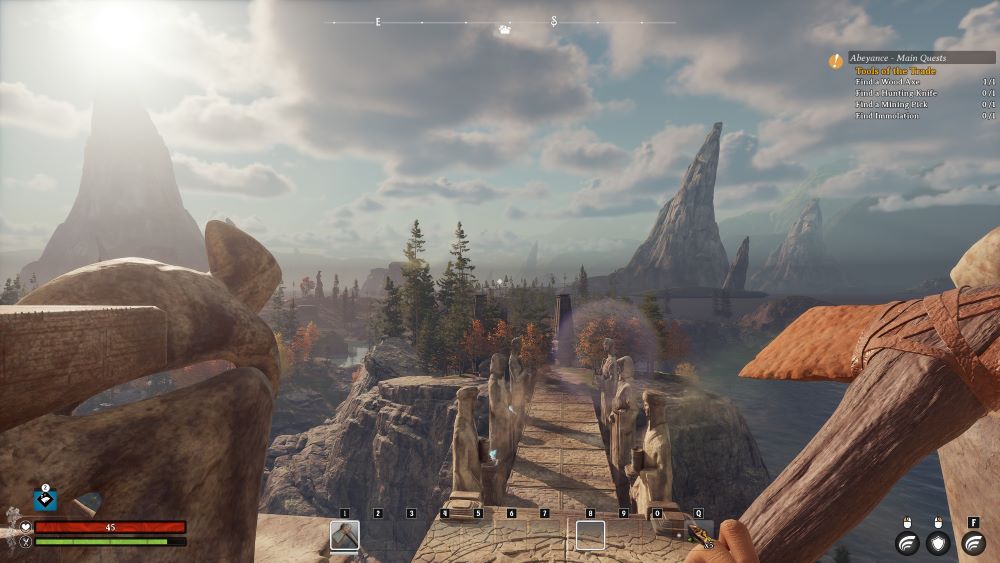
What I do want to note for posterity is my current giddiness and wonder surrounding the principle conceit of the game: portals to fae realms. I have played a lot of survival crafting games in my time, and it’s not particularly often that the world itself (or the potential thereof) excites me. But this initial Abeyance realm? Very excellent first impression. And as I was exploring the island, I kept thinking about how many problems realm-walking solves. Usually, carving up the world into disjointed instances is more of a programmer shortcut than artistic design, but it simply synergizes perfectly here. The only other games that achieved this level of environmental design brilliance for me was Starbound and No Man’s Sky. Getting that same feeling in a non-sci-fi setting is practically unheard of.
Now, it’s important to understand I haven’t actually made it off of this tutorial island yet. All this potentiality in my mind is exactly that: a superposition of imagination not yet intersected with reality. I have no doubt the waveform will eventually collapse and we’ll see, yet again, that the cat died in the box. But regardless of what ends up happening with Nightingale, I do want to see more things like this. I think having a more fae and/or eldritch angle on the genre is an otherwise untapped vein of novelty.
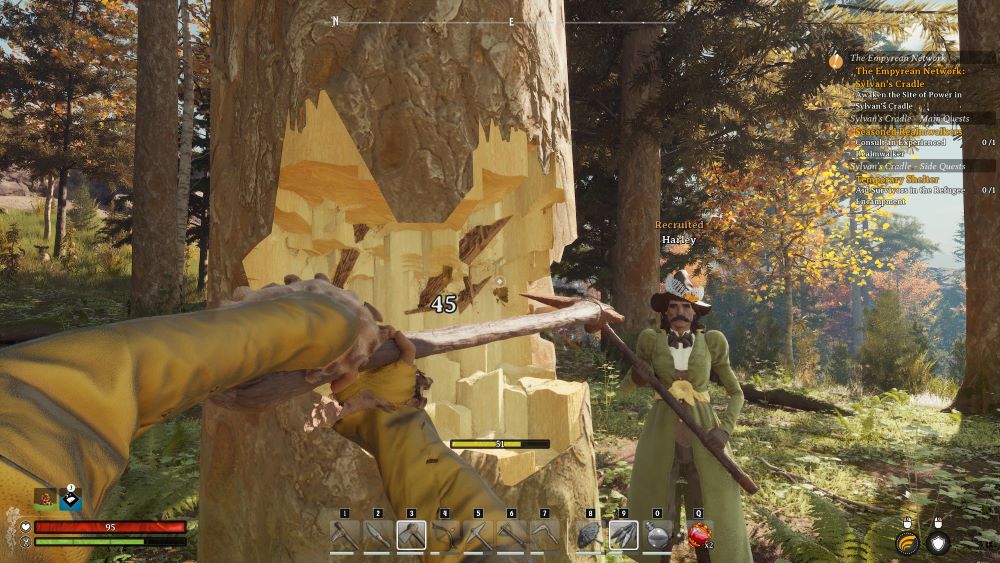
As far as general gameplay, Nightingale again surprised me in several ways. Chopping trees breaks off chunks, mining ore chips away rock where you hit it; little details like that go a long way with me. I remember reading people complaining about combat and the AI, but so far it appears serviceable, if not robust. The pseudo-zombie Bound mobs run, crawl, lurch towards you from multiple angles. Your character can block, get knocked around from attacks, and have a dedicated dodge button. Non-standard traversal is also supported, with a Mary Poppins-style umbrella glide and rock-climbing picks that you can also throw at surfaces to grappling hook yourself up. Again, all on the tutorial island.
One huge innovation that I hardly ever see in any game is the fact that multiple different resources can be used in recipes. For example, one cooking recipe calls for two Raw Edible Plants – this can be satisfied with mushrooms, blueberries, barberries, etc, or mixed and matched. This may not seem like a big deal, but think about all the times you’ve had wolf meat in a game but couldn’t craft something because it required boar meat or whatever. Additionally, all these resources have specific bonuses associated with them. Gloves need Hide to craft? Okay, well, you can use Hide (Prey), Hide (Predator), or Hide (Bug), and they will confer +Stamina, +HP, or +StaminaRegen respectively.
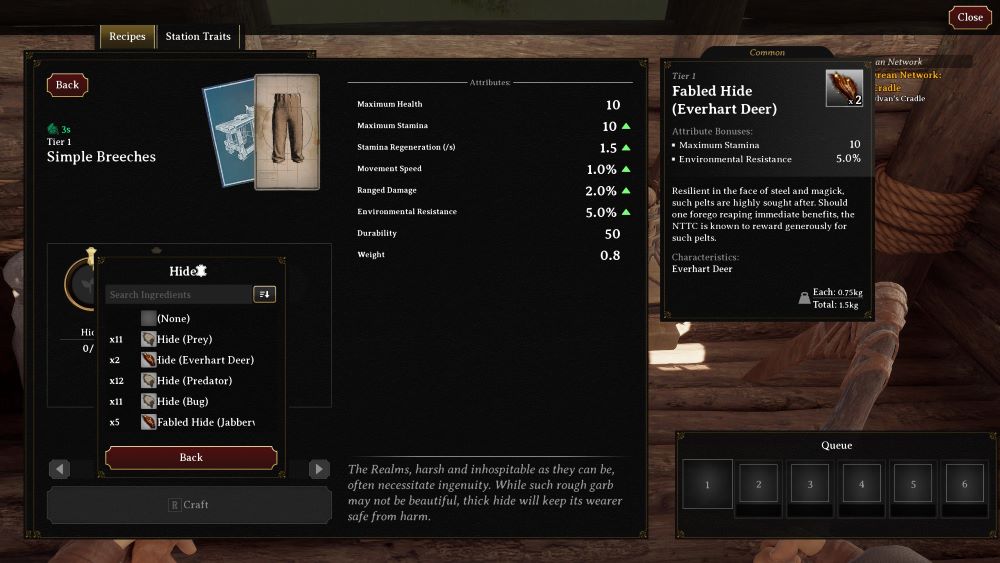
Having said that, there are definitely some… let’s say opportunities for quality of life improvements.
I was able to recruit a follower NPC who helpfully assists me in combat and also picks up resources automatically. That’s great! Their inventory is not weight-based like mine though, it’s item-based. While this works out in my favor if I’m loading them down with heavy resources like wood or stone, they are just as likely to fill their pockets with leaves and twine, necessitating some awkward inventory management. Furthermore, while I greatly appreciate being able to craft from storage, could we craft from NPC inventory too?
Also, while I love the idea of “decorative” objects conferring a bonus to crafting stations and items created, it feels real dumb to have no control over which bonuses take precedent. Maybe this is a “problem” that gets solved later on with higher-tier crafting stations (that have more than two enhancement slots), but once I realized I had to move the Hunting Trophy across the house in order for the Training Dummy to grant my crafted Knife +Critical Damage, I wanted to throw the entire system in the trash. Like, what’s the design intention, folks? Am I supposed to have two separate Crafting Tables set up, one surrounded by objects that grant me 20% ammo per craft and +Damage on ranged weapons, and the other near objects with +Melee modifiers? Or is my “pick it up and place it in another room” workaround the design goal? Just… let us toggle which ones are active.
——
Having made it to the 2nd island, things are getting a bit more abrasive. The enemies are much harder, presumably tuned to be a challenge for players in Tier 2 equipment. But the only real way to get Tier 2 equipment is to gather Tier 2 essence to unlock the upgraded crafting stations. Meanwhile, surprise, the realm has a negative modifier that reduces your HP regeneration. The whole situation was a bit brutal. But now I’ve unlocked a bow that literally deals 100 more damage per arrow than I deal currently, using materials I can gather from my Abeyance realm. Which… is not the way that is typically supposed to work. Anyway, once that gets crafted, I’ll continue onwards to farm mobs for essence to unlock more crafting stations so I can craft the gear that will allow me to be actually successful in exploring the area.
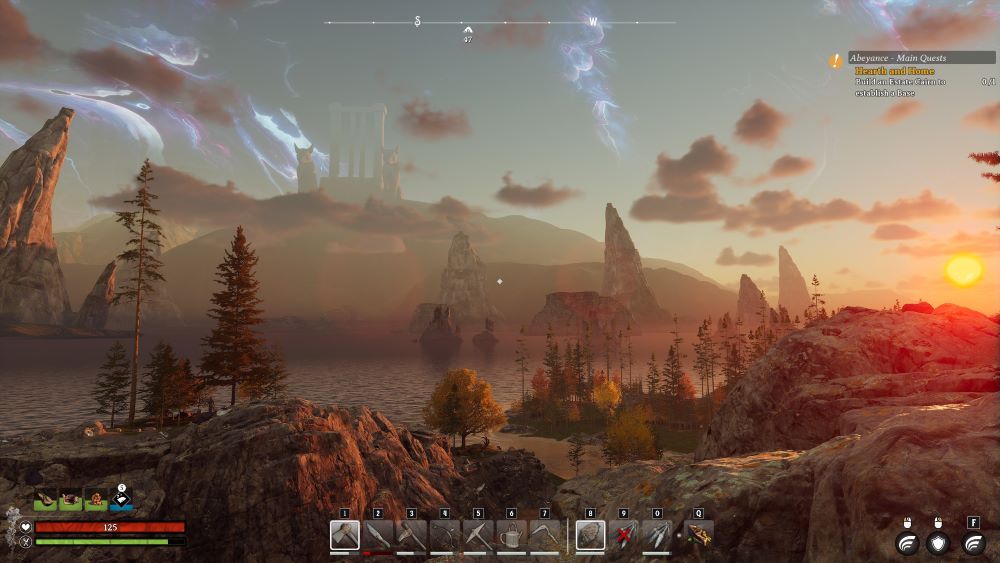
Anyway, if I had to sum up the things I would like addressed over Early Access thus far, it would be:
- Toggle active Augmentations on crafting stations
- Craft from NPC inventory
- Sort by Weight option when viewing NPC inventory
- Remove or reengineer Hunger Meter (Food buffs mean you’re always full anyway)
- Reimagine the Magick/spells system entirely (it’s barely supported and boring to boot)
- Tighten up traversal mechanics, e.g. what can be climbed, grappled, etc
- Allow us to build bridges
Other than that, so far, I’m very impressed.
Wishlist – August 2024
A non-exhaustive list of game wishes at this time interval:
- SCUM ($15.99, 60% off)
- Terminus: Zombie Survivors ($15.99, 20% off)
- ASKA ($19.99, 20% off)
- Enshrouded ($29.99, MSRP)
- Sons of the Forest ($29.99, MSRP)
- Bellwright ($29.99, MSRP)
- Nightingale ($29.99, MSRP)
- Soulmask ($29.99 , MSRP)
SCUM would certainly seem to be the sort of survival crafting game within my strike zone, but there is just something… off-putting about it in the videos I have watched. I’m not opposed to super-realistic/detailed survival games (e.g. Green Hell), but they have a tight fun-rope to walk. Need to balance your macronutrient intake with a literal stomach size constriction? OK. Need to remember to remove dirty pants if you get a laceration on your leg lest you get an infection? Cool.
But what is this all in service towards? “Prevent the player from just eating berries all day in the woods, forcing them into dangerous zones.” I can get behind that. Of course, the actual gameplay looks kinda janky, zombies are all of the same type but a few are randomly screamers that spawn in dozens of new ones to immediately chase you down, etc, etc, etc. All of sudden, it seems a bit less “realistic” and more nakedly game-y. That sort of thing works in 7 Days to Die, but not here.
On the other end, watching videos of Terminus makes it seem like something I’d be interested in. Mostly. It’s a kind of top-down survival roguelike with action points, different builds, meta-progression, and so on. Part of my hesitation though is that it doesn’t feel like the sort of game where you would, you know, actually build a base and stay put. If you’re just going node-to-node, you may as well be playing a more traditional roguelike instead. Also… not to be that guy, but $16 on sale still feels like a lot for an indie game within this visual league. There are amazing 100+ hours experiences with worse graphics, of course, it’s just that this definitely feels like a Game Pass and/or Humble Bundle title. Literally hit 1.0 last week so that’s kinda shitty of me to say, but I said it.
Finally, I must admit it difficult to remember what ASKA is all about off-hand. It arrived in Early Access around the same time as Enshrouded, Nightingale, Bellwright, and Soulmask, all of which are survival crafting games with various shticks. In reviewing the literature, it appears ASKA is the one with “skill based combat” and the recruitment of NPC villagers. Err… the one without masks involved. Or medieval plots against the crown. That one. But, hey, it’s on sale!
The other games aren’t on sale, so I’m not going to talk about them. We don’t MSRP around here.
Vintage Story – Modified
TL;DR: Mods help, fundamental issues remain.

While my Impression post went up on Monday, I actually wrote it few weeks ago. In that time since, I have downloaded the following mods for Vintage Story:
- Primative Survival
- Better Ruins
- A Culinary Artillery / Expanded Foods
- HUD Clock
- XSkills
- Carry On
- Animal Cages
- Prospect Together
As you may imagine from the titles, the mods add a lot of interesting elements to the game. Or at least would, if I was not still gated behind a Copper Saw. But let’s start at the beginning.
Once I had all the mods installed, I decided to go ahead and start a new game. I left most of the settings as the default, although I did increase the chances of surface copper, and also disabled class-specific recipe locks. Upon zone-in, I found a temporally-stable area, built a dirt house, found some clay, and basically got myself back where I was in my prior save within about 2 hours. While sifting some Bony Dirt, I actually got a Copper Hammer Head, which boosted me significantly into the Copper Age… sorta. I still needed to collect copper for a Pickaxe and then some for a Prospecting Pick, which you use as a method to determine what ore is nearby.
I then proceeded to spend literal hours of my limited gaming free time wandering around the map, prospecting stone to determine where copper might be. Now, you can find surface copper nuggets and then mark that area on your map due to the likelihood of there being copper deposits below there. However, that doesn’t necessarily mean you will find any before your Copper Pickaxe loses all its durability just smacking regular stone. No way of repairing tools, by the way.
Fast-forward some more hours, and I actually found a cave that had real copper nodes clearly visible in the walls. Yay! I collected those went back to base and… just stopped playing. I had enough for a Copper Anvil, which is necessary to create the Copper Saw, but I realized (via Wiki) that you need a Bronze Anvil to craft Iron Tools, and that making Bronze is a better use of your copper than making an anvil. After a few attempts at getting some Tin to make Bronze, I gave up. Arguably, I should have just made the goddamn Copper Anvil and then Saw and then seen what was what.
Fundamentally though, I just wasn’t having fun.
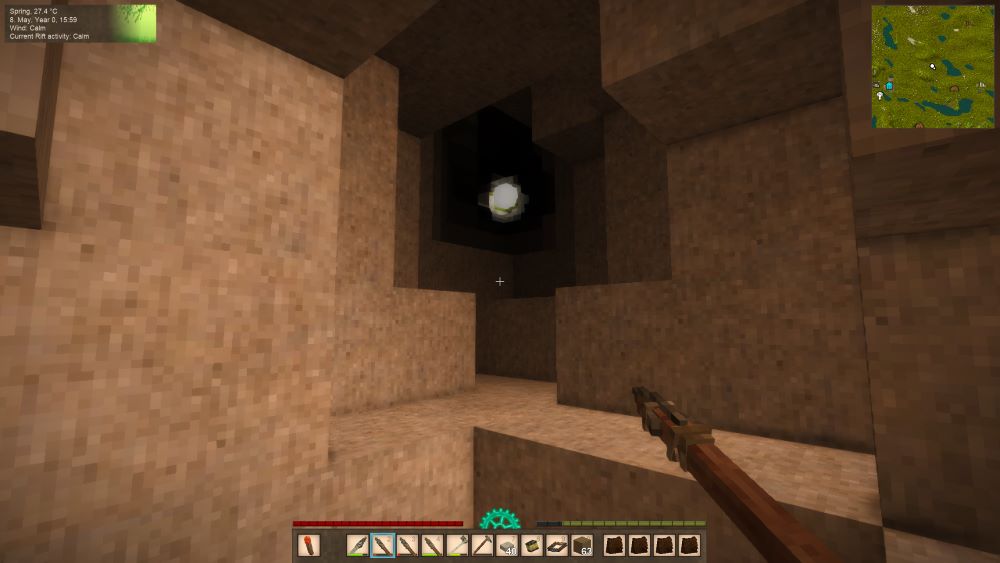
What about the mods though? Well, Primitive Survival adds a lot of food options, including the ability to chop meat into jerky, which helps with preserving food in the early-game. There is also some enhanced fishing capabilities that doesn’t rely on literal fish mobs spawning. The extra food stuff from the other mods didn’t really come into play because I didn’t enter the Wood Board Age. Or maybe I was just too dumb to understand the trick behind easier recipes or whatever.
Out of all of them, XSkills had the most promise. Basically, the mod adds character progression to the game, which is absolutely something I feel Vintage Story lacks. The default XP rate is abysmal, but you can boost it via editing some files. One of the skills grants a chance of collecting Resin from chopping trees, which is essentially all I ever really wanted from the game. There seemed to be some neat stuff in there, amongst the more generic +5% X and similar, but I didn’t earn enough XP to reach anything of particular note. I definitely recommend it though.
Weirdly enough, I do sorta still have a vague desire to play Vintage Story. I’m not quite sure if its the equivalent to Stockholm Syndrome, wherein you spend so much time understanding the intricacies of a game that leaving it makes you yearn for it more, or what. It is fun exploring the map and potentially discovering something amazing right around the next bend. The problem is that everything circles back around to an incredibly dull, “realistic” mining simulation and arbitrary gatekeeping. Fighting feels bad, the lack of armor options feels bad, it feels bad when your map doesn’t spawn any goddamn Horsetail which is the only early-game source of healing items.
It is entirely possible the game is simply not built for someone like me. And I guess that is OK. I’m not even sure what changes they could make in future updates to make it more palatable. Maybe a more cohesive early-game where you can make leather without needing Wood Boards, or perhaps more armor options with just Hides? Maybe not needing to already have copper to mine copper?
We shall see.
Impressions: Vintage Story
Vintage Story is a ponderous, “realistic” survival crafting sandbox in the style of Minecraft. Pretty much the exact style of Minecraft, in fact, although it supposedly has a different codebase that allows it to do some interesting things. How interesting those things are will greatly depend on how slow and methodical you like your gaming.
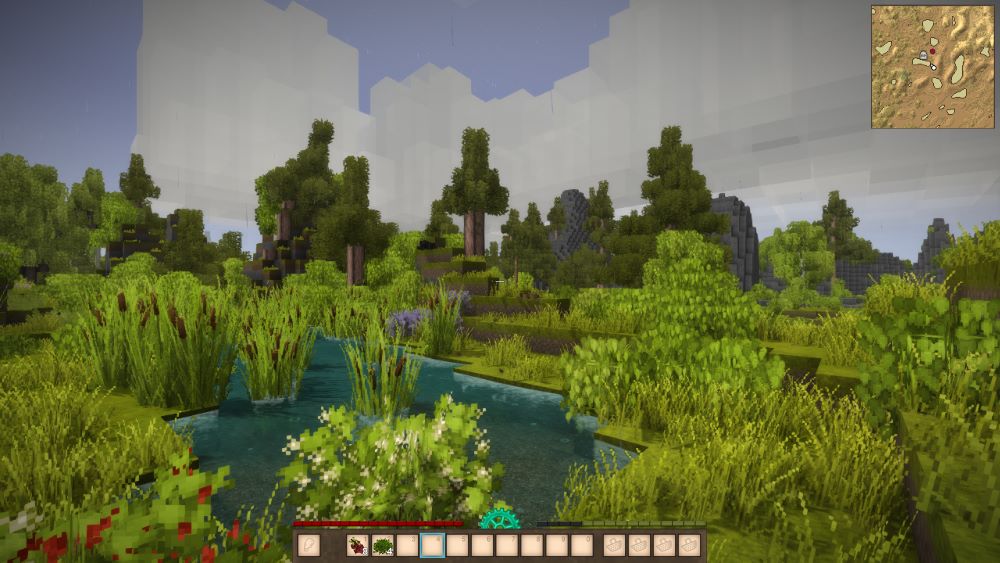
As with most survival games, you start out with just the clothes on your back. From there, you collect flint or some other hard rock to make tools. In Vintage Story though, you literally make the tools: you place the flint down on the ground, and use another piece of flint to “knapp” (e.g. chip) the other piece according to a voxel pattern. Combine the knife head (etc) with a stick in your Minecraft menu and voila, a flint knife. This will allow you to collect things like reeds to be turned into baskets or dry grass to help start a fire. You can’t just punch everything to get the proper resources here.
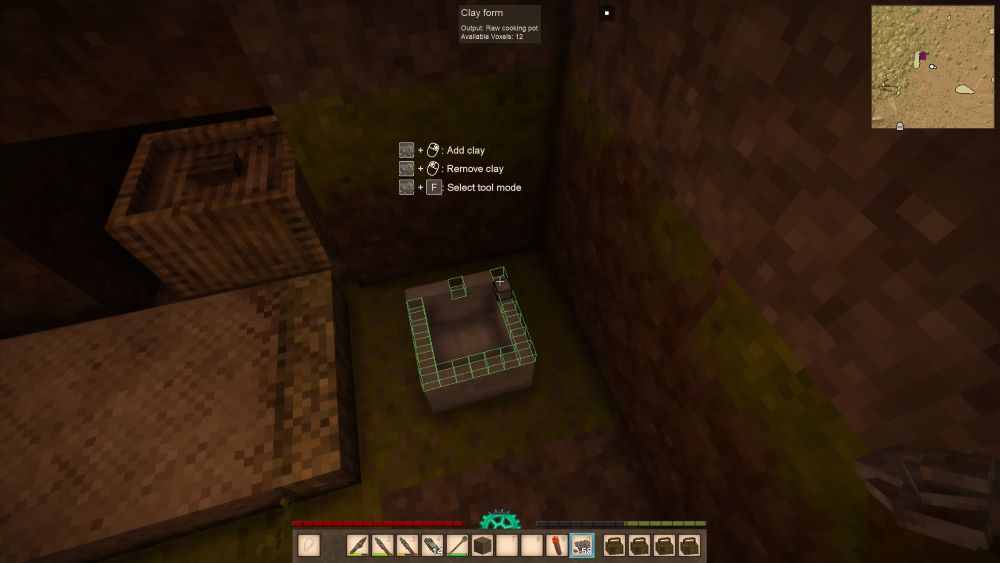
At this point, Vintage Story doubles-down on the intentionality. Flint tools are fine, but you really need clay to get to the next stage of development. Search far and wide for clay deposits, dig up a bunch, and then place some on the ground. You now have the option to create various clay vessels, like bowls, cooking pots, storage vessels, jugs, and so on. Crucially, you will also need tool molds, such as for a pickaxe and hammer. All of these things have to be sculpted, voxel-by-voxel, which is equal parts tedious and zen. Once completed, congratulations… you have still have raw, wet clay. Now you need to dig a hole, fill with dry grass, sticks, and firewood, light it on fire, and then wait 24ish hours for the pieces to harden. Oh, and make sure it’s covered from the rain and also away from flammable material.
Next comes copper. While traveling the overworld, you may come across a few pieces of copper nuggets on the surface. You can collect these – and mark your map since there is ore underground there – but will likely have to pan sand/gravel for additional nuggets. Once you have ~40 copper nuggets, you can begin the smelting process. Which requires charcoal, because firewood cannot hit the necessary temperature. Making charcoal involves digging holes, filling it to the brim with firewood, building a fire on top of that, lighting it, and then covering the whole thing up. A day later, you have charcoal. Go back and heat up the nuggets in a (fired) clay crucible, and using some wooden tongs – can’t have molten copper in your bare hands, of course – pour the copper into the (fired) clay tool molds… and wait. Once it cools, you have a copper pickaxe.
And now, finally, you can dig rocks!
I typed all that out because that is the type of game Vintage Story is. Mostly. Cooked food spoils at a reduced rate inside a clay Storage Vessel, and at an even further reduced rate in a cellar, and at an even more reduced rate if the food itself is stored in a clay Crock Pot sealed with animal fat. Neat. Meanwhile, you can construct your house and cellar by punching dirt blocks and placing them ala vanilla Minecraft. Making flint knives and other tools is a cool process, but the blade and handle are just magically connected somehow. I bring this up because the process of making a bow meanwhile requires twine, made of flax fiber, collected from flax (or looted from Drifters). Getting the first “tier” of armor above basically nothing requires Resin, which only comes from Pine trees at world creation, and only at an extremely limited chance. Like… why? We can hold molten copper in wooden tongs but can’t get some pine resin from pine trees?
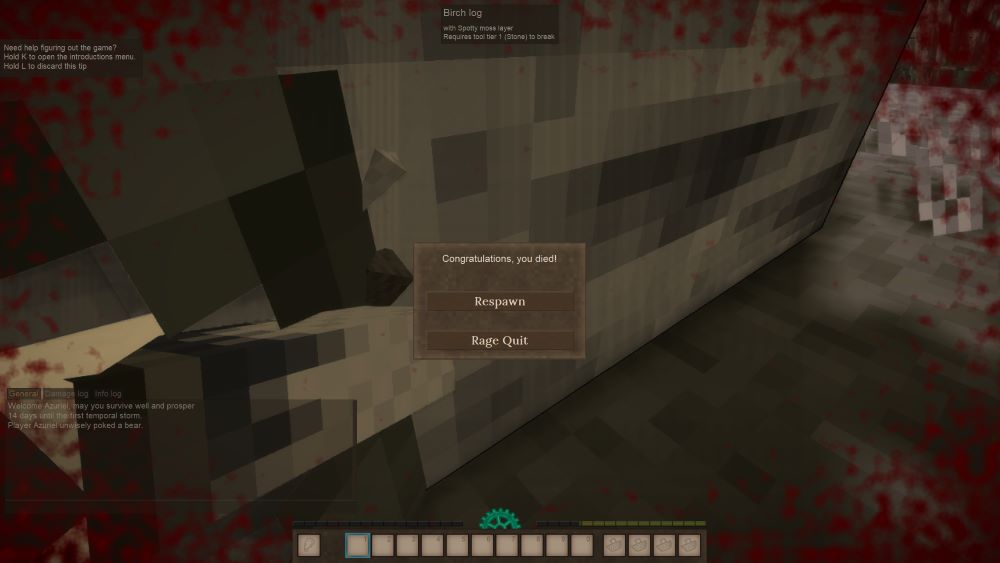
This sort of strained duality extends elsewhere. Wolves and bears are dangerous and will kill you in 1-2 hits. You can avoid them though by using a nerdpole, e.g. quickly placing blocks underneath yourself while jumping. Ore deposits are “realistic” in that they follow veins in specific sort of shapes. Getting to them can be sped up by either digging straight down and nerdpoling your way out, or creating an infinite waterfall via bucket and swimming straight up like in Minecraft. Crops take ages to grow – sometimes more than 1-2 in-game months – but animals generally spawn everywhere. Pemmican doesn’t exist, and not every animal has fat. And so on.
Those design choices are one thing, but the one that’s a bit more unforgivable (IMO) is the back-loading of content. The “real” game doesn’t really start until you can make wooden boards, which requires a copper saw, which requires a copper anvil, which requires enough copper nuggets gained from mining with the copper pickaxe. How do you get copper nuggets to make a copper pickaxe you ask? Panning sand, basically. Anyway, wood boards give you a ton of building and storage options, but the big ones are buckets and barrels, which then allow you to process things into leather, pickle food, and basically… everything. I understand that perhaps the intention was a sort of “congratulations on surviving until the Copper Age!” but that doesn’t mean the early game should be less interesting.
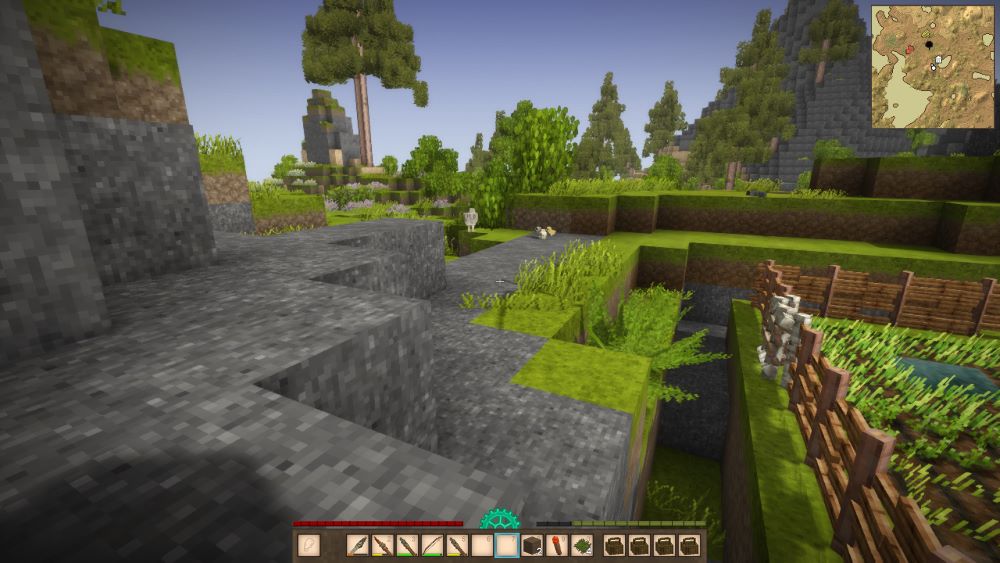
Vintage Story also suffers in the “now what” department. Surviving the first winter with limited resources is a massive struggle. After that? Farms will provide all your caloric needs rather easily. You can eventually craft some windmills and other mechanical tools to automate some tasks too. There are caves to explore and Drifters to fight and teleporter devices that can send you to far distance places. But… that’s it. I’m not saying other survival games do not have a similar endgame issue – there’s no “point” to 7 Days to Die or ARK – but the crucial difference is that playing these other games is, well, fun. They have good moment-to-moment gameplay, they have character progression mechanics that make you want to reach the next level, and so on.
That sort of thing is missing here. Once I finally got my Copper pickaxe and then realized how difficult it was going to be to find copper nodes, I was basically done. Plus, you know, if you lose your Copper Pickaxe somewhere (either by dying in a deep hole or via durability) you have to literally start all over.
Having said all that, Vintage Story is definitely a novel approach to the more traditional survival crafting genre. It is not in early access, still gets beefy updates, and was built from the ground up for mods. Indeed, there are supposedly a lot of mods out there that tackle many of the fundamental issues that I have brought up. I may end up rolling a new world with some of these mods installed and see if that smooths out the experience and make it more interesting.
Which, for the record, it was for a time. Just not enough. For now.
Impressions: Abiotic Factor
Short version: Highly impressive survival crafting game in Early Access.
The overall vibe Abiotic Factor has going for it is the original Half-Life (complete with polygon counts from 1998) from the perspective of the scientists. You play as a new recruit to a secret Australian (?) underground laboratory doing SCIENCE… on things from another dimension. Something happens literally during your first day of orientation, the base goes on lockdown, and you are basically on your own to escape.
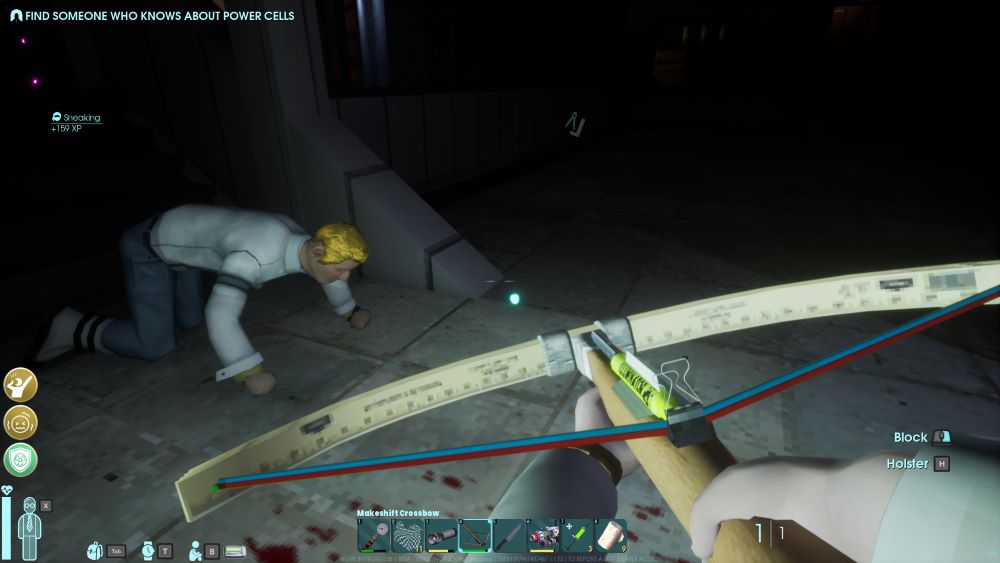
One thing I loved immediately was the novelty of the survival experience. Playing this game reminded me of playing Subnautica for the first time when none of my “punch trees” experience applied. Sure, the wooden crates give wood, but you’re mostly in an office setting at first, and wood isn’t even really what you need to craft the basic items. You might not think slinking through cubicles, snatching keyboards and breaking monitors for their sweet, sweet coils while hiding from alien monsters would be fun… or maybe you would. Because it is. There was some primal pillow fort energy when I set up my base in the gym area, hiding in terror from the rampaging night bots, and then making forays into the break rooms for literal supplies – including buying food from the vending machines to tide me over! – while getting my in-game bearings.
Are there some rough edges? Sure. One of those edges is, in fact, somewhat systemic: being a survival crafting game at all in a relatively linear, plot-driven narrative. While you can possibly spend in-game weeks in the first area, the fact of the matter is that you need to specifically craft X using resources from Y to open the next area Z. Once in that new area, you will encounter new obstacles, new crafting material, and new things to take into account, which is good. What wasn’t immediately clear to me though is that I should have packed up everything I built in the first zone and carted it with me rather than starting from scratch in the new zone. It certainly feels lame leaving an upgraded workbench that can auto-heal and warm you by proximity and going somewhere with a dearth of the more basic building materials. It especially felt super lame when I got locked into an extended journey sequence that resulted in my entire plant farm dying from lack of water while I was gone. So much for utilizing the more advanced cooking options, eh?
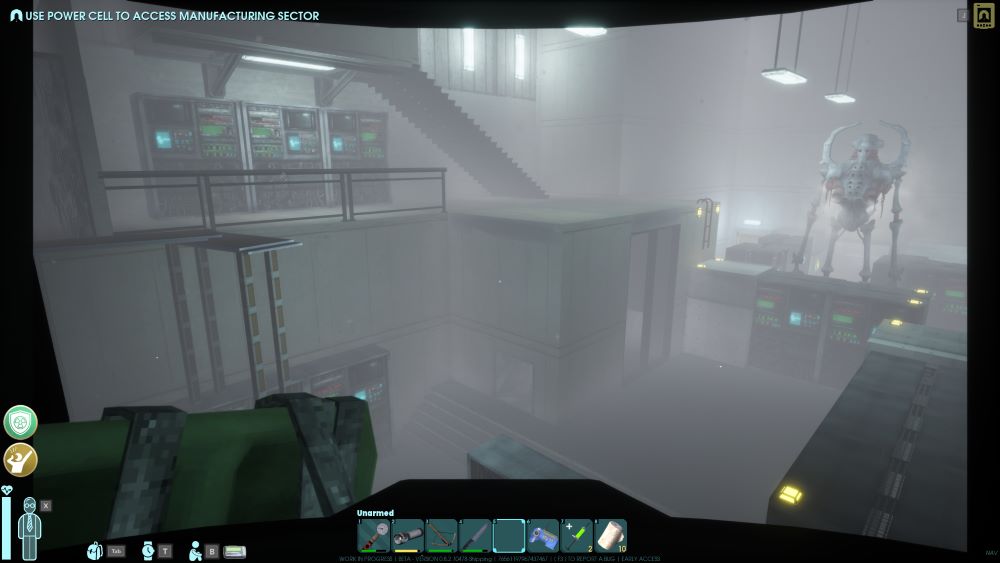
Aside from those sour grapes though, Abiotic Factor nevertheless gets high marks from me. While most workbenches require power and thus need to be located near power outlets, everything else can be placed just about anywhere. Which includes literal ramps and platforms that allow you to skip certain areas entirely. Now, whether you actually want to skip any opportunity to hoard bundles of pens, deconstructed file cabinets, and other debris is up to you. Personally, I tend to steal everything not nailed down and sometimes even that stuff too. You just never know what may come in handy.
What I do know is that I liked Abiotic Factor enough to stop playing, so the devs can finish cooking.
Impressions: Icarus
TL;DR: Empty wildlife murder simulator.
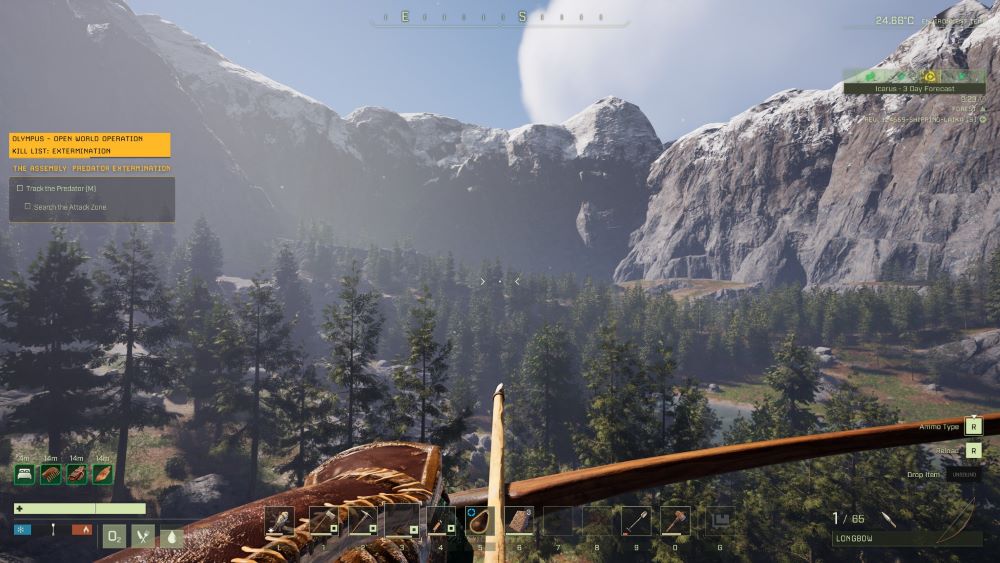
To understand what Icarus is all about, you need to know what it was about. At release, Icarus was intended to be a sort of survival roguelike, where you are dropped off at a location, fulfill a mission before the timer expired, and then bailed on the world (including anything you built) within a few days. In fact, it was originally so hardcore that if the timer expired before you left – and it counted down even with the game turned off! – your character would straight-up be deleted. Successful missions granted you a currency that could be used to both research and then later buy items that you could then bring with you planetside in the future. For example, instead of starting at zero every time, you could start with an upgraded spacesuit, a backpack with bonuses, weapons, etc.
As you may imagine, that novel approach didn’t sit well with many people. Indeed, it’s difficult to imagine a worse genre mashup… although I suppose 7 Days to Die somewhat pulls it off (e.g. eventually enemies get too tough). But generally, the beginning stages of punching trees is the least interesting part of survival games, and losing progress is the worst. Icarus had both. The developers suddenly had to pivot, and so they eventually released a more traditional open-world survival mode.
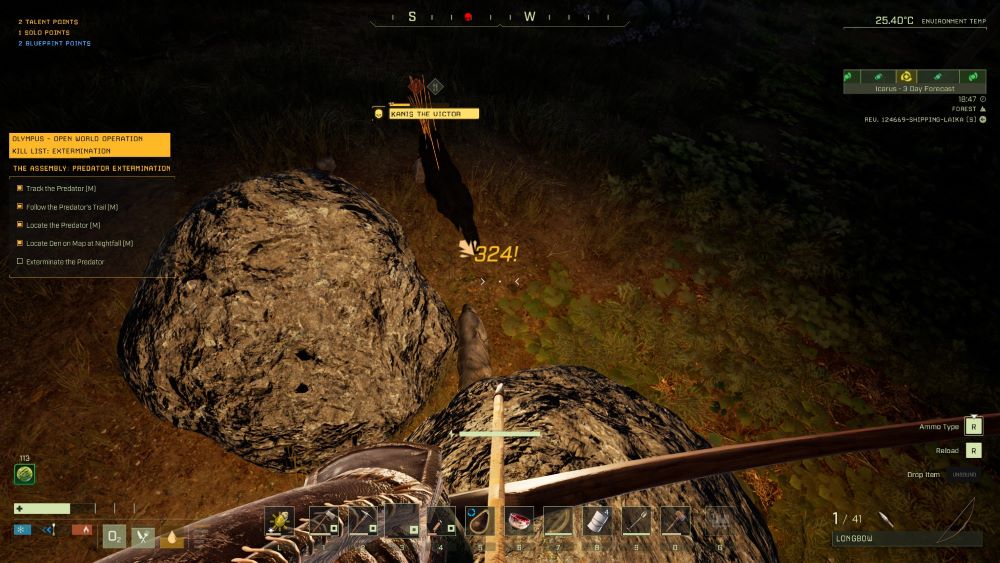
The pivot has taken some time, although the developers have sustained a weekly update schedule for over two years now, which is impressive. Or would be, if the game was fun or interesting at all.
The fundamental issue with Icarus is that there isn’t much going on. There is a relatively solid survival crafting framework in place, with XP and levels and recipe unlocks and talent points and such. The world is gorgeous and thick with trees, bushes, rocks. There is even a semi-voxel thing going, with fallen trees being satisfyingly split into logs, and ore/rock nodes deforming exactly where you are hitting them. All of which will sustain genre fans for a few hours past the refund window.
But after a while, you start to realize what you have in Icarus is basically the window dressing of other games. A forest with deer, rabbits, wolves, goats, moas, bears? A desert with hyenas and scorpions? Snow biome with polar bears and mammoths? Other titles like 7 Days to Die, The Forest, ARK, etc, have those things… aaaaand the rest of the game game. Without the parameters (and timers) of Missions, the Open World aspect falls flat. Technically, you can craft a radio that opens up both short and longer-form Missions even in the Open World, but you still run into the issue of “why.”
“Why do anything at all in any game, eh?” Because shooting zombies and looting things is fun? Because delving into caves and uncovering mysteries while running from mutants is (supposedly) fun? Because dinosaurs are fun? With Icarus, what you see is literally what you get. Kill thousands of animals to farm XP and unlock more crafting benches so you can kill more animals efficiently. Or build a quaint little abode in the woods. Which is fine for the people that want to do that, but you can also do that in (cheaper!) games that have more meat than potatoes.
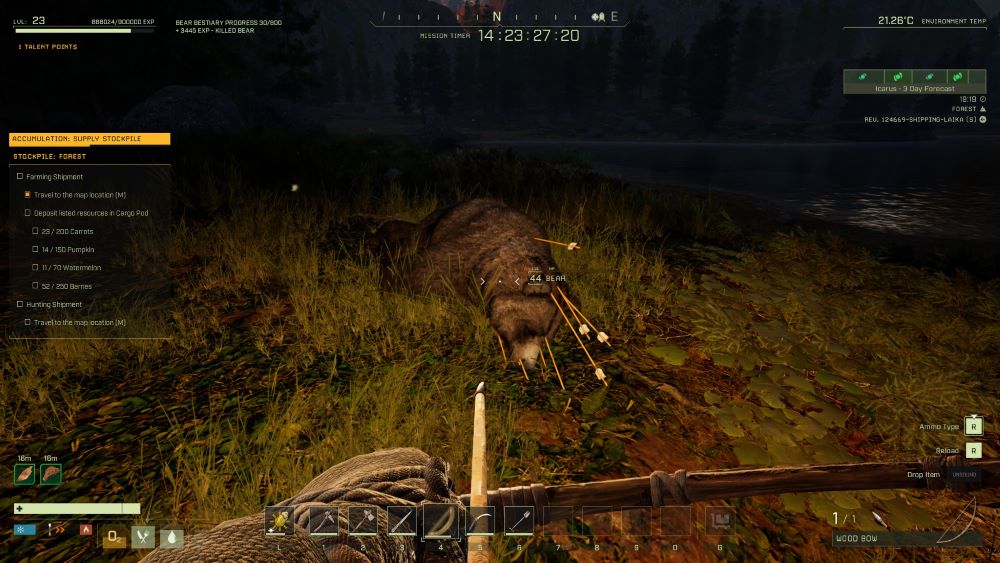
In an effort to be totally fair, I did go ahead and run a few Missions, e.g. the way the game was designed to be played, once the open-world lost its luster. And… it was pretty much as bad as it seemed. After the tutorial one, the next Mission was to collect up meat and vegetables into two different drop pods. Cool. What they neglected to mention was the fact it was going to be like 150 Pumpkins, 200 Carrots, and so on. The only possible way of gathering that much was going to be setting up a farm, and then hanging out for a while. Which I did. Next was the meat, which was something absurd like 300 meat, 400 hide, and 300 fur or whatever. I got about halfway through murdering literally every single mammal that moved before the tedium overtook me and I uninstalled.
Having said all that… is there anything good going on in Icarus? Sure. Although it is a limiting factor, the existence of oxygen as a necessary meter to watch gave texture to the survival experience. It helps that Oxite Ore is in most places, so you aren’t as constrained as in, say, Breathedge. The storms in Icarus are also interesting. Staying outside in one fills up an Exposure meter that begins hurting you when full, and the storms themselves do damage to most buildings. Now, you usually just spend the storm inside your base running around and smack-repairing things with a hammer, but it elevated “weather” from a pure, ambiance detail in most games to one that you must account for. And you do have to account for it: your walls will collapse if they take too much damage from the weather or anything else.
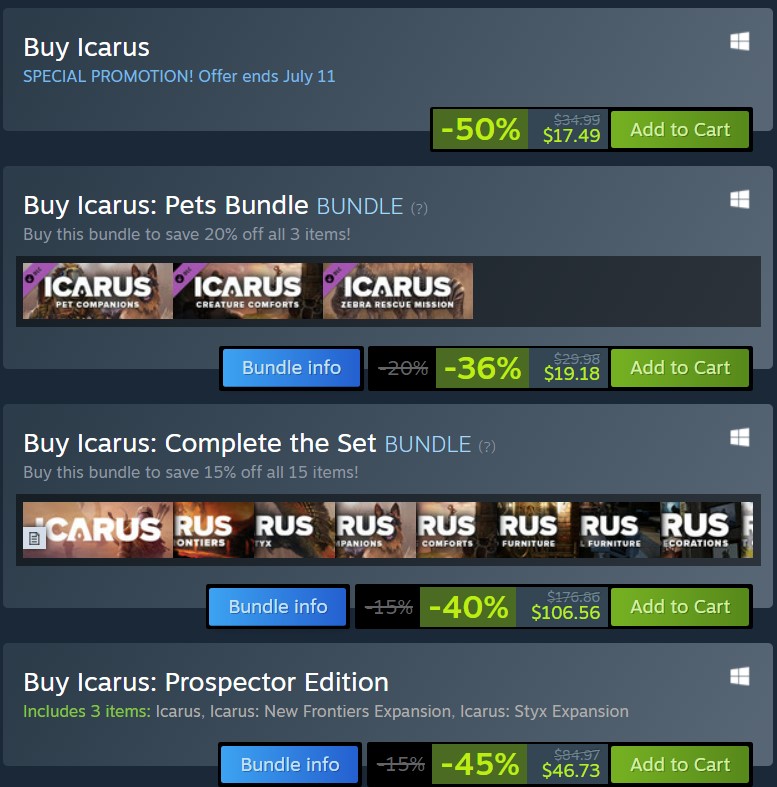
That’s about it, though. Part of me feels bad for the devs since they likely had to scrap a lot of their post-release plans when they pivoted to a more traditional open-world structure. But then I look at how much they are charging for the game + DLCs in its current state and those feeling go away.
Impressions: Once Human
Once Human is an open-world survival crafting MMO whose Beta details I mostly received filtered through the amusing lens of Bhagpuss. Based on those posts, I wishlisted the game and promptly forgot all about it. Then Tuesday came along and now its officially released. I played for almost six hours straight on that first evening, and not because it was, as my 5-year old terms it, a “stay day.”
Nor, incidentally, because the game necessarily deserves it.

Let’s start with the Pros, I guess. First, the game is free to play and not obnoxious about it. By that I mean I did not seem to get prompted to buy the Battle Pass every time I opened a menu, or had a red exclamation mark on my UI until I opened the shop, or the myriad of similar design disasters. Indeed, there is a Wish lottery mechanic (for cosmetics) somewhere in the game, but I was not actually able to find it. Maybe it unlocks later? I found a few vendors who require obscure currencies for vague items, but near as I can tell, none of them were extra bag slots, carrying capacity, or the like.
Second, Once Human does seem to support a rather robust survival crafting experience. You are encouraged to build a base immediately once out of the tutorial, and you can do so almost anywhere not already occupied by other players and/or the pre-existing set pieces. I also really appreciated the ability to go into “flight” mode when building, rather than having to awkwardly maneuver your character every which way. Collecting resources from trees/ore nodes is not too onerous at this early point, and you are overall encouraged to revisit points of interest to collect junk items that you then break down into smaller components to craft new items.
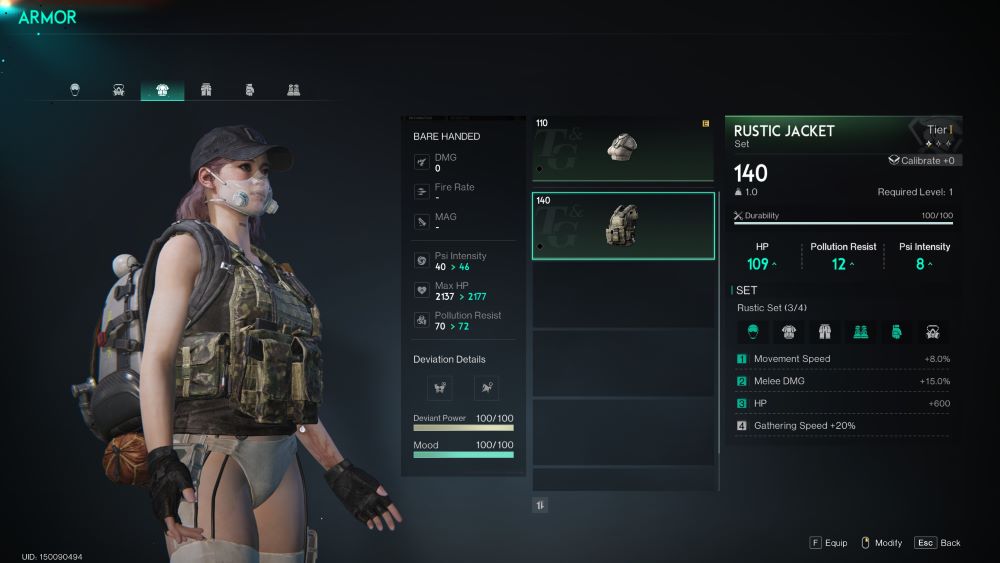
Then it struck me: Once Human is basically Asian Fallout 76.
Viewed from that lens, the veneer started to peel. Is the base-building better than Fallout 76? Absolutely not. Crafting? No. Quests? Nope. Environmental storytelling? Nonexistent thus far. The feeling of collecting and hoarding resources? Not even close. Both are post-apocalyptic, both have cryptids, and Sanity is basically Radiation – both reduce your maximum HP until healed and, hilariously, grant you special abilities if you accumulate too much (Whim vs Mutation).
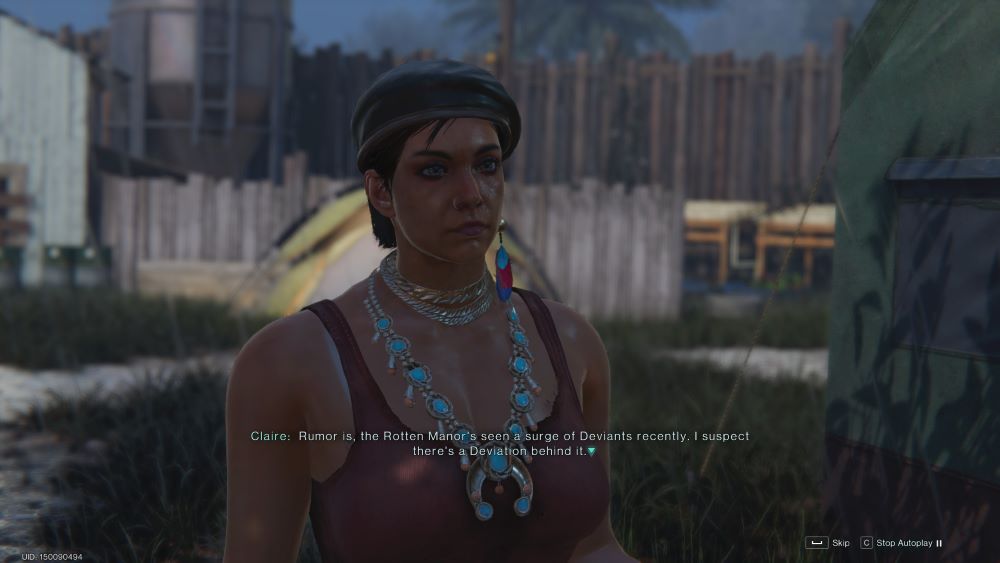
I originally didn’t want to complain about the Once Human combat system in these early stages – tutorials going to tutorial – but it’s… trivial. Every creature died to 2-3 hits with a torch, and having access to guns makes it even more ridiculous. Presumably mobs will sponge more bullets later on, and there is a dodge-roll button, but the fact that Once Human will be releasing on mobile phones in two months does not inspire confidence. The boss (or mini-boss?) fights were more interesting, and seem to be where the devs spent most of their imagination capital. Not saying that Fallout 76’s combat system is groundbreaking or anything, but it nevertheless has a heft to it even early on that is definitely lacking in Once Human.
Again, it’s possible this is all a bit unfair this early in the experience. The map looks huge, they give you a motorcycle within the first few quests, the Deviation (pet-ish) mechanic seems akin to Pals from Palworld, which could be interesting. The notion of Seasonal world resets and ever-changing “scenarios” is fairly unique in the survival space, and could go a long way in keeping the experience fresh. Time will tell.
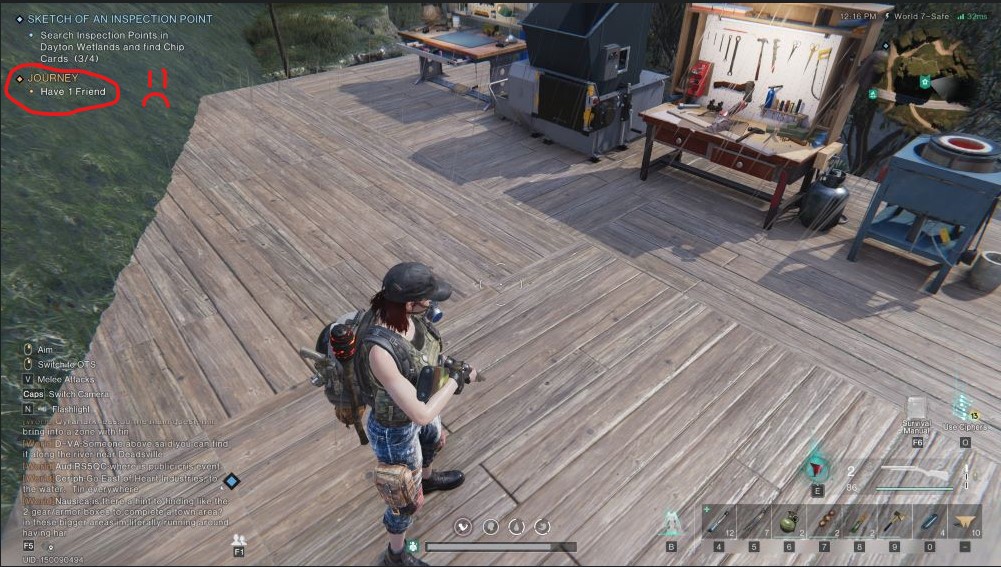
Time will also tell if I don’t just end up reinstalling Fallout 76 and playing that instead.
Impressions: Keplerth
Not going to lie, the name “Keplerth” was both intriguing and ultimately accurate.
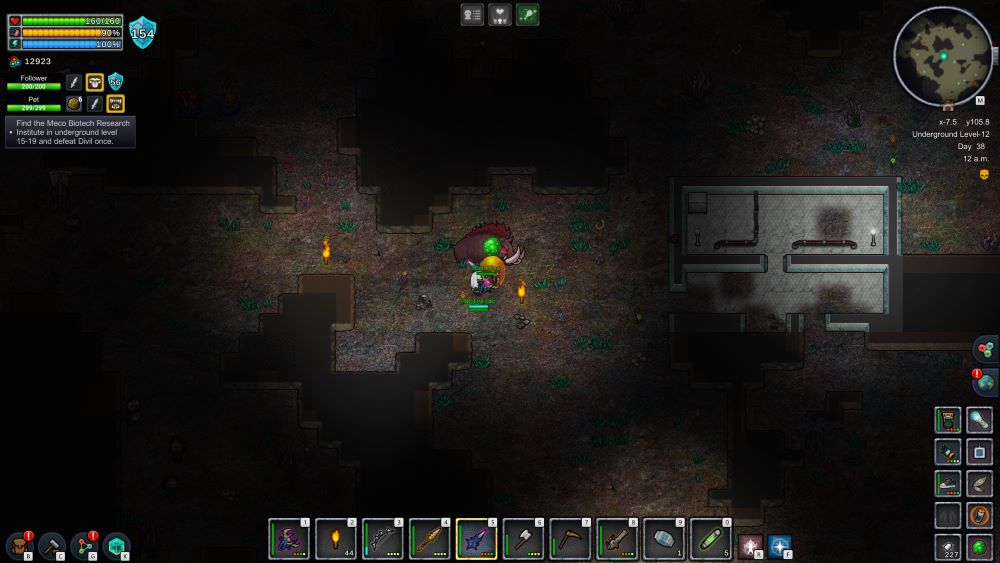
Keplerth is a top-down survival crafting game reminiscent of Terraria, with art assets straight stolen from RimWorld. Other reviews mention this as being a post-apocalypse knock-off of Necesse, if you know of that one. You will punch trees, create crafting benches, craft gear, and then tackle bosses to unlock the next tier of equipment, resources, and mobs. Rinse and repeat.
There are some interesting innovations to the formula though. For example, there is no XP here. Instead, you unlock new genes based on special resources that drop from basically everything in the game, e.g. plants, mobs, minerals, etc. The genes start simple, with stuff like +5% Evasion or +10% Attack Speed. Towards the beginning of the game, you have plenty of room to “equip” every gene you unlock; later on, you have to choose amongst them and their potential synergies.
I also appreciated how equipment bonuses work. Essentially, each piece of gear has a random set bonus and a random set bonus score (+0 through +3). So, the leg armor you craft might have bonuses to +Defense or +Pet Attack instead of the +Melee you were looking for. And even if it does have +Melee, the final set bonus may only trigger when you have 7/7 equipped and the piece you rolled grants +0. While random can be frustrating sometimes, many survival games are kind of rote in that Iron armor is Iron armor, and thus you only need 22 Iron ingots total to kit yourself out on that tier. This at least means you need to collect a buffer amount of resources. Later on, you get the ability to spend other resources to “reroll” the tier bonuses, so it is not too frustrating for long.
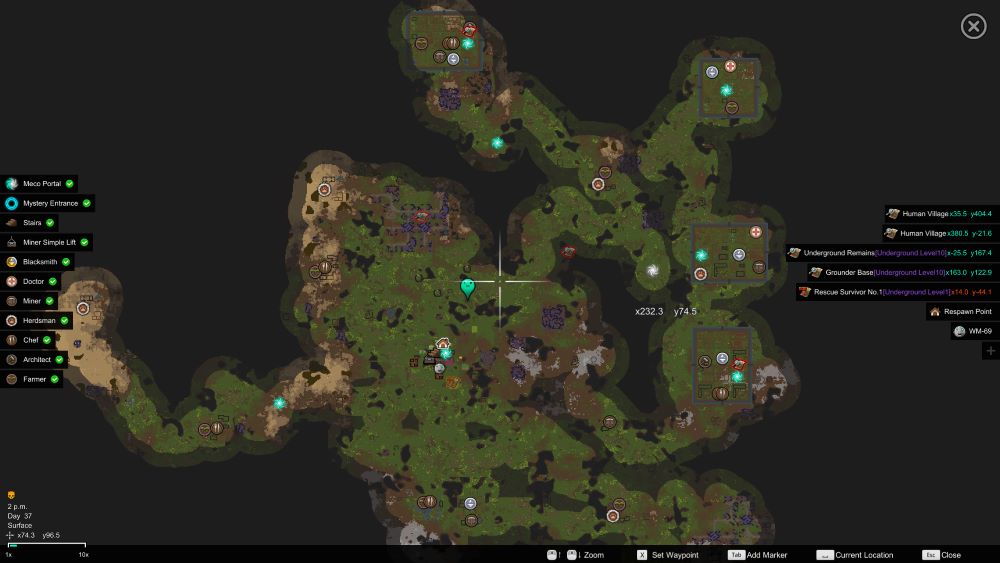
Where Keplerth struggles is… kinda everywhere else.
A lot of the mechanics feel half-baked. One of the early tutorial quests involves you attracting other survivors to your base with a communications tower. What the game doesn’t tell you is that the survivors… don’t really do anything. There is an entire elaborate construction station to create fancy furniture, but ultimately the survivors need 1 (one) recreation item (hot tub) and their heart meter will eventually fill and you click on them for money. That’s it. They do not defend your base, work the fields, or anything. You can also have farm animals like cows, chicken, horses, etc, and they will reproduce asexually as soon as their food meter hits 100%. Cooked food does require a variety of meat and plants for pretty useful buffs, so there is a point to all this, but it doesn’t always make that much sense. Like why have Horse Meat in the game when eggs are really the limiting factor for advanced food?
The special material mechanic I praised earlier is also a bit uneven. A lot of it felt natural at the time, as you just pick up all the things and new stuff seemed to unlock every 5 minutes or so. Eventually though, once your gene grid fills up and you start needing to examine what’s left, you start to realize that 5-6 of the missing genes require Thorns or Apples or some early-game stuff. Luckily the grind isn’t too bad since you can chop most everything down and replant it near your base to more quickly get additional chances when harvesting it – as opposed to having to wander around for more natural-occurring spawns – but the amount of things tagged to Thorns specifically is a bit odd.

What kind of broke the game for me though was one of the mid-tier boss drop weapons. Up to that point, you may have some melee weapons, bow and arrows, some early guns, and so on. Even with guns, there were some trade-offs with damage versus shooting speed. Then you get a 100% drop of an energy beam gun that deals constant damage with zero ammo. While it technically is out-classed in DPS later on, the utility of being able to trigger knockback, certain genes (“each hit adds X effect”), and the lack of ammo makes everything else feel dumb to use in comparison.
Later bosses also get into SHMUP/bullet-hell territory, which forces you to turtle up with your genes and equipment, which makes the fight last ages because you are no longer specced for damage.
Having said all that, I did end up playing the game for ~25 hours or so, somewhat obsessively. Keplerth definitely hit a stride for me after about the 2nd boss, once you unlocked the ability to tame battle pets, get some better weapons, better genes, and start finding other human settlements to spend money at. It is unfortunate how that petered out in the endgame, but what else can you do?
Play something else, I guess.
V Rising: All Done
I’m done with V Rising after about 56 hours.

I technically did not “beat” the game, but I am done. All bosses have been defeated aside from the last two: Adam and Dracula. I have maxed my gear and spells, acquired a Legendary weapon, and was otherwise facing down 5-6 additional hours of “gitting gud” before seeing… I don’t think there’s even credits screen here. There have been tough bosses leading up to this point, but these last two have multiple phases and Adam even requires the crafting of a special consumable to even access him for an hour. I think I could eventually take down Adam by investing in crafting a different endgame weapon, or swapping out spells during a fight transition, but honestly fuck that.
Overall, I stand by my earlier assessment of the game, e.g. it’s OK. I did develop a deeper appreciation of the visuals though and the overall art direction. Running around the map during daytime became an interesting game unto itself, as you tried collecting resources or fighting mobs only to have the shading tree collapse from an errand attack. The sound that accompanied increasing exposure to sunlight was also very satisfying (if not deadly). The moment-to-moment gameplay was satisfying.
What is less satisfying is the grind on the macro level. As stated before, there is no XP here, and mobs themselves rarely drop anything of value, so there’s really no point to combat. The whole vampire fantasy takes a bit of a hit when you rush from house to house rummaging through dressers for bits of cloth and paper. A lot of that has to do with some of the absurd recipes.

Here is an example of what I’m taking about. I need Power Cores to craft an item. Crafting them requires 18 Radium Bars + 9 Charged Batteries for 2 Power Cores. I’m just going to ignore the Charged Batteries, because you basically just farm Depleted Batteries from certain enemies and then have to juice them up out in the world. The Radium Bars on the other hand… oh boy.
- Power Core x2 = 18 Radium Bars + 9 Charged Batteries
- Radium Bars x4 = 135 Tech Scrap + 9 Sulfur + 3 Sludge-Filled Container
- Tech Scrap = mob drop and/or mining resource
- Sulfur x1 = Sulfur Ore x45
- Sludge-Filled Container x1 = 9 Glass + 9 Mutant Grease + 3 Iron Ingot
- Glass x1 = 45 Quartz
- Mutant Grease = mob drop*
- Iron Ingot x1 = 45 Iron Ore
- Radium Bars x4 = 135 Tech Scrap + 9 Sulfur + 3 Sludge-Filled Container
Again, all of that for two (2) Power Cores. You need 9 Power Cores to craft the highest tier of necklace. So that’s 90 Radium Bars. Which might not have been as bad as it felt if there was a reliable way of farming for Radium Bars directly. Instead, at best you are running around 1-2 areas breaking all the boxes in a desperate hope that you can get 5-10 Radium Bars from drops. That shit immediately reminded me of Warframe, and it feels outrageously dumb for the same reasons. I can sorta maybe get behind mining for ore as a fledgling vampire, but endgame Dracula-esque vampire overlord reduced to breaking open boxes for loot is too much. Farming enemies? Good. Breaking background clutter? Bad.
One thing that made it better/worse were servants. These are people you capture and then turn into vampires, who then can be sent on resource-gathering missions. While it takes a bit to set them up – they have to basically be equipped with the same gear you have, which means grinding some more – they can return fantastic amounts of resources on a real-time basis. To a point. There are several time increments you can dispatch servants on, such as 4h, 8h, 16h, and 24h, but the difference between 8h and 16h is not 2x the loot. Which means you are better off logging on, dispatching servants for 4h or 8h, then logging off. Sometimes they get injured, so they cannot be immediately be sent back out.

So, anyway, there I was, logging onto V Rising three times a day to dispatch servants because I no longer wanted to spend time manually farm resources. And remember, I’m already on +100% global loot. Once I realized that I could only play more of the parts of the game I enjoyed by playing it less… I did so. And then discovered that the other games I was playing instead were actually kind of fun and rewarded me for playing them more. Imagine that!
Arguably, none of this is how V Rising is “meant” to be played in the first place. You’re supposed to be out in the world with your chums, farming some mobs, attacking (or being attacked by) other vampires and stealing their loot, defending your castle from destruction, and so on. Theoretically, it would feel like less of a grind if there was more grind, insofar as you wouldn’t be hitting the endgame wall as early. Or something. But by the time I got there, I kept asking myself: why this over Diablo 4 or whatever? At least there I had something to potentially look forward to from killing all these random mobs.
That’s V Rising. I give it props for melding the survival crafting and ARPG genres in an innovative way, and overall being a very slick game. I can see how other people might play it for hundreds of hours with friends and/or internet strangers. But it doesn’t really deliver a better experience in any individual one of the categories compared to other offerings. And while it does offer most of the trappings of a good vampire fantasy, it shrivels up in the sweaty heat of an unnecessarily grindy endgame.

