Blog Archives
Hearthstone Evolving Monetization
I mentioned it last post, but Hearthstone recently came out with a new expansion, Whizbang’s Workshop, which also heralds a new Standard cycle with several sets rotating out. But after 10+ years of playing, this is actually the first time that I intentionally didn’t purchase the expansion bundle.

Now, nobody needs to know the machinations that transpired that resulted in my declining to spend money on Hearthstone, but I’m going to tell you anyway. Because, well, I certainly found it interesting.
Hearthstone is like most TCG/CCGs (e.g. Magic: the Gathering) in that it releases expansions several times a year (and pushing older expansions out of Standard). Card packs can be bought for 100g via in-game currency or purchased using real money at any time (basically $1/pack). In the weeks leading up to expansion releases, Blizzard will offer limited-time pre-purchase bundles, which sweeten the deal: $50 and/or $80 for 50/90 packs, random Legendary cards, and cosmetic Hero portraits. If you are trying to build a collection, these are typically the best bang for your real-dollar buck.
Blizzard will also sell you a Reward Track Pass ($20) that gives rewards like specific Legendary cards, and even more cosmetics. There is a separate Tavern Pass ($15) for Battlegrounds, which unlocks cosmetics but also an additional 2 Hero choices at the beginning of each game (arguably the most naked Pay2Win). Hearthstone also has an in-game store which features bundles of cards (typically $20) or macrotransaction cosmetics ($60!) for “signature” Legendary cards, e.g. alternative art.
All in all, if you want to give Blizzard your money, they make it easy to do so.
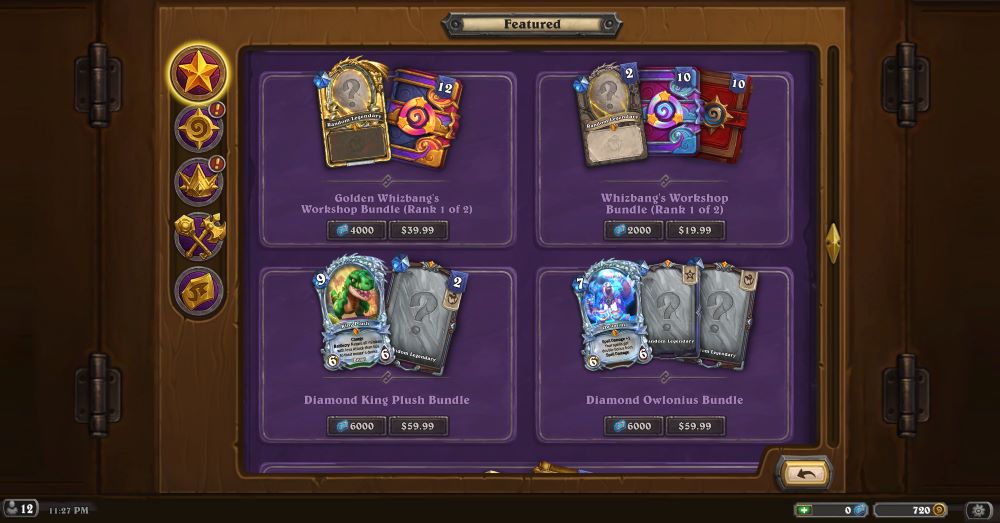
The actual value proposition has gotten murky to me though. A few years ago, Blizzard implemented both a pity timer (e.g. guaranteed Legendary cards after X packs) and copy protection that was later extended to all card rarities. This was an enormous Quality-of-Life feature that doesn’t necessarily get the press it deserves. On top of that, Blizzard more recently added a “reroll” feature once they committed to alternative art cards, which meant you could get a different card of the same rarity if you already had a “better” visual version. This doesn’t come up too often, but sometimes it’ll let you exchange a weak duplicate on the free Reward Track for a chance at something much better.
Concurrently, Blizzard has also seemingly changed their design philosophy regarding the power of cards overall. Historically, it was all about the high-profile Legendary cards flipping games by themselves. While that is sometimes still true, most of the time the best decks are only good because of the supporting Common and Rare cards. This change appears more democratic… but it has a sinister edge. When Blizzard nerfs a card, they allow you to dust (disenchant) the card for its full dust value, rather than the normal 25%. Back when Legendary cards ruled the day, a nerfed Legendary meant you could just dust it and craft another brand-new Legendary and play with a different broken deck. These days, Blizzard nerfs the (relatively powerful) supporting Commons/Rares, leaving the Legendary cards alone. Except, without the support, the Legendary card is useless, but you can’t dust it for full value because the Legendary itself hasn’t changed. Thus, “investing” in Legendaries is risky.
As an example, Blizzard just released a balance patch yesterday that contained three Paladin nerfs to Common/Rare cards. Now, the Paladin deck did need adjustments, as it could kill you from hand with buffed minions. And these cards were problematic. However, if you crafted the 3-5 Legendary cards that went along with the deck (and improved your winrate thereby), well… oops. Best you can hope for is that some other Paladin deck rises from the ashes before the cards rotate out of Standard.

Coming into this expansion, I had actually accumulated 6700g, which meant I could buy 67 packs straight-up. The copy protections mentioned above essentially means that that is enough packs to get all of the Common and Rare cards, along with a handful of Epic and Legendary cards. What would another 50-90 packs give me on top of that? A few more pity Legendaries/Epics… but remember, they are less critical than they were before and/or more risky. I would get a lot more dust to craft whatever card(s) I want, but again, I will already have the important Common/Rare cards already, and thus be gambling on “investing” in the higher tier cards that may get stranded in nerfed decks. No thanks.
Finally, to really bury the lede: Whizbang’s Workshop is a weak set compared to what we just had.
The extra funny issue surrounding everything is how players – including myself! – react to new sets. Many times the top theorycrafters will say something like “Totem Shaman is still Tier 1, but no one wants to play it.” What they really mean is that a deck that was super strong two years ago is just as strong against the current format without needing new cards. But no one wants to play it. Because A) they already played the same strategy for years prior, and B) it means acknowledging you paid money buying new cards you can’t even effectively use. It’s a double cognitive dissonance whammy!
Blizzard has gotten a bit better at adjusting cards (including buffing them, which they almost never did before) at regular cadences, but all the interlocking factors I talked about really makes me wonder about unintended side effects for players like me, e.g. the ones that try to gauge the value per dollar gained. Moving heavy into more cosmetic options is a clear workaround, but even that is fraught in nature – if the alternative art Legendary isn’t competitive, you’ll never likely be able to play it. And if you never play it, you may never be enticed to purchase said alternative art.
Or maybe you don’t care and just want to watch it animate from your collection like an NFT and/or play casual games and hope you draw it before getting killed by a bot. In which case, you do you.
Who Buys Games Anymore, part 72342
Carrion came out a few days ago, and I was intrigued after reading a review. Basically, it’s a “reverse horror” game where you control the writhing mass of teeth and tentacles as you eat your way out of a research facility. Probably not groundbreaking, but seems like a fun little game to pass the time. Was it worth $20 though? Maybe I’ll just add that to my Steam wishlist and call it a day.
Oh… or I can apparently play it right now on Xbox Game Pass.
I honestly can’t even. How does this business model work? I have the following games installed and ready to be played at a moment’s notice:
- Halo: Master Chief Collection
- Carrion
- Gris
- Ori and the Will of the Wisps
- Astroneer
- Frostpunk
- Forager
- Neon Abyss
Those are mostly indie-esque games, but they could be Dishonored 2, FF15, the Gears series, etc.
There apparently was an Xbox or Microsoft or whatever event a week ago, where they demoed a few of the upcoming games. I hadn’t been paying attention at all, until I started hearing people talk about STALKER 2. I enjoyed all three games of that series, jank and all, so hearing that there was a, erm, “sequel” coming out was great news. Bottom text, though? “Coming to Xbox Game Pass on Day 1.”
Also? State of Decay 3. Xbox Game Pass on Day 1.
Also? Destiny 2 and all (?) its expansions coming to Game Pass in September.
I’m paying like $5/month for this shit. How? The “catch” of course is that games rotate in and out all the time. I own none of these games. There really isn’t any modding supp… oh wait, there is. What?
The last time I used this title was a year ago, when I waffled on whether I wanted to buy Forager. Guess what’s on the Game Pass now? That’s right.
It’s kind of an open question on how much I would be willing to pay Game Pass, if it were not actually only $5. People still pay $15/month to play Battle for Azeroth for some reason, so that’s probably the floor. $30/month? I’m halfway to completing a $20 game that just came out, so maybe. Especially if it was a scenario in which I could sample/beat a lot of high-profile games all in a row.
Microsoft is not sponsoring this blog, I swear. But at these prices and with these games, they don’t need to.
Season Pass, Revisited
Two months ago, I was pontificating on the Clash Royale $5 “Season Pass” scheme, and the broader context behind this type of microtransaction.
This month, I have completed my third Season Pass purchase in a row. That $15 is more Supercell has seen from me in almost two years of playing Clash Royal, so clearly they are doing something right. But what changed in my thinking?
Floors and ceilings. And defined value.
If you browse any of the Personal Finance subreddits out there, one of the frequent topics is renting vs buying a home. What is correct for your specific scenario is, of course, specific for your scenario. One of the interesting lines that comes up though is this: rent is the most you will have to pay a month; a mortgage is just the minimum. As any homeowner knows, you have to cut a check to the bank every month and then pay for whatever shit may have broke in the meantime. Last summer, for example, we discovered dry rot in the roof by way of water leaking down pipes into the basement. You might come out ahead in the long run with a house, but that depends on running a long time.
In games like Clash Royale, the payment ceilings are effectively nonexistent. Most of the time, you are paying cash for random results and could end up spending $100 or $1000 for whatever it is you want. With that much uncertainty, it is better to… spend nothing. So I have been, for years, minus some 10x value offerings. Those had been great deals, but they were not real floors either – just chests and gold and random goodies that got me a leg up in the front door, so to speak.
The Season Pass is a true Floor. For $4.99 you get X, Y, and Z. Someone broke it down back when it first released but there was some extra value above and beyond the defined benefits. For example, unlimited resets on some of the Challenges. Sure, that effectively means “you get all the Challenge rewards.” But you could technically get all the Challenge rewards if you play well enough. With the Pass though, the anxiety is gone. I can play a few rounds while watching the baby, because if I have to put the phone down I won’t be screwing up my only shot at completing the run.
Much like with Humble Bundles, there is a relief that comes from knowing one small payment obviates any “need” to pay more money for the month. You don’t have to think about it anymore.
Of course, it is all a mental trick devised by mercenary psychologist-economists to get people to part with their cash. Nobody “needs” to pay any money to Supercell, and the “value” that comes from the Season Pass is, in part, derived from the fact the company has hitherto been miserly with normal rewards. If, if, you have been worn down by the unceasing barrage of unfettered capitalism though… well, the Season Pass is not the worst possible capitulation.
It sure as shit is going to get you farther than $5 will in Hearthstone.
 In An Age
PC Game Pass Price Doubles
Sep 21
Posted by Azuriel
I just received an email from Microsoft that the Game Pass is coming out of “beta” and will be increasing in price from $4.99 to… $9.99. This price increase makes it… still cheaper than the $12 legacy Humble Choice subscription, of which I have paused for the past five months in a row. It’s more expensive than EA Play ($4.99) but still cheaper than EA Play Pro ($14.99).
Will I continue to subscribe to Game Pass? Absolutely.
Looking at my account history, I have given Microsoft $60.96 over the last eight months. The two biggest games I played were Outer Worlds and Metro: Exodus, but there were a slew of “smaller” titles like Carrion, Into the Breach, Children of Morta, Nowhere Prophet, Forager, and Undermine. I’m looking forward to playing Spiritfarer, going through Halo: the Master Chief Collection, Astroneer, Grounded (I may wait until it’s out of Early Access though), Ori and the Will of the Wisps, Frostpunk, and possibly Disgaea 4.
The above isn’t taking into account the games on the service that I already own elsewhere. Fallout 76, My Time at Portia, ARK, Dead Cells, Dishonored 2, Don’t Starve, Final Fantasy 15, Hollow Knight, No Man’s Sky, Slay the Spire, Stellaris, Subnautica, The Long Dark. Shit, I just realized how many crafting/survival games I could have gotten for (relative) free. Oh well.
I don’t know why I continue to shill for this service, other than perhaps to reassure myself that this is actually a thing that exists in this world. I have long railed on the concept of Consumer Surplus and how gaming companies have systematically been extracting every last ounce via DLC, Season Passes, Loot Boxes and so on. This trend towards a Netflix model for gaming has been the one bright spot this decade, it seems, eclipsing even the Humble Bundle model before it.
Will it solve all our (gaming) ills? No. Stellaris is on Game Pass but just as the base game – it still has $100+ worth of DLCs in typical Paradox fashion. Same with ARK. But there is a natural tension surrounding extra purchases for “rented” games such that I can see perhaps a higher-tier subscription beginning to include DLC. Or maybe Microsoft will be dicks and force you to purchase the game years after launch for near MSRP to get continued use out of already-purchased DLC.
Nevertheless, companies will need to make the base game worth experiencing if they hope to grab gamers’ attention without leaning on the Sunk Cost/dissonance of ownership. Not every game is going to be on Game Pass, but I absolutely believe that there will be more of these subscription options from other companies, the same way that Netflix is no longer the only, ahem, game in town.
Posted in Commentary
1 Comment
Tags: Consumer Surplus, Hail Corporate, Value, Xbox Game Pass