Monthly Archives: January 2012
Reviews: Torchlight, Orcs Must Die!
Game: Torchlight
Recommended price: $0
Metacritic Score: 83
Completion Time: ~17 hours
Buy If You Like: Bad, bad dungeon crawlers
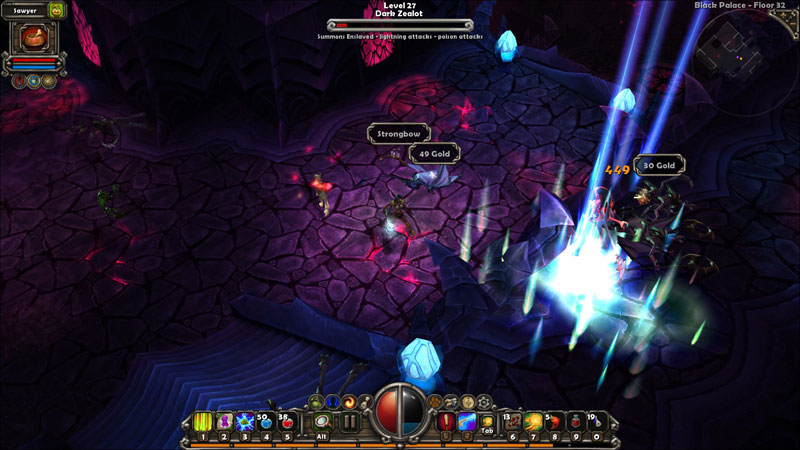
Four enemy types, 20 different skins. *Yawn*
According to Wikipedia, the Uncanny Valley is a hypothesis in robotics and 3D animation which holds that when human replicas look and act almost, but not perfectly, like actual human beings, it causes a response of revulsion among human observers. In other words, humans respond positively to human-like robots up to a point, after which our reaction to its failings is far more negative than would be towards a clearly non-human machine. Based on my overall experience with Torchlight, I firmly believe there is an Uncanny Valley of Game Design, which Torchlight cratered into face-first.
To call Torchlight a Diablo-clone is misleading; I would term it more a Diablo-mockery, although that implies Torchlight was intentional in its failings rather than simply being a cheap knockoff, like Chinese powdered milk laced with industrial solvents.
At first, everything is classical Diablo in a Warcraft 3 skin: isometric, dungeon-delving gameplay, hordes of monsters, loads of loot. There even appears to be a lot of improvements to the formula. The dog/cat companion makes the delving feel more homely. The three classes are actually modular archetypes, such as being able to make the “archer” into a rogue, the “mage” into a tank, and even the “barbarian” into a ranged magic-user. Four generic spell slots for your character and two for the pet let you do some interesting things to complement your own class abilities. I thought the Fame mechanic (Fame is like a second XP bar that only gives you extra talent points) was a clever way of making the killing of named mobs important without necessarily making you overpowered.
It was around hour six though, that I realized that Torchlight had not yet blinked its glassy, vacuous eyes.
There is no real gear progression in Torchlight. Let that sink in for a moment. I received an orange-text Unique neck item around level 4 that I was unable to replace for the duration of the entire game. Random stats are random, but when a random level 10 green is as powerful as a random level 30 green, the entire loot-centric nature of this particular genre collapses. The consolation prize mechanic is Enchanting, where you put an item in a box and have about even-odds that you paid someone 10% of your wealth to destroy said item. No, seriously. Find a decent weapon, put it in a box, pay ~1200 gold for a chance to add a random stat upgrade on it, a chance that nothing happens other than your gold evaporating, or an increasing chance your item gets disenchanted, completely wiping all its stats. The first item I tested this on got disenchanted on a 4% chance, and the second was an Unique-quality bow that was disenchanted on the first, 2% attempt.
I got an achievement for it. No, seriously.

Bum Luck: You installed this game.
Now it did occur to me that perhaps they were attempting something novel, a kind of re-imagining of the transitory nature of loot in Diablo-esque games. An upgrade isn’t an upgrade off the ground, but only after you “win it” from the Enchanter, or something. The problem is that whoever balanced this garbage was a goddamn moron. Enchanting costs gold. A lot of gold. The items you pick up off the ground never really increase in value the deeper you dungeon delve, such that each time you unload your haul in town you get the same ~2500g at level 10 that you do at level 30. Even Epic or Unique items sell for complete peanuts; the highest price I got for a sale was 1,809g for the level 4 Unique necklace I mentioned earlier, which the vendor turned around and was trying to sell for 82,432g. That’s right, instead of the typical 1/3rd or 1/5th cut you see in normal games, Torchlight is operating on GameStop levels of Fuck You resale value. If something could be worse than selling at 1/45th value, it would have to be the necessity of Transmuting four pieces of magic gear to turn into a random crappy gem, which needs to be transmuted with ~12 more crappy gems to get a mildly useful gem, to have something to put into the sockets of the level 8 shoulders you are otherwise never going to replace.
I am spending all this time talking about loot because loot matters in these games. Once you cease expecting any upgrades, the endless, nondescript corridors are filled not with opportunity or excitement, but are instead arteries clogged with the fatty plaque deposits of meaningless mobs. The original Diablo did not have much of a plot beyond “save us from evil” that I can recall, but the setting of gritty evil provided its own sense of gravitas. Conversely, Torchlight does not even bother. “Sidequests” are perversions of the term, and amount to simply killing mobs you were going to kill anyway slogging towards the stairs. Even worse, the “quest rewards” for these things are randomized green items. Look at this shit:
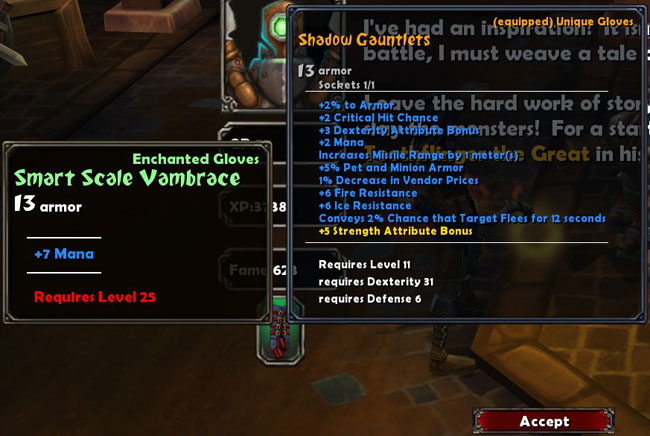
Equipped item on right, "Quest Reward" on left. Note the Required Levels.
The thing I kept hearing regarding Torchlight was that former Diablo 1 & Diablo 2 designers worked on it. If their contribution to that series is at all representative of what I experienced in Torchlight, then all I can say is good goddamn riddance.
Well, that, and I have never looked forward to Diablo 3 more than I have now.
Game: Orcs Must Die! + DLC
Recommended price: $10 (DLC included)
Metacritic Score: 84
Completion Time: ~11 hours
Buy If You Like: More trap-based Sanctum tower defense
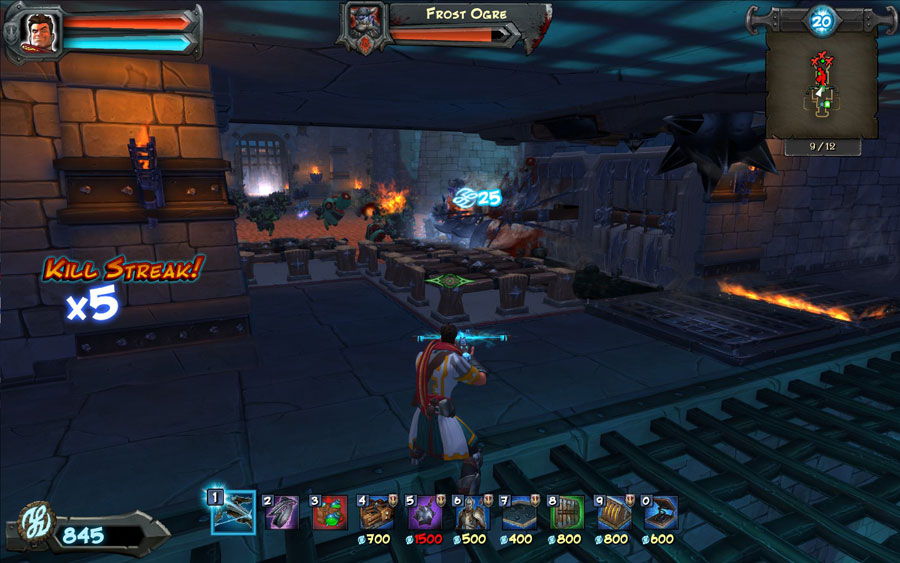
Few things feel better than killing orcs. Maybe Nazis. Or maybe Nazi zombie orcs.
Orcs Must Die (hereafter OMD) is one of the best, purest non-Tower Defense… Tower Defense games I have played. The premise is simple: the orcs are at the gates, and you must stop them. The rest of the game follows a simple elegance undermined only by the limitations of genre conventions.
To be honest, OMD felt like it had more in common with the brilliant PS1 Deception series than it does with Tower Defense. You start off each level by choosing a limited number of traps from your collection, in addition to personal weapons/spells that you will be using to kill the orcs. Traps range from spikes that impale from the the floor, to arrows that shoot from the wall, to mechanized swinging maces from the ceiling, to archer guardians; weapons include Fire/Ice/Lightning/Wind rings, to melee battlemage staves, to your trusty magic repeating crossbow. Later on, you can further select from 1 of 3 “Weavers” for that level, whom act as mini-talent trees that boost your effectiveness in different ways. Once your arsenal is selected, setting up traps costs a set amount of currency from a limited pool that grows between waves and from your merciless slaughter of orcish hordes.
And yet OMD deviates from the standard Tower Defense genre in many key, innovative ways. The most obvious is the fact that your Ash-from-Evil-Dead character can (and must!) get down and dirty in the fighting himself. While certain trap setups essentially make victory guaranteed, you typically won’t have enough currency to set them up in the early waves, and certain levels contain too many chokepoints to trust to traps alone. The standard orcs will actually chase you around if you are nearby, which can buy you some time for allow for traps to reset. Moreover, there are some enemy types like the ogres (fire, ice, and armored varieties) whom are too tough for typical traps to kill outright, and the downright scary Gnoll Hunters who leap over your orc-stopping waist-high barriers and hunt specifically for you.
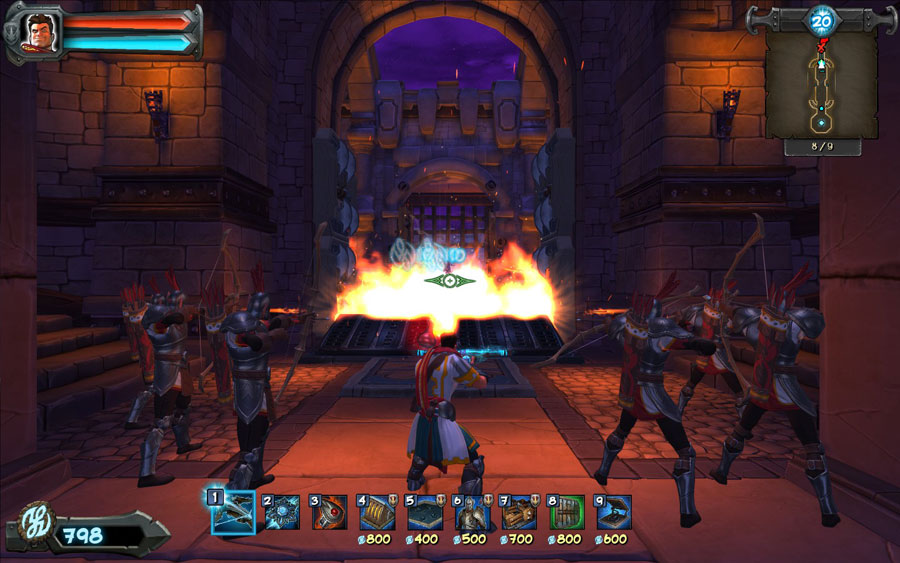
Ain't no one going home tonight.
The other area in which OMD forges ahead is in its rather brilliant, non-standard level design. In typical Tower Defense, everything is gridded out in neat, orderly squares. While traps require certain precise placement, I never got the impression from any of the levels that they were build specifically to place your traps “just so.” Fluted columns and flying buttresses foil wall and ceiling traps respectively, while floor traps cannot be placed on stairs. Any time I actually saw a 2-3 “square-trap-wide” corridor, I would get excited, like I won the goddamn architectural lottery rather than feeling this was exactly where the designers wanted my traps to go.
While there are some additional innovations like permanently upgrading traps by spending the orc skulls you earn based on level performance, OMD is unfortunately limited by genre conventions. I applaud OMD for not falling into the Tower Defense trap (har har) of simply increasing the HP of the enemies as a crutch for increased difficulty among waves, but after a while you will come up with trap setups that are essentially unbeatable. Much like in every Tower Defense game I have ever played, the slow traps (e.g. Sticky Tar Trap) are fairly overpowered; similarly, some traps and weapons feel too good, especially compared to others that don’t seem to have a place. I almost feel as though the game would have been improved if there was a mode or option to where you get a randomized list of traps, rather than entirely relying on level design to inform your decision. Or if there was some kind of incentive to utilize the “bad traps” in unique ways – since the Leaderboards are based entirely on points, I could imagine some kind of score multiplier for trying to use the Steam Trap or Push Wall Trap effectively.
Ultimately, OMD provides for some very enjoyable orc-killing and trap-setting Tower Defense gameplay. There is a Nightmare mode available for the masochists out there that hate more than 3 seconds inbetween waves, or you can try and top the Leaderboards on the traditional levels; the latter is actually fairly addicting when you have Steam friends who have the game, since their scores are highlighted in comparison to your own. Even if you are not interesting in replay value, the general play value of OMD is exceptionally high for what amounts to an inexpensive indie game.
DLC – Artifacts of Power
This pack comes with two weapons and two traps. The Alchemist Satchel lets you toss down a sort of glass caltrop which you can detonate at any time with a right-click, by shooting it, or letting a trap trigger it for you; the explosion is huge and will one-shot every orc in range, making this a fairly overpowered weapon for the early game (before the later rings). The Vampiric Gauntlets essentially lets you drain health from whomever you are aiming at, while the right-click turns your own health into mana; overall, the effect is pretty weak compared to your other options. The Shock Zapper ceiling trap is ostensively for killing flying enemies, but considering it only triggers from enemies flying directly beneath it and the fact that flyers usually path nowhere near ceilings (nevermind that even if they did, there would be better traps for that) makes this damn near the most useless trap in the game. Finally, the Floor Scorcher is a combination mini-springboard/flamethrower that has made itself a staple of all of my setups. If you set a Floor Scorcher near a ledge but facing away, it will burn everyone in a horizontal line while launching whoever is standing on top off the edge. More importantly though, it is a floor trap with a ~3-square range, which allows you to layer on the pain.
I would never buy this DLC for the $2.49 normal price, but on a deep discount the Floor Scorcher alone might make it worth a purchase.
DLC – Lost Adventures
This pack gives you 5 new levels, at least one of which is a remake of a prior level (just in reverse), and the Mana Well. The Mana Well is a fairly expensive “trap” that essentially recharges your own mana bar when you get close to it. The extra levels allows you to get additional skulls if you want to upgrade more of your traps, but overall I was not entirely impressed with them. There is no additional story behind the levels or extra dialog, which kind of makes them feel extraneous. With a default price of $3.99, or over 25% of the cost of the entire game, you would have to be crazy to purchase this DLC outside of a 75% off Steam sale.
Diablo Annual Pass Challenge
Tobold forced my hand a bit, so without further ado… I formally present:
The Diablo Annual Pass Challenge
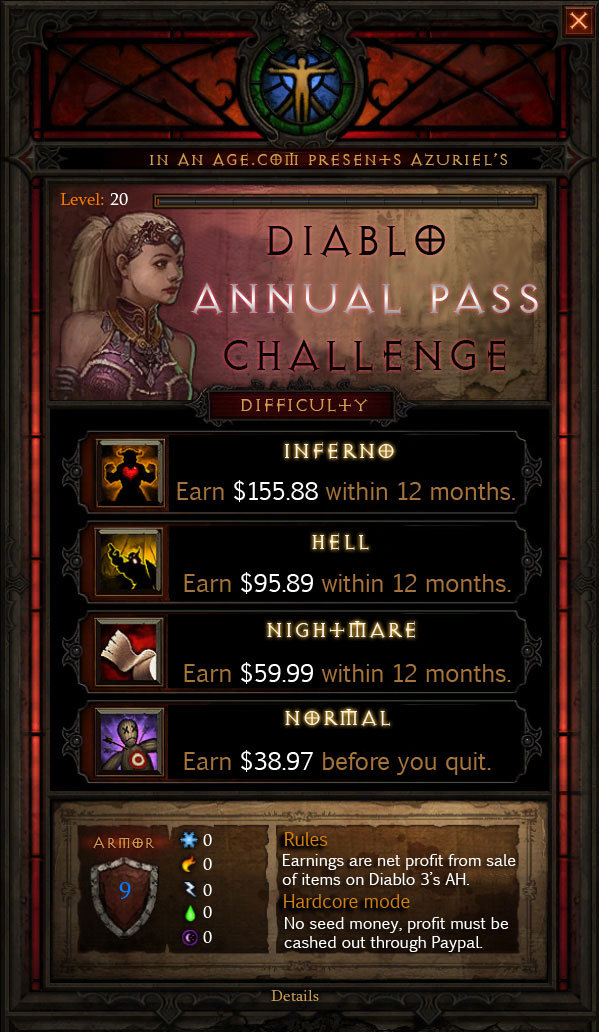
For the the visually impaired, the four difficulties are as follows:
- Inferno – Earn $155.88 within 12 months.
- Hell – Earn $95.89 within 12 months.
- Nightmare – Earn $59.99 within 12 months.
- Normal – Earn $38.97 before you quit.
Completing Inferno will mean you financed both Diablo 3 and a year of WoW (with associated perks) entirely through Diablo 3’s real-money Auction House. The step below that, Hell, means you financed an entire year of WoW through the purchase of a $59.99 game. Meanwhile, Nightmare demonstrates that you got Diablo 3 for free after paying for a year of reduced-price WoW time. Finally, completing the Diablo Annual Pass Challenge on Normal difficulty means you managed to pay for 3 of the 12 required months via Diablo 3 gameplay.
A Hardcore mode can apply to any of the above difficulties, and requires two things: 1) no seed money, e.g. putting $20 on your account to get started, and 2) net profit only counts when cashed out via Paypal.
Death is (unfortunately) permanent in all difficulties and modes. We are working on a hot fix.
For the purpose of this Challenge, “earnings” refers to net profit from the sale of items in Diablo 3’s AH. If you spent $50 and made $160 flipping items, you have only actually achieved Hell difficulty, not Inferno. “Items” refer to anything sellable on the RMAH, whether it is gear, gold, gems, characters, etc. Any money spent in the satisfaction of your Annual Pass obligation, i.e. buying game time, will still “count” as long as it came as a result of AH profit. In other words, you don’t have to just sit on the money until you reach your desired difficulty.
For those Challenge participants not using USD, simply use the relevant cost of two 6-month WoW time cards (Inferno), two 6-month WoW time cards minus the cost of Diablo 3 (Hell), the cost of Diablo 3 (Nightmare), and the cost of three months of the reduced-priced WoW Annual Pass subscription in whatever your local currency happens to be (Normal).
Good luck everyone, and don’t you dare undercut my shit.
Truer Words
In the middle of an epicly-long Kotaku article expressing the virtue of Dark Souls’ difficulty, the following lines jumped out and strangled me (emphasis added):
Because you repeat each section of the game so many times, and commit it so firmly to memory, you build up certain tricks and patterns. You achieve mastery, which is satisfying, and yet you always feel like something could go wrong, which is exciting.
When it comes to discussing difficulty in MMOs, I firmly fall on the “make it easy” side of the fence. I enjoy difficulty, I enjoy taxing my abilities to their maximum, but I also believe difficulty has its place; specifically, not in waiting for someone else to finally stop failing so I (we) can succeed. Games like Dark Souls work precisely because they are single-player.
That being said… the bold sentence in the quote above is perhaps the most succinct, inspired description of the mechanics of fun I have ever read.
Diablo 3… Soon?
There was a bit of excitement over the weekend following a Kotaku article that showed a Diablo 3 game display in a Best Buy whose countdown clock showed the release date being February 1st. Disappointingly, Bashiok replied a few hours later on Twitter with:
Diablo III does not have a release date. Any store or person claiming otherwise is guessing.
While the February 1st date no longer seems likely, I nevertheless was somewhat shocked into realizing “hey, it’s probably coming Sooner™ than Soon™” – that would have been ~3 weeks away, after all. I have mentioned before that D3 is going to be one of those rare Day 1 game purchases for me, and that puts me in a bit of a bind, decision-wise. I was close to breaking down and buying SWTOR before a price drop after reading four weeks of blogroll posts, but decided that perhaps playing through Mass Effect 1 & 2 first would be a good idea. You know, so I could make informed comparisons. A day later the D3 news broke, and I thought “oh shit, I probably should play Torchlight before it gets ruined, yeah?”
As a 3-year late aside, I am amazed at either the charity of Blizzard’s legal department or the extent to which iconic items are not protected by copyright. Scrolls of Town Portal, with blue ribbons, making blue portals, with their identical stated function? I know Torchlight was made by ex-Blizzard guys, but wow. There are obviously a lot more similarities, but that seemed the most egregious for some reason.
The decision bind is that the WoW Annual Pass “promotion” is still active, and I almost expect it to be indefinitely (in some form or another). Since I am already committing to D3 on launch, and will be interested in MoP once released, at what point does it not seem foolish to sign up? Especially given my predilection towards AH shenanigans, it is entirely possible that I may be able to finance the entire $155.88 Annual Pass damn near exclusively through D3.
…Hell, why not? Let’s call it the Diablo Annual Pass Challenge: pay for the Annual Pass entirely through D3’s real-money AH. Good idea, or brilliant idea? Time will tell!
Reviews: EYE: Divine Cybermancy, Gratuitous Space Battles, Hard Reset
Game: E.Y.E: Divine Cybermancy
Recommended price: $5
Metacritic Score: 60
Completion Time: ~14 hours
Buy If You Like: Half-Life 2 meets Deus Ex meets Warhammer 40k meets mostly hollow FPS frame
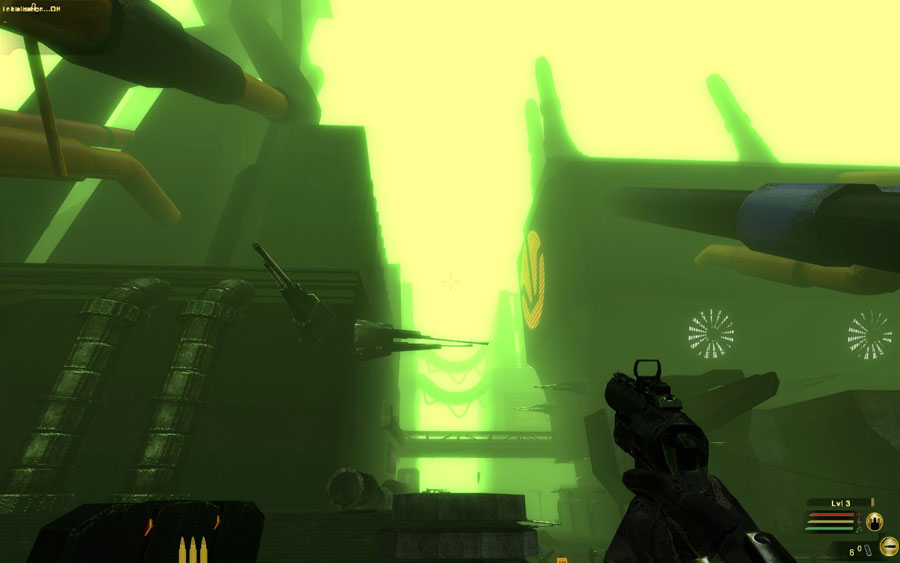
Welcome to the future.
Everything you need to know about E.Y.E.: Divine Cybermancy (hereafter EYE) are the first two lines from its Wikipedia page:
E.Y.E: Divine Cybermancy is an indie action/role-playing first-person shooter video game created by the 12-person French development team Streum On Studio, and built using Valve Corporation’s Source engine. It is a cyberpunk themed game based on the role-playing board game “A.V.A.” developed by Streum On Studio in 1998.
In other words, yes, this is a FPS built in the Half-Life 2 engine based on a board game and designed by 12 French guys.
The funny thing is that EYE plays exactly how the Steam gameplay videos look, e.g. cool. After character generation, you start out in a weird dreamscape area before jumping through a Martian gate and waking up in a cave. From here, the game takes you through impossibly large Blade Runner-esque settings, and has you kill (usually) never-ending waves of AI bots on your way to completing various objectives in – have I mentioned impossibly large? – locations. Despite the AI bots behaving very obviously like AI bots, the combat in EYE nevertheless remains deeply satisfying for reasons I cannot express.
The problem is that you can never really shake off the vague sense of hollowness that pervades the entire game. You gain XP for kills and damage, and as you level you spend skill points raising stats that allow access to either better weapons, better tech, or better PSI powers. You can upgrade your various implants by spending Brouzouf, the games currency, or you can spend it researching various technologies that may grant you additional stat points or unlock other items (or be a total waste).
And yet… none of it really matters. The game’s plot is the most convoluted, strangely localized mess I have ever seen. And despite “branching paths” the story very clearly was never meant to drive the game in any particular direction. I mentioned earlier that all the enemies behave like AI bots and I meant that – there is never any sense of scripting in the encounters you face, it very much feels like a Counter-Strike match against bots. Each map you complete can be played again as a “secondary mission,” where you are given three random objectives and placed in the middle of a never-ending firefight on said map; ironically, these secondary missions usually end up being more coherent and fun than the plot itself.
All that being said, I actually stuck through EYE to the end and found myself replaying the secondary missions quite a few times. I realize now that my experience is probably colored by my love of the sort of Deus Ex/Warhammer 40k/Half-Life 2/Blade Runner zeitgeist of the game, but I certainly did find the game more amusing than a 60 Metacritic score would seem to suggest.
If you find yourself gravitating towards cyberpunk games regardless of quality, you cannot go wrong with EYE… provided you find it on sale.
Game: Gratuitous Space Battles
Recommended price: bundle
Metacritic Score: 72
Completion Time: ~7 hours
Buy If You Like: The modular unit-designing of space games, without all the pesky gameplay
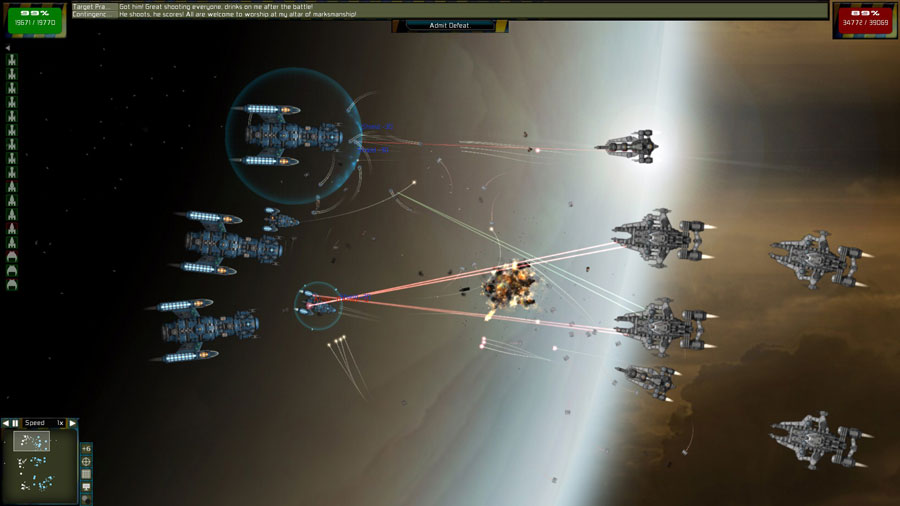
You have no chance to survive make your time.
Gratuitous Space Battles (hereafter GSB) is one of those indie games that is so ballsy that I am almost inclined to overlook the fact that there is no real game to speak of. Straight from the Steam description:
Who needs backstory? Who needs resource-gathering? Diplomacy is so last year. Gratuitous Space Battles cuts right to the chase of sci-fi strategy games, and deals with large, completely unjustified space battles between huge opposing space fleets.
Do you know in space-sim games when you are designing new hulls? You know, fitting components in the empty slots, trying to balance power/crew limitations while keeping costs under control? That is basically all you do in GSB: design space ships, place them on the left-hand side of the screen until you reach the resource cap, edit their orders a bit (ignore fighters, keep in formation, escort the cruiser, etc), and then press Fight.
Now, I will admit there is something deeply satisfying about watching epic space battles and see shit blow up. The very fact that it is impossible for you to influence the battle once it has begun is oddly comforting in ways that is typically impossible in RTS games.
But… that is the entire game. Design ship, place, watch result. There are 14 “levels” counting the tutorial and two endless modes, but the only difference in levels is the resource cap and occasionally the “anomalies” that might prevent fighters from being placed, reduce max engine speed, forbid shields, and so on in an effort to shake up otherwise unassailable strategies. And believe me, by the 2nd map I had a fleet composition that was basically impossible to defeat.
The ballsy part is how the base game costs $19.99 and there is currently $36.94 worth of DLC. A casual look reveals most of it consists of different races with their own unique hull components, and then a $6.99 DLC that turns the title into a full strategy game. If you are as disinterested in that as I am, the base game will take you about 7 hours to beat with the default race. There are two other races you can unlock to stretch that further, and you can always download player-generated scenarios to pit your fleet against theirs. Since there is zero rewards in doing so though, it is debatable as to why you would bother outside the novelty of the thing.
Game: Hard Reset
Recommended price: $10
Metacritic Score: 73
Completion Time: ~5 hours
Buy If You Like: Cyberpunk FPS meets Devil May Cry
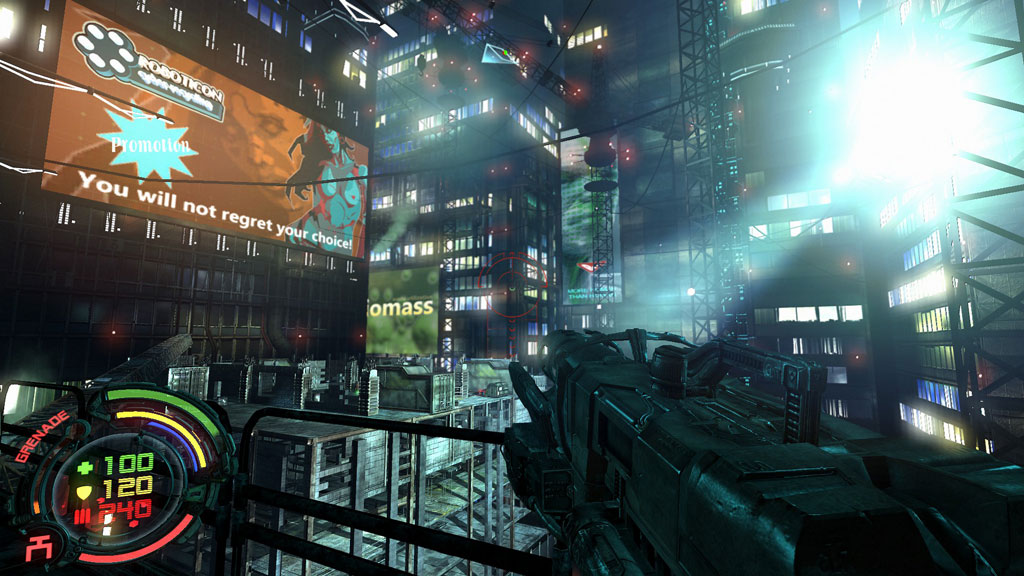
Cyberpunk hard-on: engage.
Hard Reset is one of the best-looking, most frantic, disappointingly short, unforgiving FPS games I have ever played. Set in a dystopian Blade Runner meets Matrix future, you control Fletcher as he mows down huge waves of robotic enemies using two highly moddable gun types and a cornucopia of destructible environment set pieces.
Starting out with a machine gun and a plasma rifle bound to the Q and E buttons respectively, you can upgrade them by collecting currency hidden around the levels or as drops from enemies. The machine gun can turn into a shotgun, a grenade launcher, a mine-layer and so on; the plasma rifle gets an AoE electricity mode, a rail gun, a Smart Gun mode that can track enemies through walls, and so on. The key to surviving robot attacks usually comes down to a combination of moves, such as launching a Gravity Grenade (unlockable secondary fire for grenade launcher) to trap a bunch of small bots next to an exploding barrel or what have you, and then launching a normal grenade at the pile.
Er… so yeah, that particular “combo” is fairly straight-forward. And I suppose that leads me to the disappointing aspects of the game: namely the wildly oscillating difficulty.
When you can use the One-Two grenade launcher combo, the game is actually depressingly easy; although bigger bots won’t die instantly, the gravity grenade works on everything but bosses. If one or two little bots escapes the gravity well, or spawn only after the first group blows up in spectacular fashion, watch out. The sheer density of exploding set pieces means you will frequently backpedal into a deathtrap a mere buzz-saw attack away from taking your life. That is when you experience the bizarrely out of place Checkpoint save system (no Quicksaves here), which probably sends you four waves and an upgrade into the past.
The game is also, as previously mentioned, disappointingly short. The story is not nearly as bad as other reviewers have stated, but right as it appears that the game is ready to head in a new direction while tying up some loose ends, the game… well, ends. The brevity of the game is such a hot-button issue that the developer has a passive-aggresive thread on the Steam forums called “Official announcement about GAME LENGTH” that starts out with:
Ok let me make some things clear.
You can finish Quake in 11 minutes.
You can finish Super Mario in less than 10 minutes.
You can finish Doom in less than 30 minutes.They are still good games.
You can’t finish Call Of Duty in less time than the developers wanted because it’s heavily scripted, with all the cutscenes, NPC preventing you from going somewhere etc.
Hard Reset was designed to be an oldschool game.
In spite of the truncated narrative, in spite of how it’s sometimes difficult to tell that you are actually dealing damage to robots with some weapons, in spite of how I would have preferred a cyberpunk FPSRPG over a Devil May Cry Arena-style FPS, I still find myself having enjoyed the (few) hours of Hard Reset immensely. There is reportedly a sequel or expansion in the works, and if the forum poll results are any indication, the team is well aware of how their nascent fan base feels about the necessity of Quicksaves, new story arcs, standalone single-player levels, level editing tools and mod support, and all sorts of other fantastic goodies.
If even half of the list makes it in, I personally can’t wait for Hard Reset 2.0.
Game of Dethrones
Rohan’s recent post The Guild as a Nexus of Contracts is an excellent read on the subject of Blizzard’s automatic “GM Dethrone” ability that was added in patch 4.3, and the concept of guild ownership overall. And it reminded me of the hidden depths of my rage towards this policy.

I joined the guild Invictus back when Azuriel was a level 30 draenei paladin tanking Scarlet Monastery for the first time, around a month before the release of Patch 2.2. The original GMs were a husband-wife couple who, a few months after I joined, inexplicably left total ownership of Invictus to the suave, smarmy smartass that was is myself. There was a period of time in that initial confusion when I contemplated, quite literally, /gkicking everyone and running away with the entire contents of the guild bank.
Listening to the better angels of my nature, as The Abe would say, I relinquished my power to the rightful heir to the throne, Soleste, whom shepherded us through most of the remaining bits of Burning Crusade content. In the months leading up to Wrath though, when the leveling guild-turned-10m progression guild was grinding down due to cliquish drama and apathy, I found myself once again bearing the weight of the crown.
And I am here to say: Invictus is mine.
Or at least was, until Blizzard felt good money should be thrown after bad in terms of Guild Leveling, which has probably killed more guilds than it saved in the aggregate.
I get it. Guild perks and reputation and auto-sustaining levels of guild-funded repairs gives the average member more of a stake in the guild as a whole. But it’s also bullshit. The guild will “belong to everyone” when people can vote for GM, vote for guild bank permissions, vote for bans from g-chat, veto /gkicks, decide on how loot distribution will work, spend three hours on Vent trying to prevent a drama-fueled implosions, purchase guild bank tabs, decide on guild names, tabards, and transfers.
Blizzard is not rolling out the goddamn Magna Carta here – you still can and will be /gkicked by a GM for no reason, with no appeal, at his or her complete mercy. Ownership is, to me, the ability to destroy something. And while guilds can no longer be disbanded, the membership can still be destroyed via kicking, prohibiting g-chat, removing privileges, and so on.
So what the hell is this half-measure? For every guild that is “saved” by First-Come, First-Serve succession, how many random alts of alts suddenly come into possession of a guild bank full of goods? How much residual goodwill is lost from the knowledge that everything you have worked so hard towards for years is not there waiting for you, should you return? Invictus was the sum of its members, yes. But it was also my blood, my tears, my gold, my time that formed the mortar of that structure. If I am to lose it, I want to be the one to watch it burn.
It makes no logical sense, of course. Bear the burden of leadership long enough though, bear the responsibility, and tell me it doesn’t make emotional sense.
Reviews: Metro 2033, Blocks That Matter, Far Cry, Atom Zombie Smasher, VVVVVV
Game: Metro 2033
Recommended price: $15
Metacritic Score: 81
Completion Time: ~12 hours
Buy If You Like: Half-Life meets STALKER meets FEAR
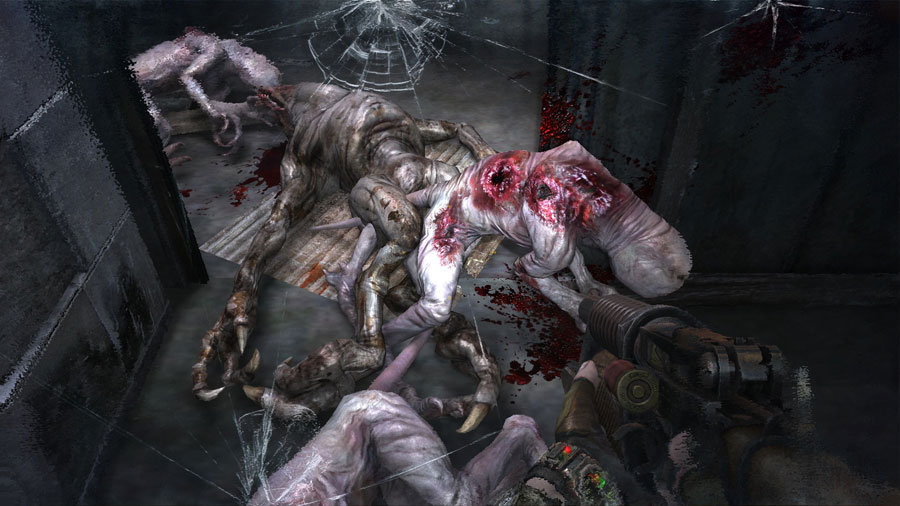
Notice the lack of an interface. You don't need one.
Metro 2033 is one of the most surprisingly authentic post-apocalyptic FPS games I have ever played. A game’s “realistic simulation” aspect is never something I particular care about, as all too often it is used as an excuse for bad gameplay mechanics. In the case of Metro 2033 however, all of the simulation bits impact the game in nothing but positive ways. For example, you start off with a flashlight with a fairly weak default luminosity that can be juiced with a handheld Universal Charger. To do so, you put your gun away, bring out this scrappy-looking device, and then pump the mechanism by clicking the mouse over and over while watching the smudged dial slowly increase with each pump. Although you will be performing this ritual hundreds of times over the course of the game, there was something so… correct about the activity that I actually looked forward to those moments. There are several weapons that require similar attention – an air-pump speargun, an electric railgun-esque weapon that shoots ball bearings – and the fidelity they engender as you huddle against a wall in the darkness or behind your increasingly fogged/damaged gas mask is wholly unique experience in videogaming.
Beyond those brilliant touches, the rest of the game itself is similarly well-designed. Although most of the game occurs in subway tunnels, the environments are surprisingly varied; you frequently are required to head to the toxic surface, which ironically feels more oppressive than the tunnels by its hostile nature, or exploring abandoned military complexes. There is a good mix of fighting mutants and humans, exploration is rewarded with pre-war ammunition (which brilliantly doubles as the game’s currency), stealth mechanics are actually supported, and the difficulty curve is relatively smooth while still escalating throughout the game. At one point there is a section where you carry a child on your back through this mutant-infested area, and the child’s weight impacts your ability to turn and aim at the monsters he is warning you about.
This is the kind of game Metro 2033 is, and I would not have it any other way.
Game: Blocks That Matter
Recommended price: $3
Metacritic Score: 79
Completion Time: ~5 hours
Buy If You Like: Indie puzzle games with robust player-generated map support
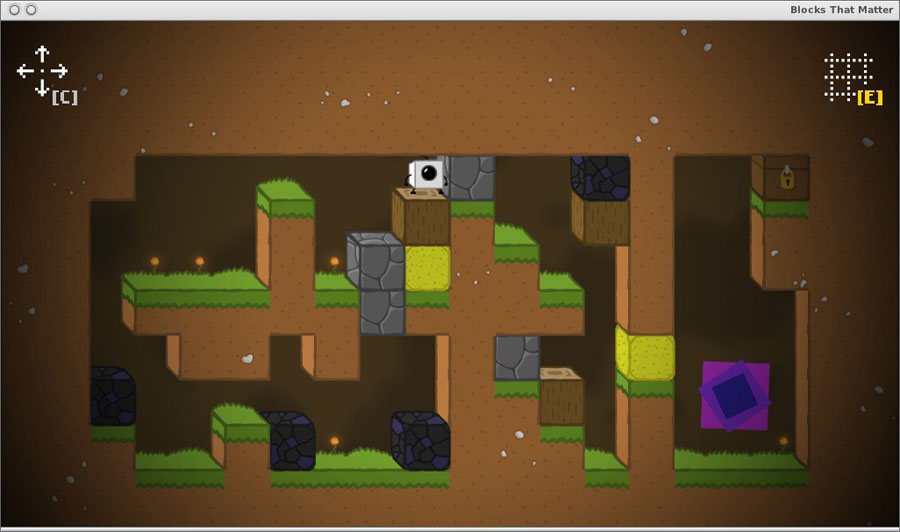
Not as easy as it looks.
Blocks That Matter is one of those “pure” puzzle games that starts with an unique, arbitrary premise and goes on to demonstrate how deep the gameplay can go. With the, ahem, building blocks of a 2D platformer, the “schtick” is that you collect blocks either by breaking them Mario-style or drilling them horizontally, but you can only place them in connected groups of four (at least one block has to be attached to a surface as well). Getting to the exit portal is usually straight-forward, but the real mind-melting begins when you decide to go after the treasure chests on the various levels. Later on, the characteristics of each block begins to matter (sand falls down if not supported, wood burns, etc) and when layered upon the sometimes extreme platforming aspects of later levels, it can definitely lead to frustration if you aren’t prepared for it.
One of the best aspects of Blocks That Matter though, are the hundreds of player-generated maps available for free download via the interface. While I only tried a handful, each one was rather brilliant in its own way and definitely complementary to the ~40 in the normal game. These maps can be sorted by highest-ranked as well, so you are sure to come across additional hours of entertainment if you enjoyed what came before.
Game: Far Cry
Recommended price: $5
Metacritic Score: 89
Completion Time: ~13 hours
Buy If You Like: Being kicked in the balls by a FPS
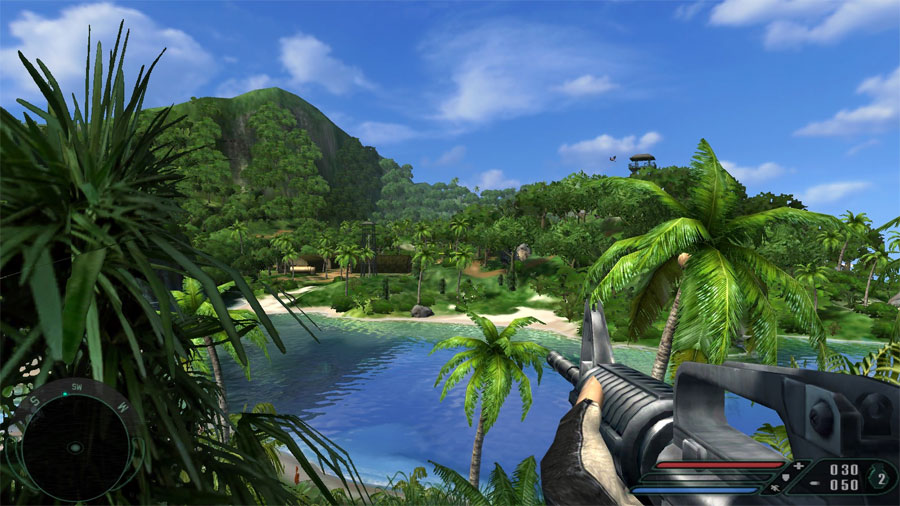
There are about 20 ways to die on the other side, and you will experience all of them.
Far Cry is hands-down the hardest, most frustrating FPS I have ever played. Setting Metro 2033 to Ranger Hardcore mode might take the cake, but you would actually have to make it through the chef cock-slapping you through the kitchen normal-mode that Far Cry offers before you could even think of baking said cake. I seriously uninstalled Far Cry twice, before achieving that head-smashing zen state necessary for slogging through the game to the bitter, bloody end.
Typically, frustrating difficulty is due to bad game design and isn’t something I suffer gladly. In Far Cry’s case, the insane difficulty actually stems from a coherent nod towards realism that says getting shot in the face or eaten by a Grue kills you. Which is fine, whatever. The frustration that settles in is how Far Cry operates entirely on a Checkpoint Save system wherein you can systematically kill 40 enemies without taking any damage, achieve 2/3 of the objectives, and then die to a rocket that was launched from a mile away, slip off the side of a mountain, stand too close to an exploding barrel, or any manner of “oops!” deaths and be forced to start all over again. There are checkpoints within levels, but you never know where they are or when they will kick in, sometimes leaving you stranded with 30 health a door away from a massive firefight you have zero chance of exiting alive. At one point in the game, I was making my way across the deck of a ship and had to learn via trial-and-error, e.g. dying, the location of the nine guys who killed me in their opening salvos. On the 10th checkpoint reload, I killed them all losing only 80% of my HP, only to be shot by a tenth guy at the end of the stern.
Aside from masochism, one of the things that kept bringing me back though was the compelling nature of the enemy AI and open-endedness of the game itself. You are being pitted against a mercenary force that reacts to noises, fans out in search of intruders, engages in pincer maneuvers, investigates dead bodies, and otherwise works together in a completely non-scripted way. Sure, a lot of the time they can magically spot you in the bushes from 100 yards away. Sure, sometimes their incidental gunfire leads you certain doom while you desperately search for a medkit. But this was the first FPS I have played in which I actually felt hunted, or at least surrounded by an intelligent enemy that fostered a sort of manic paranoia.
Like a particularly difficult bowel movement though, I am glad Far Cry is finally over and I am not looking forward to similar experiences again. At least, not ones lacking quicksaves.
Game: Atom Zombie Smasher
Recommended price: $5
Metacritic Score: 75
Completion Time: ~8 hours
Buy If You Like: Compelling indie strategy games
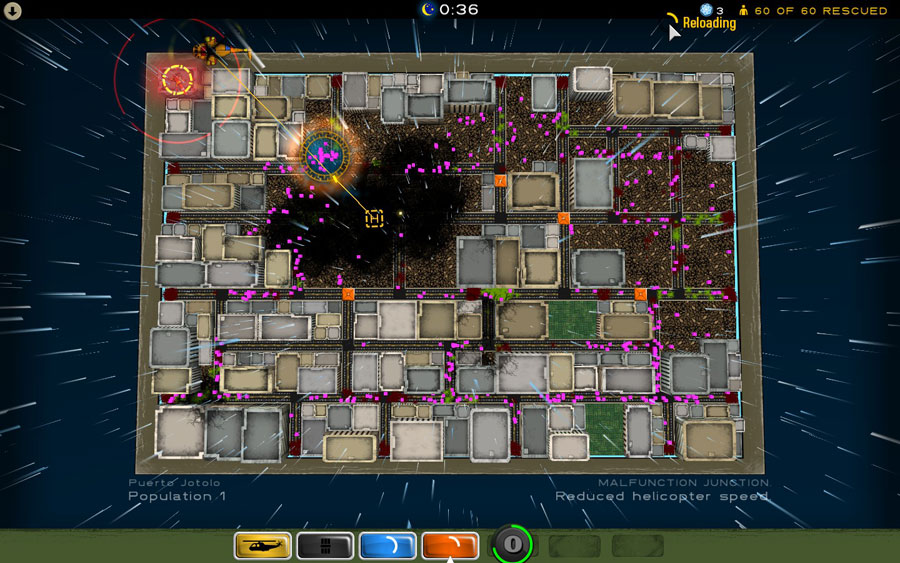
Evacuation complete.
I basically already reviewed Atom Zombie Smasher in a post entitled Population: 1. This is one of those indie games which justify the existence of indie games, and the continued need to ensure that more such works of brilliance are supported and nurtured.
What I will add though, is that I hope the game continues to go through some additional iterations. The city gameplay is excellent, and between the random selection of troops each month (“What? Only barricades, landmines, and TNT?!”) and the random buff/debuffs, even the same city layouts can feel like entirely new games each time you load it up. The map gameplay that nests the city gameplay, however, needs some work. It is ridiculously easy to fall behind and essentially make winning impossible. Similarly, a few early wins can make the rest of the game largely a joke. So while I am glad that developer chose to focus on the city gameplay as opposed to the map gameplay, the unfortunate side-effect is that the replay value suffers for it, at least to me. If they can tighten up the map, it may actually give me reason to keep playing.
Game: VVVVVV
Recommended price: bundle
Metacritic Score: 81
Completion Time: ~2 hours
Buy If You Like: Innovative retro 2D platformers
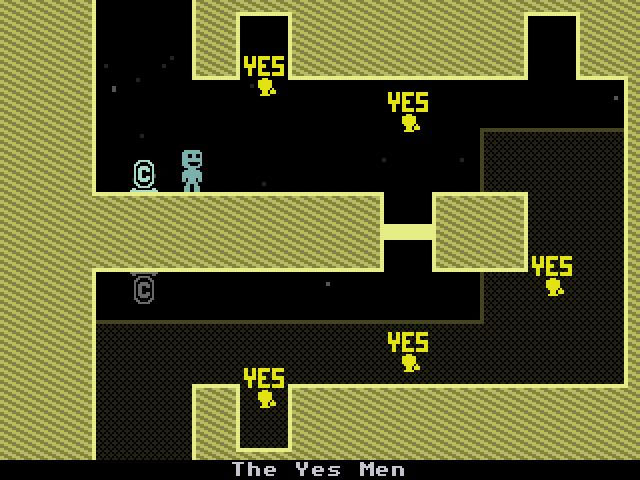
Err... what else is there to say, really?
VVVVVV is a retro indie game that takes the traditional elements of platforming and stands them on their head.
…that pun was lame, even for me.
Essentially, instead of a jump button, VVVVVV simply flips the gravity of your character around such that you end up walking on the ceiling. Since you cannot change direction in mid-air, this leads to some pretty fiendishly novel puzzle-platforming situations in which you have to make full use of ceiling and floor. Gameplay is pretty brisk, and the frequent use of checkpoints and a focus on single-room platforming (with some exceptions) means it is all action, all the time. Which, of course, means you end up beating the game pretty quickly as well. The game gets pretty difficult towards the end, and I ended up dying in a single room 50+ times, but overall the experience was pleasant.
For the length of gameplay though, the retail price of $5 is a bit much; it makes for a perfect indie bundle though, if you find one with VVVVVV in it.
Preview of Coming Events
So I may or may not have spent an inordinate amount of money on Steam sales this holiday season. The games include the following (in no particular order):
- Hitman series
- Dead Island
- L.A. Noir: Complete Edition
- DX:HR DLC
- Tomb Raider series
- Indie games such as Space Pirates and Zombies, Jamestown, From Dust, etc
- Dungeon Defenders + DLC
- Bulletstorm
- Red Faction: Armageddon + DLC
- RAGE
- Skyrim
- Warhammer 40k: Space Marine
- Torchlight
- Fable 3 + DLC
- Total War: Shogun 2
As you are probably aware, I have no MMO on my plate at the moment, nor would one probably fit on my plate, let alone dinner table at this point. However, I have been following SWTOR discussions very closely and of course keep abreast of WoW news 5+ months after having quit. If there is a price drop on SWTOR or Blizzard gets their head out of their asses and discounts server transfers, I could very well find myself back in the saddle. Ironically, the longer that Blizzard keeps the Annual Pass promotion open, the more likely I am to buy-in. Diablo 3 is one of those rare Day 1 purchases for me, and the closer the release date Soon™ gets the more valuable the Annual Pass becomes – the fewer months wasted on Cataclysm, the better.
In any case, I want to thank everyone for your patronage in 2011, and will endeavor to maintain whatever redeeming qualities you found in this slightly cocked corner of the internet throughout 2012.
 In An Age
Established Fact
Jan 13
Posted by Azuriel
In one of Syncaine’s latest posts, a commenter made the claim:
After I presented the counter-argument that it was established fact that increased difficulty was principally the cause of WoW subscriber drop-off, Rammstein “countered” with this:
Anything that Chilton says to the New York Times is “established fact”? LOL. You never considered any of the following?
1. He could be lying.
2. He could be wrong, which looks more likely when you consider he is part of the design team responsible for the drop.
3. He could be both lying and wrong, the most probable scenario.
4. He could be right. In this horribly unlikely case, what he said is STILL NOT ESTABLISHED FACT, as that would require something establishing it as a fact besides someone just saying it to someone else.
Syncaine agreed with Rammstein and made another post highlighting it. So… let us give these arguments the gravity their authors did not.
1. He could be lying.
Sure, Tom Chilton could be lying to the New York Times. But… to what end? His specific line is:
“What we’re trying to do now is figure out what our current audience wants,” Tom Chilton, World of Warcraft’s game director, told me by phone last week. “It became clear that it wasn’t realistic to try to get the audience back to being more hard core, as it had been in the past.”
Is that supposed to be less embarrassing? An admission from the game’s director that they don’t know what their present audience wants, in an article about the release of Star Wars: The Old Republic? What could they be hiding that is worse? Assuming Syncaine and company are correct vis-a-vis lack of difficulty being the cause, it would be far, far easier to admit that WoW had deviated too far from what “made WoW great” and that Cataclysm was the first step in the right direction.
Except… Cataclysm clearly wasn’t a step in the right direction because it was released with a higher difficulty and 2 million people left anyway. So how convoluted does your difficulty argument have to be to still remain valid? That people hated the ease of Wrath, burned themselves out, got served a difficult expansion, and then quit 2-3 months later after getting exactly what they wanted/needed? The nerfs did not occur until after the loss in subscriptions, after the 50+ minute LFD queues. Or is the argument that the hardcore center hollowed out in Wrath? In which case… who were the 2 million who unsubbed in Cataclysm?
Even if we assume that Chilton was lying to the NYT for whatever reason, for that argument to hold you must further assume that it was not just Chilton, but the entire damn company. Here was Mike Morhaime in the November Earning call:
That said, we know there are improvements that we can make in gaming content. The level-up content in Cataclysm is some of our best works. But it was consumed quickly compared to our past expansions set, Wrath of the Lich King. Once players reached max level, the end-game content in Cataclysm is more difficult. Balancing this content for our diverse player base can be very challenging.
Our development team is constantly analyzing the game, and we’re continuing to explore ways that we can adjust the game to better satisfy both hard-core and casual players. To that end, our next free major content update for World of Warcraft is already in testing and will be available for players in the coming weeks.
I could post more. In fact, I did post more… back in March of 2011 as I put the backpedaling on a timeline starting from January 7th’s “We don’t think it was a mistake to start with the difficulty we did” to February 3rd’s “On the other hand, maybe things have come too far in the other direction.” The whole gang is there: Zarhym, Daxxarri, Bashiok, Ghostcrawler. Were they just repeating Chilton’s lie for the past 12 months?
Not only were they lying with words, they also had to be lying with deeds. Consider the LFD Luck of the Draw buff that rolled out not even two weeks after Ghostcrawler told everyone to L2P. Consider the absolute bevvy of heroic nerfs, the T11 nerfs, the ZA/ZG nerfs, the 4.2 nerfs before the end of the patch (!), and finally the implementation of LFR. And let us not forget part of the Mists of Pandaria announcement:
In Cataclysm, Heroic dungeons were intentionally designed as gear and difficulty checks on the progression to raiding. In Mists of Pandaria, the Raid Finder will be the appropriate transition from running dungeons to Normal raids. Heroic dungeons will largely be tuned to be about as difficult as they were in Wrath of the Lich King, allowing players to fairly quickly down bosses in PUGs and hit their Valor Point caps. Valor Points will follow a new philosophy with 4.3, as a parallel way to gear up alongside the Raid Finder, but not as a fill-in for boss drops.
Which leads us to:
2. He could be wrong.
I am actually much more sympathetic to this argument, simply because we do know not just by experience, but by admission that designers (or at least the people that manage them) frequently have no goddamn idea what they are doing. Even in Blizzard’s specific case, Chilton is admitting they are still trying to figure out the current audience wants, which becomes more and more bizarre the longer you think about it.
That said, while I am sympathetic to this argument, it is also extremely weak. Blizzard is privy to 100% of the statistics that we have to crudely extrapolate from either Armory information, or from websites that have not been updated since October. And even the statistics we have access to can be incredibly misleading. I have always said that arguments based on total subs is asinine, because who knows what the churn rate is, what the concurrent users numbers are doing, and so on. Only Blizzard does, and we only know what they have said:
So the “He could be wrong” counter-argument essentially comes down to “Blizzard is wrong about why they experienced a loss in subscribers because I said so without any objective evidence other than total sub numbers.”
Could Blizzard actually be wrong? Sure. Maybe they actually lost 2 million subs because of the alignment of Praxis-12 Prime with the center of the Andromeda galaxy. But given the incredibly consistent (since February 2011), highly publicized direction shift when it comes to difficulty, it is beyond all reasonable doubt that Blizzard as a whole believes the Cataclysm drop in subscribers was due to Cataclysm being too hard. With the release of LFR and all information revealed about Mists of Pandaria thus far, it is similarly clear that Blizzard is literally betting the $1 billion farm on an easier, more accessible WoW experience.
Consider this fact established.
Posted in Commentary, WoW
25 Comments
Tags: Argument, Cataclysm, Difficulty, Established Fact, SynCaine