Category Archives: Commentary
Transition Gap
Sometimes gaming progress does not happen smoothly. Instead of one thing immediately leading into another, there is a sort of gap that must be leapt across. While not insurmountable, this break in progress can become a source of resistance to continuing to play a game at all.

Oh, an Iron Volcano in my Ice biome. That’s gonna be a Future-Me problem.
I am playing Oxygen Not Included (ONI) again. As I have described before, the game is deceptively easy at the start, but there are disasters looming in every detail. Some things are obvious, like your Dupes running out of Oxygen. Other things are much less so, like the fact that your Dupes just dug out a section of rock – which you told them to do – and then placed the 40°C (!!) rock in a storage container in the middle of your base, and now everything is heating up. Oops.
For the most part, it is generally easier to start a new game with a new map than it is to try and fix a disaster in progress. Plus, it’s fun seeing what goodies the RNG fairies might deliver to you. Cold biome nearby? Natural Gas Geyser ready to be tapped? Awesome.
Nevertheless, there is a specific transition gap that I inevitably reach and often quit playing rather than make the jump. In ONI, that gap is the Electrolyzer. This is a device that turns water into Oxygen and Hydrogen, and is pretty much the solution for breathable air for the rest of any ONI run.
It’s also a pain in the ass.
Up to this point, you make air by burning Algae, and it’s relatively straight-forward. With the Electrolyzer, you have to worry about piping the Hydrogen somewhere else, as otherwise it will clog the ceiling of whatever room you are in.
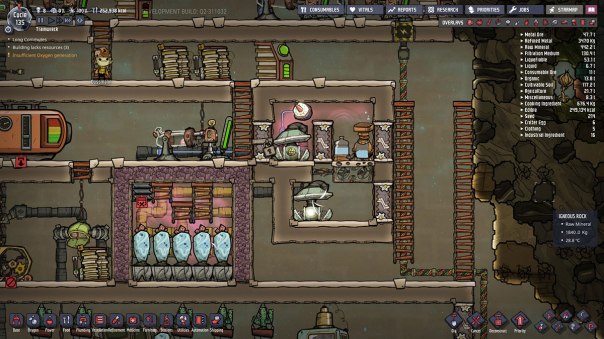
Pictured: mythical SPOM
In ONI-land, there is the mythical SPOM, or Self-Powering Oxygen Module. This is a solved solution for creating an effectively infinite air source with no maintenance or upkeep aside from water; a Hydrogen Power station powers the Electrolyzer, which supplies the station with fuel.
Despite there being a ready-made solution to the problem, or perhaps in spite of this fact, I typically end my ONI runs here. The SPOM is not particularly intuitive, so I basically need to copy it part-by-part from a Youtube guide. Even if I don’t create the SPOM specifically, the Electrolyzer still necessitates your base to account for mixed gases. Ignore the problem long enough, and it’ll be even more a pain in the ass later.
Finally, even with a cut-and-paste SPOM, you still need a ton of water at the ready to feed the beast. Where will all that water come from? Typically, the only long-term solution is to find a Steam Geyser somewhere on the map, but that could take a while, and possibly be nowhere close to you. If you set up a functioning plumbing system, you can technically harvest some additional H20 via that route. Of course, that will also require extensive planning of your base, and how you’ll be handling the hot water that comes out of a Water Sieve.
Good times. Or, maybe not so much.

Made the leap, not sure I’m enjoying the other side.
I have bridged the the Electrolyzer gap before. It’s not an insurmountable problem, especially considering the ubiquitous of the SPOM design in guides. It just takes a lot of mental headspace at a very specific moment in an hitherto casual colony management sim. Or rather, it is at this moment that Oxygen Not Included reveals itself to be a more complicated beast than you have imagined.
Many games have these transition gaps. The best designed among them either shorten the gap, or get you in the habit of hopping long before you reach the gap that matters. Otherwise, the devs risk players landing on their face. Or perhaps worse: practicing to make the leap, doing so, and then being bored on the other side.
Prey in Conclusion
I completed Prey over the weekend, after about 35 hours.

I could craft 870 rounds of ammo, if I wanted. Or if it mattered.
The majority of my concerns were comically overblown. Prey does tally up your behavior during play, but it only merits a single line of commentary at the end, and didn’t tip the scales in any case. I got the “best” ending doing the sort of things one would expect to merit a best ending, and that was that. Feel free to take all the special powers you want, unless you are specifically going for the achievement for not doing so.
How do I feel overall? Disappointed.
There are parts of Prey that are amazing. The GLOO Gun is an amazing tool that remains useful for 99% of the game. You can spend a lot of Neuromods to augment your jumping capabilities… or you can create your own path pretty much wherever, and whenever you want. At the same time, the GLOO Gun “platforms” are just tricky enough to utilize that you never think that it’s required to progress. In other words, it feels like the designers threw it into the game as a toy to play with, rather than a central mechanic (e.g. Gravity Gun in Half-Life 2), and thus you feel clever every time you use it to bypass obstacles.
The set pieces and overall level design are top-notch as well. The environment is cohesive and dense, making you feel as though you are exploring a real place. There is a ton of backtracking, which gets pretty annoying by the end of the game, but it also doesn’t necessarily feel artificial. Yes, if you want to track Volunteers, go to the Volunteer terminal. Yes, if you want to do something with Neuromods, go to the Neuromod area (again).

At least it’s not sepia-toned, but still… ugh.
Where the weakness starts creeping in is two-fold. First, the designers fell into the same design hole as Dishonored vis-a-vis “detective vision.” One of the marquee enemies you face in Prey are Mimics, which are capable of perfectly disguising themselves as chairs, coffee mugs, etc. After a few hours of exploring, you get a Psychoscope that will allow you to scan for Mimics. At this point, the rest of your gameplay experience will tunneled down a blurry circle, with buzzing in your ears.
Do you have to use the Psychoscope 24/7? No. It’s possible to pop it on to quickly glance through a room for Mimics, then turn it off. Hell, by the mid-game you likely have so many supplies and weapons that it won’t matter if you get ambushed by half a dozen at once. Nevertheless, you aren’t overtly punished for Psychoscoping the whole time… other than ruining the ambiance for yourself. Which, IMO, the is dev’s fault.
The other disappointing element is the ending.
Spoilers are below, but let me go ahead and create some more buffer.
…

…
Last chance… okay.
This is basically Bioshock Infinite all over again. Not specifically with Alternate Universes, but in the fact that the devs thought they could take another of the most reviled, cliche plot devices in history and polish that turd till it gleamed.
Nope. Even a polished turd is still a turd.
The ending actually failed on multiple levels for me. First, it was essentially spoiled in-game around halfway through by completing a quest. I expected a bad ending for trying to bail from the station via escape pod without even doing anything, but wanted to “get it out of the way” so I could continue the correct way. What I wasn’t expecting was Alex’s words after the fade-to-black. Whoops!
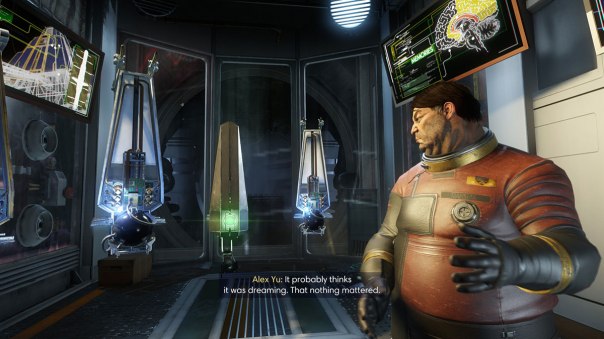
Yeah, actually, that’s exactly what I’m thinking.
The second level of failure was using the “it’s all a dream” cliche, period. I have read some arguments that state this implementation actually made your simulated in-game actions matter, given the extra-special reveal. Nope, still doesn’t work for me. Just because I’m being evaluated on my simulated actions, doesn’t mean I view simulated actions with any particular regard – none of it actually happened. Maybe it’s “based on a true story” when it comes to Morgan, but if all my actions can be rebooted with the flick of a switch, I’d rather them not have occurred in the first place.
Which… they didn’t.
Finally, the ending actually ruined a lot of the nuance I had hitherto been impressed with. For the majority of the game, your one directive was blowing up the space station. Given that, the still-living crew were effective dead already… so why bother helping them out? Was it not more cruel to give them hope before killing them all? At the same time, I felt better easing their more immediate suffering, so they could relax and eventually accept their fate when the time came.
Oh, but hey! Now we have a sudden third solution that magically makes everything better, revealed in the final act! Those dilemmas aren’t really dilemmas anymore. And they never were anything but contrived, simulated scenarios in the first place to judge your empathy. Congrats on playing through the trolley problem – not metaphorically, but literally. Woo!
I’m sure the ending worked for some people, just as there are people who feel Bioshock Infinite is a real deep narrative instead of the total bullshit cop-out it is. The special, second reveal at the end of Prey was indeed surprising, and I guess novel in the scheme of things. Nevertheless, I did not feel any better about how none of what occurred actually did, nor did it apparently matter to the people of Earth. Hell, we still don’t even know what happened, or if anything is real. It could be simulations all the way down.
And that’s why the plot device is such bullshit. A sequel, assuming one ever exists, would have to have a radically different tone or go through a lot of effort to convince the player they weren’t being duped again. But I guess we won’t be seeing a sequel so none of it really matters.
Sort of like any of your actions in the game.
Too Much Cheese
I have always had mixed feelings when it comes to Early Access games, but not always for the same reasons as everyone else. For example, one of the biggest dangers is getting hooked on a game that just never gets completed. Money dries up, development stops, you never get any sort of conclusion. I’ve never been too worried about that – either the game was fun when you played it, or it wasn’t.
No, my biggest concern is when the game gets better or more balanced… but I’m already done.
Oxygen Not Included (ONI) is a colony-management game from Klei that I started playing last year and it has gotten significant updates on the regular. Some new buildings, some new creatures, a sort of end-goal to strive for, and so on. Other things have not changed over the year, and it’s questionable whether they ever will. And that bothers me because some of the things that haven’t changed are broken mechanics.
One of the mid-to-late game threats in ONI is heat. In the beginning, you’re worried about Oxygen (hence the name), so you burn algae for air. Then you run out of algae. Switching to an Electrolyser allows you to turn water into Oxygen + Hydrogen, so you focus on getting clean water to burn, while finding a use for all the unbreathable Hydrogen (generally via Hydrogen Generator to power to the Electrolyser). This is another trap though, because the “free” Oxygen getting piped out is hot, and as your base heats up, your crops will fail. Thus, cooling things becomes a top priority.
While there are a number of “legit” ways to cool things down, the Water Sieve method is straight-up broken. Water Sieves are used to turn Polluted Water into normal Water, for use in bathrooms and such. The supposed downside of this is that the Sieve itself outputs relatively hot water at 40°C, which will gradually heat up your base and ruin your crops (which typically stop growing at 30-35°C). The real issue though is that the Water Sieve always outputs 40°C water… even if the Polluted Water was at a much higher temperature. Thus you get physics-bending/game-breaking (IMO) solutions like piping your clean water out of a Water Sieve and into an Aquatuner (which cools liquid down at the expense of heating itself up)… which is being liquid-cooled in a tank of Polluted Water… that you are piping to the Water Sieve.
Clever use of game mechanics, indeed.
Along the same lines, I have a 100% zombie-proof base in 7 Days to Die. It’s a tower with a nearby ramp and fence, along with a half-block on the other side of the fence. To the zombie AI, this half-block would allow them to jump again and land on the tower and start eating my face. In reality, once they hop over the fence, they miss the half-block, and plummet to the ground, taking damage. From there, they run back up the ramp and try again until they die again. I still try and kill them myself for the XP, but I have all the time in the world to line up the shots or try again if I miss. The devs have added a “tantrum” mechanic whenever a zombie tries to run a path and fails, but that just means the zombie will wail on a bunch of iron spikes.
There are two “easy” solutions to my “problems”:
- Don’t use these mechanics, and/or
- Don’t play these games yet
To which I would say:
- Handicapping myself via willpower alone isn’t fun, and
- These are precisely the type of games I want to be playing at the moment
If you have a list of non-Early Access survival/crafting games that I haven’t already played, by all means, let me know. Otherwise, I’m going to be over here stuffing my face with delicious cheese, and paying for it later.
Ascension
As you may have heard, I continue to play Slay the Spire.
I have beaten the “normal” game dozens of times with all three default characters, and have unlocked all the cards and relics. When you defeat everything with all three characters, you can unlock a fourth stage with a super-secret boss, and you also unlock Ascension Mode. Each character has their own Ascension Mode tracker, and defeating the standard final boss will increment the Ascension Mode up one digit, to a maximum of 20. What happens on each level is the following:
- Elites spawn more often.
- Normal enemies are deadlier.
- Elites are deadlier.
- Bosses are deadlier.
- Heal less after Boss battles (75% of missing health)
- Start each run damaged (-10% health)
- Normal enemies are tougher.
- Elites are tougher.
- Bosses are tougher.
- Ascender’s Bane
- Start each run with 1 less potion slot.
- Upgraded cards appear less often. (50% less)
- Bosses drop less gold. (25% less)
- Lower max HP. (-5 for Ironclad, -4 for Silent and Defect)
- Unfavorable events.
- Shops are more costly. (10% more)
- Normal enemies have more challenging movesets and abilities.
- Elite enemies have more challenging movesets and abilities.
- Boss enemies have more challenging movesets and abilities.
- Fight 2 bosses at the end of Act 3.
I have been focusing on playing the Silent, the 2nd character, and achieved Ascension 15.
Also, I am so done with this game.
This particular Ascension mode design is rather brilliant in a lot of ways. Many games have harder difficulties, including roguelikes, but most of them are not as granular as this. The first “downside” of more Elites, for example, is not technically a downside for someone skilled with the game – each Elite enemy killed will result in a Relic, which can substantially improve the rest of a run. It’s often advised to target as many Elites as possible in the first Stage, to either wash out a weak deck early, or load up on goodies when the risk to your time is low.
Plus, there is the more mundane benefit to the fact that even if you are a super pro player from the start, you still need to play through and beat the game 20 times before you reach the hardest difficulty. Per character! That’s a lot of gameplay. Or grinding, depending.
I lasted way longer than I thought I would at the beginning (Ascension 15, remember), but the fundamental truth is that each time I succeeded, each subsequent game became less fun. By design. Well, presumably I am supposed to become more and more proud of my ability to overcome challenges, but that doesn’t really happen in practice. Especially in Slay the Spire’s case, where after a while things become more and more RNG-based as the margin for success shrinks.
This is probably for the best. I prefer the discrete finality of a rolling credits screen to the ashes of burning out, but an ending is an ending. Now maybe I can move on to something else.
Epic Shenanigans
In case you haven’t seen the news, the Epic Store has poached another timed-exclusive game release: Metro Exodus. The wrinkle this time is that rather than being planned from the start, Deep Silver must have been given a fat stack of secret cash because the game was already available on pre-order from Steam (which are still being honored, until removed from the Steam store). And, you know, the game was all set out to be released in 2.5 weeks.
I mentioned “fat stack of secret cash” because while the revenue split is more generous in the Epic Store, they are actually doing the only thing I said would matter in the competition space: Metro Exodus had its MSRP lowered from $60 (on Steam) to $50. Which means the gross revenue from this game would be:
- Steam = $60 * 0.7 = $42
- Epic = $50 * 0.88 = $44
That calculation demonstrates how a developer could still make a higher profit on the Epic store by dropping the price to $50, but here’s the thing: they are going to be losing a non-trivial amount of sales for not being on the PC’s largest storefront. Enough to matter? Remains to be seen. The Metro Redux (aka remasters) of the first two games sold 1.5 million copies back in 2016. That would be $3 million more in Deep Silver’s pocket if they sold the same amount of games… at full price… as the remasters of the last two games combined.
That $2 difference between revenue is 4.5%. If Deep Silver sells 4.5% fewer copies due to not being on Steam, then they lose almost $3 million. I mean, without even doing much calculations, you gotta know that for every Steam sale lost, they have to sell 22 copies in the Epic Store to break even. Ergo, I suspect that Epic was waving something more than simply the 88% cut in Deep Silver’s face.
And that’s kinda the baffling thing about all this. I’m not opposed to competition between companies, especially when it results in a gain in consumer surplus. Competing on price is a huge deal, and I’m sincerely amazed that Deep Silver pulled that trigger to sell at $50. But… why then yank the title from Steam as a “timed-exclusive release”? That isn’t consumer friendly or useful to anyone at all. Why not let the same title be purchasable on both platforms, and allow nature to run its course?
We’ll have to see how things shake out a year from now, when the game is finally released on Steam… presumably at a huge discount because it will have been a whole year.
Zombie Smarts
I have been playing some more 7 Days to Die (7DTD) now that the Alpha 17.1 patch came around. There have been a lot of tweaks to the progression mechanics and Perk system, including some level-gating on Iron/Steel tool recipes. The biggest change, however, was to zombie AI.
In short, zombies are now impossibly smart… and impossibly dumb.
It’s been long enough that I don’t even remember how zombies behaved in prior patches. What zombies do now though, is behave in perfect tower defense intelligence: the shortest distance between them and you, with walls adding a virtual number of steps. Zombie are also perfectly prescient, knowing exactly which wall blocks have the lowest remaining health, and will attack that spot en mass to get to you. At the same time, zombies prefer not attacking walls to X extent, if they can walk there instead.
The result? Cue the Benny Hill theme:
Essentially, the current 7DTD meta is to not create bases at all, but rather mazes that funnel zombies into kill zones and/or large drops that loop them around until they die of fall damage. The devs have added a “zombie tantrum” mechanic to try and get some damage on looped mazes – zombies will attack anything nearby when they fall, possibly weakening your support pillars – but that will be metagamed away with multiple platforms or deeper holes.
To be clear, the prior zombie meta was solved by simply building an underground bunker. At that time, zombies could not dig into the ground, and disregarded the Z axis entirely – it was possible to hang out in the middle of a bridge and often have a nice grouped pile of zombies directly below you to hit with a Molotov. I played the game enough to recognize which Point of Interest had a pre-built bunker located underneath it, and often sought it out immediately after spawning so I could all but ignore the titular 7th day horde attack.
That said, how smart should zombies be?
The only way to answer that question is to ask what the game you’re making is supposed to be about. When you add tower defense mechanics, you get a tower defense game. This will preclude people from building nice little houses in the woods, and instead opt for mazes and obstacles and drops. It becomes a much more technical game, solvable with very specific configurations. Having dumber zombies frees up a lot more base designs, on top of possibly requiring a lot more attention to one’s base after an attack, as a single “dumb” zombie could be weakening a support in an unused corner.
My initial “solution” would be to mix and match, but I think that’s actually the worst of all possible worlds. Instead, I think zombies work best as environmental hazards. Bunkers might make you invulnerable to nightly attacks… but you have to leave sometime. Shouldn’t the punishment for hiding underground be the simple lack of information of what’s going on, combined with having to spend your morning hours slaying the zombie hordes milling about outside?
I guess we’ll see what the devs eventually decide. At present, there simply seems to be a maze-based arms race at the expense of any sort of satisfying nesting. If the 7DTD devs want to double-down, well… thank god for mods.
Slain Spire
Remember when I said I wouldn’t buy Battlefield 5 because it would consume all my free time but not “accomplish” anything? Well, I did resist the purchase…
…and promptly put like a dozen or so “empty” hours into Slay the Spire instead.
I think my total hours /played in Slay the Spire at this point is north of 50 hours. Those are rookie numbers compared to Zubon at Kill Ten Rats, who probably put more hours into writing Slay the Spire posts last year than I have playing the game. Which it entirely deserves, by the way – it is a thoroughly enjoyable experience. It’s just not a novel experience (to me) anymore, and yet I feel compelled to boot it up any time I spend more than thirty seconds looking at my Steam library.
That’s probably a sign of good game design.
Last year, the devs at MegaCrit tweeted that they were looking at a Switch and mobile version of the game after coming out of Early Access. It’s 2019 and the game is still in Early Access, although there has been a third class added and, more recently, Steam mod support. If and when Slay the Spire ever receives a mobile port, is likely the day that I earn a Corrective Action Report at work.
I can’t wait. Because then I might be able to get home sated, and ready to play something else.
Waxing my Wane
I’m generally a pretty frugal guy. Parsimonious, even. And yet I just bought half a dozen games in as many days, after having avoided doing so for these specific titles for as many years. “They were on sale though.” They were on sale last year too. What changed?
The void.
Specifically, I finally exhausted my desire to play modded Starbound (Frackin’ Universe)… after 100 hours. One. Hundred. Hours. When you get up to triple digits like that, with any game, the entire experience becomes more than just “having fun” and instead morphs into a whole routine. I would play in the evenings, lie in bed planning my actions the next day, and browse wikis and such during the day. It all really hearkened back to my heydays of WoW. Minus a few thousand hours, of course.
Then, one day, it’s all just gone. Whether it’s the game ending or just getting tired of it, the experience is over.
I am not sure how other people handle post-game depression. My go-to move appears to be ennui of unknown duration. I know of games that could probably suck me right back into mainlining. But I don’t feel like it. In this lucid state, smaller experiences seem like the better course of action. If I don’t play them now, I definitely won’t be playing them later when absorbed in something else.
So out comes a little retail therapy.
We’ll see how it goes. Right now the routine is playing a few missions in Far Cry 5, followed by an area or two of Knife of Dunwall (Dishonored DLC). The segmentation is not on purpose – I can only seem to stand playing either one in short bursts. Not exactly a glowing review, but I blame the ennui more than the gameplay itself. After these two, hopefully the pallet will be cleansed, and I can get into the more cerebral titles like Hellblade, Prey, and/or Final Fantasy XV.
And then… we’ll see.
 In An Age
Crafting is Required
Mar 19
Posted by Azuriel
Divinity: Original Sin 2 (DOS2) has a terrible crafting system.
At first, I felt like this was okay. Crafting in the original game was often a bit overpowered, such that most of the time you were better off crafting upgrades than you were trying to loot them. This was a problem in Skyrim too, which I talked about back in 2012:
I am not sure any game has gotten the craft vs loot tension correct. If the best items come from looting, players are incentivized to kill things for loot and ignore crafting. If the best items are crafted, players craft them and don’t care about killing stuff. Sometimes you can make hard enemies drop exclusive crafting material instead of loot, but that’s just loot with extra steps.
The problem is when game designers decide to have a weak crafting system, then seed their game with thousands of random pieces of debris. There is shit everywhere in DOS2: flowers, mushrooms, plates, cups, parchment, individual keys that exist forever for some reason, nails, hammers, and so on and so forth. Well over 90% of it is completely useless, despite it being integral to some crafting recipe or another. The existence of these items and your ability to interact with them is an invitation to their collection. Which, ultimately, just serves to pad game time and make inventory management a chore. It’s all a designer trap, outside maybe 2-3 arrow/scroll recipes.
So why not just get rid of crafting, if it’s going to be nigh-useless? Well… what are they going to do with all these cups and silverware so meticulously seeded on every table? Seems as though if you want interactable widgets, you need a crafting system of some kind to justify it. We’re well past the Metal Gear Solid 2 days when breaking single wine bottles or watching ice melt was an innovation.
Just because it’s an RPG doesn’t mean you have to be able to pick up all the things. But you damn well better have a useful reason to pick stuff up, if you allow it. Which makes crafting required.
Posted in Commentary
8 Comments
Tags: Crafting, Divinity: Original Sin 2, Gotcha, Loot All the Things, Newbie Trap, Skyrim