Category Archives: Commentary
Vote with Your (Whale) Wallet
There was an interesting, albeit depressing, exchange on Reddit concerning the release of Dr. Mario World, Nintendo’s latest foray into mobile nihilism. Basically, it’s Dr. Mario meets Candy Crush (e.g. stamina meters) with a dash of gacha game lootboxes. Which is a little weird, considering Nintendo seems to make a point about not being too greedy with their monetization strategies. What changed?
$$$$$$
Whales vote with their wallets. There is nothing the other 90% of us can do about it. They are an insurmountable minority.
That’s the issue with “vote with your wallets”… the people with more money have more votes.
Five years ago, I made the point that “voting with your wallet” was a losing strategy, in comparison to complaining about things and thereby possibly voting with other peoples’ wallets. That sentiment seems almost quaint these days. The current reality we inhabit is one in which the mere existence of people willing to drop $100 (or $1000) in a sitting dictates how mobile games are developed.
I would like to believe there is some kind of silver lining in all this. And maybe there is. If you are just looking for something to do on your phone, there are tens of thousands of options available for free. Not all of them are even horrible. Hell, go play Dr. Mario World if you want!
As someone who loves the purity of elegant game design though… I’m fucked. I could vow to never play these games again, convince thousands more to join the boycott, and it wouldn’t matter. When 90% of the playerbase is already not paying for anything, and the average lifetime value of paying customers is single digits, one $99 purchase justifies a lot of nonsense. Not just in one game, but every game. There will be exceptions, but they exist as deliberate acts, fighting the ocean current.
When money is speech, the richest speak the loudest.
…er, when did we decide that was a good idea, again?
Subscription Pass
When the videogame historians look back on this particular monetization strata, it will undoubtedly be the Season Pass era. Or perhaps the Microtransaction era more generally, to include loot boxes, but with legislators and science slowly turning against loot boxes, I feel like more and more games will be making a hard turn into the Season Pass model.
To be clear, I am not referring to the Season Passes of yore, in which you essentially pre-ordered DLC. The new hotness is basically a month-to-month subscription. This most recently slapped me in the face in Clash Royale:
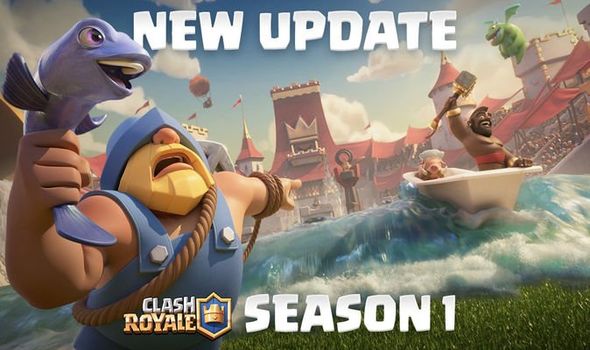
The new troop doesn’t even officially get released until Season 2…
Someone on Reddit wrote up all the incentives that your $5 will purchase, and the list is somewhat enticing. None of them are technically P2W, which is itself a moot point because you could drop $99 on shit from basically day 1 in Clash Royale anyway. Indeed, if you look at the package in comparison to what your hard-earned cash could buy normally, you’re effectively getting 10x-11x the normal value. Five dollars will get you 500 gems, which can convert to 10,000g or two emotes or two Lightning Chests… or basically give you 40,000+ gold, 800 more cards (including 60+ Epics) and a bunch of other stuff.
Of course, Supercell doesn’t want it to be an either/or scenario. You can do both. Having an exceptionally generous Season Pass can lure F2P players into making their first purchase, after which it is easy to make another. One of the “perks” of the one in Clash Royale is an auto-announcement in Clan chat that you purchased the pass, and thereafter your name shows up in gold coloring in chat and battling. Turns out that adding gold leaf to a scarlet letter makes it rather desirable.
The dilemma I face is the same as always: I am caught in eye of the monetization storm.
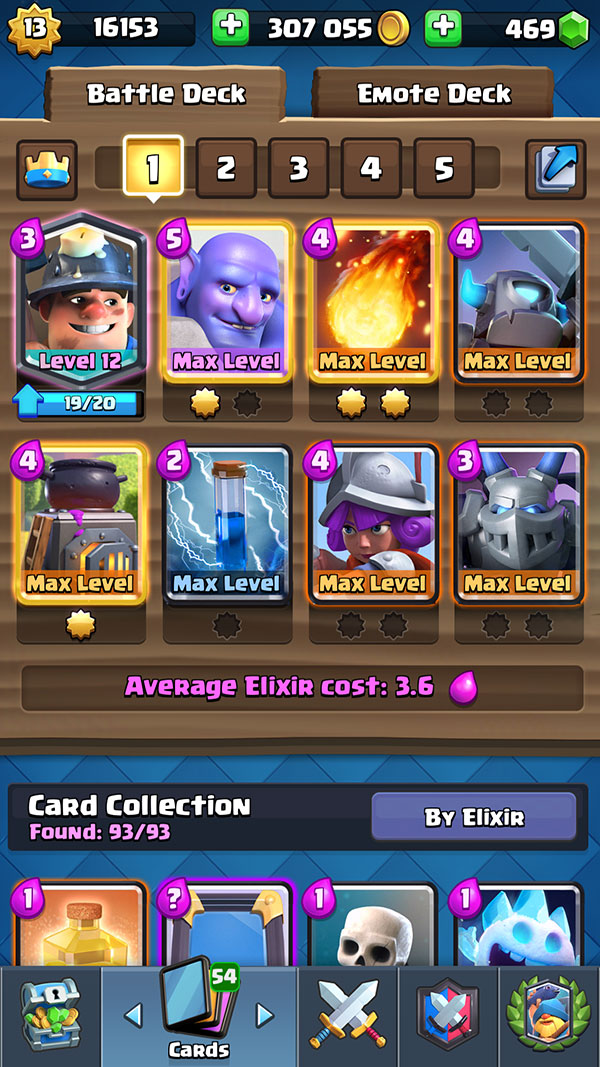
Could I be any more off-meta?
As the screenshot shows, I am one Miner card away from having a fully-maxed deck. I am sorely tempted to purchase the Season Pass entirely to get that last Miner card. It would normally not be too difficult to trade for it within my current clan, but there are at least three other members currently asking for Miners themselves, and none seem keen to trust me in giving up one of their so I can max the card and satisfy an effectively infinite number of trades thereafter.
After that though… what then? I have dozens of technically maxed cards that I cannot actually max out because I lack the gold to upgrade them all. Not that I would need to max them out in the first place, considering I don’t use them in decks. The deck I have is the one I enjoy the most. The last two slots are technically flex slots, but I have tried a bunch of alternatives and found them lacking.
Would the new Fisherman legendary card be a good fit? Completely irrelevant. New legendaries may as well not exist, because I would need literal dozens of them to get them anywhere near usable levels where I’m sitting on the ladder (~5800 last season) and in 2v2. Granted, the Fisherman has some utility outside of his base HP and damage – the ability to hook and pull troops around like Roadhog from Overwatch – but I’m still not bringing that to match that matters.
In any event, the Season Pass model gives me pause. In the context of cash purchases within Clash Royale, it’s a great deal. Would I pay a $5/month subscription to Clash Royale though? Nope. It’s not a subscription though, as there are no reoccurring payments. “Cancel any time!” And yet there will be tens of thousands who do re-up every month, for the rewards or the conveniences lost.
Technically this should be positive Consumer Surplus territory… so why do I feel so dirty?
Possibly because I felt the hook twitch. Supercell isn’t reeling in the line yet, but it’s there. Subscription versus Season Pass is a distinction without a difference, and yet those who would riot about the former in their game are praising the latter. It is a trick of psychology, a stark reminder we can be tricked, and evidence that we face amoral corporations that have a fiduciary obligation to their shareholders to trick us out of as much money as possible.
For however bad loot boxes may seem, never forget that loot boxes are apparently not enough.
Mobile Attributes
As I have begun my homebound tour of baby duty, I have a new appreciation for mobile gaming. Because it is the only gaming I can conceivably complete. While there are only three games in particular that I’m playing at the moment, I’m becoming well acquainted with the specific attributes of each one.
Time-to-Play
How long it takes from the moment you press the icon until you can start making selections. This probably shouldn’t matter as much because if you’re counting seconds you likely weren’t going to be having a lot of fun to begin with. That said, it became important to me once I realized that it takes Hearthstone 38 seconds to boot up.
Thirty. Eight. Seconds.
That’s just to get to the quest screen, by the way, not actually playing. In contrast, Clash Royale takes 17 seconds and Gems of War takes… huh, 32 seconds. For some reason, Hearthstone seemed more egregious.
Minimization
How the game reacts to being minimized or otherwise losing focus. This attribute is a bit tough to precisely quantify because apparently it matters for how long the interruption lasts. Sometimes you can minimize to shoot off a text and be fine, and other times the app requires you to log back in.
Hearthstone used to be the worst at this, not only requiring a re-login, but also counting a Dungeon Run as a loss if you minimized in the middle of a boss instead of on the reward screen. As of some patch ago, you can safely minimize without losing progress.
Clash Royale is finicky, but even when there’s the equivalent of a re-log, it’s very brief. Things are significantly different if you are in the middle of a battle though. In some cases you can get back in, but you are generally penalized as “leaving the match.”
Gems of War, in my experience, doesn’t care and will be right back up instantly.
One-Handed Play
Can the game be played with one hand… if you know what I mean. Because you have a baby in the other hand.
Both Hearthstone and Gems of War are perfectly playable with one hand. Both games are basically turn-based, and even if you’re playing a human opponent in Hearthstone, you have a minute and a half to complete your turn.
Clash Royale on the other (one) hand is technically playable, but sometimes entire matches can be decided on pixel-perfect placement of troops at precisely the right moment. So in this respect, I’d say this isn’t a one-handed game.
Fun
Pretty standard.
Depth
Same.
Microtransactions
They all have them.
…
Overall, I will say that Hearthstone’s Dungeon Run modes have been the MVP for me this far. When I said I had no desire to play Dalaran Heist anymore, that was before I got stuck watching a baby for 12+ hours a day. I’m already halfway through beating Chapter 1 heroic mode with every class, and being grateful I have something to do.
Bygones
It was once said:
“A delayed game is eventually good, but a rushed game is forever bad.” -Shigeru Miyamoto
These days, we have this:
“All of the games like this… It’s not how you launch, it’s what it becomes.” -Todd Howard
There are a number of interesting articles out this week, including this one, which covers a candid interview with Todd Howard regarding (among many other things) Fallout 76. Specifically, how he and the entire team knew it was going to be a widely panned shitshow… but released it anyway. Because eventually it could be made better.
…and it has. Even if you were hostile to the idea of a Fallout survival game in the first place, it is undeniably in a better state than before. It may still not be your cup of tea at all, but it’s better.
None of this is particularly ideal for anyone though. As consumers, we should not be offered half-completed games riddled with bugs and half-baked design philosophies. On the developer side, while they do indeed get cash for a half-completed game, they also get (well-deserved) bad reviews and negative press for releasing a shoddy product.
The thing is… this method appears to work. As pointed out in the Ars Technica article:
The examples are almost too numerous to list. There are the games like Evolve, Paragon, Battleborn, Artifact, and Lawbreakers that were never able to turn things around after moribund launches. Then there are titles like Rainbow Six: Siege, For Honor, Final Fantasy XIV, and Bethesda’s own Elder Scrolls Online that have found long-term success despite some early troubles. Right now, Bioware’s rough launch of Anthem seems to be sitting on the razor’s edge between these two possibilities.
The other two poignant examples listed earlier in the same article are Diablo 3 and No Man’s Sky. While we can quibble over whether No Man’s Sky is any better conceptually than it started, the game is undeniably a huge success now, with each content update pulling 100,000 concurrent Steam users. In other words, it did not crash and burn – the poor initial showing was only a flesh wound. And Diablo 3? The game that launched with literal P2W in the form of Real Money Auction House? Blizzard was punished with… 30 million copies sold by 2015.
And, really, at what point does it all end up sounding like sour grapes? I had to look back, but apparently the Diablo 3 RMAH was removed back in March 2014. Are we still mad five years later?
I mean, the RMAH was absolutely a terrible idea and Blizzard should have known better and we’re all so terribly disappointed in them. But if someone asked you whether they should play Diablo 3 today, is the RMAH really something you would legitimately bring up? What’s the statute of limitations on poor game design that no longer even exists in the current game?
It’s a struggle, I know. If you buy/play/enjoy Fallout 76 or No Man’s Sky or Diablo 3 or anything else today, you are indirectly supporting the (usually) same people who screwed up these games the first time around. “How will they learn, then?!” Well… they did learn. As evidenced by the game getting better. It will probably not prevent them from releasing a half-baked mess with their next game, but that may simply be the unfortunate reality at this point. We can hope that by delaying our purchase until the game is fixed – instead of preordering or Day 1 purchasing like a chump – the devs get the memo on what stage of completeness we are willing to accept. On the other hand, giving them money later on kinda justifies the whole “Release Now, Fix Later” approach.
And on the third, mystery hand? Taking a principled stand is exhausting when you could just sit down and play some damn games. If it’s fun now, play; otherwise, don’t.
“Bad Conduct”
I was recently given a temp ban (1 hour) for “bad conduct” in Clash Royale 2v2. Said behavior was closing the app in the middle of a battle. This was actually fairly surprising, on multiple levels.
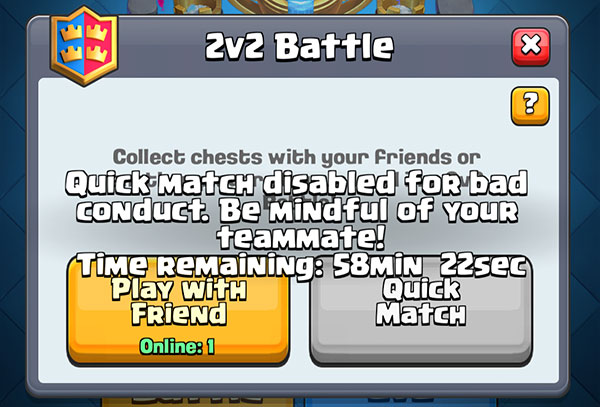
Oh, now I see…
For one, I had never even heard that this feature existed. After some Googling, it appears that they added this feature back in April 2018. I’m not sure how much it scales up, or when it triggers, or when it might reset… but it’s there. Supposedly it happens when you quit two battles in quick succession, but that doesn’t seem to always be the case. I have certainly quit plenty of times mid-battle before this, but perhaps it only trigger specifically off closing the app.
For two, this explains why I have seen a lot more people not drop games. Instead, they will sit there at max mana and do nothing, or activate the opponent’s King Tower – which I actually see as polite, if you’re giving up – or perhaps be extra fancy with Tornado to end the game faster.
For three, it has been surprising how filled with (self-)righteous fury I am over this.
The 2v2 format in Clash Royale is not competitive. By which I mean there are no penalties for losing. The format exists for fun purposes, and Crown/Chest purposes. You always want a chest to be unlocking when you aren’t actively playing the game, and to get chests you either need to play 1v1 on ladder, risking your trophy count, or you can play 2v2. I can also maybe see the 2v2 format being conducive for deck-testing purposes. No penalties for losing, so you can save your trophies until you’re sure your off-meta deck has a chance.
So we have three reasons: fun, rewards, testing.
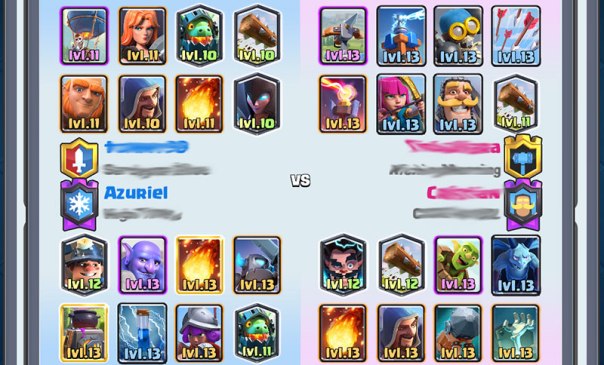
Pictured: not fun
I left the game I did because my random partner played a level 10 Wizard directly into a level 13 Tesla. Like not accidentally played, but deliberately played, as if the Wizard would destroy it and live. The max level is 13. I am level 13 with a trophy count of 5023. At this trophy count, pretty much everyone has max-level cards; anything less is generally a liability given card interactions. For example, a level 13 Fireball will one-shot a level 12 Wizard (or Musketeer). For this reason, I actually did not run a level 12 Musketeer for months until I leveled her up the rest of the way.
My partner brought a level 10 Wizard to battle. I almost can’t even blame him, because when I looked at his profile afterwards, it turns out he’s level 10. I was paired with a level 10 against two level 12 opponents with an average of 5139 trophies each. In this scenario, which has repeated for the game before this one and the one after, it was bad conduct of me to concede the fight.
I am not sure what sort of matching algorithm Supercell has going on behind the scenes. It could be that this is a method of enforced win-rate balancing working against me, pushing me down closer to 50-50. It could be that the enemy team is currently in the “losing bracket” and I just happen to be their free win. Or perhaps my historical bad behavior has placed me in some kind of circle of purgatory until I atone for my sins.
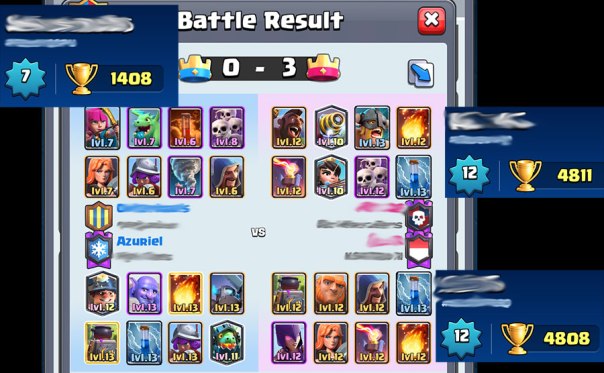
What the literal shit, Supercell?
All that I know, what I feel in my very bones, is that the true bad behavior is “matching” me with a teammate with a fucking level 10 whatever in their deck. It isn’t fun, we have a zero chance to win, and they aren’t testing anything. It’s difficult to even suggest that, had I played seriously and poured my heart and soul into that battle, that the opponents would have even had fun. They had level 12-13 troops! If fun was to be had, they would have the same experience with neither of us playing anything at all.
But, whatever. If Supercell wishes to discourage rage quits by requiring the app to still be running, I shall set my phone down for a few minutes, still running. If Supercell wishes to be a bit more clever and require spending elixir during the entire battle, I will acquiesce with some mindless troop drops too. But if Supercell continues matching me with literally useless teammates? I shall craft a deck with my own, lowest-level cards and spread this misery as far wide and deep as it can go. Because if I cannot have real, legitimate fun, all that’s left is mischief and cruelty and trolling.
Disposable Progression
As I am playing a lot of mobile games lately, my nose is being rubbed in perhaps the most annoying design “feature” I have encountered in years: disposable progression.
The game in question is Gems of War, but it’s not specific to this title. Basically, you create a four-member team of monsters and use their abilities to fight your foes. There are hundreds of different monsters available, across a number of rarities, with all sorts of possibly interesting combinations. Each monster can be upgraded with a certain currency, special traits unlocked with a separate currency, and a third currency (extra copies) can upgrade the rarity of the card itself.
The problem is that you aren’t likely to use the first four monsters you pick up. So any currency you use to level them up and otherwise bridge the gap between completing missions and unboxing better monsters is effectively wasted. Maybe it can be considered “the cost of doing business,” but it nevertheless creates perverse incentives when I play. “Do I really need to level this guy up?” The answer is generally no, or at least never feels like a solid yes, so I don’t. And thus not only do I make the game more boring and harder for myself, I also rob myself of whatever pleasure can be derived from improving one’s characters.
I mean, it’s possible things were designed this way with the goal of actually getting players to waste currency in a bid to pad out game time. After all, if you sufficiently hoard currency, it’s technically possible to max out a new monster the minute you unbox it. That is not a particularly good outcome for anyone. And perhaps there isn’t really a way around things anyway – this may be a systemic issue the moment you design a game to have dozens and dozens of party members.
Regardless, it still feels bad. I have used the same monster team for the past two weeks, so I possibly should just bite the bullet and spend all my currency leveling them up. But the moment some cool legendary monster or whatever pops out of a box, I’m going to be quite miffed. And miffed to me is not opening the wallet to spend real currency buying fake currency, but uninstalling the game.
Time-Broke
Know what’s downright quaint? This Time-Poor post from back in March.
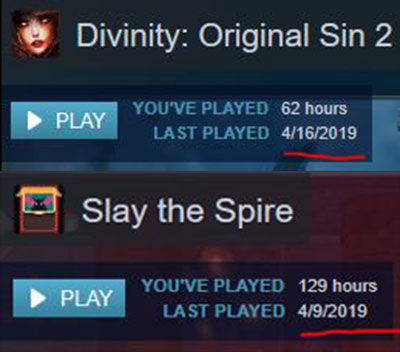
Two or three weeks sans gaming isn’t too bad in the scheme of things. Or wouldn’t be, if there was some kind of known endpoint. I’m a planner, a schemer, an optimizer. Meanwhile, my baby is an agent of chaos. Sometimes he’ll go three hours between feedings, and other times I’m feeding him every 30 minutes for an hour and a half. And since you can’t really do much else, the TV is on in the background, and when he finally calms down, you might be interested in the rest of the show.
This whole experience thus far has given me some first-person views of the gaming edifice though.
On Sunday, I actually had a solid 1-2 hour chunk of time to do non-baby, non-household chore things at like 11pm. The whole world felt like my oyster! Unfortunately, I hate oysters, and I found myself browsing Reddit – which I do on my phone anyway – and then playing a few games of Slay the Spire. The thought of diving back into Divinity: Original Sin 2 was, well, unthinkable. What would I do? Walk around, get in one combat, then turn the game off?
It got me thinking about uninterrupted time, and how often some games require it. The traditional expectation of it being required is when a game functions on Waypoint Saving. But if you have a narrative experience that you care about at all, then uninterrupted time is required. But even if a game doesn’t have a narrative, you might still need uninterrupted time in order to progress in the “what was I doing?” fashion. Or perhaps even the mundane “what buttons do what again?” sense.
Games with grinding are also right out. It used to be “ain’t nobody got time for that” was because life is full of so many other, better games you could be playing instead. Nowadays, for me, it’s literal.
Having said all that, I find time for mobile games. Clash Royale is still an hourly diversion. I bought You Must Build A Boat and also downloaded Gems of War, both of which can be played in small chunks. I was looking at Terraria, but was scared away by a review stating the last update was in August 2016. Instead, I (re)bought Stardew Valley. While I haven’t tried it out yet, I’m hopeful that it can also scratch the progression itch in a more nutritive way that gacha games cannot.
We’ll see how it goes.
Sleep Mode
I miss sleep.
That baby I alluded to is home, having arrived quite a bit early. I took two weeks off while he was still in the NICU, trying to get everything set up ahead of time. There should have been enough time for all the things, but there wasn’t. Now he’s here and my wife and I are trying to figure out the process by which each of us can get enough 1.5 hour increments of sleep to function as human beings.
- Change diaper (2 min)
- Warm milk (3 min)
- Feed baby (15-20 min)
- Burp baby (5 min)
- Pump (30 min)
- Wash pump parts (5 min)
The above has to occur every 3 hours, round the clock. And doesn’t include, you know, general touching of that baby or any of the ancillary chores such as washing clothes, self-grooming, eating, etc. We have kinda figured out that I can do everything but pump (it’s not super effective), and so we work in tandem to theoretically do everything in one ~40 min block of time (some things are sequential) rather than 1.5 hours. Still, come 2 AM, one of us is on baby watch and the other is trying to sleep, and then it’s back to solo attempting to do all the things across 1.5 hours, which isn’t really all that possible with a crying baby. And next week, I’m back to work because ‘Murica.
We’re kinda muddling through things currently, but I have reasonable confidence we’ll figure it out eventually. Perhaps by the time he graduates college.
Then it will be back to gaming!


Tension
Aug 6
Posted by Azuriel
Tension in gaming is an interesting experience.
Tension feels uncomfortable. Relieving tension feels satisfying. Ergo, the introduction of tension-producing elements in your game can naturally propel players through the gameplay loops necessary to remove the tension while also rewarding them for their efforts. This pathway is different than one that relies on the player seeking rewards; the designer is instead threatening the player’s status quo.
While elegant, tension comes with risk. If a player is unable to relieve the tension, e.g. fails the test, that failure state can be a permanent stopping point. Players can become discouraged. Even when successful, players can also burn out from being under stress all the time, feeling as though the satisfaction states are either too infrequent or too brief. Even players who thrive and seek out tension scenarios may burn out in the other direction, mastering the game systems enough such that even the tension that still exists isn’t enough to ring their bells.
I have been thinking about this lately as I continue to be engrossed with Oxygen Not Included (ONI). While it may not immediately look like it, or even feel like it, ONI is decidedly a survival game.
In the beginning, the tension is apparent. You start with three Dupes and they have nothing but a little bit of space and some air (starter oxygen is included after all). If bathrooms are not created within the first day, all three Dupes will pee all over the floor by the morning of the 2nd day. After that, you have a bit of a reprieve… but it’s kind of a trap too. The calories provided by the starter food will only ever dwindle, and I hope you didn’t build their beds where all the CO2 lingers.
Although I have over 90 hours in the game now, I nevertheless still fell into the mid-game trap regarding (mostly) non-renewable resources. I started a game on the Oceania map, which had an absolute abundance of Algae and Coal. Algae in particular is a finite* resource on the default Terra map and its scarcity often forces you into Electrolyzers early on, which forces you into taming Steam vents, etc etc. Conversely, having 21 tons of the stuff on my map allowed me to keep the early-game Oxygen-creating machines running longer. I was even good on Coal too, as I had a Hatch ranch going which was producing Coal at a good clip.
If those details sound ominous, they should. While my Coal reserves were fine for everyday use, I had been building a Metal Refinery to make refined metal for future projects. Simultaneously, I was setting up a Hatch ranch to breed regular Hatches into Stone Hatches into Smooth Hatches, the last of which eat metal and poop refined metal exclusively. Normal Hatches and Stone Hatch eat basically anything and poop Coal, so I didn’t think twice about crafting two Incubators to speed the process along. As it turns out, adding nearly 2000 kJ stress on my power grid will burn through Coal pretty quick, as will replacing normal Hatches with ones that don’t poop Coal.
ONI has a particular tendency to punish complacency, going from Comfortable to Colony Collapse within a matter of a few Cycles. If you are not creating enough Oxygen for your Dupes, the game will give you a notification with the exact discrepancy. If your Oxygen-creating infrastructure is entirely dependent on Algae and you’re about to run out though, you get no warning. Well, you will eventually get the “not creating enough Oxygen” notification, but by then you will have to be scrambling to Electrolyzers regardless of whether your infrastructure currently supports it.
In some respects, ONI feels like the ideal tension-based game. The tension of keeping all the survival balls in the air exists, driving you ever onward. But you can also engineer stable systems such that you solve (some) problems permanently. Or “permanently” until the rounding errors in your design round up to whole errors. It can be frustrating though, coming from other tension-based games where the tension is more immediately apparent.
Posted in Commentary
Comments Off on Tension
Tags: Complacency, Game Design, Oxygen Not Included, Survival, Tension