Category Archives: Commentary
A Bridge Too Nier
I have completed Nier: Automata (N:A) all the way.
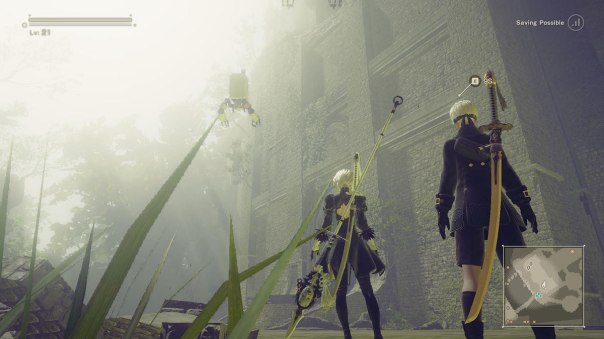
Again, the visuals were extremely good.
As I mentioned a few days ago, the major impetus for my buying N:A in the first place was the seemingly unrelenting stream of praise it received. “Best game ever!” “GOTY 2017, if not of all time!” Those sort of proclamations immediately actives my Bullshit Sense, honed as it is after the Bioshock: Infinite debacle. That was almost five years ago now, and I’m still mad that it gets any praise at all. Seriously, people, that was not a good game.
Suffice it to say, Nier: Automata is not Bioshock: Infinite. In fact, it is extremely good.
But does that mean N:A lives up to its hype? Well… yes and no.
When I look back on the games I view as true epics with moving storylines and compelling characters, I see games like Xenogears. FF7. Chrono Trigger. The Mass Effect trilogy. In this context, I did not feel that N:A’s plot achieved a spot on that pantheon. At the same time, I can also recognize that Xenogears was released in 1998, which is possibly before many fans of N:A were even born. So, in a sense, I can see how someone can view N:A as being the best story they have experienced.
However, pure epic story-telling is not the only prism through which a narrative can be judged. When I think about my experience with Far Cry 2, for example, I found it deeply moving and incredibly clever from a meta-narrative perspective.
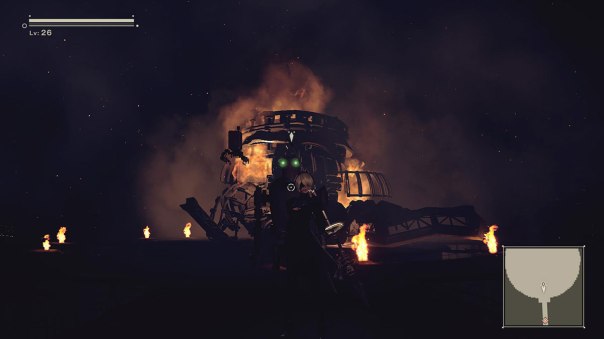
Robotic hearts in the darkness.
Far Cry 2 was a slog of bloody, seemingly pointless firefights against interchangeable factions all the way to the very end. And that was the point. The gameplay itself was being used as an emotional vehicle for the player to show them experience the pointlessness of the conflict firsthand, and feel your own culpability in perpetuating a cycle of violence for ultimately selfish ends. When I was finally given the option at the end to either escape Africa or stay and sacrifice myself to save some refugees, the weariness and resignation I felt via the protagonist was real to me too. Staying behind to manually blow the bomb came as an immense, cathartic relief.
It is in this sort of reference point that Nier: Automata actually deserves the praise it receives. N:A is no Xenogears, but it is a Far Cry 2. Or Metal Gear Solid 2. Or Spec Ops: The Line. Not in the content of its message necessarily, but in its clever use of gameplay mechanics and subverting expectations to elicit emotions rather than relying on plot alone.
Indeed, one of the most poignant and moving sequences in the game occurs during the closing credits of the E ending. I went from rolling my eyes, to mild interest, to frustration, to finally… an emotion I had not experienced since Journey. And right at the very end of it all, the game asks a final, devastating question of the player, that I was not expecting nor prepared to answer.
And I blinked. Days later, I still feel somewhat guilty.
You would be forgiven for wondering why the above is not enough for Nier: Automata to take a seat next to Xenogears. I might just be obstinate. Or it may simply be as banal a reason that those PS1 classics came first, or were experienced in my more formative years, or both. But still, I hesitate.
Honestly, it is probably better for everyone to temper their expectations anyway. If you go into Nier: Automata thinking you will experience a 10/10, or something far and away better than whatever you view as your favorite game, you will probably be disappointed. If instead you go in with eyes open, acknowledging the fact that you will essentially need to beat the same game twice (from two different perspectives) before the “real” game begins, you will likely be more open to the emotional notes that the game elicits.
Plus, I hope you like action games. And twin-stick shooters. And… you get the idea.
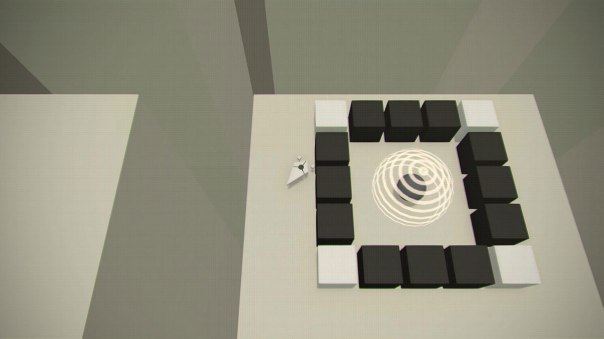
And hacking! Can’t (ever) forget that.
Speaking of notes though, the soundtrack is every bit as amazing as they say. It is a complete aural experience, with familiar themes expanding during epic moments, or contracting when the action inverts for a hacking mini-game. Some soundtracks have a few good songs, but Nier: Automata is good the entire way through, at every moment. Haunting, melodic… perfect. It absolutely deserves a seat with Mitsuda’s Xenogears and Chrono Trigger, even if thematically they differ.
So, yeah. Nier: Automata is worth playing. It’s not perfect, but it’s so goddamn ridiculous and bold and eccentric and sometimes horrifying and sad. And, ultimately, meloncholy. There are bad bits, some boring parts, and some questionable design decisions. Yet, more than anything, this is a game that ignored what everyone else was doing and shot for the moon. That ain’t nothing.
Action Gameplay
I’m still making my way through Nier, and it’s an interesting experience to analyze in situ.
Aside from the moments when it turns into a bullet-hell shoot-them-up, Nier is an action game in the vein of Devil May Cry. You have a Light attack, a Heavy attack, a Ranged attack, and a special skill. There are technically combos, I think, but I’m not sure it’s especially more productive than just mashing buttons. The only real “decision” is when to press the Dodge button. Which, by the way, can be spammed with no penalty to essentially gain infinite invincibility frames.
The end result is a relatively simplistic combat system. And it’s… still fun? I guess.
One of the common complaints regarding older MMOs like WoW is that tab-targeting combat is boring. Or mindless. 111211131141. While Nier is certainly more active from a combat perspective, I’m not sure that it is less mindless. XXXYYYXXY with some RT in there (on a controller) to dodge. If I just stood there and didn’t dodge in Nier, sure, the enemies I’m fighting might be able to kill me; conversely, most enemies in WoW can be face-tanked. But does that really matter?
The whole situation kind of reminds me of the difference between driving to the movie theater and watching the movie. The action of driving somewhere is much more involved than watching the screen – there are thousands of more individual choices and reactions necessary to drive somewhere safely. But is it more engaging? At the end of the night, which do you remember more?
And really, this is a problem with Action games even in the absence of thousands of incidental enemies you have to mow down. Furi features action combat that focuses just on bosses. I played it for a few hours, got to the second boss, and ended up setting the game down. It’s just not particularly compelling. Sure, it feels good to be able to perform the button presses necessary to avoid death. That’s a sense of personal progression.
But… I don’t know. Just like with driving, I kind of zone out the experience when I’m killing enemies in Action games. Or rather, become so hyper-focused on the moment-to-moment reactions to stimuli that I lose the overall plot. Once I get to my destination safely, the process by which I got there exits my short-term memory and becomes no more than a fuzzy recollection of time spent.
Perhaps this is less an indictment of Action combat generally, and more a specific Nier issue. Perhaps I should crank up the Difficulty slider up a notch. But I’m not sure that that would accomplish anything more than slippery road conditions would “improve” the driving experience. Common enemies would require greater focus, and yet the “reward” would be the same.
Maybe that’s just it: action combat is typically less overtly rewarding. Nier enemies drop currency and occasionally crafting mats, but it’s not on the same scale as a WoW mob. There are simply more and multi-faceted reward types in RPG-esque games than Action ones. Action games focus on the action, and generally try to reduce downtime. Go too far, and you end up the Borderlands Zone where you have to take a 5-second break after each gun drop to compare it to your equipped arsenal. That sort of thing completely breaks the flow in a way that, say, Skyrim does not.
I dunno. I’m not even through my first playthrough of Nier – New Game+ is apparently mandatory to see the rest of the plot – and I think that I had better buckle down and ignore sidequests from here on out. If I don’t, I think there is a serious chance that the combat becomes too boring to finish.
[Fake Edit]: Completed both A & B endings this weekend. Combat got more boring in B, which I didn’t think was possible. Let’s just hope C+ is a bit better…
Slay the Spire: Quick Strategy
I have beaten Slay the Spire two times as the Ironclad and three times as the Silent. All of the runs were quite different insofar as specific cards and interactions go, but the overall strategy was basically the same for each one:
Avoid Losing Health
This probably sounds like I’m trolling, but I am quite serious.

Not losing HP anytime soon.
As with many games, HP is a resource in Slay the Spire. However, regaining HP comes at a much higher cost in this game. At each Campsite, you can regain 30% of your max HP, or you can upgrade a card. While sometimes necessary, each time you heal at a Campsite instead of Upgrading a card, you are forgoing dozens, if not hundreds of opportunities of using said upgraded card over the rest of the run. Even if you end up grabbing a specific card or Relic that heals you somehow, that is typically at the expense of a different selection that might have helped you in a different way. Much better to simply not need to heal at all.
So here are my tips in avoiding losing health.
Understanding and Loving Block
Blocking often feels bad, especially when it isn’t enough to absorb an entire attack. Instead of being one turn closer to ending the fight, you instead do nothing and take 2 damage, right?

Fist full of Curses, but Block still set me free.
Well, imagine instead that there was a 1-mana card that said “Gain 5 HP.” Would you play it? Yeah, you would probably play it as much as you could. Guess what. That’s what Block does any time it absorbs damage. There will be times when you will save more HP by burning down an enemy than blocking half the damage, but you also have to look beyond the current battle. If you save 10 damage now by burning down the enemy quickly, but lose 30 HP three fights from now, you have ultimately made a poor trade.
Now, there will be times where you have a fist full of Block cards while your opponent is doing nothing but buffing themselves. Those times will suck, and it’s possible you’ll take more damage overall later. However, consider the opposite case where you have a fist full of attack cards and a pile of damage coming back your way. The latter is much more dangerous than the former.
Combat is for the Fortunate
If you do not have a reliable means of avoiding damage via deck/Relic combos, you should not be taking unnecessary risks in combat. Or getting in combat at all. This means picking a route that bypasses as many regular and Elite encounters as possible. Yeah, combat gives you a chance to add cards to your deck, and Elites giving a Relic is cool, but you can also get cards and Relics in those “?” encounters, typically without losing HP. Do those instead.
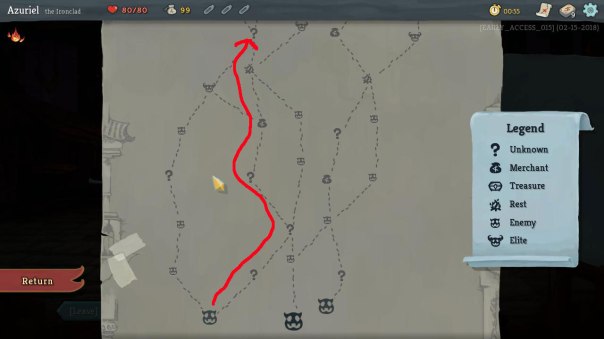
This sort of route is ideal.
The biggest exception to the general rule is everything on the 1st floor. Since you are just starting a run, it behooves you to take as many risks as possible now, when failure does not sting as much, rather than later when you could lose hours of progress.
Relics Will Carry You
Your overall run will, in a large part, be dictated by the Relics you acquire. Nab the one that gives you 3 Block every time you discard a card? You should probably start picking everything that lets you discard cards. The beginning of a run is more free-form as a result, but you generally can’t go wrong with a fast cycle deck. Just make sure you pick up some Answer cards along the way.
Answer the Encounter Questions
Slay the Spire is currently in Early Access so this can change, but generally the “questions” that an encounter will pose and the subsequent answers are:
- Single, large attack | Apply Weaken
- Multiple attacks | Apply Weaken or reduce Strength
- Escalating Buffs | Kill faster
- Punishing Attack usage (thorns, etc) | Kill faster, or Passive damage
- Punishing Skill usage | Attacks that also gain Block
- Punishing Power usage | Only use highest impact Powers
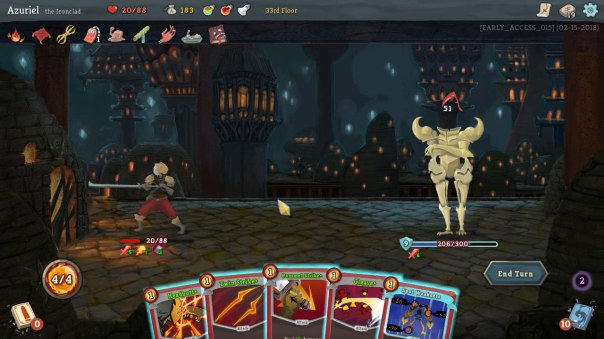
Exhibit A
Generally, you are going to want to have at least one card that applies Weaken no matter what. Several bosses have one uber-attack that will deal more than 40 damage at a time, so that one Weaken card will end up being the equivalent of “Gain 15+ block.” Would you draft a card that said “Deal 9 damage, gain 15 Block”? Of course you would.
Beyond that… well, it depends on the character you chose and the relics provided. Playing as the Silent means you have specific access to some very nice cycling cards, and can pick up cards that apply Poison. Tons of Block + Poison = eventual win. With Ironclad, you are generally more reliant on attacking, but don’t forgo Block cards on your way to stack Vulnerability (+50% damage). I had the most success with Ironclad when I kept a lean deck and upgraded the 0-cost card that buffed my Strength for the turn.
Accumulate Advantage
Some of the cards and relics you pick up during a run have an impact beyond any individual combat. For example, the Feed card gives you an increased max HP when it deals a killing blow, and the Alchemize card grants you a Potion. There are also relics that heal you when you cast a Power, or perhaps grant you a special action when you reach a campsite.
This may seem like another duh moment, but… do those things.
Specifically, engineer scenarios in which you can take advantage of them all the time. If you get a Feed/Alchemize card, start drafting card draw or extra block so that you can stall combat long enough to capitalize on them. If you get a bonus action at campsites, make sure you are not wasting the opportunity by having to heal up. You should avoid having to heal at campsites anyway (so you can upgrade cards instead), but that goes twice as much when one of your precious relic opportunities is consumed by something that is useless otherwise.
Holiday Updates
I got in some quality gaming time in the past few days.
Far Cry 4
As mentioned in previous post, I was having some issues getting into (or really, staying into) Far Cry 4 despite it being better than what else I was playing. I originally attributed this to the breakpoints within the game, but as others deduced in the comments, it might have been from other tertiary concerns as well. After thinking about it, I agree it was not so much the game itself. Part of my “obligation” in playing Far Cry 4 was that it was taking up a lot of hard drive space, and I thus felt like I needed to finish it and make room for something else I had wanted to try.
After the insight, I went back to Far Cry 4 and enjoyed the experience more as I coasted into and past the endgame. I feel like Far Cry 3 is the better narrative experience overall, but Far Cry 4 plays much better and is a much more cohesive as a whole. Being able to get mobility options like the Wingsuit early on really opens the game world up, without being overpowered.
The Talos Principle
In a word: Amazing.
Portal 1/2 are better games overall, but The Talos Principle is the first puzzle game in quite a while to engender a sort of mild existential crisis. And that’s really what puzzle games are for, right?
Inevitably, everyone always seems to point out the most superficial philosophical questions when it comes to games like this – “Can robots be people?” “Are people just robots?” – and then just stop there. The Talos Principle should invite more salient questions though, and did for me. The game’s setting is one in which mankind is slowly dying, and you can read (and listen via audio logs) to how various individuals react to that inevitability. Some fight on to the bitter end, some leave to spend their last days with family, others do a LAN party, and another pair enjoy one final sunset and then commit mutual suicide. Milton, the AI “serpent,” will question your grasp of the meaning of life over the course of the game, and how it can be ascertained, often deconstructing arguments in ways that would lead some people I know IRL into tears.
That is what The Talos Principle should be noted for, not because the player-character is an android. If anything, whether the player’s android avatar is truly conscious in the same way people are is the least interesting question posed.
Anyway, I highly recommend it if you intrigued by philosophy or pathos or puzzles. It gots all three.
Warframe
According to the Search bar, I have apparently never talked about Warframe before. I played it once last year for about two hours, and then dropped it. I was interested in taking a second look primarily because my Amazon Prime account gave me Twitch Prime, which in turn gives free goodies every month, including what I thought was a free “warframe” but ended up being cosmetics. I think.
Warframe is a third-person over-the-shoulder looter shooter. Think “Diablo meets space ninjas” with a generous helping of impenetrable nonsense. It is also about the slickest F2P experience out in gaming right now.
The general idea is that you are a space ninja and need to space-grind ninja-resources across the solar system. Maps are surprisingly well-crafted, although you will be seeing them quite a bit, as each one serves several different gameplay types – sometimes you need to kill X mobs, sometimes you need to do a sort of King of the Hill node capture, etc. As you finish missions and kill bosses and collect loot, you unlock the ability to craft different warframes (aka classes), which come with different movement abilities, attacks, and so on.
I doubt I stick with Warframe for much longer than what I have already played. While it is a lot of visceral fun being able to jump around the map as a space ninja doing cool space ninja things, there doesn’t really ever feel like much of a narrative “point.” When I completed the first story section, for example, the next required me to reactive a Solar Relay to access missions on Venus. The activation though, required a laundry list of different, metagame-related things, like obtaining 20 mods, equipping four of them, etc. While that is a good way to ensure I am playing the game properly, it also meant I had to play several maps for the express purpose of trying to obtain randomly-dropped mods. Each map probably lasts 10 minutes or less, so it’s not a huge ask, but it still didn’t sit well with me.
Guild Wars 2
Even though I had not been playing playing GW2 for quite some time, I kept it installed on my PC and had been logging in once a day in order to accumulate the free goodies ArenaNet gives you. The currency is nice, but the real prize for me were basically the Tomes of Knowledge, which are free levels. The idea was that once I ended up purchasing one or both of the expansions, I’d have the opportunity to actually experience the content on a class of my choosing, rather than having to stick with the Elementalist, which is the only level-80 class I have.
Well, I picked up Heart of Thorns this past weekend for $15. So I’m playing GW2 again.
It’s funny though, the sort of things that go through my mind when playing MMOs like this. For one thing, I really enjoy the Necromancer, and that is the class I wanted to experience more of the game with. Since she was level 45, I could have skipped near the cap with my 34 Tomes. But wait a minute, I could also get an easy 10 levels via leveling up crafting, right? Gotta save those Tomes for when they are more valuable. Probably like never. But, whatever, I have level 400 Cooking now.
As I cycled through my characters just to re-familiarize myself with things, I also noticed that at least three of my characters received a 5-year anniversary present pack. Which, incidentally, meant I got three level-50 boosts. I had already leveled the Necro into level 55 by that point, but it will be good for later alts.
Anyway, I will be playing GW2 some more now. Seeing people running around on mounts really makes me want to pick up Path of Flames, just to make leveling alts easier, but I’m going to hold off for now. Will my GW2 experience be another passing fancy (again)? Will not jumping in with both (expansion) feet cause the game to be another passing fancy? Stay tuned.
Breakpoints
The two games I have been playing lately have been Far Cry 4 and No Man’s Sky. While I can and have played NMS for 3+ hours at a stretch, I struggle to play Far Cry 4 for more than maybe an hour. This is in spite of Far Cry 4 being the more entertaining game on both a micro and macro sense.
On reflection, the reason seems obvious: breakpoints.
Far Cry 4 is technically an open-world game that allows you to run wherever. However, there are definitely a lot of story-based missions that have clearly defined beginnings and endings and checkpoints inbetween. While they are not necessarily spaced far apart, there comes a time at the end of a mission that you begin thinking about how you’ll be spending another 30 minutes sneaking/guns-a-blazin’ through the next one. Why not just hit Save & Quit and take a break instead, eh? The end is as good a place as any to quit.
Conversely, No Man’s Sky is a lot like Minecraft insofar as there are no particular breakpoints. Turning in Missions sounds like a good time… but as soon as you turn them in, new missions appear to replace the old ones. And, oh, this one just requires you to exit the space station and kill one pirate ship. While you’re out there, the planet in the background has the Trading Post destination for that other mission clogging up your log. Ooo, it’s been a minute since you’ve seen a planet with water, so maybe go collect some Kelp Pods… et cetra, et cetra.
This phenomenon is not new by any means. Anyone playing MMOs knows it intimately, insofar as the breakpoints offered by dungeons, turning in quests at a hub, winning a PvP match, and so on.
What has become more interesting to me now, is how these breakpoints affect my perception of the underlying game. Like I said at the beginning, Far Cry 4 is objectively more fun. I know it’s more fun. But when I sit down to game in the evening, I find myself hesitating on the Far Cry 4 icon. If the game is so fun, why can’t I play it for more than an hour? What does it say about a game that I feel somewhat relieved when it’s over, and I boot up something else afterwards?
When I think back on the MMOs I have played, especially with WoW, I recognize that while there were breakpoints in certain content, there were a variety of alternative activities that allowed one to unwind. Raid for two days a week, spend time farming mats the rest. Complete a dungeon, go back to town and look into enchanting your new gear. and so on. Far Cry 4 technically has some elements of that – collecting herbs, selling vendor trash, etc – but obviously the game isn’t exactly designed to give you as full a break as an MMO.
The other interesting thing about breakpoints is how I used to feel like games without them would lead to faster burnout. It seems to make intuitive sense that the longer you leave a candle burning, the faster it goes out. Instead, I feel like all the abrupt starts and stops in Far Cry 4 have decreased the mental shelf life of the game. It is almost as though my mind only recognizes the number of intervals, and not the total length – playing an hour at a time is the equivalent as as playing four hours at a time. This certainly makes sense to me in terms of FF14 as well, when I kept running into content walls that all but required me to stop playing for the day.
Perhaps breakpoints aren’t as good as I once thought.
Fun Collecting
Syncaine made an astute observation in my prior No Man’s Sky (NMS) impression post:
I’ve never read, this included, anything that suggests the game is actually fun. People point out what is missing or broken, and what is there, but never a series of ‘things’ that are interesting or fun.
As I mentioned in the post itself, I do find the game fun, and have been playing it now for over 60 hours – far longer than most AAA games these days. But… why? What are the fun bits?
In NMS’s specific case, I think most of the fun is derived from the accumulation of things. If you have ever played another survival game like Don’t Starve, 7 Days to Die, or even Minecraft to an extent, and enjoyed collecting 200 pieces of X so you can craft that next upgrade, well, NMS is here for you. Hell, it’s also sorta like herbing in your typical MMO. Run around, press the E button near a node, continue on. Except with spaceships and mining lasers and landing on different planets.
That’s… kinda it, really. Well, assuming you aren’t interested in the background plot.
Let me contrast NMS with two games. First, Starbound. Staround also features procedurally-generated planets, collecting all the things, and a plot that mostly glues the experience together. Starbound is the better game by far though, because combat spices things up and synergizes with the collection of things. In NMS, all you really fight are the Sentinels, which are everywhere all the time, and only ever escalate things if you don’t kill them fast enough. Compare that with Starbound having to dig deeper into a planet for the best minerals, with enemies getting tougher the deeper your go. The gameplay loop in Starbound and the engaging fights are more interesting and fun.
The second contrast would be with Sunless Sea. Procedurally-generated exploration game with a focus on profit from selling trade goods. Sounds pretty similar, right? Sunless Sea also has a mild Lovecraftian vibe and some great narrative. It also completely sucks as a game and feels terrible to play. The nominal gameplay is quite different – FPS versus overhead ship battles – but that is kinda the point. NMS feels engaging in a way Sunless Sea does not, even if they are both games that revolve around exploring and collecting and obtaining cash.
In the comments, Helistar mentioned that they would just “stick with ETS2 for the time being.” I had to Google the acronym, which is apparently Euro Truck Simulator 2. My first reaction was to scoff. What does driving trucks and selling cargo for cash have to do with flying around space… and selling cargo… oh. Well then. There you go.
If none of the above clears anything up for you, then No Man’s Sky is not for you. It technically really isn’t even for me. There is something there though, some half-formed game system I can’t quite describe, which is compelling. Or, perhaps as Zubon would describe, “compelling but not entertaining.” But I’m weird in the fact that compelling is automatically entertaining for me.
Full Circle
I saved almost $400 this Black Friday! By… not buying anything, thanks to bots.
Truth be told, it might not actually be due to bots, but I have my doubts. Specifically, both the GameStop $199 PS4 + $50 voucher deal and the Kohls $199 PS4 + $60 voucher deal were sold out by the time I got up on Thanksgiving morning. I am sure there are still technically $199 PS4s floating around (Edit: Looks like a no), but considering those vouchers were almost the equivalent of all three of the PS4 games that I would have played, I’d rather take my wallet and go stay home.
Then again, maybe it was all normal people pulling annoying arbitrage bullshit like WoW AH goblins. Out of curiosity, I went to eBay to look at the current listings of things.
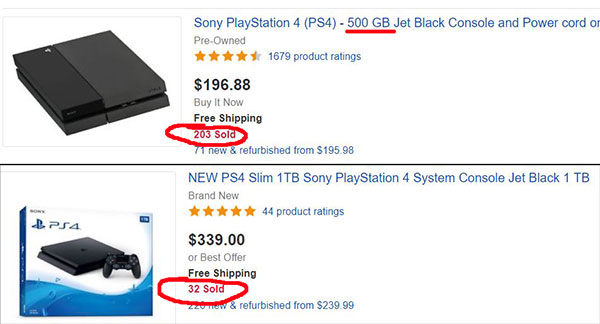
Seriously?!
WHO ARE THESE PEOPLE?! Both the clueless idiots still capable of navigating eBay but un-savvy enough to not look for deals with a simple Google search, and the swindlers preying on them. This is all a prime counter-example to show whenever someone tries to win an economics argument with the assumption of rational consumers. We are all irrational as hell.
Alas. Perhaps this entire episode is doing me a favor by not enabling me to buy three $20 PS4 games at technically $86 apiece. Even if I had gotten the voucher, they still would have been the equivalent of $66. In almost all other cases, I would prefer to play games on my PC, which already has a Blu-Ray player. Now, I may have eked out a bit more value from the free games from PS+ each month, but considering that my PS3 has gotten zero use in the last year, that’s still debatable.
I also passed on the Honor 6X for now. It actually went on a flash sale for $145, but in the process of looking at it closer, I realized that I bought my Honor 5X back in June 2016. Seems a bit silly to buy a new phone 1.5 years later when my current one is still functioning at 100%. People spend way more money on new iPhones every year, but those people are irrational.
What I did end up picking up were Far Cry 4 and No Man’s Sky, for about $13 and $20 after discounts, respectfully. I’m still on the fence about Destiny 2 at the moment, but I might take the plunge with some of my $90 in Blizzard credit from having sold WoW gold a year ago; I should still have enough for the next WoW expansion since Destiny 2 is on sale. That should be enough, right?
…right.
Survival Equilibrium
I may have mentioned it before, but I really enjoy Survival games. For the most part.
I am currently playing The Flame in the Flood, which is a Survival roguelike, and not at all a catchy Vance Joy song. The experience was immensely frustrating for my first run, as I felt like I never had enough of any supplies, and was about to uninstall and set the category as Finished in Steam. The second run, which I have been playing for the last five hours or so, has reached that point beyond which eventual victory is all but assured. Nevertheless, I hit up every single location I can, hoarding ever-greater numbers of probably unnecessary supplies for some kind of nightmare scenario. Which kinda makes sense in the vague, post-apocalypse setting.
Hitting that equilibrium moment in Survival games though is bittersweet. It’s like the middle of every Civilization game I have ever played – the game part is over, and now you must go through the motions towards inevitable victory. Ideally, you would want the challenge of the game to match up with the game’s end, and not midway. Some games like 7 Days to Die will try extending the challenge with escalating enemies, but there comes a moment when the escalation outstrips the whole Survival aspect and the underlying game becomes something different entirely, e.g. a shooter.
Then there is the opposite problem, in which the game’s challenge doesn’t ever really end, and part of the reason I added the “for the most part” caveat. I have not played it since its release from Early Access, but I never felt good in The Long Dark. There never seemed to be enough food, or fuel, or supplies. You were always on the precipice. And that’s the goal, right? The precipice is where all the fun is had. But while the surviving part is fun, I feel like there’s an invisible Anxiety Meter that fills up for me, and once it tops off the fun drops to zero.
Plus, sometimes Survival games are bullshit. I frequently found dead bodies in The Long Dark, searched them for candy bars, but could not, you know, take their clothing. I get it, things are simplified and balanced accordingly. Still, it gets a bit annoying when you come across dozens of boarded-up buildings in The Flame in the Flood, but “Old Lumber” is a relatively scarce resource you have to specifically loot from places. Or that Flint is a consumable resource for making a Campfire. Or that nothing could be salvaged from a sprung trap you just made.
Makes me wonder though. Would a more “realistic” Survival game be any fun? Seems like the more realistic it is, the less the game could actually be about Survival. At least, unless you set it out in the straight wilderness. Which kinda brings you back to The Long Dark.
Temporary EAnity
EA has temporarily removed the loot boxes from Star Wars: Battlefront 2, right before the official launch of the game:
We hear you loud and clear, so we’re turning off all in-game purchases. We will now spend more time listening, adjusting, balancing and tuning. This means that the option to purchase crystals in the game is now offline, and all progression will be earned through gameplay. The ability to purchase crystals in-game will become available at a later date, only after we’ve made changes to the game. We’ll share more details as we work through this.
I am honestly quite surprised. The negative press surrounding GTA Online’s Shark Cards or Shadows of War’s single-player loot boxes affected zero change, but here we have EA, of all people, turning off the cash spigot right before the water main gets connected. Then again, EA did get mentioned in half a dozen news article for having the most-downvoted comment in Reddit history (-676,000 at the time of this writing). Not exactly the narrative you want to be having right before the game’s release.
It’s tempting to pat ourselves on the back, at least those of us who actually care about game design and our fellow human beings. But the victory feels… well, like EA says, “temporary.” They did the right thing… under withering criticism. It’s like a politician apologizing for a decades-old scandal – an apology is more than we can expect these days, but it would have been nice if they had apologized before it was news. Or, you know, never did the action in the first place.
Alas, here we are.
It will be interesting indeed to see under what conditions the microtransactions return in SWBF2, and what possible new permutations they might take in other EA games. Will Battlefield Whatever’s design be impacted by this learning experience? Is this a learning experience at all, or simply an unfortunately-timed (for EA stockholders) zeitgeist?
We already know that the suits from TakeTwo don’t give a shit:
It appears that the GTA Online/MyCareer model is going to be the standard for big Take-Two Games going forward. People have expected a GTA Online type environment for Red Dead Redemption 2, which launches next year, though Rockstar has not announced what its online features will be.
“One of the things we’ve learned is if we create a robust opportunity, and a robust world, in which people can play delightfully in a bigger and bigger way, that they will keep coming back,” Zelnick told investors. “They will engage. And there is an opportunity to monetize that engagement.”
And that sort of underscores the vice gamers are put in to begin with. SynCaine pointed out that anyone buying SWBF2 is complicit with its monetization scheme, even if they don’t spend cash on loot boxes. That is technically accurate. But by that same token so is anyone who bought GTA V, given the Shark Card shenanigans. Do we really need to commit to never touching Red Dead Redemption 2 or the inevitable GTA VI?
I dunno. On the one hand, I am obviously an idealist when it comes to the purity of elegant game design. When the pieces fit together, when the various game systems synergize so perfectly… it’s orgasmic. Microtransactions have literally no place in any such gaming schema, any more than the concession stand does for the symphony performance. The symphony or game might rely on outside money in order to exist originally (artists have to eat), but once created, the art does (and should) exist independently.
Also, Consumer Surplus. It’s a thing.
On the other hand, we live in an absurd universe in which any sort of meaning or value is surprising. Thus, EA’s capitulation here, however temporary, is something to be celebrated. I certainly don’t think any of us expected it, especially given the likelihood that whales would have justified the PR hit by buying thousands of dollars of loot boxes on Day 1. And even if EA hadn’t backed down, if it’s possible for you to enjoy playing the game, what particular sense does it make to deny oneself? They’re microtransactions, not blood diamonds. Go have fun – nothing matters anyway.
All things considered though, I do think I’m giving SWBF2 a pass for now. Who is buying a game at full MSRP a literal week before Black Friday? Wait a month or two, save some cash, play your thirty other Steam games, and see how it all plays out. At least, that’s my plan. You do you.
 In An Age
Clever Flow
Mar 26
Posted by Azuriel
Despite not being initially impressed with Oxygen Not Included (ONI), I continued playing. And now I’m very impressed with the rather clever gameplay flow that Klei has touched upon.
My most successful base thus far.
Like I mentioned before, every game of ONI starts with three Duplicants appearing in the middle of an asteroid. While you have enough supplies for a few days, there is always a bit of a frenzy of activity hollowing out some living space for your Duplicants. Amusingly, toilets end up being actually a higher priority than even water. By the end of the second day or so, I’ve got a water pump set up, some toilets, a bunch of resource compactors (e.g. storage), some beds, a Microbe Musher, and perhaps a manual electricity generator hooked up to an Algae Deoxydizer.
This is where the subtle genius of the game design kicks in.
Ostensibly, your base seems self-sufficient. The Algae Deoxydizer is converting algae into oxygen, the Microbe Musher is turning dirt and water into Mush Bars (e.g. calories). And you presumably have a nice supply of water handy. For now, everything seems fine. Emphasis on the “for now.”
The whole time your Duplicants have been running around, they have been exhaling CO2. This pools in the lower reaches of your base, turning certain sections into unbreathable rooms. Even if you dig out a trench beneath your base for the express purpose of giving CO2 somewhere to go, it never actually goes away – it will eventually become dense enough to spill into upper rooms. So, you’re going to need to research technology to try and filter that CO2. Something like the Carbon Skimmer sounds great… but using that requires turning drinkable water into polluted water. Where is that polluted water going to live? Hmm, perhaps you need to research methods by which you can filter polluted water back into drinkable water…
And round and round we go.
While this seems like Game Design 101, I do appreciate the flow ONI has set up here. At times, things can seem incredibly frustrating insofar as a fundamental flaw in your base design reveals itself far too late for you to realistically do anything about it. But most of the time, I just get a bit more excited to start back over with a fresh world and learn from my mistakes.
Found a valuable Ice biome… through a Chlorine-saturated hot zone.
And somehow, these sort of things feel like my mistakes, rather than the game being cruel. “CO2 is heavier than Oxygen, so of course I shouldn’t have built my beds on the bottom floor.” “Oh, damn, I accepted one too many Duplicants, and now my food generation isn’t enough.” “Shit, I have been relying on six different machines that consume algae, and now I’m running out!”
Oxygen Not Included is still in Alpha, so there are a lot of things that can change. While I’m having more fun with it than I was originally, in the back of my mind, I also sort of recognize that the game is “solved.” As in, there are optimal base configurations that maximize output and minimize waste. While the same could sorta be said for other survival games, the issue is that ONI is all about managing a finite amount of resources. With something like Don’t Starve, I could always just strike off and head into the wilderness and take a chance.
I dunno. The asteroid itself is randomly seeded with biomes each time, so I can see encountering special circumstances that might change a strategy. For example, most people head towards Electrolizers and Hydrogen Generators, because they combo really well in powering your base and providing Oxygen (at the expense of water). I was heading that way too, before I discovered a Natural Gas Geyser – geysers being the only source of renewable resources – within sight of my starting point. All of a sudden, I was rushing to figure out how to exploit burning natural gas. “OK, it dumps out polluted water and a bunch of CO2. The CO2 scrubber deletes CO2 and also produces polluted water, so I should pipe that through a Water Sieve to reclaim the pure water, then send that into an Electrolyzer… but what about the Hydrogen?”
Like I said, there is a lot about Oxygen Not Included that can be compelling.
For now though, I’m going to stop generating new worlds and wait for some more releases to flesh out the rest of the game. The recent “Rancher” update overhauled a lot of the alien critter mechanics, invalidating certain strategies and presumably enabling a few others. I’m hoping that after a few more of those kind of patches, we’ll start to see something resembling a story-mode, and/or a way to make the march to endgame a bit more varied. The Rancher updates does this a little, but I feel we still end up with Hydrogen Generators and abusing Wheezewort (cooling plants) mechanics.
Posted in Commentary, Impressions
2 Comments
Tags: Clever, Flow, Game Design, Oxygen Not Included, Science