Category Archives: Commentary
Where Are All the Bodies?, pt 2
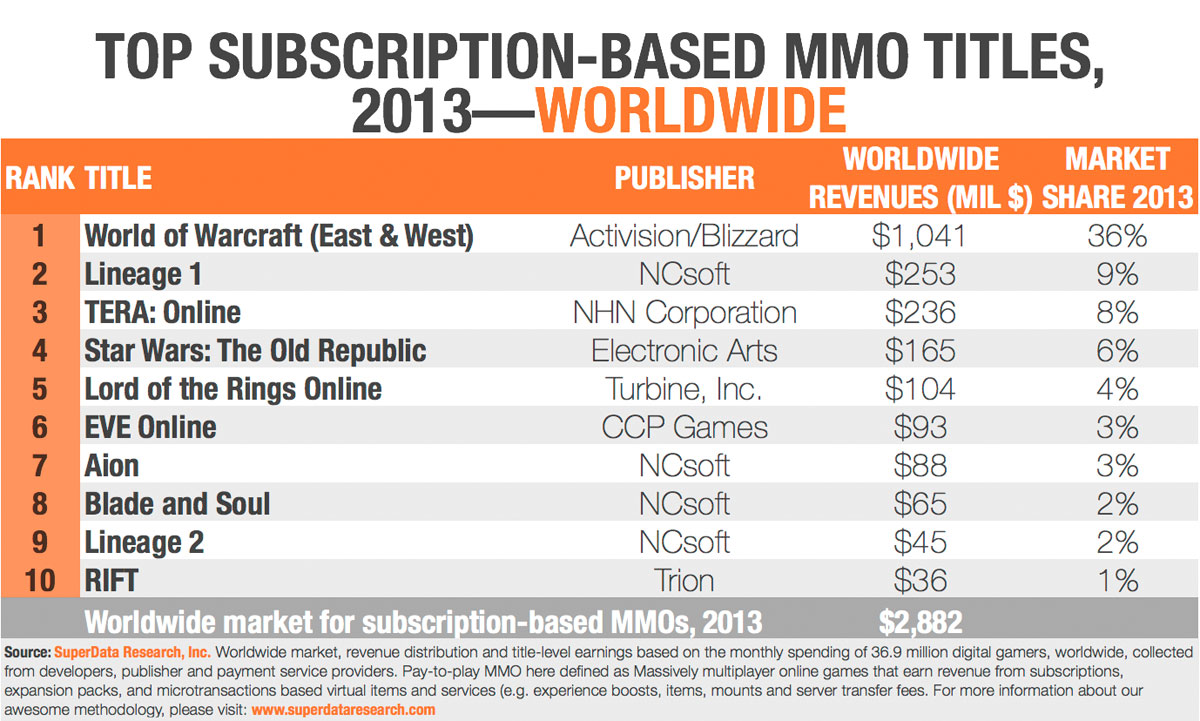
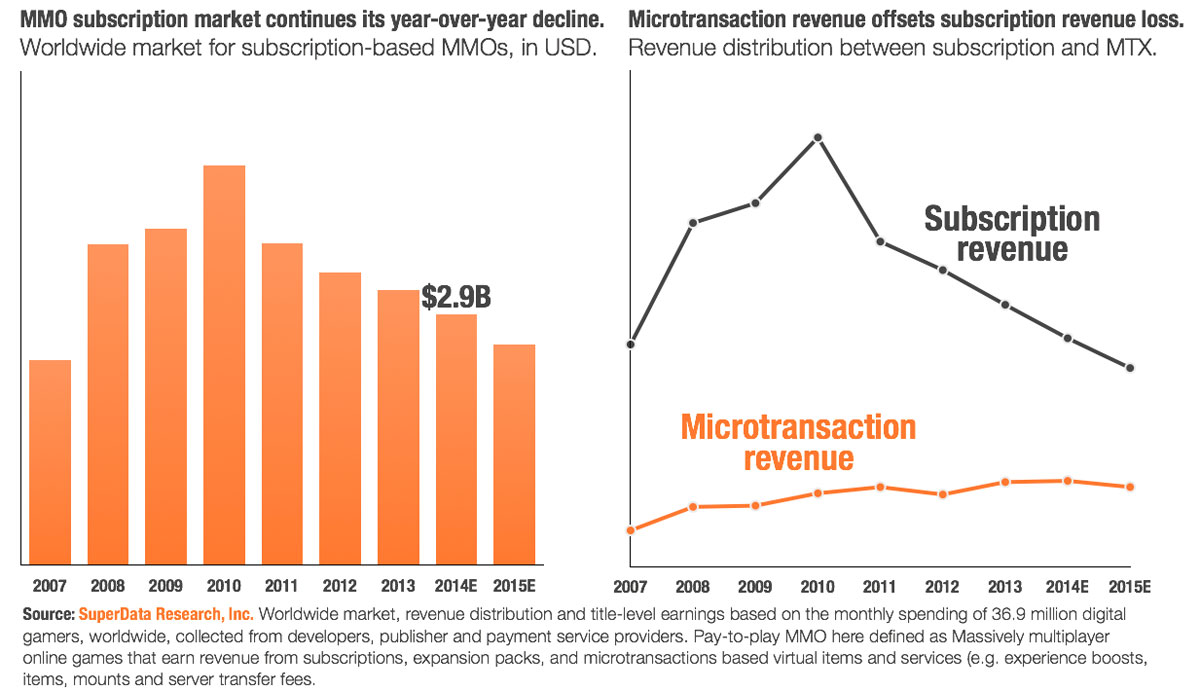
Almost exactly two years ago, I asked “Where are all the bodies?” in terms of a trend of flight from MMOs. Last week, Wilhelm presented the SuperData Research group’s June report. The two slides of note are below:
Hmm.
HMM.
As pointed out in the comments over on TAGN, the accuracy of numbers and legitimacy of the research company itself might be in question. For one thing, neither FFXI nor FFXIV are even on that list. The absence of Guild Wars 2 makes a little sense given the criteria for inclusion (subscription option), but the others? I dunno. Perhaps they are being implied in the missing 26% of market share. Which, incidentally, covers $756 million of the total revenue on the chart.
In an attempt to compare the subscription revenue graph to the last update from MMOData.net, I got the following result:
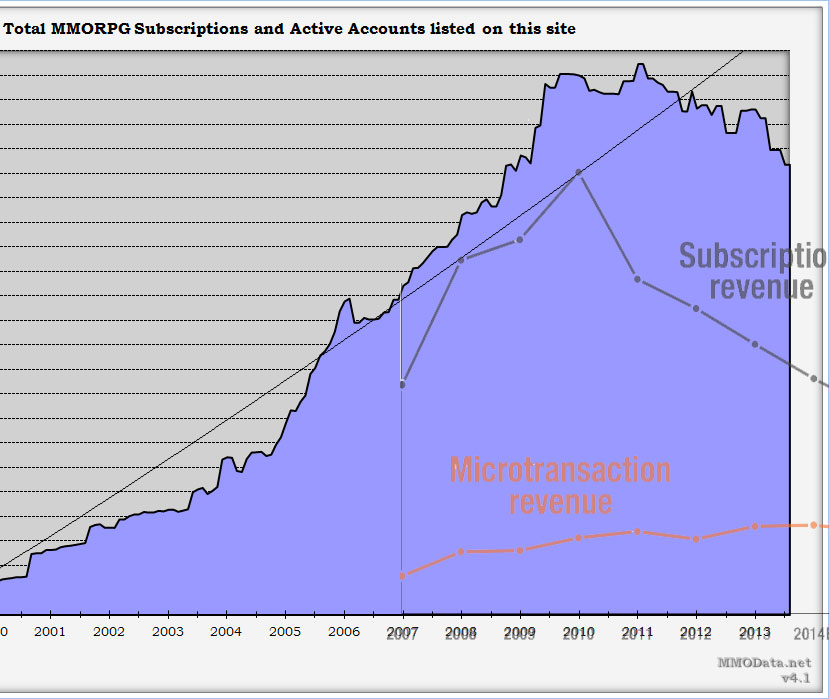
Extremely scientific, I assure you.
My methodology was to squish the one graph until the years lined up. Regardless, I have a hard time imagining the precipitous drop in subscription revenue on their chart is correlated in reality. There is a very real decline in overall MMO population – we have reached the same population levels from mid-2008 at this point – but revenue can’t be that bad. Can it?
What is sorta interesting though is in the small text below the graph, which states the data was pulled from “36.9 million digital gamers.” If you take that figure and multiply it by the market share, you get 13,284,000 as the WoW population. Of course, WoW did not have 13+ million subscribers in 2013. Discrepancy! Or is it? If you assume a 5% churn rate each month, at the end of the year you are left with 7,178,143. That is somewhat close to the estimated 7.6 million from this year. In other words, it’s entirely possible that 13+ million players played WoW at some point during the year and 6 million of them cycled out.
On the other hand, when you plug EVE into that same equation, you get 1,107,000 players throughout 2013. So… maybe it’s all bullshit.
Accuracy aside, I think the takeaway from all this is twofold. First, the MMO market has clearly peaked and we are transitioning into a much lower (presumed) equilibrium. Second, it’s still surprising how money there is in the genre. I mean, look at SWTOR there. $165 million in revenue last year? It actually took this Forbes article to kind of shock me into the realization (emphasis added):
And what may be a surprise to many is that Star Wars: The Old Republic is actually #4 on the list, bringing in $165M in revenue last year. While much of the game went free-to-play after a disappointing debut, there’s still a subscription model that has made the MMO profitable for EA. Often SWTOR is regarded as a cautionary tale in the industry in terms of bloated budgets, over-ambition and emulating competitors, but looking at the numbers, the game has evolved into a profitable enterprise for EA, and has made even its massive budget back at this point.
I don’t even know if that is true for sure, but remember, SWTOR budget was somewhere in the neighborhood of $200 million. So… are we still allowed to call the game a “failure?” The criteria gets a little goofy when you are making ~44% more than the paragon of subscription growth¹, EVE. We can maybe say that it could/should have earned more, but (presumably) profitable businesses really speak for themselves.
As always, I believe key to success is keeping realistic expectations and budgeting around that. If you need 500,000 or 1 million subscriptions to stay afloat, maybe you should calm your shit, Icarus. The entire market is like 18 million subs, and more than a third of those are locked down in Blizzard HQ. If you can get by with 50k or 100k, you should have no problems capturing a least a portion of the 500k+ people that seem to appear on MMO release days and leave a month later. Now more than any other time, you need to start small and work your way up.
¹ Which is more historical fact than current event. As far as I’m aware, EVE has lost subs at this point like all mortal MMO endeavors.
What PSX games would you actually play?
So my PSX problems from the other day were mostly solved by stumbling across an emulator website that specifically had a PSX-2-PSP section that already did the heavy lifting for you in terms of format conversion. From there, I simply had to choose any of their 1301 offerings on sale to download.
And therein lies the rub: what would I actually play?
This September, I will be 31-years old. Holy shit, right? I grew up on the crest of the videogame revolution and rode it rather thoroughly until the end of the PS2. I was there to play games like A Link to the Past and Chrono Trigger and FF6 and Super Metroid while they were current. I still remember, with perfect clarity, unwrapping the Playstation for Christmas and popping in FF7 for the first time. When Tifa and Barret appeared onscreen together in the 7th Heaven Bar, my father walked by and quipped “Wow, that’s pretty progressive of them to include interracial dating.” This was in 1997, mind you. After that, I made sure to never play RPGs when other people were around.
Point being, the original Playstation era was one of unparallelled nostalgia for me. These were prime gaming years in my prime (14-17 years old). I still remember the shivers I felt when watching the promo video for Xenogears that was included in the packaging for Parasite Eve. In fact, I just spent 30 minutes trying to find that video, and I felt those same shivers sixteen years later.
Nevertheless, I sat looking at the PSX game list for a good ten minutes without selecting anything. Believe me, I understand the intoxicating effects of nostalgia and the risk one takes in replaying old games generally; not only is the game unlikely to hold up, you risk souring your memories by subjecting yourself to downright primitive graphics and design. But all of that was not actually my concern. My concern was: I still remember all these games.
For example, I was looking pretty intensely at SaGa Frontier 2 for a bit, as I remember it being a fun game with a beautiful art direction. But… I still remember the strategies I used to defeat the game, the places where I got stuck, and the end result of the progression. I’m pretty sure I remember crafting a pistol that shot rockets in Parasite Eve – and that awful final boss encounter. I have talked about Novelty being the essence of fun before, and my particular problem is that the intervening decades have not diminished my memory of the experience of these games. “Something something riding bikes,” in other words.
There were some exceptions in the list. I let out an audible squeal when I saw Tactics Ogre. That and Final Fantasy Tactics seemed perfect for this little PSP experiment of mine, as they remain games I still somehow consider fun despite knowing everything about their systems. Maybe it is because a tactical game has many more possible permutations than your average RPG battle system? I felt no hesitation with Xenogears either, nor Castlevania: Symphony of the Night, although I’m going to hold off on FF7 until I play it via Steam.
For the rest of the list, I think what I’ll end up doing is actually picking titles I haven’t played. Enough people have talked about Legend of Dragoon to overcome my memories of renting the game and setting it down 15 minutes later. Suikoden 2 has been hyped beyond all reason, so that’s another easy one to test. Beyond that though? I dunno. I would solicit answers from you, dear readers, but I fear it would just be a bunch of “already played that” replies.
So allow me to turn the tables a bit: what PSX games would you actually play? Is there a title you would like to play again, or perhaps one you’d like to check off your bucket list? Would you even play any at all?
[Fake Edit]: The PSX-2-PSP website didn’t actually solve anything; all the PSX come up as “corrupted files” even though they are fine on my computer. It’s almost enough to drive a man to legitimacy.
PvP is Overrated
Okay, seriously, last time I abuse a (this) misleading title.
Two items of interest today. First, Blizzard finally took a step to address BG faction imbalance (read: queue times) in WoW… by opening free Horde –> Alliance transfers on a single realm:
We consistently watch queue times for all areas of the game to try to identify problem areas where we can step in and make an improvement. Battleground queue times specifically tend to be a direct result of how many people are entering the queue at any given time from both the Horde and Alliance, within an entire region. While a number of factors can lead to longer queue times, faction interest in queuing for PvP tends to be the primary influence. For that reason we’re going to be trying something new. For a limited time, and only for select realms (for this first test just a single realm), we’ll be opening faction changes for Horde characters to change to Alliance for free.
While time will tell how much this works in solving queue times, I have been watching Blizzard dance around this issue with considerable amusement. Because honestly, the solution that actually works is the one the devs are least willing to implement: same-faction BGs. Bam! Faction imbalance solved. Instead, Blizzard is treating random BGs as some sacrosanct, final line in the sand:
Faction imbalance is definitely something that’s contributing to the lengthy queue times. That said, we agree that allowing Horde vs Horde and Alliance vs Alliance Random BG’s isn’t a great answer. We’ll do it if it’s absolutely necessary (Rated BG’s allow for same-faction battles for exactly this reason), but we’re going to look at all other options first.
Honestly, even if we can’t find another good answer, we’re not sure queue times are so bad, at least at the moment, that same-faction Random BG’s would be worth it. Horde vs Alliance, Orcs vs Humans, Elves vs Trolls etc. has long been a strong core of the Warcraft universe. We want queue times to be faster for everyone, but we also don’t want to lose that.
Err… guys? It’s a goddamn random BG. Nobody cares. Horde have been battling Horde in Arena and Rated Battlegrounds (gasp!) for years. It would not be at all difficult to provide lore-based justifications for this combat. I mean, the Horde is fighting the “Iron Horde” in the next expansion, for god’s sake. One team is Horde, the other consists of “Twilight Cultists.” One team is Alliance, the other is “Scarlet Crusaders.” There are literally dozens of viable factions introduced in each expansion that could make these fights make sense, if anyone at all really cared about the “strong core of the Warcraft universe” nearly 11 years since the release of Warcraft 3: Frozen Throne. And it’s not like they could not get that same Horde vs Alliance kick from, I dunno, the actual story as told by quests and such. World PvP could still be whatever.
There are few things worse in any game than having to wait out timers. Sure, some people pine for the days of 30-minute boat rides in EverQuest and such, but you could theoretically chalk that up to “immersion.” There really isn’t anything that can be said for BG queue timers; the whole thing is arbitrary from the start. I’d like to believe that we will see same-faction BGs from Blizzard sooner rather than later, but the hills people choose to die on are varied and nonsensical on the whole.
Second item: fun with “Peace-decs” in EVE. While technically recycled, the article is interesting to me because it turns the traditional EVE “PvP sandbox” thinking on its ear.
For the uninitiated (which technically includes me as well), EVE has three security zones: hi-sec, low-sec, and null-sec. If you are out mining in high-sec, anyone who shoots you will get killed by space police within a few seconds. One way to get around that is for a PvP guild to “war-dec” your guild, which gives them the ability to shoot you without repercussion for as long as they pay the upkeep to the war-dec. What can you do? Nothing. Technically, you can quit the guild that has been war-dec’d or join an NPC guild or perhaps just not log on at all until the whole thing blows over. The developers likely hope that you either fight them or hire mercenaries to kill them or something of that nature. Or maybe they don’t particularly care.
This hypothetical “peace-dec” is the opposite of the war-dec: your guild pays a sum of money + upkeep costs to prevent another guild from being able to fire on you in hi-sec. Sounds fair, right? Holy shit though, watch the PvPers freak the hell out at the suggestion. For the inherent symmetry of the peace-dec thought experiment highlights how much of a non-sandbox the EVE universe might happen to be. I mean, is a sandbox a sandbox if other players dictate how you can play? It’s an interesting question. It’s also interesting seeing PvPers get mad at being threatened with the inability to play the game how they want to, when the existence of war-decs necessarily prevents PvE players from doing so. Why is turnabout not fair play?
In any case, the idea of a peace-dec is really growing on me, even for other games. For one thing, imagine the money-sink capability. Even if there were only a 5% chance of dying from a ganker, I’d imagine that 90%+ of the players would consider X amount of their earnings a worthwhile sacrifice for the peace of mind. Then, as you get more comfortable in your PvP ability, you can stop paying the upkeep and gain a greater profit for your skill, even if you are farming the same area. Plus, you could have instanced PvP for those who want fights they don’t have to look for. Who loses under this scheme, and why do we care about them?
VR is Overrated
Not really. Well… maybe. I mostly wanted to keep the title convention going.
I was discussing with a friend the other day about whether I think the Oculus Rift and VR in general is going to be the next big thing. Before I present my thoughts on the matter, let me preface with two items. First, I have not ever worn an Oculus Rift. I was an iPod and smartphone holdout through some extremely prime college years up until the moment I wasn’t, at which point I was slightly embarrassed for how needlessly I went without a piece of technology that otherwise made my life better. So, having not ever used this latest generation of VR headgear, it’s always possible that it will be wildly better (or worse) than I imagine. I did go to the Epcot Center back in the late 90s, which had some very primitive VR machines, and it went okay.
Second, Nintendo released this in 1995:
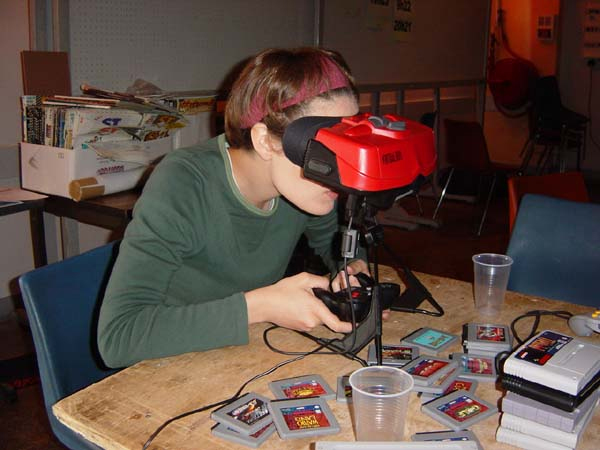
Nearly 19 years ago, folks. Nineteen years. [img source]
The answer I gave to my friend was: “Yes… eventually, in the remote future.”
I have a few issues with VR conceptually. First, what problem is it trying to solve? Maybe it doesn’t need to solve anything. Maybe it is simply another tool in increasing immersion. The issues I have with that are the non-monetary costs involved. I am talking about having to wear headgear that shuts out the outside world. For the moment, I will assume that it’s weight is negligible, that it will be comfortable for long play sessions even for those who wear glasses (such as myself), that there will be no issues with fogging up glasses, and so on. But… does the Oculus not preclude the use of keyboards? Perhaps the most obvious usage of VR would be in MMOs, but I’m not entirely convinced that going into 100% proximity voice or Vent/etc channels to interact is a step the community is willing to make. To say nothing about the more mundane concerns like, I dunno, reaching for your drink.
Second, what is it really adding to the gameplay experience? There have been a lot of FPS demos out there heralding the ability to glance side-to-side, or even full-scale treadmill-esque setups that would simulate you actually running around. That sort of thing makes for some comical Youtube videos, but in practice? I’m not convinced that limiting my PlanetSide 2 abilities to my physical endurance is a positive outside of exercise scenarios. And what real good is peripheral vision in an FPS when I would still be required to turn my character (with a controller!) in that direction to shoot the enemy?
One thing I was actually looking forward to was the ability to essentially never have to purchase a TV again. “Is a 40″ TV big enough for my apartment, or should I upgrade to 50″?” I’m already at the point where I believe that I would be better off with a projector, but what amounts to an infinite-screen TV is very tempting. At least it was, up until the moment I realized that VR is an extremely personal experience. If you have someone over, you both can’t share the same headset, so that “frugal” TV-replacement purchase suddenly balloons up with another Oculus purchase or Oculus + the TV you were going to buy anyway. Plus, you have the same issues as with the computer (e.g. find your drink) with an added bonus of precluding things like mid-movie make-outs… at least not without taking off the headgear.
Don’t get me wrong though, VR definitely has some potential. As the maker of Omni (the treadmill thing) mentioned, it can/will be used to train military units, it could help in physical therapy, I can see it being utilized for “traveling,” seeing museums, national parks, house shopping, etc, etc, etc. I’m not entirely sure what Facebook will be using it for, but maybe they think (VR) chatrooms will make a comeback. But for right now? I don’t know what I was use it for. I feel the exact same way about augmented reality tech like Google Glass as well – other than the fantastic advertising opportunities, what use would it have? Each time I’ve read a Zubon post about Ingress, I become further convinced that I am at risk of slipping into “old man” territory, railing against the incomprehensible “Nintendos” of the younger generation.
So… yeah. VR is probably the future, at some point. Not sure if it’ll ever be my future though.
Coastal Wizards Indict Cryptic Hex
In a move that should not have been so surprising in retrospect, Wizards of the Coast – makers of Magic: the Gathering – are suing Cryptozoic‘s Hex for copyright and patent infringement. Browsing through the actual complaint is actually fairly eye-opening. For example, if you turn to page 14, paragraph 30, lines 18-21:
Other users in the gaming community were confused because of the near identicality of the two games. On Cryptozoic’s own forum a registered user, on December 1, 2013, stated, “I have played a lot of CCGs [Collectible Card Games], and for the most part, CCGs are very similar to each other. However, I’ve never seen a CCG that is as similar to another as Hex is to Magic.”
Think about that for a second. Some random comment of yours on a forum from a year ago could be cited in a copyright/patent lawsuit used to bankrupt a multimillion dollar company.
Going back over my Hex posts, I just realized that I practically wrote the complaint myself a year ago (bolded for prophesy):
I have some concerns with Hex. First, while I am frankly excited about the unique opportunities involved with an all-digital TCG – cards that buff your creatures do so for the rest of the match, you can put tokens on cards that get shuffled into your library, and all sorts of crazy nonsense that physical card games couldn’t pull off – this game skews so heavily towards Magic Online that I’m surprised Wizards of the Coast hasn’t issued a takedown notice.
Seriously, look at this video.
I’m not talking about Apple’s “rounded corners” copyright bullshit, I’m talking about Grand Theft Mechanics. Creatures have summoning sickness, there is First Strike, Haste, seven cards in the opening hand, 20 life per player, four copy limit on individual cards, 60 cards per deck, land cards, instants, discrete turn phases (Draw phase, main phase, declaring attackers/blockers/combat damage, end step), and even the goddamn Stack.
Indeed, Wizards has a table outlining all those same similarities and more starting on page 16, paragraph 34. What ultimately got me the most though, were the excessively blatant clonings. “Flying” vs “Flight” is like, you know, whatever. Coming across the following card comparisons though?
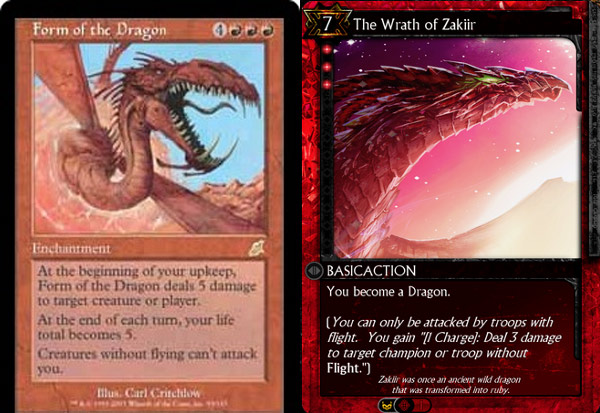
Err… totally an homage, guys.
Okay, maybe you can overlook the 7-mana casting cost, the fact that you become a dragon, can only be attacked by flying creatures, and so on. Maybe the Hex version doesn’t put you at 5 HP. Also, one is an Enchantment that can be removed, whereas the other is a spell that’s otherwise permanent. I can see giving this a pass. But then…
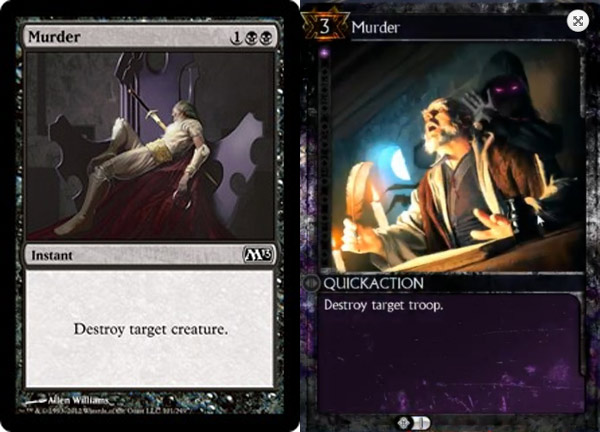
Uh oh.
It’s like they weren’t even trying. There are literally dozens of these sorts of cards floating around.
If you’re interested, I came across a Magic-playing lawyer’s blog post examining the lawsuit in plain language. In short, Wizards is bullshitting in some respects, reaching in others, but likely has a pretty solid case overall. Also, Richard Garfield’s patent on tapping cards, e.g. turning them sideways, expires in June 2014. That seems almost like someone patenting gaining XP and leveling up, but hey, someone had to invent intermittent windshield wipers; sometimes there is no more elegant a solution to a problem than the first one.
In any case, I might spend some time this weekend reinstalling the Hex beta and playing around a bit while I still can. Given how I wasted $85 paid $85 for an expensive lesson on the wisdom of Kickstarting pre-alpha projects, it’s the least I can do. Or I could watch other people play Hearthstone on Twitch, which I am sadly starting to find more entertaining than Hearthstone itself, at least in this metagame.
FFXII
In the midterm period inbetween steady access to the internet, I decided now was as good a time as any to actually get around to playing some of the PlayStation games I own but never bothered turn on. My first choice? As the title suggests: Final Fantasy XII.
All I can say is… yikes.
To say that I was a Squaresoft fanboy growing up is an understatement of the decade(s). Indeed, Final Fantasy 7 remains my #2 game of all time – and that is despite having first played FF6 on the SNES when it came out. While the “back to the roots” FF9 nearly derailed my fanboism outright, FFX quickly set things back on the right track. Sadly, when I heard that FFXI was going to be an online-only MMO, I pretty much cut ties with the company; I stayed long enough to pick up FFX-2, but that had the dubious distinction of being the only FF game I ever sold back to a video game shop for store credit (after beating it, of course). Looking back, I think my lack of engagement with the series had more to do with college and life changes than feelings of “betrayal,” but regardless FFX-2 was the last FF game I played.
Now, I’m not saying anything necessarily about the gameplay of FFXII. To be honest, in the 30 minutes I’ve been “playing” I haven’t seen all that much of it. And if I recall correctly, FFXII was widely criticized as being non-interactive. But a more pressing concern right now is how awful the game looks on my TV. The default view is double-letterboxed such that it easily loses 15″ off the TV screen. And even then the pixelation is horrendous.
I technically bought FF7 on a Steam sale a while back (because, you know, FF7) and it’s entirely possible I will encounter similar graphical issues. But to an extent I almost see this as an existential threat to older games. Or, rather, older games that were straddling the cutting-edge for their time. Things that seemed ground-breaking for its time in comparison to more sprite-based games have looped around into barely-playable nonsense graphics in less than 10 years.
It kinda makes you wonder though, whether or not this will be a recurring issue as time goes by or if it was a specific moment in computer graphics history. Personally, I’m leaning towards the latter. After all, the original Crysis has held up exceptionally well and even the original Far Cry wasn’t that bad. But have you tried playing KotOR lately? I muscled through that a few years ago, and it left me sore with the effort. It wasn’t even the graphics really, but little things like not being able to pan the camera upwards. It’s Star Wars and you got huge alien cities and you can’t look much farther than the main character’s low-polygon ass.
Dust, Draenor, Destiny
The one bit of news out of CCP’s Fanfest 2014 that peaked my interest was Project Legion. Which is, for all intents and purposes, a rebooting of Dust 514 on the platform it should have been released on in the first place: the PC. I’m not actually sure a sandbox PvP/PvE hybrid shooter MMO is what I’m looking for anymore, but given I have continued to grudgingly slink back to PlanetSide 2 for my FPS urges, let’s just say that I’m not exactly opposed to new experiences. It should be noted that in that article, CCP basically states that Dust still has 100,000 active daily players, which is around 100k more than it seemed to have any reason to have last time I played.
Incidentally, NoizyGamer believes that this year or the last one might have marked the last year of consecutive EVE subscriber growth. That’s noteworthy specifically because the ~10 consecutive years of growth itself was noteworthy. And rather annoying to argue against with my MMO market saturation theories.
Speaking of bodies, WoW lost another 200k of them since last quarter, bringing the total to a mere 7.6 million. I’m not really sure what to think about this sort of thing anymore; at the moment, I’m leaning towards simple incredulity that there are 7.6 million people paying a subscription to a game that will be going on a full year without any new content. I mean, I too was that guy years ago, but that sort of shit doesn’t fly with me these days.
Speaking of questionable Activision Blizzard moves, the console-only FPS MMO Destiny is reportedly going to cost $500 million:
To put some perspective on this, the money being spent on Destiny is more than twice the amount EA reportedly spent on Star Wars: The Old Republic and a little less than double the $265,000,000 Rockstar paid to get GTA V made. The Reuters article cites analysts saying that Destiny will have to sell 15-16 million copies at $60 to break even. So, the final game has to make a very, very good first impression.
For reference, Borderlands 2 cost ~$35 million and sold 8.5 million copies as of February 2014. It’s worth noting that the first link estimates Destiny at $140 million, so it’s entirely possible that the $500 million is in reference to the entire 10-year franchise run that Activision Blizzard purchased from Bungie rather than the BorderHaloLands game we have on display.
Still… goddamn. This doesn’t even seem like the same ultra-conservative game company of a year ago, who didn’t want to branch out into the mobile space simply because the Top 10 games change every year. I’d like to imagine those executives with a fat Hearthstone egg on their face, but great handfuls of money make for surprisingly effective yolk removal.
Destiny Unfulfilled
Remember BorderHaloLands, more commonly known as Destiny? You might recall I have mentioned it before. Well, yesterday was the first day of a press junket and the overarching narrative is… not good, with Kotaku and Destructoid basically calling it boring. They also called it rather amazingly detailed and lush and beautiful. And barren. And lifeless. And populated with level 2 mobs with health bars that you shoot to power your rechargable super-skills. Yeeeeaaahh.
There is a mega-thread on Reddit if you want more sources and commentary.
What’s kinda funny to me are the understated dangers of game design, at least when you let the hype train roll along just a tad too long and it misses it’s station. In just about every article I’ve read on Destiny, unfavorable comparisons are being drawn between Destiny and Titanfall. And why not? Both are next-gen sci-fi shooters trying to establish new IPs. The problem is that, like it or not, Titanfall pretty much ate Destiny’s lunch before he even got to the cashier. Just look at these developer quotes in the Polygon article:
“The way we like to think about it, is not everybody is going to want to play Destiny, but everybody is going to be able to play Destiny if they want to,” Parsons added. “We’ve made significant improvements to the way players are going to play. People are surprised at how quickly they master the controls and get up to speed and having a great time.”
“It might not feel new compared to some of the other things that have come out recently, like Titanfall,” said design lead Lars Bakken, who added that there are changes, like free-floating double-jumps that can last for a long time. “But we’ve been prototyping for a long time and we’ve created experiences that you’ve never been able to experience before in the previous games that we’ve made, especially because it’s inherent to your character.”
I mean, I laughed at the design lead sheepishly trying to draw a parallel between the now-genre-defining wall-running parkour of Titanfall and his own game’s “long-lasting double jumps.” And then I felt sad for them. Because how were they supposed to know? As I mention in the comments yesterday, I was all gung-ho for Hex to the tune of an $85 Kickstarter pledge right up until Hearthstone came out of nowhere – 3 short months later – and pretty much flipped the proverbial design table. Now I feel like anyone coming out with a digital TCG that requires you to spam-click “Pass Priority” a dozen times a turn is basically Dead On Arrival. Hex has moved on to beta recently, but I’m not even sure I have the alpha client still installed. Why bother?
In any case, the word on the street is still that there won’t be any PC version of Destiny. The reason?
Parsons also said creating and releasing a PC version of Bungie’s shared world shooter would not be as easy as many believe, because all versions of the game connect to the same persistent video game world, which itself extends to multiple platforms.
“It is not nearly as simple as you think,” he said. “It is one central world no matter what the platform, and so that requires lots of intensive thought.
Err… okay. It sorta sounds like they’re implying that people on a Xbone can play with people on a PS4, but I’m relatively certain that that’s not actually going to happen. Just like the chances of me considering a purchase of this game. But good luck, Bungie, all the same. You’re going to need it in this new environment, especially considering you’ve already got the next 10 years of this IP all planned out. If Destiny 2 doesn’t have wall-running, you’re going to be in for a bad time.
Payment Model Perspective
I was browsing Kotaku the other day, and came across an article/review of a mobile game called Wayward Souls. Truthfully, I only read it because the byline mentioned Secret of Mana, which is relevant to my interests; it is, incidentally, probably my second-most played game of all time right behind A Link to the Past. Did you realize that SoM came out in the US 20 years ago this past October? Two decades.
Anyway, Wayward Souls is whatever – doesn’t seem to capture much of SoM’s magic beyond the pixel and music style based on the video alone. What was interesting to me though, was when they mentioned in the video that they’re going with the MineCraftian business model, e.g. selling it for $5 at first, and increasing the cost as time goes by. To me, this raises a number of interesting questions. First… is there a term for this payment model? I use MineCraft as perhaps the most well-known example, but surely it was tried beforehand.
Second, does it feel bad to anyone else?
I mean, I understand the logic behind it. Traditionally, game companies are going to want to charge full MSRP at release to capture the dollars of whom we now term “whales,” e.g. the people who would have paid $100 for the game, if they had charged that much. As time goes by, the price comes down via sales and whatnot to capture the players who would have bought it for less than MSRP. The MineCraft model seems like it should never work, but actually makes a lot of sense when you realize that the traditional model relies on a well-informed and excited playerbase for your game – in an ocean of crappy mobile games, you’re not going to have the whales spending money out of the game. This alternative model lets you build buzz somewhat organically, and then try and capture the big spenders as you ride the wave home. Plus, it sort of short-circuits the “wait until the Humble Bundle sale” strategy insofar as it will supposedly be more expensive the longer you wait (which ironically sorta is how Humble Bundles work).
Like I mentioned though, the MineCraft model doesn’t particularly work for me. It grates, like a piano out of tune. But I can’t fully articulate why though, especially when you consider nearly all games do this via cheaper preorders. Damn near everything is 20% off on GreenManGaming before it comes out. Sometimes a game will drop in price within the first three months (and sometimes faster these days, if they miss the forecasts), but it’s usually quite some time before it drops below the preorder price. So… what’s the difference, really? I can’t even claim that it’s because of psychological manipulation, because that’s pretty much behind all sales strategy. It just feels… bad, somehow. And causes me to mentally dig my heels in and wait for the Humble Bundle because screw you for defying the natural order of things. Or something.


Sometimes I Really Hate Bioware
Aug 11
Posted by Azuriel
So hey, there is another sale on Origin right now – pretty much the entire EA catalog (all six games) is reduced by 50% or more. Know what isn’t reduced in price though? Goddamn Mass Effect DLC:
For god’s sake, Bioware, get your shit together.
That’s right, you can buy the entire Mass Effect franchise for $15. If you want to get all the canon DLC though, that will be an additional $64. For a 2+ year old game. For DLC that has never been on sale.
At this point I can no longer tell if Bioware is just stupid, or evil, or what. Is the nefarious plan to rope in new players at the $15 price-point and then squeeze the $64 out of the few who become super-enamored with the game? Or is the marketing department asleep at the wheel (or fired) and they just never got around to running the numbers on having a Bioware point sale? Or, you know, migrating from the goddamn ridiculous point system like every other game company?
I suppose the good news is that Casey Hudson, project director for KOTOR and the entire Mass Effect series, left Bioware last week. While I still have some sour grapes (more like sour raisins at this point) over the ME3 ending debacle, the fleshed-out endings went a long way in regaining my trust. I do not idolize content creators as a rule – individual works are the only thing that deserves respect – but this move makes it more likely that Bioware will be left with games I won’t be compelled to play, thereby making it easier to both hate them and not give them money simultaneously.
But seriously, Bioware, put that goddamn Mass Effect DLC on sale and I will buy it.
Posted in Commentary
6 Comments
Tags: Bioware, Casey Hudson, DLC, EA, Evil, Mass Effect