Category Archives: Commentary
Legendaried
As you may or may not have seen on MMO-Champ, there was an interview with J. Allen Brack, Lead Producer of World of Warcraft, in which he dropped a Legendary bomb:
Brack: There’s one more piece which is an announcement that we’re releasing a rogue legendary weapon. Specific for rogues, so it will be a dagger. There will be some sort of quest, traditionally we’ve done these quests that players need to participate in order to create the legendary weapon in this case we’ll be focusing on rogues that will try to make that happen. […]
We haven’t decided on the name and how it’s going to work, we just know that we really want a legendary weapon to come out of this tier and we really want it to be a rogue dagger. That’s really all we know at this point. As time goes on we get a lot more lore, a lot more story, an “in” to the creation of all the legendary weapons. We really did a lot with the legendary axe that you got out of Lich King and then we’ve had other legendaries with the Cataclysm tiers that have had these storylines, we’re hoping this one’s going to be the most exciting, the most epic legendary quest line.
what is this I don’t even

Where do I start?
- Did no one in the design meeting raise their hand and question how “the most exciting, most epic legendary quest line” can even happen if you don’t have the least-played class in WoW in your raid team? Hey, Brack, you know that cool quest line you did for Shadowmourne? People saw and participated in that because THREE HUGELY POPULAR CLASSES were capable of taking it. Same deal Dragonswrath, same deal with Val’anyr, same deal with every single crafted legendary¹.
- At what point was it decided that legendary weapon quests were good uses of design time while class quests were not? Is the idea that legendary quests are like class quests that only a handful of classes even have access to?
- Legendary quest lines never really made any sense to me in an MMO setting to begin with. Is the collection of fragments of an ancient weapon cool? Yes. Is infusing them with the souls of your fallen foes awesome? Yes. Is a quest line that takes dozens of people weeks to accomplish epic? Yes! Er… unless you aren’t the guy getting the legendary. Don’t get me wrong, it feels great being part of something bigger than yourself. Problem is that an item to just one person is NOT something bigger than yourself. Legendaries in WoW, aside from one brief flirt with sanity in TBC, are designed for RPGs, not MMORPGs. If it has “worked” in vanilla and Wrath and Cataclysm thus far, it is working in spite of the terrible design.
I get that it was forewarned (in the tank Q&A of all places) that the 4.3 legendary “will have much more narrow appeal.” But… really? Remember the blue post back in June that speculated about why rogues are the least-played class? I am almost wondering if this legendary dagger is a cynical attempt at rectifying that discrepancy.
¹ Meaning more than one class could use it, not that all of them had 3 popular classes or whatever.
Questing and Interactivity
I was all prepared to talk about questing and how I think MMO designers are doing it wrong… and then I discovered Jeff Kaplan pretty much said everything back in 2009.
“Basically, and I’m speaking to the Blizzard guys in the back: we need to stop writing a fucking book in our game, because nobody wants to read it.”
That line is a part of a larger commentary on what Kaplan calls Medium Envy – the tendency for game designers to turn their game into a book or movie at the expense of the one quality that sets games apart: their interactivity. The industry has wild oscillations on this subject, with brilliant examples of the Right Way (Half Life series with zero cutscenes) and the Wrong Way (Metal Gear Solid series). Of course, I say “Right Way” but obviously feel that cutscenes and cinematics have a place in expanding the narrative in ways that perhaps interactivity could not (at least without gimmicks).
I definitely recommend checking out the presentation through the summary at the above link, the Wow Insider writeup, or even listen to the whole hour-long presentation via Vimeo (audio only, but it does have photos of the slides). Assuming, of course, you did not already read this two years ago.
Skeptical of Storybricks
You have probably read about Storybricks from any number of other bloggers. If you have not, well, take your pick. Far be it from me to denigrate free thinking and innovative design (god knows we need some these days), but none of these full-page ads for Storybricks ever seem to answer what is to me the fundamental question:
As a player, why would I WANT this?
Keep that question in mind as you read this excerpt from Too Damn Epic’s Storybrick article:
By focusing on expressive AI, a different experience than currently experienced in MMOs (one that is closer to a tabletop system) becomes available. NPCs will be given drives, emotions and desires. More importantly, relationships between characters will be developed and interactions between the player and characters will affect how characters relate to the player.
For example, imagine a farmer that you as a player have never encountered, an NPC that feels neutrally toward you. This farmer owns a flock of sheep. As a player, you come upon a merchant wanting wool and kill the sheep for the merchant. If you then encounter the farmer his reaction towards you will no longer come from a neutral disposition but one of anger or unfriendliness. And what you experience may be completely different from your friend who did not kill the sheep. Storybricks is the tool that allows players to build these complex relationships into their stories giving the depth to their experiences.”
Put aside for the moment what kind of game architecture would be necessary to compute all these dynamically changing quests and attributes. Would you, as a player, WANT to quest in a potentially labyrinthine “unforeseen consequences” environment? Killing a farmer’s sheep is pretty straightforward of course, but this sort of system could engender a Machiavellian plot wherein finding the Blacksmith’s hammer pisses off the Innkeeper whose daughter is in love with the prince who gives your execution order to the assassin who buys the temper-steel poisoned dagger from the newly upgraded Blacksmith. If someone (non-ironically) wrote a plot that involved every quest you completed as having the opposite effect you intended, you would call that writer a hack. As WOPR would say, “The only winning move is not to play.”
Of course, the Storybrick guys aren’t making a game like that, or any game for that matter; they are simply making the tools. More precisely, tools for a game that does not exist yet, and one in which would require user-generated content submission, such as Neverwinter Nights or Fallout 3/NV. I say “require” because I cannot ever imagine that a game designer would leave the fate of the narrative solely in the hand of player actions. And I certainly could never see it in an MMO. Why? Here is what epic.Ben asserts from the TDE article:
In other words, Storybricks is going to shift the focus in your MMOs. Instead of mindlessly clicking quest text and proceeding through a Pavlovian loop of grinding, achievements, and raiding, you’ll actually pay attention to what’s happening in the world around you. NPCs will display emotional depth, and dynamically react to your experiences in the game world.
One of the hallmarks of the MMO genre is a notion of a persistent world, but that persistence is always in tension with the fact that other players exist. Players say they want a world where consequences matter, that if a town gets burned down it stays burned down. But do they really want a world in which the choice of saving the town is never given to them because some noob 4 years ago logged off in the middle of the quest to put the fire out and the town burned down? “Phasing” was a much-touted Blizzard innovation which amounted to open-world instancing, with exactly zero of the MMO elements intact – the designer reaction to the infinitely frustrating disappearing party member issue of Icecrown was to… phase the background and NPCs in Firelands instead.
Going back to Storybricks, what happens when Bob and Tim want to quest together, but Bob killed the sheep while Tim bought wool instead? Under traditional MMO design, nothing happens because it doesn’t matter how the quest is accomplished (assuming you can even complete a quest different ways). And under Storybricks? I have no idea. Does the farmer have a Schrödinger-sheep that is both alive and dead? Assuming the farmer hates Bob and likes Tim, does he still give out a quest to both, or just Tim? Can Bob get credit if he helps Tim complete it? If the farmer has the same quests regardless of feelings towards Bob, does the farmer having “emotions” matter at all?
This is my fundamental problem with the epic.Ben’s assertion above, and Storybrick’s unspoken premise that “if we build it, they will come.” Or more precisely: “if we build emotive NPCs, the player will care.” Emotional depth and multifaceted character development are the pinnacle of what a storyteller can achieve when crafting a tale, but it always hinges on the listener/player caring about said character first. Why do I care that the farmer is mad at me for killing his sheep? Is he an interesting character? Or am I supposed to care because he holds potentially fun (or required!) quests hostage behind a fancied-up logic gate of prior actions? Much like what happens in real life all the damn time, just because a person interacts with other emotive beings does not mean they care about how other people feel.
I can see and appreciate the work the Storybrick people are doing in building a cart, and hoping that a horse comes along to carry it. Finding a fictional character you have some interest in and realizing that there is emotive, narrative depth to their actions is a truly magical experience. That being said, it still requires someone to have crafted an interesting character to begin with. And if they already went through that much effort to make one, I just do not see the appeal of using Storybricks to fill in the blanks Mad-Lib style. Nor do I see the appeal to the player of being in an environment where potentially random actions have lasting, permanent consequences. If accidentally killing a sheep with a stray Arcane Explosion can be rectified by reputation grinding with the Farmer, that is almost worse.
Dead Island
Probably old news, but this is by far the best zombie apocalypse game trailer I have ever seen:
There were parts of that video that looked like live-action. That aside, I was not entirely sure there was space in the game market for another Left 4 Dead game, but… according to this Joystiq preview it is apparently a Borderlands-esque RPG complete with “stat boosting shouts,” tank-melee-rogue-ranged party dynamic, quests, XP, and items with stats on them. Obviously that article mentions some issues with the game that may or may have been solved by the time it is released next week, so who knows.
I typically believe myself immune to marketing, but damn. Not going to buy the game until a Steam deal comes along, although I shall be easgerly following its progress in the Metacritic space.
Paradox of Voice Acting
It’s fascinating to me reading this Kotaku article about how BioShock Infinite’s Actors Berated Each Other to the Point of Tears to Get the Scene. Although I would agree with some critics that Bioshock 1 was worlds better than Bioshock 2, I was already pretty excited about Bioshock Infinite from its first trailer (assuming I can actually play it on my PC). Seeing the lengths (depths?) the voice actors go through to paint a scene makes me want it more.
But then… how important is good voice acting to begin with?
Games have had voice acting for decades now, and I am not entirely sure I can even remember particularly good performances. Sure, bad voice acting tends to stand out, if only because it pulls us out of the narrative flow. But is that not the paradox of good or even amazing voice acting? The better the voice acting is, the less we remember it. This lies is stark contrast to amazing soundtracks which you tend to vividly recall.
Perhaps this is some sort of physiological thing insofar as in these games we are not concentrating on how well the actor sounds, but rather what sort of information they are conveying – we remember the words, the story, the way the narrative makes us feel, but we lose their voice in the process. And maybe that in itself, the ability of spoken words to immerse you in the narrative instead of jarring you out of it, is the mark of quality acting. That just seems… cosmically tragic, as opposed to how other forms of art usually work.
Honestly, I am trying to remember any of the voice acting in games I have played.
- “War… war never changes.” Fallout narrator.
- “James!” The wife of the protagonist of Silent Hill 2, but mainly for that one specific (but hidden) exclamation.
- Thrall and Aggra during the Call of the World-Shaman questline. The dialog is pretty bad (aside from Thrall’s Fire speech clips), but the emotion got through. In fact, Thrall’s voice acting and dialog during the Flame segment is the best I have heard in WoW and many other games.
- Well, I thought King Terenas’ acting was rather brilliant in WotLK’s intro and ending segments.
I am starting to wonder if I remember WoW’s actors more simply due to repetition than quality (although they have it too in the above examples); the Fallout narrator is the same from all the Fallouts, and each time he says that catchphrase. In any case do you typically remember quality voice acting in the games you play? Do you have favorites?
Always Online: Missing the Point
I still have a problem with the always-online trend, but it actually comes from the other direction. Fundamentally, I am always connected to the internet… but that does not mean I always have a connection capable of running a client/server game without lag.
Spotty Wi-Fi? It happens. ISP having issues with Blizzard’s servers? Been there, done that. Indeed, Time Warner (the only cable internet provider in my area) frequently has intermittent disconnects in the 11pm-3am time period when I am most active (I work 2nd shift). And obviously playing multiplayer games like FPS and WoW is impossible when, I dunno, I am downloading torrents, Steam/iTunes/antivirus programs decide to update, someone on the same connection boots up Netflix, and so on and so forth. Any of those other things are about 1000% more likely than lugging a laptop onto airplanes, trains, or buses.
So please don’t construe this always-online DRM as a value-added feature when it is nothing but movie executives futilely pushing 3D movies because it eliminates the majority of piracy. There are better ways of eliminating that kind of piracy, but the movie industry is choosing the one that makes them more money.
Speaking of choosing the option that makes them more money. Tobold mentions that the cash AH in Diablo 3 necessitates a constant connection, but cheating prevention is honestly a red herring as Tycho from Penny-Arcade divines:
For my part, and I’m not, like, The Lord or anything, but the gulf between able to install a Spawn copy of the game and not being able to play offline at all seems pretty deep. Don’t really know what else to tell you. I saw that Blizzard came out with a response response, expressing their surprise at the consumer reaction, when this is more or less how consumers react every single time they learn the precise circumference of their golden leash.
By their own admission, Diablo isn’t not really focused around a PVP experience; if you’re playing with someone who has duped items or whatever, all it means is that you will be more likely to defeat Satan. Without a means to gain advantage over another, “cheating” as a concept becomes substantially more opaque. Who is the cheated party, precisely? Satan the Devil? Fuck him, who cares.
Who is being cheated? This is the part of the movie where, in a series of retrospective realizations cut with you looking at your own face in the rearview mirror, you come bit by bit to the heart of it. The person you are cheating is Blizzard, Blizzard in the aggregate, with your attempts to interfere with their digital marketplace. You mustn’t play offline or goof around with your files or any other naughty business because they are endeavoring to transform your putative ownership into a revenue stream.
There, now don’t you feel better?
Diablo 3 was going to spawn a black market(place) if Blizzard did not do anything, but there were other options available. Flagging items as being offline-only, having separate offline characters*, or hell, even turn item/gold duplication into a (somewhat hidden) feature, preemptively destroying that market. If you choose to log onto some epic’d-out guy’s server, it is indistinguishable to you whether said guy hacked the items into existence or bought them all from the AH. Don’t group with that guy. This is Bashiok:
Q u o t e:
but it also has the potential to damage the game economy and overall experience for the many thousands of others who play World of Warcraft for fun
We still think that’s true for a MMO in which thousands of players co-mingle in a persistent world and vie for supremacy in eSport competitions or ‘world first’ boss kills in raids. Neither of these are true though for a co-op action RPG.
The worst that could happen is you open your game up to the public, someone jumps in wearing some awesome gear, and you don’t know if he found those items himself. But that’d be the case whether we offered an official way to buy items from other players or not.
I have a hard time reading that and accepting the premise that cheating harms anything, especially under the Diablo model of a co-op dungeon grinder. Hell, I have a hard time accepting the premise of a co-op anything that you play with total strangers all the time as opposed to with people you know, but that might just be me. I would never open up a public Minecraft or Magicka or Portal 2 or Dawn of War 2 server, for example. Competitive game modes like TF2 or Counter-Strike or WoW BGs are one thing, “intimate” team projects you cannot quickly exit are quite another.
*Blizzard did address this by saying they did not want someone leveling up to the cap, eventually coming around to the whole online idea, and then realizing that they would have to reroll completely. To which I reply: you are allowing the buying and selling of characters. Throw down $20 and you can have a fully epic’d, level-capped character to play around with online. Problem solved.

The Underplayed Piece of D3 News
You can buy and sell characters.
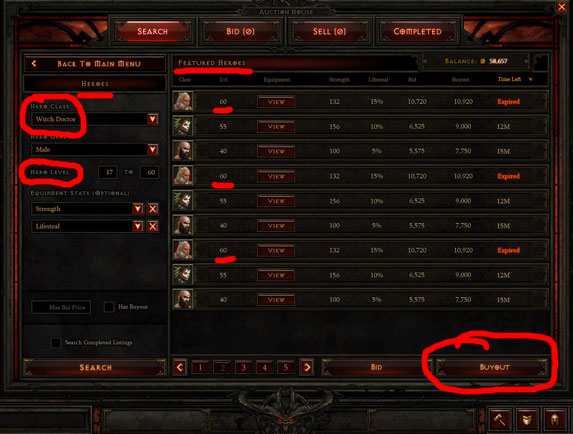
The screenshots (from MMO Champ) are fairly low resolution, but it does clearly show Featured Heroes results, the drop-down box for the class, narrowing your search to level ranges and, of course, three listings of level-capped toons for sale. Apparently the market price for a level-capped Witch Doctor is 10,000g. I would recommend buying out all three and relisting for $20 apiece.
…things are going to get fun, aren’t they?
One quick item of note (that may be old news to some):
- Personal loot. I was planning on making a post about how the whole RMT value of gear would make grouping and co-op loot rolling bizarre, but hey, this appears to have been settled over three years ago. In effect, each player gets loot from bosses/kills individually. In WoW terms, imagine killing 10m Magmaw or whatever and each person getting a (random) piece of gear instead of two pieces of random gear that has to be divvied up between 10 people. The funny thing is that this works in Diablo because loot is truly randomly generated, but absolutely doesn’t work in WoW judging by most peoples’ reactions to the random-stat loot in Throne of the 4 Winds, etc.
- Of course, grouping can still get weird assuming you are playing with friends. If a cool Barbarian axe drops that you can’t use on your Wizard, do you give it to your Barbarian friend… or sell for $5?
- Making things worse, few (if any) items in the game are BoP. This means you can swap with your friends (passing down a good item), but also that if you agree to mix-n-match loot in co-op, your friend can sell that Barbarian axe you gave him for cash later and you would never know (especially if he replaced it with a legit upgrade). Might sound petty or too goblin’ish right now, but believe me, this is a Diablo game; eventually there will be some 0.001% chance item drop that could easily sell for $100+ on eBay without even considering a Blizzard-sanctioned RMT system.
I would say that this will be the last post about Diablo 3, but honestly Diablo 3 is the most interesting thing that has happened in weeks. Other than Limbo being released on Steam.

 In An Age
Still Skeptical of Storybricks
Sep 20
Posted by Azuriel
This past weekend Nils and I were walked through the Storybrick demo with Kelly from Namaste in a sort of dual presentation. It was illuminating in a lot of different ways.
A) Storybricks is actually two seperate things: the AI and then the game.
To understand how big a difference this is, think about the difference between the Havok engine and Assassin’s Creed, Bioshock, Fallout 3, Half Life 2, LA Noir, Portal 2, and the Witcher 2. Havok, by itself, is not anything – it is not a game, it is a tool to make games. Storybricks is NOT entirely like the Havok engine though, as it would essentially be a tool within a tool, Inception-style.
This is an important distinction because the build-it-yourself AI part of it is actually pretty interesting. It reminds me of a post by Notch of Minecraft fame where he made what seemed like a mild change (animals flee when attacked) and then discovered an “emergent” AI behavior when suddenly sheep would realistically flee from wolves. Even though I pooh-poohed the thought of unintended consequences in my last Storybrick post, that was more in a story aspect. I am otherwise a big fan of tweaking small variables in a complex system and watching how the dominos fall in unpredictable ways – fans of playing/theorizing the WoW AH pretty much have to be, by definition.
B) The Storybricks GAME doesn’t exist.
This is a particular point I feel was not emphasized enough in other Storybrick write-ups. There is no game, at the moment. Kelly described how they do not want to start building a house, and then halfway through realize they should have been using a hammer instead of a rock to nail everything together. That… sort of makes sense. I mean, I am not a game designer or anything, so I do not know what the “proper” way of game development consists of.
What concerns me, and I got this impression from Nils as well, is that it is always easy to come up with ideas that should be fun; actually having them be fun is another matter entirely. As I mentioned in the previous section, I like the idea of subtle changes making surprising differences down the road. I also like the idea of a Silent Hill meets Fallout 3 style game. There is nothing to really say that either will be fun in practice however.
C) The Storybricks game won’t resemble any MMO.
Making matters worse, as Kelly explained, is that you cannot really even begin to explain a Storybrick game. This is not WoW + NPCs that remembers you. This Storybrick game would not have combat, no NPCs could die, and they are debating right now whether leveling should even exist. The socializing and NPC relationships would be the game. Which confuses me when she explained how all these D&D DMs were excited about it: what exactly are they imagining here? Their campaigns “coming to life?” What is D&D without dice rolls, saving throws, combat at all? It is a purer form of collaborative storytelling, sure. But it is no longer D&D. And they (or their players) probably signed up to play D&D.
So instead of imagining your favorite game with more compelling NPCs, imagine your favorite game without combat, without gear progression, without levels, without a set narrative at all. Then you can start imagining Storybricks and its emergent interactions. The closest thing I can imagine is Myst, except people are the puzzles.
Concerns
Now that I have kind of outlined the experience, I am going to more briefly list my concerns about the project. And because this whole post is a lot more negative and antagonistic than I necessarily feel, I have a bonus section for the Namaste folk at the end. So my concerns are:
1) I do not see Storybricks working in an MMO setting at all. One of the examples that came up in the demo was how a player might need a key from the guard to unlock a door. The guard might just straight-up give the key to Bob because of their prior relationship, whereas Tom might be forced to run some errand for the guard. The issue is that if Bob and Tom are friends/grouped up, would Bob not be able to simply give Tom the key to use? If that is the case, could you not imagine Bob hanging out in the newbie area and offering to escort new players straight past the “guard gate” (assuming there is some medium of exchange possible)?
2) Related to 1), I have never felt it particularly compelling in D&D when the guy with the highest Charisma or Speech skill is the de facto NPC ambassador. This is not to say specialized roles are not compelling, simply that if Bob is better at making the Storybrick connections (aka making the dice rolls), Bob will basically do them for the group. At most, I have a connection to Bob or the group as a unit, not to the NPCs. In a single-player game on the other hand, each player will have 100% connection with the NPCs.
3) It may be beyond the scope of the tool, but I do very much hope that Storybricks would have some kind of mode or setting that would allow the players designing the modules to be able to direct a player’s experience in a more traditional way. In other words, let people go nuts in the village with NPC interaction, while still having a overarching narrative in the castle.
4) I think serious consideration should be given right now as to what the object of a Storybrick game would be, e.g. the fun part. Sandboxes are all about player-driven goals, of course, but the sand has to be fun to play with. Speaking of which…
Bonus: Ego to Absolvo
In this Storybrick game type, the player explores a mysterious realm populated with souls from Purgatory. The object is for the player to escape the realm by releasing the Pivot Soul, the deceased spirit which binds the player to this place. Souls can be released by either directing them towards an act of contrition (absolve), or by convincing them their earthly transgressions deserves a more permanent punishment (condemn). It is up to the player to decide whether to absolve the Pivot Soul or condemn it; similarly, the player must decide whether to try and release/condemn the other souls (and which ones) before the player leaves. All the souls in each level are connected in some way, either by the event that led to their deaths, or by some other means.
The above concept requires no combat and no particular narrative beyond the Pivot Soul. Better still, you can use the same stock medieval models/setting in your demo while not being tied to a more cliche archetype. And to me, such a scenario is immediately more compelling – assuming the writing is done well, I can imagine seeking out every NPC even after identifying which of them is the Pivot Soul. Players could talk about the “moral” choice they made (absolving a murderer vs leaving them in Purgatory vs sending them to Hell), how many souls they absolved/condemned, which ones, by what means, and so on. And because of the way the Storybrick AI works, you probably could not save them all.
In any case, I do wish the Namaste folks the best of luck. My skepticism is not rooted in malice, or because the tools lack potential. Rather, my skepticism is merely a pragmatic expression of More Show, Less Tell.
Incidentally, if you want someone to brick up a truly convoluted Machiavellian scenario, or want to run with the Ego to Absolvo idea, have your people call my people.
Posted in Commentary
3 Comments
Tags: Ego to Absolvo, Storybrick