Category Archives: Impressions
Alpha Impression: Sir, You Are Being Hunted
I have been spoiled by other games’ betas. That is clear to me now.
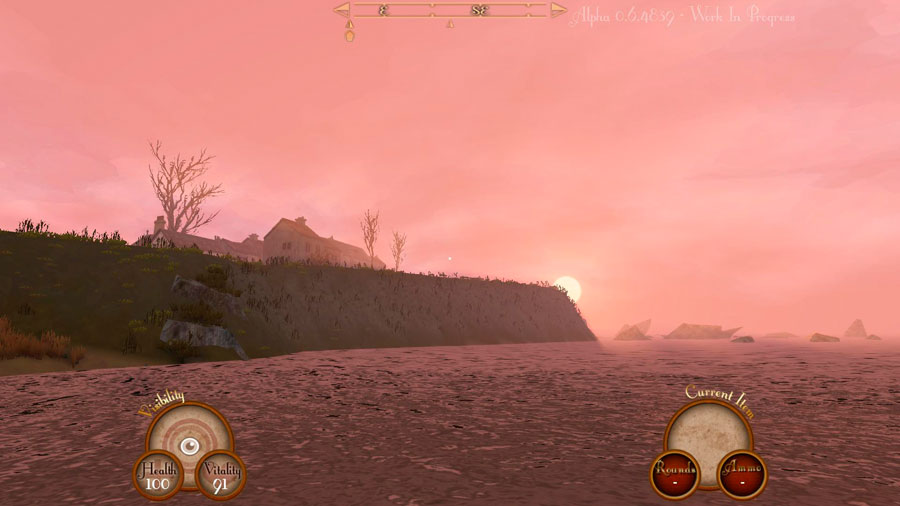
This part is okay.
Sir, You Are Being Hunted is a game I mentioned being excited about back in May, then promptly forgot about. Recently, it was up on Steam Early Access at a discounted rate, and I decided to take the plunge. A few hours of gameplay later, and I feel thoroughly soaked.
The problem I have with the game is that it is basically a sandbox without any sand. When you start playing, you are introduced to the core gameplay – find pieces of the Device, plug them into Standing Stone – given some binoculars and food, and sent on your way. As a veteran of Don’t Starve, this opening felt perfectly fine. What became readily apparent however, is that the game utterly lacks interactivity in its present state. Alpha is alpha is alpha, yes. But when I rummage through three entire villages and am armed with 3 alarm clocks, one bear trap, and two empty bottles against robots with shotgun sniper rifles, things feel lame.
Now, of course, the name of the game is to be, well, hunted. But the present AI behavior reminds me of the delicate, high-wire act that all stealth games must perform. If you have enemies patrol in a set pattern, it turns stealth gameplay into a sort puzzle game with logical, measured moves. It might feel less “realistic” to have the guard always look to the left for three seconds when he walks to the balcony, but as a game mechanic it is grokkable and feels “right.” Alternatively, you could have enemies who basically follow no pattern whatsoever, looking randomly in any direction at any time. More realistic? Sure. More frustrating? Absolutely.
Right now, Sir basically has the worst of all possible stealth worlds. The world is procedurally-generated and I’m not really certain one of the procedures is to place the Device pieces near cover. I basically spent the last 40 minutes trying, futilely, to grab a Device piece in the middle of a field where two robots were “patrolling.” And by “patrolling,” I mean they walked in random, jerking movements in a 3-meter radius around said Device. Tenchu, Dishonored, and Deus Ex this ain’t; the only possible solution is dropping an alarm clock, crab-walking as far away from it as possible, and grabbing the Device and running.
Of course, the robots run as fast as you do, are armed with shotgun sniper rifles as mentioned previously, and the only way to lose them is to be crouched in foliage. Which they immediately begin to search, because that’s the name of the game. But considering how you can’t really sneak through the foliage at any appreciable speed, they will find you immediately and GG.
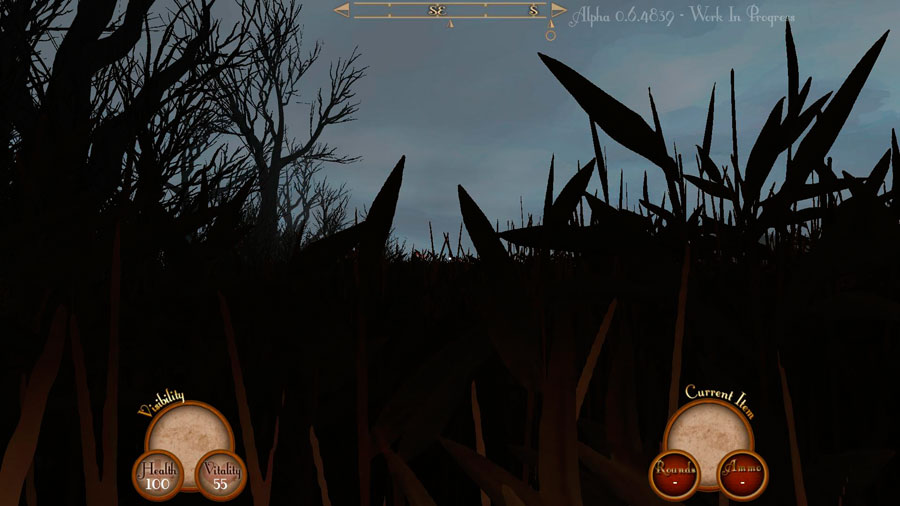
98% of your gameplay time is this.
Alpha is alpha is alpha. But right now, Sir You Are Being Hunted is basically a crouching simulator and not much else.
Beta Impression: Battlefield 4
I have been playing the Battlefield 4 beta these last few days, and I’m not quite sure what to think.
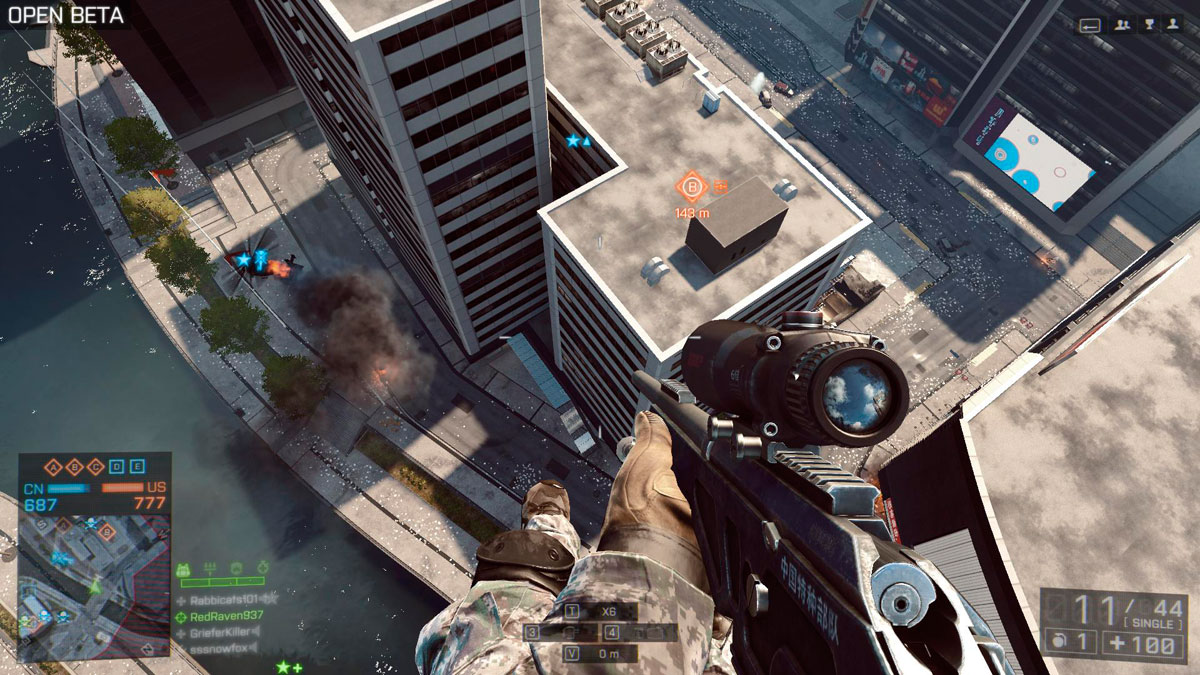
40 fps on High without latest video drivers.
It certainly isn’t the jump in quality from Battlefield 2 to 3, that’s for sure, although there are some interesting moves. For example, the default rocket launcher has a tracking mode that activates when the Recon class designates a target with their binoculars; this sort of solves the incredible power discrepancy between Engineers that had unlocked the, er, lock-on launcher versus newbie players.
Another interesting change was how they gave the Recon class (aka snipers) C4 charges. While this makes roof-top campers extremely annoying – they can drop C4 at the elevators and wait for the door opening sound for an auto-kill – it also creates an amazing tension in the class. Do you run out and C4 that tank while risking being caught in close-quarters with a sniper rifle, or do you hang back and try and snipe with a tank blowing you and your team up? Giving snipers claymore mines and assault classes C4 makes more thematic sense, but reversing those roles makes for more interesting gameplay decisions. Even better, the thermal Binoculars you get not only lets you lock on to vehicles for your teammates to kill (you get bonus XP when they do so), but it lets you more easily spot enemies running around that are too far to hit. Or, honestly, that you aren’t skilled enough to hit. Just spotting them is basically 1/4th a kill though, and it’s a useful service to do so.
Win-win.
However, some design changes have gone in the wrong direction. Technically, it was Battlefield 3 that “introduced” the concept of the medic class having to actually unlock their core ability, i.e. to revive people, but Battlefield 4 is taking that to ridiculous extremes. It takes 11,000 Assault-class XP to unlock the Defibrillator, which I hope to god is a placeholder value. Perhaps if smaller maps were available it might not be so bad, but actually getting that amount of XP on a class that otherwise brings nothing interesting to the table is a massive chore; not only do the other classes have easier ways of racking up easy XP, but remember that BF4 (and BF3) made the change to a regenerating HP model too. Between that and the near-zero Time To Kill numbers, the ability to throw a Med-Pack is only ever useful when you find yourself dueling someone from behind cover.
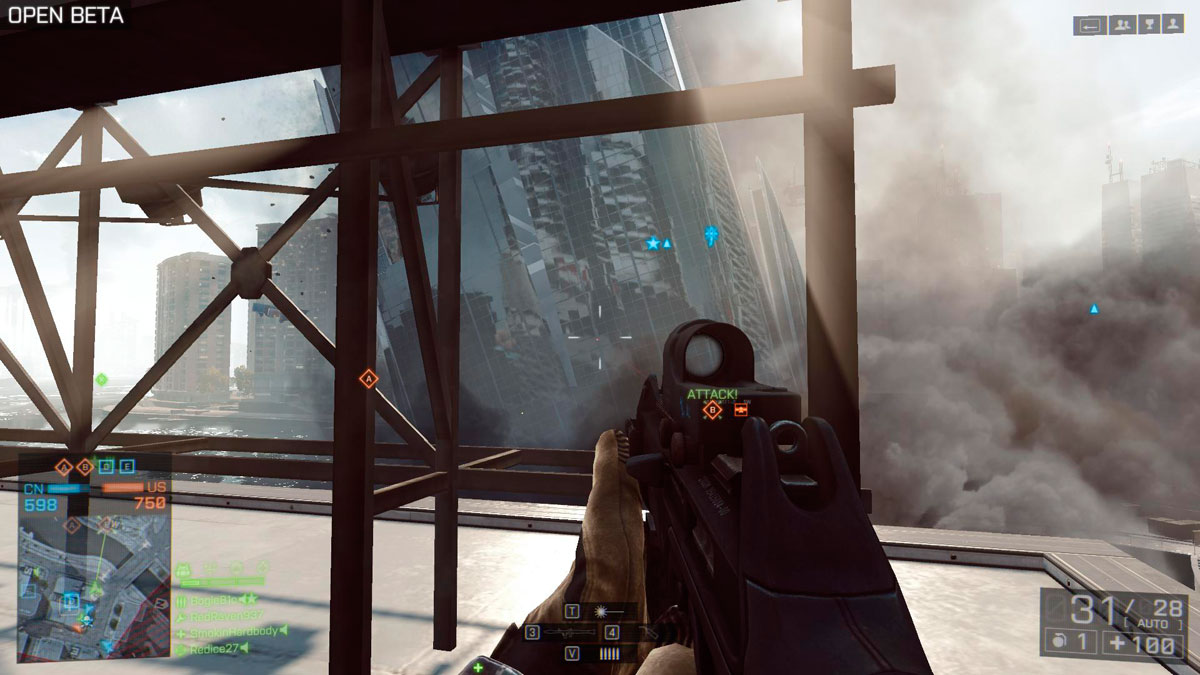
That tower is just bad news anyway.
The unlocking situation gets even more ridiculous when you look at the Support class, aka the ammo guy. While I suppose it was annoying/immersion-breaking when a single Support dude could drop an ammo box and spam infinite grenades over the wall, putting the ammo box behind a 52,000 (!) XP grind-wall is an extreme overreaction. The most obvious trickle-down effect is that it makes every class weaker by extension: what good is an Engineer without rockets? Given how you respawn with full ammo, the smart move is then to play both aggressively and carelessly by spamming everything you have and then effectively suicide yourself for Round N+1.
While there has also been some grumblings over the idea of “Battlepacks” – random lockboxes filled with camos, dog tags, XP bonuses, etc – as someone who played Mass Effect 3’s multiplayer for a while, I don’t see it as such a big deal. Yes, it is a cynical cash grab given how you can pay money to buy those things. However, as far as I can tell, you do not actually unlock more powerful weaponry from these boxes. Which automatically makes them less of an issue than ME3’s lockboxes where opening a rare Widow or Carnifex/Paladin was basically the start of your game.
Beta is beta though, and this one is more restrictive than most. Overall, I can’t say that I’m too impressed. It’s honestly been so long ago that I uninstalled BF3 that I forget if being able to spawn inside a vehicle from the Deploy screen is something new to BF4 or not. And, really, that’s kinda what it comes down to: why do we need Battlefield 4 again? Once all the maps are unlocked, then perhaps we’ll see where the differences lay. Plus, supposedly Commander Mode is back.
But right now I do not see any reason why I would be compelled to purchase Battlefield 4 on Day 1 as opposed to when they bundle the game + first Map Pack together. Or, really, when they bundle the game + Season Pass.
Progression
I am probably nearing the end of my focused Hearthstone play. Why? Two words: beta wipes. All progress, cards, gold, etc, will be wiped at least once in the upcoming weeks, and possibly more than once. If you happened to purchase something for real money, you will get the equivalent amount of gold once Hearthstone goes Live.
All of this is known information, so why am I bringing it up? That’s actually an interesting question, as I examined my roiling emotions after a string of recent Arena losses. Scrubbing out at 1-3 or – god help you – 0-3 sucks. Hard. Each Arena buy-in requires $1.99 or 150g, with the latter amount requiring roughly three days of dailies plus 30 wins in Ranked/Unranked play (i.e. against other people) to collect. Or just complete four dailies. Going that route actually works out pretty good as long as you keep Hearthstone as your sort of “side game” that you play for 30-45 minutes each day before playing your main game; as long as you keep yourself from getting too into things, you can legitimately play (Arena) for free pretty easily.
Alternatively, if you win at least 7 Arena matches in the buy-in, you get enough gold to play again.
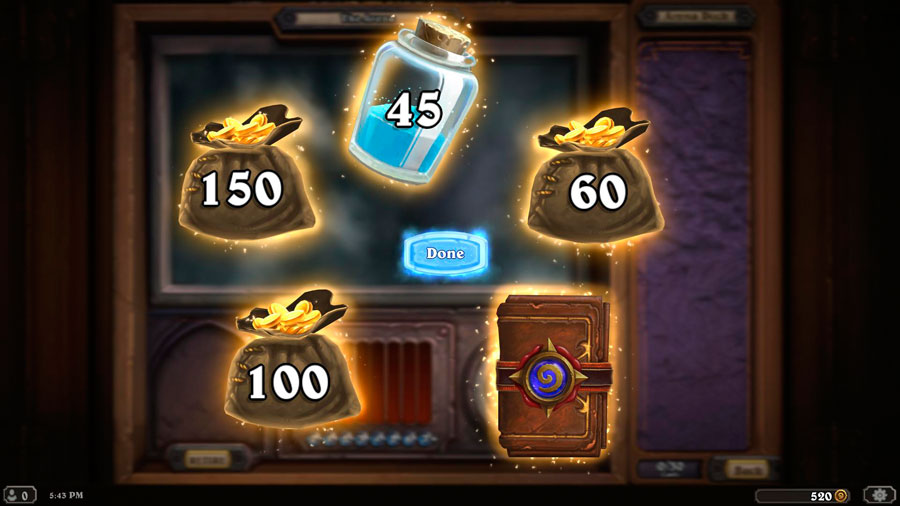
Money in the bank.
As you can see, I received 310g for having gone 9-2 with the Rogue (nine wins is the maximum). An earlier 8-3 record resulted in 215g. Needless to say, I was feeling pretty pleased with myself, especially given the Arena portion of the game is significantly more interesting to me – playing against Constructed decks feels pretty rote in comparison. Plus, where else would I get to screw around with Legendaries in what feels like a guaranteed draw for each Arena match? You aren’t likely to see those and other high-powered cards from packs you open, but seeing epics and such is pretty common across 30 random draws.
But then the RNG floor fell out. I felt I was getting a good handle on which Heroes were best in Arena – things are much different than in Constructed where you can build around combos – but I suddenly realized how exceptional my winning decks truly were. My 8-3 Druid deck had eight removal cards, including AoE removal. The 9-2 Rogue deck had two Saps, a bunch of Silence creatures with multiple ways of returning them to my hand, a fistful of removal, and two Defias Ringleaders that make going second a complete joke when you drop a 2/3 and 2/1 on your first turn.
Here was the deck:

Building this was so much fun.
You don’t need to know anything about the Hearthstone other than that this deck was unfair. Three Fan of Knives, two Blade Flurry, two Sap, two Patient Assassins, Betrayal… Jesus, it was sublime. Hearthstone Arena is entirely about tempo, and let’s just say most games involved me playing dubstep to their John Cage 4’33”.
Needless to say, I have spent the past three days falling back down the Bell Curve face-first. A string of awful Hero choices plus awful card choices plus opponents who all but win by round four (having demolished my early game). It is entirely possible this all has been by design, via hidden MMR rankings. One of the biggest Hearthstone innovations amongst the pile of others has been the fact that Arena games are unmoored from any particular tournament. If you play a Booster Draft in Magic Online, you’re playing either for 15 minutes or two hours depending on your record, against whomever happened to stroll into your tournament with you. In Hearthstone, you can play one Arena game and then come back a week later if you want. This is fantastic… provided you don’t rely on being a big fish in a small pond for your wins.
All this losing made me realize that I don’t like it. Losing, that is. A fair ranking system is based around ensuring you lose 50% of the time, but it seems to me that losing feels much worse than the positive winning emotions, especially when losing results in opportunity costs and/or costs you real money. Presumably the delta between winning and losing is compensated by the fun you have actually playing the game. But I am coming to the realization that it isn’t enough. I need a tangible sense of progression too. Knowing that the pity packs are full of cards going away in X number of months means losses are simply time consigned to the abyss.
The obvious counter-points are A) new gear tiers in MMOs result in obsolescence of progression, B) time spent gaming is technically “wasted” by default, and C) how in god’s name did you play Counter-Strike for four years then?
The answer to the first is pretty simple: properly-formatted achieved goals can’t be taken away. My goal in WoW was never “have BiS gear in every slot” – that is just a recipe for disappointment. Instead, my goals were more general, like “be better off than I was yesterday.” Grinding Valor, getting raid drops, capping Conquest… all of these things resulted in a feeling of sustained progression that persisted even when new tiers came out. In fact, my “investment” in gearing up paid off in getting the new gear quicker or more easily.
Obviously I quit playing WoW, but I still don’t see that time as wasted; leisure activities being a waste of time presupposes an (nonexistent) objective purpose in life, which answers point B.
As for C), well… that’s the pickle. I feel games like Counter-Strike allow you to experience meaningful fun even as you ultimately lose a round/match, probably because winning/losing doesn’t matter in the first place. As long as I pulled off some kind of crazy kill before dying, I could walk away satisfied even if our team was otherwise destroyed. Which is leading me to believe that the existence of progression in a game sets up its own failure, given that losing progression (either directly or via opportunity cost) makes me feel worse than gaining progression. At the same time, I tend to gravitate towards games with “investment” opportunities over games where I am “just” killing time. All games kill time, but killing time + progression makes it feel more meaningful on top of whatever arbitrary goal-achievement neurochemistry is going on.
All of which is an extremely roundabout way of saying that I lost a bunch of Hearthstone Arena matches this weekend and am sad as a result. Going from being more than self-sustaining to practically in-the-hole playing is bad, and there not being any sense of long-term progression (in the beta) makes it worse. Also, trying to unlock Shaman cards in Constructed play feels terrible; seriously, Blizz, why did you put all the juicy Shaman cards in the packs? Chain Lightning is practically required to get anywhere.
Wait a minute, why am I in-game again? Might as well knock out this daily…
Beta Impressions: Path of Exile
That’s right, I’m all beta, all the time up in this joint.

Okay, Trade Chat being on by default in the opening seconds is a little immersion-breaking.
For those not keeping track at home, Path of Exile is a F2P love letter to Diablo 2, and the Diablo franchise in general. It features six classes, a 1350-point talent tree forest, the Materia system from Final Fantasy 7, extremely gritty and realistic graphical style, and an outstandingly clever commitment to the game’s own setting. It is currently in Open Beta, and you can download it here.
While the central concepts of Path of Exile may seem strange at first, they are all pretty logical once you get past the unfamiliar veneer. For example, let’s talk about that 1350+ point talent tree. It is not an actual talent tree as you are familiar with, at least unless you played Final Fantasy X. The tree itself is entirely passive abilities and stat increases that act as nodes you activate with talent points you receive from leveling up or getting as quest rewards. The overall tree encompasses all six classes, with the difference being the starting location for each class. Thus, for example, the Witch starts on one corner of the board nearest all the +Intelligence and other magic boosting nodes.
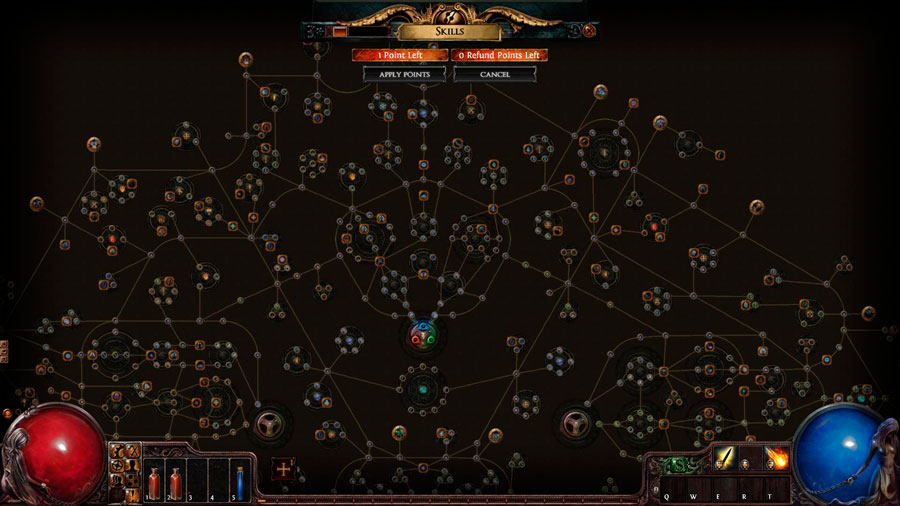
Hey, remember when this was fun?
The bigger nodes give bigger bonuses, and the extremely large ones are sort of capstone goals to help guide your character’s overall build. While your talent selection generally builds itself, it is possible to work your way across the board into other classs’ territories, if you are so inclined. That said, while the tree is certainly impressive the first few times you look at it, I’m not entirely sure of its practical use beyond standing out from the crowd. I spent 30 minutes mousing-over everything, decided which nodes I eventually wanted, and now will spend the next fifty levels getting variations of +10 Int or +20% mana regeneration. Woo, choice.
Meanwhile, the FF7-esque Materia system that Path of Exile emulates… is exactly what it sounds like. Basically, all the abilities your character has access to is governed by Skill Gems you socket into open slots on your gear. Want to use Raise Zombie? You need to fit that Skill Gem into an open blue slot. Fire Trap? Green slot. Shield Bash? Red slot. As you kill enemies, any socketed gems gain XP and level up just as you do, under the normal sort of hack-n-slash scheme (+1-2 damage, +1 mana cost each level). Later on, you will receive gear with Linked sockets which – again, exactly like in FF7 – let you link, say, a Fireball gem with a Multiple Projectile gem to (drumroll) shoot multiple Fireballs.
It is worth mentioning that, for the most part, any class can equip any Skill gem. I found a Shield Bash gem while running around with my Witch, for example, although I was unable to equip it because it required a Strength score of 16 (I had 14). While there will presumably be some +Strength gear somewhere, I could also raise that stat by navigating my way to a +Strength node in the talent tree. Pretty cool, IMO, although I believe the downside is a more limited selection of skills available for everyone overall. Shield Bash appears to be Shield Bash for everyone, so if X, Y, or Z skill is OP or garbage, you will likely be using the same skill loadouts no matter what class you pick.
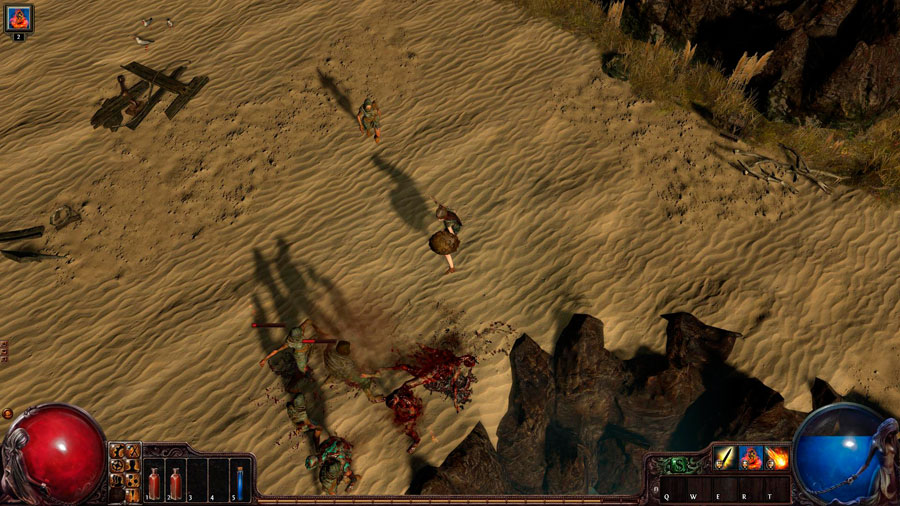
The Hack-n-Slash is hack and slashy.
What is beyond reproach and, frankly, goddamn brilliant is Path of Exile’s integration of the game’s setting into the gameplay. The premise of the game is that your character has done something or pissed someone off enough to be exiled to some hideous and hostile land to die (think: colonial Australia). So while the game looks understandably dark and gritty, it actually goes much farther than that. For example, when you sell items to a vendor, the currency is… scraps of an Identify Scroll. Five scraps equals one full scroll. Which you can then consume to identify an unknown magic item, ala Diablo. There are other barter currencies that double as actually useful items (Transmutation Orbs turn normal items into magic ones, other orbs randomize a magic item’s properties, etc) too, which sets up some interesting dilemmas insofar as using them as currency to buy better gear or use them to possibly make what gear you already have better.
Now, seriously, how amazing is that economic system? Every prototypical hack-n-slash would simply have used gold pieces as the medium of exchange here. Hell, I don’t think anyone would have cared if gold pieces were used as the currency in Path of Exile, even though it doesn’t make any logical sense for there to be a vast sum of wealth in a prison colony. It reminds me of Metro 2033 where your currency for buying guns and such were rounds of military-grade ammo, which you could technically load into your guns and fire.
Are there downsides? Sure. Since there is nothing worth less than a scrap of scroll, the beginning hours of gameplay highly encourages you to loot 100% of all junk since 5 pieces of anything = 1 useful scroll. This goes the other way too, wherein selling a magic item nets you a rounded-down amount of other material rather than 1400g vs 1100g. Vendor items get a bit goofy too, when they charge the same price for a necklace that provides 2 HP/sec regeneration with another necklace that provides 3.7 HP/sec regeneration.
Another example of the noble commitment to rational setting consistency? Instead of health/mana potions, you have health/mana flasks that use X number of Y charges for Z effect. And they recharge when you kill enemies. I mean, sure, there isn’t much of a logical reason why the Frost Elemental slime drops a wooden tower shield, but at least you’re not seeing more glass beakers full of replenishing liquid mowing down zombies as you’d find in an alchemist’s lab. Monsters drop less items as a result of this artistic/setting direction, but it still manages to feel similar to the loot explosions of Diablo (if less intense).
So, basically, I am having a lot of fun thus far with Path of Exile. While the devs have posted a sort of cash shop manifesto for this F2P game, they appear to actually be taking the “no P2W” mantra seriously. Hell, I don’t think they are even selling +XP potions, which is something I have simply come to expect from these games. The one lingering concern I have is the whole Ranged vs Melee (im)balance, which is something they do have on their roadmap to address. But beyond that? If you liked Diablo 2, play this game. Hell, if you liked (or disliked!) Diablo 3, play this game. It’s a F2P hack-n-slash, so what do you have to lose?
Other than your time, of course.
[Hearthstone] Remaining Concerns
My Press™ coverage of Hearthstone has been pretty glowing thus far, so I wanted to talk today about some lingering concerns about a few issues that cropped up in the last week. I do not believe these to be structural problems necessarily – I feel like they could be fixed within the Beta – but I also have no idea how Blizzard will address them, if at all.
1) Unbalanced Heroes
On paper, the nine Heroes you can pick between are balanced. Here is a rundown of their powers:
- Druid – Hero gains +1 Attack until end of turn, and +1 Armor
- Priest – Restore 2 health to target
- Warrior – Hero gains 2 Armor
- Paladin – Put a 1/1 creature into play
- Rogue – create a 1 attack/2 durability weapon, or +1 Attack to weapon this turn
- Warlock – Lose 2 Health and draw a card
- Hunter – Deal 2 damage to enemy Hero
- Shaman – Create a random totem (usually 0/2 creature w/ ability)
- Mage – Deal 1 damage to a target
By the way, all of the listed abilities cost the same amount of resources (2 crystals).
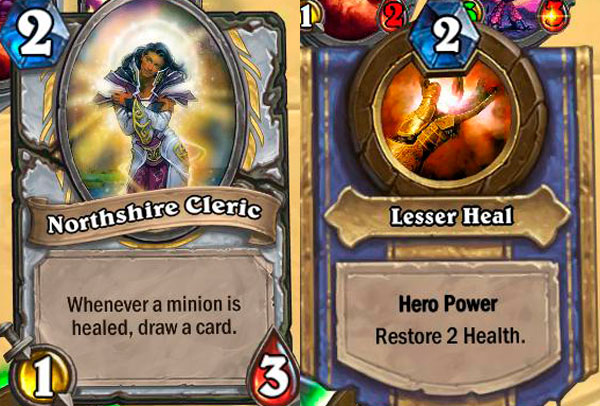
One of the more annoying classes to play against.
The problem in reality is two-fold. First, there is a huge difference in synergy between a Hero’s powers and the class-restricted cards. The Priest’s ability, for example, combos ridiculously well with one of the default Priest cards: Northshire Cleric, a 1/3 creature that let’s you draw a card when a creature is healed. In fact, entire mechanics revolve around and/or become enabled by the Priest’s ability. Enrage, for example, is an ability that triggers an effect when the creature is damaged. One of the most common cards that uses Enrage is the Gurubashi Berserker, a 2/5 creature that gets +3 Attack each time it’s damaged. Smashing into a 2/2 will beef the troll up to a 5/3, which is nice… but also puts it within range of a lot of counter-attacks. A simple heal from the Priest though, puts it back to 5/5, letting it snowball further. Then you have goofy cards like the Angry Chicken, which is a 1/1 with Enrage: +5 Attack. Obviously you need to combine that creature with some other effects to boost its Health, of which the Priest has many.
By means of comparison, nothing combos with the Hunter ability. In Magic: the Gathering, the devs eventually created the Bloodthirst mechanic that boosted a creature’s stats (or some bonus effect) if it was played the same turn as the opponent taking damage. No such thing exists in Hearthstone, at least for now. And while Rogue decks need no assistance, the Combo system on Rogue cards have nothing to do with the Rogue’s ability; at least the Druid, Warrior, and Warlock are thematically consistent with their class cards. Then again, perhaps we should look at the Priest as an outlier rather than the bar that other classes should reach.
The second problem is related to the first: what class cards are available by default radically changes the strength of your deck. Now, sure, technically everyone will be able to unlock all 20 basic class cards by simply playing against the computer (assuming they didn’t want to challenge players). But take my word for it: many of those early games suck. Hard.
Through either a combination of the first issue or the second, I can already tell that some Heroes are being left in the dust by the Beta population. I would say more than 95% of the Ranked games I have played have been against either the Mage, Rogue, or Priest. For a good reason: they’re strong.
There are a few clever things Blizzard is already doing to (presumably) combat this trend. One of the types of daily quests is to win 2 games as a specific class. When I logged on yesterday, for example, I had to win 2 games as a Druid and Warrior (two separate quests, as I had missed yesterday’s daily). Having played neither before, I created custom decks for both and then went for a spin against some human opponents. Those games played out very differently than my normal games, and were pretty fun to boot, although I doubt I will be spending much time with them until I luck into some of their non-basic class cards from booster packs.
The other clever move to improve class experimentation, if not promote diversity, is how Arena mode matches start by forcing you to pick between three random class Heroes before you start the actual Draft process. The other day, I had to pick between the Hunter, Druid, and Shaman, all of whom I had never played with before. While they let you mouse-over their Hero powers from that specific screen, the more critical aspect of the Heroes is ultimately their selection of class-specific cards. Spending some time in your collection looking at all of the class’ cards – which, by the way, Hearthstone allows you to do even if you don’t own them – is definitely recommended.
For the record, I chose the Hunter. And went 0-3.
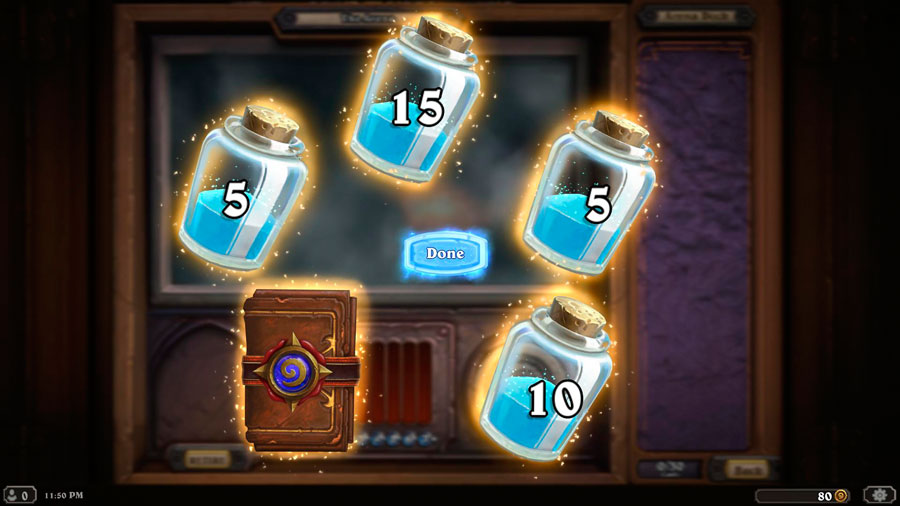
Worst possible Arena result, I think.
2) Unbalanced Cards
Beyond the Hero issue and the class-specific card issue, I have a problem with the card balance in a few locations. Basically, I don’t feel like strictly-better cards should exist in a CCG, especially not when it appears it’s being “balanced” around rareness. Take a look at the following:
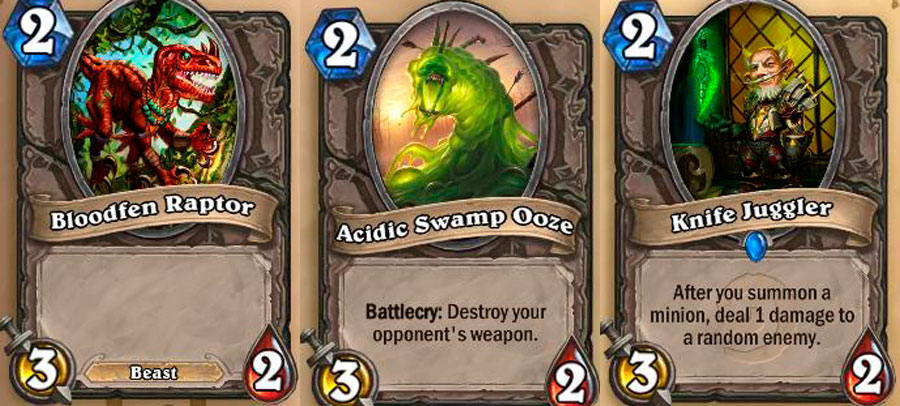
Balance!
There is precisely one scenario in which you might choose the raptor over the gnome: if you were playing some kind of Beast deck (e.g. with the Hunter). And actually, you might put in the gnome even in your Beast deck; por que no los dos? At least with the Ooze, you can convince yourself that there are certain scenarios in which blowing up the opponent’s weapon is better than whittling down their blockers for free.
By the way, only the Paladin, Warrior, and Rogue are likely to ever have weapons equipped. That Ooze is pretty much a dead draw 90% of the time in my experience.
A few other cards are simply ridiculous. Pint-Sized Summoner, for example, pretty much single-handedly caused me to lose an Arena game (I had no targeted removal at the time). Bloodlust is probably balanced, but 100% of the games in which I lost to a Shaman have been due to that one card… and a bunch of suddenly bloodthirsty totems. And so on.
3) Over-reliance on Taunt
This section is going to be short, because the title sums it up: Taunt is both ubiquitous and pretty much the only means of combat shenanigans.
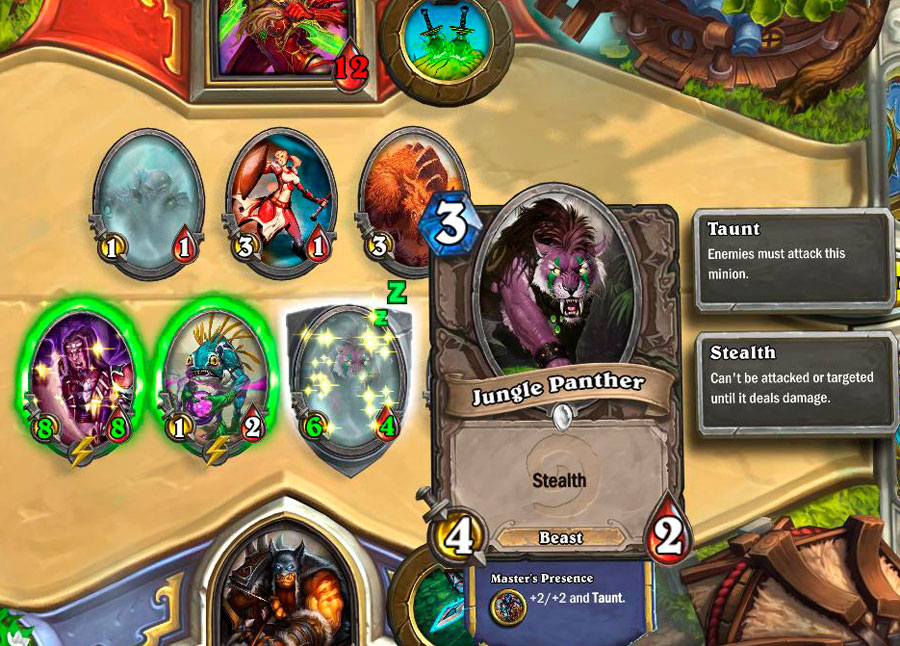
This should have been a combo, dammit!
In case you aren’t aware, Taunt is a creature ability that forces an opponent to only attack the creature with Taunt, as opposed to being able to attack any creature or just smash the opponent’s face in directly. Without Taunt, basically whoever drops creatures first is at a huge advantage since they can decide to attack any “special” creatures their opponents play with their own creature or ignore them. Pretty much the only rational strategy then becomes A) play special creature and then immediately drop a Taunt meatshield, or B) beef up a Taunt creature and control the board. An all-in-one package example of the latter is Ancient of War, which is an absolute bomb drop in Arena, by the way.
4) Playing first puts you at a huge disadvantage
Another shorty, but basically I never ever want to go first when playing Hearthstone.
Each player draws three cards before a game, and can choose to send any (or none) of the cards back and draw different ones. Whoever goes second draws a fourth card during this phase, and thus can fish for their deck combo cards or removal that much deeper. Plus, after the first player’s turn, they get a 0 crystal card called “The Coin” that will temporarily give you 1 crystal for a turn. So, basically, going second you can cast a 2 crystal card on your turn 1, or 3 crystal card on turn 2, and so on. What makes it even worse is that The Coin counts as playing a card/spell, which can trigger all sorts of nonsense, such as a Defias Ringleader suddenly giving the Rogue a 2/3 and 2/1 creature on turn 1.
Conclusion
Having said all that, I do feel like these are solvable problems. For the most part. Given the simplicity of the resource system and the mechanics in this first set, I am not quite sure how things will get balanced. The Knife-Juggler and Pint-Sized Summoner could be reduced to 2/1 and 1/1 respectively, and still be worth playing. But what about those Hero powers? The Hunter power can’t be reduced to 1 crystal or the damage increased to 3. Would they buff the Hunter class cards instead? What if a player doesn’t actually use those “balancing” cards?
Time will tell upon release exactly how broken some of these interactions are. Time will also tell how much we or Blizzard particular care. I probably have the most fun in Arenas (I went 8-3 and 9-2 this weekend, the latter of which resulted in 310g) where dropping game-changing cards is the norm, and Ranked matches sorta feel like 2v2 Arena in WoW somtimes. I would rather it be balanced of course, but this is also a CCG – there being only a few viable decks at the upper-end is pretty much par for the course. But if Blizzard wants to do some (more) groundbreaking things with their game design, they are going to have to fix the above four issues at a minimum.
Hearthstone’s UI
As you may have picked up on in my Hearthstone Impression post, I am a huge fan of its UI. In fact, it is one of the best UIs I have ever seen in a videogame. Which is… kind of an unusual thing to say about videogames in general, right? Who cares about UI anyway?
Well, technically everyone. A game’s UI is how you interact with the game itself, or glean useful information about the game state. Sometimes you can get away without having an UI at all, like with LIMBO. Other times the designers might get all fancy and try to integrate the UI into the game world itself, like with Dead Space. Most times though, a game’s UI is simply there, and the most you can hope from it is to get the hell out of your way (Skyrim).
It is an extremely rare game that features a UI that actually makes the game itself better. Hearthstone is pretty much the only example I can think of. But why? Let’s break it down:
Emulates the Warcraft Experience
This might sound obvious, but Hearthstone: Heroes of Azeroth is derived from the Warcraft franchise and prominently features characters from said game world. It is one thing to use the likenesses though, and a completely different thing to emulate the color palette, the visuals, and the ineffable mood of the game as well. Everything from the menus to the animations to the sounds feels like it could have been pulled straight out of either WoW or Warcraft 3. In fact, I am pretty sure they did outright copy/paste a lot of the sound effects, at a minimum.
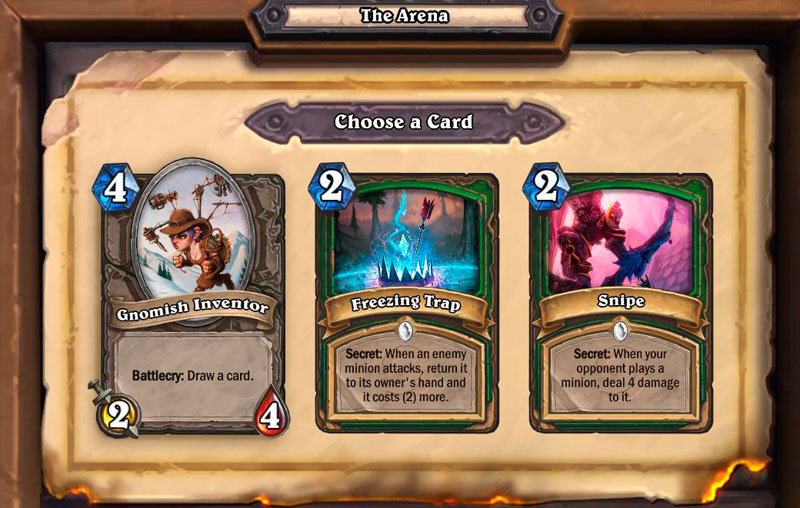
Not all of the iconic cards are good, mind you.
The result of this is that an otherwise completely new gameplay experience will instantly feel familiar to someone who may not have ever played a CCG before. And more subtly, assuming you still have fond memories of the other games, some of those are likely to bleed through via nostalgia.
UI Elegantly Informs the Gameplay
Digital card games differ from regular video games in that their UI essentially is the entire game; beyond the cards themselves, the rest of a CCG match takes place in each player’s head. Hearthstone is literally the first CCG I have played that has attempted to – and successfully accomplished – bring(ing) the mental game back into the visual realm.
For example, when your hero plays a Weapon card, it clanks and rattles next to your hero, while the hero tile itself lifts off the board and goes smashing into your intended target. Then, at the end of your turn, the weapon card (which has long since ceased being a rectangular object) gets hidden behind an oval sheet of iron, which sounds and looks like a full-plate helm shutting. You don’t have to know anything about the specific rules of Hearthstone to know intuitively, from this very UI design, that A) weapon cards let your hero attack, and B) your hero can’t use the weapon during an opponent’s turn.
There are “little” touches like this all over the place in Hearthstone. Creatures with Taunt have a different shape on the battlefield to distinguish them. Creature with Death-rattle (an ability that triggers on their death) has a little skull and crossbones icon on them, whereas a creature with a normal triggered ability has a lightning bolt. Even if you did not know what those icons meant at a glance, hovering your cursor over the creature quickly brings up an unobtrusive cheat sheet description. This is a UI scheme that both enables and enhances your ability to “grok” all the moving pieces extremely quickly.
3) Genre Game-Changing Innovation
Seriously guys, this screenshot has pretty much ruined all other CCGs for me:
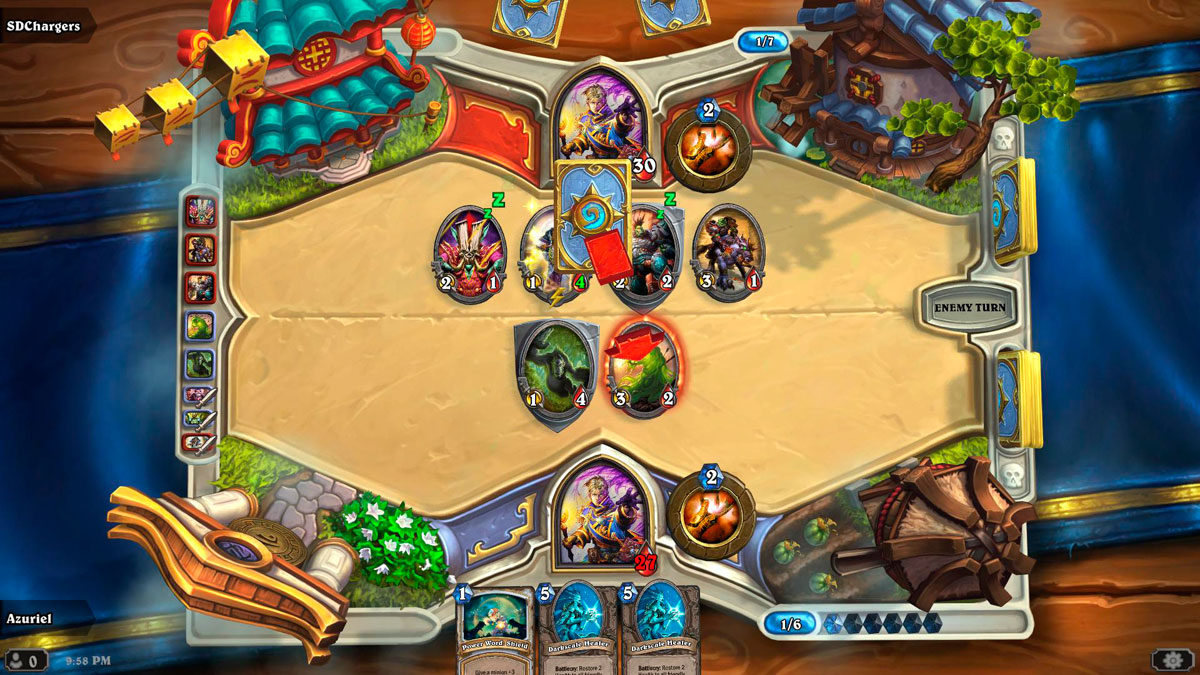
We can never go back.
If you are not quite sure what you are looking at, it is pretty simple conceptually: you can see what your opponent is looking at. If your opponent is hovering their cursor over your creature (to perhaps read its text), the creature glows. If they then cycle through their hand looking for a way to turn the game around, you see their cards glow one at a time. If they decide to target you with a creature or spell, a huge arrow appears where their cursor is, and you can watch as they debate with themselves as to which would be the better move.
This sort of thing is simply unprecedented in a digital CCG. And mandatory from now on, IMO.
Not convinced? Think about playing Chess in person versus playing against someone online. The pieces are all the same, the board is the same, everything is the same… except for the feedback. When you are face-to-face with someone, you can see where they are looking on the board, you can see them pick up a piece and start to move it before putting it back again. Aside from the mind games this opens up, at a minimum it might give you pause to consider that Bishop over in the corner that you had forgotten about until your opponent had briefly considered moving it.
Like I mentioned earlier, CCG battles always took place in the theater of the mind. You never really knew what your opponent was thinking or about to do… unless you happened to be lucky enough to be dueling them in-person. Can you imagine other games operating with this lack of feedback? Think about playing a FPS in which you could not hear another player walking or even which way they were facing when you did see them. An incredible amount of nuance would be lost.
Finally, at the bare minimum, consider the benefits of knowing that your opponent is actually at their chair and not AFK. I’m more than willing to wait a few minutes for someone to make their move as long as I know they are actually in the process of determining what move to make. Compare that to most other CCGs like Scrolls or SolForge or Magic Online where you are basically left watching the round timer count down.
4) Evokes the Physical Space
This last one is a lot more subtle than the others, but welcome nonetheless. Essentially, everything in Hearthstone feels… real. Like a three-dimensional object, with heft and contours and such. You don’t play cards by just clicking on them and then clicking on a target, you actually have to drag them from your hand and drop them on the target (assuming the card doesn’t automatically turn into a ball of flame or whatever midway through the action).
The way creatures are handled is similarly finely detailed. You might have noticed how creatures are sort of oval shaped, right? Well look at an unplayed creature card:

Clever girl.
That’s right, the creature oval “breaks off” from the card when you play it. When a huge creature is played, the oval crashes onto the playing surface, creating shock waves and a small crater. Attacking with said creature involves the oval flying towards the enemy hero, smashing into them and shaking the screen. You start to forget you are playing a CCG at all as it feels sorta like a miniature game at this point. And yet there is still a connection between the cards and their products. Compare that to Scrolls, which also summons creatures but has no real tie between the product (parchment scroll) and the result (animated sprite).
And let’s not forget how this oval thing also solves the problem in CCGs when it’s not easy to distinguish between creatures, enchantments, spells, and so on. Cards are generally of uniform size, and the artwork (which usually takes up 50% of the real estate) can sometimes work against your quick assumptions by having a bunch of dragons or whatever on a “Deal 5 damage” spell. This is not a problem in Hearthstone, as all creature cards have ovals inside them.
Seriously, this is like goddamn paperclip levels of elegance here.
Conclusion
As I mentioned in my Impression post, Hearthstone feels both visceral and whimsical simultaneously. The further pillow fight analogy comes from the sense of “slamming” the cards down on the table, almost feeling the creatures smash into your opponent’s face. Then there are the spell effects like Consecrate that could have easily gotten away with simply dealing 2 damage to all enemies and been done with it. Nope: all your opponent’s creatures and hero tile are lifted high off the table as cracks of golden light bleed through, and then everything slams down at once.
The whole thing reminds me of how it feels to roll dice in D&D campaign – the physicality of the action imparts a gravitas completely independent of the otherwise unremarkable generation of a random number. For Hearthstone to evoke this feeling using just sounds and what could be Flash animation is pretty amazing.
If CCGs are not your proverbial cup of tea, it’s unlikely that even an amazing UI is going to change your mind. If you enjoy the genre at all though, or are merely ambivalent, then suggest you give Hearthstone a try at release. Watching Youtube videos of other people playing does not replicate the experience dropping late-game bombs on your opponent and watching them futilely cycling through their hand trying to come up with a response.
Beta Impression: Hearthstone
Yes, I made it into the beta with that ridiculous email and Press™ credentials. It just goes to show you that with hard work and a can-do attitude Camus was right. Embrace the Absurd.
Anyway… Hearthstone!
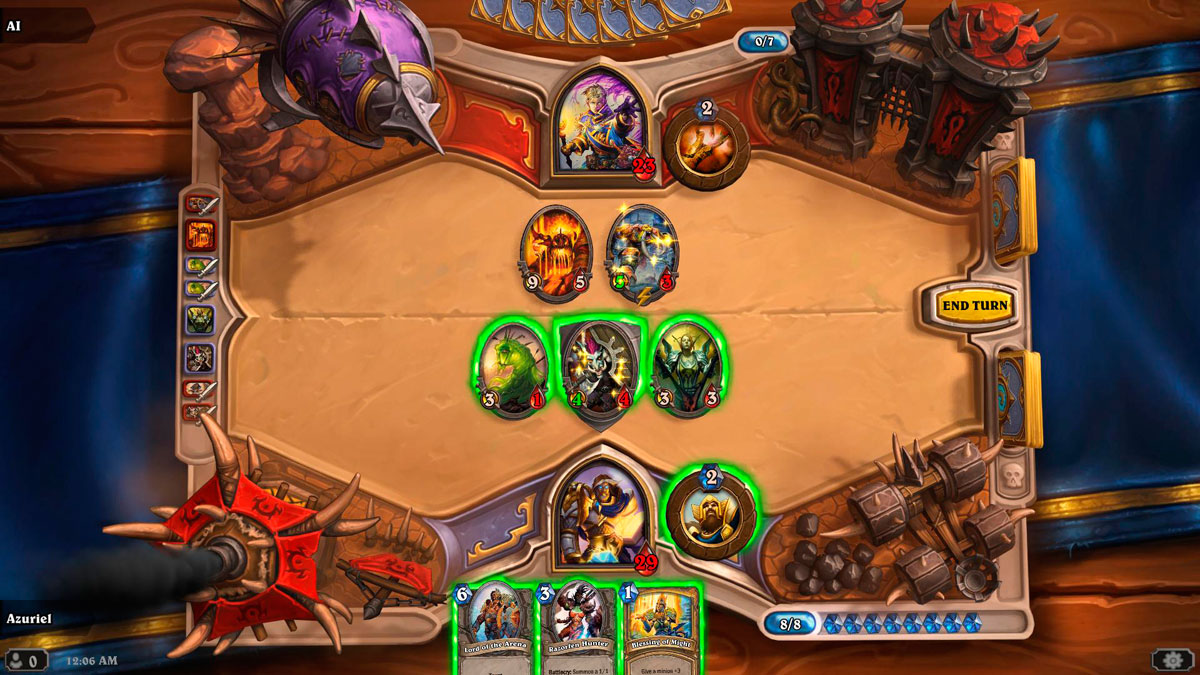
Momentum is extremely fluid.
For those not following along at home, Hearthstone is a free-to-play CCG made by a small team at Blizzard, all of whom likely had an awkward conversation with their bosses as to why they were apparently hiding their goddamn genius game development and UI skills under a bushel.
Indeed, that is exactly the first thing anyone should talk about when it comes to Hearthstone: it has perhaps the best UI in any game ever made. It is both visceral and whimsical, simultaneously. You know that feeling in a pillow fight, about ten seconds in, when you are just wailing on somebody and clearly winning before Jason knocks over the lamp and your mom comes upstairs and makes everyone go to bed? It is kinda exactly like that. Or close enough that I am going to continue using this ungainly metaphor for the rest of the post.
The basic premise of the pillow fight is that each player creates a 30-card deck, limited to 2 copies of an individual card, and then tries to reduce the opposing player from 30 life to zero in a turn-based manner. A few unique gameplay wrinkles show up immediately. First, players have to choose a Hero to represent them, corresponding to one of the original nine classes in World of Warcraft. Each class has their own unique set of cards that cannot be used by the others, although there is a large portion of “neutral” cards that can go into any class’s deck. In addition to the unique pool of class cards, each hero has a “hero power” which is an ability that costs two resources and can be used once each turn. The Paladin hero, for example, can create a 1/1 creature whereas the Warlock can pay 2 Health to draw a card (ala Life Tap).
The second gameplay wrinkle comes from the gameplay flow. Each turn, a player gains another resource point (aka Gems, Crystals, whatever), up to a maximum of 10, with them reseting at the start of each turn. While there are technically “Secret” cards with hidden triggers that can be played, there is otherwise no action possible during an opponent’s turn.
Finally, combat plays out a little differently than you might expect, coming from SolForge or Magic: the Gathering. Summoning Sickness and Haste (i.e. Charge) is all there, but there really is no concept of “blockers”; unless your opponent has a creature with Taunt, you are free to send your units to attack the player or his/her creatures at your leisure, in whatever sequence you choose. While the optimal move is sometimes obvious – sending your 1/1 into that 5/1 – the math becomes exceedingly fuzzy when you start having to compute whether it’s better to just send all the damage to their dome and hope you maintain enough initiative to win the damage race.
Here is an example of some strategery:
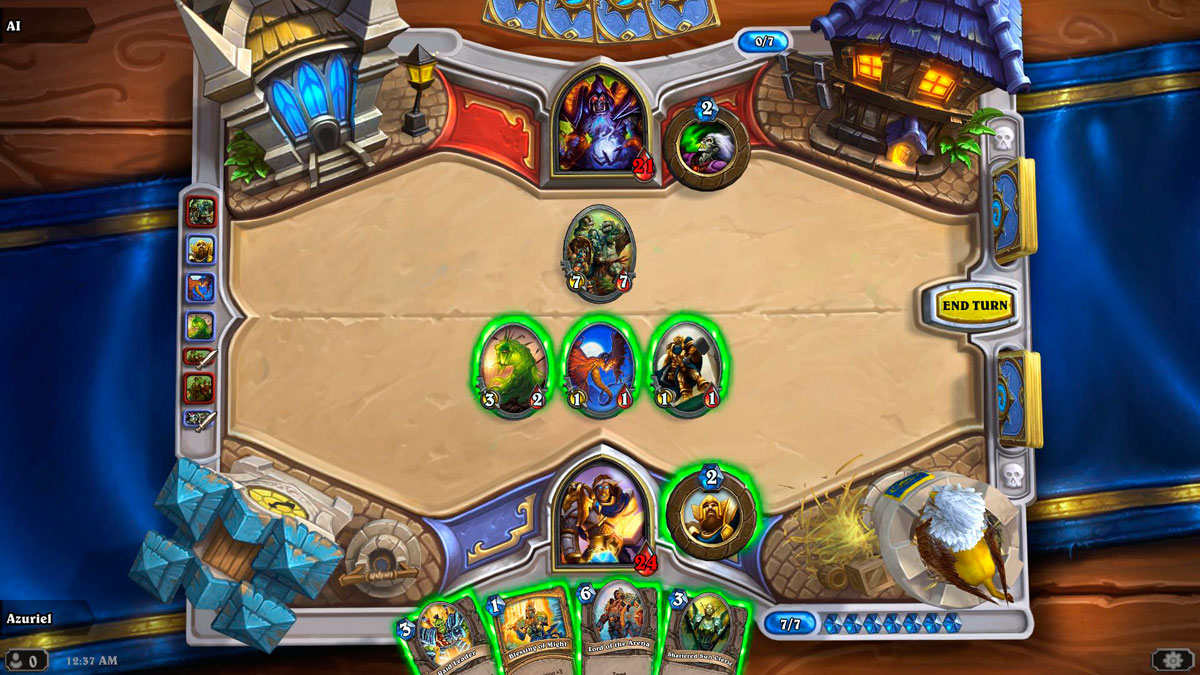
This Warlock is in for a bad time.
It’s turn 7, and the Warlock has a 7/7 mob. On my side, I have a 3/2, a 1/1, and a Young Dragonhawk (1/1 with Windfury, which lets it attack twice per turn). In my hand is Raid Leader (2/2, gives my other creatures +1 Attack), Blessing of Might (gives creature +3 Attack), Lord of the Arena (6/5 mob with Taunt), and Shattered Sun Cleric (3/3 that gives a creature +1/+1 when it comes into play). My moves? Blessing of Might on the Young Dragonhawk, Shattered Sun Cleric also targeting the Young Dragonhawk, and then playing the Raid Leader. Attack the Warlock directly with all my creatures, dealing 6 + 6 + 3 + 1 damage to the dome, bringing him to 8 life with more than lethal damage still on the board.
Why play this way? There are a few reasons I chose to, and a few more that argue for a more conservative approach. Warlocks have a lot of removal by default, including Hellfire that deals 3 damage to everything. As amazing as my 16 damage was the prior turn, a single Hellfire would have wiped my entire board and left the Warlock with a 7/4 creature wailing on me. I could have perhaps played the Lord of the Arena and then Blessing of Might on the Dragonhawk, dealing 12 damage and leaving a sort of Taunt barrier that would survive (and trade) a Hellfire. Or I could have done my big play like last time, and sent the 6/2 Dragonhawk into the 7/7 as its second attack and finishing it off with the 1/1, having dealt a total of 9 damage to the Warlock.
Having actually wrote all this out, it has become apparent that my original play was monstrously dumb. A single Hellfire would have wrecked me, to the point of not being able to recover. At the time, my thought process was that the Warlock had to remove my Dragonhawk or lose the next turn, so he’d send in his 7/7 targeting my 6/2, leaving it as easy picking on my next turn… which would be irrelevant because I’d have lethal damage available anyway. Shit, I was probably just too damn excited to contain myself. “Sixteen damage in one turn! Ka-Pow, right in the kisser!”
While there are moments of high excitement, there are also moments of extreme depression. Hearthstone, like many (most? all?) CCG games, forces one to become intimately acquainted with the Three Sisters: Tempo, Card Advantage, and RNG. Take a look at this screenshot which, days later, still causes me to groan:
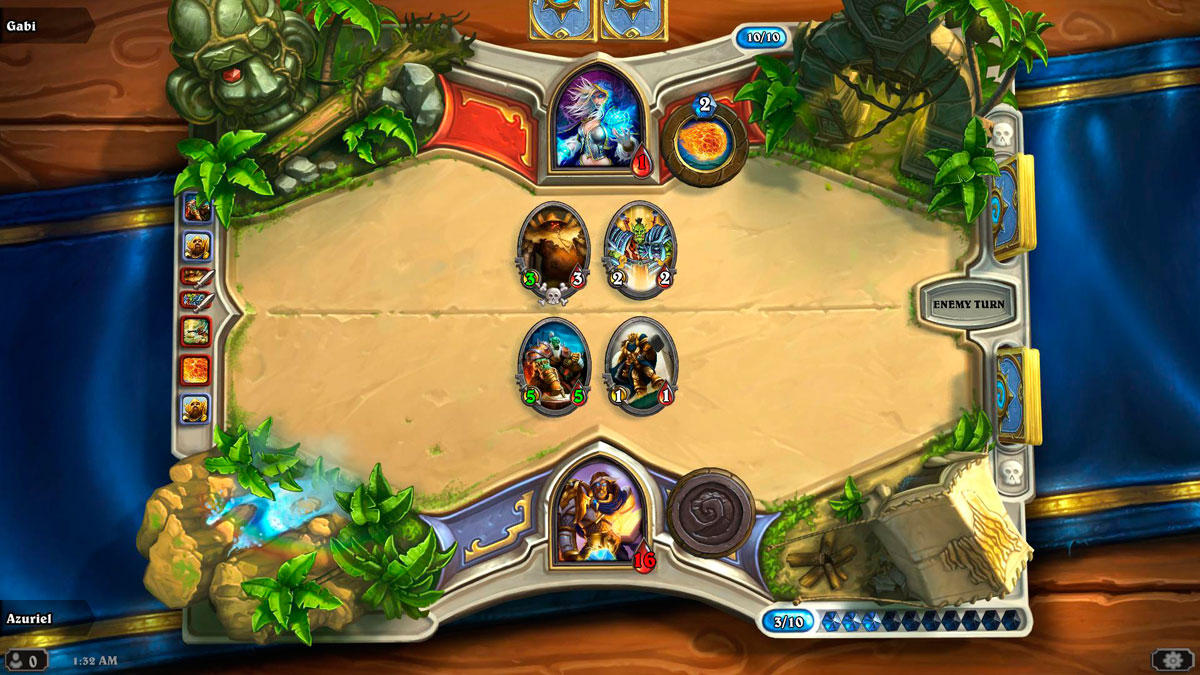
Seriously?! C’MON!
My opponent is at 1 HP, and it’s their turn. They send their 3/3 (which makes a 2/1 at death) at my 5/5, and then the 2/2, and then send a 1-damage fireball at my 1/1 creature. Approximately 247 days or five turns later, whichever is worse, the Mage wins. Wins. I never draw a creature with Haste Charge, or any “direct” damage (by Paladin standards), and nothing on my side of board lives long enough to attack. I created a 1/1 each turn only to have it pinged away.
You will have games like this, and it will suck. It is not quite on the same level as being Mana Screwed in Magic, but games possibly grinding to a halt is at least one problem that Scrolls solved beautifully – in Scrolls, you either turn a card into a resource or discard it to draw 2 new cards. With Hearthstone, some heroes like the Paladin have a severe problem with running out of steam. There are technically some Paladin-specific trickery to “solve” this issue – Divine Favor is a 2-cost spell that let’s you draw cards until you have as many as your opponent – but that is heavily dependent on actually having said cards in your collection, and drawing into them at the opportune moments.
Speaking of which…
The Business Side
So where are the Hearthstone F2P hooks? Well… it’s kinda weird. I mean, not really, but it sorta is. Here is how you spend money:
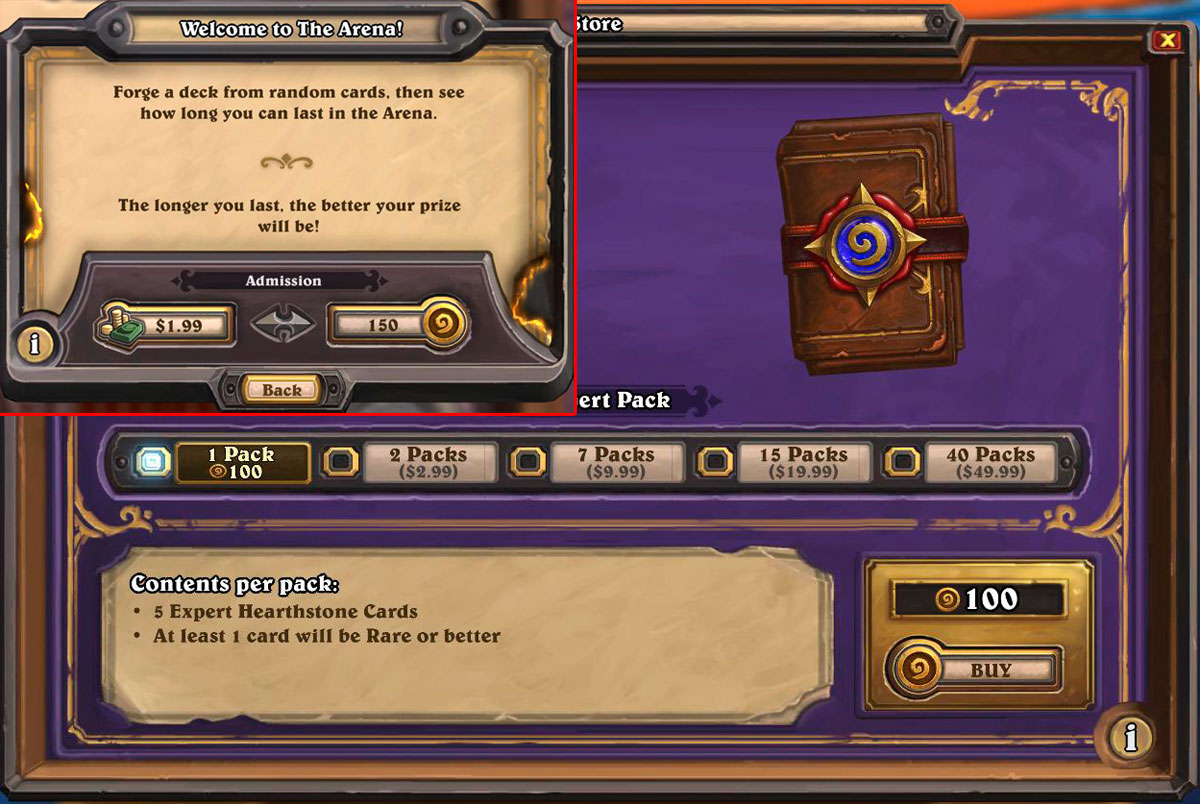
Almost… reasonable?!
You can buy 5-card booster packs for 100g or at an escalating discount; they come out to be $1.50, $1.43, $1.33, and $1.25 apiece in the various quantities. Entrance into the Arena (which used to be the Forge) is 150g or $1.99. Purchasing boosters for 100g is almost always a waste of precious gold, considering that even if you go 0-3 in the Arena, you will receive a booster pack at a minimum in addition to some other prizes. Supposedly, if you win 7 or more Arena matches, you will make enough gold to purchase another entry. I went 4-3 and came out with 45g and some dust (used to create cards) in addition to the booster, so I technically “paid” a 5g premium for a series of fun games and dust instead of simply having a booster.
What are sources of gold? There are basically two: daily quests and winning matches against people. The “daily quest” is really just a random quest that asks you to win 3 matches, kill 40 creatures, play some games as a specific class, and so on, with a reward of 40g. Winning matches gives you 5g after you win a total of 5, e.g. 1g apiece. I think there might also be a gold award when you level a class up to 20.
So you can sort of see the outline of the F2P hooks. You are not going to be playing in the Arena every day without forking over some serious cash. Being competitive in the Ranked games will require Legendaries and other power cards, which come from random packs. All pretty standard for a CCG, really.
But honestly? Blizzard is pretty much doing everything wrong if their goal was pure F2P exploitation. There are no special classes of booster packs (more expensive versions that have guaranteed rare cards) like in SolForge or the upcoming Hex. You can play the equivalent of Booster drafts using in-game currency. And the biggest jaw-dropper once you think about it? You can manually create any card in the game via the dust. Including Legendaries. Yeah, it takes like 1600 dust to craft a Legendary and your sole source of dust is going to be from activities that involve money (e.g. boosters or Arena), but again, you can substitute in-game currency for the costs. So, eventually, a person that spends $0 can have a full set of all the cards in the game.
Probably around the same time a new set comes out, but hey.
Bottom line: Hearthstone has some legs. In fact, it’s about to have a few more pairs after it chops the current (and upcoming) competition off at the knees. The game is fun, the UI is a feast for the senses, and the few issues I do have with the game can easily be addressed by the end of Beta. This Impression post is already absurdly long, but you can be certain that there will be more to say about Hearthstone in the weeks and months to come.
Beta Impression: SolForge
After becoming increasingly disenchanted with Scrolls while still craving a card-game experience, I found out that SolForge was in Open Beta as a F2P game. On Steam, no less. Score!

I have to consciously not read that as Solf Rge.
SolForge plays a lot differently than many other CCGs (there is no trading that I’m aware of): it has the most distilled, fast-paced card gameplay that I have ever seen, outside of maybe Dominion. The basic premise is that you build a 30-card deck with the goal of reducing your opponent from 100 HP to zero. There are four “factions” that roughly correspond with certain card themes, and your deck is limited to having cards from only two factions. Each player draws five cards, someone is selected to play first, and then you see this screen:

*rubs hands together*
The first big twist is that there are no resources to manage. On your turn, you can play two cards from your hand, be they creatures or spells. When you play any card, an upgraded version of that card is shuffled back into your deck. There is a combat step where all creatures attack, and you can trigger it at any point during your turn (before, in the middle of, or after you played your cards). At the end of your turn, any leftover cards in your hand are also shuffled back into your deck and you draw a new hand of five cards. Every four turns or so, your avatar “levels up” and then you are able to start actually drawing the upgraded versions of the cards you played previously (even if the original is still on the board).
A quick note about the leveled-up cards: it is way more strategic than you think. A lot of cards might have an especially weak Level 1 form, only to ramp up in power with Level 2 and Level 3. Others are strong Level 1 contenders, but feature a definite lack of scaling that almost make them dead-draws in the endgame. Still others sort of force you to use them early to keep them relevant at all. An example of the latter is Cull the Weak, a removal card which destroys a creature with 4 Attack or less, which ramps up to 7 or less and finally 14 or less at Level 3. Played early, Cull will serve you immensely well into the late stages of the game; drawing into a Level 1 Cull around Turn 15 though, and it may as well be a blank card.
Examples of the first two types of cards (late vs early game focus) can be seen here:

The Darkshaper is by far my favorite card in my collection.
Where things really get (further) mind-bending is combat. Creatures you play have Summoning Sickness are “On Defensive” until the start of your next turn, meaning they won’t initiate combat. Creatures will also stay in the lane you played them in (unless they have the Mobility trait), attacking anything directly across from them. Once creatures are “On the Offensive,” they will attack every turn. As in, creatures will attack on your turn, and then attack again on your opponent’s turn. Damage a creature takes is permanent, as are most boosts and the like. As you might imagine, creatures die pretty quick; conversely, this means that any creature that does stick around (especially if they have a nice ability) start becoming increasingly dangerous.
What I am failing to get across in words is this: the tempo is SolForge is insane. And addicting. Let’s say that I play a 5/5 creature and my opponent then plays a 7/7 across from it. If I do nothing, my 5/5 will automatically run to its death, and my opponent will begin dealing 7 damage a turn with the now 7/2 creature. Before the attack phase, I might cast a spell that gives one creature +3 attack and another creature -3 attack, making the match-up a 8/5 versus a 4/7. On my opponent’s turn, if he/she doesn’t kill the creature with a spell or throw another creature in front of my now 8/1, it will attack again on his/her turn.
Goddammit, words aren’t working. Here was board position of the closest fight I have ever seen:
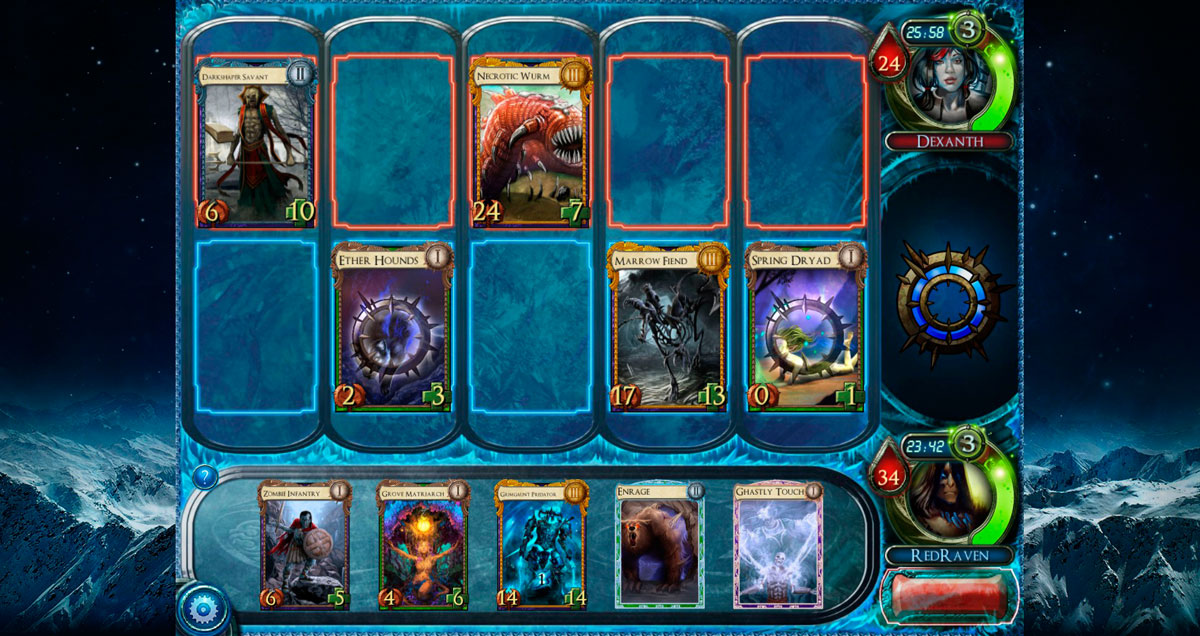
There has to be a way out…
It is my opponent’s turn, late in the endgame. His creatures are the 6/10 Savant that let’s him give a creature -3/-3 whenever he casts a Level 1 spell, and “just” a 24/7 wurm. Mine are all just vanilla creatures aside from the Dryad, which gets +1/+1 each time a creature comes into play on my side. He just cast the +3 Attack/-3 Attack spell I mentioned earlier, targeting his wurm and my dryad, taking out one of my 2/3 Ether Hounds with the -3/-3 trigger. He then plays his own Ether Hounds, providing blockers for my Dryad and Marrow Fiend, using the Savant’s trigger to kill my last Ether Hound. He attacks, creatures die, and we go down to 7 and 4 HP respectfully.
What are my options on my upcoming turn? Well… the 6/5 is just a vanilla creature; the 4/6 will spawn a 1/1 creature in its space after it dies; the 14/14 creature has Mobility and gets +6/+6 when a creature dies across from it; the card Enrage gives a creature +5/+5; and the last card gives a creature -3/-3. Hmm. After I make my moves, the board looks like this:
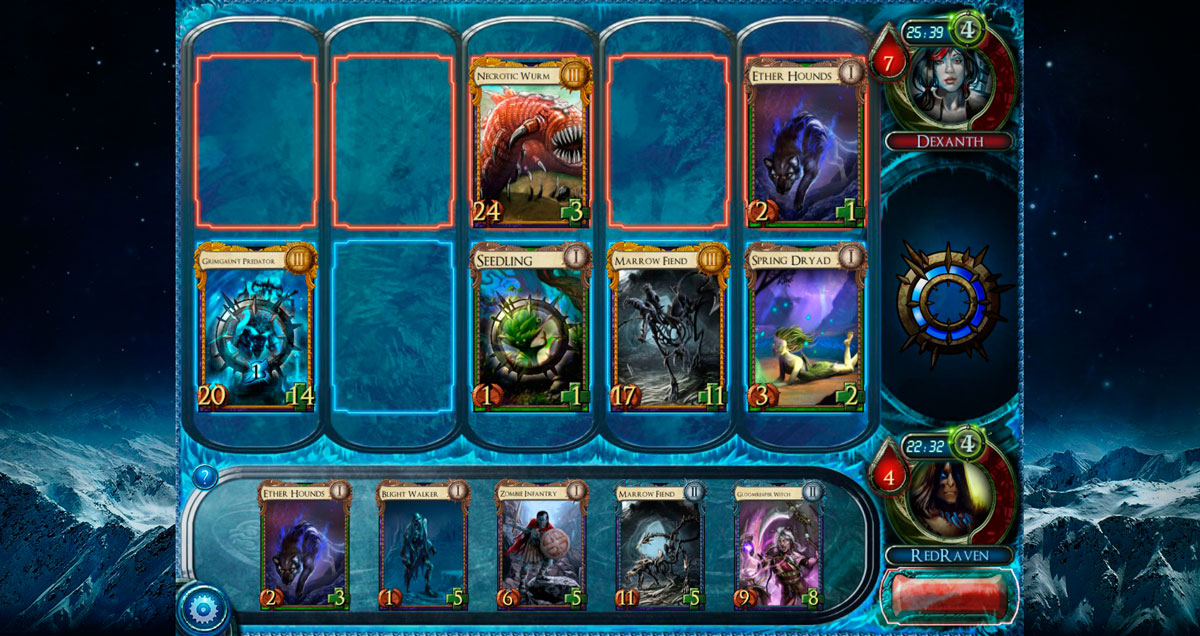
Not horse-shoes or hand grenades, unfortunately.
I had tossed my 14/14 in front of the Savant because the -3/-3 triggers were generating insane card advantage, and would basically negate my center lane gambit. Said gambit was tossing in the 4/6 creature in the path of the 24/7, and relying on the 1/1 that spawned after its death to give me the reprieve I needed to win. And, in fact, I would have won on his turn, but he managed to cast either another Savant or perhaps a Gloomreaper Witch (kills a 1-power creature when it comes into play) to remove my 1/1 and block my 20/14, and then some other throwaway creature to stand in front of my 17/11. The wurm, unopposed, kills me. GG.
Whether all of that sounds like gobbledygook or a smashing good time probably depends on how familiar you are with card games, or with Magic specifically. Oh, did I forget to mention that? Richard fucking Garfield had a hand in SolForge’s development, along with the guys who made Ascension, who were already pro Magic players. Now that I think about it, Richard fucking Garfield worked on Card Hunter too. Dude gets around. Considering how everything he touches seems to directly trigger my nucleus accumbens, I’m going to say that this is a Good Thing.
Less so for my wallet.
Beta Impressions: Scrolls
I tried out Scrolls the other day, mainly due to this video. My initial impression is… mixed. Which is not good for a game that requires $20 to buy-in into a beta state.
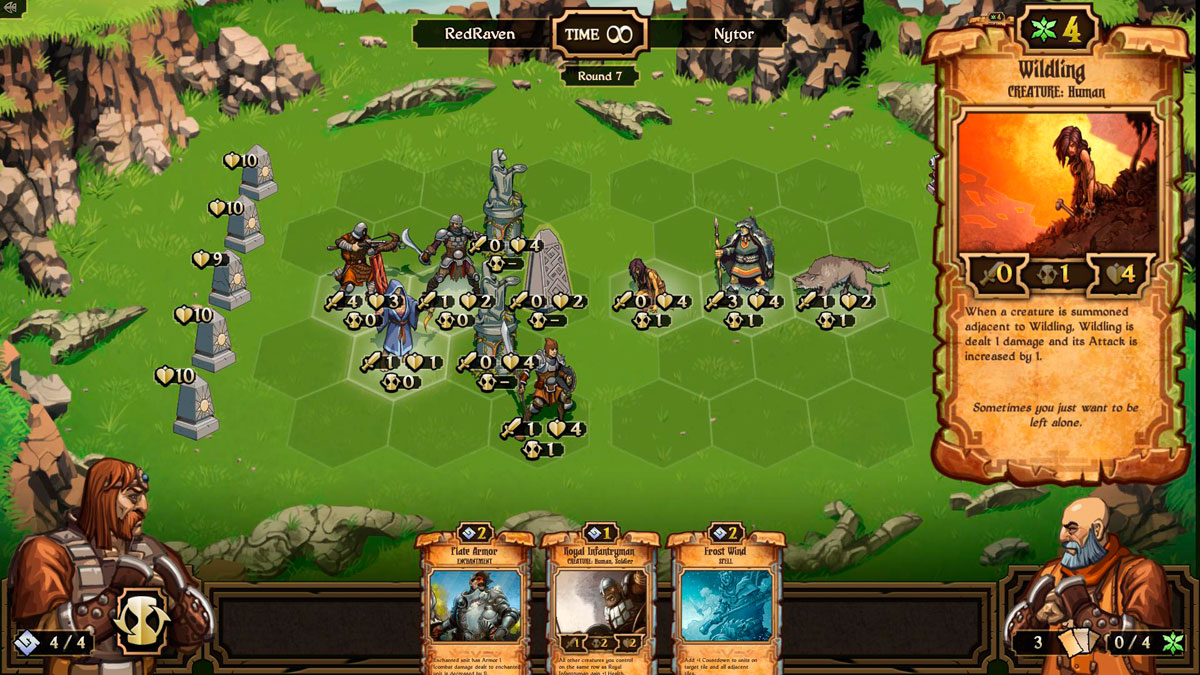
The flesh is willing, but the mind is weak.
For those who may have forgotten, Scrolls is the TCG follow-up project to Mojang’s genre-defining Minecraft. It is essentially Magic-lite with a few extra tactical considerations. Each player has five 10-HP totems at the end of five lanes, and take turns placing creatures or structures or casting spells/enchantments in an effort to reduce three of those five totems down to zero health. Creatures will attack down their lanes when their timer reaches zero, damage is persistent, and creatures can also be moved usually one “hex” each turn.
What I enjoy about Scrolls so far is its rather ingenious, nested card mechanics. At the start of the match, you draw five cards and thereafter draw one card per turn. Each turn, you have the opportunity to discard a card to increase your resources by 1 permanently (e.g. turning it into a MtG “land” essentially) or discarding a card to draw two new cards. As you can only have three copies of a given card in your deck, this immediately makes the early game exceedingly complex on a strategic level. Should you turn that high-cost card into resources now, or save it for later? Now that you’re at 5 resources, should you discard in order to draw two new cards or continue pumping up resources to allow you more options each turn? I doubt that Scrolls is the first card game to feature a system like this, but I am finding it extremely… delicious.
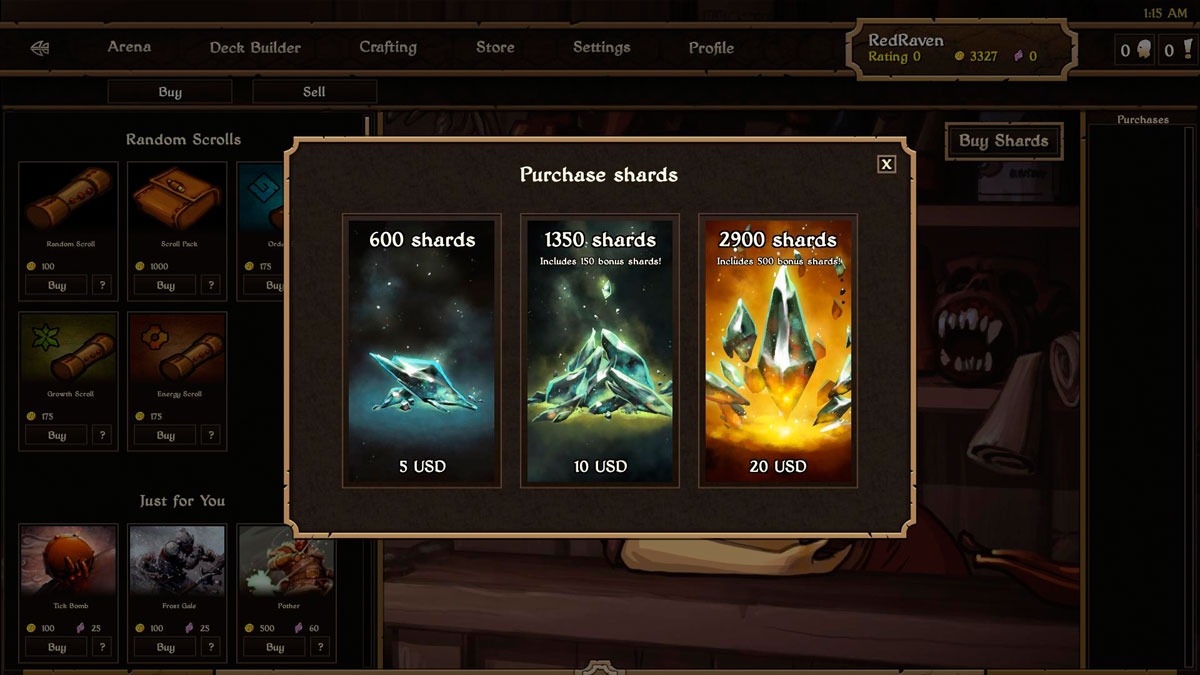
Really? That big pile of Minecraft money not good enough for you?
Now that I think about it, my mixed reaction basically comes down to the Store aspect. After you purchase the game, you unlock one of the three Starter decks to play with. Thereafter, you are stuck purchasing new cards in awkward increments using in-game gold earned from winning matches (either against AI or people). I made the unfortunate mistake of purchasing the Order deck and realizing that I don’t actually like its gameplay – a high emphasis on maneuverability and defense and so on. I am getting around ~300g for winning Trial matches (e.g. scenarios), but the other Starter decks are 6500g total. I started with 2000g, but foolishly purchased the 10-card booster packs at 1000g apiece.
So, essentially, I am stuck with a deck I don’t particularly enjoy playing while having to grind out dozens of games with no hope of actually seeing any new cards for that entire duration. Technically, I can also purchase things in the store for Shards, which is the RMT currency. However, the thought of spending more money on top of the $20 I already paid to play the game in the first place is repulsive. Scrolls is not a F2P game. Finding myself confronted with a payslope after the initial paywall is incredibly frustrating, especially with there being no way to undo the designer trap (having to choose a Starter deck with zero information) I fell into to begin with. This is a TCG, sure, but if your Starter deck isn’t fun to play, most rational people won’t be playing for long.
I am going to continue playing in the hopes that things improve, but at the moment I couldn’t really recommend Scrolls to anyone just yet.
My Current Obsession: Don’t Starve
As I mentioned back in my Card Hunter post, it is pretty rare that I get 100% engrossed in a given game. The all-in immersion in a game’s delicious logical systems is precisely what I desire, but gaming today is typically focused on front-loading the fun, followed by a tapering off of stimulation. So color me surprised when I found myself playing Don’t Starve until 6am again, trying (in vain) to get myself prepared for a winter I have never survived long enough to see.
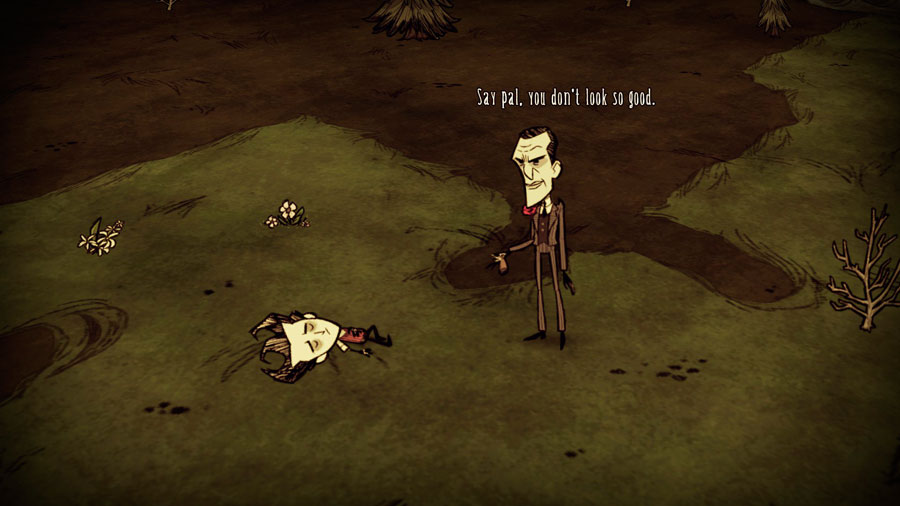
It’s all inevitably down-hill from here.
In a nutshell, Don’t Starve is an indie survival roguelike. You wake up, get taunted a bit by the above-pictured guy, and… that’s it. As the Steam store description states:
Uncompromising Survival & World Exploration:
No instructions. No help. No hand holding. Start with nothing and craft, hunt, research, farm and fight to survive.
They’re not kidding. Just when you think you’re getting the hang of a particular mechanic… BAM! You get stung to death by angry bees.
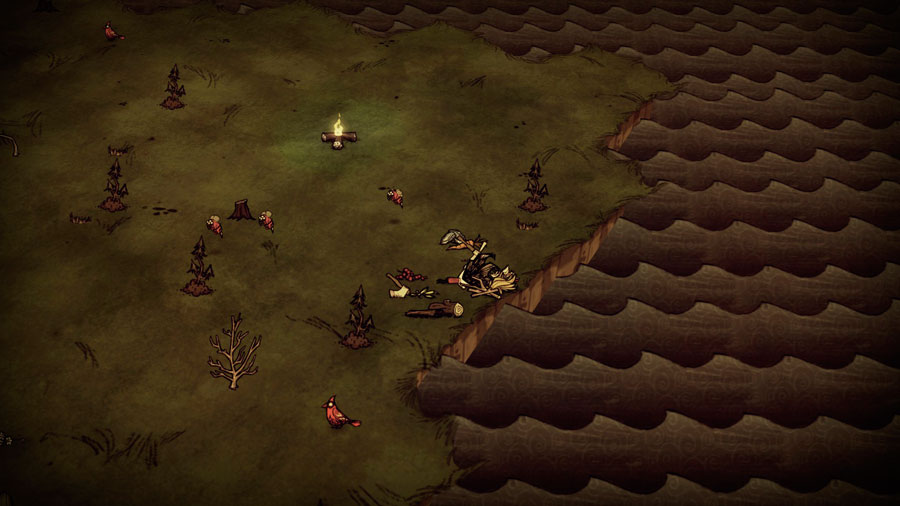
Not a good way to go.
If you die, that’s it, game over; your save file is erased. Occasionally there will be a sacrificial altar-looking thing, which acts as a one-time respawn mechanic. You can even construct your own Meat Effigy, which will also respawn you once… but you will have a lower maximum HP for as long as it exists. And keep in mind that you don’t resurrect with your gear – all of your shit is piled on the ground next to the giant spider nest or murloc Merm camp or swamp filled with giant tentacles or whatever nightmare area you died in.
And that’s another thing: there’s a sanity meter too.
But, seriously, Don’t Starve is one of the most brilliant games I have played in years. While I sort of feel like it’s still in beta (there’s a countdown until the next patch on the title screen), how all the game systems already interlock is astonishing. As you might imagine from the title, getting food is important. But actually getting enough food to survive is pretty easy. The problem is that actually foraging all that food will consume a large portion of your day, leaving you little time to explore before nightfall. You can’t just hoard food either, because it spoils. Even worse, no crops grow during the winter and the ponds freeze over and you can’t eat monster meat without going insane and… you get the idea.
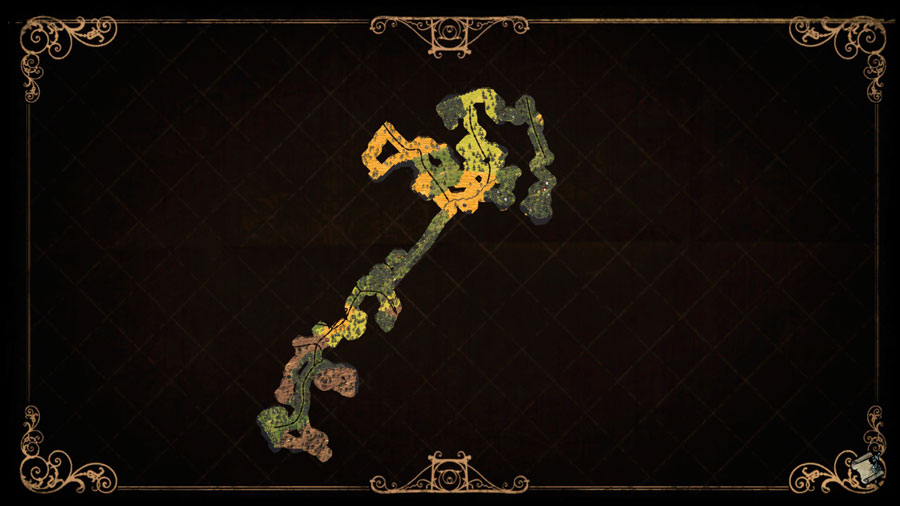
This is how far I walked looking for Flint, one time.
What I find so engaging is how I feel like I’m… juggling. You know in RTS games like Starcraft (etc) when you’re trying to micromanage some battles and having your base produce more units and sending scouts out to look for expansions? I actually dislike RTS games that are structured that way – I can do any one of them well, but not all simultaneously – but Don’t Starve somehow threads that needle. I would spend a few days making food supplies, then trek out into the wilderness looking for more of a certain resource I was lacking, foraging when I could, and trying not to get too far afield. Then come back, craft some new feature in my camp, and then get attacked by Hounds and die on Day 22.
And I’m not even mad.
Each world is procedurally-generated, which means next time I might be able to locate an even better starting location for my camp. Or maybe I’ll run across one of those random set-pieces and get a huge leg-up on survival with the ready-made supplies there. Or maybe I’ll actually find that goddamn Maxwell’s Door again and be able to play the game within a game. Oh, did I forget to mention that? The base game is a sandbox, but you can do Adventure Mode (a story-ish game mode) if you walk through Maxwell’s Door. If you die inside though, you get booted back outside into the “normal” world and it’s forever closed to you on this world. Collect four mysterious items though, and you can jump to a brand new world with another Maxwell’s Door located somewhere on it.
But let’s not get too far ahead of ourselves though, because none of us are likely to make it. As it says on the Steam page:
Randomly Generated New Worlds:
Want a new map? No problem! At any time you can generate a new living and breathing world that hates you and wants you to die.
One day, I will see the winter. And die horribly, no doubt. But seeing it will be enough. For now.
 In An Age