Category Archives: Impressions
Impression: Metro: Exodus
Despite the country being on lockdown and me working from home, my time has actually decreased from before. Figure that one out. Hint: baby.
What I have been doing in extremely limited bursts though, is playing though Metro: Exodus. My overall impression is… better than expected.
The Metro series has been an interesting experience. I reviewed the first game way back in 2012, and the key takeaway was that it was one of the best “authentic” gaming simulations at the time. Features that might otherwise be annoying actually felt right, such as having to pump up your flashlight battery as you explore subway tunnels. The second title was similar, although I seem to recall a truly ridiculous number of “knock you unconscious so we can show exposition” sections. Like, serious traumatic brain injury levels of blackouts.
Exodus starts out in the tunnels and I was not really feeling it. You kinda have to be in a mood to enjoy jump scares and such, right? When the game opened up into an almost Far Cry 3+ way though, it almost felt like too much. You have a map (Far Cry 2-style) and markers, but was it really a Metro experience to just… walk around wherever?
It is, and I like it. Or maybe I’m just getting Fallout vibes and liking that.
Indeed, in addition to pumping up the flashlight, you now have to scavenge for materials to create bullets and repair your gear. There is some minimum level of crafting you can do anywhere, and there are workbenches scattered about to complete bigger tasks like making grenades. Some human enemies drop weapon mods you can otherwise permanently learn, with others being tucked away in remote areas of the world.
There is definitely a tension with exploring though. As usual for the series, the mutants you kill drop nothing. Which itself is a surprisingly uncommon game design mechanism, if you think about it. The result is that sneaking and avoiding enemies is encouraged, which heightens the tension considering how much simpler it’d be to stealth kill them instead. The difficulty I’m on (Normal) doesn’t make avoiding fights necessary, but I do find myself tackling most missions during the daytime, which increases the amount of human enemies, who do drop gear and are easier to take out anyway. Aside from that, the other tension is the lack of fast travel. Exploring is fun and all, until you get to a point where you have to traverse the map in the opposite direction a few times.
I’m not sure how far along in the game I am, but it’s going well. We shall see if Metro: Exodus loses steam or pushes through to the end.
Impression: Factorio
I was gifted Factorio from one of my friends whom I had gifted Rimworld. We’re cruel like that. Given how much I enjoyed Rimworld and Oxygen Not Included and other resource-collecting/crafting games, it seems like Factorio should be right up my alley.
For some reason though… it’s not.
I am in the very early stages of the game. The tutorial, in fact. And while I very much enjoy crafting/survival-esque games and colony management games, Factorio is neither. It is an automating and stand-around-waiting game. You directly control an engineer and initially collect resources 1 at a time until you build machines that can do it for you automatically.
For example, you discover an iron ore field. You can mine it yourself, one nugget at a time, until you can build a Stone Furnace to smelt the ore into an Iron Plate. Use those Iron Plates to build a Burner Drill, which will automatically mine whatever you set it on top of, e.g. iron ore. Then you build conveyor belts so the iron ore can fall out of the Drill and be moved elsewhere, where you build robotic arms that can place iron ore into Stone Furnaces and more robotic arms to place the Iron Plates directly into a storage box. Or onto other conveyor belts to move it to Assemblers which can convert them to Iron Gears, which are necessary to produce the next dozen things down the tech tree. You will also need a similar setup to mine/process copper, stone, and coal to power everything.
In principle, this is the same sort of thing you’re doing in Oxygen Not Included. But that game… is fun. I’m not sure what Factorio is yet.
There’s a rather annoying part of the tutorial in which you are specifically tasked with creating 50 gun magazines per minute while also consuming 12 technology per minute. I get that the point of the exercise is to push the player into understanding you can build a dozen Lab buildings to accelerate research, and same with the mass-production of magazines (to feed turrets to fend off hostile wildlife). That said, I was the closest to quiting the game outright at that moment. All prior tutorial steps were “build X, which takes a half dozen steps,” which was fine. The magazine/tech thing was arbitrary though, and I was a little worried I would run out of technology to research before I successfully built enough Labs. Nevermind how many extraneous magazines were crafted as I trialed-and-errored my way to figuring out how to achieve that, again, arbitrary rate.
At this point, I may abandon the tutorial altogether and give the “real” game a try. Not having any express goals is not something I typically enjoy in gaming generally, but is not something that bothered me in Rimworld or Oxygen Not Included.
We’ll see if I have the same sort of success (read: fun) in Factorio.
Impression: Kingdom Come: Deliverance
It has actually been a while since I first started playing Kingdom Come: Deliverance (KC:D), but in that time I have put in around 50 hours. I am not certain that I will put in any more time to complete the game, but figured I would go ahead and dedicate some virtual real estate to my experience.
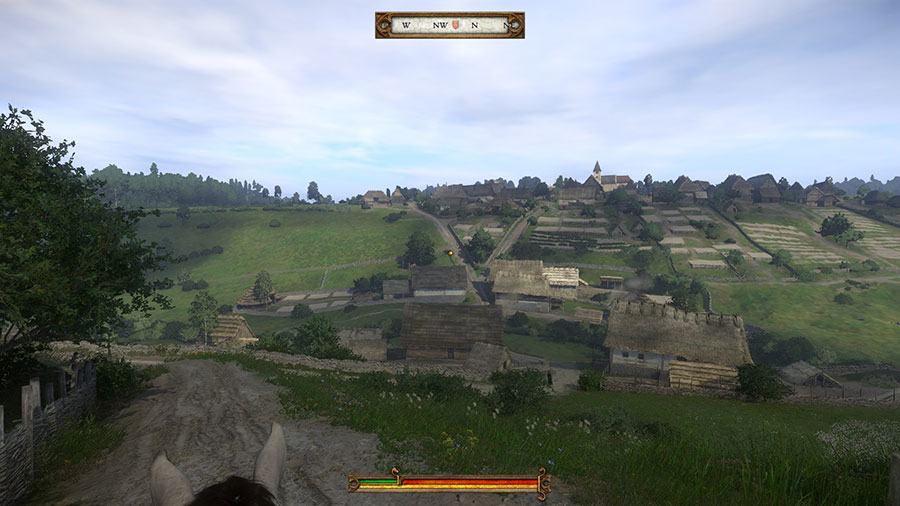
In short, KC:D is for a very specific type of player. And I’m not it.
There are a lot of things to like about the game. Visually stunning. Novel setting and premise, insofar as it’s a no-magic, no-hero medieval adventure. Immersive without needing quotes – first-person perspective in which you can see your feet, helmets getting in the way, walking (or riding) through the muck and rain. Arbitrarily hardcore, even at the expense of fun… which some people enjoy.
Again, I’m not one of them. Or maybe I can be, but not entirely this particular flavor.
The best example is with the combat. You have probably encountered dozens of variations of “you start out as an illiterate blacksmith’s son with no combat experience, OF COURSE combat is hard at first!” I mean, yes and no. Yes in that you start off as a level 1 character with literally no skills or points to put them in until you get XP. No in that the combat system is still trash at max level, as you typically just perform the same moves you have been doing the whole time, except this time you have enough skill points for shit to matter. That’s about as realistic as World of Warcraft or literally any RPG ever made. Except here you are still stuck stabbing faces (lest you be unbeatably countered) while waiting for your opponents to attack (so you can unbeatably counter them).
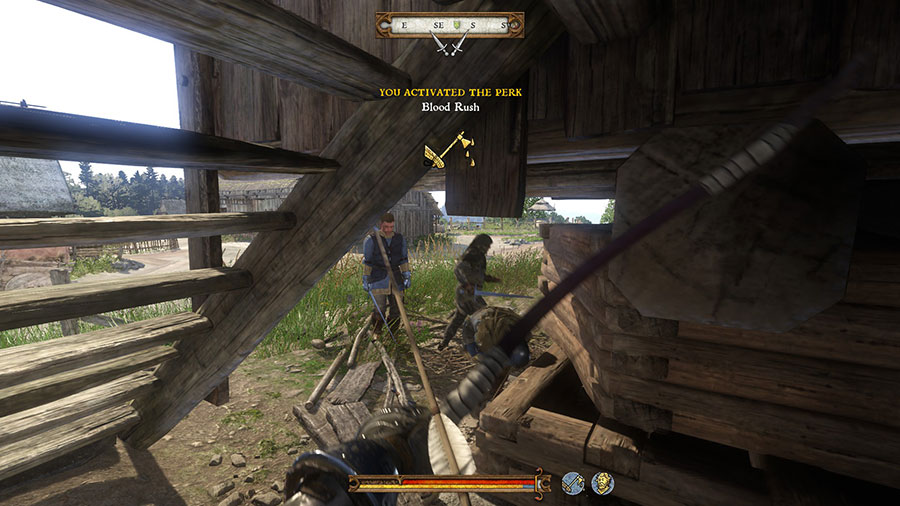
Oh, and occasionally you will be surrounded by peasants and murdered because lock-on targeting jank. Which is “realistic,” I guess. About as realistic as clipping through a bush or under some stairs and attacking back with impunity.
Another vaunted feature is the whole “the world goes on without you” bit. Example: if someone asks you to meet them tomorrow at sunrise at the crossroads, they will simply go on without you if you don’t show. REALISM. Except… that doesn’t always happen. Some quests will wait for you for months, including Crossroads Boy before you talk to him. Which is handy when you unexpectedly get locked up in jail for in-game weeks after attacking sleeping bandits who were scripted to ambush you, but apparently count as innocent villagers when you pre-murder them.
Which, philosophically, well… huh. Morally though, I think I’d feel worse if the voice of god had not automatically whispered my witness-less deeds to every guard in the kingdom.
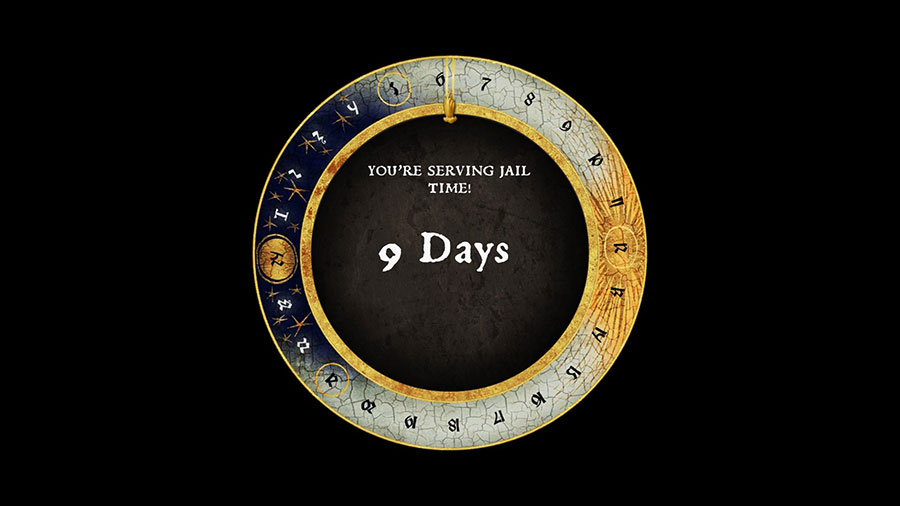
But, real talk, are you the type of player who is fine permanently failing quests you did not realize were timed? I’m not. Which means I had to do a lot of Googling on every upcoming quest to figure out when I was “allowed” to go explore the game and when I was locked on rails lest I run out the invisible clock. One of the biggest failings of the Witcher 3’s story (IMO) was a false sense of urgency with the primary quest, which made the overall impetus for action a joke. But Kingdom Come: Deliverance’s seemingly random adherence to the clock feels worse in practice.
Most RPGs do the false sense of urgency thing. But most RPGs don’t try to present themselves as some kind of immersive sim either. I don’t hold a Final Fantasy to the same sort of standard, even if the fate of the world is supposedly at stake.
At the end of all that, I still put in 50+ hours, so that’s saying something. I did not encounter TOO many bugs beyond some combat jank. I did lose probably around 4 total hours of progress to the asinine saving system, which involves you needing to manually drink some liqueur. There are mods to fix that (and other issues) but I could not be bothered to manually install them. Instead, I simply stole everything not bolted down from everyone I could to pay for my Quick Save addiction, which was still not good enough to prevent me from losing progress in dumb ways (e.g. peasant dog-piles).
If you’re looking for Skyrim 2.0, Kingdom Come: Deliverance is not it. But it’s also not the worst thing in the world. Just go into it knowing a lot of systems are obtuse on purpose, and not always because it’s good game design.
Nevertheless, sometimes the novelty of brazzeness counts for more than you think.
Children of Morta, Finished
As I wrap up Children of Morta, I can reflect that it has consistently demonstrated excellent game design. That is the case even when I don’t necessary enjoy the gameplay of some of the characters. For example, Kevin is a rogue-ish character that uses daggers with ever-increasing attack speed and has a lot of dodging ability. Those two elements are at odds with each other, especially when you encounter enemies who don’t get “stunlocked” by his attacks. That said, some people might like the challenge of that back-and-forth playstyle, and there are some levels in which that fast attack will stunlock every relevant enemy.
The one area in which the game stumbles a bit though? The final boss fight.
I’m not going to go into the details of the fight, just the setup. Which is… spawn in, get three random items, fight boss. None of the boss fights leading up to this point have been so straight-forward. Which is nice on the one hand, because it avoids the frustration of going through three floors of monsters only to die and have to re-clear. On the other hand, it obsoletes nearly a half-dozen or so upgrade paths that you may have spent money on AND prevents you from potentially getting some nice single-run buffs.
This could technically be good roundabout design, insofar as it encourages you to farm gold and XP in other dungeons so you can purchase those last few upgrades to damage (etc) you might have skimped out on. If you are great with reflexes and pattern recognition, go beat the final boss; everyone else can make the fight progressively easier by farming.
Given how many other games completely change all the rules for the final boss fight, I’m inclined to give Children of Morta a pass on this one. I have died a few times already without making much progress through the phases, so I am a tad salty about the change-up. And given how close to the end I am, the thought of farming isn’t exactly appealing. But this final bit is the capstone of a very enjoyable game otherwise, so yeah, I will play along.
[Fake Edit]: I ended up beating the game last night.
Impressions: Children of Morta
After completing the “meaty” Outer Worlds, I decided I wanted to play something lighter via the Xbox Game Pass. The first thing that caught my eye was Children of Morta. And somehow, I have been playing it in longer sessions than I ever did with Outer Worlds.
Fundamentally, Children of Morta (CoM) is an indie Diablo-esque roguelite. Well, that might be over-selling it a bit much. Perhaps an isometric Rogue Legacy? You basically run around procedurally-generated levels and kill monsters, leveling up and collecting gold you use to purchase upgrades for the entire Bergson family. There are no permanent equipment drops or anything, just random relics and runes and other temporary, just-this-run type of augmentations.
Having said that, there are a lot of design decisions that enhance and smooth the gameplay loops.
For one thing, death is not permanent. This is not Rogue Legacy where you end up having totally new family members taking over. While you do lose the progress you made in the dungeon itself, the dungeon is only 3 stages long (with a boss fight). The gold you collect is permanent and accumulates, which means that even several brief failures might allow you to purchase an upgrade or two to HP, Damage, or any of the other characteristics.
That less-harsh roguelite theme continues in other areas as well. For example, you can collect a separate, temporary currency during runs that allow you to purchase various (single-run) Relics and such from a merchant, if he happens to spawn. Or you can use this same currency to open chests that contain mostly gold. I can easily imagine “clever” designers making the player choose between using gold for permanent, generic upgrades versus spending gold in-dungeon for temporary buffs to potentially get an edge against an upcoming boss. Luckily, that is not case here.
Another welcome design is how the story sort of moves forward regardless of success or failure. During any particular run, there can be a bonus room with a snippet of lore or a short quest that otherwise results in a cutscene back outside the dungeon. While there are limits to how far the story will go before a particular boss dies, it was incredibly welcome to know that a particularly embarrassing run would not result in a total walk of shame.
I have not completed the game yet, but I have unlocked all the playable characters and am working on the second area of three known ones. Each of the characters plays very different than the others, but a few are more unbalanced than others. Oh, but did I mention that as you level up specific characters they automatically unlock bonuses that apply to the whole family? This design element ensures that you spend time changing up your play style instead of sticking with just one person all the way to the end. Well, that and the fact that Fatigue can build up the longer you play just one character. But the former design element softens the blow of the latter.
Overall, I am very much enjoying the experience.
ONI Goes Gold
Another Klei game has graduated Early Access, showing the world how Early Access should be done.
I had stopped playing Oxygen Not Included (ONI) back in March, because I was getting a bit overwhelmed with my longest-running base, but didn’t want to start over with a fresh one because there were some pending updates. I continued holding off because the release date was going to happen soon, then it got delayed, so I waited some more. Booting up the launch version last night was satisfying, like slipping into a well-worn chair after a month-long vacation.
For the most part.
New biomes have been introduced, new machines, new elements, new critters, and a new selection of theme asteroids with random modifiers like “metal-rich” or “magma channels” or “frozen core.” There are trees now, in certain locations, and an entire engineering path in which you can burn trees for fuel, turn them into ethanol, and so on. There are also some major changes to heat deletion, specifically removing some of the cheesy methods and making it more of a hassle.
At the same time… the (optimal) early game is pretty much identical. Construct some Outhouses, dig out some 16×4 rooms, make your vertical shafts three tiles wide for airflow and future-proofing reasons, dig out a basement for your Carbon Dioxide to settle so the Dupes don’t smother in their sleep, and so on. The Research tree has been rearranged, Skills have undergone a third (final?) revision, but everything you learned about the first 50 cycles or so is pretty much the same.
The one thing that stays interesting is the placement and types of geysers that can spawn. In the beginning there were only Steam geysers and volcanoes and such, but now there are ~19 different varieties that can radically change the trajectory of your entire game. For example, having a nearby Natural Gas Vent (i.e. geyser) means you can rush an early Natural Gas Generator and otherwise skip Coal power entirely. A water geyser, in whatever form, is pretty much required for any kind of long-term survival, so it’s good to find an early one and get that concern out of the way.
In many ways, ONI reminds me of Civilization in this regard. Many of the steps you undertake are the same, although early environmental resource placement can cause you to switch strategies. By the mid-to-late game though, all roads lead to Rome and you end up doing the same sort of things, e.g. the one that work, as you coast to an inevitable conclusion.
Granted, I haven’t made it to the endgame in the released version of ONI – or in the beta for that matter – so maybe they changed things up. Hell, there are some asteroid options like Rime, wherein everything is basically frozen except for the starting biome, causing you to be very concerned about generating heat instead of having to worry about cooling everything down like normal.
In any case, Steam says I have played 80 hours of Oxygen Not Included already, so even if the release version doesn’t capture my long-term attention, it’s because I have already spent a long time enraptured in its systems. It is decidedly NOT Rimworld or Dwarf Fortress, but it is another fun game from Klei (makers of Don’t Starve). If you like failing miserably several times before becoming lord of the elements, I recommend the game.
Graveyard Keeper
In my still-limited free time, I have been playing Graveyard Keeper.
Even before I purchased the game – or got it through a bundle, I forget – Graveyard Keeper had been unfavorably compared to Stardew Valley. Specifically, how the game devolves into an inordinate grind. Having played the game now for about 25 hours, I have to agree. But it is not the grind that is the problem, but the overall disjointed experience.
As you might imagine from the name, the primary task is the maintenance of the graveyard and nearby chapel. Bodies will be delivered periodically, and interring them can not only improve the overall quality of the graveyard, but gives you a Burial Certificate which you can trade for coins. As things progress, you get the ability to perform autopsies to improve the “quality” of the bodies before burial – primarily by removing “sinful” organs – such that higher quality headstones and such can unlock the full potential of a buried corpse.
So, the gameplay loop starts relatively tight. You chop trees and mine stones/ore to build headstones and such to improve the graveyard. Improving the graveyard eventually allows you lead sermons that generate Faith resources, which allow you to research further technology.
Things fall apart in the mid to late game. The ultimate goal of the game is to collect six items from certain NPCs in town and spend 12g on a last item. 12g is 1200 silver and you get 1.5 silver for each buried/burned body. Thus, you need alternative means of making money. Which is fine, because the quests necessary to get the special items are long and involved and require you to do all sorts of tech-tree development, building dozens of workstations, and basically creating a little empire. However… you can’t specialize. The bartender will purchase the wine you make, for example, but each bottle sold will reduce the price of the next bottle, and prices only recover slowly over time. Which means you need to do all the things all the time, when there will never be enough of it to matter.
To me, that is not even the worst part. The worst part is that your time horizon is ever only seven in-game days. In Stardew Valley, you had seasons and yearly events to plan towards. Sometimes that was a massive pain and source of min-maxing, given that you could spend a lot of time on crops only to have them all die a day before harvesting because the calendar changed. But it also gave you a focus. Hell, you could focus on just a few things, e.g. fishing vs animals vs growing crops, depending on your mood. Graveyard Keeper requires a generalized approach of running around all day every day, never really getting a sense that you’re making progress on any particular thing.
I even have some zombies now to assist in automating resource collection, and I still never have time to do all the things I need to do to feel satisfied on my progress. At one point, I just abandoned the whole corpse part of the game for several in-game weeks because I couldn’t be bothered. I was trying to unlock the second-tier Alchemy Bench so that I could actually start using the Embalming techniques I had unlocked 10 hours beforehand, but the convoluted tech tree and components meant I couldn’t do much of anything. Even when there are interesting choices to make, such as removing more organs than necessary to turn them into alchemical ingredients at the cost of corpse quality, all it becomes is just another chore to do on the path to something else.
It is difficult to discern why I still like playing this game. Well, perhaps not too difficult: it’s a game that encourages planning and thinking even when not actively playing. Same with Fallout 76, really, in that even at work I am strategizing on what I plan to do in-game when I get home. But this chronic tension and sense of never making particular headway is also exhausting, and the last thing I need more of in my life.
Pebbles Can Still Ruin Your Day
Pebbles are small, but if one finds its way into your shoe and you can’t get it out, it can be enough to ruin your day. Or in this case, your gaming experience.
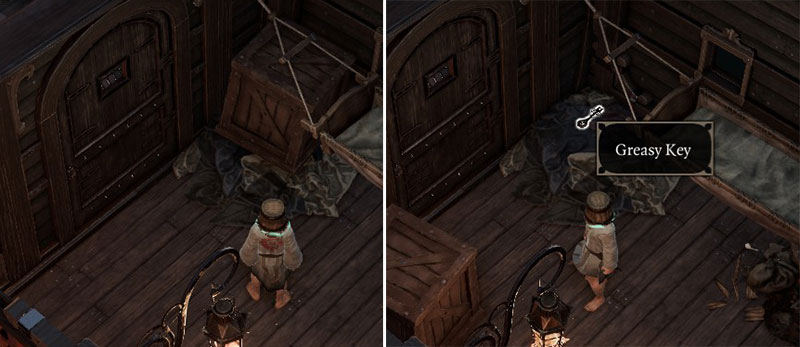
Another pebble: needing to walk around with Alt held down all the time
I started playing Divinity: Original Sin 2 (DOS2) recently, and it’s been fun thus far. There are a lot of interesting new design directions this time around, and I might talk about them in a different post. In this post though, we need to talk about a pebble: inventory management.
…actually, that might not be the root of the issue. This pebble has layers.
DOS2 and the series in general makes a big deal about the autonomy and uniqueness of each character. Characters have origin stories, personal quests, unique special abilities, and their own dialog options. Talk with one distraught woman as Ifan and she shouts “stay away from me you disgusting pig!” Talk with the same woman as Sebille, and you’ll hear her story. It’s immersive… to a point. It’s also awkward, considering you are a player controlling four unique beings, one of which is supposed to be the “main” character.
The awkwardness extends out into the game proper too. Some of the “Civil Abilities” you can put points into are Persuasion and Bartering. The former will let you overcome conversation checks, while also improving your discount with a vendor; the latter improves just the latter. That’s fine, right? It’s typical for CRPGs to essentially encourage specialization, such as you have someone really good at disarming traps, someone running interference for your wizards, and so on.
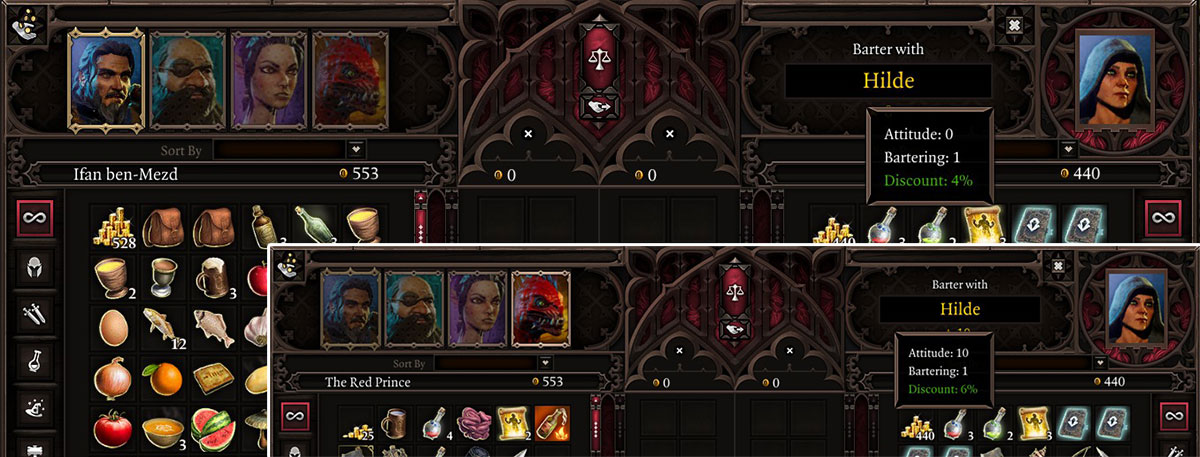
It’s 2% now, sure, but it’ll be higher later… and not even the point
The problem is when the “main” character isn’t the one with the Persuasion skills. I had been playing for about 5 hours and wanted to offload some goods at a local vendor, only to realize that the person with the biggest discount wasn’t carrying any of the merchandise. And there was zero way to move items around except one at a time. That’s the pebble. There’s a “workaround” where you stash everything inside a backpack that you can then pass around, but that still involves manually moving one item at a time into the backpack. Why isn’t there a “move all items” option?
My characters are like level 3, and the difference between the “main” character I had been controlling and scooping up all the loot with and the guy with the highest discount is 2%. No big deal, yeah? Also, there is apparently a magic mirror in Act 2 or whatever that allows you to freely respec all your characters any number of times, so I’ll be able to solve this Persuasion situation to make my “main” character also be the primary seller.
Like I said, it’s a pebble, not some bottomless chasm.
…at the same time, this little pebble is drawing my attention to the fact I’m walking on a trail full of them. With sandals. I made Ifan a Summoner, who is apparently going to need to be the most Persuasive out of the bunch if I want to be using him to click on treasure chests and dead bodies. Or I could keep the Red Prince as the sell-bot since he’s already the best at it, but that would mean I’ll need to be using him to pick up stuff and talk to people. That would mean I’ll miss out on Ifan’s dialog options though, so I’ll need Ifan to be the sell-bot. But he’s a Summoner, not a warrior, so my carrying capacity is lower. I guess I could move crafting material around to compensate…

Significantly more chatty than when I clicked on her with Ifan
By the way, there’s another Civil Ability called Lucky Charm that gives you a chance of finding special loot in every container you check. Originally, this proc’d only if the character who had the skill checked the container. It’s since been patched to be party-wide, which is nice. Because that is otherwise insane. Which is what is kinda feels like for the rest of these abilities.
All of the above because I noticed a 2% discount between characters. But try walking for 80+ hours with a pebble in your shoe and tell me it doesn’t become a big deal over time. And make you question why you can’t just take off your shoe for a second and get it the hell out.
Impression: Prey
Perhaps the most interesting thing about Prey is how much of its cleverness is wasted on me.
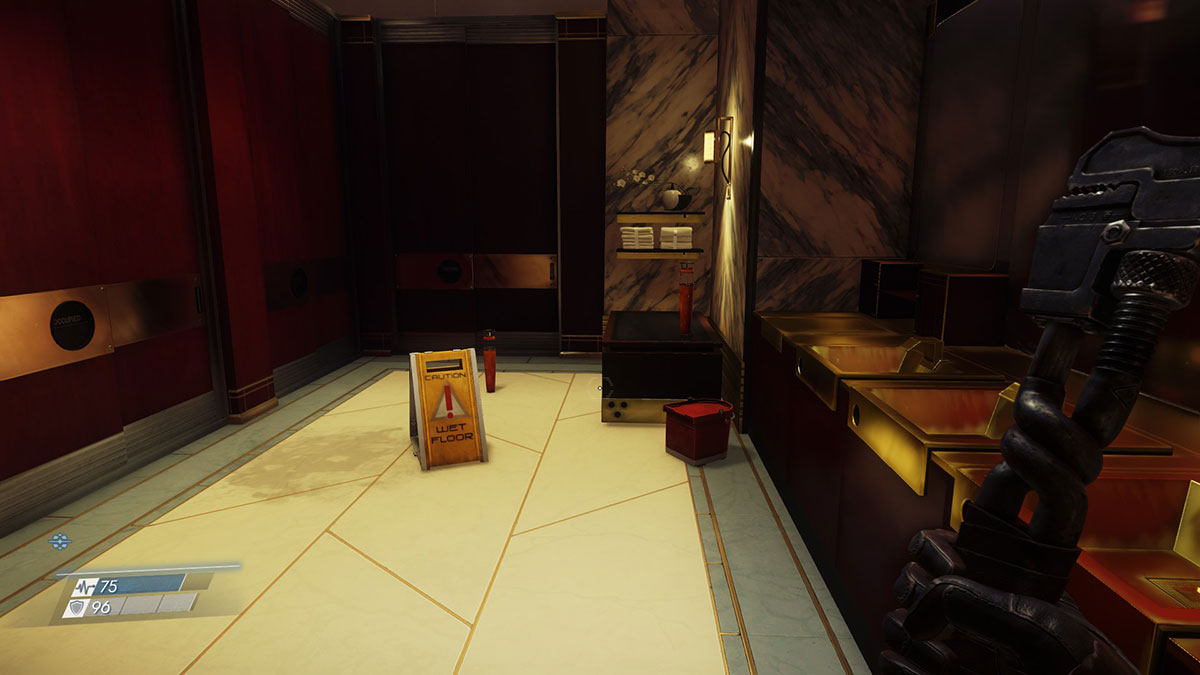
There’s a Mimic in here.
I knew from prior reporting that this game was different than standard games. I had heard of tales of fancy solutions to seemingly impossible situations. That “cheesing” encounters might even be necessary to survive. What I had not considered though, is how tunnel-visioned I had become on rote, formulaic solutions to cliched problems such that I had not even considered the possibility of trying something else.
The very first weapon you pick up is a wrench, which is about as tropy as you get. Then you get the GLOO gun. This is a weapon that deals no damage, but spits out expanding foam balls that can immobilize enemies, put out fires, seal flaming pipes, temporarily block arcing electrical panels, and become climbable platforms when it dries. The silenced pistol comes an hour or two later, and by then you will have encountered quite a few of the stronger enemy types with just a wrench and GLOO gun. The designers were very clearly trying to educate the player on all the myriad solutions to the problems they want you to solve.
Trouble is, I’ve been “trained” too well over the years.
It’s only well after the fact that I realize a better solution existed. For example, I walked into a room, and saw the windows sealed with GLOO foam. A note on the counter read “I sealed two Mimics in there, but there are casualties, so as many as eight.” I wrenched the foam out of the way, and used a combination of Wrench, Silenced Pistol, bullet-time, and panic to kill the half-dozen or so Mimics that popped out of the window.
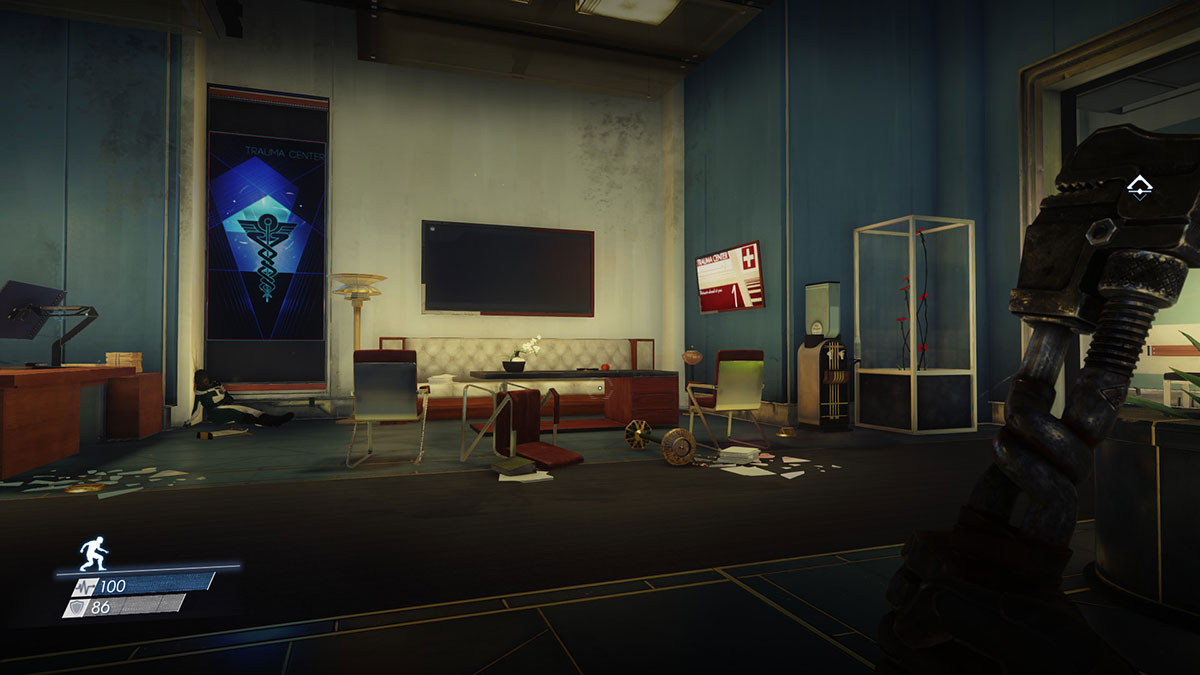
As it turns out, no Mimic in here.
After searching the now enemy-less room, I realized a few things. First, there was a broken turret in the hallway before this room. I could have repaired it, then set up the turret to cover the window. Second, there was a flammable oxygen pipe that run just under the window – which could have been shot to spray a jet of flame across the opening, catching the Mimics on fire. Third, I have Recycler Grenades, and could have just blown them all up. Instead, I chose the dumbest, most caveman solution possible and wasn’t overly punished for it.
Speaking of Recycler Grenades, these are items that basically convert everything within a certain radius into blocks of materials. And I do mean everything, furniture and enemies included. You can spend a lot of Neuromods (e.g. skill points) unlocking the ability to to lift ever-heavier items out of the way – and there are quite a few early rooms barricaded with heavy objects – or you can… just toss a Recycler Grenade at the obstruction and clear it instantly plus get some materials to make more grenades. This was not my own discovery, I had to read about it. It’s entirely possibly that I would not have even ever tried. That’s some goddamn 1984 doublethink shit, where you lack the language to even acknowledge your oppression.
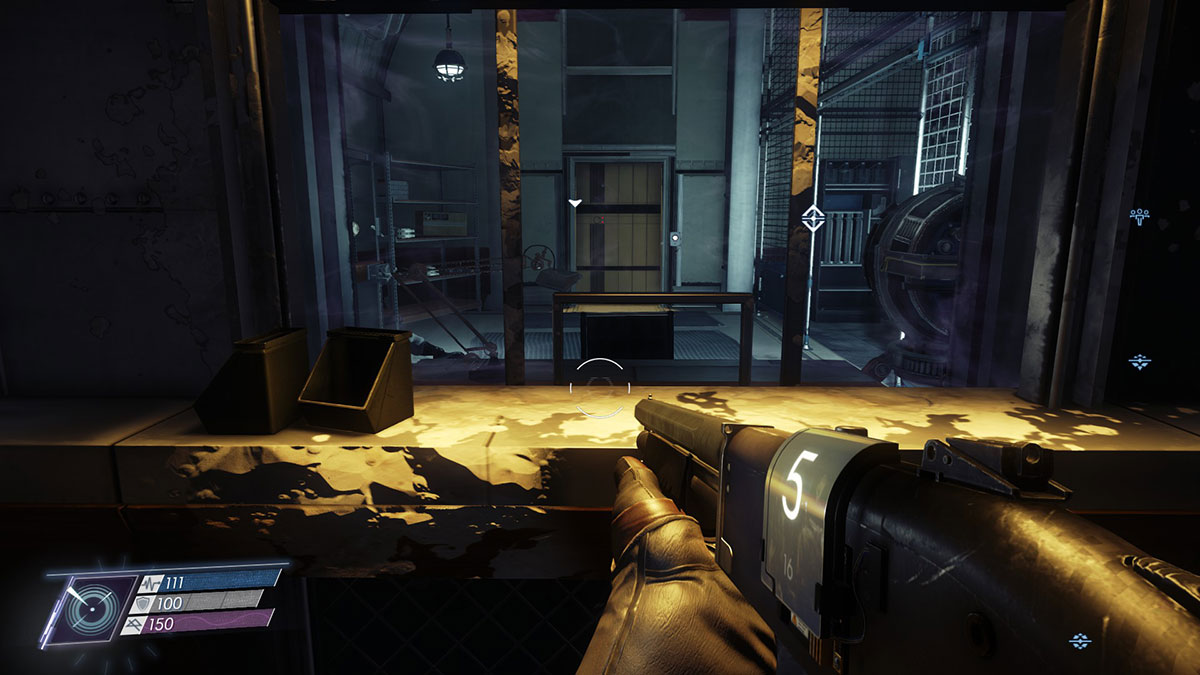
At least four ways into this locked room, and I always choose the dumbest.
To be clearer in my own language here, I am praising Prey. It’s just blowing my mind a bit that years of other, less clever games could essentially atrophy any out-of-the-box thinking. I even played Deus Ex back in the day, and I enjoyed all the sequels too. Part of me feels like Prey should punish more mundane gunplay more, or just forgo guns altogether.
At that point though, perhaps forced cleverness isn’t really cleverness at all.
Anyway, six hours in, Prey is an exceedingly unique experience with some really inventive scenarios. The existence of Mimic enemies cause you to really examine all the debris in a room, which can sometimes (and sometimes not, apparently) lead you to realize alternative solutions to an otherwise straight-forward enemy situation. The GLOO gun is pretty much the closest thing to the Gravity Gun from Half-Life 2 that I have seen a game introduce in a decade. And damn near everything else is similarly polished and grokkable in surprising ways.
Pick this game up when you can. On sale, of course, but on the next one.
 In An Age
Prey in Conclusion
Feb 21
Posted by Azuriel
I completed Prey over the weekend, after about 35 hours.
I could craft 870 rounds of ammo, if I wanted. Or if it mattered.
The majority of my concerns were comically overblown. Prey does tally up your behavior during play, but it only merits a single line of commentary at the end, and didn’t tip the scales in any case. I got the “best” ending doing the sort of things one would expect to merit a best ending, and that was that. Feel free to take all the special powers you want, unless you are specifically going for the achievement for not doing so.
How do I feel overall? Disappointed.
There are parts of Prey that are amazing. The GLOO Gun is an amazing tool that remains useful for 99% of the game. You can spend a lot of Neuromods to augment your jumping capabilities… or you can create your own path pretty much wherever, and whenever you want. At the same time, the GLOO Gun “platforms” are just tricky enough to utilize that you never think that it’s required to progress. In other words, it feels like the designers threw it into the game as a toy to play with, rather than a central mechanic (e.g. Gravity Gun in Half-Life 2), and thus you feel clever every time you use it to bypass obstacles.
The set pieces and overall level design are top-notch as well. The environment is cohesive and dense, making you feel as though you are exploring a real place. There is a ton of backtracking, which gets pretty annoying by the end of the game, but it also doesn’t necessarily feel artificial. Yes, if you want to track Volunteers, go to the Volunteer terminal. Yes, if you want to do something with Neuromods, go to the Neuromod area (again).
At least it’s not sepia-toned, but still… ugh.
Where the weakness starts creeping in is two-fold. First, the designers fell into the same design hole as Dishonored vis-a-vis “detective vision.” One of the marquee enemies you face in Prey are Mimics, which are capable of perfectly disguising themselves as chairs, coffee mugs, etc. After a few hours of exploring, you get a Psychoscope that will allow you to scan for Mimics. At this point, the rest of your gameplay experience will tunneled down a blurry circle, with buzzing in your ears.
Do you have to use the Psychoscope 24/7? No. It’s possible to pop it on to quickly glance through a room for Mimics, then turn it off. Hell, by the mid-game you likely have so many supplies and weapons that it won’t matter if you get ambushed by half a dozen at once. Nevertheless, you aren’t overtly punished for Psychoscoping the whole time… other than ruining the ambiance for yourself. Which, IMO, the is dev’s fault.
The other disappointing element is the ending.
Spoilers are below, but let me go ahead and create some more buffer.
…
…
Last chance… okay.
This is basically Bioshock Infinite all over again. Not specifically with Alternate Universes, but in the fact that the devs thought they could take another of the most reviled, cliche plot devices in history and polish that turd till it gleamed.
Nope. Even a polished turd is still a turd.
The ending actually failed on multiple levels for me. First, it was essentially spoiled in-game around halfway through by completing a quest. I expected a bad ending for trying to bail from the station via escape pod without even doing anything, but wanted to “get it out of the way” so I could continue the correct way. What I wasn’t expecting was Alex’s words after the fade-to-black. Whoops!
Yeah, actually, that’s exactly what I’m thinking.
The second level of failure was using the “it’s all a dream” cliche, period. I have read some arguments that state this implementation actually made your simulated in-game actions matter, given the extra-special reveal. Nope, still doesn’t work for me. Just because I’m being evaluated on my simulated actions, doesn’t mean I view simulated actions with any particular regard – none of it actually happened. Maybe it’s “based on a true story” when it comes to Morgan, but if all my actions can be rebooted with the flick of a switch, I’d rather them not have occurred in the first place.
Which… they didn’t.
Finally, the ending actually ruined a lot of the nuance I had hitherto been impressed with. For the majority of the game, your one directive was blowing up the space station. Given that, the still-living crew were effective dead already… so why bother helping them out? Was it not more cruel to give them hope before killing them all? At the same time, I felt better easing their more immediate suffering, so they could relax and eventually accept their fate when the time came.
Oh, but hey! Now we have a sudden third solution that magically makes everything better, revealed in the final act! Those dilemmas aren’t really dilemmas anymore. And they never were anything but contrived, simulated scenarios in the first place to judge your empathy. Congrats on playing through the trolley problem – not metaphorically, but literally. Woo!
I’m sure the ending worked for some people, just as there are people who feel Bioshock Infinite is a real deep narrative instead of the total bullshit cop-out it is. The special, second reveal at the end of Prey was indeed surprising, and I guess novel in the scheme of things. Nevertheless, I did not feel any better about how none of what occurred actually did, nor did it apparently matter to the people of Earth. Hell, we still don’t even know what happened, or if anything is real. It could be simulations all the way down.
And that’s why the plot device is such bullshit. A sequel, assuming one ever exists, would have to have a radically different tone or go through a lot of effort to convince the player they weren’t being duped again. But I guess we won’t be seeing a sequel so none of it really matters.
Sort of like any of your actions in the game.
Posted in Commentary, Impressions
2 Comments
Tags: Any More Tags Would Be A Spoiler, Bioshock Infinite, Detective Vision, Prey