Category Archives: Philosophy
Wrong Choices
Ghostcrawler tweeted the sort of thing I’m sure sends “real” MMO players into howling fits:
“No,actually,there is not a wrong choice.Wether we(players) buy new items OR upgrade old ones should be our decision,not DEV’s.”
Giving players the ability to make choices with wrong answers doesn’t make players happy overall. (Source)
Choices having bad consequences is the best (only?) way to make a decision matter, as the argument goes. However, this quote got me thinking: do such players actually enjoy being able to make the wrong choice, or is it simply that the bad choice existing (which they did not pick) validates their good decision? Or put another way, who really likes making bad decisions?
I understand that the demonstration of skill necessitates there being wrong choices. Demonstrating skill, or improvement thereof, is fun. At the same time, the Mass Effect series (for example) was fun to play even though there weren’t any “wrong choices” (provided you weren’t specifically looking for X result).
There is only ever one correct answer to the questions of “which does the most DPS” or “what is the most efficient use of resources.” Ergo, is there actually any real decision to be made when one is correct and the other(s) not? I suppose the fun is supposed to be the result of figuring out which one is which, but that sort of clashes with the mockery and disdain frequently attributed to those who don’t look up the correct decision from the Wiki/EJ. Compare that to the question of “which transmog set is the best?”
I do not believe that there has to be a wrong choice in order for choices to be meaningful generally. We make identity choices every day – what type of person do I want to be, what do I believe in? – and I do not think that anyone would suggest that those choices are either irrelevant or have wrong answers (well… no one with any sort of self-reflection). And while I am willing to concede gameplay being under the (broad) umbrella of choice, e.g. one makes a wrong choice by pressing 11342 instead of 11324, I consider there to be a distinction between executing a rotation under pressure versus avoiding falling into a designer trap. One has its place as a legitimate test of skill, and the other is simply you winning via a few mouse clicks several months ago.
Path of Least Resistance
Out of the multitudes of derogatory, loaded phrases, “Path of Least Resistance” is perhaps the one I dislike the most (“welfare epics” is another top contender). The phrase, in a bit of cognitive Jujitsu, attempts to style strength as weakness. “Path of Least Resistance.” Is that not… efficiency? Optimization? Are we supposed to be seeking the path of most resistance? How is that different from simply Doing It Wrong?
The phrase and its implied meaning is more than contradictory though, it’s often hypocritical as well. At its base, it means expending the smallest amount of effort for the greatest gain. Ask those players who bemoan their peers taking the Path of Least Resistance how they feel about “Play to Win.” Is it “cheating” or unsportsmanlike to spam an uncounterable move over and over to ensure victory? Playing to Win is (usually) the Path of Least Resistance. Fair fights are more difficult, and thus more risky – something to be avoided if possible to make the wins easier and more assured.
Those using Path of Least Resistance as a negative attempt to levy moral failings upon players not even participating in the same game as them; the only game in which the Path of Least Resistance is a negative is the game inside the accuser’s own head. Efficiency and efficacy are, in fact, virtues. It is fine to critique game design that results in unintended or counter-intuitive behavior, such as RvR merry-go-rounds instead of gritty trench warfare. But the critique must always be of the rules, not the minds or motivations that master them.
Chicken & Eggs, PlanetSide Edition
I have been playing around with PlanetSide 2 (Ps2) for the past couple of days.
As far as initial impressions go, the “introduction” to Ps2 is uniformly awful. Oh, hey, they lifted the character creation head presets from Fallout. Pick a faction and server without knowing anything about either. And before you even get a chance to check out character/class settings and such, you are launched via drop pod into the heaviest fighting on the map and, in all likelihood, killed immediately. Now that you have some free time, go ahead and look over the thoroughly unhelpful menus while trying to ascertain to what degree SOE is set to gouge your wallet (spoiler: the Nth degree).
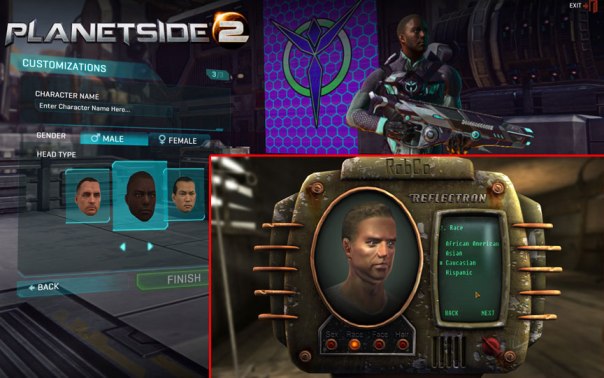
Not that it really matters, but hey.
Once you finally respawn, things do not get much better that first day. Coming from Battlefield 3 and even Tribes, killing people seems to take 1-2 seconds of full-auto fire more than it should. It is also difficult to tell who the enemy actually is – while you get a No Smoking sign on your crosshairs when aiming at a friendly, everyone has the same profile and even colors at first glance. Character animations look stiff, and the models seem lifted from Natural Selection, that Half-Life mod from a decade ago.
I respawned time and time again, courageously throwing myself in front of bullets intended for players actually capable of accomplishing something, while I returned fire with my Nerf Gun that shoots wads of wet tissue paper. In a lull in the dying action, I tried deciphering the stone tablet hieroglyphics that was my minimap. “Generator destroyed.” “Generator repaired.” Was that a good or bad thing? Whose generator? When the the vehicle I was spawning at finally got destroyed, I found myself literal miles away from any discernible action, with no way of knowing where to go, what to do, or why I was doing this instead of finishing packing.
I was lost and alone in the blinding snow.
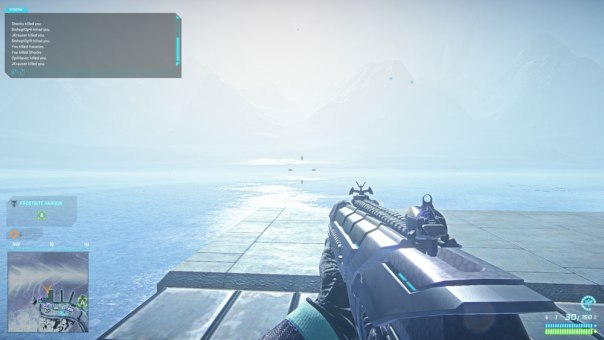
Forever Alone…
The second and third days, by contrast, were infinitely better.
It took a lot of outside research, but I started understanding the pros and cons of the various classes. I learned enough about Certs (i.e. upgrade points) to know what they are, how to get more, and good places to spend them. I used Reddit to find a Google Doc that explained what the symbols on the map are, how to properly assault a Bio Dome, and some tricks for getting around. I learned enough about the weapon shop to know how badly SOE is gouging me (way worse than Tribes: Ascend, by the way)… but also the cool bit where you take a new weapon out for a 30 minute test-drive without paying anything.¹
On the third day, I found one of the best features in almost any game I have ever played:
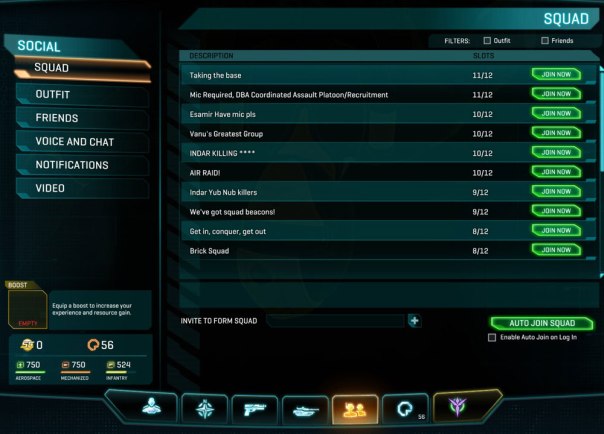
Please make this the future.
I called this post Chicken & Eggs because games like PlanetSide 2 (and nearly all MMOs) require you to have social structures in place before you can really start having fun. Social structures which, incidentally, seem like a waste of time to seek out/develop when you aren’t having fun. “Join a guild to have a good time.” Why would I, if I’m not having fun currently? Which is supposed to come first? I am not necessarily suggesting that fun should occur without effort, but let’s be serious for minute: there are a hundred different games you could be playing right now that are fun from the word Go.
While I still believe the First Day experience in PlanetSide 2 is pretty awful, I absolutely love this grouping system with descriptions they have in-game and hope this sort of idea is lifted wholesale by every MMO multiplayer game. Why can’t there be some sort of in-game bulletin-board-esque system that allows like-minded individuals find each other in every game? Why do socially-oriented games basically require out-of-game social structures to work at all? I have always enjoyed the no-obligation/instant grouping of LFD, but I still recognize the existence of a social hole it cannot fill. Yet here, in a single simple feature, I can differentiate between the friendly strangers, the SRS BSNS folks, jokers wanting to recreate that helicopter scene from Apocalypse Now, and more.
So come on, social game designers, this is not that hard a concept. If the game is made better by playing with people we know, make it easier to get to know people in your own goddamn game. Nearly 99% of everyone I know online I originally met through WoW or blogging about WoW. Make your game a foundation for new friendships (by making it easier to do so) and people will continue coming back. We get the opportunity to express ourselves and meet new people, and you (likely) get a pair or more of multi-year customers.
¹ This feature is cool, but it has a 30-day cooldown on that specific weapon, and starts up an 8-hour cooldown on every other item. Apparently this cooldown is per character though, so you can cheese the limitation by rolling a new toon, trying it out, and then deleting it later.
Once More, With Feeling
Allow me to revise my previous post a bit. The fundamental question I was asking was:
“Is it a good use of designer resources to specifically construct one-time events (in MMOs)?”
The traditional sort of knee-jerk response would probably be “Yes.” My answer is No.
A one-time event is essentially the most extreme example of planned obsolescence in MMOs. If you get upset at the idea that nobody does Tier N content when Tier N+1 is released, then you should be grabbing pitchforks at the very mention of one-time events. Were you upset when ToC made Ulduar irrelevant? Were you sad when Cataclysm redesigned the entire leveling experience, including removing your favorite quests? Do you support attunements as a means to make all raids relevant through the duration of an expansion? Are you sad about how fast leveling has gotten in WoW, or how many dungeons are being “wasted?” If you answered Yes to any of those questions and yet still enjoy the idea of the AQ gate opening just the one time ever, then you have some serious cognitive dissonance going on.
A raid being rendered moot by the next patch’s 5m heroics is just another form of planned obsolescence; it is another form of one-time events, same as the leveling speed changing, dungeons becoming empty, and so on. The only difference is one of duration, e.g. months/years versus an hour on a Sunday afternoon.
There is, however, an important distinction to make here.
When ToC made Ulduar irrelevant, Ulduar still existed. In fact, you can still zone into Ulduar today and go have fun. Will it be the same experience as it was when it was the new hotness? Of course not – you can never cross the same river twice. The difficulty changed quite a bit following the months of its release, to say nothing of the changing abilities of players, the higher level cap, and so on. But fundamentally the place is still there and still capable of generating new memories. The planned obsolescence was social in nature, not structural. Blizzard did not simply remove the raid portal, or leave all the bosses dead. Few people wanted to do Ulduar after ToC was released because better gear was available elsewhere, they had gotten their fill of Ulduar content, they wanted to tackle new challenges, or whatever.
This brings me to a smaller point I was trying to make yesterday: social obsolescence happens naturally, automatically, and inevitably. If ToC was released with just sidegrades available, there still would have been fewer people raiding Ulduar; the exodus might not have been as abrupt, but it still would have occurred. Even in horizontal-progression games, you do not see an evenly distributed population. People generally crave novelty, and will mob whatever new content is introduced, leaving barren ghost towns in their wake. Nobody cares that you have got the Kingslayer title yesterday.
And so now we have arrived at my larger assertion: making events only occur once adds little to nothing to the experience.
Liore and Syl in the previous comments said that the AQ opening would have been less epic/less people would have showed up if it were repeatable. Based on what? Did those people know, for sure, that the gong would never be struck again? Would the significance of the first opening have been diminished in any real way if the event was available the very next year? Or weeks later? I have a hard time believing that could be the case, because Firsts are always special. Neil Armstrong is the first human to step on the moon; his accomplishment is in no way diminished by the fact eleven other dudes have also stepped on the moon. Have you heard of Eugene Cernan or Harrison Schmitt? Those are the last two people to have rung the gong on the moon, so to speak, but no one really cares. Neil still is/was the man.
Ultimately, to me, it comes down to a question of where best to utilize limited designer resources. When new raids and dungeons are released, there is always a special moment attached to it. A camaraderie that exists as thousands and thousands of players try something for the first time, race to the top, and otherwise share an experience. Undoubtedly that is the same goal of one-time events, to evoke those same feelings and perhaps pretend that this is a game world that is always changing (at 12:00 PM Pacific Time/19:00 GMT this Sunday only). The difference is that with the latter, the content is thereafter removed, generating no new experiences, no new memories, and no lasting history beyond the recollections of an ever-dwindling veteran playerbase.
I want game worlds to get bigger by having more things in them, not less, and not temporary things. Designers should stick with making the tools and toys; let the players bring the dynamic themselves.
And if you need something to only happen once to enjoy it the most, 1) I feel bad for you, and 2) the first time only happens once already. Enjoy the feeling as it lasts… don’t just take the ball and go home.
OTOH Experiment
Everyone knows the importance of first impressions, and how they can color every experience thereafter. The situation is a bit more dire when it comes to blogging (or at least it feels that way), because once we nail something down with words, it not only helps cement the first impressions in our own minds, but it also becomes baggage that gets checked any time we say something contrary in the future. You would not see Wolfshead or Syncaine posting about how much they enjoy Mists of Pandaria, for example, even if they were genuinely impressed; so much of their identity and “e-cred” is wrapped up in historical posts about hating WoW that everyone would assume they are trolling at best, or hypocritical at worse.
I was thinking about all that this weekend, as I mused over the sort of feedback and counter-arguments I have been getting about my Guild Wars 2 posts. Do they have a point? Am I letting my first impressions and foreknowledge about the “endgame” color my moment-to-moment enjoyment? Am I not talking about the fun/interesting things because I subconsciously fear “contradicting” myself?
To answer these questions, I decided to try an experiment I am calling: On The Other Hand. The idea is to carve out a space between playing Devil’s Advocate and cleaning the slate as much as possible for a second impression. The experiment does not involve me being relentlessly positive or pretending to like things I do not – it merely gives me mental room to acknowledge that I may have been unfair in the past.
I’m wrapping this all up in a fancy “experiment” instead of just coming out and admitting possible wrongs, because… well, it is easier. Hey, I never pretended to be a humble guy.
In any case, the first night of the experiment actually happened on Saturday when I strolled into a zone I had never been to before; took some screenshots, jotted down some notes. Since I spent all day Sunday playing FTL (ominous foreshadowing?) I am going to try and run the experiment for another day or two. The end result may be in one big post, or several smaller ones. I especially want to try to get back into a third dungeon.
So look forward to that, or dread it, as is your predilection.
Wirehead
I have obviously been posting a lot about Guild Wars 2, mainly because that is what I have been doing for the last few weeks. There are some additional such posts in the pipeline. But behind all this seeming enthusiasm lies the similar feeling of… offness that Spinks talked about.
While playing, I feel an irrational need to hit every resource node I come across. It feels good. Which is… good. Fine. But when I think about the game as a whole, I see no future in it for me. So many people online and in-game mention that the lack of endgame progression is not an issue because you are not paying a subscription. “Just stop playing.”
…but this is an MMO.
An MMO, to me, makes no sense to play sporadically. If you are not committed to the idea of playing often (or everyday), what are you doing? Why am I hitting resource nodes and selling things and hoarding gems if I will be uninstalling in a few months? Doing something only tangentially fun for weeks (e.g. dailies) makes sense to me if your final reward is something you can reasonably use for X amount of time. If you immediately stop after achieving the goal, my time retroactively feels wasted.
Nevermind how the “community” aspect is supposed to develop without player continuity.
Think about Tiny Tower, or 10000000, or any number of “time-management” iOS games. I bought 10000000 off of a Penny Arcade recommendation, and it is basically Bejeweled with RPG elements. I got really into it, maximizing resource gains, plotting out upgrades, “grinding,” and so on. Then I won. And felt empty.
I get post-game depression fairly often, a vague feeling of loss. Even if I had fun along the way, the post-game mood usually makes me question why I bothered in the first place. What mitigates such feelings is usually the sense that I still accumulated something, be it twitch-skills from FPS games (pro skills from Counter-Strike carry over into Battlefield 3, etc) or the experience of a story in the case of many RPGs or proper books. I played Xenogears over a decade ago for 80 hours one time, and I still think about it occasionally.
I will not think about Tiny Tower or 10000000 a decade from now. Nor, potentially, Guild Wars 2. Those games were/have been/are fun to play, respectively. But I am not looking for opportunities to kill time with amusing diversions. I do not have enough time, in fact. What I am looking for are opportunities to “invest” my time, or at least a simulation thereof, while having fun too.
Scott Adams once quipped that the last invention humanity will ever make is a Holodeck. As soon as that was built and marketed, humanity would collectively starve to death inside a Holodeck two weeks later. The future is actually much simpler than Holodecks or realistic VR headsets and such – the future is a wire in your brain that stimulates your nucleus accumbens directly. Watching college sports or playing MMOs or contemplating the vastness of the universe are all primitive methods of manually fondling your glands. The dark secret of The Matrix is that the overlay was completely unnecessary – a little bit of electricity in the right spot removes the inefficient middleman of reality.
The above may seem a non sequitur, but here is the connection: I feel Guild Wars 2 is simply a wire in my head. It generates good feelings, but doesn’t mean anything. It is a personal problem, of course. But all problems are ultimately personal problems. And I grow increasingly weary of doing fun things while simultaneously waiting for the other shoe to drop.
Playing Guild Wars 2 feels like going to Disneyland ahead of the apocalypse.
“So stop playing.” I’m sorry, I cannot hear you over the humming of this wire in my head.
Collective Individualists, or Individual Collectivists
I usually do not participate in theme weeks, but Stubborn’s recent Individualist vs Collectivist post struck a chord. A discordant one.
But first, as always, we have to define the terms of the debate. Throughout Stubborn’s post, for example, he seems to be using “grouping” as interchangeable with Collectivism. While grouping is certainly something Collectivists do, that is like calling me a Landscape Artist when I mow the lawn. The intention matters.
But rather than get too philosophical about it, I have an easy quiz you can take to determine whether you are a Collectivist, or at least have Collectivist tendencies. Have you ever felt:
- Shame, or
- Guilt, or
- A sense of obligation
…to do or refrain from doing some action in an MMO? If you answered “yes,” congratulations comrade, you are a Collectivist!
I knew the precise moment my WoW days became numbered: six weeks after having killed the Lich King in ICC. There I was, logging on at 9pm sharp, trying to drum up support for yet another ICC run that I did not want participate in, let alone tank and raid lead. So why did I do it? Because I knew that 4-5 of my guild mates wanted to do it, that if I did not personally pull the group together the raid would not form, and that each raid which failed to form would drive said guild mates further and further away (into other guilds, or simply away period). Collectivism is about putting the needs of the Collective ahead of your own. You sacrifice your own enjoyment for the benefit of the whole, because the guild/group/corp/etc is intrinsically linked to your own enjoyment.
Contrast the above with Stubborn’s assertion that Diablo 3 ranks highly on the (arbitrary) Collectivist scale:
D3 gets the most collectivist score because it has no add-ons, heavily emphasizes grouping at harder difficulties, and has individual loot. I’d give it a 5, but I have hopes for more collectivist MMOs to come around, and besides, it stinks.
Do you care about the other people you group with in Diablo 3 beyond their potential function as loot efficiency creators? Do you feel guilt for leaving such a group, or a sense of obligation to stay, or shame when you “fail” them? Probably not.
But… maybe you do. In which case, this debate becomes even more abstract as we are awkwardly forced into quantifying how much a game may or may not encourage Collectivist tendencies in players. Is the game anti-Collectivist, or are the players simply pro-Individualists (read: rational entertainment consumers)?
Here is how I see it: Collectivism is something you bring into the game from the outside.
A game can force you to group with other people in order to play, but whether you identify with that group is 100% up to you. Everyone readily agrees that WoW’s random LFD groups are five individuals looking for loot, but Trade Chat groups were not the opposite by default. Did I have a higher tolerance for failure back in TBC? Yes… because if I did not carry that terrible player through heroic Shadow Labs, it meant I was playing zero dungeons tonight. Walking that player through detailed text explanations of each boss encounter was necessary like wearing a shield and pressing Consecration was necessary – in both cases I was simply pressing buttons, not connecting to another human being.
Perhaps I should just quote Samus, who needs nominated for Best Metaphor of the Year:
Any social element is IN SPITE OF the design of these games. You are sitting in a room with all the chairs facing the wall, praising the room for the great conversation you still managed to have.
Having said all that, I can still agree with Syl vis-a-vis being glad that MMOs like Guild Wars 2 are moving towards “bonus instead of malus” incentives for grouping. If I wanted to be social (the most important step!), many MMOs would make being social difficult; simple things like penalizing group XP, throwing quest barriers up, and placing people in awkward Mineral Rights scenarios (“You take the Copper node.” “No, you!”). These days, I would also include general looting rights, even in raiding. While loot system is traditionally the backbone of a raiding guild’s identity – Loot Council vs DKP vs Main spec > Off spec rolls, etc – it can also be divisive. I might like playing with Bob, but if he is in a guild with Loot Council… well, we can no longer be friends raid together.
Ironically, in a certain light, relaxing these grouping barriers actually seems to make games more Individualistic. And it does. Everyone says LFD is the most Individualistic, community-destroying feature ever… and then praise GW2’s auto-grouping, auto-scaling, individual looting, no-words-necessary Dynamic Events in the same breath¹. And the multiple guilds thing, which is great, but sort of undermines the whole guild loyalty/identity thing though, right? Maybe, maybe not.
I feel like this is one of those rare situations in which the otherwise terrible relationship cliche of “set the bird free, and if it comes back, it was meant to be” is applicable. After all, even a sociopath can fake relationships long enough to get the loot, so to speak. A Collectivist cares about the Collective, and will return even if they are not penalized for leaving. A closet Individualist on the other hand… well, they need the handcuffs in spite of themselves.
Of course, the thoroughly legitimate fear is that there ain’t that many Collectivists after all. And I am inclined to agree. So it is simply up to you to decide whether or not the chance of fake becoming real via going through the motions is worth all the cognitive dissonance and hand-waving.
I say open up that cage and let’s see what happens.
¹ LFD might be worse for basically never grouping the same people together again, but simply seeing the same few dudes in Events multiple times is not all that more social by itself. It is the difference between paying for gas at the pump and paying the cashier inside.
Blue Balls
I debated titling this “Diablo’s Blue Balls,” but [spoiler] Diablo doesn’t have balls.
To the ongoing amazement of all (including myself), I have continued to play Diablo 3. You know, the game that I quit twice? In fairness, “playing” consists of 40-60 minute circuits of Act 1 Inferno with 177% Magic Find as I farm random items to sell on the AH for gold to purchase actual items, so that some semblance of progression can be squeezed from the rock that is Act 3 Inferno.
After three days of putting off another progression attempt like one does a dental appointment or a particularly difficult bowel movement, I finally sat on the chair and grit my teeth while awaiting the verdict. It was worse than I imagined. The “awesome” 1.5 million gold weapon I purchased actually decreased my DPS and survivability. In a panic, I scoured the AH for other upgrades… upgrades which helped in the sense of elongating the amount of time it took my face to collapse from the champion pack curb-stomp.
Up until now, I have been treating Diablo 3 as I treated daily quests in WoW: a not entirely joyless task in service of the greater goal of progression. The allure of rare items netting real money certainly added spice to the stew, but the endpoint always was taking down the titular Diablo on Inferno. As has become increasingly clear, that goal is no longer entirely reasonable.
Mike Morhaime has some words to say about Diablo 3 at this two-month mark, although you have to swim through six paragraphs of PR bullshit to find any:
You’ve seen some of that work already in patch 1.0.3, and you’ll see additional improvements with patch 1.0.4. On the game balance front, this update will contain changes designed to further deliver on the team’s goal of promoting “build diversity,” with buffs to many rarely used, underpowered class abilities. Another topic we’ve seen actively discussed is the fact that better, more distinct Legendary items are needed. We agree. Patch 1.0.4 will also include new and improved Legendary items that are more interesting, more powerful, and more epic in ways you probably won’t be expecting.
[…] On the flipside, we are also committed to ensuring you have a great experience with Diablo III without feeling like the auction house is mandatory, which was never our intention. Thank you for all the feedback about that.
[…] We’re also working on a gameplay system that will provide players who have max-level, high-powered characters new goals to strive for as an alternative to the “item hunt.” We’re not ready to get into specifics just yet, but I can say that we’re actively taking your feedback into account as we plan out the future of the game.
After thoroughly washing my hands, what I got from all that was: nothing.
To suggest that the designers never intended the AH to be mandatory is simply ludicrous. I do not mean that in a “greedy corporation cash shop” sense, I mean that in a “did these morons ever do any projection analysis of what the hardest difficulties require in their own goddamn game” sense. It matters not that a pro player can cheaply gear themselves well enough to go through Act 2 when all that budget gear came from other players. Was the design really that a player would spend 2+ months farming an Act for upgrades to progress to the next one when that is eight times as long as it took to get there in the first place? And, please, spare me the Diablo 2 anecdotes unless it involves the necessity of specific gear to finish the final boss.
…that is kind of the rub though, right?
As a player, I want both the fun to never end and the satisfaction of a completed experience. Meanwhile, the designers of MMOs and cash shop games want to delay the gratification for as long as possible while still retaining player interest. If the tacit tension between both parties is maintained successfully, both profit. After all, a game that abruptly ends before the player wants it to is just as bad as an unfinished game drained down to the curdled dregs at the bottom of an otherwise bone-dry barrel of fun.
…except that is wrong. The latter is worse than the former, and you do not even really need balls to appreciate that fact. Simply examine every unsatisfying ending to any game you have played – the one quality they will all have in common is lack of closure. Of release.
If Inferno was easier, there is little doubt that I would have completed it and shelved Diablo weeks ago. Many could argue that Blizzard was doing me a favor by setting forth this Sisyphean task, as those are (presumably) weeks of fun I would not have otherwise had. But that is not what happens. What happens is I sit here, without even the satisfaction of a logical endpoint, miserably looking back on those weeks of “fun” with a jaundiced eye and two blue balls.
And what I see is time spent playing Diablo 3 when I could have had more fun playing damn near anything else.
Revisiting Single-Player MMOs
Keen has a post up entitled “MMORPGs are not Single-player Games,” which laments the direction MMOs are heading as evidenced by The Elder Scrolls Online having a 100% solo “main story.” I am not particularly interested in talking about TESO, but rather this paragraph (emphasis mine):
If it’s so important to your game that the player be the hero in the story, why are you making a MMO? MMO’s suck at being single-player games. Did you skip SWTOR? What makes MMO’s any good at all are the multiplayer elements. Take those away and what are you left with? A game worse than the one you could have made if you actually made a single-player RPG.
Well… do MMOs suck at being single-player games?
It may be easy to answer in the affirmative, and in some respects I would agree. Undoubtedly there are concessions made in an MMO that are irrelevant in a single-player RPG. Daily quests, for example, exist as “content” to get people to log on at regular intervals and maintain social ties. The related notion of paced content (i.e. weekly resets) is also an MMO staple that makes no particular single-player sense. Even normal quests are likely more generic (and numerous) than they would have to be.
But in a very real sense I consider the average MMORPG these days as a much better single-player game than the average RPG. There are two main reasons why.
1) The gameplay is often more satisfying, for longer.
The example I used in Keen’s comment section was The Witcher. Here is a 3rd-person action-RPG game with hotbars and talents and exploration and quests and so on. Basically, a mini-MMO, if you will. As I detailed in my review, The Witcher’s combat system is terrible. Way worse than even Warhammer Online’s janky PvE gameplay. While I considered the storyline/setting to be somewhat of a redeeming factor, it could very well be that something like The Secret World or World of Darkness (assuming that is still a thing) or some other MMO eclipses it even within its own specific niche.
I would never agree with someone who would suggest that stories in RPGs are irrelevant, but let us be honest here: most of your RPG hours are spent in combat. RPGs don’t necessarily need gameplay deep enough to last 1000 hours because the story runs out in 40-100 hours, of course. But there is nothing worse than getting stranded 2/3rds of the way through an otherwise good story with gameplay that has ran out of steam. MMO combat systems, even the ones that feel “off,” convey a depth far beyond the average RPG. They have to.
Keen responded with “length isn’t related to quality,” which is true enough in a general sense. After a while though, one must admit that voluntarily playing the same game for 1000+ hours is perhaps indicative that fun is being had. I would not trade Xenogears’ 80 hours for WoW’s 7800 hours, or for the rest of my Top 10 RPGs for that matter. But for the Top #11-#120?
Absolutely.
2) Show & Tell enhances the single-player experience.
I truly believe that Show & Tell is the future of single-player gaming. If you are not familiar with the concept as I use it, this quote (from a year ago) sums it up:
In this light, I do not particularly think the trend of companion AI or whatever is necessarily bad. Having played Minecraft for a while now, I have reached that plateau where you want nothing more than to show off the cool biodome tower you built or the Pit of Doom you dug or the cross-Atlantic powered railroad to someone, anyone else capable of appreciating the amount of effort/vision it took to do so. Of course, the thought of trying to do what I have done on a multiplayer server where anyone could wreck my house and steal my materials at any time is mortifying. I want a Show & Tell, not a group assignment. I want a single-player MMO.
Repetition is required for communities – people are more asocial in LFD precisely because you aren’t going to see anyone again (unless you have a ranking system, of course). We can, however, condense the process via Show & Tell. What this means in a general sense is instead of blooming into a flower in front of others over time, you do hours and hours of blooming beforehand and invite others into your garden. […]
But that’s just it: players generally have a preternatural desire to express themselves any way they can. Player housing would not be about having somewhere to chill out waiting for a LFD queue, or even arranging your trophies and armor sets in aesthetically pleasing ways. It would be about designing and decorating a virtual space for others to look at. You already know the meaning behind that piece of gear that’s been sitting in your bank for the last four years. Other people don’t know, and deep down I believe it is a common human desire for said object or achievement to be recognized and acknowledged as something meaningful.
Show & Tell can be (and has been) implemented in bad ways. I am not a huge fan of arbitrary Achievements, for example, and I think focusing on the latest gear rewards is a bit crass. Transmog and costume options, on the other hand, are much better. Being able to invite you in to see my living room skull pit in Skyrim?
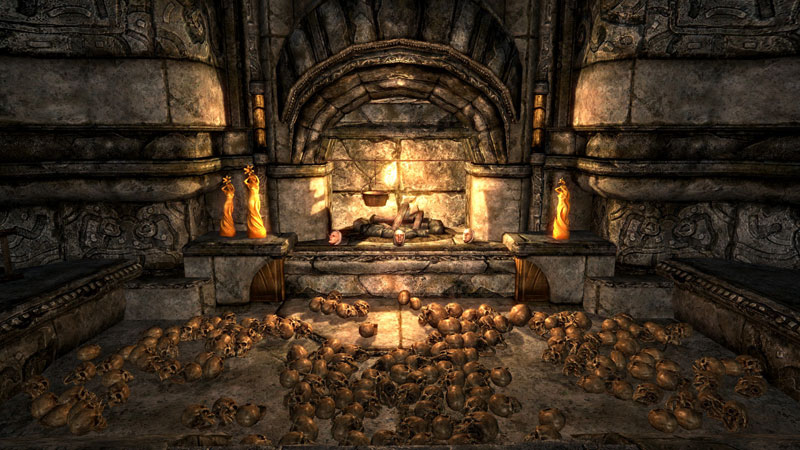
166 Human skulls. All legitimately obtained, I might add.
Would have been epic. The mere possibility of being able to eventually post the above screenshot, and having someone able to appreciate it on some level somewhere, generated dozens of hours of additional gameplay. In a single-player game. MMOs generate gameplay in this fashion all the time, of course, and I am here to confirm that it works for single-player games too. And, by extension, MMOs that are played as single-player games.
______
So getting back to the question at the top, I say: MMOs can (and often do) make excellent single-player games.
Keen openly wondered why this “mystery demographic” is getting catered to by MMO developers at the expense of “MMO identity.” I would say: where is the mystery? The vast majority of MMO players today are single-player MMO, erm, players. Less than 20% of WoW players raid; what are the other 80% doing? How many EVE players never make it out of high-sec space or never engage in consensual PvP? When you look at graphs like this:
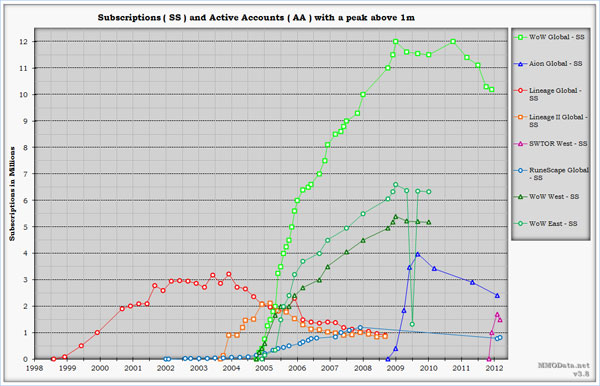
This technically qualifies as a Rorschach test in six states and the District of Columbia.
…what do you see? Did 5+ million social MMO players crawl out of the woodwork in a single year? I don’t think so. Rather, Blizzard tapped into the latent single-player market by letting said players solo at their own pace all the way to the level cap. That was Blizzard’s biggest innovation.
Are social players more valuable to the long-term success of MMOs? Absolutely. Can studios focus exclusively on such players, ala Darkfall etc? Of course. But in so doing they leave literally millions of dollars on the table. And so the reason we see a “dilution” in the MMO identity is precisely because developers are seeking out the most profitable piece of that Venn Diagram – the intersection of single-player and MMO – by trial and error writ large.
The age of single-player MMOs has arrived. And for the majority of gamers, this is good news.
 In An Age