Category Archives: Philosophy
Out of Game
You may or may not have been following the Gevlon + Rohan argument about whether PLEX-selling – that is purchasing a RMT item that confers 30 days of game time in exchange for in-game currency – constitutes cheating in EVE, or is “unfair,” or skipping content, or is ruining the simulation, etc. It has been a fascinating series of posts precisely because I find it almost impossible to relate to their worldview at all. Parts of the argument have the contours of unassailable logic; see Rohan’s near prose when it comes to inconveniences. And yet some part of my mind reels backwards each time I get too close to accepting their premises.
So, let us back up a bit: what constitutes out-of-game resources/thinking?
I still think PLEX is unfair. All the arguments for PLEX have sidestepped the basic unfairness issue, and pointed to the good effects that PLEX has. But at it’s heart, Eve permits one faction of players to skip content for real money, but does not do the same for other players. It weakens the fidelity of the economic simulation that is Eve Online. […]
PLEX is like the designated hitter rule in baseball, or shootouts in hockey. It’s legal, it’s in the rule book. It’s popular, the crowds enjoy it. It might even be necessary for the continued health of the game. But baseball without the designated hitter is a purer form of baseball, as is hockey sans shootouts.
See what I mean about contours of unassailable logic? PLEX can exist within the game, in your cargo hold or on the AH, but it is not of the game, so to speak. You cannot be mining an asteroid and a PLEX fall out; you cannot assemble a PLEX from a blueprint. Every PLEX that exists came into being from a cash transaction outside of the game. In a very real way, it is a breaking of the 4th wall. Rohan is essentially correct.
…and yet, I cannot shake the nagging feeling of the arbitrary.
Across the main post and comments, Gevlon says:
You can only skip grind. If you skip competitive elements, you are cheating. Skipping any competitive element is cheating. Otherwise you are on the slippery slope of “I just skip one more element” until the point of you skip it all and buy a pilot with top killboard stats and peacock around without actually killing anyting yourself. That’s not against the ToS either. […]
@Ephemeron: true that for most people getting E15 is probably just as long as solo mining 500M ISK but it’s an out-of-game skill. Again, if we accept this, the conclusion is “the best way of winning EVE is being good in RL money making”
@Azuriel: you are an inch from being banned from here for being an idiot.
The second account ship obeys the same rules as the first. With 2 hulks you can mine twice as fast, true. But can lose two times more ISK to a ganker.
Real life money is real life money. Buying things in real life with it is normal. Having lot of money is winning RL. But a game is separated from RL for a reason. Buying an EVE-ship by having RL money is just as bizzare as buying a car from ISK.
Putting aside the unfounded belief in the objectiveness of sandbox competition, I see the contours in this argument as well. The ISK from the sale of the PLEX cannot be affected by anything Gevlon does; the credit card which creates the PLEX cannot be ganked, unlike the ship earning 500m ISK mining Veldspar.
But let us go back to our question: what constitutes out-of-game resources/thinking?
Where things break down for me, in both arguments, is when it comes to the arbitrary natures of the distinctions being made. Gevlon, for example, is perfectly fine with multi-boxing. He himself has three accounts running so as to have three separate characters gaining skill points… in an apparently competitive game. But at what point did a second and third account not count as buying advantage using real-life money? Those additional accounts are supporting the primary one: his original “competitive goal” of buying and piloting a Titan is only becoming a quicker reality due to the additional skill point paths he is paying a premium for. Using just one account, his goal would be months (if not years) farther off, as he cannot train Trading and Combat skills at the same time.
I find Rohan’s argument similarly arbitrary. What makes PLEX so especially odious and disrupting? The nakedness of purchasing it from CCP? Consider for a moment other out-of-game transactions. Does multiboxing reduce the fidelity of the economic simulation? Although both of your spaceships exist in the “pure” game world, the reality is that you are paying for an advantage over those with one account. A normal player cannot be in two places simultaneously, nor specializing in two separate skills, nor being able to jump around and trade on six different stations. And let us not pretend opening a 2nd account is any less naked than PLEX.
For the moment though, let us assume that multiboxing is fine.
Is it fine to accept ISK from a friend whom also plays the game? Is the competitiveness of the game intact, should he simply pay for all of your ship fittings and cover all of your losses? Does that constitute out-of-game? Let us even assume he received all of his ISK “legitimately.”
Suppose that instead of simply gifting you the ISK, your friend grants it as payment for letting him copy your homework. Or for driving him to the airport. Out-of-game? What if you offered to pay his EVE subscription for a month, in return for 500m ISK? Your friend still risked his ship getting ganked, still had to undercut Gevlon’s Veldspar by .01 ISK on the AH, and so on.
Rohan and Gevlon’s arguments have such shapely contours because they imitate the elegance of Plato’s Forms: the “pure” EVE is such, and self-contained. But it’s not. Other people exist, and the relationships can cross over between in-game and out-of-game. Ever play Monopoly? You may not have been able to buy Boardwalk by slipping the Banker a real $20 bill, but in the last game I played every single one of us brought in out-of-game resources in the form of favors, grudges, and so on. I gave my friend Andreas a railroad essentially out of spite; he had done nothing in-game to warrant such a one-sided transaction, but I was tired of Aaron winning all the time.
Point being, I can understand how PLEX appears as an “obvious” case of Pay-To-Win (assuming you subscribe to the notion of ISK = winning)… but I see no rational reason to draw such otherwise arbitrary distinctions. Using a Vent or Mumble server to coordinate attacks is an out-of-game maneuver. So is helping a friend with ISK, either freely or for services rendered. I would even argue that reading gaming blogs and Wikis and other 3rd party websites are absolutely out-of-game resources regardless of whether you can open up a browser in-game or not.
Where is the clearly delineated line? Does it start at the cash shop, or at the relationships you bring to the game? Is there one at all?
Kickstarter, Cash Shops, and Ultimate Capitalism
The perfect capitalist scenario is full price discrimination. That is to say, the ability to charge each individual customer the maximum amount they are willing to pay (consumer surplus = $0). Under normal situations, this is exceedingly difficult in non-monopolistic markets. If my maximum for a game is $85 and yours is $250, the monopolist would have to have some way of preventing me – or, say, Gamestop – from (re)selling the game to you at a discount.
Enter F2P and cash shops.
Every customer pays the same entrance fee (be it literal F2P or some cover charge or $X+ for the “collector’s edition”), but now you have the ability to engage in some voluntary price discrimination. Want some costumes? $10. How about a shiny mount or horse armor? $25. Server transfers? Hats? Keys to unlock chests? Speed the game up? Unlock a dungeon? Cha-ching!
When Guild Wars 2 comes out, there will be some people out there that bought it for $60. Others will have bought it for $80. Still others will spend $150. And many more will spend $5, $10, $100 more over time via the cash shop. Nearly perfect voluntary price discrimination. Same game, same amount of development (those developers would have been creating said content regardless), different prices for different customers.
Enter Kickstarter.
A lot of bloggers have been covering Kickstarter here lately. Two of the “previewed” games caught my eye: The Dead Linger, and Faster Than Light (FTL). The latter game is a roguelike space exploration game that has successfully received 2,005% of its funding goal. After watching the video and reading about it, I am somewhat sad I missed the chance to “buy-in” with $10.
The Dead Linger is an opportunity to buy-in at $25 for a game that sounds like a cross between Left 4 Dead and Minecraft (25,000 km procedurally generated worlds, 16-person multiplayer, PvP modes if you want, etc). Then I looked at the $100 option, which included the game and goodies, plus your name or handle as part of a street sign or graffiti. “How cool would it be to see people posting their screenshots and then seeing ‘Azuriel was here’ in the background?'” I thought.
That’s when I remembered how cool $100 is, especially when compared to a game not even in playable alpha yet.
The interesting thing to me about Kickstarter in a cash shop world are the implications. In effect, it proves that there are people out there just looking for the opportunity to give their money away. If I was fanatically in love with Bioware and Mass Effect 3, how could I show my appreciation for what they do? Buy the Collector’s Edition? Buy the novels? In each case, what is taking place is a sale, a transaction, a transfer of goods for compensation. My “contribution” is not distinguishable as an act of charity or praise; Bioware simply gets the feedback that I deemed the product a good value for the money.
Kickstarter is different. Sure, a lot of people treat it as a extra-early preorder. But you can also contribute anonymously. If I sent Bioware a check for $1000 in a the mail, would they cash it? I have no idea. What Kickstarter has done is package up charity and enthusiasm into a “product” that can be sold.
Rationally, it is no different than sending a check in the mail, but it feels different. There is a meter that fills up, there are (limited!) time-sensitive bonuses, there is the satisfaction of needs going on (the game wouldn’t exist without this funding), there is a sensation of fellowship with other Kickstarters. In short, it is brilliant marketing. Utterly and completely brilliant.
As a skeptical consumer, however, I worry. The gamification of charity aside, I am concerned about how the industry marketeers must already be foaming at the mouth. How long is it until it is not just Day 1 DLC we see, but “Pay $100 for your name in graffiti on Station Omega?” It already appears as though pre-order “bonuses” (if you pay for it, it is not a bonus) in the form of DLC is here to stay. When is Kickstarter’s methodology entirely co-opted, and eventually devalued?
Oh, wait. Resident Evil 6’s Premium Edition, which includes a real-life replica of Leon’s leather jacket, costs over $1,000. The future is now.
The Virtual Line
Tobold has an interesting post up today on what he considers the defining characteristic of games: “a game is a risk-free environment in which you can try out various actions for fun or for learning without fear of the consequences, because the consequences aren’t real.”
The second paragraph is this:
As you can see there is a growing trend of “games” turning into “ungames”. There are many reasons for that, one of which is Maslow’s hierarchy of needs. Once you climb up that pyramid high enough, you are leaving the real world needs behind. If somebody’s needs are for status and achievement, he can fulfill that need in a virtual environment, and these virtual environments are usually designed to offer a lot of that status and virtual achievements for less effort than it would take to achieve something in the real world. There are now a sufficient number of people who are sufficiently well-off that they can spend real money on virtual status symbols or game achievements. That is bound to be used by those who are still lower on the pyramid and are just trying to make a buck. The danger is that people become confused about where the border between real and virtual is, which leads to stories like the Chinese guy who murdered a friend who borrowed and then sold his virtual sword.
Hagu knocks it out of the park with the very first comment:
I think “”played” to earn real money” is a bit restrictive.
In real life, if I had a $5 bill, a glass I paid $20 for but with no resale value, and a manuscript I spent 1000 hours creating, then I would be increasingly unhappy with the item being destroyed.
I would regret far more the lost of an item I spent hundreds of hours acquiring than a D3 sword I can sell for $5
The question I want to ask, though, is this: where is the border between real and virtual?
I am not asking that to be cute or contrary. I am literally asking what difference does it make? When have the consequences of a game not been real? Is the emotion you feel by reading fiction different to you than the emotion from an encounter in the real world? Is the frustration you feel at work different to you than the frustration you feel playing a videogame? Anger? Sadness? Disappointment? Embarrassment? Social pressure? Joy? Victory?
One cannot derive nourishment from a virtual apple. A virtual fire will not stave off hypothermia. Beyond that though? How exactly “real” is, say, Security under Maslow’s hierarchy? As any parent, victim of a crime, or survivalist can tell you, security is, at most, a state of mind. A paranoid schizophrenic won’t feel safe in a padded cell; conversely, there are people who voluntarily live in Detroit and St. Louis, the two US cities with the highest violent crime rates as of 2010. If you can feel safe without actually being safe, I think that begins to call into question “consequence-less gaming.”
When I play videogames, I do not think of the stresses of the day, the drama, the frustration with my job, or really anything from the real world. About the only difference between my gaming state and actually having no stresses, drama, or a frustrating job is that, perhaps, the feeling would persist beyond the end of the gaming session. Then again, biologically, we are designed to take things for granted; happiness has diminishing returns. Nevermind that (arguably) the persistence and permanence of anything is just wishful thinking on our parts.
Obviously, the subjective solipsism rabbit hole can get pretty deep.
I am not advocating that virtual relationships are as equally valuable as real ones, all other things being equal. If someone has the choice between a friend IRL and a game friend, I hope you would choose the one whose couch you could actually crash on. I just think it should be recognized that gaming is not really all that far removed from real life as Tobold (or Syncaine for that matter) might suggest. And that the things you experience in your head are as real to you as anything else; phantom limb pain is still pain.
The Chinese guy who murdered his friend over a game item gets our attention because the item wasn’t as “real” as, say, a family heirloom with no monetary value but priceless sentimental value. I’m suggesting that perhaps that is a distinction without all that much difference. Is the attachment to one more real than the other? Is murder more “understandable” over one than the other? The virtual sword isn’t real, but the emotions are.
“It’s just a game.” Sure. That folded American flag is just cloth and dye too. It’s what it means to you that matters. And meaning only exists in your head.
Entitlement
“Entitlement,” like “casual” before it, is such a loaded word these days that I consider any gaming argument in which it is included to be a lost cause. How can you reason with someone who sees no merit in criticism, or (apparently) believes the rightful state of the consumer is to be one of permanent, ingratiatory groveling? I suppose we should be happy developers deign to part with their digital goods at all, yes?
Keen made a recent post on the subject of people being skeptical about proposed game features that have already been “proven” to work in older titles; things like 500 people fighting over keeps in DAoC, non-instanced player housing, and so on. I was going to write on the subject, when this section of a user comment jumped out of nowhere:
For an entitled gamer, why play a game where you can’t have something when there are plenty of games that will bend over backwards to hand it all to you on a silver platter? And unfortunately, the majority of gamers are entitled. Note that I am not using the word casual here because there are some casual games who are not entitled and some serious gamers who are.
I hate this system. I hate that the vast majority of new games shoot for the lowest common denominator to get as many subs as possible rather than finding a niche in the market and shooting for a reasonable slice of the pie.
At first blush, you may be tempted to agree. Don’t.
It’s dumb, it’s contradictory, it’s asinine. Look at all the whiny, entitled gamers in these sort of comments wanting player housing and 100+ player PvP battles, amirite? Having a preference does not make someone entitled. Wanting to be catered to as a consumer does not make someone entitled. Seeking maximum value for one’s gaming dollars does not make someone entitled. Buying/supporting only the games you like is not being entitled.
I wonder if people even understand what they are saying when they type things like “the vast majority of new games shoot for the lowest common denominator to get as many subs as possible.” That presupposes there is a “higher common denominator” that is being neglected when their own desires are equally fantasy bullshit. It is suggesting that games and mechanics these days are not being built to the satisfaction of their own refined palate, as if they were entitled to that.
You can’t have the argument both ways.
I understand and empathize with the sentiment. We live in a world where Firefly gets canned after a dozen episodes while Jersey Shore will be running its sixth season. Shit is unfair. And I would also agree that (MMO) gaming is in an era of extreme loss aversion; if something like Darkfall could make enough money to finance a sequel, surely that is “successful” enough, right? An investor flight to AAA quality has, in many respects, killed off the “middle class” of game designers. Without said middle class, it is entirely possible there are no designers catering to your preferred play style, and indie games can only go so far.
That said, twisting “entitlement” into (even more of) a pejorative and otherwise demonizing your fellow consumers is ultimately counter-productive. Begrudging them their satisfaction of capitalism working as intended (to them), gets you no closer to your dream game sequel. Instead, it leaves us all bitterly divided, rooting for each others’ failures, while those actually responsible continue eroding consumer surplus in the form of on-disc DLC, always-online DRM serving no other game purpose, and similar nonsense.
In other words: don’t blame the players, blame the game (designers). It is the latter saying your money isn’t good enough.
[ME3] What I Want to See from Bioware
Yeah, yeah, I thought I was ready to move on too.
The two things that have really been getting my goat, though, are the Ending Apologists and the Art is Inviolate camps. In truth, they are two sides of the same coin, neither of which seem capable of acknowledging the possibility of ME3’s ending(s) being half-assed. So, I feel compelled to offer counter-rebuttals to their rebuttals, in the form of massive spoilers after the following unbearably cute picture I have bastardized for my purposes.
So, stop reading and start finishing Mass Effect 3, dammit.
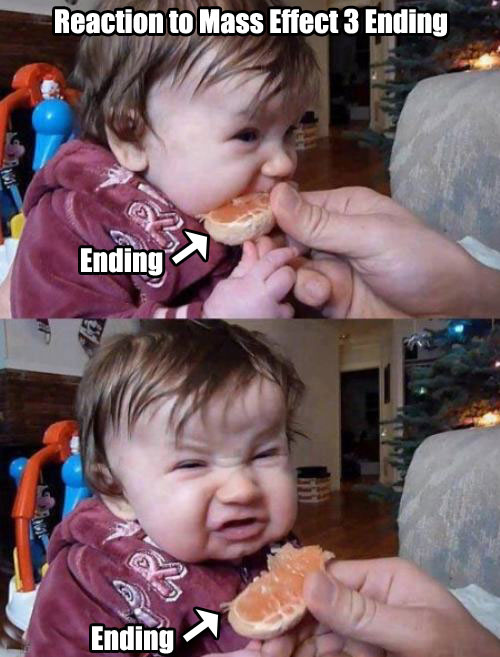
Spoilers below this line!
Before I get started in earnest, whenever I use the term “plot hole,” I am referring to the definition provided via Wikipedia:
A plot hole, or plothole, is a gap or inconsistency in a storyline that goes against the flow of logic established by the story’s plot, or constitutes a blatant omission of relevant information regarding the plot. These include such things as unlikely behavior or actions of characters, illogical or impossible events, events happening for no apparent reason, or statements/events that contradict earlier events in the storyline.
The Normandy Scene
What. The. Fuck.
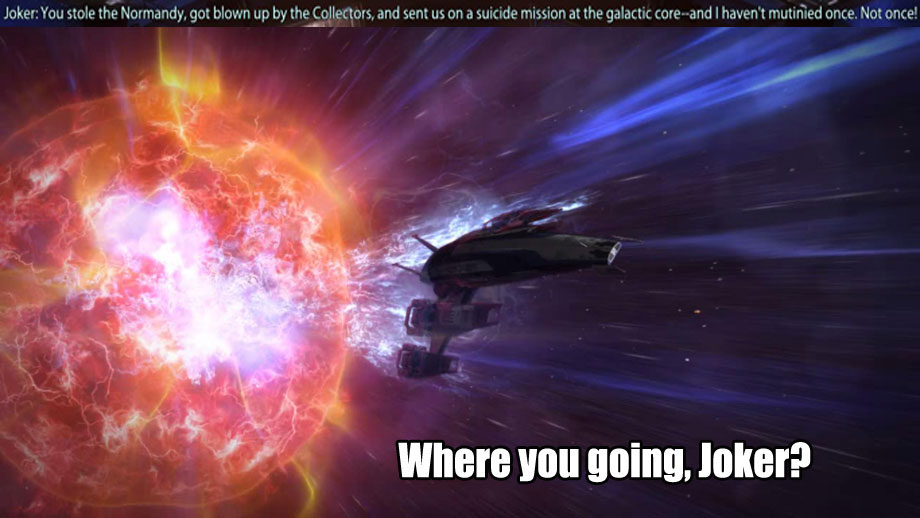
Exhibit A.
More than anything else in the game, the Normandy sequence at the end almost completely and totally ruined the game for me. There is no logical, thematic, or even artistic reasoning for what occurred.
Okay, let me back up. There are two things that this sequence accomplishes:
EstablishesImplies that there is no escape from the Red/Blue/Green explosion. As in, no corner of the galaxy is safe, there won’t be pockets of Reapers hanging out, etc.- It looks cool.
The thing that I want to note though, is that up until this point – beginning from when Shepard stands up post-laser – I had it in my mind that I was going to have to replay the final mission again. Why? Because I had taken EDI and Liara with me, my two favorite characters, and I presumed they were dead. They had to be… otherwise, where were they?
So imagine my surprise when I see this:
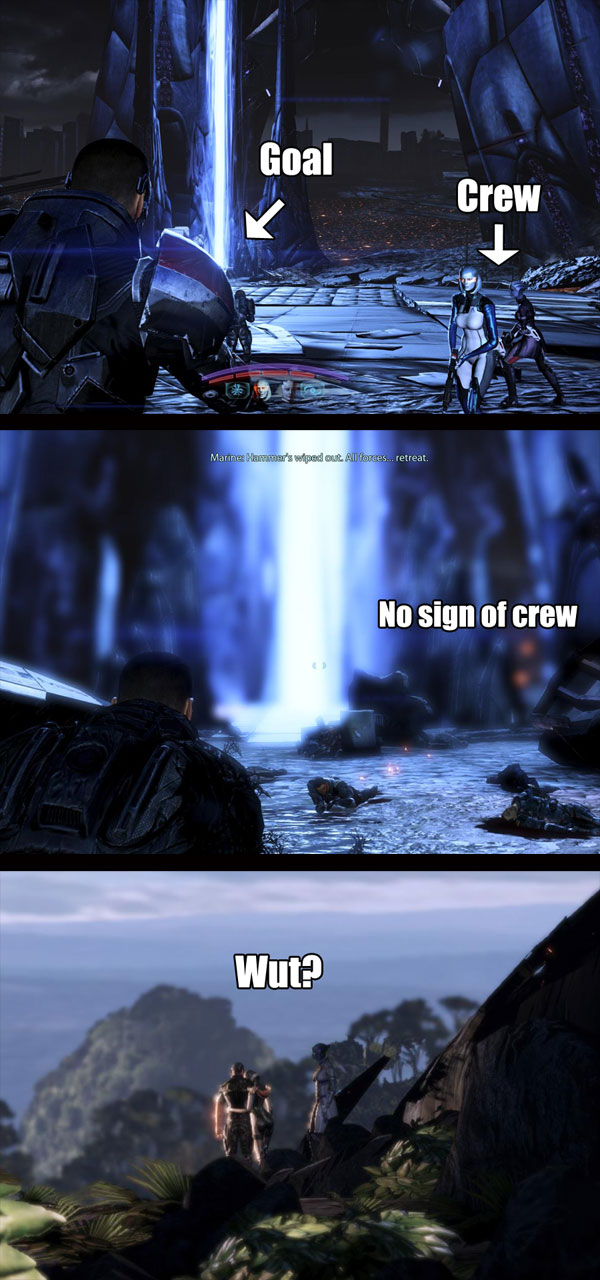
Exhibit B.
The Normandy sequence is the very definition of plot hole. Why was Joker flying away? How did he know to fly away? How did crew that was with you at the beam suddenly appear on the Normandy?
There have been various (tortured) “explanations” I have seen. For example:
Q: How did Normandy end up caught up in the Mass Relay explosion with the people who were on earth?
A: There are clearly some parts of the ending scene that the player doesn’t see. There’s two segments where Shepard blacks out between first running for the beam and his final choice. There’s also a clearly defined scene skip between him rising on the platform and ending up where he meets the ghost child thing. These skips give room for an arbitrarily long period of time for Normandy to escape. Given that Normandy made it that far it seems that this is a reasonable series of events:
1. Somehow off camera(Shepard doesn’t see this happen) the two squadmates you choose get separated during the run for the beam.
2. Everyone gets blasted by the Reaper on the way to the beam.
3. The radio calls go out saying Shepard, along with the rest of the Hammer team is dead, that nobody made it to the Citadel
4. The Alliance fleet calls for a retreat, intending to regroup somewhere else.
5. Normandy picks up the crew still on Earth, then flies out to the Mass Relay, takes it
6. The Crucible, along with the slower ships in the fleet see the Citadel arms open and figure(correctly), that this means Shepard actually survived and opened it.
7. The Crucible docks.
First of all, the necessity of any explanation is proof of a plot hole – who sees the Normandy sequence and goes “yeah, I expected that to happen”? Nobody. Secondly, it has never been established that Shepard is the only person who can open the arms of the Citadel. What that means is that even if the crew “gets separated” or assumes that Shepard is dead, they still should have continued their own individual attempts to make it to the teleport beam.
But, fine, let us assume that the other two crew members were knocked out, and woke up only after Shepard got up and teleported. Why did they not make their way towards the beam then? If the Normandy was capable of making a safe landing to pick up the crew members, whether said crew members were conscious at that point or no, the Normandy could have dropped off additional troops at the beam. Indeed, if the Normandy picked up the crew before Shepard woke up, we would expect them to drop off more troops at the beam (if not search for Shepard’s body). The only excuse explanation I can see for why none of this occurs is an assumption that Shepard woke up first and the beam turned off after Shepard took it (but not before Anderson “followed”).
For now, let us assume that the Normandy had sufficient time and opportunity to pick up the crew members on Earth between the time Shepard opens the Citadel arms and when the Crucible is fired. The fact that the Citadel arms opened and the direct communication with Admiral Hackett proves that the Alliance knew Shepard was both alive and on-board; this disabuses the notion that the Normandy was fleeing to regroup, or for any rational reason. If anything, I would assume that Joker and crew would be waiting around to pick Shepard up, having the only ship capable of doing so.
“If the facts don’t fit the theory, change the facts.”
– Albert Einstein
Incidentally, unlike many others, I am not actually assuming that the Normandy was taking a Mass Relay in that final sequence. It seems to me that the visuals would have looked the same if the Normandy had engaged its normal FTL drives – the explosion only looks like a “beam” because of the Doppler effect of FTL travel. In other words, I can imagine that the sequence itself would have occurred if Joker was trying to avoid either the initial energy explosion from the Citadel, or the secondary explosion from the Mass Relay.
That does not explain why Joker was trying to avoid it, nor whether the damage the Normandy took was because of engine stress or whether all spaceships took similar damage off-screen (e.g. possibly wiping out the space fleet).
What I want to see from Bioware:
- Best Case: an explanation of how the crew (EDI and Liara, in my case) got back on-board the Normandy, what the Normandy was doing while I was on the Citadel, if they knew/suspected Shepard was alive or dead, and why they were running away.
- Worst Case: ensure that the crew with you on the final mission don’t show up in the final scene.
To be honest, it wouldn’t make more sense to see the other crew members, given that everyone was on Earth and fighting to the death. However, it is that much more plausible to see others exiting the Normandy rather than the very people at your side.
Kill the Indoctrination Theory
First off, I want to make it clear that I find the Indoctrination Theory extremely convincing. Indeed, it “solves” a lot of the problems I have with the end of the game, and makes a certain amount of lore sense.
At the same time, it also proves the Bioware writers are terrible.
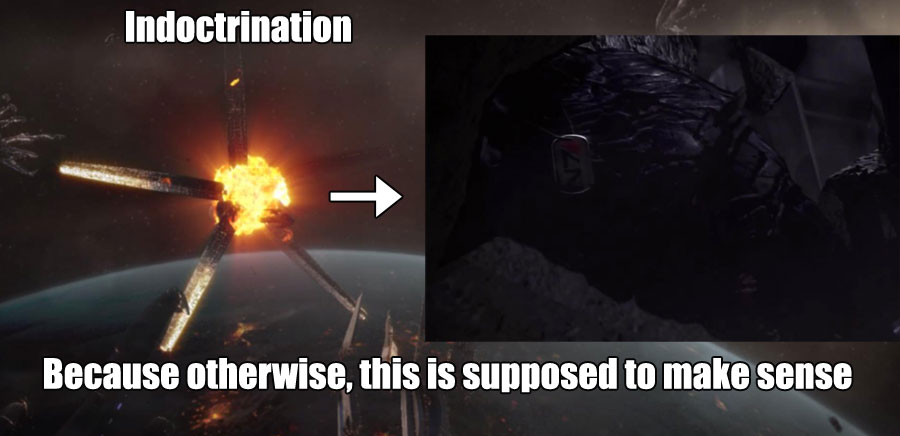
I get it now! Shepard was Master Chief all along!
That notion might not be immediately obvious, but it can be summed up by this quote by Shamus, in the Mass Effect Ending Deconstruction article:
And no, I’m not a believer in the “indoctrination theory“. I think that would be better than the ending we got, but I don’t think it it was ever intended by the writers. This theory involves an incredible level of subtle symbolism, which goes against just how ham-fisted the rest of the story is. To wit: If these writers thought Shepard was indoctrinated in the last stage of the game, we would know it.
Milady also has a recent article on the same subject, entitled The Intentional Fallacy:
[…] To me, the theory is disproved due to a fault in consistency. The unreliable-narrator hermeneutics is not supported by the work’s tone and structure. Mass Effect had until then never attempted any plot exposition that was not direct (like showing videos of the Cerberus scientists at various locations degenerating because of indoctrination, instead of silencing the facts and allow for the player to draw her conclusions based on the environment; that simply had never been done), and surely Mass Effect had not had any dream-like sequences, any instance of unreality, ambiguity. Shepard’s dreams are merely dreams, by what we gather from our previous experience of the game.
In other words, if Bioware intentionally had Indoctrination in mind (har har), they would have wrote it into the story more. I understand that that sounds like a backhanded dismissal of the very evidence brought up in support of the Indoctrination Theory, but I get where Milady and Shamus et tal are coming from. Remember the TV show Lost? Do you honestly believe the writers set out to make a sickeningly cliche religious allegory starting in Season 1? Of course not. In fact, it was pretty clear they were making shit up as they went along until the end of Season 3, when they announced that there would only be six seasons total.
There is also the fact that Indoctrination negates the last half hour of the game. In other words, Commander Shepard starts breathing in the rubble, gets up, and… what? Heads back towards the beam, gets teleported, and still has to open the Citadel so the Crucible (still orbiting Earth) can dock? Or do you suppose that while Shepard was “dreaming” the ending, the Catalyst actually opened the Citadel arms and fired the Crucible with Shepard’s remote orders? I don’t see why he would.
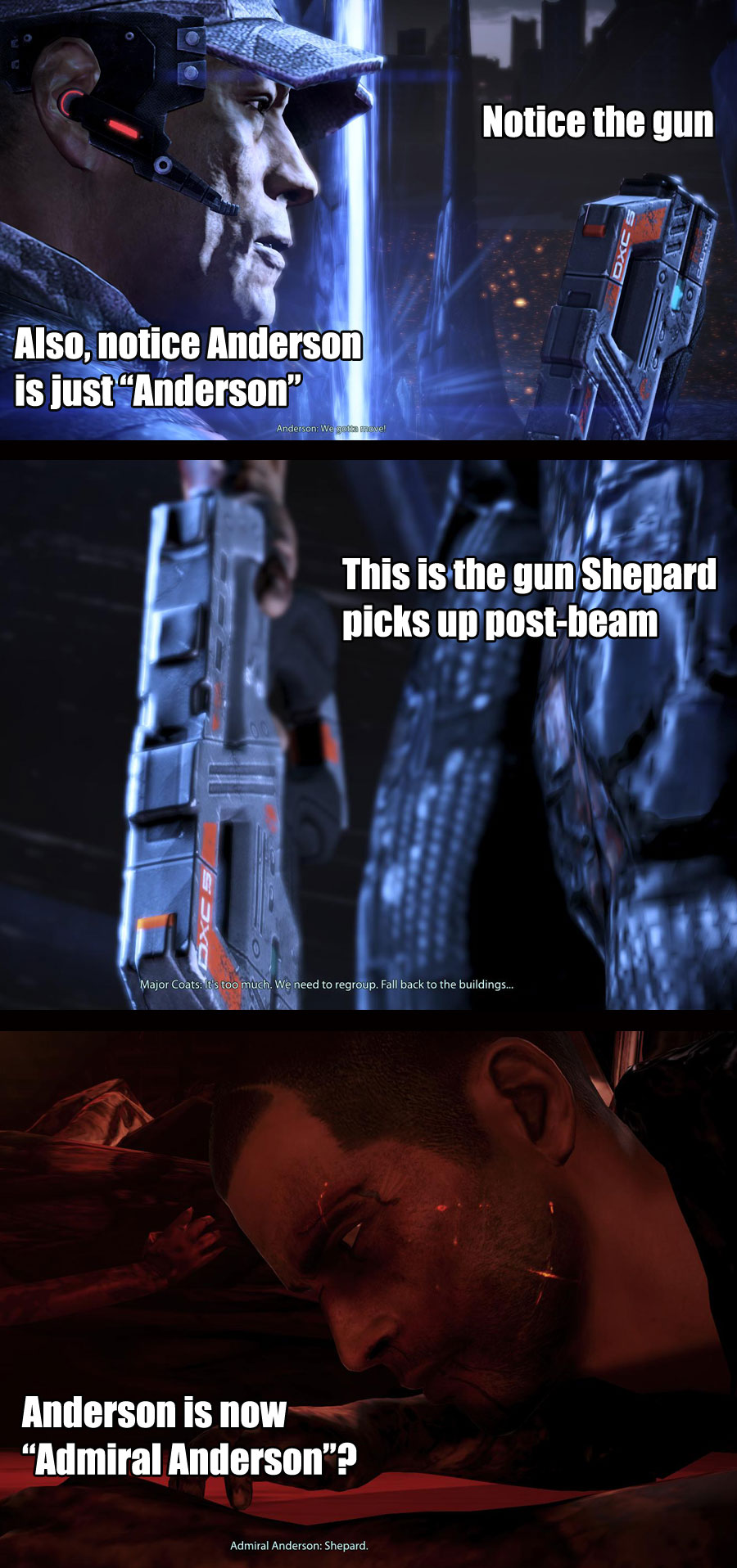
And then you start seeing conspiracies everywhere.
Personally, Indoctrination actually makes the ending worse for me. When I was presented all three choices, I actually chose Synthesis. While many Indoctrination supporters list that as being “what the Reapers were after all along,” that is not really the case. The Reapers were trying to preserve the existence of organic life in the face of an inevitably synthetic-only future – synthesis allows both organic and synthetics to coexist, by removing the difference between them. There is no creator to rebel against.
Even if we assume that Reapers are examples of said synthesis… so what? If everyone is able to keep their own form, as implied both with the ending and the very existence of Shepard (has he/she not already been synthesized?), what is the problem? The Reaper method was bad because you were killed, liquified, and otherwise extinguished as an individual. If you were capable of retaining individuality and agency… what are the downsides?
Oh, right. The downside is that Bioware put in that goddamn “breath scene” only in the Destroy ending, making it a choice between beating the Reapers and living, or doing the right thing (IMO) and dying.
What I want to see from Bioware:
- Best case: Settle the Indoctrination debate once and for all. If Indoctrination is real, include a true final battle scene, potentially followed by the same sort of choices.
- Worst case: Remove the breath scene.
Pave Over the Other Plot Holes
This is really kind of a catch-all category.
What happened to the people aboard the Citadel when it was captured by the Reapers? How did the Reapers gain control of the Citadel? If the Reapers were capable of capturing the Citadel, why didn’t they do it earlier? I mean, Christ, if the entire Reaper modus operandi was to warp to the Citadel to decapitate the galactic leadership… err, why did they change their plans this time around? Just because they couldn’t warp right there doesn’t mean the galaxy is that much less screwed when the Reaper armada shows up manually. Hell, Reapers show up at Earth, Shepard heads to the Citadel to get help, and then finds that the Reapers are already there. Game over.
Of course, this rabbit hole is probably bottomless.
After all, if the Catalyst is in the Citadel the entire time, why does he need the Keepers to do anything? Why not just turn the Citadel radio dial to WRPR 106.1, Reaper FM? How is it possible that the plans for the Crucible have escaped Reaper attention across countless millennia? How is it that countless different species even knew what they were making? As Shamus later states:
Case in point: The crucible is the ultimate weapon, derived from Prothean ruins, yet it was never mentioned or hinted at in any of the previous games. None of the beacons talked about it. Vigil didn’t bring it up, and I’m willing to bet the Prothean squadmate (a DLC character) doesn’t mention it either. This is because it wasn’t planned at the outset. It’s a late-story asspull done by writers who never had a plan.
It is one thing to leave story hooks for future titles; it is quite another to leave plot holes so big you could fly a whole new trilogy through them.
What I want to see from Bioware:
- Best case: Shore up these plot holes via Codex entries, FAQs, or at least acknowledge they exist.
- Worst case: leave everything vague and unsettled.
Conclusion
I do want to make one thing abundantly clear: I still love the Mass Effect series overall.
I just think it should be acknowledged that “artistic integrity” does not mean that the ending was not half-assed, or shouldn’t be changed based on (fan) feedback. If it was Bioware’s story when they wrote it, it will still be Bioware’s story when they rewrite it, regardless of the reasoning behind the revision.
Is there something you would like to see in the DLC? Would you prefer Indoctrination Theory debunked, proven, or left ambiguous? Would you even be interested in DLC set before the final battle, e.g. taking back Omega, etc?
The Weaponization of QQ
The end goal of all QQ is for a game (etc) you enjoy to be fixed or changed for the better.
If you look at something like the WoW forums, or any game forums really, you will see dozens and dozens of impassioned arguments as to why the author is quitting. I seem to recall there being an actual study that demonstrated that the vocal complainers spend the most money on a given game, far in excess of the average; considering I cannot find said link though, let us assume the opposite for now. Why tell tens of thousands of anonymous readers that you are unhappy with the game? Why not just shrug and uninstall?
The ideal scenario in an “I quit” post is for you to continue playing a game you enjoy (in most respects), and for other people to quit. It is like “voting with your wallet,” using other peoples’ wallets. As strategies go, it never seemed too effective, although obviously it is effective enough that moderators tend to shut it down pretty quickly. Besides, the only audience you can reach by posting on forums are the people who read the forums, so any damage is pretty limited.
Oh, the times they are a-changin’.
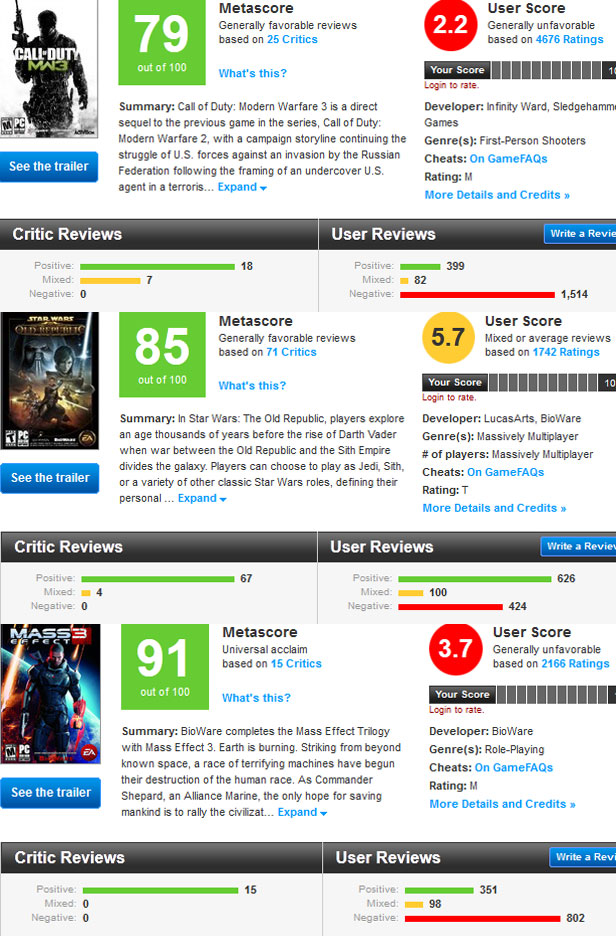
Welcome to the future.
I do not know whether Modern Warfare 3 was the first Metacritic salvo in a post-Weaponized QQ landscape, but it has become increasingly obvious that it will not stand (or fall) alone.
Now, obviously, there is nothing inherently wrong with a game receiving universal critical acclaim by professional gaming journalists, while being panned by uncouth Philistines. Or vice versa! But if you dig a little deeper, an incredibly large portion of the negative reviews for those three games (and who knows how many others) stem from issues not necessarily connected to the game itself – complaints about the state of the game industry, or the existence of Day 1 DLC/multiplayer, or people who wanted a sandbox instead of a themepark.
Maybe those things are connected to the game. Maybe you do enjoy MW3 less knowing how much was copy-pasted from MW2. Maybe people have wildly differing views on what constitutes a “review.”
What I do know is that, going forward, we can expect more of this:

Head to the bunker.
That right there is the present scoring of Mass Effect 3 for the Xbox 360 on Amazon. The PC version has less reviews, but it too is 2/5 stars.
What ever you think about the ending, and how much ever it may have soured the entire experience in your mind… is the game really 2/5? Were all of the emotions you felt during the journey not worth it? I am not entirely sure I want a philosophical debate about the nature of objective experience (or the nonexistence thereof); I just want everyone to know that this is our future.
Believe me, I am the first in line to say that customers have the right to question the creative decisions of designers/writers. However… is this what we want? Do we want developers worried that any reasonably controversial aspect of their work will lead to highly visible backlash? Does that actually encourage higher quality games, or simply encourage safer games? Or are the collateral effects of public catharsis simply their problem?
I used to believe the latter. Now… I’m not so sure.
The Problem With Romance
I normally play female characters in videogames despite being a guy in real life. Part of the reason is I find women more aesthetically pleasing. Part of the reason is cold pragmatism – if there is no strict game difference, why not choose the gender that typically gives you ability to seduce NPCs, receive gifts/attention from others (in MMOs), and otherwise get the door held open?
The biggest part though, is that I find female characters inherently more interesting. A man is always expected to prove himself, both in games and real life. A man is supposed to stand up for himself, supposed to be the embodiment of chivalry, supposed to fight and die for what he believes in. Simply put, a man is expected to “be a man.”
Generally speaking, women are not expected to do such things. Oh, they are expected to quite a number of other things, sure. But to fight and kill and die? When I see a female character putting herself on the front lines, I always subconsciously wonder what it was in her life that drove her to that point. A tragic past? Is she striving to be the son her father wanted? Righteous vengeance? Men fight dragons and bandits and each other because it’s required, expected. Women fight those things out of choice. And choice is what makes stories interesting.
The problem I am increasingly running into is not really feeling comfortable with RPG romances, playing as a female toon. For example, my machinations trying to get Alistair from Dragon Age: Origins in the sack as a female dwarf was perhaps the most embarrassing moment in videogaming for me. Partly because Christ, do I have to draw him a picture?, and partly because I expected Chris Hansen to walk out of the bushes in the middle of the cinematic.

"Why don't you have a seat right over there."
And, well, having to help him [highlight to reveal spoiler] marry one chick and get a second one pregnant [/spoiler] wasn’t exactly the most inspiring of endings. Guys can be such assholes.
Simply skipping the romances is not an option: as I established yesterday, missing content of any nature is difficult enough for me. But more than just that, this is a issue for me because I also genuinely enjoy this “optional” content – deep, philosophical ruminations and high school-esque relationship angst hold equal (if not more) appeal. I live a mostly vicarious life; no deeper psychoanalysis required.
So what ends up happening, even in games wherein lesbian romances are possible, I end up playing a dude. In fact, my first character in Skyrim was a level 4 female Redguard before starting over once I realized there was marriage options… even though the “romance” consisted of 3-4 lines of text and one event. Hence, Leonidas.
In any event, I am curious to know how other people handle game romances. Do you ever play the opposite gender and hit up those romance options? Is it totally not a problem? I am also curious as to whether men have more of an issue with this than women. My default assumption is yes, based both on cultural norms and simply the history of gaming wherein most main characters are male and rescuing princess love interests. I could be completely wrong.
Either way, let me know in the comments.
I May Be Ruined
I am about ~15 hours into Mass Effect 2.
Everything is going swimmingly, although I am beginning to suspect (all) other games have been ruined for me in two very specific ways.
First, I am not sure I can go back to text boxes in RPGs anymore. It is not just about BioWare’s penchant for fully-voiced stories, it is about the equally gripping body language. Everyone has heard about the whole “93% of communication is nonverbal,” right? We are now at a point in game design when at least one company is capable of delivering on that 93% and I do not know if I can go back.
It isn’t just about the smiles, the winks, the nods, or the scare quotes by characters with only three fingers either. It is about the more subtle touches that keep my eyeballs glued to the story exposition. For example:
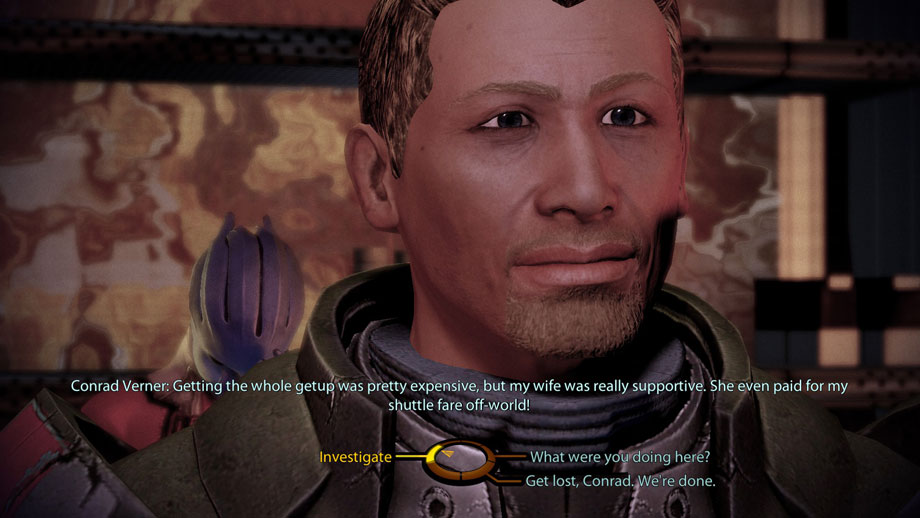
I should have shot him in the foot when I had the chance.
The asari bartender in the background facepalms when Conrad speaks the part about his wife buying the ticket. I actually had some difficulty taking that screenshot because the time between the background facepalm and the camera switching back to Shepard is less than a second – I had to redo that part of the conversation twice to get the shot.
Think about that for a moment. Someone actually went through the trouble of programming a facepalm into a (presumably) throwaway, non-required dialog option, with less than a second of screentime. Understated is an… er, understatement.
Going back to strict text and using my imagination to fill in the blanks? I am not quite sure it will feel the same knowing that the blanks are literal blanks; unless the developers clearly make up for it in other areas of the game, I suspect I will recognize the gaps as deficiencies rather than “imagination opportunities.”
The second way I have been ruined actually came via The Witcher, and is very clearly manifesting itself in Mass Effect 2. Specifically, I now believe I can and should be able to romance anyone and everyone, simultaneously.

Romance All the Things!
I first noticed this tendency when I was flirting with the ship psychiatrist – whom should really know better – and became nervous that things might get out of hand before the entire playing field became available, so to speak. This was not a problem in The Witcher; in fact, you typically only had a single opportunity for “romance” at any given time, so it was a series of all or nothing encounters.
To be honest, this probably has more to do with my methodical nature in gaming than anything else. The baseline assumption I operate on is that I will only ever play a game once – I am looking to maximize my fun, not fill time, and 2nd playthroughs almost always lose out to the dozens of other games available. Ironically, this leads to counter-intuitive game behavior wherein I suck the very marrow out of a game’s bones, completing every sidequest and bonus mission long after such things have ceased being fun and/or make sense to do. Exploring every planet in every system cluster in Mass Effect 1, running Miscellaneous quests in Skyrim as a level 54 character with 100k+ gold, and so on.
As you might suspect, mutually exclusive romance options present a certain difficulty to me.
I do have a residual desire to play ME1&2 again as FemShep, which I would have done originally if not for the availability of romance options at all (that’s another post). The ideal romance scenario would be the “Deus Ex ending” one, wherein you could save right before the critical choice and I could reload to see each outcome. I am getting the impression that this is not how things will shake out.
Youtube exists, but it is just not the same.
Skyrim is a Bad MMO
Skyrim, of course, is not intended to be an MMO.
That said, as I sailed past 100 hours played and started finally running out of the “named quests,” I started thinking back to when a lot of bloggers were musing on a hypothetical Skyrim Online and how great that would be. As it turns out, there is not much imagination necessary: Skyrim really already emulates a lot of the standard sort of MMO tropes. And, perhaps ironically, some of Skyrim’s other qualities sort of demonstrate why such mechanics generally do not really work in MMOs.
Questing
Quests range from “Talk to this guy,” to “Collect 20 Nirnroot,” to “Kill the Bandit Leader in a nation with an inexplicable 10,000:1 bandit to honest citizen ratio.” While there are no exclamation points over peoples’ heads, each city is so densely packed with quest-givers that your minimap – if such thing existed – would be lit up like a Christmas tree. And just like with every quest in an MMO, you never get a sense that you are actually solving anything. Give the Blacksmith 10 Fire Salts to reheat his forge? He may greet you a little differently, but his “secret technique” results in no higher quality merchandise, no larger gold cap, no discounts.
Sidequests are sidequests, though, right? Well, to an extent. The problem is when there are more sidequests than main quests, or when the main quest is boring. At some point, you give the player enough freedom to hang themselves… and they do.
See, I have completely lost the Skyrim narrative. “What am I doing? Why do I care?” Helping a dude steal a horse is supposed to enrich the game world’s verisimilitude, I guess? If that is the case, it failed. The quests are so disjointed and arbitrary that I end up feeling like a dyslexic, ADD-addled coke-fiend with Tourettes, sputtering along countryside with an ever-increasing laundry list of chores. The situation really makes me appreciate all those otherwise lame zones in WoW, insofar as the quests actually lead somewhere or enriched the background of the zone.
Crafting
I have heard a lot of people lament the state of player crafting in MMOs, but again, Skyrim is a good case-in-point about where strong player crafting can lead to. Basically, I have not upgraded a single piece of gear in the last 40 hours of gameplay. Considering there is no such thing as quest XP, and I have more gold than I could ever possibly spend, the lack of possible gear upgrades essentially boils questing down to its base narrative components. Some hold up, most do not.
Short of the sandbox-esque nuclear option of destroying gear and/or permanent durability loss, I do not see a worthy payout for the costs of strong player crafting. I just completed a long questline to reconstruct a 1,000+ year old amulet whose power started a war and led to it being split into three parts and sealed away; the names of amulet keepers were to be forgotten under the pain of death. After finally reforging it, I held it in my hands and… oh, +30 to Health/Mana/Stamina? I created an amulet with +67 to Health and +40% extra Bow damage nearly 50 hours ago.
/vendor
While some of this can be mitigated in MMOs by making recipes rare, requiring special crafting materials from higher-level content (which is different than normal loot… how?), and so on, strong player crafting still seems to boil down to reducing or eliminating much of the incentive to quest. Perhaps that is indeed the entire point, eh? Moving away from designer quests and into “Spam Trade chat for an hour” player quests? That is fine to do, with the assumption that the game itself is either going full quest-less, or the quests that do exist are so ridiculously fun and exciting that they are intrinsically worth doing.
Pacing
Although this is not a formal review, if I had to sum up all of my problems with Skyrim in a single word, it would be “pacing.” There simply isn’t any. Even if the game revolves around doing what you want, pacing is important. I am level 51 and I can 2-shot dragons with my bow from stealth – the game is essentially over for me. And yet the main questline is not remotely near complete, nevermind the handful of other quests remaining. Yes, “I did this to myself.” If EVE gave every new player a Titan for completing the tutorial, those players would also be “doing it to themselves” for (ab)using it too.
Point being, it is the designers’ jobs to craft a well-paced game. I don’t care how sandbox your design is, I shouldn’t be allowed to break the game for myself. One of the great strengths of the themepark experience is exactly the derided “on rails” component: it will take you X days of Y quests to get Z gear. The bosses you face tomorrow will be stronger than the ones faced today. There will be a quantifiable reason to collect 10 bear asses.
After 100 hours of gameplay, clearly Skyrim is doing some things right. I have never taken more screenshots in my entire life, for example. Despite my character being completely broken, I still treat the world seriously (sneaking around when I could simply kill things straight-up) because it projects seriousness in most every scenario. But instead of making me pine for Skyrim Online, it does the opposite. I miss the strong narratives of Fallout 3 and New Vegas. I hated having to level through Burning Crusade content in WoW, but I hate tracking down 20 Nirnroots more.
Pacing is something to keep in mind when constructing your hypothetical sandbox or Impossible MMO. More options, more things to do, can actually result in less meaningful gameplay. Skyrim deserves its accolades, but it makes for a pretty bad MMO. And the changes necessary for Skyrim to be ported into the MMO world would, in fact, make it resemble nothing like its present state.
 In An Age
Specialization is Key
Mar 2
Posted by Azuriel
I was reading Syl’s Monday post on GW2 when a particular section leaped off the page:
If you have attempted group content in WoW at any point in the last two years, you probably recoiled in horror as I did at the thought of looking forward to shared group responsibility. We have a term for that now – The Dance – and every indication that it was the principle cause of the nearly 2 million subscriber exodus.
After all, by making every player vital to the group’s success (e.g. everyone must Dance correctly), the strength of the group is reduced to that of its weakest member. And if we follow the “down with the holy trinity!” argument to its inevitable conclusion, we end up in Dance Dance Central.
When I asked whether Syl really wanted shared responsibility, the response was:
The sentiment is interesting to me, because I approach it from the 100% opposite direction.
There are some responsibilities that I do not trust other people to accomplish. I was the guy in school/college that would do all of the heavy lifting in the group project – picking the topic, doing the research, writing the paper – while you sailed to an easy A by reading two (of 10) paragraphs in front of the class.
Actually, “trust” is not even the operating word I am looking for, as that implies an uncertainty of contribution. It wasn’t a question of whether you would perform, or even how. It was a matter of your capacity for performance, and whether the final outcome would be better or worse with said contribution.
Is that arrogant? No.¹ Ability brooks no morality. Being better at the “game of school” did not/does not make me a better person, or someone else worse for their lack. The unilateral determination of the value of the contribution might be construed as arrogant, but the final grade was always a true arbiter. Just as the death of the boss is an arbiter of a raid strategy.
Which segues me back to raiding and the following claim: specialization is better for group-based activities.
People are NOT experts at everything, nor should they have to be. If the content requires precise movement at specified times, who do you want in that position? Probably a person meeting the following criteria: A) best internet connection, B) the most experience, and C) someone who wants the responsibility. Maybe you’re thinking long-term and want to get another guy trained and battle-tested. Maybe someone wants to branch out and test the tanking waters. That’s fine! Do what works for your team.
What no one wants is for the person chosen to randomly be the easily excitable, newbie friend raiding on WiFi. It’s not fun for him, it’s not fun for you, it’s not fun for anyone. It creates friction in group scenarios, even when you are raiding with good friends.
This brings me to Guild Wars 2, and two conditional claims/predictions.
1) Trinity specialization will be required to succeed at endgame content; or
2) Endgame content will be mostly trivial.
The “everyone can pitch in” group content philosophy is simply zerging. The “trinity should die” desire is the desire for Dance 2.0.
Syl goes on to mention:
Putting aside the question of the actual value of teammates in CoD/BF/TF2 games (and the fact that a lot of FPSs are in fact class/role-based), I want to talk about improvisation. The ability to change strategies, to adapt to changing conditions, to snatch victory from the jaws of defeat… that was actually my favorite part of raiding in WoW. The Mimiron kill video was one of the most epic experiences in the game for me. Same with our first Yogg-Saron kill.
The rub is that improvisation requires room to screw up and not fail. In other words, improvisation requires a lower difficulty. It requires mistakes to not matter as much. I am not at all a fan of pass/fail mechanics, so I actually DO hope there is room for improvisation in GW2. But if a group of 5 Necromancers can clear all the content, chain rezzing each other, swapping weapons to “be the tank” when they are randomly the target of the boss, requiring no specialization at all (or worse, requiring everyone to “specialize” in everything)… well, have fun with that.
A certain continuum exists between the two extremes, but it is not as wide as many believe. The only way to reliably hit that mark, IMO, is to require specialization in tasks – specifically being able to choose the 1-2 people around which an encounter pivots – and extend the margins of victory for everyone else. Think the ooze-kiter in the Rotface encounter, or the two portal healers in Dreamwalker.
Allowing those 1-2 people to be anyone (tanks/healer/DPS) would be an amazing innovation, but I’m not entirely convinced that is what will be going on in GW2.
¹ Although it’s probably arrogant saying it.
Posted in Commentary, Philosophy
53 Comments
Tags: Difficulty, Guild Wars 2, Improvisation, Prediction, Specialization, The Dance