Dust, Draenor, Destiny
The one bit of news out of CCP’s Fanfest 2014 that peaked my interest was Project Legion. Which is, for all intents and purposes, a rebooting of Dust 514 on the platform it should have been released on in the first place: the PC. I’m not actually sure a sandbox PvP/PvE hybrid shooter MMO is what I’m looking for anymore, but given I have continued to grudgingly slink back to PlanetSide 2 for my FPS urges, let’s just say that I’m not exactly opposed to new experiences. It should be noted that in that article, CCP basically states that Dust still has 100,000 active daily players, which is around 100k more than it seemed to have any reason to have last time I played.
Incidentally, NoizyGamer believes that this year or the last one might have marked the last year of consecutive EVE subscriber growth. That’s noteworthy specifically because the ~10 consecutive years of growth itself was noteworthy. And rather annoying to argue against with my MMO market saturation theories.
Speaking of bodies, WoW lost another 200k of them since last quarter, bringing the total to a mere 7.6 million. I’m not really sure what to think about this sort of thing anymore; at the moment, I’m leaning towards simple incredulity that there are 7.6 million people paying a subscription to a game that will be going on a full year without any new content. I mean, I too was that guy years ago, but that sort of shit doesn’t fly with me these days.
Speaking of questionable Activision Blizzard moves, the console-only FPS MMO Destiny is reportedly going to cost $500 million:
To put some perspective on this, the money being spent on Destiny is more than twice the amount EA reportedly spent on Star Wars: The Old Republic and a little less than double the $265,000,000 Rockstar paid to get GTA V made. The Reuters article cites analysts saying that Destiny will have to sell 15-16 million copies at $60 to break even. So, the final game has to make a very, very good first impression.
For reference, Borderlands 2 cost ~$35 million and sold 8.5 million copies as of February 2014. It’s worth noting that the first link estimates Destiny at $140 million, so it’s entirely possible that the $500 million is in reference to the entire 10-year franchise run that Activision Blizzard purchased from Bungie rather than the BorderHaloLands game we have on display.
Still… goddamn. This doesn’t even seem like the same ultra-conservative game company of a year ago, who didn’t want to branch out into the mobile space simply because the Top 10 games change every year. I’d like to imagine those executives with a fat Hearthstone egg on their face, but great handfuls of money make for surprisingly effective yolk removal.
Proprietary Hardware
This weekend got me thinking about proprietary hardware and how much of a total loss of value it is to consumers.
As I mentioned earlier, I spent most of this weekend moving to a new apartment. While I never double-checked the validity of the claim, the housing company stated that the only internet that could be provided would be from AT&T, e.g. U-Verse. Okay, fine. AT&T ended up mailing me their modem/router combo and was going to add $100 deposit + a monthly lease for equipment, which I attempted to decline (since I already own a modem & router). AT&T mailed one anyway, which I slapped a return sticker on and sent back Friday. When I went to hook up my modem on Sunday, a growing sense of horror enveloped me as I realized that a CAT5 cable would not fit into the installed plug. Uh oh.
Thank god for smartphones, eh?
After several fruitless Google searches for, in retrospect, impossible things like phone jack -> Coaxial cable adapters, I came to understand that AT&T utilizes their own proprietary internet hardware. This was further confirmed at Best Buy (hey, I was desperate) when the DSL modem I was looking at stated that it would work with AT&T DSL but not U-Verse. I ended up going to a AT&T store but they didn’t carry any of the U-Verse equipment with them and would have to order it to be re-shipped. Lesson learned: make sure your shit works before sending anything back.
What this reminded me of though is memory cards.
Any time I kinda sorta maybe get the urge to bite on a PlayStation Vita sale, the reality of proprietary memory cards that damn near cost the same as the system itself always shocks me back to reality. Right now, a 32gb Vita memory card is $69.81 on Amazon. Do you know how much a 32gb MicroSD card is? $20.22. Shit, you can get a 64gb for $38.60. Is there anything extra you get for buying Sony? Nope. It is a total fucking loss for you to purchase a Vita memory card other than the fact that Sony forces you to buy into their bullshit proprietary technology, which is itself just a more-expensive version of ineffectual DRM.
And just let me say how much a regret buying a Google Nexus smartphone these days. At the time, getting an unlocked $250 smartphone was my overriding concern, but the biggest model I bought is clocking in at… 16gb. Of which you can use 12.92gb. And hey, I’m sure it’s just a huge coincidence that the majority of these phone manufacturers don’t have expandable storage options and yet multiple models with differing levels of internal storage. I mean, seriously, how much space/weight/battery juice does a phone actually lose by having the MicroSD slot? Shit, is it too much to ask for a $20.22 32gb MicroSD card to be built into the damn thing? Proprietary hardware strikes again, at zero benefit to the consumer.
I understand the logic, to an extent. Proprietary hardware is sort of an enforced patent, the sort of difference between a brand-name pharmaceutical drug and the later generic version. But in electronics and gaming, we hardly ever get non-proprietary hardware (controllers and Game Genies aside). Talking myself out of a Vita purchase the other day almost resulted in talking myself into a PSP purchase solely on the basis of ROMs, at which point I started to wonder why Nintendo (or anyone, really) never bothered with a handheld that could officially play SNES (etc) games. Or did they and I haven’t noticed? I know about the Wii’s virtual console and Sony’s PS+ deal with some older PSX games, but it almost seems like a no-brainer for some company to swoop in with a fully open-source, Vita-like handheld that can load ROMs and be an otherwise premier ROM target. I mean, it certainly seems like the smartphone market never quite got there all the way.
Anime Micro-Reviews: Strike the Blood, Kill la Kill, Anohana
Strike the Blood
Episodes: 24
Genre: Harem, Supernatural, Action
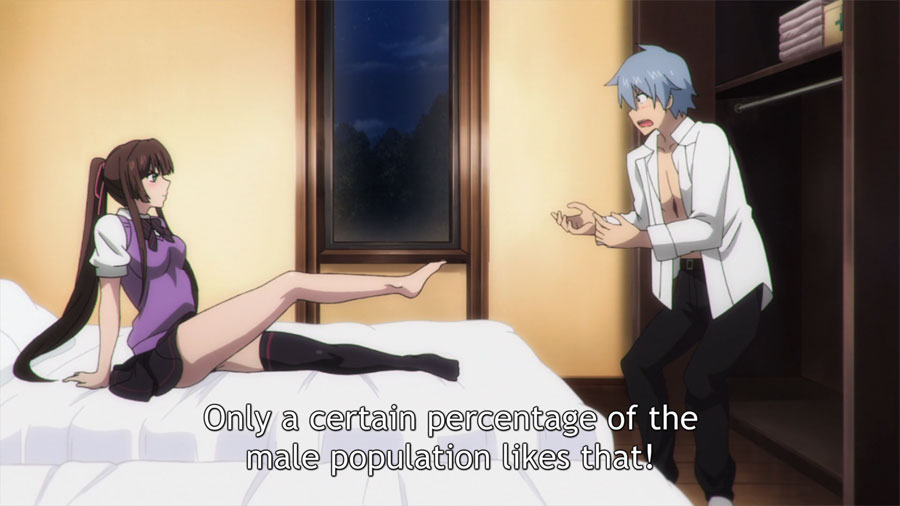
Strike the Blood is a sort of disguised, supernatural harem action anime. The main character is a high school student, Kojou, who has been transformed into the “4th Progenitor,” a sort of super-vampire who could upset the balance of the other three super-vampires. In response, various human and supernatural parties try to court his attention, keep an eye on him, and/or try and kill him. Did I mention this all this takes place on a man-made island way out in the ocean, made structurally sound by magic and ancient relics? And a significant portion of the population are pseudo-demons?
While there were quite a few particularly hilarious scenes/situations, the bottom line is that this really was as I described it: an action harem anime. If it annoys you when 4-5 girls compete for the male lead’s attention in just about everything they do, then you’re not likely to have a good time. If instead you’re looking for something funny with angst and drama all the traditional harem trimmings, this is likely worth your time.
Kill la Kill
Episodes: 24
Genre: Action, Fast-Paced
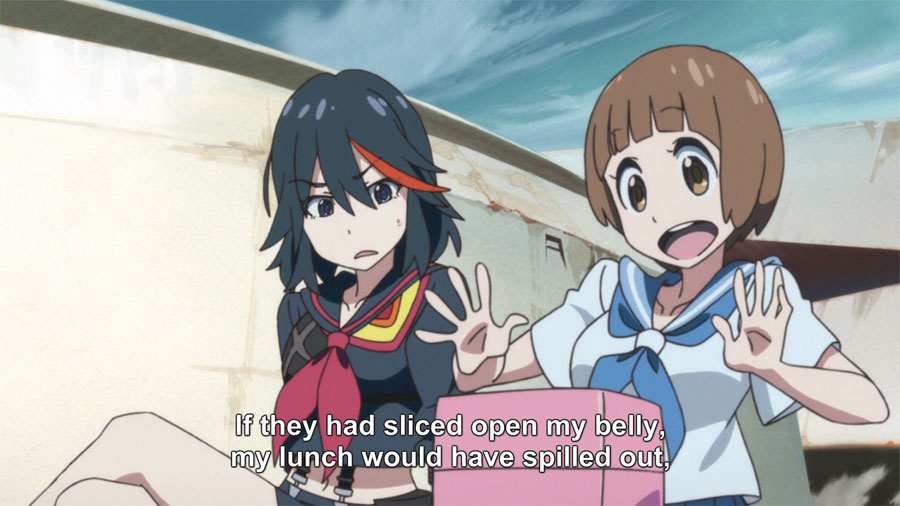
Kill la Kill is a fast-paced action anime from the creators of Gurren Lagann. In this regard, I sort of view a parallel between it and FLCL; both are less-serious, more-manic derivatives of what came before while still holding ground on their own merits. The premise is that a particular Japanese high school is crafting school uniforms with “Life Fibers,” which grant the wearer immense power. Ryuuko recently transfers to this school to seek revenge for the death of her father at the hands of a mysterious assailant. What follows is a huge assortment of duels, explosions, and Sailor Moon-esque transformation sequences as Ryuuko dispatches her foes with one half of a pair of scissors. The show only gets crazier as time goes on.
This anime does many things particular well. For example, while the heroine (and most female foes) dons a fairly fanservice costume, there is at least an attempt at a rational explanation for it on top of the anime not dwelling too much on it… outside of some jokes at the anime’s own expense, of course. The pacing of the show is also extremely well done, with just enough breaks in the action to catch one’s breath. In this regard, the episodes seemed to fly right by and always leave you hungry for more. I recommend a watch if you enjoy zany action anime.
Anohana: the Flower We Saw that Day
Episodes: 11
Genre: Everyday Life, Ghost, Drama

Are you in the mood to be depressed? Homesick? Want to feel like you need to call your friends right now? Then, boy do I have the anime for you! Anohana is an anime that follows a small group of friends, several years after the accidental death of one of their members. After a year or so of social withdraw, Jinta suddenly begins to see what he believes to be a hallucination of Menma, the member of the group that had died years prior. After interacting with her over a series of weeks and months, he comes to believe that perhaps she is a spirit trapped on Earth until her final wish is granted. From there, he begins to try and recruit his old friends to help figure out Menma’s last wish and fulfill it.
I’m not going to lie – this can sometimes be a hard anime to watch, for reasons that have nothing to do with it’s otherwise outstanding quality. In fact, this is perhaps the best anime I have ever seen in its examinations of how much impact a death can have on a circle of friends. There’s survivor’s guilt, jealousy, feelings of failure, love triangles, mental health issues, and more all in 11 short episodes. Still, if you are in the market for an anime that will make you feel something, Anohana is an easy recommendation.
Destiny Unfulfilled
Remember BorderHaloLands, more commonly known as Destiny? You might recall I have mentioned it before. Well, yesterday was the first day of a press junket and the overarching narrative is… not good, with Kotaku and Destructoid basically calling it boring. They also called it rather amazingly detailed and lush and beautiful. And barren. And lifeless. And populated with level 2 mobs with health bars that you shoot to power your rechargable super-skills. Yeeeeaaahh.
There is a mega-thread on Reddit if you want more sources and commentary.
What’s kinda funny to me are the understated dangers of game design, at least when you let the hype train roll along just a tad too long and it misses it’s station. In just about every article I’ve read on Destiny, unfavorable comparisons are being drawn between Destiny and Titanfall. And why not? Both are next-gen sci-fi shooters trying to establish new IPs. The problem is that, like it or not, Titanfall pretty much ate Destiny’s lunch before he even got to the cashier. Just look at these developer quotes in the Polygon article:
“The way we like to think about it, is not everybody is going to want to play Destiny, but everybody is going to be able to play Destiny if they want to,” Parsons added. “We’ve made significant improvements to the way players are going to play. People are surprised at how quickly they master the controls and get up to speed and having a great time.”
“It might not feel new compared to some of the other things that have come out recently, like Titanfall,” said design lead Lars Bakken, who added that there are changes, like free-floating double-jumps that can last for a long time. “But we’ve been prototyping for a long time and we’ve created experiences that you’ve never been able to experience before in the previous games that we’ve made, especially because it’s inherent to your character.”
I mean, I laughed at the design lead sheepishly trying to draw a parallel between the now-genre-defining wall-running parkour of Titanfall and his own game’s “long-lasting double jumps.” And then I felt sad for them. Because how were they supposed to know? As I mention in the comments yesterday, I was all gung-ho for Hex to the tune of an $85 Kickstarter pledge right up until Hearthstone came out of nowhere – 3 short months later – and pretty much flipped the proverbial design table. Now I feel like anyone coming out with a digital TCG that requires you to spam-click “Pass Priority” a dozen times a turn is basically Dead On Arrival. Hex has moved on to beta recently, but I’m not even sure I have the alpha client still installed. Why bother?
In any case, the word on the street is still that there won’t be any PC version of Destiny. The reason?
Parsons also said creating and releasing a PC version of Bungie’s shared world shooter would not be as easy as many believe, because all versions of the game connect to the same persistent video game world, which itself extends to multiple platforms.
“It is not nearly as simple as you think,” he said. “It is one central world no matter what the platform, and so that requires lots of intensive thought.
Err… okay. It sorta sounds like they’re implying that people on a Xbone can play with people on a PS4, but I’m relatively certain that that’s not actually going to happen. Just like the chances of me considering a purchase of this game. But good luck, Bungie, all the same. You’re going to need it in this new environment, especially considering you’ve already got the next 10 years of this IP all planned out. If Destiny 2 doesn’t have wall-running, you’re going to be in for a bad time.
Payment Model Perspective
I was browsing Kotaku the other day, and came across an article/review of a mobile game called Wayward Souls. Truthfully, I only read it because the byline mentioned Secret of Mana, which is relevant to my interests; it is, incidentally, probably my second-most played game of all time right behind A Link to the Past. Did you realize that SoM came out in the US 20 years ago this past October? Two decades.
Anyway, Wayward Souls is whatever – doesn’t seem to capture much of SoM’s magic beyond the pixel and music style based on the video alone. What was interesting to me though, was when they mentioned in the video that they’re going with the MineCraftian business model, e.g. selling it for $5 at first, and increasing the cost as time goes by. To me, this raises a number of interesting questions. First… is there a term for this payment model? I use MineCraft as perhaps the most well-known example, but surely it was tried beforehand.
Second, does it feel bad to anyone else?
I mean, I understand the logic behind it. Traditionally, game companies are going to want to charge full MSRP at release to capture the dollars of whom we now term “whales,” e.g. the people who would have paid $100 for the game, if they had charged that much. As time goes by, the price comes down via sales and whatnot to capture the players who would have bought it for less than MSRP. The MineCraft model seems like it should never work, but actually makes a lot of sense when you realize that the traditional model relies on a well-informed and excited playerbase for your game – in an ocean of crappy mobile games, you’re not going to have the whales spending money out of the game. This alternative model lets you build buzz somewhat organically, and then try and capture the big spenders as you ride the wave home. Plus, it sort of short-circuits the “wait until the Humble Bundle sale” strategy insofar as it will supposedly be more expensive the longer you wait (which ironically sorta is how Humble Bundles work).
Like I mentioned though, the MineCraft model doesn’t particularly work for me. It grates, like a piano out of tune. But I can’t fully articulate why though, especially when you consider nearly all games do this via cheaper preorders. Damn near everything is 20% off on GreenManGaming before it comes out. Sometimes a game will drop in price within the first three months (and sometimes faster these days, if they miss the forecasts), but it’s usually quite some time before it drops below the preorder price. So… what’s the difference, really? I can’t even claim that it’s because of psychological manipulation, because that’s pretty much behind all sales strategy. It just feels… bad, somehow. And causes me to mentally dig my heels in and wait for the Humble Bundle because screw you for defying the natural order of things. Or something.
Stuff, and Other Things
So, there are a lot of things going on in the next few weeks, and it has impacted (and may continue doing so) my posting schedule. Basically, I’m moving to a new apartment, applying for a Grad School scholarship in Japan (all expenses paid, if I get it), getting ready for a completely unrelated vacation in Japan this August, and playing videogames like a madman in effort to unpack the stress of all of that. I might start doing shorter posts of my various digital escapades rather than attempt to forward some kind of thesis every time I write something, but we’ll see. Hell, there’s been a decent amount of juicy gaming news, but sometimes it’s tough to write without a narrative.
By the way, if you have suggestions for good blogs that you read that are not already listed on the sidebar, by all means let me know in the comments below (or email); I might not directly add them to the sidebar, but I promise to take a look. My Feedly app keeps me sane during breaks at work, and my normal dealers seem to be on vacation lately. Or, you know, they might be in similar situations to myself. Nevertheless, this dry spell couldn’t have come at a worse time. Feed me your words/arguments.
Hearthstone, and the Infinite Dollar P2W Hypothesis
When it comes to Hearthstone, it seems you can’t win for losing.
The basic gist is that Trump, one of paragons of Hearthstone streaming, recently hit Legend rank (skip to 1:24 for the last game) with his F2P Warlock deck. This makes the 3rd class he has hit Legend with using the F2P deck concept; the prior two were Mage and Shaman. Back in February, Reynad piloted a F2P Warrior deck to Legend. Additionally, the #1 ranked player in both the NA and EU brackets, Kelento, uses a Hunter deck with six Rares. That’s right: zero Legendaries, zero Epics. With five out of the nine classes accounted for, forum-warriors and Bad Player Apologists alike continue with the narrative that Hearthstone is just another P2W cop-out. “Let’s see them hit Legend with Priest!” “Pfft, anyone can hit Legend after 180+ wins.”
Other than, you know, themselves.
As has been mentioned before though, they might not be wrong: everything hinges on how one defines Pay-2-Win. If one defines P2W as any game in which additional dollars confers any possible advantage, I suppose it could be said Hearthstone is P2W just like any given CCG. Then again, all of the F2P decks that hit Legendary rank were made using Dust and Gold given by quests and wins. In other words, zero actual dollars were utilized. Is such a broad measure of P2W even useful as a definition of anything? One can imagine a scenario in which someone paid a pro player to actually play his/her character for them, which would seemingly fit the definition of P2W even if the game itself was otherwise structured to be anti-P2W.
This sort of musing has led me to imagine something I’m calling the Infinite Dollar P2W Hypothesis. Namely, does having infinite money somehow confer infinite advantage? Under this rubric, there are a number of interesting conclusions. For example, we can safely state that games like Candy Crush Saga and even Dungeon Keeper are P2W; both games (seem to) have infinitely spammable features that make even the most difficult challenges irredeemably easy. For example, in Candy Crush Saga, you can buy extra attempts/turns on the same map along with Lollipop Hammers that break candy without taking up precious turns. Dungeon Keeper is a bit edgier of a case considering there is a hard time-limit of 3 minutes to assault a dungeon, but you can absolutely purchase infinite resources and instant build times with infinite gems.
In Hearthstone, a ~$600 purchase in booster packs guarantees you every card in the game. As mentioned above though, not only do you not need every card in the game to hit the highest of ranking, you often don’t even need anything other than cards any given player can acquire in less than a week of gameplay. But we’re talking about infinite dollars, right? In which case, all the instantly purchased/crafted Legendary cards in the world won’t save you from Kelento’s Hunter deck, by definition of he being #1 on two continents. Control-type decks seem to require a lot of Legendaries to be competitive, sure, but I think it’s difficult to argue that P2W equals “money improves poor performance” without that (indirectly at worst) applying to everything.
A P2W definition that restricts the advantage stemming from only cash purchases paints games like PlanetSide 2 as P2W (camouflage is SC only) whereas Hearthstone gets a free pass. And considering how “F2P” games like Candy Crush Saga and Dungeon Keeper are moving towards a random daily prize model (that either awards cash shop items directly or cash shop currency), suddenly we’re in a world in which the “obvious” P2W games aren’t actually P2W anymore.
Perhaps P2W is one of those nebulous concepts, like porn, relegated to the “I know it when I see it” category. Be that as it may, I think my own evolving opinion is settling on the Infinite Money Hypothesis. Because in a world where companies like Blizzard price things specifically to dissuade certain behavior (e.g. $25 server transfers), surely we can conclude that infinite money breaks whatever balance they believe they achieved through pricing. If everyone had infinite money, would the policy still work? If not, it is at best a blunt instrument. At worst, a cynical money grab.
All that being said, I’m willing to entertain counter-examples.
Dungeon Keeper App: A Study in Bad Game Design
Your first thought might be: “Obviously!”
No, not obviously. When the Dungeon Keeper (DK) app first came out, the entirety of the criticism revolved around EA and the bastardization of a beloved (?) franchise into a time-n-money sink exploitative F2P game. Here is the thing few people might know: DK is perhaps the best entry into this sub-genre. This might sound a little be like being called “the best STD,” but the game itself is surprisingly good.
At least, it was good.

My original design.
What made DK good (and still does) is the fostering of creativity and depth through constraint. As you might already know, DK is a downtime management game – you spend more time not doing things than actually doing them. The basic principal is to construct a dungeon filled with traps to safeguard your own stockpile of resources while raiding the dungeons of others. Everything takes time to complete: summoning minions, constructing traps, upgrading traps, excavating rock tiles to make room for traps, and so on. On release, the excavation was particularly lampooned in that the map was filled with tiles that took 4 hours and 24 hours apiece to dig out. Or, you know, you could spend Gems (an RMT currency) to dig them instantly.
Here’s the thing though: being time-locked forced you to construct novel dungeon designs with whatever you had available. Since everyone starts on the same map, we could imagine there being X variations of the perfect defensive layout had all the squares been filled with soft dirt (takes 3 seconds to dig). Instead, we have X * Y variations because different people are at different levels of excavation; some concentrate on digging out all the 4-hour tiles instead of the 24-hour ones, some are the opposite, and still others concentrate all their time on upgrading traps instead of excavation. Creativity through constraint. Yes, technically this also enables the designers to wheedle in-app purchases out of you. But! It’s a compelling gameplay mechanic nonetheless.
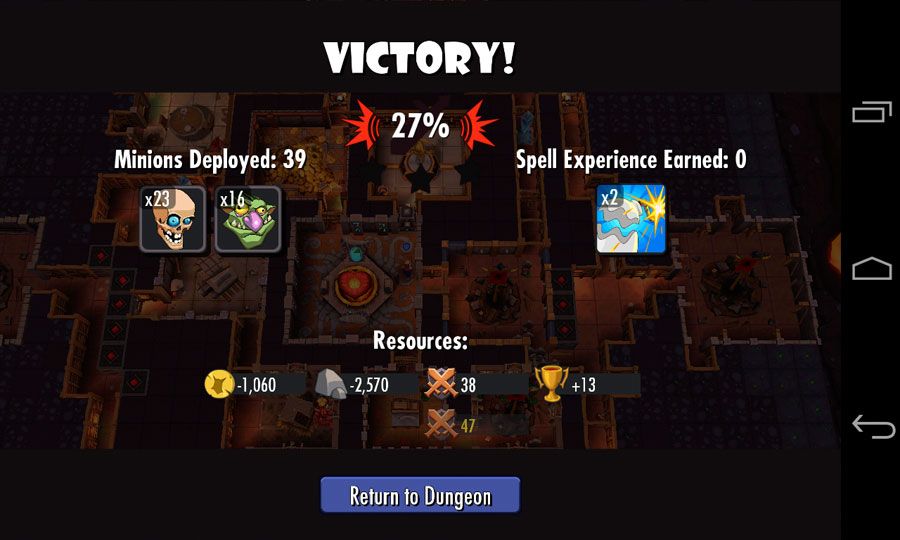
Somebody just got sent home.
Before I move on, I also want to mention that the other end of the creativity came from watching the replays of your own dungeon getting sacked. Given how attacking players can use magic to bomb open your walls or remotely disable your traps, sometimes it feels like there is nothing you can do to stop attacks. But what you can do is make your dungeon punishing. Magic regenerates very slowly, such that a player looking for enough resources to purchase an upgrade are unlikely to blow their entire load just to sack your one dungeon when they could split it up inbetween juicier, less-defended targets. It is a particularly novel delight watching a replay of someone throwing 2+ hours of congealed time at your defenses and see them go home with nothing. It’s part of the reason why I have played DK for so long.
The problem(s) with DK really came with their Update #2 several weeks ago. There are other fundamental problems, but I’ll get to that in a bit. In short, Update #2 destroyed the in-game economy.
Prior to Update #2, you unlocked bomb-proof walls as you upgraded various rooms and the Dungeon Heart. The number of such walls you could place were extremely limited, so you really had to think about the best location to place them. Did you want to protect a particular room? Force minions down a particular corridor? Or did you want to prevent people from digging a tunnel from the South part of the map? What the Mythic devs decided was to up-end the entire mechanic: instead of bomb-proof, they made walls upgradable. Instead of 20 bomb-proof walls at the end, you could have 100 not-bomb-proof walls that could sustain various amounts of magic damage depending on level.

Seriously, watching people fail on your dungeon never gets old.
For example, my current Bomb Wall spell deals 500 damage in a 3×3 square. A level 1 wall has 300 HP, and each level beyond that increases wall HP by +150. It costs 10k Stone to place a level 1 wall, 30k to upgrade to 2, 60k to 3, 120k for 4, and so on. As you might imagine, this whole “wall update” introduced a Stone sink on a massive scale. The game already had sinks of sorts – my current rooms now cost 2 million Stone apiece to upgrade – but I can imagine there may have been a need at the higher end. Or, perhaps more cynically, the devs wanted the DK Premium “subscription” (+40% resource gains from raiding) to be more appealing.
The Stone sink though has set off a cascade of fail throughout the game. The amount of resources that can be stolen from your dungeon is 30% of your stockpile (up to a maximum determined by your Dungeon heart level) + 10% of your unclaimed resources from quarries/mines around the map. Although there was always an incentive to “hide” your Stone in upgrading traps and such, there simply weren’t all that many locations; you can only have X number of Fire Traps and doors and such. Update #2 introduced 100 more to the pile, e.g. walls, and made it a high priority to upgrade them, e.g. to help prevent more Stone from being stolen via Bomb Wall spells. But since all the high-level players are now Stone deficient, the only people who have Stone laying around are… low-level players.
So the current “metagame” in DK is sandbagging, which means intentionally lowering your Trophy score (i.e. ELO) to get matched against noobs who either don’t know what they’re doing or have already abandoned the game and are simply letting their resources rot. Since they are low-level, it’s easier to steal their resources with your high-level minions given how their traps/layouts aren’t difficult. Since it’s not difficult to invade, you can send in less advanced troops that have quicker build times (e.g. 40-second Trolls instead of 20-minute Ghosts). Since you have quicker build times, you can raid more often and likely not need to use magic at all. Since you’re raiding more often, you are in-game for longer, which prevents your rapidly accumulating Stone reserves from being vulnerable to theft. And because of all of this, you are more likely to hit whatever Stone target you were going for and then spend said Stone, putting you back down to near-zero and safe to log off.

My current dungeon noobgrinder. Hint: don’t spawn inside the killbox.
The Mythic devs have responded on the forums that Update #3 will fix all of this and punish the sandbaggers, but the preview we have gotten is woefully naive. Their “solution” is the introduction of PvP tiers of sorts based on ELO. The higher the tier, the more bonus Stone you receive for a win. At my hypothetical tier, I could see an additional… 35k Stone. For fighting someone tooth and nail as advanced as myself. Who isn’t likely to have 35k Stone laying around to begin with. Compare that to someone at a lower ELO would could easily have 200k sitting around just waiting to be stolen.
Needless to say, this is bad game design. It is not bad simply because I dislike it; it is bad because it will not accomplish what it set out to do, or worse, have the opposite outcome.
I am not especially surprised at this non-solution, as the devs have yet to address a similarly counter-intuitive decision vis-a-vis intentionally not opening mines/quarries. There are 8 mines along the outside of the map, and unlocking them means getting free resources each time you click them; at the highest levels, you can get 200k+ Stone every 32 hours or whatever. However, enemy Keepers use these same mines as spawn points. Thus, the more mines you open, the more vulnerable your dungeon. The less mines you open, the less vulnerable your dungeon (just stuff all your warehouses in the corner), the easier it is to keep resources you steal from others, and the better off you are in general. Also? You can’t close mines you have opened. Basically, if you’re like me and open all the mines, you’re just screwed, permanently.

There is close to zero downside to this.
There is a similarly counter-intuitive punishment mechanic in upgrading your Dungeon Heart. You gain access to more traps and rooms by upgrading the Heart, but each level increases the maximum amount of resources that can be stolen from you. Thus, the only sane strategy is to make the Heart the last possible thing to upgrade. If you upgrade early, whoops, permanently screwed with hardmode.
My solutions to these issues? Well, first, I’d levy a 20k (or 20%) penalty to resource gains for each mine you do not unlock, down to some minimum – if your raid would have resulted in 100k Stone, you actually only get 60k if you have three mines unopened. Considering how the only players worth attacking are those with 100k+ Stone up for grabs, this would hopefully encourage people to open their mines, making more targets available. On a related note, the second change is one’s ELO score should be commensurate with the amount of Stone that can be stolen, not Dungeon Heart rank. Thus, the sandbaggers can get “easy” Stone, but significantly less such that they might have been better going after equally-skilled players.
Third, mine/quarry resource gains should double, minimum. Fourth, flip the numbers: 30% of unclaimed Stone is vulnerable and only 10% of one’s stockpile, not vice versa. This encourages more periodic log-ins during the day and makes people feel safer in saving up their Stone rather than immediately sinking it into walls. There is nothing more demoralizing than logging on and seeing someone having stolen 100k Stone, knowing that you would have been better off upgrading a door or whatever.
This may seem like a lot of words to devote to an evil, bastardized mobile app, but… I think you’d be surprised. I have long since deleted Castle Clash and feel like another game in this sub-genre would have to get a lot of things right to surpass Dungeon Keeper in terms of fun and strategery. Is it annoying waiting all the time? Sure. Then again, a 4-hour excavation only takes 2 hours if you slap your imps, and thus each time I boot the game up during my breaks at work there is something new to do. I spent two hours (!!) “playing” last night (in 6-minute increments) trying to scrape up 500k Stone to hit 2 million without risking getting bled dry overnight. The app definitely has an expiration date at some point – the thought of trying to get 6 million Stone for an 8-day upgrade is just obscene – but the same could be said about a lot of games.
So, yeah. Dungeon Keeper. Didn’t see that coming, did you?
Alpha Centauri 2
News out of PAX: Firaxis is working on a new Civilization game… in space.
Honestly, Alpha Centauri is basically one of those infinite-nostalgia games for me. My prior exposure to the Civilization games was actually Civ 2 for the SNES (yes, really), so you can imagine how blown away I was after installing those Alpha Centauri discs back in high school. Hell, I haven’t even played a Civ game since then – I have Civ 5 in my Steam library, but I was always a bit leery of getting sucked back in.
The thing that impressed me the most in Alpha Centauri though were the quotes that came with every technological advancement. You can read the big list of them if you’d like, but here are a few of my favorites:
Resources exist to be consumed. And consumed they will be, if not by this generation then by some future. By what right does this forgotten future seek to deny us our birthright? None I say! Let us take what is ours, chew and eat our fill.
- CEO Nwabudike Morgan “The Ethics of Greed”
This was one of the first times I encountered a thought turned on its ear.
We are all aware that the senses can be deceived, the eyes fooled. But how can we be sure our senses are not being deceived at any particular time, or even all the time? Might I just be a brain in a tank somewhere, tricked all my life into believing in the events of this world by some insane computer? And does my life gain or lose meaning based on my reaction to such solipsism?
- Project PYRRHO, Specimen 46, Vat 7. Activity recorded M.Y. 2302.22467. (TERMINATION OF SPECIMEN ADVISED)
I laughed. And still do at the meta-humor.
Man’s unfailing capacity to believe what he prefers to be true rather than what the evidence shows to be likely and possible has always astounded me. We long for a caring Universe which will save us from our childish mistakes, and in the face of mountains of evidence to the contrary we will pin all our hopes on the slimmest of doubts. God has not been proven not to exist, therefore he must exist.
- Academician Prokhor Zakharov
(Heard after researching Intellectual Integrity)
This was likely my first formal introduction to the Just-world hypothesis/fallacy. From a videogame! And beyond the above quotes, Alpha Centauri fielded a lot of more classical, real-world quotes from Plato and Aristotle which, combined with the coolness of the game itself, instilled a sense of wonder and wanting to know more. I definitely doubt I would have read The Republic without having played Alpha Centauri.
I don’t have any great expectations that Civ: BE will be better than my crystallized childhood memories of AC, but I remained cautiously optimistic nonetheless.
So far, it looks like the tentative release date is Fall 2014.


FFXII
May 9
Posted by Azuriel
In the midterm period inbetween steady access to the internet, I decided now was as good a time as any to actually get around to playing some of the PlayStation games I own but never bothered turn on. My first choice? As the title suggests: Final Fantasy XII.
All I can say is… yikes.
To say that I was a Squaresoft fanboy growing up is an understatement of the decade(s). Indeed, Final Fantasy 7 remains my #2 game of all time – and that is despite having first played FF6 on the SNES when it came out. While the “back to the roots” FF9 nearly derailed my fanboism outright, FFX quickly set things back on the right track. Sadly, when I heard that FFXI was going to be an online-only MMO, I pretty much cut ties with the company; I stayed long enough to pick up FFX-2, but that had the dubious distinction of being the only FF game I ever sold back to a video game shop for store credit (after beating it, of course). Looking back, I think my lack of engagement with the series had more to do with college and life changes than feelings of “betrayal,” but regardless FFX-2 was the last FF game I played.
Now, I’m not saying anything necessarily about the gameplay of FFXII. To be honest, in the 30 minutes I’ve been “playing” I haven’t seen all that much of it. And if I recall correctly, FFXII was widely criticized as being non-interactive. But a more pressing concern right now is how awful the game looks on my TV. The default view is double-letterboxed such that it easily loses 15″ off the TV screen. And even then the pixelation is horrendous.
I technically bought FF7 on a Steam sale a while back (because, you know, FF7) and it’s entirely possible I will encounter similar graphical issues. But to an extent I almost see this as an existential threat to older games. Or, rather, older games that were straddling the cutting-edge for their time. Things that seemed ground-breaking for its time in comparison to more sprite-based games have looped around into barely-playable nonsense graphics in less than 10 years.
It kinda makes you wonder though, whether or not this will be a recurring issue as time goes by or if it was a specific moment in computer graphics history. Personally, I’m leaning towards the latter. After all, the original Crysis has held up exceptionally well and even the original Far Cry wasn’t that bad. But have you tried playing KotOR lately? I muscled through that a few years ago, and it left me sore with the effort. It wasn’t even the graphics really, but little things like not being able to pan the camera upwards. It’s Star Wars and you got huge alien cities and you can’t look much farther than the main character’s low-polygon ass.
Posted in Commentary, Philosophy
Comments Off on FFXII
Tags: Existential Crisis, FF7, FFXII, Graphics, Nostalgia, Old Games, Square Enix