Gaming News Roundup
Square Enix stocks tumble on news that FF16 and especially FF7 Rebirth have not met sales targets. Which would normally be concerning… if not for the fact that these games are still Sony exclusives. Which, as a strategy, appears to be changing going forward.
In response to the tumbling profits, Square Enix announced what it calls “Square Enix Reboots, and Awakens”, a three-year plan for rebooting for long-term growth. This involves a rethink across all parts of the business, but the highlight is a “shift to a multiplatform strategy.” Square Enix said it will “aggressively pursue a multiplatform strategy that includes Nintendo platforms, PlayStation, Xbox, and PCs.” […]
As part of this multiplatform push, Square Enix said it will “build an environment where more customers can enjoy our titles in regards to major franchises and AAA titles including catalog titles.” The suggestion in all this is mainline Final Fantasy games will ditch PlayStation exclusivity going forward, although Square Enix has yet to announce specifics beyond Final Fantasy 16’s upcoming launch on PC.
It really boggles the mind sometimes, how stuck in the past these game executives can be. Helldivers 2 has been a breakout smash hit, with a large portion (possibly majority?) of the playerbase being on PC; it was significant enough for the Steam review-bomb campaign to work in any case. PC receiving ports in general has improved over the years for sure, but the fact that it takes ages is moronic. It’s been over fours years and PC still doesn’t have The Last of Us 2. Horizon: Forbidden West just came out on PC like two months ago. FF7 Remake took almost two years. Ghost of Tsushima took four years. God of War: Ragnarok probably won’t be out till 2025.
Speaking of ports, Ghost of Tsushima has beaten out God of War for the top spot on the Steam concurrent user spot for Playstation single-player games, at 77k and some change. Helldivers 2 sits at 457k, by the way. I’ve heard some chatter on Reddit about how this demonstrates that Sony’s “strategy” works, e.g. only releasing games on PC after a long-ass time. I mean… I guess? Unless there is some presumption that people bought PS5s just for this game, or that PS5 owners will buy it again on PC, I think this simply demonstrates Sony delayed a solid boost of revenue for 4 years for no reason.
Fallout: London is a fan-made Fallout 4 mod that is essentially an entirely new Fallout game. You may have heard some stories about how its original April release was delayed due to the “surprise” next-gen updates to Fallout 4 that Bethesda released a few weeks back. Well, it appears that the mod is back on track to be released… sometime. Soon™! The real news though, is how the modders somehow convinced GOG to host the 30-40GB files. This was needed, as Nexus Mods has an upper size limit. These fan projects usually get killed by the suits right before release, so the fact that not only will this thing (presumably) come out, but the fact that GOG is hosting the files is extraordinary.
Valve is working on what appears to be 6v6 MOBA-like Overwatch game called Deadlock. Now, I understand that Valve has a unique sort of “structure” over there, wherein developers basically just stew in a petri dish until games extrude through the biofilm… but, really? This is whatever actual game developers still left over there have chosen to spend their time on? Christ. I guess it’s at least something, as opposed to whatever George R.R. Martin and Patrick Rothfuss are doing. Finish your fucking stories!
Impressions: V Rising
V Rising is a hybrid ARPG with survival-crafting elements, sorta like Diablo meets Age of Conan. The approach is pretty novel, but there are some awkward elements that diminish the experience a little bit.
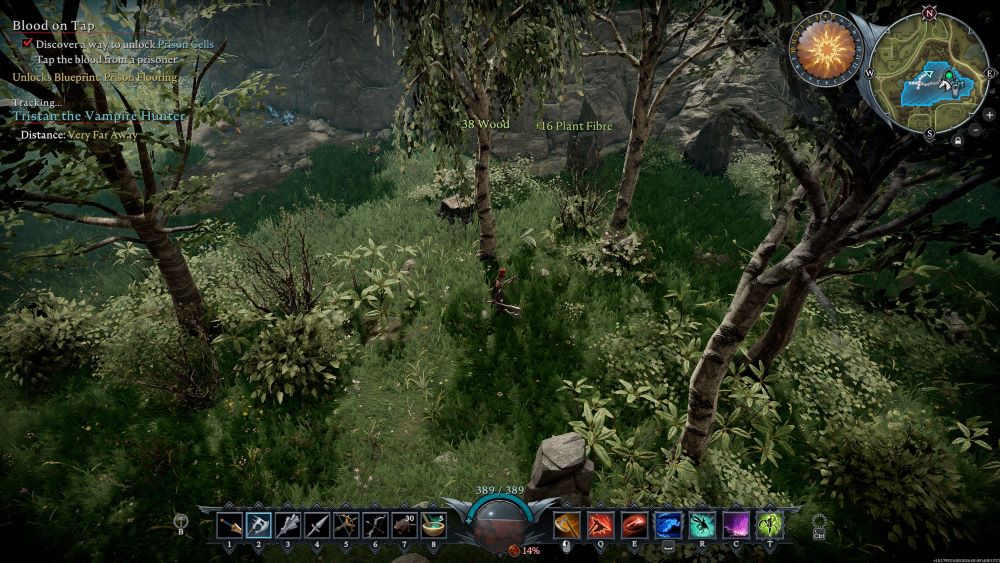
To start, I am playing solo on a “private server,” which is basically just single-player (like with ARK, Conan, etc). However, it is very, very obvious that the game is centered around and balanced on a more public, multiplayer and even PvP experience. For example, by default, you cannot use any of the Waypoint portals if you have ANY resources in your inventory. This option can mercifully be changed in the server settings, but the map itself consists of lanes, specific camps of NPCs, and then dozens and dozens of nondescript castle areas. Which is great for multiplayer servers (options!) and PvP (lanes forces players into channels for encounters), sure. But there really aren’t any exploration aspects, no map secrets, no particular reason to go to out of the way areas. Unless, of course, you were hiding from/laying in wait for other players.
The progression system is also a bit weird. First, there is no XP. Instead, your character’s power is based on Gear Score – you deal/receive damage based on the difference in Gear Score between you and your foe. Increasing one’s Gear Score is achieved by unlocking technology via killing bosses and consuming their “V Blood.” This is not necessarily a linear process though. Killing the boss that gives you a Workbench to craft better weapons results in a huge power boost. Other bosses might just give you ability to turn into spider, or upgrade gems into better ones, or similar. You can tackle the bosses in any order (provided you have a decent Gear Score), but nevertheless there are times when things end up… uneven. For example, I just upgraded all my armor and now find myself ~10 Gear Score higher than like eight bosses I have yet to kill. And none of those bosses will see me improve my Gear Score at all.
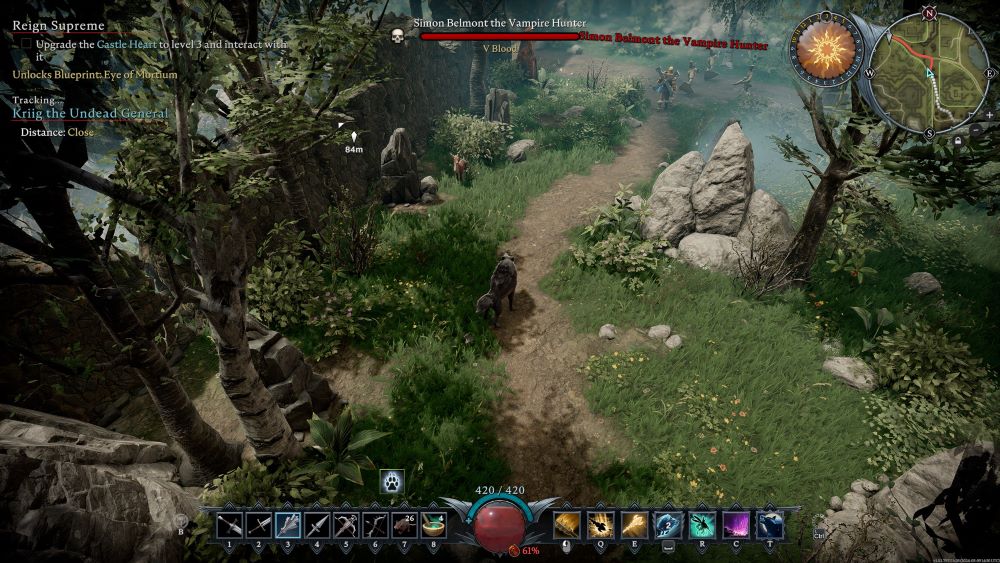
Progression-wise, it is also worth mentioning that there is a recipe/research component as well. You can unlock Copper weapons by killing the appropriate boss, but getting the next “Merciless Copper” tier requires the recipe to drop from random loot. Sometimes you can purchase the recipe from a vendor’s random stock, and other times you can randomly learn it by consuming Paper or whatever at a Research Desk. So, random, but with grindable guardrails.
Having said all that, is the game even fun?
I guess. I mean… probably? Sure.
At the time of this writing, I show ~22 hours /played. My solo server has loot bumped up 2x, item stacks 3x, Waypoint access on, Durability and Castle decay basically turned off (25% of normal). I don’t feel “bad” about these custom settings because, just like with my time with ARK, the “normal” settings are absurd nonsense. You can dispatch vampire servants to collect resources for you, but they take real-world hours (2h min, 24h max) to return. Considering you have to grind resources to craft equipment for them to wear so they can… err… help you skip grinding resources, they are of questionable merit. Of course, the servants could help defend your castle from other players trying to break it down and steal your resources, if you were into that sort of thing.
From a strict, gameplay-only sense, V Rising is OK. It’s a kind of Diablo-lite where you can hotswap weapons to mix and match abilities (which share cooldowns), while also tailoring your two spell slots and one ultimate move to your preferences and/or the boss’ tactics. Enemies are fairly straight-forward where I’m at in the game, but the environmental factors add layers to strategy. For example, there are patrols of NPCs not just within each camp, but also throughout the lanes in the world. These patrols can include bosses, sometimes ones way beyond the difficulty of the area too. This brings opportunities as well though, as sometimes patrols can be lured into attacking other factions or even having two bosses attack each other! This makes the world feel a lot more interesting than what I normally see in the genre.
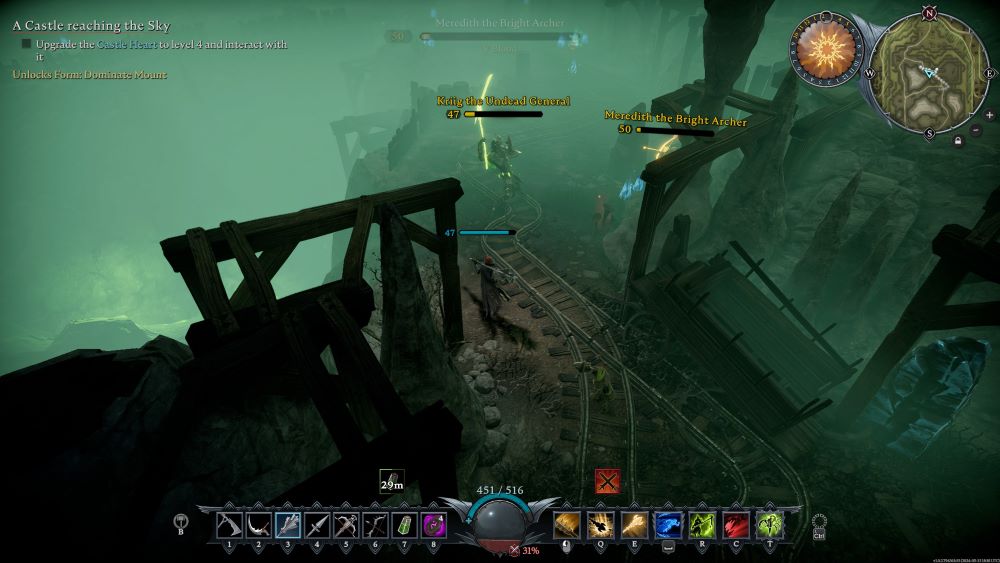
Anyway, I’m still playing V Rising and have every expectation to keep playing for now. Whether that is due to the underlying gameplay being better than I am giving it credit for, or because I am starved for new survival-crafting experiences, I cannot say. What I can say is that if you expect a Diablo experience, you will be disappointed. I definitely spend more time hitting rocks with a mace than I do hitting enemies for loot. But don’t expect something akin to Terraria/Starbound either, because the crafting is prescriptive and environment static. So… yeah. V Rising is its own thing and it’s fun enough for now.
Microsoft Fallout
About a week or so ago, the rumor mill was a-churnin’ about how the surprising popularity of the Fallout TV show – 65 million viewers in 16 days! – was causing Xbox execs heads to extend (pardon my Seuss). Even Todd Howard was saying Bethesda wants to “find ways to increase our output, because we don’t want to wait that long either.” Which is funny, considering that it is Bethesda’s own metered cadence which will ensure that Fallout 5 is not released until the 2030s; Elder Scrolls 6 is next in line after the tepid Starfield, with Fallout 5 not coming out until, presumably, the ending of the TV series.
Welp, cue that monkey paw finger-curl:
Microsoft has closed a number of Bethesda studios, including Redfall maker Arkane Austin, Hi-Fi Rush and The Evil Within developer Tango Gameworks, and more in devastating cuts at Bethesda, IGN can confirm.
[…] Arkane Lyon, which is working on Marvel’s Blade, survives the cull, as does Bethesda Game Studios (Fallout, The Elder Scrolls, Starfield), and Machine Games (Indiana Jones and The Great Circle). Doom developer id Software is also unaffected.
A further quote from Matt Booty, head of Xbox Game Studios, says:
Today I’m sharing changes we are making to our Bethesda and ZeniMax teams. These changes are grounded in prioritizing high-impact titles and further investing in Bethesda’s portfolio of blockbuster games and beloved worlds which you have nurtured over many decades.
To double down on these franchises and invest to build new ones requires us to look across the business to identify the opportunities that are best positioned for success. This reprioritization of titles and resources means a few teams will be realigned to others and that some of our colleagues will be leaving us.
Cruel irony abounds, considering a year ago Matt Booty said Microsoft has no plans to shut down Arkane Austin “right now,” after the disastrous Redfall launch. And I guess he was technically accurate. There are fewer charitable interpretations for axing Tango Gameworkers though, considering the effusive praise Hi-Fi Rush received from Microsoft brass – “Hi-Fi RUSH was a break out hit for us and our players in all key measurements and expectations. We couldn’t be happier with what the team at Tango Gameworks delivered with this surprise release.” Certainly seems like they could have been happier after all.
I don’t want to undersell the sad reality of thousands of game devs losing their jobs. That shit sucks.
…however. In the specific case of Arkane Austin, I have to wonder if there is the barest glimmer of a silver lining. For one thing, it is worth pointing out that no one at Arkane actually wanted to develop Redfall. It was a studio known for immersive sims, and Redfall wasn’t that. In fact, that same report stated that 70% of the team members who worked on Prey left the company during Redfall development. So, really, Microsoft is kinda putting the zombie studio out of its misery.
Oh, but know what might be an interesting franchise for an immersive sim? Fallout. That is wild-ass speculation on my part, and contradictory besides considering most of the immersive sim devs already left. But. BUT! Can you imagine? Of course, it would probably be best (and poetic besides) for Obsidian to take up the mantle of Fallout again, especially considering both studios are under the same (reaving) Microsoft umbrella. Unfortunately, Obsidian is releasing Avowed this year and they are also working on The Outer Worlds 2 for some reason. Seriously though, was anyone asking for that?
Alas, we will have to see how things shake out. Just… goddamn, could someone give me more Fallout?
Review: Planet Crafter
Planet Crafter really surprised me by keeping my attention all the way to… just before the very end.

The premise of the game is that you are dumped onto a barren, hostile world and tasked to terraform it into something more hospitable to life. The “twist” is that there is no combat. At all. The planet is barren, after all, so what would even attack you? But what intrigued me was precisely how intrigued I stayed for the 35 hours I played. And that’s quite the trick considering I am not much of an Explorer type nor someone typically into Factorio-style automation games.
The secret sauce is probably the sense of progression.
When you first start out, you have an extremely tiny oxygen meter and will be doing some desperate loops around your starting capsule to gather raw materials. Eventually, you will start building a rudimentary base and start stockpiling supplies. However, almost all crafting recipes and upgrades are gated around one’s Terraforming Index (Ti) score. Improving this score is only possible by creating machines to generate Heat, Pressure, Oxygen, etc, to first form an atmosphere, and so on. Certain resources to build these machines are not located on the ground like most everything else, so you will need to go explore deeper afield – including inside the wrecks of spaceships – to gather what you need.

And so a cadence is formed: build up machines to improve Ti, go exploring for new material, come back and build new machines that got unlocked while you were exploring. Each loop will increase your ability to travel further as you expand oxygen capabilities, movement speed, and inventory space, and start fostering a sense of curiosity about what’s over the next ridge or inside that cave.
It’s also worth mentioning the more visual sense of progression as you improve Ti: watching the planet bloom. Glaciers recede, opening new travel and resource opportunities. Liquid water starts to form. Weather occurs. You start building Flower Spreaders, grass starts generating, then you upgrade to Tree Spreaders. By the time endgame rolls around, you are flying around searching for the last remnants of secrets left behind, occasionally stopping to gaze at the previously lifeless stone arch now covered in an explosion of color and growth. It’s a real treat.
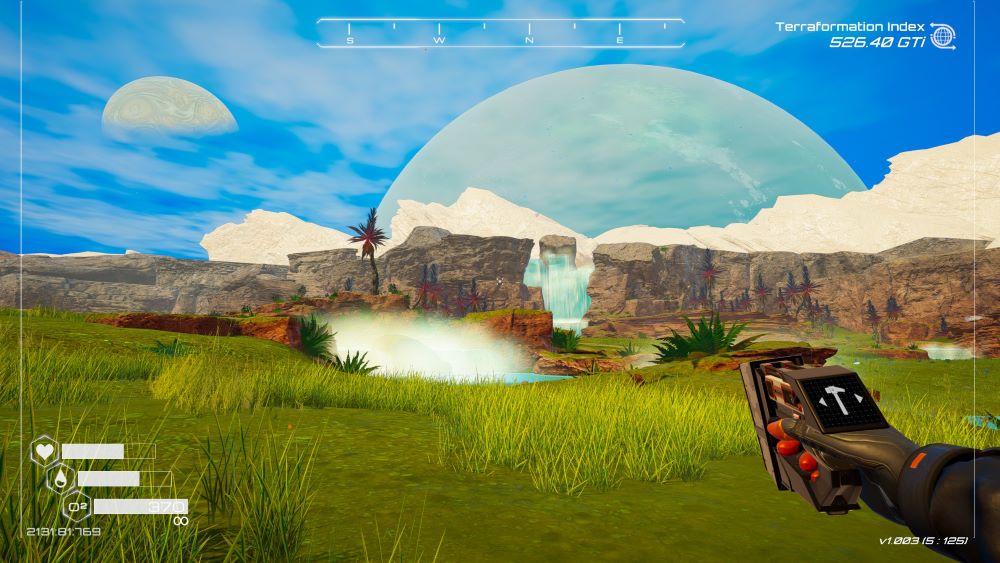
The only shame then is the final stumble. I have unlocked every technology except the final one to end the game. I have explored procedurally-generated wrecks, I have optimized my automation, I have uncovered every mystery on the planet, consumed every bit of novelty. My score is sitting at 1.43 TTi and 5 TTi is the end. After timing it, I would need to leave the game running for 5.5 real-world hours to get to that number.
Could I speed it up? I mean, hopefully. I’ve already built 6+ T5 generators of various types (Pressure, etc), overlapping Optimizers fitted with boosters, dozens of satellites that further juice the numbers by 1000% a pop. Each added machine makes the overall number increase by what feels like an insignificant amount. I spent the entire game waiting for the “Spam End Turn in Civilization” inevitability to kick in, and was surprised every time Planet Crafter bobbed and weaved out of the way. But, alas, it did come after all.
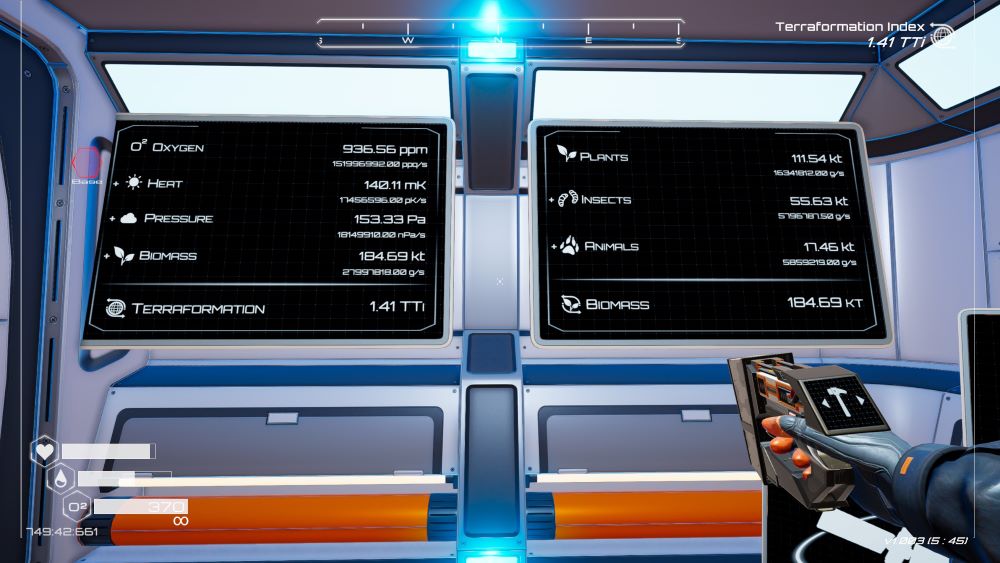
Nevertheless, Planet Crafter did deliver an extremely solid 20-30 hours of entertainment without once leaning into combat or contrivances. If you’re looking for Subnautica minus the thalassophobia, or the first half of Breathedge minus the chatty sidekick, then Planet Crafter is your game.

7 Days to More Money
In a completely unexpected turn of events, 7 Days to Die is actually coming out of Early Access. Soon!
The Fun Pimps are happy to announce 7 Days is leaving Early Access! With the launch of the next update, we’re moving officially to 1.0 for 7 Days to Die.
TFP Co-Founder Richard Huenink details the move in this Video. He’ll talk about our decision to leave early access, the tentative launch dates for PC and Console Alpha 22 (Now 1.0), the roadmap of planned future updates and features ahead for all platforms, and the games new pricing.
I say “completely unexpected” because, well, it is. The game has indeed been in Early Access for 12 years already, with Alpha 22 (now “1.0”) slated to come out in a few months. However, the Early Access period has been so long due to the dev team having no project manager – each major release has radically redesigned the scope of the game, changing progression mechanics, and otherwise putzed around art assets without actually making forward progress on systems or endgame.
But now they are, so… why aren’t I happy? Take a gander at the roadmap:

I don’t think you really even need to know anything about the base game to intuit that the stuff in the 2025 columns would, in fact, be a more appropriate 1.0 experience. In particular, Bandits have been promised for literal ages, and are still nowhere to be found. Do I believe we will get a UI/Main Menu Overhaul? Yes I do. Will there also be Bandits? Not falling for it this time, Lucy.
What is really going on with this 1.0 release is the increase in base pricing.
Q: Why increase the cost?
A: We feel as though the quality standard of the game has gone up significantly from when the initial price was set over 8 years ago along with over a decade of content and improvements. We’ve looked at how others have handled leaving early access, and this is a common practice. We in particular want the price of the PC version to have parity with the Console version. We do not wish to force any current users to spend more money to play the game they’ve always supported. However, new users should see the value the game offers reflected in the cost, and we hope that continued support might fund future endeavors in expanding the 7 Days to Die game even further – DLCs, Expansions, and continued free updates (including everything listed in the Road Map)!
Look, my intent is not necessarily to paint The Fun Pimps as capitalistic assholes. I bought the game 7 (!) years ago for $10, and even now you can still purchase it this week for $5.99 ahead of the $44.99 (!!) price increase. In those years, I have played for over 327 hours. And regardless of any price increases, my copy will be upgraded for free, I’ll get all the updates for free, and so on.
It’s just that this “release” is clearly a business decision first.
This is especially true in terms of the console re-release. The history is that the game was released on consoles back in 2017 but had been stuck in Alpha 15 ever since then because porting company went bankrupt. We’re in Alpha 21 on PC, for reference. The Fun Pimps reacquired the rights a few years ago, but financially it never made sense for them to hire out another porting team. Until now.
Q: What about the old Console version?
A: Due to the significant technical differences between old and current console hardware, we will not be upgrading the legacy version. Legacy owners will have to buy the new title. However, we are working closely with Sony and Microsoft to provide a discount to digital legacy owners on their purchase of the new console edition.We made the decision early on to focus on a ‘new’ version of the game that is unified with our PC version, and our efforts to update the game post-launch will be entirely focused on that version.
Again, good on them for trying to get console fans a discount, assuming such a thing materializes. It also makes sense that you may have to cut your losses and start fresh with a new version given all the difficulties up to this point.
I just… I dunno. It’s complicated. As I mentioned last year, each Alpha has included a seemingly pointless overhaul of the progression system, although each iteration has taken it further and further away from zombie MineCraft and more towards something generic. Once upon a time, you would come across a small town and break into houses to scavenge for supplies and hope a big wandering mob of zombies didn’t stroll in after you. Now, 100% of the Points of Interest are mini-dungeons with traps, blocked corridors, zombies popping into existence when you cross thresholds, and a loot chest at the end. Which is cute the first time you come across the PoI, but later you just stack wooden frames and hack your way through the roof to get the loot chest and skip the mini-dungeon part.
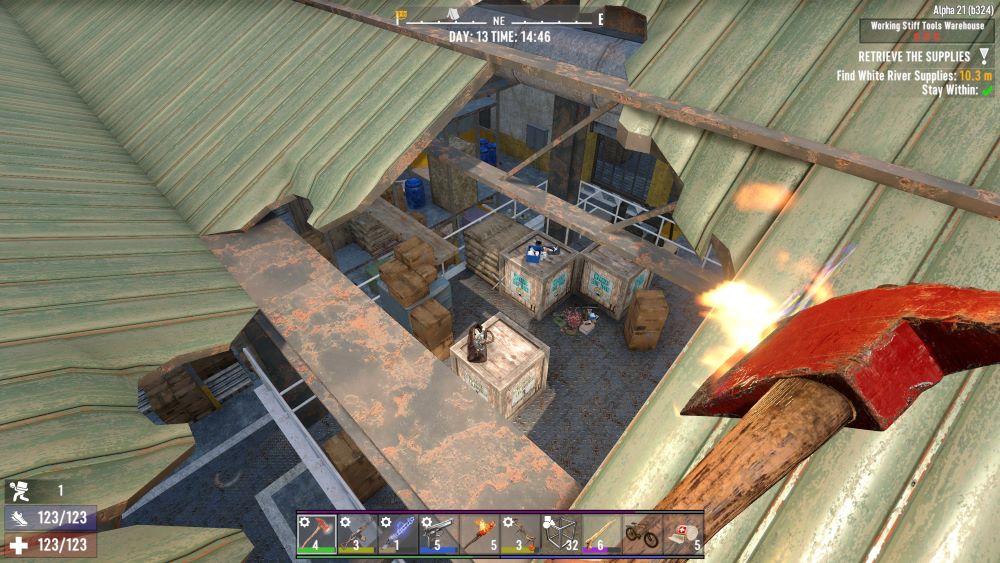
Assuming you aren’t just spam-completing quests from the Traders, since that is actually the best way to get gear; crafting shit with resources you gather is sooooo 2017. Oh, and base-building? Yawn. Despite the fact the entire game is premised on a wave of zombies attacking you every 7 days, the devs have decided that the zombies are omniscient structural engineers who know both the shortest distance to your brains and which specific wall cubes in the way have the least amount of HP. Which, of course, means “traditional” structures like bunkers or buildings with a bunch of traps surrounding it are pointless. Instead, you need to construct Ninja Warrior obstacle courses for zombies to tight-rope walk towards you single-file for anything you build to have meaning.
Or just sit on top of a roof for a couple of weeks before moving to a different building. Whichever.
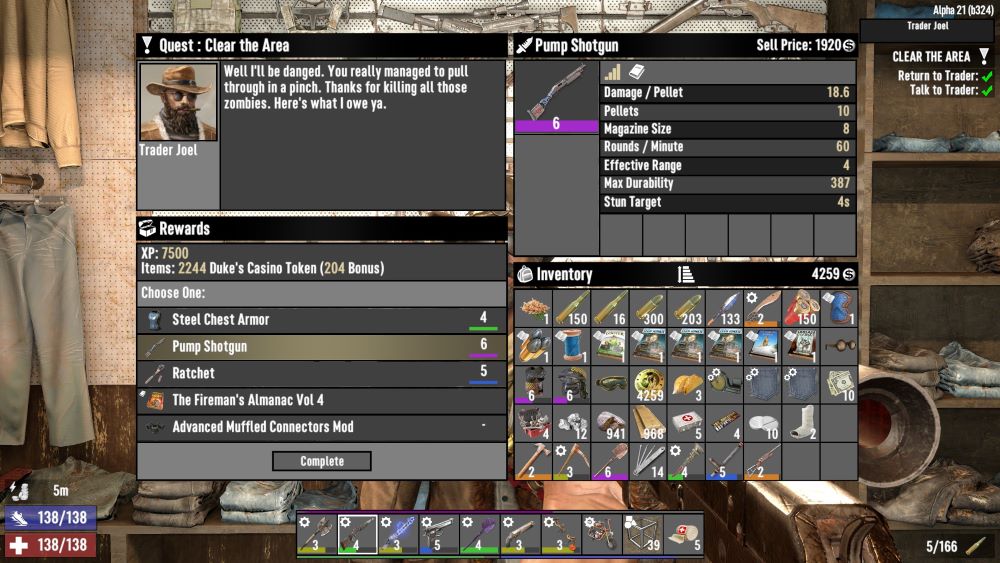
In fairness, all of this nonsense was introduced in patches, and it’s entirely possible to remove it in the same way. Given the consistency in which the devs have moved backwards though, I don’t have much faith in them spontaneously understanding why their game was popular to begin with and to stop undermining it. So while the business decisions they are making with 1.0 are rational and the last-chance deals magnanimous, I still don’t like it.
About the only bright side to all this is that, perhaps, having a firmer foundational codebase will encourage more modders to fix all the bullshit. Darkness Falls is already a transformational mod that improves the game in about every way, and I know of others (Undead Legacy). That last Q4 2025 slide does says “Steam Workshop Support” so that may be the golden ticket. We’ll just have to see.
Fallout TV – Season 1
I have been hyped about the Amazon release of the Fallout TV series for a while now, and the entire 8-episode run dropped around a week ago. I’m going to talk about it in this post, but I also understand how someone talking about a show you haven’t watched yet can technically constitute as spoilers. Like if there is some drama out there and a friend says “I liked it, but the ending was sad,” a good slap to their face is an appropriate response. So, this post will have stops and you can exit at your leisure. The comments though, are a free-for-all.
That said, Fallout TV: it’s good.

But is it good?
For me, I had an excellent time watching it. Going in, I am not even sure what I was expecting. Well, I was hoping that the show wouldn’t suck and otherwise be another entry on the Very Long List of Bad Game Adaptations. And I do believe that it, ahem, vaulted over that very low bar. The humor was there, the ultra-violence was there, shit even the common player-behavior tropes were there (e.g. getting distracted by side-quests). It was a very faithful and respectful recreation of the games.
I just don’t know if it’s good for non-Fallout viewers.
I mean that quite literally: my wife isn’t really a gamer, and I don’t know if I should even recommend it. Again, I enjoyed the show and felt it was worth my time. Would she? Like, think about all the retro 1950s aesthetics, the general Vault-Tec intentional weirdness, and so on. None of this would have been independently chosen for a post-apocalypse tale; these things do not enhance the plot or character arcs in any way. It’s there because it’s Fallout. Which, fantastic, I’m happy to see one of my favorite franchises be more culturally recognized. If this gets people curious about the games, that’s more potential fans later.
Maybe that’s enough?
At the same time, I think about Game of Thrones. You don’t have to have read the books or even be into low-magic medieval fantasy shows to be entertained – the acting and dialog and action carries itself. In comparison, I do feel that the source material for Fallout does most of the heavy lifting – Lucy and the Ghoul notwithstanding. Perhaps it is an unfair comparison to begin with though, considering Game of Thrones had a ready script for most of the seasons whereas Fallout is telling a new (canon!) story within the setting.

Speaking of canon, I do want to comment a bit about some of the “controversy” I see online.
Err… I was going to talk about it, but everything appears to have been settled in the interim.
For posterity though, in the show there was a blackboard with a timeline of important dates written on it to illuminate the post-post-apocalyptic things going on in the Fallout universe. One of those dates was “2277 – The Fall of Shady Sands”… followed by an arrow further pointing to a mushroom cloud. Some fans took that to mean that Shady Sands was nuked in 2277, which contradicts the events of Fallout: New Vegas, e.g. no one mentioned the city being destroyed, the NCR were still a prominent faction in New Vegas, etc. Furthermore, the parting shots of Season 1 clearly show New Vegas in a, let’s say, less civilized way than encountered in-game. Ergo, Todd Howard is wiping New Vegas from canon in his years-long quest to get revenge on Obsidian devs who dared make a better Fallout game!
Or something.
Except… nah. Emil Pagliarulo (writer/director of Fallout 3 & 4) said New Vegas is canon, Todd Howard (Bethesda man) said New Vegas is canon. They showed a pre-war Mr. House in the goddamn show! “Ackshually, the games say that Mr. House predicted when the bombs would fall, which contradicts the show where they just tell him who would launch them.” Unless, I dunno, China (or the US!) launched them before Vault-Tec was ready. Perhaps that is a mystery better explored in deeper detail in future seasons of the show. It might even be especially topical as the gang heads toward New Vegas, as seen in the final minutes of the ending.
In any case, I had zero issues with anything the show presented continuity-wise, and am excited to see where it goes from here. Are there still some lingering questions? Sure. But I’m more interested in things like “what happens next?” rather than “How did Hank not instantly recognize Moldaver” or “How did Moldaver survive the war,” and so on. Season 2 has been approved, so we’ll possibly get answers to those questions and then see what New Vegas purists will get mad about next. Since there’s pretty much no way to dance around a canon ending to that game, there will be plenty of material.
Questgate: Hearthstone Edition
You know what would be a great idea? In the patch which you release a new, hyped-up game mode you also make an indefensibly irrational change that guarantees a predictable, hostile fan reaction across your entire playerbase. You know, so that everyone is talking about that instead of whatever we were talking about before. I believe the technical term is “slamming your dick in a car door.”
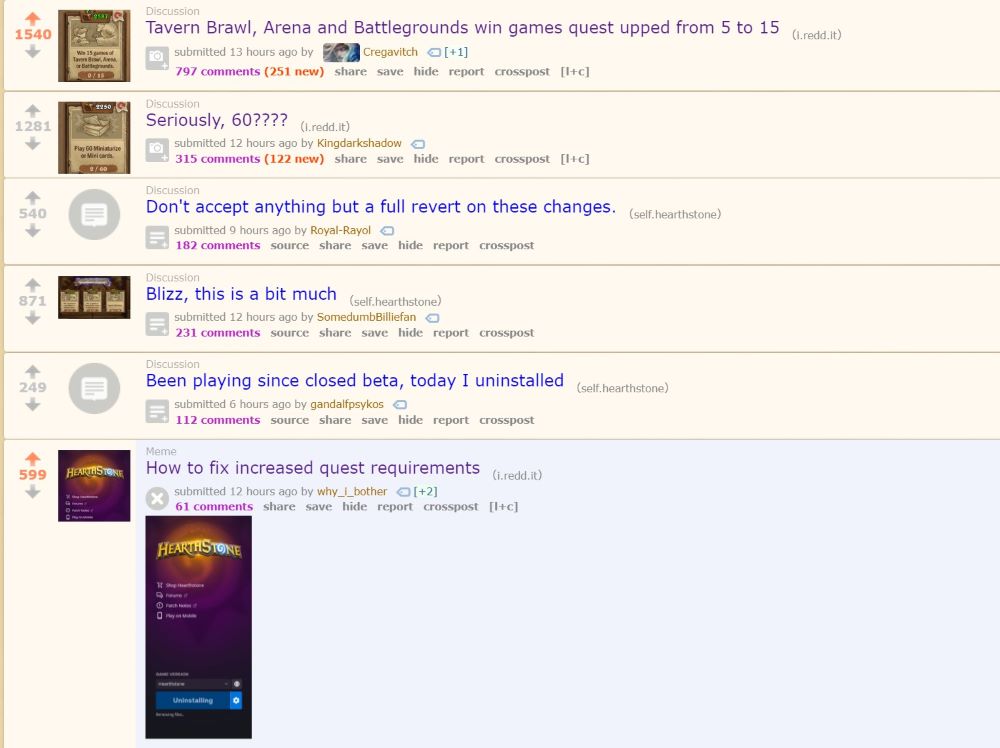
The change in question is to Weekly Quests in Hearthstone. Specifically, the requirements for completing them increased by ~300% (or more!) whereas the reward, e.g. Reward Track XP, only increased by ~20%. The more XP, the more progress you make along the Reward Track, the more freebies and in-game currency you earn to buy more packs, mini-sets, and so on. It’s how to F2P.
Now, some of these quests are the kind that you achieve organically from just playing the game. Things like “Spend 500 Mana” or “Draw 30 cards.” Then there are ones a bit more annoying to achieve, like “Use your Hero Power 50 times” or “Play 50 Battlecry Minions.” Those can technically be achieved in the course of normal play, but only if you’re playing a deck/class that wants to be pressing the Hero Power button and/or casting Battlecry minions. You can reroll one Weekly Quest per day, so I typically rerolled those in the hopes of getting something easier to complete in Battlegrounds or in the Tavern Brawl game modes. Finally, you had the standard “Win 5 Ranked Hearthstone Games” that everyone gets at the beginning of the week.
…except now it’s win 15 games. And you now need to play 100 Battlecry minions. Or play 60 (!?!) Miniaturized/Mini minions when it was like 16 previously. In return, you get an extra 500 XP over what it was rewarding previously, e.g. 3000 vs 2500, or 2250 vs 1750.
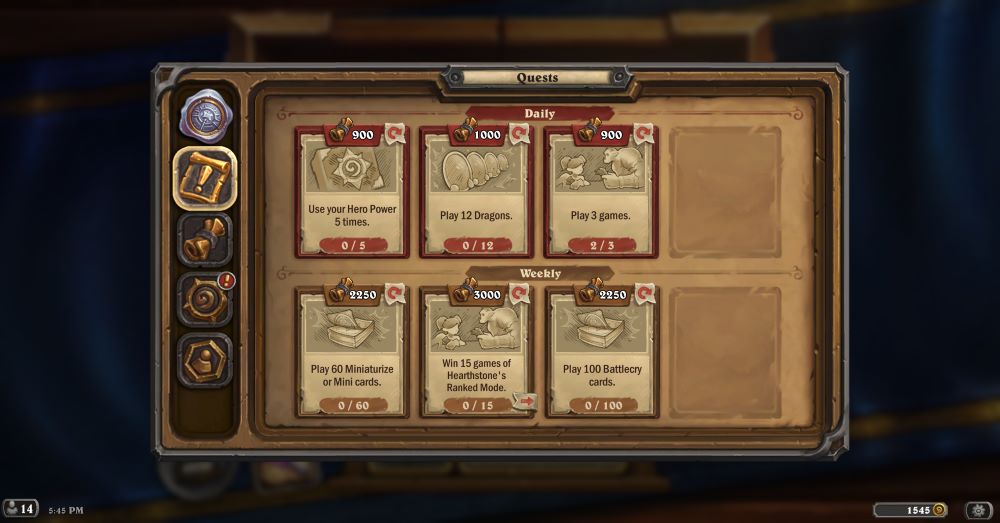
For context, you earn approximately 400 XP/hour by playing Ranked Hearthstone without any quests at all. So, yes, technically there is more XP to be earned. But that very much depends on one’s ability to actually complete any of these Weekly Quests before they reset.
And that’s the rub. How long individual games take will depend on the individual and what decks they use, but I’d say the average for me would be 10 minutes per Ranked game and 20 (or 30+) minutes per Battleground. If we assume you are being matched with people of appropriate skill, you will only be winning 50% of the time. So the one “win 15” quest jumps from 100 minutes to 300 minutes for Ranked, and 200 minutes to 600 minutes in Battlegrounds.
If Hearthstone is your primary game, spending 10 hours a week playing Battlegrounds is probably something you were doing anyway. But if it’s not? Well, Blizzard clearly doesn’t want you playing at all.
If there is actually any other reasonable conclusion to reach, I’d love to hear it.
Hurry Up and Wait: April Edition
Once again, I was already looking stuff up, so why not just share it?
April 23rd – Bellwright [Early Access]
This one is seems to be billed as an open-world Kingdom Come: Deliverance, but it also has some Medieval Dynasty vibes. Hard to say whether it will be worth anyone’s time yet. I originally thought it was going to be a survival-crafting game, but the store page makes it very clear that there is a sort of linear plot going on heading towards a rebellion against the Crown. If they can channel the general feel of Kingdom Come: Deliverance without some of the design jank, this could be good. We shall see.
April 26th – Manor Lords [Early Access]
Banished meets Total War in this medieval city-building tactical battler. Supposedly. All I know is that the game looks gorgeous, like an insane level of detail, and the city-building aspects are the most organic-looking I have ever seen in this space. Also, important detail: Game Pass Day 1.
May 8th – V Rising [1.0]
I snagged a copy of V Rising on sale before its recent pre-1.0 price increase, so I’m looking forward to… I guess playing it a month from now? That’s kind of fucked up, now that I think about it. Why increase the price like a full month before release? Anyway, it seems a combination of survival-crafting + Action RPG and I’ve heard some good things, so I hope it’s worth the wait.
May 14th – Diablo 4 [Season 4]
Diablo 4 landed on Game Pass a few weeks ago, but I didn’t dive in due to other priorities (read: farming virtual crops). Then, when I was actually starting to get ready to play, I hear about a “transformational” update coming in May. This is the summary from the IGN interview with the devs:
When Diablo 3 got its pre-Reaper of Souls expansion patch dubbed ‘loot 2.0’ in 2014, it was credited with turning Blizzard’s action role-playing game around. Critics and players called loot 2.0 a big improvement on Diablo 3, with changes that sparked renewed interest from a community that had dropped off following the base game’s 2012 release. Now, 10 years later, Blizzard is aiming to repeat the trick with Diablo 4 Season 4.
I mean, I guess that’s a good thing. Eventually. Although it’s a bit odd how they keep leading with “loot 1.0” when they know loot 2.0 is better. Rod Fergusson mentions it’s more due to “overshooting the mark” in a quest for depth and complexity in the looting system. Which I am unqualified to talk much about, considering I haven’t played the game. But it all kinda sorta maybe sounds like Quality of Life shit that was sorted out a decade ago already, and probably should have been in the game from the start. I could be wrong.
May 16th – Ghost of Tsushima [PC]
The once PlayStation exclusive is finally making its way to PC. And while I am liable to wait for ages more before it drops to a “reasonable” price, I am excited that it is coming to PC at all. If I did ever buy a PlayStation 5, this would have been one of the games I would have bought it for.
Farm-Sim Annoyances
Although I am continuing to play Stardew Valley, this experience is reminding me of design annoyances frustratingly common to the genre at large. Non-exhaustive list:
Challenge/Interesting Decisions are Front-Loaded
When you first begin any farm-sim, you have a mountain of dilemmas to resolve. Which seeds do you buy first? Do you focus on fast-growing crops to maintain cash flow or do you invest in long-term payoffs? Should you spend time clearing the farm, foraging for extra crops, mining for ore, or fishing? Do you spend your first wave of cash on building a Chicken Coop or buying more seeds? Do you focus on trying to complete the Community Center (or equivalent) in Year 1, or save that for later?
As time passes however, an inflection point is reached and things only ever get easier. Early investments in more passive income streams (Beekeeping, Animal Husbandry, etc) and Sprinklers free up all your time to do… nothing much. I mean, you could spend more time foraging/fishing/mining, but those activities were typically required to get you to this point in the first place, so they themselves may not be relevant anymore. While there may be endgame goals that require substantial amounts of cash, its achievement ends up largely a function of pressing the Sleep button over and over.
Robust (but Pointless) Cooking System Locked Behind Midgame+
It boggles my mind how consistently farm-sim games lock Cooking behind expensive home upgrades. Then comes the double-whammy of most recipes being a net-loss of income compared to just selling the ingredients – nevermind the opportunity cost of the home upgrade itself! Even worse, by the time you unlock the ability to cook, have the proper ingredients, and learned the recipes, the buffs (if they even have any) and Energy gained by consuming a cooked meal are largely irrelevant due to farm automation and/or character progression. In the Summer, I would frequently leave my farm with 50% Energy or less from watering crops. By Fall, I would leave with 100% Energy and have nothing to do to meaningfully “spend” it even outside the farm.
My assumption is that these game designers are afraid that making Cooking profitable will turn the farm-sim into basically a cooking-sim. Or perhaps Cooking itself is only intended to be another “Community Center”-esque achievement grind and/or money-sink. Nevertheless, it always just feels bad to be generating hundreds of crops and just throwing them in a bin because there is no reason to, you know, combine resources together.
Intentionally Limited Inventory Space
Managing inventory space is a key activity in several genres, but none feel so much like a punishment than in farm-sims. The primary problem is that you are typically restricted to a small amount backpack space and then given a dozen or more different crops that can have 3-4+ different quality outputs on top of tools, forage items, etc. There might be an argument that this leads to “interesting decisions” in whether to trash one item over another, but considering that this issue often appears even when on the farm, all it amounts to is an incredible annoyance of running back and forth.
Non-Trivial Amount of Trivial Combat
One of my deep-rooted disappointments in the genre is usually how little care is given to the combat side of the game. Now, yes, this is a farm-sim and not an Action RPG. And yet almost all of them feature monsters you must defeat in the Mines while you dig for ore. Presumably this aspect is included to make digging for ore more stimulating, but you know what would be even more stimulating? Supporting what ends up being 40% or more of the gameplay with some character progression.
Maybe getting random gear drops with different stats and abilities would feel a bit out of place in something like Stardew Valley – running around in plate armor isn’t quite the vibe it’s going for. Then again, there are a bunch of different weapons with stats, including weapon speed, crit chance, crit power, defense, rings with powers, and so on. Sophisticated gear systems aren’t necessary in every farm-sim, but if you are going to ask the player to engage in combat for 30+ hours, please make it a bit more meaningful than pressing left-click with the same weapon the entire time.
Tool Upgrade Timeout
The amount of necessary planning that goes into tool upgrades is quite absurd. Like, I’m never excited about upgrading my Watering Can or Axe. Instead, I’m meticulously scanning the calendar and weather report to gauge when I can safely forgo the tool for two days. And, inevitably, the next morning I realize that I needed some extra Hardwood or dig a patch of ground or whatever, and then become sad.
“No big deal. Upgrade the Watering Can the day before rain, go mine while your axe is in the shop, etc.”
Yeah, I get it. But… why have the mechanic in the first place? The verisimilitude of upgrading is too important to compromise, despite the fact that you can otherwise craft complex machinery instantly next to a wood chest? Perhaps it is to engender a sense of anticipation for how much more of the world the upgrade will unlock? I can see that… for the first upgrade tier. After that, the Watering Can becomes useless as you craft Sprinklers all over your farm, and the minute energy-per-swing savings from Axe/Pick upgrades is moot as your increased energy maximum (and ability to actually cook food) makes time-in-day the limiting factor.
I had some more annoyances written out, but I realized that many of them have become mercifully moot over the past few years. Sun Haven, in particular, slaughtered a lot of the sacred cows like only being able to Save the game when the day is over. The My Time at [X] games features a more robust combat system with more incremental gear drops. And so on. I remember reading a few days ago about another farm-sim game (whose name escapes me now) that would allow you to borrow a basic replacement tool while yours is being upgraded in the shop. Brilliant, if true!
There is a case to be made that the player friction created by some of these design decisions are integral to the fun. For example, if you could cook your first wave of crops into tasty Energy food, the entire “Energy economy” is liable to go away. Which it already does in the midgame due to Sprinklers and unlocking the Kitchen, mind you – nevermind how Sun Haven gets by just fine with no Energy bar (!!!) at all. Or how limited inventory space means you have to be more thoughtful about forays into town and/or the mines and develop a system of organizing the 37 different chests on your farm.
If this sort of friction is indeed integral, what does that imply when it all goes away in the midgame?
It could be the case that I’m playing these farm-sims more like survival/automation games than intended. If you just want to relax and farm shit with your bros and hoe, none of this really matters. “Oops, forgot to grow any Melons for the Community Center gift, maybe next year then.” I can’t imagine playing that way myself, but I have heard the same things said about my predilection towards optimization. In any case, I do hope that as the genre continues to evolve (or just iterate) one version will release that maintains the same density of interesting decisions from beginning to end.
Or maybe I should just go farm in Valheim instead.
 In An Age
Unsustainability
May 27
Posted by Azuriel
Senua Saga: Hellblade 2 recently came out to glowing reviews and… well, not so glowing concurrent player counts on Steam. Specifically, it peaked at about 4000 players, compared to 5600 for the original game back in 2017, and compared to ~6000 for Hi-Fi Rush and Redfall. The Reddit post where I found this information has the typical excuses, e.g. it’s all Game Pass’s fault (it was a Day 1 release):
Now, it’s worth pointing out that concurrent player counts is not precisely the best way to measure the relative success of a single-player game. Unless, I suppose, you are Baldur’s Gate 3. Also, Hellblade 2 is a story-based sequel to an artistic game that, as established, only hit a peak of 5600 concurrent players. According to Wikipedia, the original game sold about 1,000,000 copies by June 2018. Thus, one would likely presume that the sequel would sell roughly the same amount or less.
The thing that piqued my interest though, was the reply that came next:
I mean… sure. But there’s an unspoken assumption here that these small games with gigantic, 5-6 year budgets would be justified even without being on a subscription service. See hot take:
Gaming’s “sustainability problem” has long been forecast, but it does feel like things have more recently come to a head. It is easy to villainize Microsoft for closing down, say, the Hi-Fi Rush devs a year after soaking up their accolades… but good reviews don’t always equate to profit. Did the game even make back its production costs? Would it be fiduciarily responsible to make the bet in 2024, that Hi-Fi Rush 2 would outperform the original in 2030?
To be clear, I’m not in favor of Microsoft shutting down the studio. Nor do I want fewer of these kind of games. Games are commercial products, but that is not all they can be. Things like Journey can be transformative experiences, and we would all be worse off for them not existing.
Last post, I mentioned that Square Enix is shifting priorities of their entire company based on poor numbers for their mainline Final Fantasy PS5 timed-exclusive releases. But the fundamental problem is a bit deeper. At Square Enix, we’ve heard for years about how one of their games will sell millions of copies but still be considered “underperforming.” For example, the original Tomb Raider reboot sold 3.4 million copies in the first month, but the execs thought that made it a failure. Well, there was a recent Reddit thread about an ex-Square Enix executive explaining the thought process. In short:
That… makes sense. One might even say it’s basic economics.
However, that heuristic also seems outrageously unsustainable in of itself. Almost by definition, very few companies beat “the market.” Especially when the market is, by weight, Microsoft (7.16%), Apple (6.12%), Nvidia (5.79%), Amazon (3.74%), and Meta (2.31%). And 495 other companies, of course. As an investor, sure, why pick a videogame stock over SPY if the latter has the better return? But how exactly does one run a company this way?
Out of curiosity, I found a site to compare some game stocks vs SPY over the last 10 years:
I’ll be goddamned. They do usually beat the market. In case something happens to the picture:
And it’s worth pointing out that Square Enix was beating the market in August 2023 before a big decline, followed by the even worse decline that we talked about recently. Indeed, every game company in this comparison was beating SPY, before Ubisoft started declining in 2022. Probably why they finally got around to “breaking the glass” when it comes to Assassin’s Creed: Japan.
Huh. This was not the direction I thought this post was going as I was writing it.
Fundamentally, I suppose the question remains as to how sustainable the videogame market is. The ex-Square Enix executive Reddit post I linked earlier has a lot more things to say on the topic, actually, and I absolutely recommend reading through it. One of the biggest takeaways is that major studios are struggling to adjust to the new reality that F2P juggernauts like Fortnite and Genshin Impact (etc) exist. Before, they could throw some more production value and/or marketing into their games and be relatively certain to achieve a certain amount of sales as long as a competitor wasn’t also releasing a major game the same month. Now, they have to worry about that and the fact that Fortnite and Genshin are still siphoning up both money and gamer time.
Which… feels kind of obvious when you write it out loud. There was never a time when I played fewer other games than when I was the in the throes of WoW (or MMOs in general). And while MMOs are niche, things like Fortnite no longer are. So not only do they have to beat out similar titles, they have to beat out a F2P title that gets huge updates every 6 weeks and has been refined to a razor edge over almost a decade. Sorta like how Rift or Warhammer or other MMOs had to debut into WoW’s shadow.
So, is gaming – or even AAA specifically – really unsustainable? Possibly.
What I think is unsustainable are production times. I have thought about this for a while, but it’s wild hearing about some of the sausage-making reporting on game development. My go-to example is always Mass Effect: Andromeda. The game spent five years in development, but it was pretty much stitched together in 18 months, and not just because of crunch. Perhaps it is unreasonable to assume the “spaghetti against the wall” phase of development can be shortened or removed, or I am not appreciating the iteration necessary to get gameplay just right. But the Production Time lever is the only one these companies can realistically pull – raising prices just makes the F2P juggernaut comparisons worse, gamer ire notwithstanding. And are any of these games even worth $80, $90, $100 in the first place?
Perversely, even if Square Enix and others were able to achieve shorter production times, that means they will be pumping out more games (assuming they don’t fire thousands of devs). Which means more competition, more overlap, and still facing down the Fortnite gun. Pivoting to live service games to more directly counter Fortnite doesn’t seem to be working either; none of us seem to want that.
I suppose we will have to see how this plays out over time. The game industry at large is clearly profitable and growing besides. We will also probably have the AAA spectacles of Call of Duty and the like that can easily justify the production values. Similarly, the indie scene will likely always be popping, as small team/solo devs shoot their shot in a crowded market, while keeping their day jobs to get by.
But the artistic AA games? Those may be in trouble. The only path for viability I see there is, ironically, something like Game Pass. Microsoft is closing (now internal) studios, yes, but it’s clearly supporting a lot of smaller titles from independent teams and giving them visibility they may not otherwise have achieved. And Game Pass needs these sort of games to pad out the catalog in-between major releases. There are conflicting stories about whether the Faustian Game Pass Bargain is worth it, but I imagine most of that is based on a post-hoc analysis of popularity. Curation and signal-boosting is only going to become increasingly required to succeed for medium-sized studios.
Posted in Commentary, Philosophy
Comments Off on Unsustainability
Tags: Armchair Game Development, Microsoft, Square Enix, Unsustainable, Xbox Game Pass