Hearthstone Evolving Monetization
I mentioned it last post, but Hearthstone recently came out with a new expansion, Whizbang’s Workshop, which also heralds a new Standard cycle with several sets rotating out. But after 10+ years of playing, this is actually the first time that I intentionally didn’t purchase the expansion bundle.

Now, nobody needs to know the machinations that transpired that resulted in my declining to spend money on Hearthstone, but I’m going to tell you anyway. Because, well, I certainly found it interesting.
Hearthstone is like most TCG/CCGs (e.g. Magic: the Gathering) in that it releases expansions several times a year (and pushing older expansions out of Standard). Card packs can be bought for 100g via in-game currency or purchased using real money at any time (basically $1/pack). In the weeks leading up to expansion releases, Blizzard will offer limited-time pre-purchase bundles, which sweeten the deal: $50 and/or $80 for 50/90 packs, random Legendary cards, and cosmetic Hero portraits. If you are trying to build a collection, these are typically the best bang for your real-dollar buck.
Blizzard will also sell you a Reward Track Pass ($20) that gives rewards like specific Legendary cards, and even more cosmetics. There is a separate Tavern Pass ($15) for Battlegrounds, which unlocks cosmetics but also an additional 2 Hero choices at the beginning of each game (arguably the most naked Pay2Win). Hearthstone also has an in-game store which features bundles of cards (typically $20) or macrotransaction cosmetics ($60!) for “signature” Legendary cards, e.g. alternative art.
All in all, if you want to give Blizzard your money, they make it easy to do so.
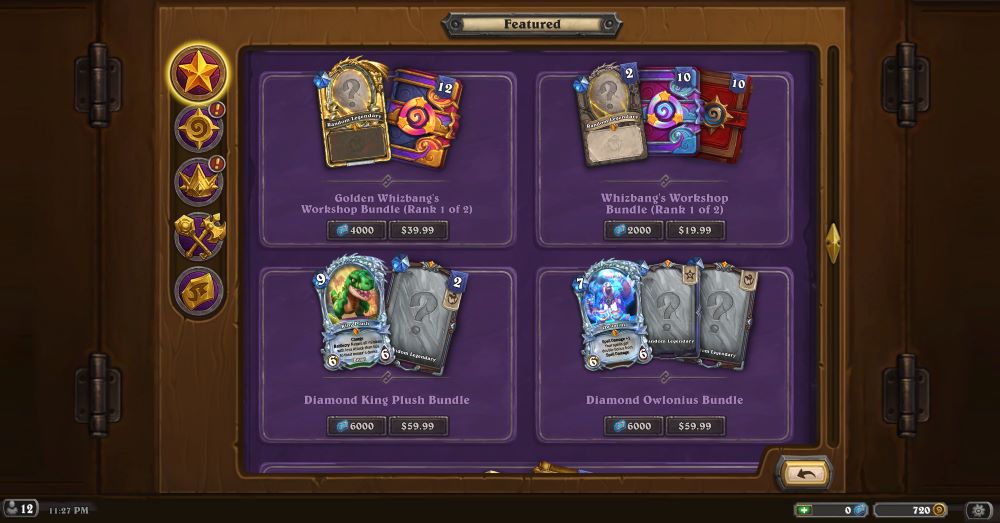
The actual value proposition has gotten murky to me though. A few years ago, Blizzard implemented both a pity timer (e.g. guaranteed Legendary cards after X packs) and copy protection that was later extended to all card rarities. This was an enormous Quality-of-Life feature that doesn’t necessarily get the press it deserves. On top of that, Blizzard more recently added a “reroll” feature once they committed to alternative art cards, which meant you could get a different card of the same rarity if you already had a “better” visual version. This doesn’t come up too often, but sometimes it’ll let you exchange a weak duplicate on the free Reward Track for a chance at something much better.
Concurrently, Blizzard has also seemingly changed their design philosophy regarding the power of cards overall. Historically, it was all about the high-profile Legendary cards flipping games by themselves. While that is sometimes still true, most of the time the best decks are only good because of the supporting Common and Rare cards. This change appears more democratic… but it has a sinister edge. When Blizzard nerfs a card, they allow you to dust (disenchant) the card for its full dust value, rather than the normal 25%. Back when Legendary cards ruled the day, a nerfed Legendary meant you could just dust it and craft another brand-new Legendary and play with a different broken deck. These days, Blizzard nerfs the (relatively powerful) supporting Commons/Rares, leaving the Legendary cards alone. Except, without the support, the Legendary card is useless, but you can’t dust it for full value because the Legendary itself hasn’t changed. Thus, “investing” in Legendaries is risky.
As an example, Blizzard just released a balance patch yesterday that contained three Paladin nerfs to Common/Rare cards. Now, the Paladin deck did need adjustments, as it could kill you from hand with buffed minions. And these cards were problematic. However, if you crafted the 3-5 Legendary cards that went along with the deck (and improved your winrate thereby), well… oops. Best you can hope for is that some other Paladin deck rises from the ashes before the cards rotate out of Standard.

Coming into this expansion, I had actually accumulated 6700g, which meant I could buy 67 packs straight-up. The copy protections mentioned above essentially means that that is enough packs to get all of the Common and Rare cards, along with a handful of Epic and Legendary cards. What would another 50-90 packs give me on top of that? A few more pity Legendaries/Epics… but remember, they are less critical than they were before and/or more risky. I would get a lot more dust to craft whatever card(s) I want, but again, I will already have the important Common/Rare cards already, and thus be gambling on “investing” in the higher tier cards that may get stranded in nerfed decks. No thanks.
Finally, to really bury the lede: Whizbang’s Workshop is a weak set compared to what we just had.
The extra funny issue surrounding everything is how players – including myself! – react to new sets. Many times the top theorycrafters will say something like “Totem Shaman is still Tier 1, but no one wants to play it.” What they really mean is that a deck that was super strong two years ago is just as strong against the current format without needing new cards. But no one wants to play it. Because A) they already played the same strategy for years prior, and B) it means acknowledging you paid money buying new cards you can’t even effectively use. It’s a double cognitive dissonance whammy!
Blizzard has gotten a bit better at adjusting cards (including buffing them, which they almost never did before) at regular cadences, but all the interlocking factors I talked about really makes me wonder about unintended side effects for players like me, e.g. the ones that try to gauge the value per dollar gained. Moving heavy into more cosmetic options is a clear workaround, but even that is fraught in nature – if the alternative art Legendary isn’t competitive, you’ll never likely be able to play it. And if you never play it, you may never be enticed to purchase said alternative art.
Or maybe you don’t care and just want to watch it animate from your collection like an NFT and/or play casual games and hope you draw it before getting killed by a bot. In which case, you do you.
Veni, Vidi, Vici… Vitavi
Fresh off their supermassive success with Baldu’s Gate 3, Larian Studios confirms… they out:
I told you at the beginning that we were a company of big ideas. We are not a company that’s made to create DLCs [or] expansions. We tried that actually, a few times, and it failed every single time. It’s not our thing. Life is too short, our ambitions are very large. And so, like Gustav [the codename for BG3, taken from Swen’s dog who recently passed away], Baldur’s Gate will always have a warm spot in our hearts. We’ll forever be proud of it, but we’re not going to continue in it.
We’re not going to make new expansions, which everybody is expecting us to do. We’re not going to make Baldur’s Gate 4, which everybody is expecting us to do. We’re going to move on. We’re going to move away from D&D, and we’re going to start making a new thing. I’m saying it here because I have a forum and [we’re getting] bombarded by people that expect us to do these things, but that’s not for us. It’s going to be up to Wizards of the Coast, because it’s their IP, to find somebody to take over the torch. We think we did our job and so, for us, it’s time to get a new puppy.
It’s an amazingly ballsy move to just, you know, move on from something like Balder’s Gate 3. At least, until you realize that Hasbro pocketed $90 million of those BG3 dollars for licensing reasons. Why continue that arrangement when you could just, you know, put the same work into Divinity: Original Sin 3 and keep all the money in-house? Mystery solved.
“I’m always the one where it starts with the initial idea and then I give it to the team and they start iterating it and they turn it into something much better. During BG3 I pitched to them what the next game would be…If I see they’re excited, I’ll say, ‘Okay let’s do that.’ If they’re not, it’s back to the drawing board. So they were very excited about a couple of the things we were planning on doing. Then the pivot to start doing BG3 DLC was expected because it’s what you do…We didn’t have any antagonism against BG4 or DLC, but the heart wasn’t there. It was more routine work than actually being excited. Now we have the excitement back in the room and that’s a big important thing.”
Vincke says the next game won’t be Divinity: Original Sin 3, and that it will be “different than what you think it is” but that it’s “still familiar.” Elsewhere, Vincke said that the new project will “dwarf” the scope of Baldur’s Gate 3, which would be quite impressive given the scope of that game.
Well then.
Good on them. In this age of cynicism, enshitification, and corporate greed, Larian’s stance of actually caring about their team is wildly refreshing to see outside the indie space. Not many companies would be willing to leave giant piles of money on the table. Then again, perhaps it is precisely the passion of new projects that Larian understands will lead them to find other tables with fresher piles of money.
Chasing the High
It’s super dumb, but I have pretty much exclusively been playing Hearthstone Battlegrounds for the last 1.5 weeks. I say “super dumb” because this sort of gaming doesn’t mean anything. And, yeah, “does anything really mean anything?” but Battlegrounds is on a whole other level of frivolousness.

If you’re unfamiliar, Battlegrounds is a game mode within the Hearthstone client that is essentially an Auto-Battler. There are two main phases: Tavern and Battle. During the Tavern phase, you spend gold purchasing minions, upgrading the Tavern tier (unlocking higher-tier minions in the pool), refresh available minions, sell minions, use your Hero Power, and/or rearrange your minions. After about 60-90 seconds, you transition into the Battle phase. During Battle, minions take turns attacking from left to right, but their targets are chosen randomly (barring Taunt or other special effects). Whoever has a minion(s) left standing wins and deals X damage to the opponent’s hero.
Battlegrounds has been around for a while, but I didn’t really bother playing it for years. As my interest in Hearthstone proper started to wane though – I don’t care much about ladder ranks – Battlegrounds started to become more appealing. Throughout the seasons, Blizzard started to really shake things up with new, rotating features that added some spicey randomness. Granted, there’s already plenty of randomness in the game mode, but these were on another level. Things like Buddy units (unique to each Hero), Quests (bonus effects if you can complete them), and the latest season introduced Spells as something you can purchase in the shop. All of these things were introduced in a particular season, and then rotated out, keeping things fresh.
And then someone this season went nuts and added all of the things.

Specifically, this current season has Spells and then several weeks later… Quests too. The Quests have been revamped though, and some of them feature crazy effects like “Discover a new Buddy each turn.” That’s not actually the most powerful Quest effect, but I had a few degenerate games where I leveraged it to a massive win. Indeed, the sheer nonsense you can evoke depending on randomness – and the speed in which you must do so – is what is driving me to almost compulsively play Battlegrounds. I’m chasing the high I get from some of these games, or chasing the dream where I was a turn or two away from going nuts before getting wrecked by someone else’s high-roll.
Really though, the randomness cannot be overstated:
- Starting Hero selection is between 2-4 from random pool (94)
- Opponent hero selections are random (for you)
- Overall minion type pool is random (5 out of 9)
- The minions you’re offered in each Tavern are random
- There are only X copies of specific minions in the pool, which opponents can buy
- Getting a “triple” confers a huge bonus, which is a pick 1-of-3 minions from a higher tier
- Minion attacks are random (aside from Taunts or other special conditions)
- HUGE variance can that lead to losing to 5% odds
- Certain spells are random
- Steal a random minion from the tavern, Discover a Battlecry Minion, etc
- Quests are random on top of random
- At a baseline, you are offered a choice of three quests (out of 60)
- Your hero selection impacts which quests are available
- Quest completion methods are randomly assigned (out of 15)
- Play X Battlecry Minions; Speed Y Gold; Kill Z Minions; etc
- Minion types, hero selection, and quest power impact X/Y/Z values
- Some Quest rewards are themselves random
- Cast 5 Random Spells each turn; Discover a Buddy; etc
Sounds like it would be frustrating, yeah? And yet… it usually feels fine.
In Hearthstone, a card that does 3-6 damage is frustrating. Not drawing your combo pieces is frustrating. In Battlegrounds, the randomness is usually just presented as you needing to make the best decision out of available options. Did your minions miss the enemy buff target three times in a row and yet they hit your buff minion right off the bat? OK, that sucks. What’s your next play?
It also helps that losing early just means you can queue into a potentially better game right away.
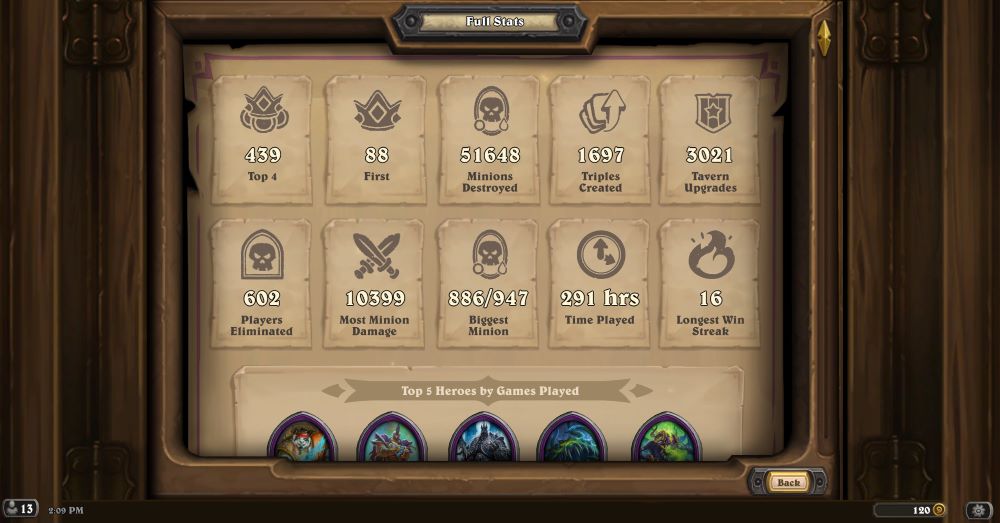
Near as I can tell, whatever reward center in my brain that lights up from deck-building roguelikes (e.g. Slay the Spire) or survival-crafting games has been short-circuited by this season of Battlegrounds. I’m somewhat mad at myself because I should be playing Red Dead Redemption 2 (played one session) or anything else in my extended library. We’re talking like probably 30-40 hours of potential progress spent on otherwise wirehead activity in the past few weeks.
And yet… I need another bump. The next Battlegrounds season gimmick has been teased as being co-op, which honestly sounds pretty awful. I doubt that they keep Quests around for another entire season in any case, but maybe Blizzard will see the spike in (my) gametime and consider keeping it around. The fact that it may go away for a while makes me want to get my fill even more.
Gimmie, gimmie, gimmie! I need it.
Oh, and Hearthstone proper released a new expansion cycle too, I guess. Yawn.
Set the World on Fire
So, there’s a new Fallout TV trailer and it’s… fire.
The original trailer was pretty good, but this one is taking my hype to an entirely new level. Irreverent, ultraviolent, post-apocalyptic, tragic, it’s hitting all the tones that make the series one of my favorites.
Amusingly, some people on Reddit are critically examining the trailer for lore inconsistencies. Example:
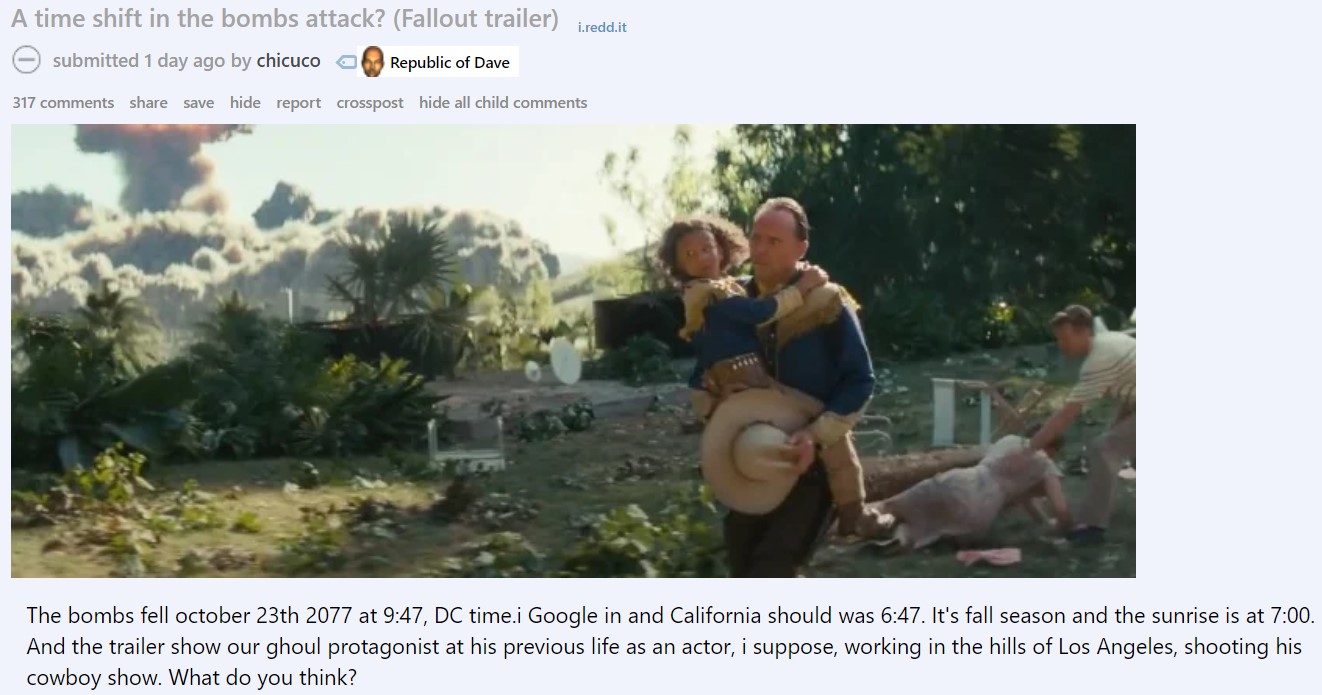
There are some great “Acktually” moments in the comments though. Yes, if the bombs dropped on 9:47am on the East Coast, it’d be before 7am on the West. However, the whole war lasted “two hours” so it isn’t impossible for LA to be nuked 20+ minutes after DC. Besides, there are lore inconsistencies in the games themselves such as the clocks in Fallout: New Vegas being stopped at 9:47 despite also being in a different timezone (Obsidian likely just lazy with reusing assets), or why people were at drive-in movie theaters so early in the morning, children in school on a Saturday, and so on.
Regardless, these sort of “criticisms” are encouraging precisely because they are so trivial. If you have to go full Neil deGrasse Tyson to complain about something, everything else you’re doing must be pretty good. Compare that with, say, Amazon’s Lord of the Rings show or the Borderlands trailer. Or don’t, in the latter case, it’s awful. Granted, Fallout isn’t out yet, but still! Really looking forward to this one.
Review: Tiny Tina’s Wonderlands
It’s… okay. Which is actually kind of an accomplishment given the risks Gearbox took with it.

Tiny Tina’s Wonderlands (TTW) is a non-baseline Borderlands game with the same general conceit as Tiny Tina’s Assault on Dragon Keep, a DLC from Borderlands 2. The eponymous Tiny Tina is running a Bunker & Badasses (e.g. D&D) game and all of the action takes place within that setting. The first few guns are repeating crossbows and there is actually a dedicated melee weapon slot that is useful to most characters, but there are eventually regular guns, rocket launchers, etc. The grenade slot has been replaced with Spells though, which is basically what grenades have turned into in the series anyway.
What is interesting though is how… distilled the Borderlands experience is in this game.
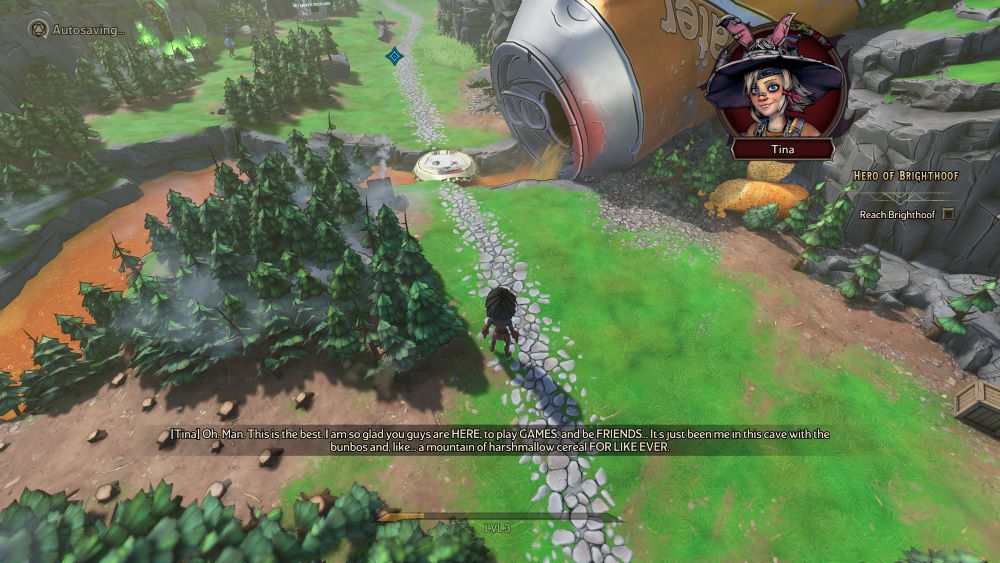
In the mainline titles, you spend a lot of time working through certain locations, and then traveling vast distances via vehicles to reach the next biome. In TTW, the overworld is literally a tabletop you navigate your bobblehead figurine around. It didn’t take me long to realize that I actually preferred this method of getting around Borderlands – the vehicles were always the weakest part of the gameplay.
Walking in tall grass in TTW will sometimes spawn enemy figures, but if you punch them before they fully form you can avoid the random battle. Getting into these battles (or any of the side-quest dungeons) presents you with one of a half-dozen arenas filled with random themed opponents (e.g. pirates, skeletons, sand-sharks, etc). There is nothing to “explore” in these specific areas, so you just blast away until the meter says you have killed enough to move on. Again, basically Borderlands.
To be fair, there are actually a lot of traditional, hand-crafted areas of the game that do feature a lot of exploration. Not only are these areas large, they are also seeded with special loot D20s that will permanently increase your loot luck each time you find one. There are other collectible widgets too if you so desire. A few of these areas are completely optional side-quest zones, which is kind of impressive when you consider that they can easily be skipped entirely.
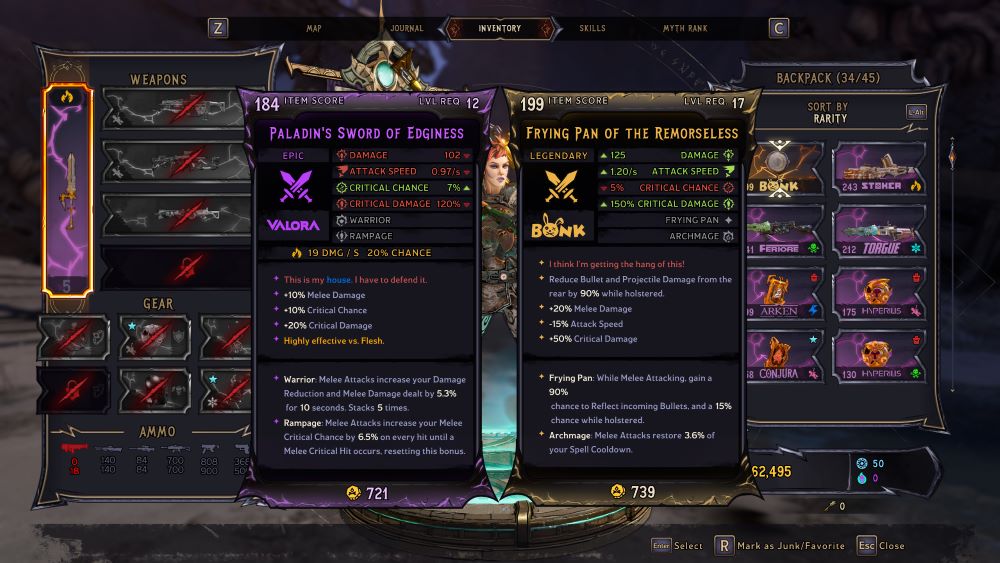
Another thing that worked out well was the class system. You choose a class at the beginning and see a traditional Borderlands talent tree. Once you reach a certain stage in the game though, you get to multi-class. In the mainline games, each character had 3-4 talent trees, sure, but their main ability and general role was locked down. Here you could mix and match and take some classes in radically different directions.
Having said all that, there are a few things that bring the experience down.
First, character and gear progression is locked behind the main story, rather than levels. What this meant is that I was stuck with just two weapon slots until level 15+ which just felt awful. Considering that you can pause the game at any time and swap out weapons in the menu just meant I had to constantly interrupt the action once I ran out of ammo of a particular type.
Second, TTW continues the unfortunate series tradition of punishing you for doing side-quests. Everything scales with your level, from enemies to rewards, and since side-quests can grant you unique weapons, you are either getting a neat weapon to use for half and hour or “saving” the side-quests until after the main story is completed, so you can guarantee a max-level roll.
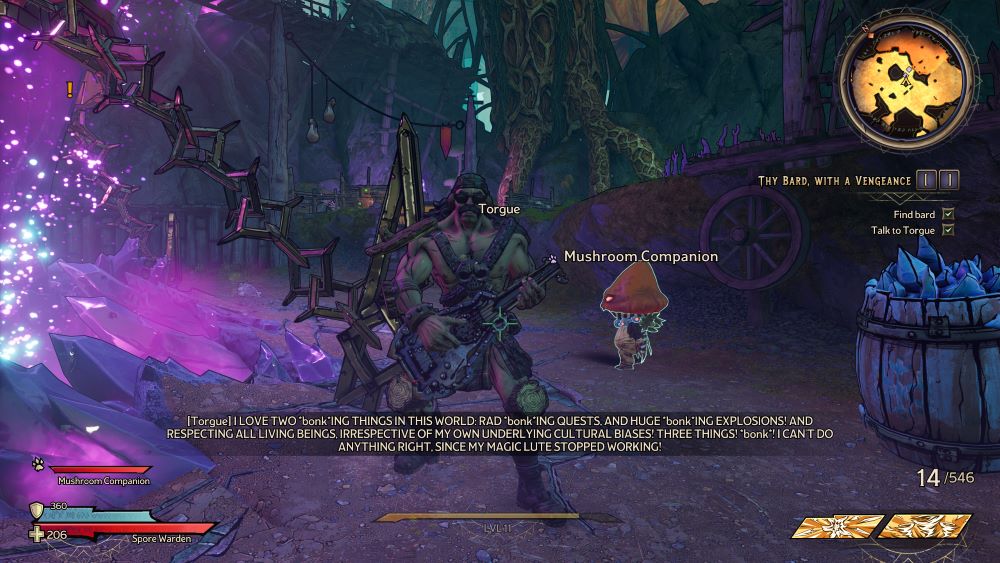
Finally, while the quality of the Borderlands series writing is an acquired taste at the best of times, the disadvantage here is that the story doesn’t “matter.” For as widely panned as the Borderlands 3 plot is, it at least moves a narrative forward. I actually like Tiny Tina’s character (and humor) in the series but TTW doesn’t really explore anything new. “She’s lonely.” Okay. “People don’t stick around.” It’s a cave. “She’s just 13 looking for friends.” Yeah, as established in Borderlands 2 & 3, the DLC, and the Pre-Sequel.
It really wasn’t until the credits at the end that I sort of realized what was really going on with the game. No, not some extra post-credits reveal – the devs just thanked everyone for playing and explained that they built the game during the pandemic while working from home. Suddenly the whole “power of friendship” throwaway storyline, the bold design decisions (e.g. cutting the overworld, etc), and the truncated post-game support made sense. Regarding that last point, the mainline games typically allowed you to do a New Game+ equivalent so you could farm Legendary drops from specific bosses and/or negate the penalty for doing side-quests below level cap. In TTW, that doesn’t happen. Instead, you can play in Chaos arenas against random enemies waves with random buffs for your random loot. Similar, but very much not the same.
So, yeah. If you’re not a fan of the series, this won’t change your mind. If you are a fan, this is… fine.
Hurry Up and Wait: March Edition
Since I am already looking stuff up for myself, may as well write it down for others too.
Games – Waiting for Sales
- Nightingale
- Enshrouded
- Sons of the Forest
- Horizon: Zero West
- Dying Light 2
- Kynseed
Nightingale is the blogging topic du jour and I do admit feeling a bit left out of the same conversation everyone else is having. Similar to Enshrouded actually, although I see less posts about that for whatever reason. While I would like to say that I’m waiting for Nightingale to release their offline mode out of principle, the reality is that… surprise! It’s not on sale. That’s literally it.
May not have to wait for too much longer though, because my research indicates the next sales are:
- Steam Spring Sale: March 14th – 21st
- Epic Game Store Spring Sale: April 4th – 28th
It’s not guaranteed that the above games will actually be on sale more than their 10% EA “release” discount, but it’s worth the gamble in my eyes. Either there will be a steeper discount, or I can continue waiting while the games get (presumably) better.
Games – Waiting for Updates/Release
- Stardew Valley (1.6) – March 19th
- Diablo 4 (Game Pass) – March 28th
- Core Keeper (1.0) – Summer 2024
- The Planet Crafter (1.0) – sometime 2024
- Once Human – Q3 2024
- Satisfactory (1.0) – late 2024
- Light No Fire (1.0) – maybe 2024?
- Zero Sievert (1.0) – unlikely 2024
- 7 Days to Die (A22) – ???
- Craftopia (1.0) – ???
- Final Fantasy 7: Rebirth (PC release) – ??? :(
It may seem a bit weird seeing Stardew Valley on there, but at one point last year I had the urge to download the Stardew Valley Expanded mod, only to find out that ConcernedApe decided to put out another update with new stuff 4 year later. Guess the dude is taking a page out of G.R.R. Martin’s book. Anyway, it felt silly to start playing a mod that may or may not immediately work with a new patch.
I was originally excited for Diablo 4 to hit Game Pass, but then I remembered that I hadn’t thought about it at all since it was even announced. Like, zero interest. I’ve played all the other ones though, so may as well keep the streak alive. This time for free*!
As for the Early Access games on the list, I have come to understand and eventually accept that hitting 1.0 releases with them are usually irrelevant. For example, I waited until 1.0 to play Smallands (Impressions post pending), and yet there’s an update coming in April that will rebalance crafting and more patches on the roadmap to enhance the pet/mount system. So… whatever I was waiting for in 1.0 is kinda irrelevant. This problem is especially bad in life-sim games like Coral Island, Sun Haven, etc, which have added post-game/marriage quests material that is pretty important for fans of the genre.
Other Media
- 3-Body Problem (Nextflix) – March 21st
- Fallout (Amazon) – April 12th
- Dune: Part 2 (streaming) – Summer 2024?
Dune: Part was released in theaters March 1st. I have been eagerly awaiting this for a while, but haven’t actually went to any movie theaters for years before COVID, and I’m not about to begin again now. So, optimistically, I’ll be waiting 2-3 months before this comes to a streaming service so I can watch it during the time I should be sleeping.
3 Body Problem is something I’ve already talked about recently. I am wishing it the greatest possible success, because I really want the second book to exists as some kind of Season 2. It would be quite the spectacle. And as for Fallout, I talked about that too. My body is ready… even if it is possibly dumb.
Reinvestment
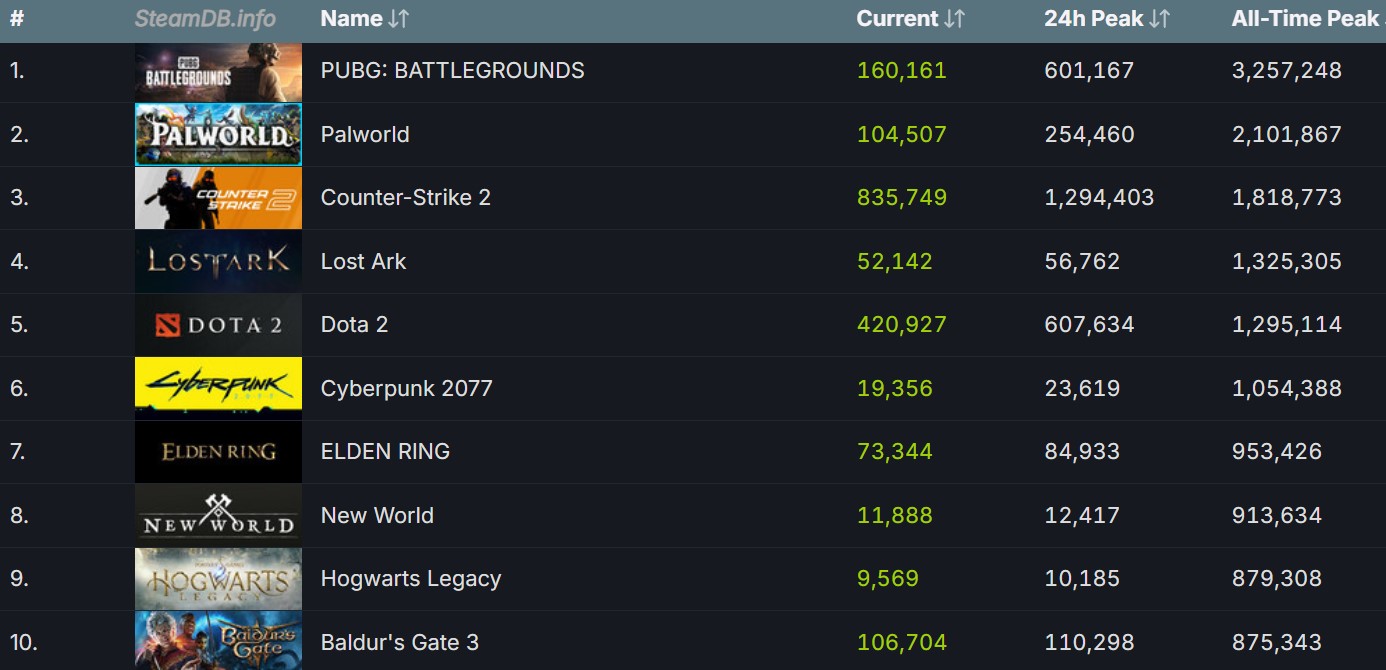
Palworld, as we’ve established, is having a moment. A sensation, if you will. The latest figures is it selling 25 million copies across Steam and Xbox in a single month. It also breached the 2.1 million concurrent players milestone on Steam, which puts it at #2 of all time, above even Counter-Strike. Palworld has not sustained that concurrency, but it’s nevertheless in exclusive company.
That’s not really what I wanted to talk about today though.
I want to talk about the Japanese blog post by the Palworld game director that was released three days before the official launch. It details the 5+ miracles that he credits with even being able to get Palworld released at all. For example, the gunplay was all designed by a 20-year old convenience store clerk they found on Twitter, who created 3D renders of weapon reload animations in his free time. There are other bits of interesting serendipity, so let Google auto-translate for you and take the ride.
One element that struck me in particular though: funding.
So I thought the other way around. What is the maximum budget? The most obvious upper limit would be the limit at which the company would go bankrupt. Of course, you can borrow money, but let’s think about that when the balance in your bank account becomes zero. The budget limit is initially until the balance in your bank account reaches zero. When it reaches zero, you can borrow money.
In that case, do you need to manage your budget?
No, all you have to do is borrow money or release money just before the company goes bankrupt and your account balance drops to zero.Well, we’ll probably be able to develop it for about two more years. For the time being, I decided to keep making it without worrying about the budget. We want to complete it as soon as possible, so let’s hire a lot of people.
So that was Miracle #5, in that they basically built Palworld without setting a budget at all. It’s actually a bit more interesting than even that, because they didn’t originally want to spend a lot of time making the game at all. But, due to the positive feedback from the initial trailers, they decided to go for broke.
What really gets me though is this last part:
Almost all of the company’s money was gone.
It’s as calculated!
Well, maybe it’s as calculated…?
No matter how you look at it, it’s just a miracle.
It is not known how much money it cost. I don’t even want to see it.Judging from Craftopia’s sales, it’s probably around 1 billion yen…
Because all those sales are gone.
In case you were unaware, before Palworld this company released Craftopia. Which is also still in Early Access. The game isn’t bad, actually, and shows a lot of promise under the jank. Or showed. Because although it is clear that Craftopia’s measured success bankrolled Palworld, it’s not so clear whether any of those millions of Palworld dollars will make their way back back to Craftopia. And that’s just sad.
I get it – this is how most things work pretty much everywhere, especially in the game industry. Release game, collect revenue, use money to continue employing people to create new game, repeat. Indeed, if a particular release falls flat on its face, not only is that series’ future imperiled, sometimes the company itself is at risk. But in this case, the original game (Craftopia) isn’t even done yet. The creators of ARK infamously released a DLC to their Early Access game, but it was arguably necessary because they were running out of cash ($40 million lawsuit settlement will do that to you). I get no sense that Pocket Pair were in similar straits. Rather, it was likely a cold calculation that the Craftopia well was drying up and it was time to move on to other milkshakes, to mix metaphors.
Obviously, the move worked out for Pocket Pair. And, yeah, for millions of players too. I am happy for these devs’ success, as their willingness to try random shit and just go for it is (hopefully) an inspiration to other studios. I just hope some of that Palworld money comes back to Craftopia in a meaningful way, and not just a “we’ll keep these five original dudes employed in a broom closet” way. They don’t have to and economically it would probably be a mistake. But I think they owe it to themselves.
And that’s because without Craftopia there literally wouldn’t be a Palworld. Not just in the funding aspect either. Craftopia actually has capture spheres, riding creatures, and even the ability to capture human NPCs. This is a “Yo dawg, I put Early Access in your Early Access” situation – Palworld is probably 25% of what Craftopia already delivered years ago. Is it the best 25%? Well, it’s hard to argue against a literal pile of free speech cash.
I suppose we’ll have to see how Pocket Pair proceeds. There is technically still a roadmap for Craftopia (circa December 2023) and there have been a few bug patches released since then. I seriously doubt that any amount of reinvestment will have Craftopia achieve a comparable level of success as Palworld – clearly even AAA games have been blown aside – but I do hope that they at least replenish the coffers and allow Craftopia to reach release with the vision and funds it originally earned.
AI Ouroboros, Reddit Edition
Last year, if you recall, there was a mod-led protest at Reddit over some ham-fisted changes from the admins. Specifically, the admins implemented significant costs/throttles on API calls such that no 3rd-party Reddit app would have been capable of surviving. Even back then it was known that the admins were snuffing out competition ahead of an eventual Reddit IPO.
Well, that time is nigh. If you want a piece of an 18-year old social media company that has never posted a profit – $18m revenue, -$90m net losses last year – you can (eventually) purchase $RDDT.
But that’s not the interesting thing. What’s interesting is that Google just purchased a license to harvest AI training material from Reddit, to the tune of $60 million/year. And who is Reddit’s 3rd-largest shareholder currently? Sam Altman, of OpenAI (aka ChatGPT) fame. It’s not immediately clear whether OpenAI has or even needs a similar license, but Altman owns twice as many shares as the current CEO of Reddit so it probably doesn’t matter. In any case, that’s two of the largest AI feeding off Reddit.
In many ways, leveraging Reddit was inevitable. It’s been an open secret for years that Google search results have been in decline, even before Google started plastering advertisements six layers deep. Who knew that when you allowed people to get certified in Search Engine Optimization, that eventually search results would turn to shit? Yeah, basically everyone. One of the few ways around that though was to seed your search with +Reddit, which returned Reddit posts on the topic at hand. Were these intrinsically better results? Actually… yes. A site with weaponized SEO wins when they get your click. But even though there are bots and karma whores and reposts and all manner of other nonsense on Reddit, fundamentally posts must receive upvotes to rise to the top, which is an added layer of complexity that SEO itself does not help. Real human input from people who otherwise have no monetary incentive to contribute is much more likely to float to the top and be noticed.
Of course, anyone who actually spends any amount of time on Reddit will understand the downsides of using it for AI training purposes. One of the most upvoted comments on the Reddit post about this:
starstarstar42 3237 points 1 day ago*
Good luck with that, because vinyl siding eats winter squid and obsequious ladyhawk construction twice; first on truck conditioners and then with presidential urology.
Edit: I people my found have
That’s all a bit of cheeky fun, which will undoubtedly be filtered away by the training program. Probably.
What may not be filtered away as easily are the many hundreds/thousands of posts made by bot accounts that already repost the same comment from other people in the same thread. I’m not sure how or why it works, but the reposted content sometimes becomes higher rated than the original; perhaps there is some algorithm to detect a trending comment, which then gets copied and boosted with upvotes from other bot accounts? In any case, karma farming in this automated way allows the account to be later sold to others who need such (disposable) accounts to post in more specialized sub-Reddits that otherwise require certain limits to post anything (e.g. account has to be 6+ months old and/or have 200+ karma, etc). Posts from these “mature” accounts as less obviously from bots.
While that may not seem like a big deal at first, the endgame is the same as with SEO: gaming the system. The current bots try to hijack human posts to farm karma. The future bots will be posting human-like responses generated by AI to farm karma. Hell, the reinforcement mechanism is already there, e.g. upvotes! Meanwhile, Google and OpenAI will be consuming Reddit content which itself will consist of more and more of their own AI output. The mythological Ouroboros was supposed to represent a cycle of death and rebirth, but the AI version is more akin to a dog eating its own shit.
I suppose sometime in the future its possible for the tech-bro handlers or perhaps the AI itself to recognize (via reinforcement) that they need to roll back one iteration due to consuming too much self-content. Perhaps long-buried AOL chatroom logs and similar backups would become the new low-background steel, worth its weight in gold Bitcoin.
Then again, it may soon be an open question of how much non-AI content even exists on the internet anymore, by volume. This article mentions experts expect 90% of the internet to be “synthetically generated” by 2026. As in, like, 2 years from now. Or maybe it’s already happened, aka Dead Internet.
[Fake Edit] So… I wrote almost exactly this same post a year ago. I guess the update is: it’s happening.
The Unknown
It’s a cliche, but I was thinking about “there’s nothing scarier than the unknown.” I find this to be literally true, although I haven’t asked whether its the case for people with, e.g. arachnophobia or similar.
In thinking about it though, “the unknown” isn’t exactly what I’m afraid of. Rather, the unknown is simply a placeholder for existing or imaginary fears. And since its a placeholder, it becomes dynamic and mutable based on whomever is experiencing it. This is handy in games, movies, etc.
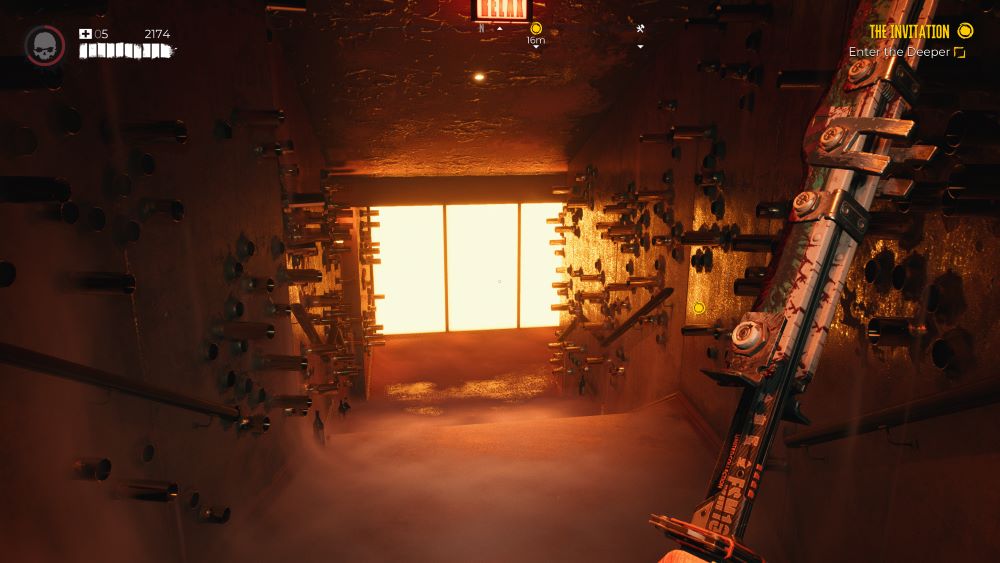
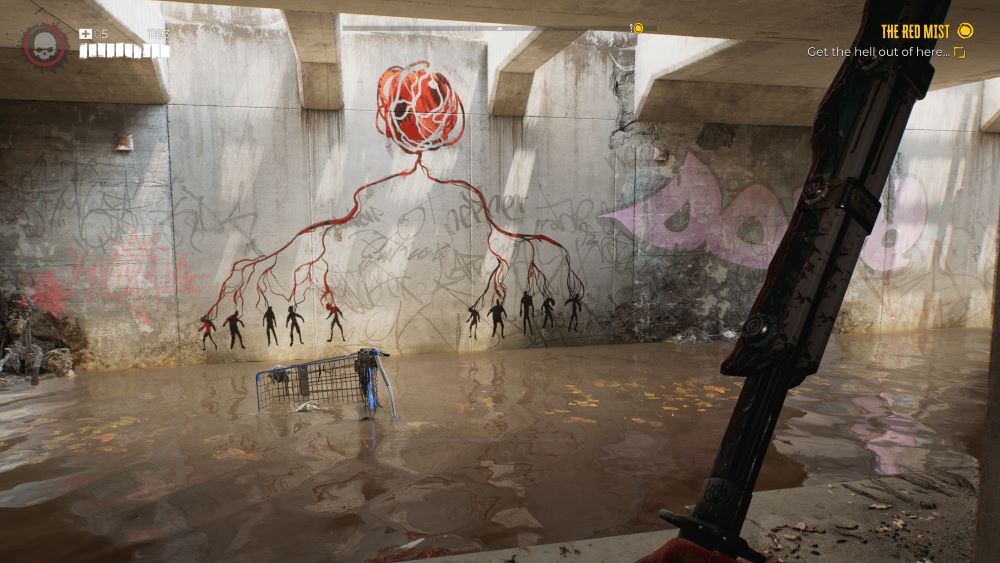
What brought this up initially was my playing through Dead Island 2’s DLC content, Haus. The base game has plenty of jump scares – sometimes frustratingly unintentional, when zombies materialize from thin air – but Haus leaned into the whole creepy psychological nightmare house schtick. Which is fine, whatever. But I had a moment, in a particularly creepy room, where I thought “Oh, I bet they’re going to do X!” In this case, X is an overly-elaborate amalgamation of scenes from Silent Hill, Dead Space, and similar, that I won’t be getting into; solve for your own damn X.
Thing is, the devs couldn’t do it. The language of action necessary to do X wasn’t in the game. This isn’t Dead Space where an air duct could burst open and a giant tentacle kill you instantly if you fail the Quick Time Event. There are just… zombies, who attack you in predictable ways. Do the zombies crawl out of small sewer grates and other unexpected places? Sure. But zombies are zombies in Dead Island 2. I can panic when a Burster appears in close proximity, but that is a known hazard.
When you don’t know what the game can do, that’s when it’s scariest.
I’m reminded of when I first played Valheim, so long ago. The game was Early Access (still is), made by a small group of people (still is), and they were trying different things. For example, I don’t know of any other survival game in which chopping down trees requires my complete attention, lest I be crushed.
So, there I was, setting sail for the first time in search of… whatever. Vaguely, I knew about the existence of Serpents from Reddit posts, but not necessarily what they looked like, what their attack patterns were, or whether you could see them coming, outrun them, etc. And after a while of sailing, I started to think maybe they weren’t in the game at all.
Somehow, that actually made the situation worse. I started feeling uneasy any time I came across darker water, or other anomalous phenomenon (real or imagined). Wouldn’t it be just the worst if you were sailing along, oblivious, and then a dark shadow beneath your boat yawned, teeth the size of spears sprouting from the waves, while you and your boat disappear in an agonizing instant? Just me?
Anyway, as you can imagine, it was fun times when I encountered my first Leviathan and it sunk beneath the waves after my incessant barnacle trimming. This is it, I’m going to be eaten! It wasn’t. But for that first moment, it could have been, and Valheim got me.
Then lost me when I searched seven mountain ranges for a single goddamn silver node. Not bitter.
 In An Age
Stardew Valley Revisited
Apr 1
Posted by Azuriel
For the past few days, I have been playing Stardew Valley again.
The reasoning was due to a recent 1.6 update, plus hearing good things about the “Stardew Valley Expanded” mod (which was recently updated to be compatible), which I never saw when I was playing back in 2018. Also, despite spending 50 hours playing the first time, I never actually made it all the way through a full year, dropping the game during Winter.
Well… they’re right. You can’t go home again.
When Stardew Valley first released, it was a pivotable indie phenomenon almost right away. It obviously did not invent the farming/RPG life-sim – Stardew Valley itself being an homage to Harvest Moon – but the genre itself saw a renewal and resurgence of interest due to its surprising success. Slay the Spire did the same thing with roguelike deckbuilders; not the first, but certainly a wild success that created space in which alternatives to flourish.
But that is precisely my problem with Stardew Valley: alternatives exist. Dare I say… better ones too. Or, perhaps, some amalgamation thereof.
In the years since 2018, I have played My Time at Portia, Sun Haven, Coral Island, and My Time at Sandrock. The first thing I noticed coming back to Stardew? All the Quality of Life “regressions.” For one thing, you have zero control over the length of the day. For another, in a shocking throwback, the game only saves when you sleep. That has always been dumb design with zero redeeming features, and is especially banal considering the mobile version of Stardew does allow you to quicksave. Other games have also realized that a map showing location of NPCs and important buildings is kind of important. That one can be remedied with mods, but it just makes you wonder why. As in, why play Stardew Valley instead of one of these other games?
And that really is the rub, ain’t it? Why play this over that?
I don’t have a good answer at the moment. Many of Stardew’s NPC stories/events have been lauded as being more realistic and/or nuanced than the genre average, but it’s hard to tell if that is even accurate. Sun Haven and the My Time at [X] series certainly have deeper combat and character skills. Coral Island definitely wins the graphics award, along with some very attractive character art. All of them have fishing, farming, Community Center-esque activities, and so on. I don’t particularly have any nostalgia for Stardew either. So… why this one?
For the moment, I will continue to investigate. I’m at that pivotal optimization stage where there are some interesting decisions going on – do I spend money upgrading my pickaxe, saving for a barn, upgrading the house, etc – but I already see an “endgame” of sorts taking shape. Like, I’ll be done with most of the Community bundles by the end of this first year, I already have a horse, and I just hit the bottom of the mines. From here, there doesn’t seem to be a whole lot of new stuff to look forward to other than more passive ways of getting money, to buy something or other. Then again, I never actually got to any endgame the first time around, so perhaps there is more to be seen (and was added in the past 6 years). Plus, you know, there’s probably something expanded in the Expanded mod.
We shall see.
Posted in Commentary
Comments Off on Stardew Valley Revisited
Tags: Farming, Life Sim, My Time at Portia, Stardew Valley, Sun Haven, You Can't Go Home Again