Review: Mass Effect 3
Game: Mass Effect 3 + Multiplayer + DLC
Recommended price: $40
Metacritic Score: 89
Completion Time: ~32 hours
Buy If You Like: Mass Effect; story-driven, cover-based sci-fi shooter RPGs.
By far, Mass Effect 3 (hereafter ME3) is the hardest review I have ever tried to write.
Cue the Stages of Grief
There are three entirely different prisms through which this game can be judged. The first is as the 5-year culmination of arguably the most important sci-fi videogame story of our time. The second is as a comparison between the individual components of the trilogy, as in how it stacks up compared to the first two titles. The third is as an independent game, divorced from the accumulated emotional detritus and hype of the series.
The distinctions are important precisely because no matter how grating certain features or design decisions are in isolation, I have found myself literally incapable of escaping the rose hue of the first prism. This is not to say I did not notice the deficiencies, but rather they seemed to matter less in the final analysis. Your mileage may vary.
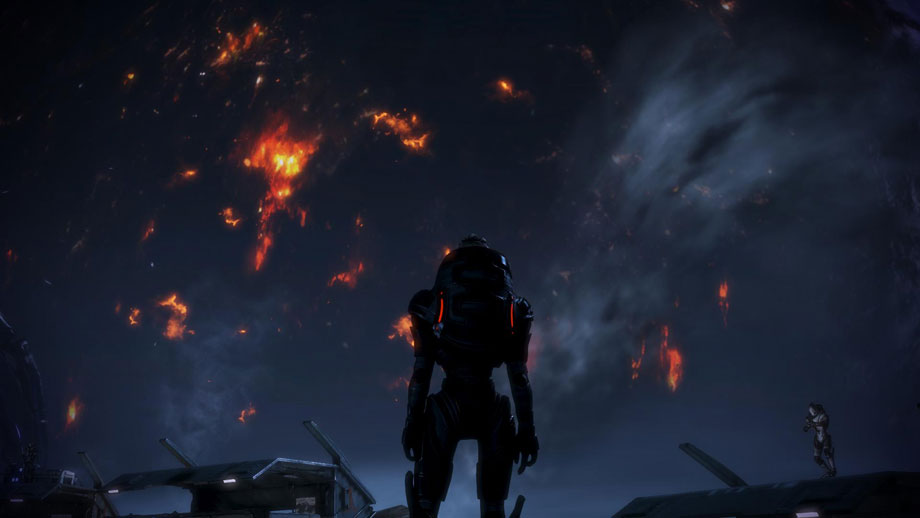
For example, things feel off from the very start. The Reaper invasion – the nightmare scenario that formed the impetus to action in the first two games – has finally arrived. Earth is under attack. And… I feel nothing. Outside of a Lunar sidequest in Mass Effect 1, this is the first time Earth has ever actually appeared in the series in any real way. My Paragon Commander Shepard has never been fighting for Earth, or even humans specifically, but for the right of all sentient life in the galaxy to exist. Indeed, humanity has almost represented a background bumbling bureaucratic force, a one-dimensional foil to Shepard’s actions throughout the trilogy that lacks the novelty of the alien scenarios.
It does not help that throughout the Earth invasion, throughout your leaping from burning building to burning building, throughout the panning of cameras to the monstrous Reaper capital ships landing among the skyscrapers… there is nothing but an eerie, empty silence. Where is the stirring music? I spent the first twenty minutes of Mass Effect 3 wondering if my game had glitched, perhaps setting the music volume slider at 0%. There are plenty of amazing songs in the rest of the game – the absolutely haunting “Leaving Earth” comes to mind, or the stirring “The Fleets Arrive” – so the lack has to be some inexplicable design choice.
Certainly, it won’t be the last such inexplicable choice.
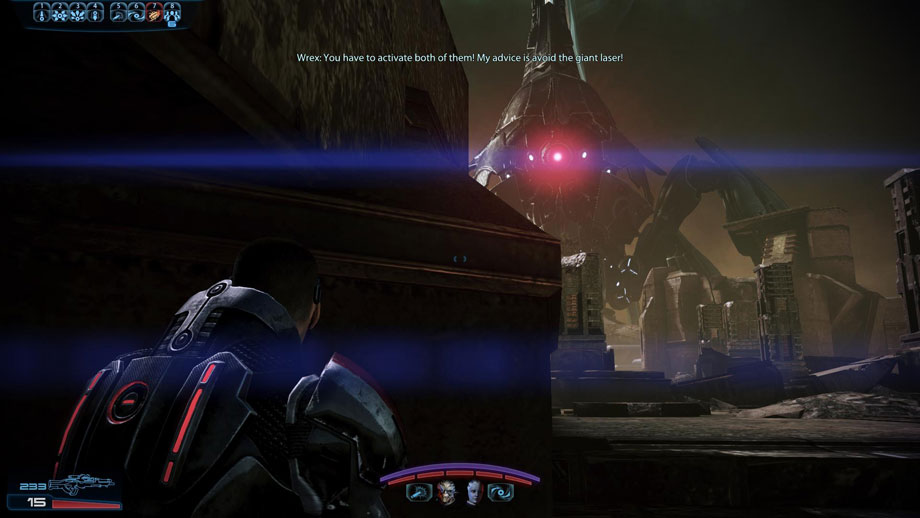
Wrex: the Krogan Sun Tzu
Once Commander Shepard is back aboard the Normandy though, the game once again feels like Mass Effect. And it really was not until ME3 that I could point out what that even meant. The brilliance of the series, in my mind, is the notion that one ship and one crew can make a difference, in a relatively believable manner – the sort of “right place, right time” effect. At no point did I feel like Shepard was a god amongst men, even as I was performing miracles and uniting species after centuries of war. Flying around the galaxy in a desperate attempt to cobble together a coalition for a final stand against the Reapers… yes, this is Mass Effect.
One thing that deserves special attention is the combat system. Simply put, it’s rather brilliant. For the most part, combat in ME3 is the same as ME2 aside from some subtle, key differences. The first is the inclusion of Carrying Capacity, which I will admit to having a strong negative reaction to at first. Shepard and crew can carry all five types of weapons if they wish, but the lower the percentage of Carrying Capacity utilized, the greater rate at which Biotic/Tech abilities recharge. In other words, if Shepard takes an assault rifle, shotgun, and sniper rifle into battle, he/she may get a -150% modifier on cooldown times. Alternatively, if Shepard only takes a sniper rifle and pistol, he/she may have a +50% modifier. Given the radically increased power of Biotic/Tech abilities this time around, choosing a loadout actually becomes a choice, especially since some guns are balanced around their weight.
On a related note, the gunplay in the missions themselves has never felt more fun and exciting. You will still spend 80% of the game crouching behind chest-high walls, but the obstructions are less obviously arbitrary, and the environment/graphics look amazing. More importantly, the enemies are radically more varied, have a deeply cunning AI that will flank you or flush you out of cover with grenades, and otherwise keep you in the moment and on your toes.
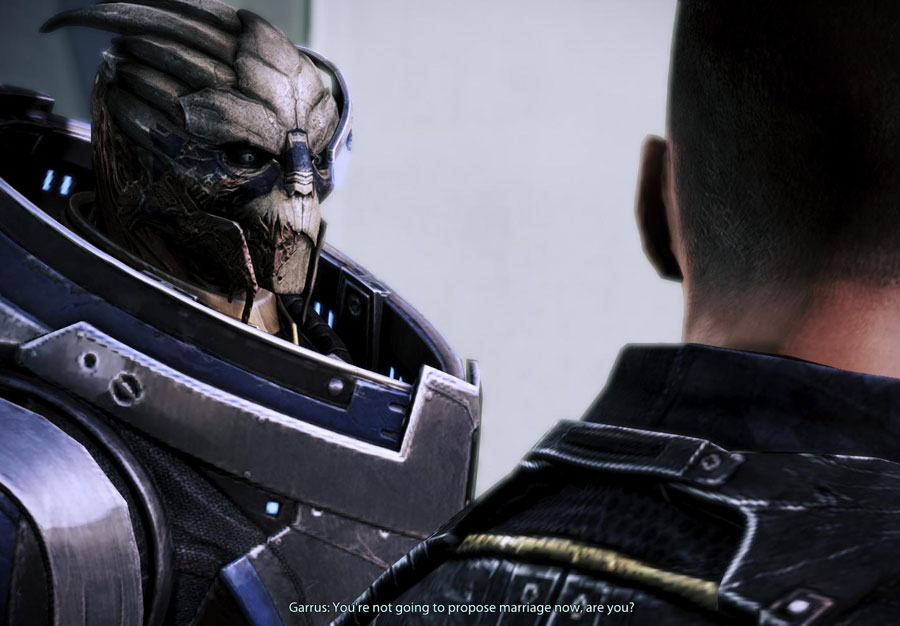
Damn, Garrus. Way to shoot me down.
Any review of ME3 would be remiss to not mention what has become, if not the most, at least one of the most controversial endings in gaming history. Without getting into spoilers, the thing to understand about why it is as big a deal as it has been in the gaming media comes down to this: catharsis. Simply put, there was not any. And with as much passion as the franchise has generated, I do not find it surprising in the least that so many people have taken the pent-up energy to the forums and blogs (as I myself have done). As of the time of this writing, Bioware has taken the rather extraordinary step (if you think about it) to begin development of a free, epilogue DLC to be released this summer. If said epilogue is able to honor the choices players have made in this franchise, if it is capable of giving me the catharsis I hunger for months after the fact, then Mass Effect could very well unseat the sacred cows of Chrono Trigger, Final Fantasy 7, and perhaps even Xenogears in my Top 3 games of all time.
As it stands, there is really no question that you should play Mass Effect 3 if you have at all enjoyed the first two titles in any capacity. Objectively, I think Mass Effect 2 as an independent experience (insofar as that is possible) edges out Mass Effect 3, but… well. To quote Fight Club: “You know how they say you only hurt the ones you love? Well, it works both ways.” Without a doubt, Mass Effect 3 has wounded me in ways no other game has ever done, and that in itself is a remarkable triumph.
“I think we ought to read only the kind of books that wound and stab us… We need the books that affect us like a disaster, that grieve us deeply, like the death of someone we loved more than ourselves, like being banished into forests far from everyone, like a suicide. A book must be the axe for the frozen sea inside us.”
–Franz Kafka
Multiplayer
The multiplayer that comes with Mass Effect 3 deserves its own special section, because in many ways it is almost a second, complete game. Indeed, its development started originally as a first-person shooter spinoff before it was enfolded into ME3 proper.
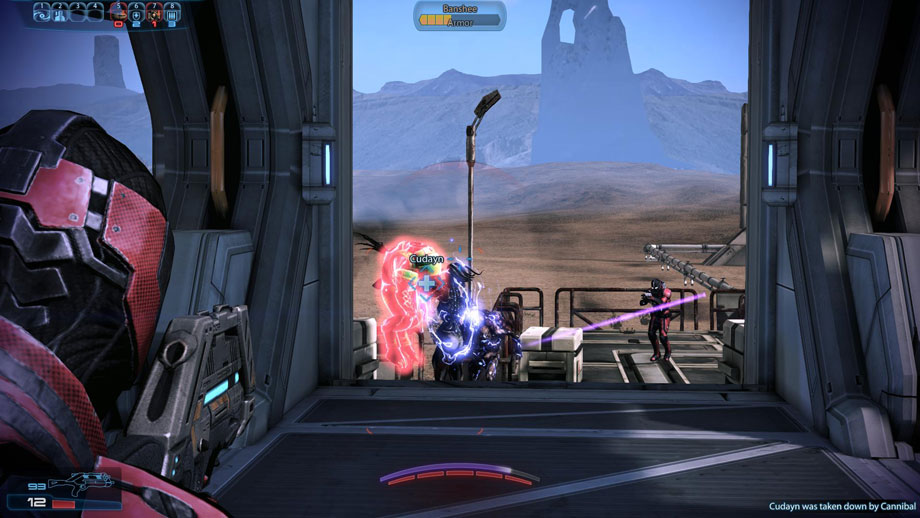
You're going to need a LOT of Medigel for that one, buddy.
In effect, multiplayer is a stand-alone, four-person co-op survival mode. Although winning multiplayer matches increases the Galactic Readiness Rating in the single-player game (essentially allowing you to skip sidequests and still achieve your goals), there is otherwise zero overlap. You pick one of the six classes, one of the five races, a weapon loadout, a difficulty level, and then head into one of the six maps to face one of the three enemy factions. Each map has 11 waves, three of which will consist of special objectives that will be a King-of-the-Hill, activating four beacons, or assassinating four specific enemies amongst the others. Successfully completed maps will take around ~30 minutes, you will gain XP for the class you chose (with a level cap of 20), and Credits.
The replay factor, aside from the entertaining gunplay, comes from the unlocking of packs. Starting out, you have access only to the five most basic weapons and human versions of the six classes. As you earn Credits, you can purchase different levels of packs – Recruit, Veteran, and Spectre – which unlocks new weapons, weapon mods, races, character customization options, and one-use items or buffs to give you an edge. Obviously this can lead to frustration at times, especially if you opt to buy packs via Bioware Points (i.e. microtransactions) instead of Credits, but it does give you an incentive to try and make weapons or classes you would not typically pick, work.
The sort of bottom line is this: if you had fun with Mass Effect’s combat system, you will have a ton of fun with the multiplayer. I have already spent more time playing multiplayer than I have playing Mass Effect 3 itself. And at the time of this writing, there is a free multiplayer DLC (Mass Effect 3: Resurgence Pack) coming to introduce two new maps, new race combinations (including Geth and Batarian), and new weapons. Given that packs can be purchased with real money via Bioware Points, it is entirely possible all future multiplayer DLC may be free.
DLC: From Ashes ($9.99)
From Ashes is the poster-child for everything evil about Day 1 DLC: it is hideously overpriced, lacking in content, and has fundamentally shifted my perspective about the nature of the Mass Effect plot. What you are purchasing is one throwaway stand-alone mission, a Prothean squad-mate (Javik), a new weapon (a particle rifle with regenerating ammo), and a bunch of new dialog between Javik and the other party members (especially with Liara).
The problem is that without the DLC, the Protheans were always this unknown, almost magical race who fell to the Reapers in the last cycle and whose artifacts you spend a lot of time collecting. Interacting with Javik, however, reveals the Protheans as a belligerent, almost xenophobic race that would have enslaved or destroyed the races we have come to love in the Mass Effect franchise. In other words, by the end of the game I honestly felt that the Reapers did us a big favor by wiping out the Protheans.
So while From Ashes is not in any way essential to the plot of Mass Effect 3, I personally believe that its absence radically limits the scope of the narrative. In other words, I consider it both required and overpriced. Then again, honestly, you could probably just read the Mass Effect Wiki and watch the Youtube videos for the same effect, saving yourself $10.
The Virtual Line
Tobold has an interesting post up today on what he considers the defining characteristic of games: “a game is a risk-free environment in which you can try out various actions for fun or for learning without fear of the consequences, because the consequences aren’t real.”
The second paragraph is this:
As you can see there is a growing trend of “games” turning into “ungames”. There are many reasons for that, one of which is Maslow’s hierarchy of needs. Once you climb up that pyramid high enough, you are leaving the real world needs behind. If somebody’s needs are for status and achievement, he can fulfill that need in a virtual environment, and these virtual environments are usually designed to offer a lot of that status and virtual achievements for less effort than it would take to achieve something in the real world. There are now a sufficient number of people who are sufficiently well-off that they can spend real money on virtual status symbols or game achievements. That is bound to be used by those who are still lower on the pyramid and are just trying to make a buck. The danger is that people become confused about where the border between real and virtual is, which leads to stories like the Chinese guy who murdered a friend who borrowed and then sold his virtual sword.
Hagu knocks it out of the park with the very first comment:
I think “”played” to earn real money” is a bit restrictive.
In real life, if I had a $5 bill, a glass I paid $20 for but with no resale value, and a manuscript I spent 1000 hours creating, then I would be increasingly unhappy with the item being destroyed.
I would regret far more the lost of an item I spent hundreds of hours acquiring than a D3 sword I can sell for $5
The question I want to ask, though, is this: where is the border between real and virtual?
I am not asking that to be cute or contrary. I am literally asking what difference does it make? When have the consequences of a game not been real? Is the emotion you feel by reading fiction different to you than the emotion from an encounter in the real world? Is the frustration you feel at work different to you than the frustration you feel playing a videogame? Anger? Sadness? Disappointment? Embarrassment? Social pressure? Joy? Victory?
One cannot derive nourishment from a virtual apple. A virtual fire will not stave off hypothermia. Beyond that though? How exactly “real” is, say, Security under Maslow’s hierarchy? As any parent, victim of a crime, or survivalist can tell you, security is, at most, a state of mind. A paranoid schizophrenic won’t feel safe in a padded cell; conversely, there are people who voluntarily live in Detroit and St. Louis, the two US cities with the highest violent crime rates as of 2010. If you can feel safe without actually being safe, I think that begins to call into question “consequence-less gaming.”
When I play videogames, I do not think of the stresses of the day, the drama, the frustration with my job, or really anything from the real world. About the only difference between my gaming state and actually having no stresses, drama, or a frustrating job is that, perhaps, the feeling would persist beyond the end of the gaming session. Then again, biologically, we are designed to take things for granted; happiness has diminishing returns. Nevermind that (arguably) the persistence and permanence of anything is just wishful thinking on our parts.
Obviously, the subjective solipsism rabbit hole can get pretty deep.
I am not advocating that virtual relationships are as equally valuable as real ones, all other things being equal. If someone has the choice between a friend IRL and a game friend, I hope you would choose the one whose couch you could actually crash on. I just think it should be recognized that gaming is not really all that far removed from real life as Tobold (or Syncaine for that matter) might suggest. And that the things you experience in your head are as real to you as anything else; phantom limb pain is still pain.
The Chinese guy who murdered his friend over a game item gets our attention because the item wasn’t as “real” as, say, a family heirloom with no monetary value but priceless sentimental value. I’m suggesting that perhaps that is a distinction without all that much difference. Is the attachment to one more real than the other? Is murder more “understandable” over one than the other? The virtual sword isn’t real, but the emotions are.
“It’s just a game.” Sure. That folded American flag is just cloth and dye too. It’s what it means to you that matters. And meaning only exists in your head.
Entitlement
“Entitlement,” like “casual” before it, is such a loaded word these days that I consider any gaming argument in which it is included to be a lost cause. How can you reason with someone who sees no merit in criticism, or (apparently) believes the rightful state of the consumer is to be one of permanent, ingratiatory groveling? I suppose we should be happy developers deign to part with their digital goods at all, yes?
Keen made a recent post on the subject of people being skeptical about proposed game features that have already been “proven” to work in older titles; things like 500 people fighting over keeps in DAoC, non-instanced player housing, and so on. I was going to write on the subject, when this section of a user comment jumped out of nowhere:
For an entitled gamer, why play a game where you can’t have something when there are plenty of games that will bend over backwards to hand it all to you on a silver platter? And unfortunately, the majority of gamers are entitled. Note that I am not using the word casual here because there are some casual games who are not entitled and some serious gamers who are.
I hate this system. I hate that the vast majority of new games shoot for the lowest common denominator to get as many subs as possible rather than finding a niche in the market and shooting for a reasonable slice of the pie.
At first blush, you may be tempted to agree. Don’t.
It’s dumb, it’s contradictory, it’s asinine. Look at all the whiny, entitled gamers in these sort of comments wanting player housing and 100+ player PvP battles, amirite? Having a preference does not make someone entitled. Wanting to be catered to as a consumer does not make someone entitled. Seeking maximum value for one’s gaming dollars does not make someone entitled. Buying/supporting only the games you like is not being entitled.
I wonder if people even understand what they are saying when they type things like “the vast majority of new games shoot for the lowest common denominator to get as many subs as possible.” That presupposes there is a “higher common denominator” that is being neglected when their own desires are equally fantasy bullshit. It is suggesting that games and mechanics these days are not being built to the satisfaction of their own refined palate, as if they were entitled to that.
You can’t have the argument both ways.
I understand and empathize with the sentiment. We live in a world where Firefly gets canned after a dozen episodes while Jersey Shore will be running its sixth season. Shit is unfair. And I would also agree that (MMO) gaming is in an era of extreme loss aversion; if something like Darkfall could make enough money to finance a sequel, surely that is “successful” enough, right? An investor flight to AAA quality has, in many respects, killed off the “middle class” of game designers. Without said middle class, it is entirely possible there are no designers catering to your preferred play style, and indie games can only go so far.
That said, twisting “entitlement” into (even more of) a pejorative and otherwise demonizing your fellow consumers is ultimately counter-productive. Begrudging them their satisfaction of capitalism working as intended (to them), gets you no closer to your dream game sequel. Instead, it leaves us all bitterly divided, rooting for each others’ failures, while those actually responsible continue eroding consumer surplus in the form of on-disc DLC, always-online DRM serving no other game purpose, and similar nonsense.
In other words: don’t blame the players, blame the game (designers). It is the latter saying your money isn’t good enough.
Bioware Cupcakes
Best ending line in a gaming news article goes to Kotaku.
The short version of events leading up to that article is that, similar to the (shut down) Child’s Play charity drive, a group of gamers decided to “protest” Mass Effect 3’s ending by sending Bioware 400 cupcakes… each one identical, aside from red, blue, or green frosting. The cupcakes arrived, and then this happened (emphasis mine):
Writing on the company’s forums, Chris Priestley says that while “we appreciate creative and thoughtful” acts of feedback, “we decided ultimately the reason that they were sent was not done in the context of celebrating the work or accomplishment of the Mass Effect 3 team.”
As a result, instead of eating them all up, BioWare donated all 400 cupcakes to a local youth shelter. Where, presumably, after picking their colours and finishing their last bite, the kids were left wondering whether their choice had really been that important, and if somebody could please come in an explain what the hell just happened.
I’m sure that, one day, I won’t find these stories so goddamn hilarious. Today is not that day.
—
In other news, I have added a new section to the site called “Currently,” as in Currently Playing/Reading/Watching. I do not expect it to become relevant to the blog proper, but if you enjoy occasionally seeing what other bloggers are up to (as I do), there you go.
WoW Should Lose Millions of Subscriptions More Often
Ever have that moment in your academic career, usually right after midterms, when you sort of wake up and realize “Oh, yeah, this might actually be important enough to take seriously”? I am getting the distinct impression Blizzard is going through that right now, as evidenced by their refreshingly direct Dev Blogs lately. The most recent was about the new direction they are taking the Mists of Pandaria loot system. One section reads:
Here is a model I’ve seen some people say they want:
- The boss dies.
- I get the exact item or items I want.
- I never have to come back and kill this boss again.
- I politely ask Blizzard when there will be new content for me to run.
I added that, somewhat tongue in cheek, to point out that the intent of the new system is not to make killing bosses or getting loot more efficient, or to let you choose buffet-style which items you get. We like random loot being random, as long as it isn’t so frustratingly random that you stop enjoying the experience. The intent of the new loot system is really to relieve social pressure on a group of random and anonymous strangers. We think it is reasonable for groups of friends, such as the typical raiding guild, to have a discussion about how to divvy up loot. That discussion is a tried and true RPG tradition going back to D&D or earlier. We don’t think that is a reasonable expectation for Raid Finder, though.
This is such a frank representation of the very essence of MMO gameplay (e.g. random loot creates content), that it honestly shocked me to see it written so casually. The explicit admission of the (warped) social dynamics of LFR is similarly amazing. It is one thing to see these issues examined in blogs and on forums; it is entirely another for a developer, in an age of David Reid-esque bullshit, to treat the audience like adults.
It feels like when the carnie game operator lets you in on the trick.
Another sample section:
Bonus Roll
We have one other new system that will use part of the personal loot model. This is what we’re calling the bonus roll.
Once upon a time, raiders had to invest a lot of time and effort every week preparing for a raid. This felt kind of cool in the abstract because it built anticipation, rewarded players who prepared for raid night, and otherwise just added a little more ceremony to the act of entering the dragon’s lair to seek glory and treasure. The reality is that you spent your time killing mobs to farm flask materials or gathering Whipper Root Tubers. The reality didn’t match the fantasy and we eventually greatly minimized the need to farm consumables altogether. Of course, that led to another problem, as raiders would log on for raid nights, finish, and then have nothing to do the rest of the week. The bonus roll is intended to give those players something to do that is hopefully more enjoyable than grinding elementals or Blasted Lands boars. We want to see players out in the world doing stuff, and we want that stuff to be a little more interesting (if not downright fun) than farming mats.
This is one of those things that, intellectually, shouldn’t be true. But it is.
I am (still) playing Mass Effect 3’s multiplayer and loving it. Is it fun in of itself? I… guess so? Would it still be fun if I had 100% of the guns unlocked, max ranks, infinite consumables, etc? I can tell you right now with a completely straight face: no, it would cease being fun. I derive pleasure from both the act of playing, and the feeling of increase that comes from progression (the accumulation of credits to unlock random weapons, in this case). The only sort of rationalization I can give you to explain this phenomenon is that I can both have fun and experience progression in any number of other games, which puts “just fun” games at a disadvantage.
Game designers undoubtedly realized this years ago, which is why you see “RPG elements” in damn near everything these days.
Back to the Dev Blog (emphasis added):
Area of Effect Looting
Yes, we are doing area looting. After killing a group of enemies, you may have a bunch of corpses lying around (perhaps because you went all Bladestorm on a bunch of hozen). If you loot one of the corpses, the loot window will include items from all of the nearby corpses for which you have loot rights. Some recent games have incorporated a similar feature, and it’s one of those things that players just want in their MMO these days. It’s already in and it works fine.
Does this sound like the Blizzard of WotLK, or TBC or Cataclysm for that matter?
I am not entirely sold on the concept of Valor Points being turned into gear upgrade fuel, for exactly the reason Ghostcrawler mentions: “There will be a bit of a game in trying to decide when to upgrade your gear versus hoping for a new piece to drop from a raid boss […].”
Other than that? I am very impressed by what I have seen thus far. Female Pandaren are in a much better place than female Worgen ever were, the MMO-Champ emote videos really highlights how far animations have came since I started playing in TBC, no major feature has been Dance Studio’d yet, and Blizzard overall seems to be operating at a level of humility and industry not hitherto seen. I mean, hell, Blizzard has already started work on the sixth expansion, i.e. the expansion after the expansion after Mists.
Seems to me that WoW should lose a few million subscriptions more often.
[ME3] What I Want to See from Bioware
Yeah, yeah, I thought I was ready to move on too.
The two things that have really been getting my goat, though, are the Ending Apologists and the Art is Inviolate camps. In truth, they are two sides of the same coin, neither of which seem capable of acknowledging the possibility of ME3’s ending(s) being half-assed. So, I feel compelled to offer counter-rebuttals to their rebuttals, in the form of massive spoilers after the following unbearably cute picture I have bastardized for my purposes.
So, stop reading and start finishing Mass Effect 3, dammit.
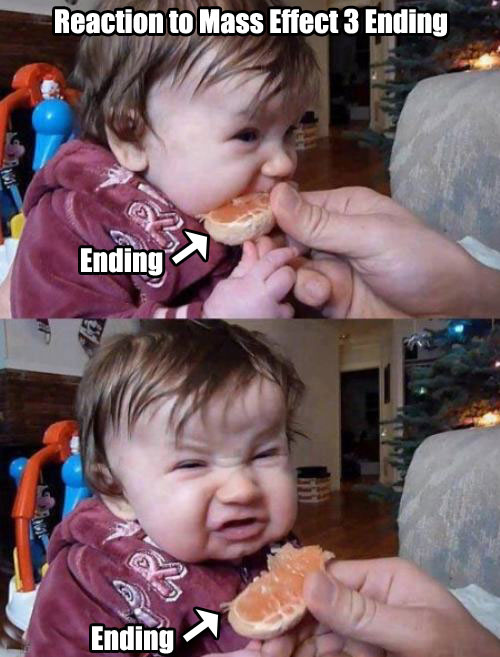
Spoilers below this line!
Before I get started in earnest, whenever I use the term “plot hole,” I am referring to the definition provided via Wikipedia:
A plot hole, or plothole, is a gap or inconsistency in a storyline that goes against the flow of logic established by the story’s plot, or constitutes a blatant omission of relevant information regarding the plot. These include such things as unlikely behavior or actions of characters, illogical or impossible events, events happening for no apparent reason, or statements/events that contradict earlier events in the storyline.
The Normandy Scene
What. The. Fuck.
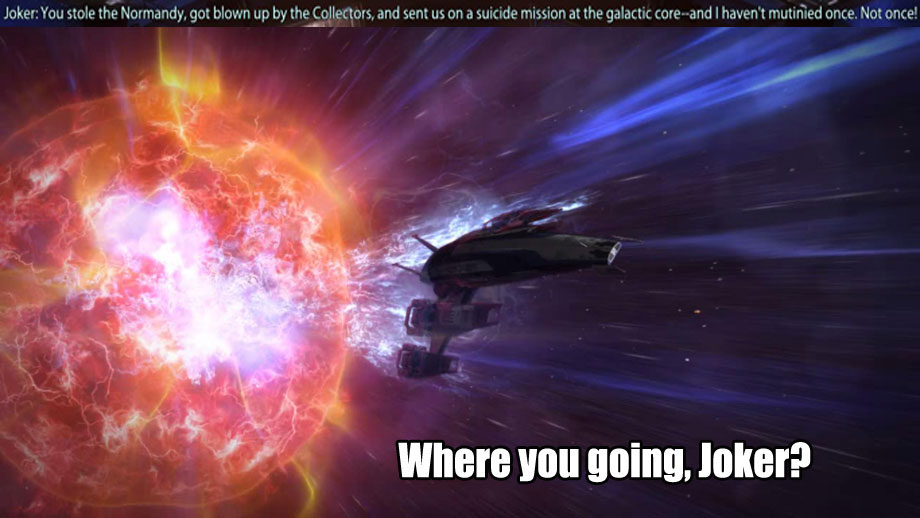
Exhibit A.
More than anything else in the game, the Normandy sequence at the end almost completely and totally ruined the game for me. There is no logical, thematic, or even artistic reasoning for what occurred.
Okay, let me back up. There are two things that this sequence accomplishes:
EstablishesImplies that there is no escape from the Red/Blue/Green explosion. As in, no corner of the galaxy is safe, there won’t be pockets of Reapers hanging out, etc.- It looks cool.
The thing that I want to note though, is that up until this point – beginning from when Shepard stands up post-laser – I had it in my mind that I was going to have to replay the final mission again. Why? Because I had taken EDI and Liara with me, my two favorite characters, and I presumed they were dead. They had to be… otherwise, where were they?
So imagine my surprise when I see this:
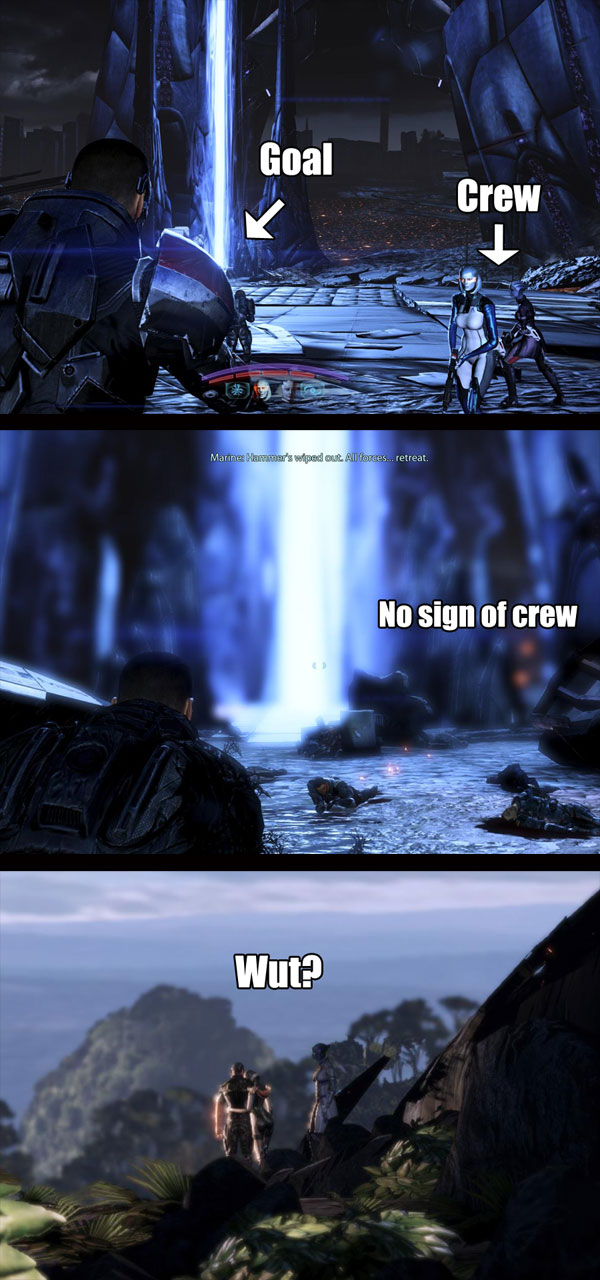
Exhibit B.
The Normandy sequence is the very definition of plot hole. Why was Joker flying away? How did he know to fly away? How did crew that was with you at the beam suddenly appear on the Normandy?
There have been various (tortured) “explanations” I have seen. For example:
Q: How did Normandy end up caught up in the Mass Relay explosion with the people who were on earth?
A: There are clearly some parts of the ending scene that the player doesn’t see. There’s two segments where Shepard blacks out between first running for the beam and his final choice. There’s also a clearly defined scene skip between him rising on the platform and ending up where he meets the ghost child thing. These skips give room for an arbitrarily long period of time for Normandy to escape. Given that Normandy made it that far it seems that this is a reasonable series of events:
1. Somehow off camera(Shepard doesn’t see this happen) the two squadmates you choose get separated during the run for the beam.
2. Everyone gets blasted by the Reaper on the way to the beam.
3. The radio calls go out saying Shepard, along with the rest of the Hammer team is dead, that nobody made it to the Citadel
4. The Alliance fleet calls for a retreat, intending to regroup somewhere else.
5. Normandy picks up the crew still on Earth, then flies out to the Mass Relay, takes it
6. The Crucible, along with the slower ships in the fleet see the Citadel arms open and figure(correctly), that this means Shepard actually survived and opened it.
7. The Crucible docks.
First of all, the necessity of any explanation is proof of a plot hole – who sees the Normandy sequence and goes “yeah, I expected that to happen”? Nobody. Secondly, it has never been established that Shepard is the only person who can open the arms of the Citadel. What that means is that even if the crew “gets separated” or assumes that Shepard is dead, they still should have continued their own individual attempts to make it to the teleport beam.
But, fine, let us assume that the other two crew members were knocked out, and woke up only after Shepard got up and teleported. Why did they not make their way towards the beam then? If the Normandy was capable of making a safe landing to pick up the crew members, whether said crew members were conscious at that point or no, the Normandy could have dropped off additional troops at the beam. Indeed, if the Normandy picked up the crew before Shepard woke up, we would expect them to drop off more troops at the beam (if not search for Shepard’s body). The only excuse explanation I can see for why none of this occurs is an assumption that Shepard woke up first and the beam turned off after Shepard took it (but not before Anderson “followed”).
For now, let us assume that the Normandy had sufficient time and opportunity to pick up the crew members on Earth between the time Shepard opens the Citadel arms and when the Crucible is fired. The fact that the Citadel arms opened and the direct communication with Admiral Hackett proves that the Alliance knew Shepard was both alive and on-board; this disabuses the notion that the Normandy was fleeing to regroup, or for any rational reason. If anything, I would assume that Joker and crew would be waiting around to pick Shepard up, having the only ship capable of doing so.
“If the facts don’t fit the theory, change the facts.”
– Albert Einstein
Incidentally, unlike many others, I am not actually assuming that the Normandy was taking a Mass Relay in that final sequence. It seems to me that the visuals would have looked the same if the Normandy had engaged its normal FTL drives – the explosion only looks like a “beam” because of the Doppler effect of FTL travel. In other words, I can imagine that the sequence itself would have occurred if Joker was trying to avoid either the initial energy explosion from the Citadel, or the secondary explosion from the Mass Relay.
That does not explain why Joker was trying to avoid it, nor whether the damage the Normandy took was because of engine stress or whether all spaceships took similar damage off-screen (e.g. possibly wiping out the space fleet).
What I want to see from Bioware:
- Best Case: an explanation of how the crew (EDI and Liara, in my case) got back on-board the Normandy, what the Normandy was doing while I was on the Citadel, if they knew/suspected Shepard was alive or dead, and why they were running away.
- Worst Case: ensure that the crew with you on the final mission don’t show up in the final scene.
To be honest, it wouldn’t make more sense to see the other crew members, given that everyone was on Earth and fighting to the death. However, it is that much more plausible to see others exiting the Normandy rather than the very people at your side.
Kill the Indoctrination Theory
First off, I want to make it clear that I find the Indoctrination Theory extremely convincing. Indeed, it “solves” a lot of the problems I have with the end of the game, and makes a certain amount of lore sense.
At the same time, it also proves the Bioware writers are terrible.
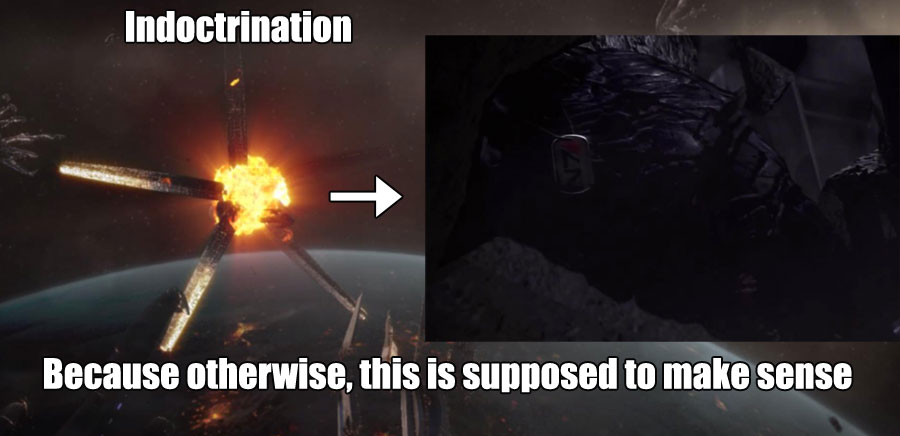
I get it now! Shepard was Master Chief all along!
That notion might not be immediately obvious, but it can be summed up by this quote by Shamus, in the Mass Effect Ending Deconstruction article:
And no, I’m not a believer in the “indoctrination theory“. I think that would be better than the ending we got, but I don’t think it it was ever intended by the writers. This theory involves an incredible level of subtle symbolism, which goes against just how ham-fisted the rest of the story is. To wit: If these writers thought Shepard was indoctrinated in the last stage of the game, we would know it.
Milady also has a recent article on the same subject, entitled The Intentional Fallacy:
[…] To me, the theory is disproved due to a fault in consistency. The unreliable-narrator hermeneutics is not supported by the work’s tone and structure. Mass Effect had until then never attempted any plot exposition that was not direct (like showing videos of the Cerberus scientists at various locations degenerating because of indoctrination, instead of silencing the facts and allow for the player to draw her conclusions based on the environment; that simply had never been done), and surely Mass Effect had not had any dream-like sequences, any instance of unreality, ambiguity. Shepard’s dreams are merely dreams, by what we gather from our previous experience of the game.
In other words, if Bioware intentionally had Indoctrination in mind (har har), they would have wrote it into the story more. I understand that that sounds like a backhanded dismissal of the very evidence brought up in support of the Indoctrination Theory, but I get where Milady and Shamus et tal are coming from. Remember the TV show Lost? Do you honestly believe the writers set out to make a sickeningly cliche religious allegory starting in Season 1? Of course not. In fact, it was pretty clear they were making shit up as they went along until the end of Season 3, when they announced that there would only be six seasons total.
There is also the fact that Indoctrination negates the last half hour of the game. In other words, Commander Shepard starts breathing in the rubble, gets up, and… what? Heads back towards the beam, gets teleported, and still has to open the Citadel so the Crucible (still orbiting Earth) can dock? Or do you suppose that while Shepard was “dreaming” the ending, the Catalyst actually opened the Citadel arms and fired the Crucible with Shepard’s remote orders? I don’t see why he would.
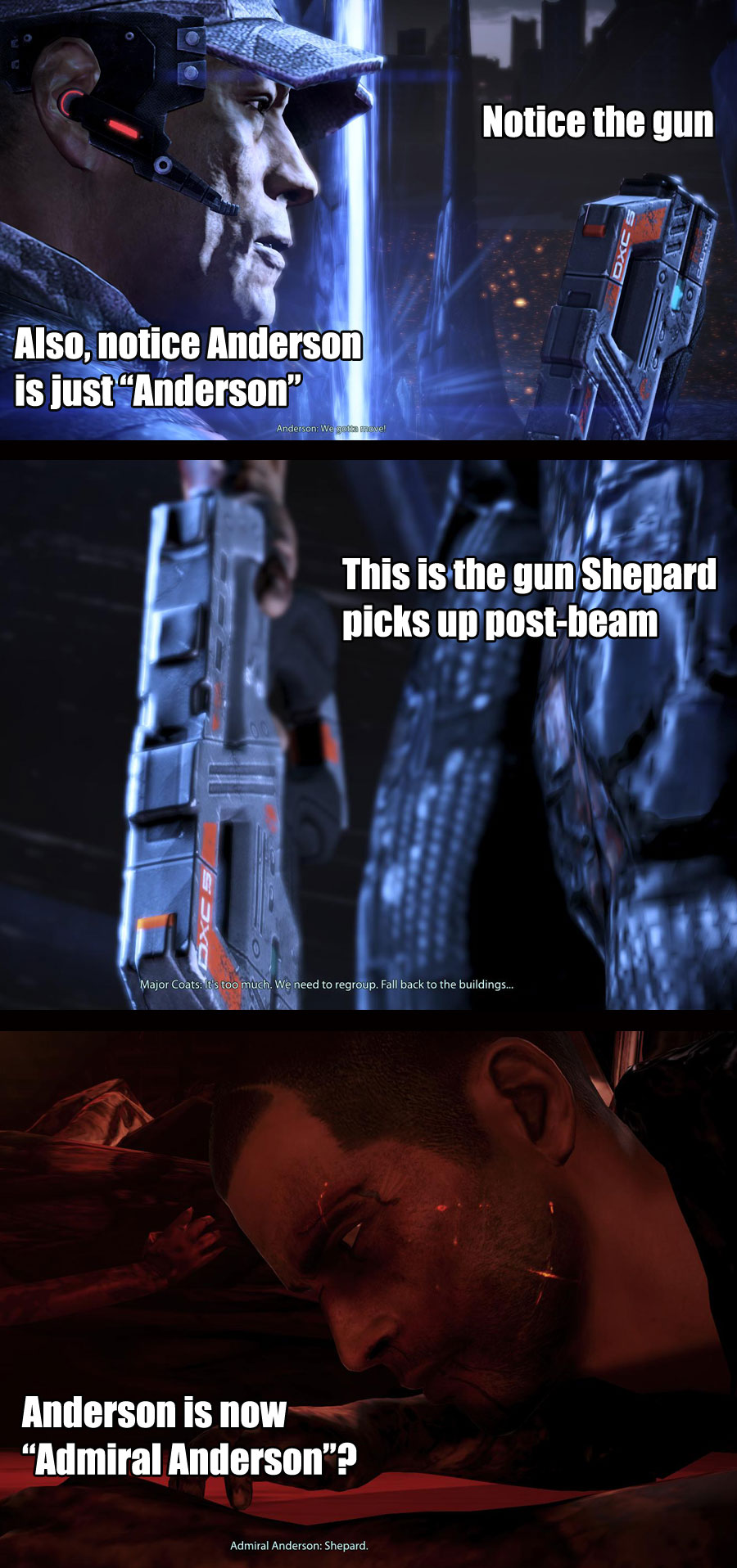
And then you start seeing conspiracies everywhere.
Personally, Indoctrination actually makes the ending worse for me. When I was presented all three choices, I actually chose Synthesis. While many Indoctrination supporters list that as being “what the Reapers were after all along,” that is not really the case. The Reapers were trying to preserve the existence of organic life in the face of an inevitably synthetic-only future – synthesis allows both organic and synthetics to coexist, by removing the difference between them. There is no creator to rebel against.
Even if we assume that Reapers are examples of said synthesis… so what? If everyone is able to keep their own form, as implied both with the ending and the very existence of Shepard (has he/she not already been synthesized?), what is the problem? The Reaper method was bad because you were killed, liquified, and otherwise extinguished as an individual. If you were capable of retaining individuality and agency… what are the downsides?
Oh, right. The downside is that Bioware put in that goddamn “breath scene” only in the Destroy ending, making it a choice between beating the Reapers and living, or doing the right thing (IMO) and dying.
What I want to see from Bioware:
- Best case: Settle the Indoctrination debate once and for all. If Indoctrination is real, include a true final battle scene, potentially followed by the same sort of choices.
- Worst case: Remove the breath scene.
Pave Over the Other Plot Holes
This is really kind of a catch-all category.
What happened to the people aboard the Citadel when it was captured by the Reapers? How did the Reapers gain control of the Citadel? If the Reapers were capable of capturing the Citadel, why didn’t they do it earlier? I mean, Christ, if the entire Reaper modus operandi was to warp to the Citadel to decapitate the galactic leadership… err, why did they change their plans this time around? Just because they couldn’t warp right there doesn’t mean the galaxy is that much less screwed when the Reaper armada shows up manually. Hell, Reapers show up at Earth, Shepard heads to the Citadel to get help, and then finds that the Reapers are already there. Game over.
Of course, this rabbit hole is probably bottomless.
After all, if the Catalyst is in the Citadel the entire time, why does he need the Keepers to do anything? Why not just turn the Citadel radio dial to WRPR 106.1, Reaper FM? How is it possible that the plans for the Crucible have escaped Reaper attention across countless millennia? How is it that countless different species even knew what they were making? As Shamus later states:
Case in point: The crucible is the ultimate weapon, derived from Prothean ruins, yet it was never mentioned or hinted at in any of the previous games. None of the beacons talked about it. Vigil didn’t bring it up, and I’m willing to bet the Prothean squadmate (a DLC character) doesn’t mention it either. This is because it wasn’t planned at the outset. It’s a late-story asspull done by writers who never had a plan.
It is one thing to leave story hooks for future titles; it is quite another to leave plot holes so big you could fly a whole new trilogy through them.
What I want to see from Bioware:
- Best case: Shore up these plot holes via Codex entries, FAQs, or at least acknowledge they exist.
- Worst case: leave everything vague and unsettled.
Conclusion
I do want to make one thing abundantly clear: I still love the Mass Effect series overall.
I just think it should be acknowledged that “artistic integrity” does not mean that the ending was not half-assed, or shouldn’t be changed based on (fan) feedback. If it was Bioware’s story when they wrote it, it will still be Bioware’s story when they rewrite it, regardless of the reasoning behind the revision.
Is there something you would like to see in the DLC? Would you prefer Indoctrination Theory debunked, proven, or left ambiguous? Would you even be interested in DLC set before the final battle, e.g. taking back Omega, etc?
Bioware “Addressing” Mass Effect 3’s Ending(s) via DLC
Dr. Ray Muzyka, co-founder of BioWare, has a blog post up regarding Mass Effect 3’s ending and resulting controversy. The money-shot (literally), is this paragraph:
Building on their research, Exec Producer Casey Hudson and the team are hard at work on a number of game content initiatives that will help answer the questions, providing more clarity for those seeking further closure to their journey. You’ll hear more on this in April. We’re working hard to maintain the right balance between the artistic integrity of the original story while addressing the fan feedback we’ve received. This is in addition to our existing plan to continue providing new Mass Effect content and new full games, so rest assured that your journey in the Mass Effect universe can, and will, continue.
My first, immediate reaction? Summed up by this picture I saw on the Kotaku forums:
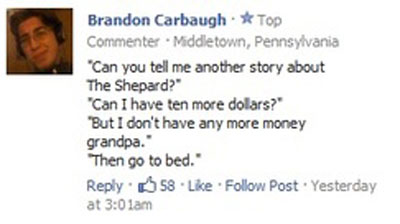
Burn Level: Legendary
Between the wording of that paragraph and the extent to which he stresses that the team was “surprised” at the “passionate reaction of Bioware’s most loyal fans,” this news does not exactly inspire confidence. Implicitly, it sort of disproves Indoctrination Theory, yeah? And even more depressingly, it implies that the team of writers who had crafted this brilliant narrative up to that point felt like the Normandy bit at the end made a single goddamn piece of sense.
I think I need to make a post dedicated to narrative/artistic integrity at some point, if for no other reason than to try and hammer out my own feelings on the subject. I felt post-ending DLC worked well in Fallout 3 (regardless of whether it was based on fan reaction or not), but at what point does this become indistinguishable from game companies selling us the final chapter to incomplete products? If Bioware changes the ending, is that them “caving to pressure?” Is a revised ending still the inviolate artistic expression it was before? And what if the new ending is actually good? Will you be able to, as a player, re-immerse yourself without the nagging feeling of patronization?
While I do some soul gerrymandering on the subject, don’t miss Kotaku’s “Why I’m Glad Bioware Might Change Mass Effect 3’s Ending for the Fans” article, or Forbes’ awesome “Mass Effect 3 And The Pernicious Myth Of Gamer ‘Entitlement’” take-down (thanks to Liore for pointing it out). They sum up my general feelings on the subject, although… well, suffice it to say, I’m the kinda guy that got annoyed that the Oracle was played by a different actress in Matrix 3 (and how they handled the transition) even though the first actress died IRL.
The Weaponization of QQ
The end goal of all QQ is for a game (etc) you enjoy to be fixed or changed for the better.
If you look at something like the WoW forums, or any game forums really, you will see dozens and dozens of impassioned arguments as to why the author is quitting. I seem to recall there being an actual study that demonstrated that the vocal complainers spend the most money on a given game, far in excess of the average; considering I cannot find said link though, let us assume the opposite for now. Why tell tens of thousands of anonymous readers that you are unhappy with the game? Why not just shrug and uninstall?
The ideal scenario in an “I quit” post is for you to continue playing a game you enjoy (in most respects), and for other people to quit. It is like “voting with your wallet,” using other peoples’ wallets. As strategies go, it never seemed too effective, although obviously it is effective enough that moderators tend to shut it down pretty quickly. Besides, the only audience you can reach by posting on forums are the people who read the forums, so any damage is pretty limited.
Oh, the times they are a-changin’.
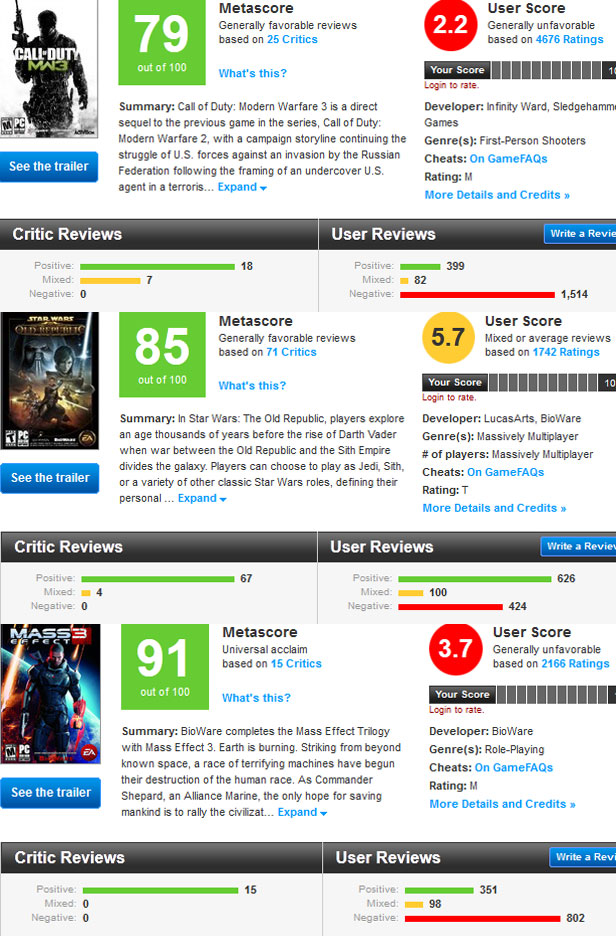
Welcome to the future.
I do not know whether Modern Warfare 3 was the first Metacritic salvo in a post-Weaponized QQ landscape, but it has become increasingly obvious that it will not stand (or fall) alone.
Now, obviously, there is nothing inherently wrong with a game receiving universal critical acclaim by professional gaming journalists, while being panned by uncouth Philistines. Or vice versa! But if you dig a little deeper, an incredibly large portion of the negative reviews for those three games (and who knows how many others) stem from issues not necessarily connected to the game itself – complaints about the state of the game industry, or the existence of Day 1 DLC/multiplayer, or people who wanted a sandbox instead of a themepark.
Maybe those things are connected to the game. Maybe you do enjoy MW3 less knowing how much was copy-pasted from MW2. Maybe people have wildly differing views on what constitutes a “review.”
What I do know is that, going forward, we can expect more of this:

Head to the bunker.
That right there is the present scoring of Mass Effect 3 for the Xbox 360 on Amazon. The PC version has less reviews, but it too is 2/5 stars.
What ever you think about the ending, and how much ever it may have soured the entire experience in your mind… is the game really 2/5? Were all of the emotions you felt during the journey not worth it? I am not entirely sure I want a philosophical debate about the nature of objective experience (or the nonexistence thereof); I just want everyone to know that this is our future.
Believe me, I am the first in line to say that customers have the right to question the creative decisions of designers/writers. However… is this what we want? Do we want developers worried that any reasonably controversial aspect of their work will lead to highly visible backlash? Does that actually encourage higher quality games, or simply encourage safer games? Or are the collateral effects of public catharsis simply their problem?
I used to believe the latter. Now… I’m not so sure.
Interview Overload
Ever read about an hour’s worth of interview transcripts about a game you’re not even technically playing anymore? I have! [emphasis added throughout]
- “However, mounts are sacred–one of the only things left that’s visual prestige. So we do want to make sure we give them out for the right things, like the Challenge Mode achievements Tom spoke about.”
- Re: Guild Leveling. Blizzard isn’t sure they will be increasing the level cap; they may just be swapping out abilities (i.e. Have Group, Will Travel is getting axed). Other big news here is that no daily/weekly XP or Reputation caps anymore.
- “LFR has been huge for us–one of the most successful features in the game, similar to when we implemented the Dungeon Finder. We can watch the numbers exponentially grow–the number of people that are raiding now, compared to before 4.3, is incredibly dramatic–it’s so much more. We can’t tell you the exact percentage, but it’s massively larger. And not only that, they’ve continued to raid, and these are players that have never raided before.”
- Re: Firelands dailies: “What didn’t work is that it’s staged out to take too long for the number of quests you need to do. I think that to get all the marks you needed to get was excessive amount of time.”
- Blizzard doesn’t actually seem to know how the Beta will actually pan out, given that over 1 million people will be getting in.
- You can (i.e. will) farm tokens to buy a consumable item that gives you, personally, an extra shot at getting gear from a boss. It works in LFR, Normal, and Heroic versions of raids. Yes, an extra shot at heroic raid loot. Yes, every heroic raiding guild will require it.
- Blizzard nixed the whole “monks don’t auto-attack” thing. Called that one.
File under Missing the Point:
Q: In addition to the linear nature of Cataclysm questing zones, many players felt that it was hard to feel completely engaged in a zone due to heirloom/guild xp bonuses. They’d outlevel a zone before completing a lot of the major plot arcs. The revamped 1-60 content is complete, but was there anything to learn from this in designing future zones? Especially now that Pandaria has more zones than we first heard about at BlizzCon.
A: Well, actually, we are very deliberately trying to set it up so you can skip some amount of content on the way to 90. We feel those decisions make the World of Warcraft seem like a world. If you look back to original WoW, we had Eastern Kingdoms and Kalimdor, for players to quest in at any given time. There was an amount of choice in what you did–sometimes that choice diminished somewhat, but generally speaking, there were different options.
We’d like to capture that as much as possible, so not only is the quest flow itself a bit less linear, but also your zone choices is a bit less linear. That inherently means you won’t get to do all the quests on the way to 90, but it does mean that if you play the game on an alt, you have an option to do something new.
I think the problems you’ve described with heirlooms or guild xp bonuses and everything stacking becomes worse when it’s linear, because when you end that linear experience before you’re supposed to, it’s a lot more noticeable.
Actually… is Tom Chilton missing the point at all? Reading the response over again, it seems to me he wants WoW questing to get away from zones even having “major plot arcs” for heirlooms and leveling bonuses to trivialize. After all, isn’t the complaint that a person out-levels, say, Duskwood before finishing all the quests in the area? That is only a “problem” if one views the zone as something to be completed. If the zone is instead looked upon as a playground with different equipment – Raven Hill as a Merry-Go-Round, Darkshire as the swing-set, the southern portion as a series of muddy sandboxes – then “out-leveling” it does not make a whole lot of sense.
On the other hand, Chilton cannot have it both ways, right? Players are funneled into Duskwood from Westfall, and thus they encounter Raven Hill first; Darkshire’s issues are as much a part of Raven Hill as the other parts of the zone. Less linear is fine in theory, but there is a meta-narrative that has to glue these quests together in some way. And what about the people who come to enjoy a given zone’s zeitgeist? I love the idea of being able to skip entire zones (Wetlands and Arathi Basin are terrible for Alliance), but the issue at hand is not being able to stick with the zones you actually like. Non-linearity does not fix the issue of quests going gray.
Re: ZA/ZG
With Zul’Aman and Zul’Gurub, they got a worse reputation than they deserved. A big mistake was going from a tier of content that had 9 instances to run, down to a tier of content where you only have 2 instances to run and no raids. If you run people through the grinder of the same two instances over and over, it ends up feeling much worse. If you take any instance and say ‘these are the only two instances you get to run for many months,’ then that ends up feeling pretty bad.
Re: Community
Q: Last question–about community in WoW. There’s been a lot of changes with people coming back and playing together, and using tools like Real ID and Looking for Raid across servers. How do you balance player-created communities across servers with pre-existing raiding guilds, that are facing challenges now like downsizing from 25s to 10s or dealing with real life and scheduling conflicts among older members?
A: I think that is an important balance to try to achieve. Over time, we’ve gone in the direction of making the game accessible to a lot of different people, such as queueing up for dungeons and raids with friends–which have impacted these guild ties and such. So I think that for us, one thing we’re hoping to do is get guild community back with challenge modes, without excluding your average player from content. Certainly with challenge modes, we don’t plan for you to queue up. We feel that if you queued for a challenge mode in Dungeon Finder, that would cause a lot of problems. That guy being yelled at by his wife for 15 seconds will make everyone else pull their hair out and panic that they’re going to miss a medal. It’s an interesting opportunity for us to really emphasize both playing with your guild and friends without it feeling like the average player is missing out on seeing an instance.
Re: Raiding
Q: So you are in discussions about possibly changing how the raid lockouts work?
A: Sure. I think we’re gonna look at how the 10/25 person lockout worked as a shared cooldown. Was that the right decision, or do we want to do something different? I don’t really know what the right answer is yet. We haven’t decided.
And then we get to the Ghostcrawler interview…
Q: So I was playing the Monk a little bit, and I noticed a couple things that were different from Blizzcon. There’s no more dark Chi.
A: <some debate about how to actually pronounce “Chi”>
Q: So there’s no more dark Chi…
A: Dark balls.
Q: There’s no more dark balls, yeah. What prompted that sort of change?
A: [snip]
I am not sure if I mentioned it before, but I genuinely enjoy having Ghostcrawler around. He may be the face of the B Team, he may be a straight-up design troll in some respects, but hey… at least he has a face, yeah? In a world of Bobby Koticks and David Reids and faceless community managers, I am all for more Greg Streets and Curt Schillings, even if they get things wrong.
Q: […] Glyphs was one system I was looking at and trying to wrap my head around the changes. I think you guys had said something about this somewhere, but prime glyphs are basically gone now.
A: Yeah. We apologize for prime glyphs. They were a bad idea. At the time, we were worried that, say, a Paladin who didn’t have a glyph for Crusader Strike would be like, “What the hell? This is my most important ability! I need to glyph Crusader Strike! I don’t want to glyph… I don’t know, Turn Evil or something like that, because I want a glyph for Crusader Strike.” So we did that, and it ended up just complicating everything because now we have to imagine that, “Oh yeah, everyone has stupid prime glyphs that give them 5% damage or crit or something like that.”
See? After talking about a new glyph for Prot paladins that lets you aim Consecration (ala Death & Decay, but shut up), the followup is:
Q: <grinning> See the grin on my face?
A: <laughs> The Glyph of Divine Plea, which Divine Plea is Holy only now, changes it from a “for the next X seconds you’re a bad healer” to a cast time, and then at the end of that cast time you get all the mana right away. So you have to pay the cast time, and while you’re casting you’re not doing anything, but at the end of the cast time you get all the mana and there’s no self Mortal Strike that a lot of Paladins hate.
Want some more? Here was a show-stopper of an admission, from the answer to the problems with Legendaries:
I think part of that is because almost every raiding Rogue had an expectation of getting a legendary. That’s something I’ve talked about a little bit recently. So, one dark secret that players have probably all figured out by now is that Blizzard designers tend to careen from one extreme to the other, and so, when we decide something doesn’t work out, we go to the complete opposite, illogical extreme, and then we reel it back in a little bit. So, we were kind of reacting against the Warglaives model where, “You have a tiny percent chance of getting a legendary! Congrats!” to trying to make it a little more predictable, and the way we did that was with the style where you need so many parts, and the parts have a fairly predictable droprate, and eventually you’ll have your legendary, which then led to the opposite problem of they’re super predictable, people could point to a calendar day and say, “April 20th! That’s when I get my legendary!”
What sort of designer admits that? Bad ones? Good ones? Final quote:
Q: Interesting. So you did a blog post a while ago about the “Great Item Squish (Or Not) of Mists of Pandaria.” I noticed that the combat text was popping up and saying things like “14K” instead of 14,000 or whatever. Is that the route you decided to go with, like the “mega damage” approach?
A: Yeah, we went with the “not.” Mega Damage, here to stay. So we had this all in and working. We squished everything, and it was working. We had the whole thing implemented, and we sat down and tried it out, and, you know, Mortal Strike hit for 200, and Fireball hit for 150, and we were like, “This feels wrong.” We knew exactly how it would feel like, and we knew that our damage as a percentage didn’t go down, but it felt terrible. And we were like, “Okay, this is now super risky”, because we’re going to change talent trees on players, and even though we think it’s a great design, and we think players will love it, it’s a hard sell. And to do that, and have them hit really wimpy, I think even if players understood why we did it, deep down they wouldn’t like it.
So we decided to back off of that. We’re trying the solution with commas, and K’s, and M’s, and to be honest, it helps a lot, and our hope is, by 6.0 or 7.0, players are demanding the item squish, and by then it’s not controversial at all. It’s like a celebration when we finally do it.
Okay, so that is a lot to digest.
Instead, I think I’m going to play some more Mass Effect 3 multiplayer.
 In An Age
The Gray Moral Morass
Mar 29
Posted by Azuriel
You may or may not have been following the whole EVE cyberbullying thing.
Syncaine being Syncaine, he is both morally repugnant and technically correct in his deconstruction of the argument. What exactly can one do in defense against the emotional blackmail of “I’m suicidal?” Is that not carte blanche acquiescence to every situation, including purely PvE concerns of “loot didn’t drop, so I might as well”? And what about the in-game incentives CCP purposely built into EVE to encourage competition, subterfuge, and retribution?
So, on a whim, I decided to check EVE’s Terms of Service. And I don’t even recognize what game they believe it’s for (emphasis mine):
As an Eve Online subscriber, you must observe and abide by the rules of conduct and policies outlined below, as well as the End User License Agreement. Failure to comply with these regulations can result in the immediate termination of your account and you will forfeit all unused access time to the game. No refunds will be given.
1. You may not abuse, harass or threaten another player or authorized representative of CCP, including customer service personnel and volunteers. This includes, but is not limited to: petitioning with false information in an attempt to gain from it or have someone else suffer from it; sending excessive e-mails, EVE-mails or petitions; obstructing CCP Employees from doing their jobs; refusal to follow the instructions of a CCP Employee; or implying favoritism by a CCP Employee.
2.You may not use any abusive, defamatory, ethnically or racially offensive, harassing, harmful, hateful, obscene, offensive, sexually explicit, threatening or vulgar language. (Alternate spelling or partial masking of such words will be reprimanded in the same manner as the actual use of such words.)
3.You may not organize nor be a member of any corporation or group within EVE Online that is based on or advocates any anti-ethnic, anti-gay, anti-religious, racist, sexist or other hate-mongering philosophies.
4.You may not use “role-playing” as an excuse to violate these rules. While EVE Online is a persistent world, fantasy role-playing game, the claim of role-playing is not an acceptable defense for anti-social behavior. Role-playing is encouraged, but not at the expense of other player. You may not create or participate in a corporation or group that habitually violates this policy.
Did I pick the wrong ToS? This is for EVE – EVE – right?
There was also Rule 9:
…but after some thought, it was probably intended to prevent IRL pyramid scheme spam.
So, assuming that CCP enforces their own ToS, there clearly are lines in-game actions can cross, the people behind the pixels are protected to an extent, and it is not the exact free-for-all that it is made out to be. That said, I do wonder about the degree of dissonance between the “no harassment” policy and in-game bounties, war-decs, and general grief potential. Is there any evidence that CCP has acted on this policy before? Is it harassment if I get shot down by a Goon ship every time I enter Goon territory? They just won’t leave me alone!
Incidentally, here is Blizzard’s stance on harassment on PvP realms:
In related news, the deal will probably be over by the time this post goes up, but did you know this happens:
Cheaper than most F2P games!
That’s… almost tempting. And kinda ridiculous at the same time.
Posted in Commentary
11 Comments
Tags: Cyberbully, EVE, Harassment, Moral, Terms of Service