Review: Mass Effect
Game: Mass Effect
Recommended price: $15
Metacritic Score: 89
Completion Time: ~32 hours
Buy If You Like: 3rd-person pseudo-RPG shooters

Subtitles: On.
It is somewhat difficult trying to review a franchise-launching game like Mass Effect years after its initial release. Should it be compared to the standards of games of today, or of its time? Is it even realistic to believe the experience can be compartmentalized away from the knowledge $200 million MMOs are using its primary narrative mechanics 4 years later?
As I watched the ending credits this past weekend, it became clear in my mind that the concerns were largely moot. I loved this experience, I loved the narrative, I loved the setting where the writers were taking me. And I loved these things despite the weakness of the actual game bits of the game.
The combat system in Mass Effect is a cover-based 3rd-person shooter meets half-assed RPG elements. The shooting elements were decent on their own, even if the majority of the fights seemed to oscillate between completely trivial to instant death (at least towards the beginning). Your squad members are mostly competent in straight-up fights, although controlling them was sufficiently awkward that I was glad it mostly seemed irrelevant to the outcome.

Owned.
The “RPG elements” of the game though? I have mentioned this before, but there is really no point in having gear with stats – or talents that grant stats – if there is no way to actually look at your stats. Talent A gives me 3% more Hardening, but Talent B decreases the cooldown on my Throw ability by 5%. And yet I have no idea what my Hardening percent currently is (or, honestly, what it even does) or what my cooldown on Throw is currently sitting at. The first talent point in the weapon skills appears to boost damage and accuracy by crazy amounts (~10% vs 1-2% increments), but it is difficult to feel clever about making good choices when you never actually get to see numbers go up.
After the first area is cleared, the game map opens up most of the galaxy and gives you free reign to plow through dozens of side quests in a fairly non-linear fashion. The problem here is that it is all the same… literally. Each system has a landing planet where you are dropped off in a vehicle, drive around collecting junk, and cap off the experience in one of the two possible building layouts that are otherwise copy-pasted across the universe. Sure, the box maze is slightly different, but there are only so many times one can endure entrance corridor, large room, T-tunnel, two side rooms (or big room, small side room, stairs, small side room) before the very thought of landing on a planet becomes nauseating.
But then I asked myself why I was doing all these side quests to begin with. And the answer was that I loved it here. I didn’t want the game to end. I wanted to stick around in a game setting that people took the time to actually try and make intelligible. How is faster than light travel possible? Element Zero reduces mass, i.e. the Mass Effect. Why don’t we care about ammo? “Bullets” are just shavings off a brick of nondescript metal, accelerated at high speeds. Why can people take a bunch of bullets to the face? Kinetic shielding.
Mass Effect is Sci-Fi, but it doesn’t feel like the hand-waved or mystical Sci-Fi of settings with hyperspace or The Warp. Element Zero is fantastical, sure, but its interactions within the realms of physics largely makes sense. In other words, Mass Effect has more in common with Dune than Star Wars. And that is amazingly refreshing.

See you soon, space cowboy.
What is more than merely refreshing is the inclusion (and highlighting) of non-verbal dialog in an RPG. All dialog is fully voiced, which goes a long way in bringing otherwise disposable NPCs to life. But when they start winking at you, touching your character, raising an eyebrow… you realize how far the genre has come since Kefka’s 16-bit laugh of madness. Mass Effect might not break a lot of ground plot-wise, but it does break ground in the sense of being drawn into caring about the plot in ways most other RPGs can not achieve.
Overall, I was very, very impressed with my ~32 hours spent in this new universe, and eagerly look forward to spending some more in Mass Effect 2. And if they shore up some of the rough edges in the combat system, all the better.
Skyrim: Day 0
The ideal scenario, I believe, is to start playing popular (or notorious) games right when they come out. Not only is the potential for spoilers minimized, but there is also something to be said in exploring a brand new game as a virtual group, together. And the pageviews. Can’t forget about the pageviews.
Riding in on the backwash of the tidal wave of Skyrim blog posts does grant me the sort of perspective that First Day/Month players don’t start out with. Sometimes it’s good (“Don’t Sneak into a wall for two hours.”), sometimes it’s bad (“Infinite mana via Enchanting, yo.”), and sometimes… well, you start noticing things right away:
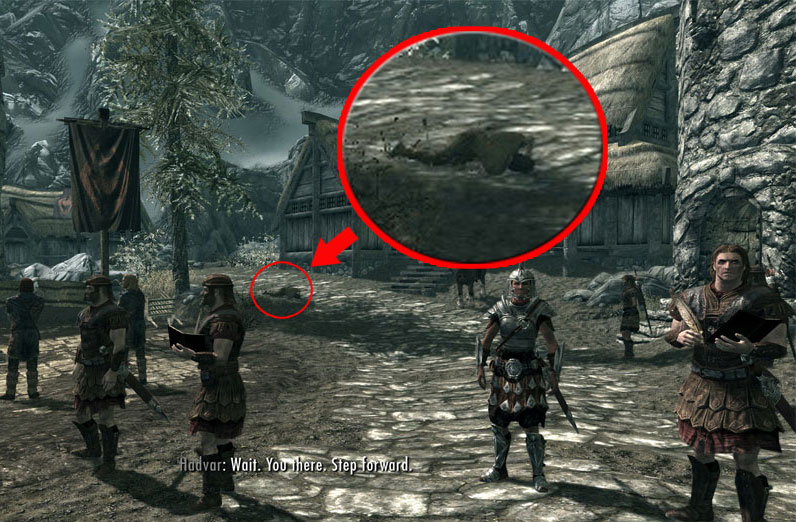
Wait a minute... did that arrow really hit him in the...
That aside, I wanted to kind of lay out the way I was approaching Skyrim before I get too far (12 hours and counting) into it to remember – indeed, I only stopped to write this because I had a C++ crash-to-desktop interrupting me.
- I strongly disliked Oblivion overall; in many ways, I considered it the anti-RPG. Here was a RPG that punished you for specializing in three skills that you actually use. Here was a RPG filled with quests that had no rewards, i.e. XP. Here was a RPG that discouraged exploration insofar that dungeons get stocked with crap treasure the earlier you reach it. Here was a RPG I broke in half after an hour of tinkering at the weapon enchanting workbench and 1000g (“Hey… -100 HP for 1 second costs practically nothing. And it can reduce them to zero? And it stacks if you cast it real fast?!”).
- If I’m honest, Oblivion’s true crime could simply have been that I played it after having spent 150+ hours in Fallout 3. Not only do I enjoy post-apocalypse settings better than fantasy, but it did everything else Oblivion seemed to be trying to do, but way better. Scaling enemies felt a lot more natural in Fallout 3, for example, while still allowing you the freedom to go practically anywhere starting at level 2 (something lost in Fallout: New Vegas, but that’s another post).
- I did finish Oblivion, albeit after starting a fresh character with 3 non-used specialized skills, a sword/bow that instantly killed everything below 100 HP, and a general disinterest in side-quests. There were some genuinely novel things going on, and I do remember a few of the quests. Like when you had to fish a ring out of a well, but the ring was enchanted to weight 200 lbs. It sounded (and felt) exactly like something out of my college buddy’s D&D campaign.
- The Shivering Isles expansion was loads of fun, and easily better than the entire normal game.
If the above sounds concerning in any way, allow me to alley those fears: I walked into Skyrim with a fundamentally different attitude. In the years since Oblivion, games like Minecraft (and, if I’m honest, other gaming blogs) taught me to enjoy more free-form, emergent gameplay.
I still prefer narrative-driven games, of course, but having an audience for Show & Tell purposes actually gives those random occurrences a narrative feeling – nobody cares about the crazy dream you had last night, but hey, look at this:
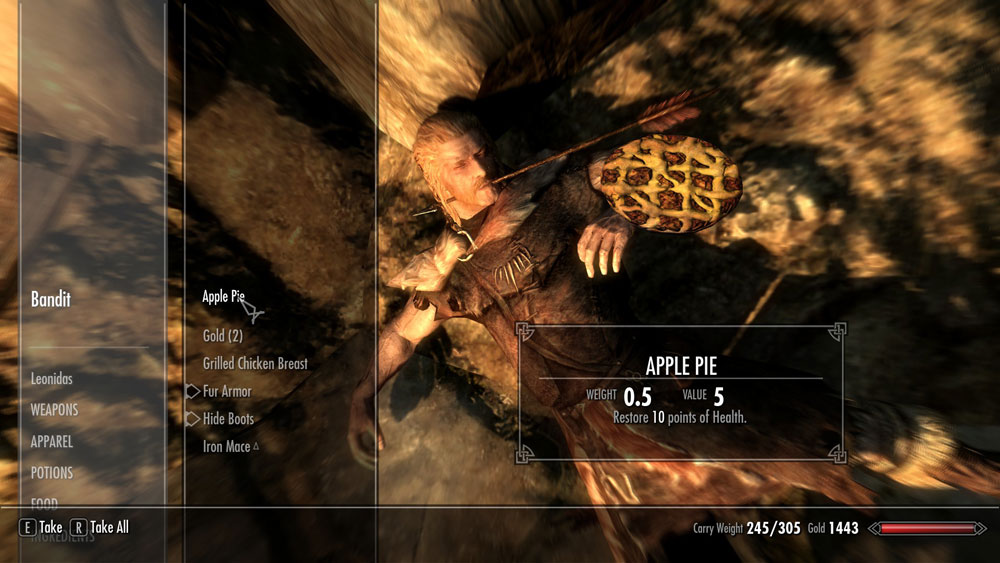
Horrific arrow wounds + delicious apple pie.
So, anyway, Skyrim is happening. Given the blogging saturation surrounding the game, I will attempt to keep “Christ, look at that mountain!” posts to a minimum. There is actually some topical problems I have with the game’s design, which I’ll get into a bit later. Interestingly, none of the problems are the interface.
Little-Known Game
Finished Mass Effect over the weekend.
As I was browsing my Steam game list looking for, you know, a shorty, breezy title to cleanse the palate, I came across a game I hadn’t heard much about in the blog scene. Not quite sure what it’s all about yet – it has something to do with dragons and getting lost in the woods and collecting brooms, I think. Since there doesn’t seem to be much written about it, I’ll keep poking around and let you know if I find anything interesting.

Grains of Salt
In the course of researching EVE’s current subscription numbers (did they in fact break 400k?), I came across the PDF detailing the minutes from the last CSM meeting. In my Crtl-F’ing down the page, I came across this passage:
CSM continued to the point of how does risk versus reward scale? “Badly” (followed by laughter) was the response from some of the people in the meeting. The CSM suggested that rebalancing prices of modules so that average cost of modules versus cost of hull would be reasonably constant. Right now looting a frigate wreck gives you a good fraction of the value of the ship (because most of the value is in the modules), vs. larger ships where this isn’t true. Right now T2 is so cheap that it’s a no brainer, if you can use T2, you use T2. Following this train of thought, the CSM said it’s hard to make money by PVP’ing, most people now grind money so they can PVP. By adjusting somehow the drops from PvP, it could be possible to make it viable to only PvP, ISK vice. PvP-ing in a frigate means that you only need to kill a few ships to break even, flying in a Vagabond means that a player needs to kill 100 (in the ballpark at least) to pay for that ship. One CSM member pointed out that that buying a ship to fight in is not an investment in making more ISK (like when a player invests in his mission running ship), it is an investment in fun. CCP asked in turn whether it wasn’t a bit depressing to have to run content in the game that a player doesn’t necessarily wants to run, in order to be able to have fun. The CSM responded that all activity added to the game, there wouldn’t be ganking of helpless miners if there was no one mining.
Consider my eyebrow raised.
Now, I have been thoroughly warned about the propaganda and lies and how “everything these reps are saying has been vetted by PR people.” But taken on face value, it interests me that designers could be “depressed” about forcing players to grind before they have fun, and then the players (or the group representing them) defending the practice.
One of the big justifications in WoW for requiring Badges of Justice for the PvP cloaks back in TBC (and requiring raiders to cap Valor with heroics since then) was exactly that sort of cross-pollination. It is a sticky design issue, for sure.
Of course, this paragraph also happened:
A side-discussion ensued about why people try EVE. CSM pointed out that the unique attraction of EVE was “you can grief people” and “it’s not a game for wusses”. It was also pointed out that the broad scope of the sandbox was both a selling-point but also a negative — it was easy to get lost.
My particular deal-breaker is arguably a reason why I should not be in MMOs anymore: EVE seems particularly hostile to single-player gameplay. Carebear guilds Corps aside, I have little desire to reenter a position of social obligation, having driven that particular nail deep enough already. If I’m logging on at 9pm, it will be because I wanted to, not because I seek to avoid awkward, passive-aggressive guild drama.
Now, if I find like-minded people later? Sure, let’s go destroy something beautiful together.
Massive Effect
Having completed Torchlight, I decided to move onward to Mass Effect. Why not Skyrim, which is literally burning a hole through my Steam library? As Liam O’Brian might say, the status of my preparations is in doubt. I prefer one meaty title with a helping of indie garnish along the side – with something like Skyrim, I’m getting the impression that I’ll still be eating turkey sandwiches for months later.
About 5 hours into Mass Effect, all I can say is holy shit.
One of the most groundbreaking things occurred in the city after the first “dungeon.” In talking with a receptionist to the Consort, she winked at me.
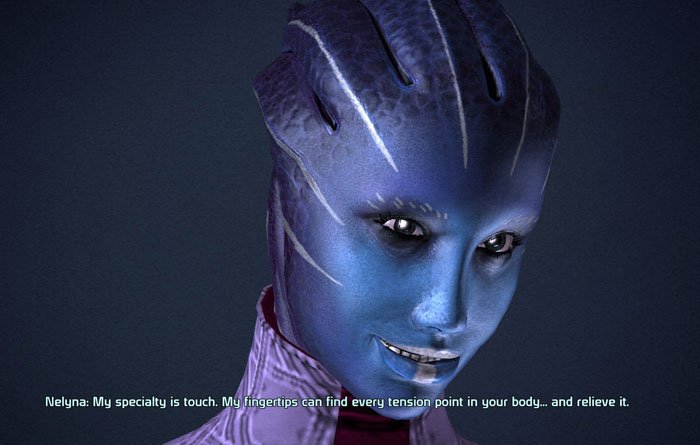
She also said that, but nevermind.
My incredulity may sound facetious, but I am actually very, very impressed.
See, I have been thinking about the problems with storytelling in videogames for quite some time. How is one supposed to convey subtle nuance in a game? In purely written works, it is somewhat easy to evoke the emotion you want to get across, provided you massage the language a bit. For example, consider the following:
‘Look, I can explain,’ he said.
Lord Vetinari lifted an eyebrow with the care of one who, having found a piece of caterpillar in his salad, raises the rest of the lettuce.
How could someone ever translate that in game form? Nevermind Vetinari’s specific sentiment here, think generally: there is an entire genus of expression that the format is preventing designers from expressing.
Games have some pretty unique qualities that cannot be replicated by other mediums too – Far Cry 2’s plot wouldn’t work without player interaction – but many times it feels as though designers simply give up. Game narratives are written in the language of action because of these restrictions on expression. Why are we always killing 10 [%local_wildlife]? Or killing everything, period? Well, how else are you supposed to convey conflict when reduced to crude avatars with clubs? Even though all games have access to written dialog, at some level we do expect everything to be translated into the language of action. And until the last few years, it was functionally impossible to express more than a rudimentary emotional gesture anyway.
There are pitfalls too, of course. Blink during the wink, and you’ll have missed it. Or, hell, focus on the subtitles and miss it too. It is also arguable about whether games should try and be more like the other mediums, instead of focusing on its own unique strengths.
To that last charge, I say “Watch that scene in FF7 again.” Pay close attention at 1:19. More than the murder itself, it was Sephiroth’s smirk that drove home how irredeemably evil the man was. Without the CG movie we would never have saw it; calling attention to smirk in-game via text would have ruined its subtle gravity. While story can certainly be a crutch to prop up forgettable gameplay, story can also be a pole that vaults a game into the classics.
So, Mass Effect, you have my full attention. I just hope you do a little more winking a little less of this:
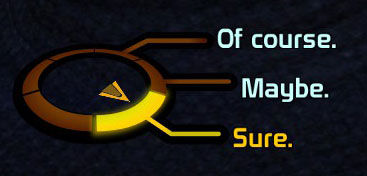
Decisions, decisions.
Raph Koster Says Immersion is Dead
More or less (emphasis not added):
Things that we once considered essential to games drift in and out of fashion. And I think immersion is one of those.
Immersion does not make a lot of sense in a mobile, interruptible world. It comes from spending hours at something. An the fact is that as games go mainstream, they are played in small bites far more often than they are played in long solo sessions. The market adapts — this reaches more people, so the budgets divert, the publishers’ attention diverts, the developers’ creative attention diverts.
As I watch my son and daughter play games or participate in role play sessions, I find myself reluctantly admitting to myself that it is a personality type that ends up immersed in this way, and were it not in games it would be in something else. Immersion isn’t a mass market activity in that sense, because most people are comfortable being who they are and where they are. It’s us crazy dreamers who are unmoored, and who always seek out secondary worlds.
It’s just that games aren’t just for crazy dreamers anymore.
The part that struck me in particular was later on when he said:
But stuff changes. Immersion is not a core game virtue. It was a style, one that has had an amazing run, and may continue to pop up from time to time the way that we still hear swing music in the occasional pop hit. It’ll be available for us, the dreamers, as a niche product, perhaps higher priced, or in specialty shops. We’ll understand how those crotchety old war gamers felt, finally.
There are immediate, topical parallels to be drawn, of course. Difficult MMOs, for instance. And then, if immersion can go out of style, what does that say about sandboxes in general?
…actually, considering the widespread success of Skyrim, Minecraft, and the stubborn persistence of EVE, I am not entirely sure what he is talking about. Did he honestly believe the opposite, that immersion was something more than a niche genre? That there is a true Form of gaming that always included it? I enjoyed my years of table-top D&D, especially the world-building aspects of a six-year stint of being a Dungeon Master, but I was perfectly fine coming back home and doing some Battlefield 2, building M:tG decks, or playing some Super Smash Bros.
I am not too concerned about it though, because the name Raph Koster means nothing to me, regardless of how often he is quoted as being an “authority” on game design. Similar to Will Wright, the moment you stop making successful videogames or your ideas stop creating them, is the moment you cease to be an authority on the subject. Simcity 2000 ranks up as one of the best games I ever played (and it’s highly, highly underrated Streets of Simcity “expansion”) but come on, Willy. Get back on the horse, we need you.
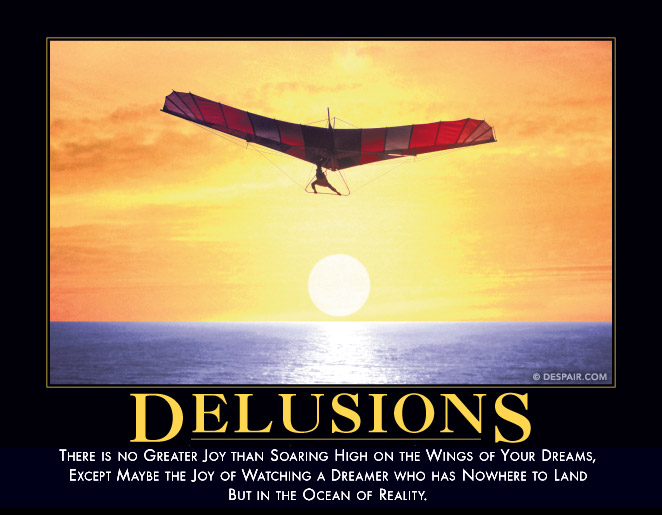
And it might be juvenile schadenfreude, but I couldn’t help but giggle when Raph Koster talked about how his own children apparently disproved his life’s work. This Demotivational poster came to mind:
Reviews: Torchlight, Orcs Must Die!
Game: Torchlight
Recommended price: $0
Metacritic Score: 83
Completion Time: ~17 hours
Buy If You Like: Bad, bad dungeon crawlers
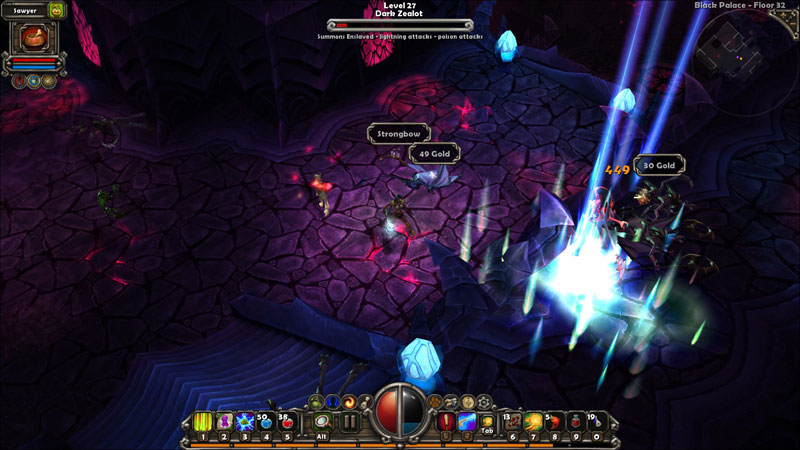
Four enemy types, 20 different skins. *Yawn*
According to Wikipedia, the Uncanny Valley is a hypothesis in robotics and 3D animation which holds that when human replicas look and act almost, but not perfectly, like actual human beings, it causes a response of revulsion among human observers. In other words, humans respond positively to human-like robots up to a point, after which our reaction to its failings is far more negative than would be towards a clearly non-human machine. Based on my overall experience with Torchlight, I firmly believe there is an Uncanny Valley of Game Design, which Torchlight cratered into face-first.
To call Torchlight a Diablo-clone is misleading; I would term it more a Diablo-mockery, although that implies Torchlight was intentional in its failings rather than simply being a cheap knockoff, like Chinese powdered milk laced with industrial solvents.
At first, everything is classical Diablo in a Warcraft 3 skin: isometric, dungeon-delving gameplay, hordes of monsters, loads of loot. There even appears to be a lot of improvements to the formula. The dog/cat companion makes the delving feel more homely. The three classes are actually modular archetypes, such as being able to make the “archer” into a rogue, the “mage” into a tank, and even the “barbarian” into a ranged magic-user. Four generic spell slots for your character and two for the pet let you do some interesting things to complement your own class abilities. I thought the Fame mechanic (Fame is like a second XP bar that only gives you extra talent points) was a clever way of making the killing of named mobs important without necessarily making you overpowered.
It was around hour six though, that I realized that Torchlight had not yet blinked its glassy, vacuous eyes.
There is no real gear progression in Torchlight. Let that sink in for a moment. I received an orange-text Unique neck item around level 4 that I was unable to replace for the duration of the entire game. Random stats are random, but when a random level 10 green is as powerful as a random level 30 green, the entire loot-centric nature of this particular genre collapses. The consolation prize mechanic is Enchanting, where you put an item in a box and have about even-odds that you paid someone 10% of your wealth to destroy said item. No, seriously. Find a decent weapon, put it in a box, pay ~1200 gold for a chance to add a random stat upgrade on it, a chance that nothing happens other than your gold evaporating, or an increasing chance your item gets disenchanted, completely wiping all its stats. The first item I tested this on got disenchanted on a 4% chance, and the second was an Unique-quality bow that was disenchanted on the first, 2% attempt.
I got an achievement for it. No, seriously.

Bum Luck: You installed this game.
Now it did occur to me that perhaps they were attempting something novel, a kind of re-imagining of the transitory nature of loot in Diablo-esque games. An upgrade isn’t an upgrade off the ground, but only after you “win it” from the Enchanter, or something. The problem is that whoever balanced this garbage was a goddamn moron. Enchanting costs gold. A lot of gold. The items you pick up off the ground never really increase in value the deeper you dungeon delve, such that each time you unload your haul in town you get the same ~2500g at level 10 that you do at level 30. Even Epic or Unique items sell for complete peanuts; the highest price I got for a sale was 1,809g for the level 4 Unique necklace I mentioned earlier, which the vendor turned around and was trying to sell for 82,432g. That’s right, instead of the typical 1/3rd or 1/5th cut you see in normal games, Torchlight is operating on GameStop levels of Fuck You resale value. If something could be worse than selling at 1/45th value, it would have to be the necessity of Transmuting four pieces of magic gear to turn into a random crappy gem, which needs to be transmuted with ~12 more crappy gems to get a mildly useful gem, to have something to put into the sockets of the level 8 shoulders you are otherwise never going to replace.
I am spending all this time talking about loot because loot matters in these games. Once you cease expecting any upgrades, the endless, nondescript corridors are filled not with opportunity or excitement, but are instead arteries clogged with the fatty plaque deposits of meaningless mobs. The original Diablo did not have much of a plot beyond “save us from evil” that I can recall, but the setting of gritty evil provided its own sense of gravitas. Conversely, Torchlight does not even bother. “Sidequests” are perversions of the term, and amount to simply killing mobs you were going to kill anyway slogging towards the stairs. Even worse, the “quest rewards” for these things are randomized green items. Look at this shit:
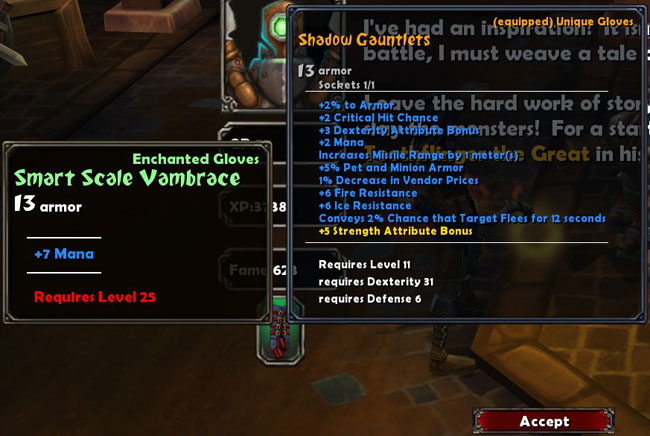
Equipped item on right, "Quest Reward" on left. Note the Required Levels.
The thing I kept hearing regarding Torchlight was that former Diablo 1 & Diablo 2 designers worked on it. If their contribution to that series is at all representative of what I experienced in Torchlight, then all I can say is good goddamn riddance.
Well, that, and I have never looked forward to Diablo 3 more than I have now.
Game: Orcs Must Die! + DLC
Recommended price: $10 (DLC included)
Metacritic Score: 84
Completion Time: ~11 hours
Buy If You Like: More trap-based Sanctum tower defense
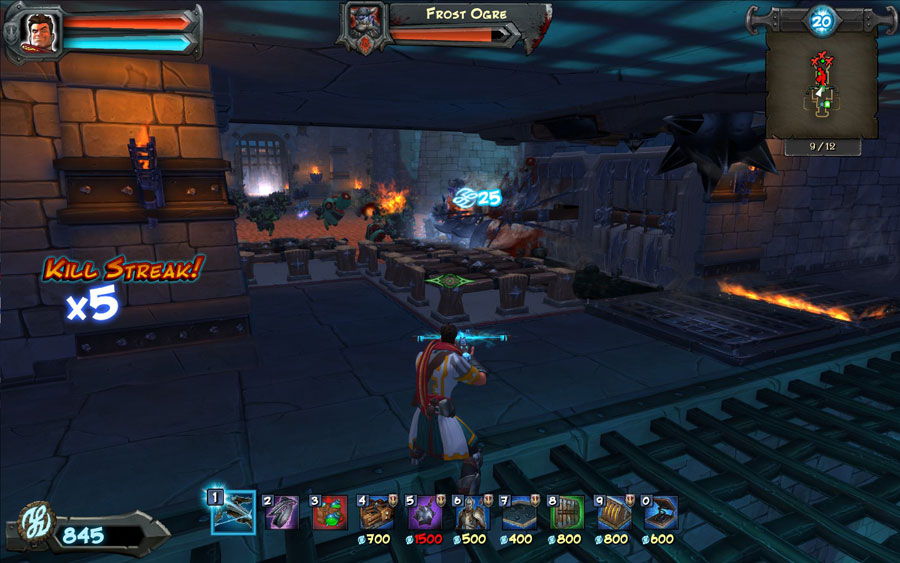
Few things feel better than killing orcs. Maybe Nazis. Or maybe Nazi zombie orcs.
Orcs Must Die (hereafter OMD) is one of the best, purest non-Tower Defense… Tower Defense games I have played. The premise is simple: the orcs are at the gates, and you must stop them. The rest of the game follows a simple elegance undermined only by the limitations of genre conventions.
To be honest, OMD felt like it had more in common with the brilliant PS1 Deception series than it does with Tower Defense. You start off each level by choosing a limited number of traps from your collection, in addition to personal weapons/spells that you will be using to kill the orcs. Traps range from spikes that impale from the the floor, to arrows that shoot from the wall, to mechanized swinging maces from the ceiling, to archer guardians; weapons include Fire/Ice/Lightning/Wind rings, to melee battlemage staves, to your trusty magic repeating crossbow. Later on, you can further select from 1 of 3 “Weavers” for that level, whom act as mini-talent trees that boost your effectiveness in different ways. Once your arsenal is selected, setting up traps costs a set amount of currency from a limited pool that grows between waves and from your merciless slaughter of orcish hordes.
And yet OMD deviates from the standard Tower Defense genre in many key, innovative ways. The most obvious is the fact that your Ash-from-Evil-Dead character can (and must!) get down and dirty in the fighting himself. While certain trap setups essentially make victory guaranteed, you typically won’t have enough currency to set them up in the early waves, and certain levels contain too many chokepoints to trust to traps alone. The standard orcs will actually chase you around if you are nearby, which can buy you some time for allow for traps to reset. Moreover, there are some enemy types like the ogres (fire, ice, and armored varieties) whom are too tough for typical traps to kill outright, and the downright scary Gnoll Hunters who leap over your orc-stopping waist-high barriers and hunt specifically for you.
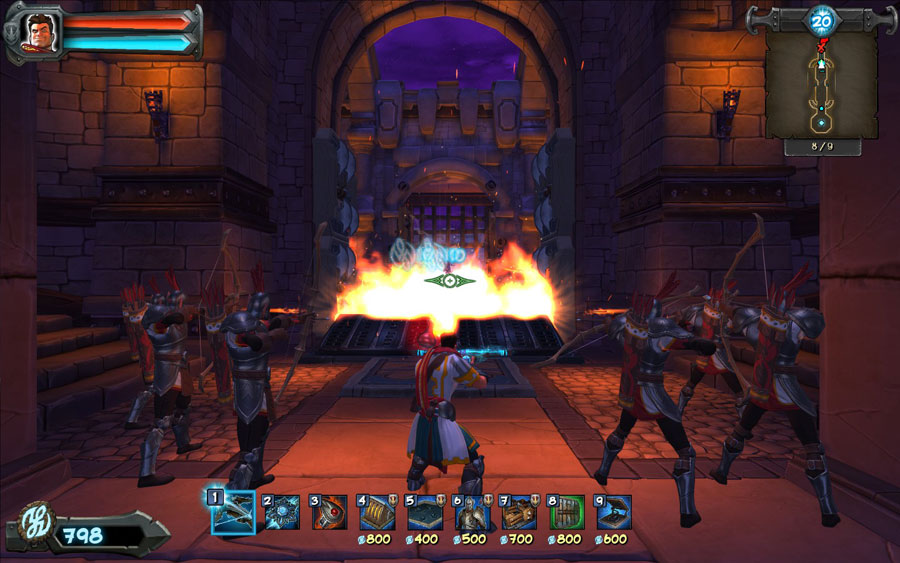
Ain't no one going home tonight.
The other area in which OMD forges ahead is in its rather brilliant, non-standard level design. In typical Tower Defense, everything is gridded out in neat, orderly squares. While traps require certain precise placement, I never got the impression from any of the levels that they were build specifically to place your traps “just so.” Fluted columns and flying buttresses foil wall and ceiling traps respectively, while floor traps cannot be placed on stairs. Any time I actually saw a 2-3 “square-trap-wide” corridor, I would get excited, like I won the goddamn architectural lottery rather than feeling this was exactly where the designers wanted my traps to go.
While there are some additional innovations like permanently upgrading traps by spending the orc skulls you earn based on level performance, OMD is unfortunately limited by genre conventions. I applaud OMD for not falling into the Tower Defense trap (har har) of simply increasing the HP of the enemies as a crutch for increased difficulty among waves, but after a while you will come up with trap setups that are essentially unbeatable. Much like in every Tower Defense game I have ever played, the slow traps (e.g. Sticky Tar Trap) are fairly overpowered; similarly, some traps and weapons feel too good, especially compared to others that don’t seem to have a place. I almost feel as though the game would have been improved if there was a mode or option to where you get a randomized list of traps, rather than entirely relying on level design to inform your decision. Or if there was some kind of incentive to utilize the “bad traps” in unique ways – since the Leaderboards are based entirely on points, I could imagine some kind of score multiplier for trying to use the Steam Trap or Push Wall Trap effectively.
Ultimately, OMD provides for some very enjoyable orc-killing and trap-setting Tower Defense gameplay. There is a Nightmare mode available for the masochists out there that hate more than 3 seconds inbetween waves, or you can try and top the Leaderboards on the traditional levels; the latter is actually fairly addicting when you have Steam friends who have the game, since their scores are highlighted in comparison to your own. Even if you are not interesting in replay value, the general play value of OMD is exceptionally high for what amounts to an inexpensive indie game.
DLC – Artifacts of Power
This pack comes with two weapons and two traps. The Alchemist Satchel lets you toss down a sort of glass caltrop which you can detonate at any time with a right-click, by shooting it, or letting a trap trigger it for you; the explosion is huge and will one-shot every orc in range, making this a fairly overpowered weapon for the early game (before the later rings). The Vampiric Gauntlets essentially lets you drain health from whomever you are aiming at, while the right-click turns your own health into mana; overall, the effect is pretty weak compared to your other options. The Shock Zapper ceiling trap is ostensively for killing flying enemies, but considering it only triggers from enemies flying directly beneath it and the fact that flyers usually path nowhere near ceilings (nevermind that even if they did, there would be better traps for that) makes this damn near the most useless trap in the game. Finally, the Floor Scorcher is a combination mini-springboard/flamethrower that has made itself a staple of all of my setups. If you set a Floor Scorcher near a ledge but facing away, it will burn everyone in a horizontal line while launching whoever is standing on top off the edge. More importantly though, it is a floor trap with a ~3-square range, which allows you to layer on the pain.
I would never buy this DLC for the $2.49 normal price, but on a deep discount the Floor Scorcher alone might make it worth a purchase.
DLC – Lost Adventures
This pack gives you 5 new levels, at least one of which is a remake of a prior level (just in reverse), and the Mana Well. The Mana Well is a fairly expensive “trap” that essentially recharges your own mana bar when you get close to it. The extra levels allows you to get additional skulls if you want to upgrade more of your traps, but overall I was not entirely impressed with them. There is no additional story behind the levels or extra dialog, which kind of makes them feel extraneous. With a default price of $3.99, or over 25% of the cost of the entire game, you would have to be crazy to purchase this DLC outside of a 75% off Steam sale.
Established Fact
In one of Syncaine’s latest posts, a commenter made the claim:
WoW is bleeding accounts because people are finally realizing that being handed everything with minimal effort and no risk is, in actuality, not that much fucking fun over the long run.
After I presented the counter-argument that it was established fact that increased difficulty was principally the cause of WoW subscriber drop-off, Rammstein “countered” with this:
Anything that Chilton says to the New York Times is “established fact”? LOL. You never considered any of the following?
1. He could be lying.
2. He could be wrong, which looks more likely when you consider he is part of the design team responsible for the drop.
3. He could be both lying and wrong, the most probable scenario.
4. He could be right. In this horribly unlikely case, what he said is STILL NOT ESTABLISHED FACT, as that would require something establishing it as a fact besides someone just saying it to someone else.
Syncaine agreed with Rammstein and made another post highlighting it. So… let us give these arguments the gravity their authors did not.
1. He could be lying.
Sure, Tom Chilton could be lying to the New York Times. But… to what end? His specific line is:
“What we’re trying to do now is figure out what our current audience wants,” Tom Chilton, World of Warcraft’s game director, told me by phone last week. “It became clear that it wasn’t realistic to try to get the audience back to being more hard core, as it had been in the past.”
Is that supposed to be less embarrassing? An admission from the game’s director that they don’t know what their present audience wants, in an article about the release of Star Wars: The Old Republic? What could they be hiding that is worse? Assuming Syncaine and company are correct vis-a-vis lack of difficulty being the cause, it would be far, far easier to admit that WoW had deviated too far from what “made WoW great” and that Cataclysm was the first step in the right direction.
Except… Cataclysm clearly wasn’t a step in the right direction because it was released with a higher difficulty and 2 million people left anyway. So how convoluted does your difficulty argument have to be to still remain valid? That people hated the ease of Wrath, burned themselves out, got served a difficult expansion, and then quit 2-3 months later after getting exactly what they wanted/needed? The nerfs did not occur until after the loss in subscriptions, after the 50+ minute LFD queues. Or is the argument that the hardcore center hollowed out in Wrath? In which case… who were the 2 million who unsubbed in Cataclysm?
Even if we assume that Chilton was lying to the NYT for whatever reason, for that argument to hold you must further assume that it was not just Chilton, but the entire damn company. Here was Mike Morhaime in the November Earning call:
That said, we know there are improvements that we can make in gaming content. The level-up content in Cataclysm is some of our best works. But it was consumed quickly compared to our past expansions set, Wrath of the Lich King. Once players reached max level, the end-game content in Cataclysm is more difficult. Balancing this content for our diverse player base can be very challenging.
Our development team is constantly analyzing the game, and we’re continuing to explore ways that we can adjust the game to better satisfy both hard-core and casual players. To that end, our next free major content update for World of Warcraft is already in testing and will be available for players in the coming weeks.
I could post more. In fact, I did post more… back in March of 2011 as I put the backpedaling on a timeline starting from January 7th’s “We don’t think it was a mistake to start with the difficulty we did” to February 3rd’s “On the other hand, maybe things have come too far in the other direction.” The whole gang is there: Zarhym, Daxxarri, Bashiok, Ghostcrawler. Were they just repeating Chilton’s lie for the past 12 months?
Not only were they lying with words, they also had to be lying with deeds. Consider the LFD Luck of the Draw buff that rolled out not even two weeks after Ghostcrawler told everyone to L2P. Consider the absolute bevvy of heroic nerfs, the T11 nerfs, the ZA/ZG nerfs, the 4.2 nerfs before the end of the patch (!), and finally the implementation of LFR. And let us not forget part of the Mists of Pandaria announcement:
In Cataclysm, Heroic dungeons were intentionally designed as gear and difficulty checks on the progression to raiding. In Mists of Pandaria, the Raid Finder will be the appropriate transition from running dungeons to Normal raids. Heroic dungeons will largely be tuned to be about as difficult as they were in Wrath of the Lich King, allowing players to fairly quickly down bosses in PUGs and hit their Valor Point caps. Valor Points will follow a new philosophy with 4.3, as a parallel way to gear up alongside the Raid Finder, but not as a fill-in for boss drops.
Which leads us to:
2. He could be wrong.
I am actually much more sympathetic to this argument, simply because we do know not just by experience, but by admission that designers (or at least the people that manage them) frequently have no goddamn idea what they are doing. Even in Blizzard’s specific case, Chilton is admitting they are still trying to figure out the current audience wants, which becomes more and more bizarre the longer you think about it.
That said, while I am sympathetic to this argument, it is also extremely weak. Blizzard is privy to 100% of the statistics that we have to crudely extrapolate from either Armory information, or from websites that have not been updated since October. And even the statistics we have access to can be incredibly misleading. I have always said that arguments based on total subs is asinine, because who knows what the churn rate is, what the concurrent users numbers are doing, and so on. Only Blizzard does, and we only know what they have said:
Are you basing this conclusion [heroics too hard] off of forum posts or in game data? I hope it’s the latter so you get a truly accurate picture.
That’s an analysis pulled from hard data. We always try to base improvements an accurate overall picture. (source)
The Luck of the Draw buff, however, is being made in response to the feedback we’re seeing on the forums, as well as the statistics we’ve been reviewing which reflect all types of dungeon party trends. We feel it’s a good way of closing the disparity between the success of pick up groups and the success of preformed groups, without trivializing the content for some players to appease others. (source)
By looking at actual stats, actual progression, time spent playing, where, and to what extent, we can see that most people are looking for more accessible raid content, so yes, we absolutely are able to tell without a doubt that the plan we’re enacting is actually what players playing the game want and need, and are not just listening to people on the forums. (source)
So the “He could be wrong” counter-argument essentially comes down to “Blizzard is wrong about why they experienced a loss in subscribers because I said so without any objective evidence other than total sub numbers.”
Could Blizzard actually be wrong? Sure. Maybe they actually lost 2 million subs because of the alignment of Praxis-12 Prime with the center of the Andromeda galaxy. But given the incredibly consistent (since February 2011), highly publicized direction shift when it comes to difficulty, it is beyond all reasonable doubt that Blizzard as a whole believes the Cataclysm drop in subscribers was due to Cataclysm being too hard. With the release of LFR and all information revealed about Mists of Pandaria thus far, it is similarly clear that Blizzard is literally betting the $1 billion farm on an easier, more accessible WoW experience.
Consider this fact established.
Diablo Annual Pass Challenge
Tobold forced my hand a bit, so without further ado… I formally present:
The Diablo Annual Pass Challenge
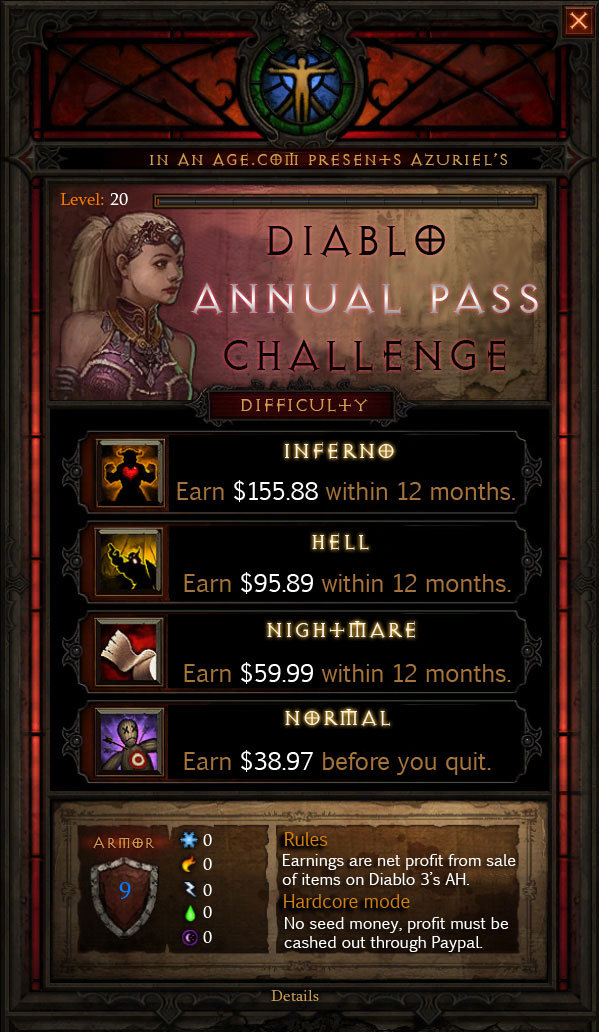
For the the visually impaired, the four difficulties are as follows:
- Inferno – Earn $155.88 within 12 months.
- Hell – Earn $95.89 within 12 months.
- Nightmare – Earn $59.99 within 12 months.
- Normal – Earn $38.97 before you quit.
Completing Inferno will mean you financed both Diablo 3 and a year of WoW (with associated perks) entirely through Diablo 3’s real-money Auction House. The step below that, Hell, means you financed an entire year of WoW through the purchase of a $59.99 game. Meanwhile, Nightmare demonstrates that you got Diablo 3 for free after paying for a year of reduced-price WoW time. Finally, completing the Diablo Annual Pass Challenge on Normal difficulty means you managed to pay for 3 of the 12 required months via Diablo 3 gameplay.
A Hardcore mode can apply to any of the above difficulties, and requires two things: 1) no seed money, e.g. putting $20 on your account to get started, and 2) net profit only counts when cashed out via Paypal.
Death is (unfortunately) permanent in all difficulties and modes. We are working on a hot fix.
For the purpose of this Challenge, “earnings” refers to net profit from the sale of items in Diablo 3’s AH. If you spent $50 and made $160 flipping items, you have only actually achieved Hell difficulty, not Inferno. “Items” refer to anything sellable on the RMAH, whether it is gear, gold, gems, characters, etc. Any money spent in the satisfaction of your Annual Pass obligation, i.e. buying game time, will still “count” as long as it came as a result of AH profit. In other words, you don’t have to just sit on the money until you reach your desired difficulty.
For those Challenge participants not using USD, simply use the relevant cost of two 6-month WoW time cards (Inferno), two 6-month WoW time cards minus the cost of Diablo 3 (Hell), the cost of Diablo 3 (Nightmare), and the cost of three months of the reduced-priced WoW Annual Pass subscription in whatever your local currency happens to be (Normal).
Good luck everyone, and don’t you dare undercut my shit.
 In An Age
SWTOR Will (Probably) Be Fine
Jan 23
Posted by Azuriel
With the 1-month honeymoon coming to its end, and a series of “amateur-hour” missteps combined with other bad news, the general feeling seems to be coalescing around SWTOR’s present or future inevitable “failure.” While everyone is entitled to their own insipid pessimism, the sorts of reasoning being provided are a little weak.
1) Absurdly High Standards
There are two main flavors of absurdity under this umbrella. The first is simply ridiculous, the sort that sees WoW going from 12 million to 10 million as a failure, a sign of collapse, of crushing moral defeat. Or, going from 32 to 26.667 times the size of EVE, the MMO yardstick whose robustness is the de facto definition of success. I agree that WoW deserves the subscription loss, that it is directly linked to Cataclysm, and further that WoW may never recover those subs and/or continue a sub decline for the foreseeable future.
However, let’s be honest here: if that is the sort of yardstick we are using, the entire MMO market is an abysmal failure.
The second, lesser form of absurdity is identifiable in this quote from Nils:
For comparison, EVE is the second largest Western MMO on the market at, by last count, 375,000 subs. Between 25% and 62.5% larger than 2nd place is a failure? Really?
You know what, though? I think it is important to have a discussion about what “success” really means – just like with “casual” and other loaded terms, having some kind of idea where people actually stand would reduce the effects of talking past one another.
2) Vague Definitions of Success
“Success” is largely arbitrary, and depends on the goals one sets for oneself. If you set out to run an 8-minute mile and can only get to down to a 9-minute mile, you have “failed.” That you improved from a 15-minute mile to 9-minutes is irrelevant in an objective sense.
Success in a market sense, is a little less arbitrary – you are either making money or you are not. According to the information we have available (circa last May), SWTOR needs a minimum of 375k subscriptions to break even, and ~500k to be reasonably profitable. So in the Nils quote, SWTOR would be a success at 500k.
But what of the analyst who sent EA stocks tumbling 3% based on “disappointing sales” and churn rates? Since we don’t have access to his data or methodology, it is difficult to appraise his conclusions. However, the very next day EA stocks went back up 2% after three separate brokers said SWTOR is “performing in line with expectations.” One of them went on to say:
Evan Wilson of Pacific Crest wrote Friday that he has raised his sales estimate for “Star Wars” to 2.2 million units from 1.5 million units for the quarter, and said he remains “comfortable” with his 800,000 subscriber target when the company’s fiscal year ends in late March.
“Admittedly, we set our expectations as if Star Wars was to be a good, not great, MMO,” he wrote. “Fortunately, we think the company did too.”
Hardly a ringing endorsement, but there it is. There is a line between the soft bigotry of low expectations and aggressive schadenfreude – the challenge is finding it. “Good, not great, MMO” might be a bit too low for even my standards, especially given write-ups like these in the LA Times (turns out SWTOR officially cost $200m). We will know more about the numbers in February when EA’s financial statements become available, but I am inclined to say that if SWTOR can achieve/maintain 500k-800k subscriptions for the year it will undeniably be a success.
3) Endgame Concerns
About a week ago, Tobold was discussing Richard Bartle’s feelings towards the SWTOR endgame (which are rather interesting, by the way). Down in the comment section, Tobold said something I wanted to highlight:
It is an interesting question because by all accounts, we have no idea what the average WoW player is doing. Looking at Cataclysm, only approximately 17.28% of the Western audience killed 1 raid boss in T11 content, and ~12.69% killed 1 raid boss in T12. Even if my methodology¹ is flawed, it is likely we are looking at a game in which over two-thirds of players do not participant in raiding, i.e. the “accepted” endgame. So… what are they doing? Heroics? Battlegrounds? Goldshire RP? Everyone seems to agree that the WoW leveling game has been irreparably destroyed, and yet there seems to be no other explanation as for what the vast, vast majority of the playerbase seems to be doing.
In this respect, SWTOR’s raiding endgame seems as likely as not to be irrelevant. Perhaps the social mechanisms of organized raiding trickle down to the masses, perhaps raiding increases player engagement, perhaps you need hardcore gamers to bind a community together long enough for a population’s sheer gravity to take over. These are open questions. Until we get some usage statistics from Blizzard though, I feel comfortable enough suggesting that the depth of SWTOR’s endgame is not particularly important to its overall success/failure; it clearly is not in WoW.
Retention is a function of social ties, which inevitably take place primarily in the endgame, but they are not about the endgame per se. As long as Bioware steps up its guild infrastructure plans and its Show & Tell aspects, as I said before I see no particular problem with retention at whatever sub level they achieve.
Flowers, Sunshine Aside…
The real challenges SWTOR faces are more systemic in nature.
Nearly everyone has expressed concerns when it comes to the full voice acting, for example, but I am much more concerned about the related problem of localization. According to that LA Times article I linked earlier, SWTOR is only localized in two languages (German and French). In contrast, WoW has been localized into eight: German, French, Spanish, Brazilian Portuguese, Russian, Korean, and both Traditional and Simplified Chinese. While SWTOR catches somewhat of a break when it comes to the aliens speaking gibberish that can be Cut & Paste, just imagine the ridiculousness that is recording all other voice work in three separate languages (plus male/female differences!), let alone additional languages in the future.
This is relevant because, quite honestly, WoW could shut down all US/EU servers and still probably maintain 5+ million Asian subscriptions into perpetuity (Aion inexplicably has 4 million after all). Meanwhile, SWTOR does not have access to the Asian MMO market and thus has much shorter reach. Assuming, of course, that Star Wars is even a hot commodity over there to begin with.
The other systemic issue is the gravity of the game itself. While I believe SWTOR will probably be fine in maintaining at least ~500k subs (and be successful as a result), needing at least 375k subs to be worth the $200 million endeavor is somewhat worrisome. All MMOs probably have some kind of break-even point, well-publicized or not, but generally speaking a game company grows in relation to the success of the game. The question arises as to how long EA would tolerate sub-375k performance before more drastic measures were enacted. Given EA’s rather public rivalry with Activisn-Blizzard when it comes to Call of Duty vs Battlefield 3, I am inclined to believe they will go to heroic lengths to keep SWTOR in the fight should it fall, but it may well go the other way too.
In any case, things are shaping up to be an interesting year.
¹ I actually think my methodology is better than the sort of Armory audits appearing on MMO-Champ as of late. The problem with Armory audits is the “white noise” of alts. Since I extrapolate based on guilds, it is much more likely that a raider’s alts are filtered out rather than included, and thus not diluting the figures. Of course, MMOData.net hasn’t been updated since WoW started hemorrhaging subscriptions, and so finding the current US/EU/KR/TW baseline is impossible, thus possibly skewing the percentages of T12 and beyond.
Posted in Commentary, SWTOR
15 Comments
Tags: Endgame, High Standards, Localization, Raiding, Retention, Subscription, Success, SWTOR