Epic Whims
Epic is in court again, this time facing off with Google. And during the testimony, it was admitted that the Epic Game Store is still not profitable. Not sure of the current figures, but they had lost $330 million back in 2021. That is not always a bad thing for tech companies, who typically operate under a “if you build it, they will come” fantasy funded entirely by rich gamblers who hope to get cheap shares of the next Facebook. Still, even Epic thought their storefront would be profitable by 2023.
Interestingly though, Epic is not being funded by venture capitalists per se. They are being funded by their ridiculous, beyond-all-comprehension wildly successful Fortnite money:
When Fortnite launched in 2017, Epic was a 500-person company—known primarily for producing the Gears of War franchise and creating the industry-leading game development software, Unreal Engine. It was booking about $100 million per year in revenue. A year later, Epic made a staggering $5.6 billion in revenue. Ninety-seven percent of it was from Fortnite.
[…] According to Forbes estimates, the Cary, North Carolina-brd developer posted revenues of more than $6 billion in 2022, with the vast majority still coming from Fortnite.
Forbes (paywall)
I knew Fortnite was successful, but part of me still imagined that the Unreal engine was most of what sustained the company. That does not appear to be the case.
My question is: how long can this go on? I mean, on the one hand the Fortnite money machine is still printing. And, hey, Uber has been around for 9 years and only became profitable a few months ago. But we’ve also seen Epic lay off 16% of their staff this year and divest themselves of Bandcamp and other properties. Clearly, sustainability is a concern.
With that backdrop in mind, will they continue dropping free games every Thursday through 2024?
Beyond the freebies, this is relevant to my interests because of all the (timed) exclusives too. Dead Island 2 is still not available on Steam, and likely won’t be until next April. While the Epic Games Store has improved over the years – they have had wishlists and shopping carts for at least two whole years now! – exclusivity equals higher prices for longer. Who knew? Some of that is changing a little, as it seems Fanatical and Humble are selling an EGS key for Dead Island 2, but that’s just 1 of 2 listed key sellers to the dozens of Steam alternatives.
Not that I’m hurting for games, of course. But I do want to play Dead Island 2.
Cyberpunk Appreciation
Absence (and a shit-load of updates) really have made me fonder of Cyberpunk 2077.

My second attempt at the game started from remembering how fun the movement was – specifically, being able to just push aside NPCs while running. It seems like such a tiny little detail in the scheme of things, but not only is it an insanely good quality-of-life measure whose lack immediately gets felt in other games, pushing NPCs around also makes them more real. It is the difference between walking through tall grass in a game and seeing the blades bend, rather than a 2D texture awkwardly rotate.
Coming from Starfield, the dialog and general interaction is also miles beyond. I’m not going to say Cyberpunk has ruined other RPGs for me, but even the other best examples in Baldur’s Gate 3 and the Mass Effect series seem… almost immobile in comparison. To say nothing about the stiff talking heads of Starfield and other Bethesda games. Come 2024, if your RPG doesn’t have Idris Elba casually stepping over a chair for no reason while relaying quest details, what the fuck are you even doing?
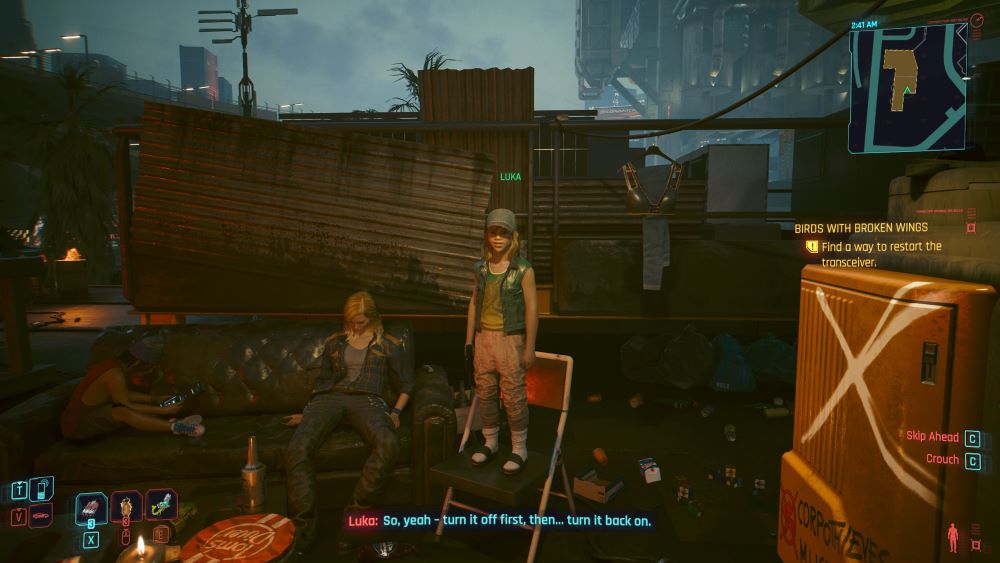
I also appreciate the ability to exit conversations by just walking away. I occasionally employ that IRL.
So, yeah, overall I am having a blast. We’ll have to see if I maintain the momentum to reach the endgame, as currently I am just doing all the new expansion stuff. The whole Johnny angle never really appealed to me and I burned myself out doing side-quests as a result. Will history repeat itself? Does it even matter if it does? Stay tuned.
Night (City) and Day
Sometimes it ends up being the little things.
I was playing Starfield last week and wanted to rest in my bed (10% XP boost) before exiting my ship. Except one of my companions was standing inside the cockpit hatch. I literally couldn’t move past them. It wasn’t quite as bad as this, but it was close. “Why can’t I just sort of shove past them like in Cyberpunk 2077? That always felt satisfying.”
About an hour later, I was patching Cyberpunk and bought the Phantom Liberty DLC.
Granted, I was always planning to go back to Cyberpunk eventually, especially after the Skill revamp in 2.0. But let me tell you: being able to walk through a crowd of NPCs and not constantly be collisioned is exactly as satisfying as I remembered. And also reading random notes left on tables. And being able to have ammo. And having interesting dialog, set pieces, weapons, item modifiers, plot. You know, the “little things.”
I’ll probably be back to Starfield eventually. Bethesda also says Starfield will be supported for “years to come.” Cool. So… I guess I’ll see you in a few years then. Meanwhile, there are better games to play.
Incentivizing Morality
In the comments of my last post, Kring had this to say:
In an RPG I don’t think there should be a game mechanic rewarding “the correct way” to play it. The question isn’t why aren’t we all murder-hoboing through a game where you can be everything. The question is, if you can be anything, why would you choose to be a murder-hobo?
In the vast majority of games, “the good path” is incentivized by default. This usually manifests in terms of a game’s ending, which sees the hero and his/her scrappy teammates surviving and defeating the antagonist when enough altruistic flags are raised. Conversely, being selfish and/or evil typically results in a bad ending where the hero possibly dies, or becomes just as corrupt as the original antagonist, and most of the party members have abandoned you (or been killed). It’s almost a tautology that way – the good path is good, the bad path is bad.
Game designers usually layer on addition incentives for moral play though. The classical trope is when the hero saves the poor village and then refuses to accept the reward… only to be given a greater reward later (or sometimes immediately). I have often imagined a hypothetical game in which the good path is not only unrewarding, but actively punished. How betrayed do you think players would feel if doing good deeds resulted in the bad guy winning and all your efforts come to naught? It would probably be as unsatisfying in such a game as it is IRL.
Incentives are powerful things that guide player behavior. And sometimes these incentives can go awry.
Bioshock is an example of almost archetypal game morality. As you progress through the game, you are given the choice of rescuing Little Sisters or harvesting them to consume their power. While that may seem like an active tradeoff, the reality is that you end up getting goodies after rescuing three Little Sisters, putting you about on par with where you would have been had you harvested them. By the end of the game, the difference in total power (ADAM resource) is literally about 8%. Meanwhile, if you harvest even one (or 2?) Little Sister, you are locked into the bad ending.
An example of contrary incentives comes from Deus Ex: Human Revolution. In this one, you are given the freedom of choosing several different ways to overcome challenges. For example, you can run in guns blazing, sneak through ventilation shafts, and/or hack computers. The problem is the “and/or.” When you perform a non-lethal takedown, for example, you get some XP. You also get XP for straight-up killing enemies. But what if you kill someone you already rendered unconscious with a non-lethal takedown? Believe it or not, extra XP. Even worse, the hacking minigame allows you to earn XP and resources whereas acquiring the password to unlock the device gives nothing. The end result is that the player is incentivized to knock out enemies, then kill them, search everywhere for loot but ignore passwords/keys so you can hack things instead, and otherwise be the most schizophrenic spy ever.
Does DE:HR force you to play that way? Not directly. Indeed, it has a Pacifist achievement as a reward for sticking just to non-lethal takedowns. But forgoing the extra XP means you have less gameplay options for infiltrating enemy bases for a longer amount of time, which can result in you pigeonholing yourself into a less fun experience. How else could you discover the joy that is throwing vending machines around with your bare augmented hands without having a few spare upgrades?
Speaking of less fun experiences, consider Dishonored. This is another freeform stealth game where you are given special powers and let loose to accomplish your objective as you choose. However, if you so happen to choose lethal takedowns too many times, the environment becomes infested with more hostile vermin and you end up with the bad ending. I don’t necessarily have an issue with the enforced morality system, but limiting oneself to non-lethal takedowns means the majority of weapons (and some abilities) in the game are straight-up useless. This leads you to tackle missions in the exact same way every time, with no hope of getting any more interesting abilities, tools, or even situations.
I bring all this up to answer Kring’s original question: why choose to be the murder hobo in Starfield? Because that’s what the game designers incentivized, unintentionally or not. Bethesda crafted a gameplay loop that:
- Makes stealth functionally impossible
- Makes non-lethal attacks functionally impossible
- Radically inflates the cost of ammo
- Severely limits inventory space
- Gates basic character functions behind the leveling system
- Has Persuasion system ran by hidden dice rolls
- Feature no lasting consequences of note
Does this mean you have to steal neutral NPCs’ spaceships right from under them and pawn it lightyears away? Or pickpocket every named NPC you encounter? No, you don’t. Indeed, some people would suggest that playing that way is “optimizing the fun out of the game.”
But here’s the thing: you will end up feeling punished for most of the game, because of the designer-based incentives not aligning with your playstyle. In every combat encounter – which will be the primary source of all credits and XP in the game regardless of how you play1 – you will be acutely aware of how little ammo you have left, switching to guns that you don’t like and also take longer to kill enemies with, being stuck with smaller spaceships that perform worse in the frequent space battles, and don’t offer quality of life features you will enjoy having. Sinking points into the Persuasion system will make those infrequent opportunities more successful, but those very same points mean you have less combat or economic bonuses which, again, will leave you miserable in the rest of the game.
Can you play any way you want in Starfield in spite of that? Sure. Well… not as a pacifist. Or someone who sneaks past enemies. Or talks their way out of every combat encounter. But yes, you can avoid being a total murder hobo. You can also turn down the graphical settings to their lowest level and change the resolution to 800×600 to roleplay someone with vision problems. Totally possible.
My point is that gameplay incentives matter. Game designers don’t need to create strict moral imperatives – in fact, I would prefer they didn’t considering how Dishonored felt to play – but they should take care to avoid unnecessary friction. Imagine if Deus Ex: Human Revolution did not award extra XP for killing unconscious NPCs, and using found passwords automatically gave you all the bonus XP/resources that the hacking game offers. Would the game get worse or more prescriptive? No! If anything, it expands the roleplaying opportunities because you are no longer fighting the dissonance the system inadvertently (or sloppily) creates.
In Starfield’s case, I’m a murder hobo because the game doesn’t feel good to play any other way. But at the root of that feeling, there lies a stupidly simple solution:
- Let players craft ammo.
That’s it. Problem solved – I’d hang up my bloody hobo hat tomorrow.
Right now the outpost system is a completely pointless, tacked-on feature. If you could craft your own ammo though, suddenly everyone wants a good outpost setup, which means players are flying around and exploring planets to find these resources. Once players have secured a source of ammo, credits become less critical. This removes the incentives for looting every single gun from every single dead pirate, which means less time spent fighting the awful inventory and UI. With that, being a murder hobo is more of a lifestyle choice rather than a dissonance you have to constantly struggle against.
That’s a lot of words to essentially land on leveraging the Invisible Hand to guide player behavior. And I know that there will be those that argue that incentives are irrelevant or unnecessary, because players always have the choice to play a certain way even if it is “suboptimal.” But I would say to you: why play that game? Unless you are specifically a masochist, there are much better games to roleplay as the good guys in than Starfield. You can do it, and there are good guy choices to make, but even Bethesda’s other games are infinitely better. And that’s sad. Let’s hope that they (or mods, as always) turn it around.
- I have read some blogs that suggest you can utilize the outpost system to essentially farm resources, turn them into goods to vendor, which nets both credits and crafting XP. So, yeah, technically you don’t have to rely on combat encounters for credits. However, you can’t progress through the story this way, and I’m not sure that using outposts in this fashion is all that functionally different from simply stealing everything. ↩︎
Murder Hobo
In Starfield, I roleplay exclusively as a murder hobo. Oddly enough, Wikipedia has an entry on that:
murderhobo (plural murderhobos or murderhoboes)
- (roleplaying games, derogatory or humorous) A character who wanders the gameworld, unattached to any community, indiscriminately killing and looting.
I was reflecting on this the other day. I found myself on a planet and inexplicably, irrationally, exploring. Everything is procedurally generated, there is zero environmental storytelling, and the payout for fully scanning a planet is not even remotely worth your time. But… I do it occasionally. So there I was, walking towards a Point of Interest, and then a ship landed nearby. These are technically a random encounter, but the ships often leave the area stupidly quickly, making you wonder why Bethesda bothered programming them in.
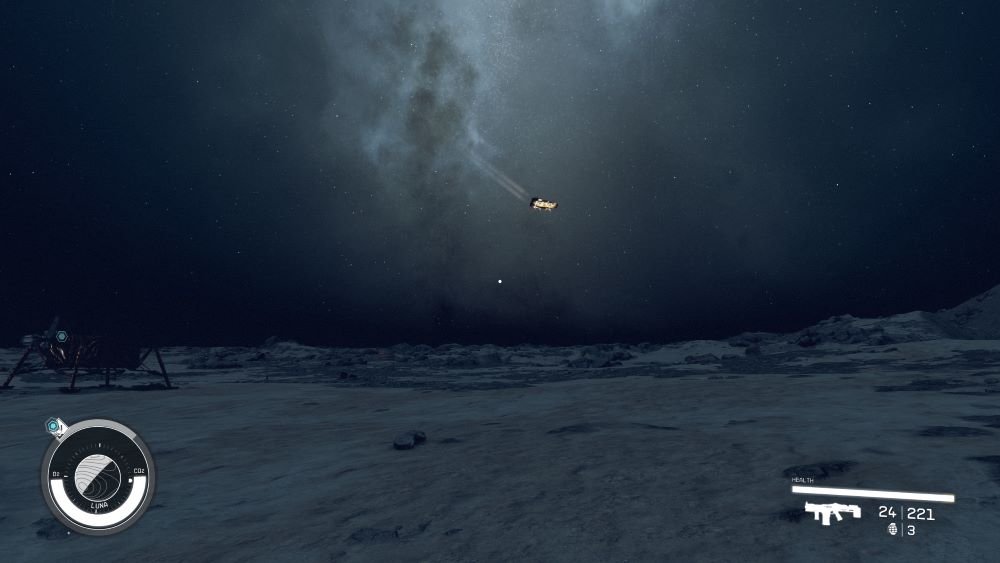
So, I zip over there fast as I can, expecting some pirate action. Instead, they were neutral NPCs. I talk to them, they say they are low on supplies, and ask for some water. I give it to them. Then I check out their ship. Lockpick my way past the hatch, empty their cargo hold of cash and valuables, and then… look at the captain chair. Then I sit in the captain chair and blast off into space. A few menu screens later, I land the ship in New Atlantis, register it, sell it, and then fast travel back to the planet I was exploring originally.
In the abstract, I think this sequence was literally the most psychopathic thing I have ever done in a (non-Rimworld) videogame. This small group of people landed on an uncharted planet, desperate for supplies. A random passerby graciously gave them water. Then, moments later, they had to watch as their only means of survival is stolen out from under them. They are literally stranded on a desolate planet with no breathable atmosphere, no shelter, no hope.
Also, no consequences.
Now, obviously that is the problem here. I do not usually murder hobo my way through Baldur’s Gate 3, or Cyberpunk 2077, or Mass Effect, or really most other games. I was thinking about that though: why don’t I? What is enough of a consequence to augment my behavior? Some kind of automatic karma penalty like in Fallout? That often led to some arguably more murder hobo-ish behavior insofar that stealing from “bad guy” was apparently worse than just killing him and taking the now-ownerless items. Companion dissatisfaction? That can certainly be annoying, especially when you want to be a bit more “Renegade” in your dialog choices. Often though, this can be gamed by simply selecting different companions, doing what you wanted to do, and then swapping them back in once you’re done.
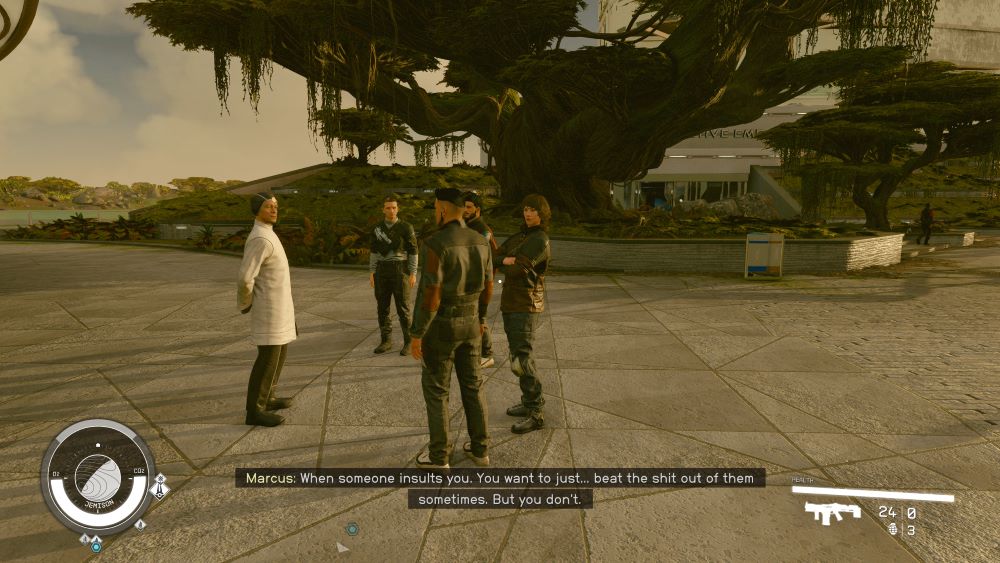
Honestly, I think it comes down to the possibility of accountability. I do not know every permutation to your choices in Baldur’s Gate 3, but I have read enough posts and interviews to know that characters you interact with in Act 1 may or may not show up in Act 2 and Act 3 based on your actions. That leads one to a different posture when it comes to negotiations; the more people survive, the more possible quest givers exist for the late-game. This requires a certain level of detail though, which is not always possible in a more sandbox-lite environment.
One method I would like to see though, is almost a metagame appeal to empathy. Every named NPC in Starfield carries 800-1200 credits, which is kind of a lot for how easy it is to pickpocket them. If you lose the roll, you get caught, and have to Quick Load your way out of consequence. But if you succeed… nothing happens other than credits in your pocket. What if NPCs had dialog lamenting their loss of credits? About how they won’t be able to make rent payments? What if they asked other NPCs (or even you) for help looking for a lost Credstick or whatever? What if that group of now-stranded civilians put out a mayday asking for rescue? Or really just a personal appeal to return their ship?
Sometimes being a murder hobo is its own reward, but often I think it is just a natural consequence of game incentives/lack of disincentives combined with a failure of immersion. If NPCs don’t matter, it doesn’t matter what happens to them. You can make them matter using elaborate penalty systems or story hooks, or make them matter by making them “real” enough to care about.
Or maybe this is all just me, and I have a bit of the Dark Urge IRL.
Procedural Dilemma
One of the promises of procedural generation in gaming is that each experience will be unique, because it was randomly generated. The irony is that the opposite is almost always the case, as designers seem to lack the courage to commit. Or perhaps they recognize that true randomness makes for bad gameplay experiences and thus put in guardrails that render the “procedural” bits moot.
Both Starfield and No Man’s Sky feature procedurally generated planets with randomized terrain, resources, flora, and fauna. Both games allow you to land anywhere on a given planet. But neither1 game allows there to be nothing on it. There are desolate moons with no atmosphere, yes, but in both games there will be some Point of Interest (PoI) within 2 km of your landing location in any direction. Sometimes several. And the real kicker is that there are always more PoIs everywhere you look.
There is not one inch of the universe in these games that doesn’t already have monuments or outposts on it, and the ludonarrative dissonance of that fact is never resolved.
The dilemma is that true procedural generation probably leads to even worse outcomes.
Imagine that the next eight planets you land on have zero PoIs. No quest markers, no resources of note, no outposts, no nothing. How interested are you in landing on a ninth planet? Okay, but imagine you can use a scanner from orbit to determine there are no PoIs or whatever. So… the first eight planet scans come up with nothing, are you scanning the ninth planet? At some point players are going to want some indication of where the gameplay is located, so they know where to point their ship. Fine, scanners indicate one planet in this system has two “anomalies.” Great, let’s go check it out.
But hold up… what was the point of procedural generation in that scenario? There isn’t much of a practical difference between hand-crafted planets and procedurally-generated-as-interesting planets surrounded of hundreds of lifeless ones. Well, other than the fact that those random PoIs in the latter case better be damn interesting lest players get bored and bounce off your game due to bad RNG.
Minecraft comes up as an example of procedural generation done right, and I largely agree. However, it is “one world” and you are not expected to hop from one map to the next. The closest space game to resolve the dilemma for me has been Starbound + Frackin’ Universe mod – some planets had “dungeon” PoIs and/or NPCs and many did not. Each star system has at least one space station though, so it’s not completely random, but it’s very possible to, for example, land on a bunch of Eden planets or whatever and not find an exact configuration that you want for a base.
As I mentioned more than ten years ago (!!), procedural generation is the solution to exactly one problem: metagaming. If you don’t want a Youtube video detailing how to “get OP within the first 10 minutes of playing” your game, you need to randomize stuff. But a decade later, I think game designers have yet to fully complete the horseshoe of leaning all the way into procedural generation until you come right back around to hopping from a few hand-crafted planets and ignoring the vast reaches of uninteresting space.
- NMS may have actually introduced truly lifeless planets with no POIs in one of its updates. They are not especially common, however, as one would otherwise expect in a galaxy. ↩︎
COVID Also Sucks
My family made it nearly 3.5 years dodging COVID, but alas.
A family “friend” decided her “sniffles” didn’t warrant a warning, and ended up getting my wife infected. Which then spread to the rest of us. Five solid days of continuous fevers and muscle pain thus far, let’s see how much longer it can go! Plus, the bonus roll on long COVID.
I’m not going to write more on this subject though, because it makes me (ir)rationally angry. Well, other than to say this: if you know you’re sick and possibly contagious, fucking say something.
Space Combat Sucks
I have been playing Starfield exclusively for a week now, and part of that time has been spent in a spaceship fighting other spaceships. Whenever I am performing this task in any space game though, I ask myself: has this ever been fun? And I mean literally fun, not “it’s fun to be in an X-Wing because I like Star Wars.” Because I don’t think I have ever enjoyed space combat in any game.
Here is every space combat: You see one or more red triangles 2 km away. The triangles approach and lasers/plasma/whatever starts coming your way. Once a circle appears, you left-click the circle and keep it pressed down. Then you look at their shields and your shields to determine which will run out first. If it’s them, don’t move – just be a space turret. If it’s you, fly towards them and get a few seconds reprieve while both of you pivot to try and get “behind” the other. Repeat or die.
The funny thing is that I feel space combat sucks… for all the right reasons. Space is empty. There are usually no ship-sized pillars to hide behind, and many space games do not feature bullet-time, VATS, or other special powers that would make you be any different than simply a turret. And it’s easy to imagine “real” space combat maneuvering being made pointless by AI-driven targeting systems, lasers that literally deal damage at light speed, and limitations based on the physiology of the human crew. For example, we can imagine a pilotless drone ship being able to wildly spin around shooting in every direction, but not with a person at the helm.
Incidentally, I consider games not providing a lore-based excuse as for why every space battle isn’t just millions of tiny drones blasting each other out of the sky as extremely lazy. We have faster-than-light travel, we usually have AI companions, but apparently fixed-wing aircraft piloted by meatbags is the best we can do for taking down capital ships? Give me a break.
I do feel like Everspace 2 was the closest space combat has been fun for me, although they do “cheat” at bit. Specifically, there are a ton of special powers, including the ability to warp forward X amount of distance, and every combat features copious amounts of ship-sized pillars in the form of asteroids or derelict ships. Plus there were different “classes” of ships, one of which was essentially a carrier from StarCraft in that you spawned drones and let them do most of the fighting while you hid behind cover. Another ship class was basically an sniper assassin, wherein you used cloaking fields to escape and get into a position to fire a long-ranged weapon at your foes. So, yeah, actually Everspace 2 had fun space combat… but at a certain point, is that not basically a cover-based shooter with extra steps?
I will give a special shout-out to No Man’s Sky though. It is very much in the “space turret” combat category, but it does feel better flying around in space than most other games. Plus, unlike nearly every other game, you can seamlessly go from space into a planet’s atmosphere – with bogies still on your tail! – and vice versa.
If there are other actually good space combat games out there, let me know what they are.
 In An Age
Past is Prologue
Nov 15
Posted by Azuriel
Starfield has been a wild success. Like, objectively: it was the best-selling game in September and has since become the 7th best-selling game for the year. And those stats are based on actual sale figures, unmuddied by Xbox Game Pass numbers. Which is astounding to think about.
[Fake Edit] A success… except in the Game of the Year department. Yikes. It’s at least nominated for Best RPG, along with (checks notes) Lies of P? No more sunlight between RPG-elements and RPG anymore, I guess. Doesn’t matter though, Baldur’s Gate 3 is going to continue drinking that milkshake.
Starfield having so many procedurally-generated planets though, is still a mistake. And its a mistake that Mass Effect: Andromeda took on the chin for all of gamedom a decade ago.
Remember Andromeda? The eagerly-anticipated BioWare follow-up to their cultural phenomenon trilogy? It ended up being a commercial flop, best remembered for terrible facial animations and effectively killing the golden goose. What happened? Procedurally-generated planets. Andromeda didn’t have them, but the (multiple) directors wanted them so badly that they wasted months and years fruitlessly chasing them until there was basically just 18 months left to pump out a game.
You can read the Jason Schreier retrospective (from 2017) for the rest of the story. And in total fairness, the majority of the production issues stemmed from EA forcing BioWare to use the Frostbite engine to create their game. But it is a fact that they spent a lot of time chasing the exploration “dream.”
That’s how it begins. Granted, we wouldn’t see how No Man’s Sky shook out gameplay wise until 2016.
The irony though, is that BioWare started to see it themselves:
And there it is: “it was never fun.” It never is.
I have logged 137 hours in No Man’s Sky, so perhaps it is unfair of me to suggest procedural exploration is never fun. But I would argue that the compelling bits of games like NMS are not the exploration elements – it’s stuff like resource-gathering. Or in games like Starbound, it’s finding a good skybox for your base. No one is walking around these planets wondering what’s over the next hill in the same way one does in Skyrim or Fallout. We know what’s over there: nothing. Or rather, one of six Points of Interest seeded by an algorithm to always be within 2km walking distance of where you land.
Exploring a procedurally generated world is like reading a novel authored by ChatGPT. Yeah, there are words on a page in the correct order, but what’s the point?
Getting back to Starfield though, the arc of its design followed almost the reverse of Andromeda. In this sprawling interview with Bruce Nesmith (lead designer of Skyrim and Bethesda veteran), he talked about how the original scope was limited to the Settled Systems. But then Todd Howard basically pulled “100 star systems” out of thin air and they went with it. And I get it. If you are already committed to using procedural generation on 12 star systems, what’s another 88? A clear waste of time, obviously.
And that’s not just an idle thought. According to this article, as of the end of October, just over 3% of Xbox players have the “Boots on the Ground” achievement that you receive for landing on 100 planets. Just thinking about how many loading screens that would take exhausts me. Undoubtedly, that percentage will creep up over time, but at some point you have to ask yourself what’s the cost. Near-zero if you already have the procedural generation engine tuned, of course. But taking that design path itself excludes things like environmental storytelling and a richer, more tailored gaming experience.
Perhaps the biggest casualty is one more felt than seen: ludonarrative. I talked about this before with Starfield, but one of the main premises of the game is exploring the great unknown. Except everything is already known. To my knowledge, there is not a single planet on any system which doesn’t have Abandoned Mines or some other randomly-placed human settlement somewhere on it. So what are we “exploring” exactly? And why would anyone describe this game as “NASApunk” when it is populated with millions of pirates literally everywhere? Of course, pirates are there so you don’t get too bored exploring the boring the planets, which are only boring because they exist.
Like I said at the top, Starfield has been wildly successful in spite of its procedural nonsense. But I do sincerely hope that, at some point, these AAA studios known for storytelling and/or exploration stop trying to make procedural generation work and just stay in their goddamn lane. Who out here is going “I really liked Baldur’s Gate 3, so I hope Larian’s next game is a roguelike card-battler”? Whatever, I guess Todd Howard gets a pass to make his “dream game” after 25 years. But as we sleepwalk into the AI era, I think it behooves these designers to focus on the things that they are supposedly better at (for now).
We learn from our mistakes eventually, right? Right?
Posted in Commentary, Philosophy
2 Comments
Tags: Exploration, Mass Effect: Andromeda, procedurally-generated, Starfield