Black Desert?
So, Black Desert is currently on sale on Steam for $6.

Considering it is a B2P game, I was considering just picking it up now and then playing later at my leisure. Something was making me hesitate though, even at this low price-point.
Then it came back: Gevlon had a series of money-making posts regarding Black Desert, and I remembered what bothered me. Specifically, the fact that wealth generation in the game entirely revolved around keeping the game running on your computer overnight/while you were at work.
Offline progression doesn’t particularly bother me in the least. Nor, of course, needing to actively grind. But being AFK while your computer runs all day? Some people in the comments to those posts were talking about how doing X is better than Y if you couldn’t remote desktop to your PC while at work in order to restart production. What the literal shit kind of game is this?
The sale is on till Wednesday, so perhaps I’ll pick it up regardless just to say I gave it the ole college try. But if you have played Black Desert and can explain some of its redeeming features, I’m all ears.
Impressions: ME:A, Supplemental
A few (dozen) more hours in, and things are humming along.
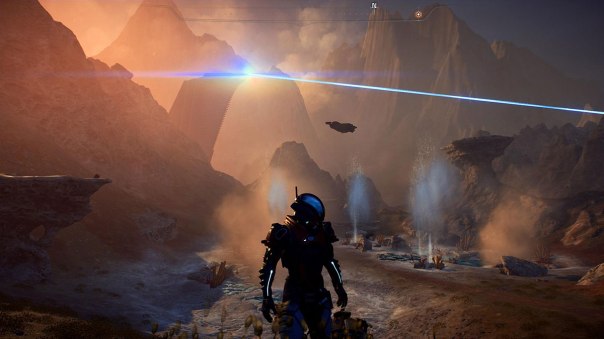
OK, so the game can look REAL good.
In these early stages of the game, three abilities do not feel like nearly enough. I came across a website that suggested that Barricade – a Tech power that constructs cover on demand – was the bee’s knees. After a boss-ish encounter that saw me kiting an armored beast around for 5 minutes, I’d suggest it’s more akin to bee’s ass. Energy Drain and Pull were rather ineffectual with Barricade as the wildcard, and it’s too early in the game for my weapons to have much of an impact on anything.
Indeed, I have talked about uneven difficulty in games before, and Andromeda seems poised to follow the same patterns. In Divinity: Original Sin, the difficulty was uneven in the early game because enemy CC was powerful while you lacked options towards ending encounters quickly, e.g. by blowing up the team with OP spells. In Andromeda, you can specialize yourself into a corner by not selecting all of the abilities, or perhaps not bringing the right kind of weapons. Andromeda allows you to actually change the three abilities you have in the middle of combat, but that won’t help you if you never spared the Skill points to buy them.
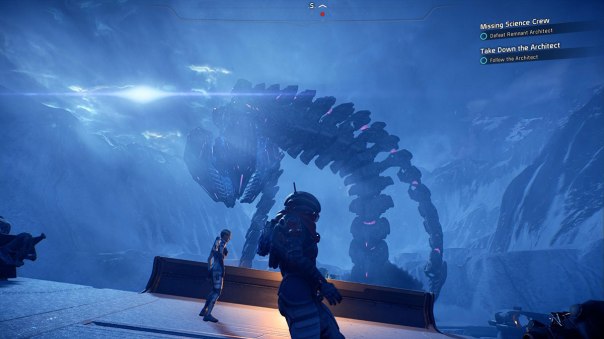
Better bring the right weapons/skills to this fight.
That said, I don’t actually like Andromeda’s swapping Skill system.
While the game goes out of its way to make the process mostly smooth – you can swap Favorite loadouts with a couple clicks – I find the entire process too… metagame-y. Ryder’s ability to switch abilities on the fly is given an in-universe explanation, but that doesn’t prevent the flow of combat from being broken whenever you pause the game to become an entirely different “class.” It’s like… why? I would agree that this is better than being able to paint yourself into an unwinnable corner by choosing the “wrong” abilities, but only barely. Why not allow us to equip more abilities at once?
Ah, right… consoles.
In any event, I will continue chugging right along. I am warming up to the characters a bit more, and going out of my way to complete most of the side-quests in typical Mass Effect style. It is hard to tell how far along in the game I am, but I’m guessing it might be closer to halfway than anything.
Impressions: Mass Effect: Andromeda
Bad facial animations are bad.
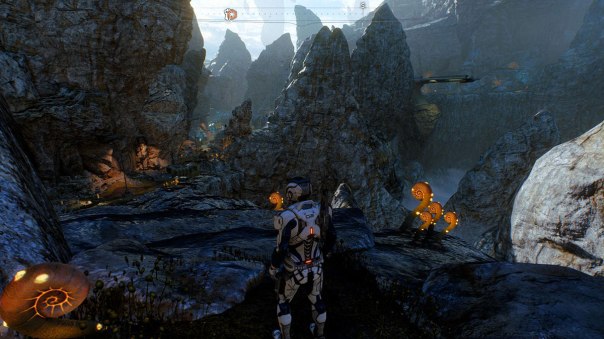
Rest of the game? Pretty good.
It is difficult to know whether I would have noticed the details on my own had it not been for the hilarious (and sad) examples spread across the internet. I would like to imagine that I’d notice, but maybe not. The toothpaste is out of that tube though, and straight into the fish-lips of every member of humanity that survived the journey to Andromeda. Maybe cryogenics causes one’s skin to slog off the bone.
Were the “older” (e.g. actual, real) Mass Effects just as bad? (No.) I dunno. All I know is that five years ago I said:
About 5 hours into Mass Effect, all I can say is holy shit.
One of the most groundbreaking things occurred in the city after the first “dungeon.” In talking with a receptionist to the Consort, she winked at me.
… and then a few months later:
My favorite aspect of the original Mass Effect was the integration of non-verbal dialog into the narrative, and the general narrative itself. In ME2, that is kicked up a notch^². Characters smile, nod, gesture, facepalm, wink, and otherwise emote in subtle, natural ways. Indeed, these little actions end up becoming part of the dialog, creating nuance and meaning that words themselves could not convey.
Perhaps the novelty has worn off. Perhaps the Witcher series has ruined facial expressions for other games for me. Or perhaps the animations in ME: Andromeda are really that bad. At the moment, I am leaning towards the latter. Ryder pretty much looks drunk all the time.
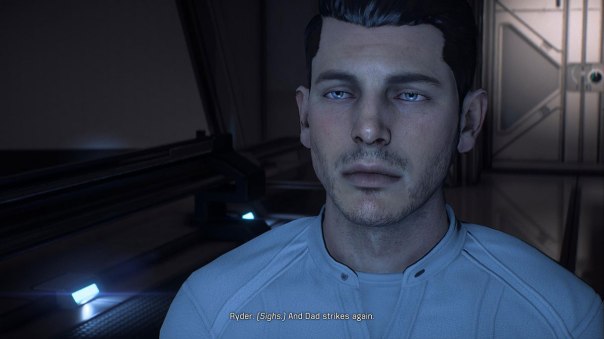
Time to hit the bottle again.
I have only played about an hour or two thus far, but the rest of the game seems okay. The gunplay does not seem as tight, but it could be the learning curve of the Frostbite engine. Or perhaps my low-level guns. I like how you can swap out abilities and such, but don’t like how apparently I’m limited to three abilities at a time. I suppose in the paradigm of quick recharging Biotic skills, it would be too much to be just slinging more mass effect fields than bullets.
Still, I always question whether these sort of decisions are made based on solid design principles, or whether it was to dumb down the game for consoles.
FF14 Dungeons, Take Two
This past week I ended up running the dreaded early dungeon gauntlet in FF14 again – you know, the three early dungeon Square Enix requires everyone to do in order to move the Main Story Quest forward. Things more or less went as well as last time.
The first dungeon run went comically bad. As soon as we zoned in, the healer just ran through half the dungeon and aggroed all of the mobs. This, of course, resulted in a wipe. The healer never rezzed themselves though, which is pretty indicative that his/her behavior was intentional trolling. Unfortunately, you cannot Vote Kick someone within X minutes of zoning into the dungeon, so we all had to wait.
Then it turned out that the healer and the other DPS voted to kick the tank, which happened to be frequent In An Age commenter, MaximGtB (who offered to help me through these early dungeons). It took me a while to figure out what even happened though, because FF14 does not allow you to Whisper or receive a Whisper while in a dungeon. And I did not know if there was an easy way to teleport out of a dungeon you were in.
So, yeah, comically bad.
After that, MaximGtB shepherded me through the three dungeons without major incident. In two of the dungeons, we had a Thaumaturge or Black Mage or whatever that insisted on using a knockback in their spell rotation, much to my Pugilist’s (and the tank’s) annoyance. It was also kind of annoying fighting 3-4 mobs at a time with zero AoE abilities. I suppose that might be a feature rather than a bug at this stage, as it would be easy for new players to spam that sort of thing and get aggro.
My overall impression about FF14’s dungeons have not really changed. There is zero reason for these early dungeons to be mandatory and/or exist. They are apropo of nothing. I don’t remember if Wailing Caverns had any lead-in, but other early WoW dungeons like Deadmines were the culmination of zone-wide storylines. That the devs required these three irrelevant dungeons for the MSQ simply boggles my mind. Mandatory is one thing, zero story is another.
In any event, further progress on my character will have to wait, as Square Enix is “moving data centers” and that apparently requires two full days of downtime. Which is almost enough time to be tempted to pop another WoW Token.
…think I’ll start Mass Effect: Andromeda instead.
Sidequestless
My early-level experience in FF14 has not been as painful as it felt previously. There are all manner of reasons why this might be the case – psychological, emotional, a more fun class, etc – but I suspect that a large part of it has to do with the increase in Main Story Quest (MSQ) XP. Which is weird, because I’m pretty sure that was already active the first time I played.
The difference is that I’m actually taking advantage of it.
I’m sure this will change down the road, but essentially I am skipping everything but the MSQ quests and still hitting the necessary milestones to continue adventuring. It feels a bit off to stroll into a new town filled with exclamation marks and roll out with just one quest on the log, but it also feels… liberating? “Oh, you want me to kill 6 whatevers on the ass end of the Earth? No thanks.” At my level (which has jumped up to 15 now), those sidequests reward around 1100 XP whereas the MSQ will dump 6500 XP on your head for walking 10 feet and talking with another NPC. Plus, the story feels a lot more coherent without all the narrative breaks.
The downside is… well, not experiencing any sidequests. Which I am both happy and sad about.
Sidequests are an interesting game design mechanic. Pretty much every RPG has them, and they are almost entirely used as pacing. Filler, in other words. Of course, if you actually find the combat/exploration/etc in the RPG engaging, then sidequests are actual, legit content. Plus, if the designers go the extra mile, sidequests might become more interesting than the actual storyline. A good example of that would be the Mass Effect or Witcher series, wherein the supporting characters and their interaction with the main character is most of the appeal.
In MMOs, sidequests are almost always chores to be completed. “Kill 10 whatevers.” “Talk to these NPCs.” “Go here and click on the shiny thing.” Some are more memorable than others, some engage in world-building, others sew the seeds of interaction with new story characters. But the vast majority are pointless busywork. And that’s the rub, right? Skipping the busywork means skipping the few gems out there.
Of the FF14 sidequests I did before focusing exclusively on the MSQ, 99% of them were filler. At the same time, I would have been sad to miss the ole “cold as a dead whore’s crotch” exchange:
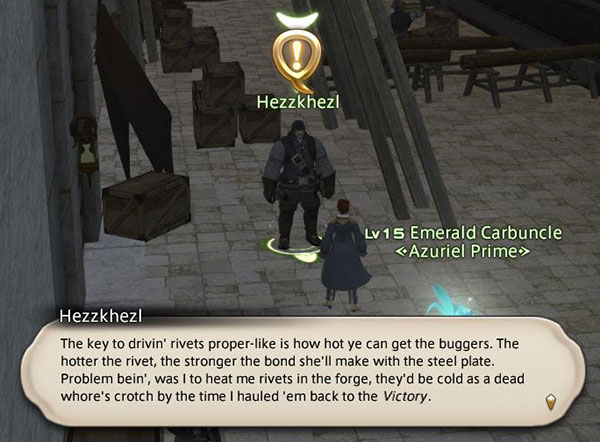
The above is why I typically complete all the sidequests in MMOs: for those brief slices of amusement, in the middle of so much bland white bread.
Alas, I no longer have eight hours of uninterrupted gaming time a day, so decisions have to be made. And that decision is to largely skip sidequests. I have long heard that SW:TOR has made a similar move regarding deprecating sidequests to streamline their “fourth pillar,” and I wonder if there has been a similar loss in incidental storytelling. It is not even as though they can keep the “good ones,” because sometimes it’s the weird throwaway sidequests that end up being the best.
I’m not sure there is a real solution here. I suppose FF14 deserves some credit for at least having the possibility of people clearing these sidequests later, via leveling up other classes (which changes your level back to 1). Although with all the XP bonuses and such you get now, I’m not sure if that’s enough.
Yearly Attempt: FF14
I have resubbed to FF14.
It took a curiously long amount of time to figure out where to download the launcher for the game. In fact, had it not been the fact that I was socially committed to trying the game again, I might have just stopped right there. I understand that things might be confusing if random people were presented with a 25GB download link right off the Square Enix page and then prevented from opening it because they didn’t technically buy the game.
But seriously? I shouldn’t have to Google how to download your MMO.
Once I downloaded the launcher, reinstalled, and resubbed, I logged into my original character from a year ago just to test the waters again. And boy ole boy, do I get what the Blizzard devs have talked about before vis-a-vis not wanting to confuse returning players. Coming back to WoW is an intimately familiar experience. Granted, it is probably moreso because I had been playing that for almost a decade now.
Coming back to FF14 after having played for a month a year ago is a whole other story. Can I teleport around town at will, or do I need to need to be near one of the Aethershards? Where the hell are the mailboxes? What was I doing again? Why can’t I see the armor I have in stock?
When I left off, my character was a level 25 Arcanist/level 13 Thaumaturge on Hyperion. Meanwhile, my friend is on Cactuar. Do I pay the transfer fee? It seems to be a bit silly given the low levels, but it is difficult to tell the value of “skipping” as much of the painfully boring FF14 early game as possible. On the other hand, I don’t know my ass from a hole in the ground either, so maybe another go-around in the level 1-40 tutorial was in order.
This time around, I learned my lesson and rolled a melee character (Pugilist). Thus far… things are okay. Level 1: Press 1. Level 2: Press 1, then 2. Level 6, Press 1, then 2, then 3. I am eagerly awaiting level 10 when I actually get a reactionary button (triggers after I dodge), and then level 15 when I get a melee DoT to weave in. It may sound boring – and it absolutely is – but it is worlds better than casting Ruin a million times.
I am not 100% convinced I’ll settle on the Pugilist/Monk path. I managed to find a guide or two regarding endgame rotations, and the Monk seemed to be heading in the Feral druid direction of All the Things. Ninja just sound bizarre. The Dragoon looks fine, as does the Bard to an extent. Considering my newly rolled toon is just level 8, I have quite a ways to go.
Overall, things are fine for now. I am not buying Heavensward, as A) I doubt that I make it to the vanilla endgame before the end of this month, and B) it is included for free in the Stormblood expansion. I do not anticipate playing FF14 for even as long as I played Guild Wars 2, but I do plan on completing the main story quest and seeing what all the plot fuss is about. Assuming there is any.
Inflection Points
In Divinity: Original Sin, I have definitively hit an inflection point in terms of character power. And that is kind of a shame.
Basically, once you hit level 15 you can start learning “Master” level skills/spells. As one might expect, these can be extremely powerful. For example, one of them is Meteor Shower, which drops 30 little fireballs in a specific area, each of which can deal a few hundred points of damage apiece in addition to spread fire in the area. These powerful spells cost a lot of Action Points – generally meaning needing to wait around multiple turns to save up enough AP – and are limited to One-Per-Battle in terms of cooldowns.
The issue is that you can game the hell out of the system. The AP cost is entirely irrelevant if you happen to spot a group of enemies before engaging in combat, for example – AP only exists within combat, so go nuts for the alpha strike. Hell, I bring down the stars on even one dude, because why not? It’s always been powerful to initiate combat with a “free” spell, but up till now those spells didn’t necessarily gib your target.
Another of the Master level skills allows an Archer to fire 16 arrows in a 45-degree arc. Great for groups… or, you know, if you want to effectively one(16?)-shot bosses from point-blank range. Oh, and hey, there’s a low-level Ranged Power Shot skill that increases damage by 20% at the cost of accuracy. Which would normally be an issue if not for the fact that Arrow skills auto-hit as long as the target is in range.
MMO players will recognize this phenomenon as “Optimizing the fun out of the game.” As I have mentioned previously though, the optimizing process itself is what I find fun to begin with. And it has been pretty fun figuring this out. The problem is that the game is now “solved,” and I am in one of those positions at the end of a Civilization match where winning is a foregone conclusion, but for the long, tedious march to an official win condition.
I said this situation is a shame because I’m not so sure it was necessary. Up until this point, effective AoE in Divinity was actually decently limited. Yeah, there were combos and such that you could set up, e.g. dropping Oil in an area and then lighting it on fire. But none of it was enough to one-shot groups by itself. Hell, often those combos ended up being counter-productive. The Oil+Fire combo was good for setting people on fire, but the resulting smoke prevented targeted follow-up attacks until they moved out of the area.
This scenario sort of reminds me of Final Fantasy Tactics, when you are suddenly given an excessively OP party member (Orlandu) for basically no reason. The game was challenging up to that point, and considerably less so afterwards. Why? What was the designer reasoning?
Sometimes inflection points are inevitable. At the beginning of a game, your character’s options for skills and magic items are likely limited, so there might be less room for synergies. More options means more combos means more opportunities for OP results. Simply not giving anything new past a certain level isn’t a particularly good design, so the devs might actually be trapped in that regard.
And, hey, I’m not blind to the fact that it probably feels good, both as a player and as a designer, to reach the endgame and feel like a total badass. Every wizard dreams of the moment they go from shooting Magic Missiles into the darkness to altering the fabric of reality itself. This is why games like WoW end up giving you +5% upgrades each tier instead of a more measured 1% – anything less feels unrewarding.
The fundamental problem is that I found the Divinity combat system rewarding as-is. Even with good equipment, things felt dicey all the time. I’m sure that someone out there had a lot of fun going from dicey fights to forgone conclusion ones, but that person is not me. And I cannot help but wonder if it was necessary at all. If super-skills are necessary, do they need to be this particularly powerful? Why 30 meteors instead of, say, 10? That would still be a huge improvement over the standard Fireball spell.
In any case, I am continuing to play Divinity and hopefully wrap things up soon.
CraftCraft
A few weeks ago, Gevlon had an interesting post on how crafting in MMOs is fundamentally broken:
If you fight monsters or players, you must constantly cast spells. If you gather, you must move between spawn points. Both needs you to sit at the computer and press buttons (unless botting). But to craft, you just press a button and maybe wait and you are done.
Basically, crafting is broken because all other options available to get in-game currency take keyboard effort (gathering, grinding mobs) whereas crafting does not. And, having reflected on that, it is 100% true. Just as in real life, the people making bank aren’t those doing the work, but the ones working the bank.
Gevlon concedes that there really isn’t a solution to this problem, mainly because “active crafting” would essentially be a grindy minigame. Well, he says the solution is to make it so that everyone can craft everything, thereby hopefully making the crafter-class irrelevant. I’m not so sure, considering how much gold people already make from selling vendor mats in WoW. Any knowledge gap is enough space for the Bourgeoisie to pop up like mushrooms.
Would a minigame really be that bad though?
Maybe. I remember getting pretty frustrated with Wildstar’s crafting system, which was essentially a lot of RNG and wasted mats. I did not spend a whole lot of time in FF14, but I recall a similar minigame there that required button presses for optimum results. Based on the comments on Gevlon’s blog post, it seems there might be other, older MMO examples as well.
Still, I’m thinking that that pretty much has to be the “solution.” This is assuming that you believe there is a problem to begin with. But crafting has felt divorced from the general MMO gameplay experience for ages. Even Fishing in WoW feels more interactive than the normal sort of insane grind (or extreme automation via addons) that is, say, prospecting stacks of ore and/or creating Glyphs. Running around Herbing on a toon feels fun. Smelting ore and transmuting it does not. And yet one of those is much, much more lucrative than the other.
A more active crafting overhaul would require a fundamental rebalancing of the sort of boilerplate crafting experience though. Most crafting systems are predicated on you crafting hundreds of redundant items, for example. Skill-ups – assuming they still exist – would perhaps need to come from successful strikes on the anvil, rather than just one for the finished product. Or perhaps simply an offline system ala EVE.
In any case, I do feel like active crafting is the way forward. There would still be a goblin-esque master class, as I find it unlikely A) even an active system would be slower at gold generation than grinding mobs, and B) a good 80% of the player population is too lazy to craft their own gear. Maybe the right system hasn’t been found yet. Or perhaps the right system is trapped on an older MMO?
 In An Age
Steamy
May 23
Posted by Azuriel
I am not a frequent reader of Polygon, but their recent (hit) piece on Steam is interesting. There is a lot going on in the article, but these are the two thesis paragraphs:
Basically, Valve conned us 13 years ago into believing they were the Good Guys, to the point that we unapologetically ascribe sins to Origin and UPlay that Valve themselves invented, and still perform where not prevented by EU law. Shkreli would give his left nut for the amount of free advertising that blasts over the internet for every Steam sale. All of this, all of this free money coming in, all this outrage over other corporations screwing over customers and employees alike… and we still eat it up for Valve.
I will admit that this article gave me pause.
It is a weird situation to find myself in, especially given that I am Pro-Consumer. Have you heard about Consumer Surplus? I invented that term. I will talk all day about how obscene it is for Blizzard to charge $25 for a character transfer, but spend zero time talking about how Valve takes a 75% cut of community-created DotA item/model sales.
That said, I’m not entirely sure there is a contradiction there, much less a cause for proletarian revolt.
Look, most of us grew up in the pre-Steam days. Do you remember what buying PC games was like? It was chaos. Sometimes you needed to keep the CD in the tray to play the game, sometimes you didn’t. Sometimes the publishers installed a rootkit on your machine, sometimes they didn’t. The first time I ever “pirated” a game was with Command & Conquer 3 because the disc I bought from the store wouldn’t play; there was either a scratch on the CD or some bug or something, but it instantly crashed on boot. Downloading a Day 1 crack on a game you just bought for $50 and couldn’t even return is pretty emblematic for that time period.
In short, Steam saved the PC gaming industry. It provided a framework in which the industry could grow, while simultaneously providing immense value to gamers. Steam sales actually were revolutionary at the time – the only times you ever got a discount elsewhere was when the game was in a bargain bin. Steam sales are disappointing these days, for sure, in a world of GreenManGaming, Amazon discounts, and all the other storefronts. Whom deliver Steam keys 99% of the time. Which is what most gamers want, considering the platform itself is immensely stable in comparison to oh, say, RockStar’s Social Club.
There are legitimate complaints regarding Steam. The Support sucks, so I have heard. It took them entirely too long to introduce Refunds, and I understand that that only came under threat of court orders. I’m also sure that the author’s claims regarding reimbursement percentages for selling character models is probably true.
But overall, I think the article is mostly attacking a straw man. There will be Valve fanboys, just as there are Apple fanboys. The difference is that Apple is a walled garden of overpriced, proprietary bullshit. Steam appears to be a near-monopoly… but based on what, exactly? Origin (or GOG, etc) might indeed be the better gaming platform these days… if it weren’t for the fact that they have an absurdly low (in comparison) library of available titles. Does Steam have exclusivity agreements that nobody knows about? If not, who is really responsible for its market share? No one is stopping anyone from opening a competing service that only takes 25% of the cut or whatever.
The bottom line is that nobody is being tricked here. Uber intentionally treating their entire workforce as contractors to avoid paying for health benefits or time off is not at all the same as “tricking” people into buying videogames over the internet. The damning “culture of cliques” at Valve is laughable; welcome to everywhere. Hell, if you want to see an abused workforce, take a gander over at Amazon warehouse for a moment.
“Good Guy Valve” is a marketing fiction, sure… but built on the back of a decade of actual value.
Posted in Commentary
11 Comments
Tags: Good Guy Valve, Polygon, Steam, Uber, Valve