Blog Archives
Review: Planet Crafter
Planet Crafter really surprised me by keeping my attention all the way to… just before the very end.

The premise of the game is that you are dumped onto a barren, hostile world and tasked to terraform it into something more hospitable to life. The “twist” is that there is no combat. At all. The planet is barren, after all, so what would even attack you? But what intrigued me was precisely how intrigued I stayed for the 35 hours I played. And that’s quite the trick considering I am not much of an Explorer type nor someone typically into Factorio-style automation games.
The secret sauce is probably the sense of progression.
When you first start out, you have an extremely tiny oxygen meter and will be doing some desperate loops around your starting capsule to gather raw materials. Eventually, you will start building a rudimentary base and start stockpiling supplies. However, almost all crafting recipes and upgrades are gated around one’s Terraforming Index (Ti) score. Improving this score is only possible by creating machines to generate Heat, Pressure, Oxygen, etc, to first form an atmosphere, and so on. Certain resources to build these machines are not located on the ground like most everything else, so you will need to go explore deeper afield – including inside the wrecks of spaceships – to gather what you need.

And so a cadence is formed: build up machines to improve Ti, go exploring for new material, come back and build new machines that got unlocked while you were exploring. Each loop will increase your ability to travel further as you expand oxygen capabilities, movement speed, and inventory space, and start fostering a sense of curiosity about what’s over the next ridge or inside that cave.
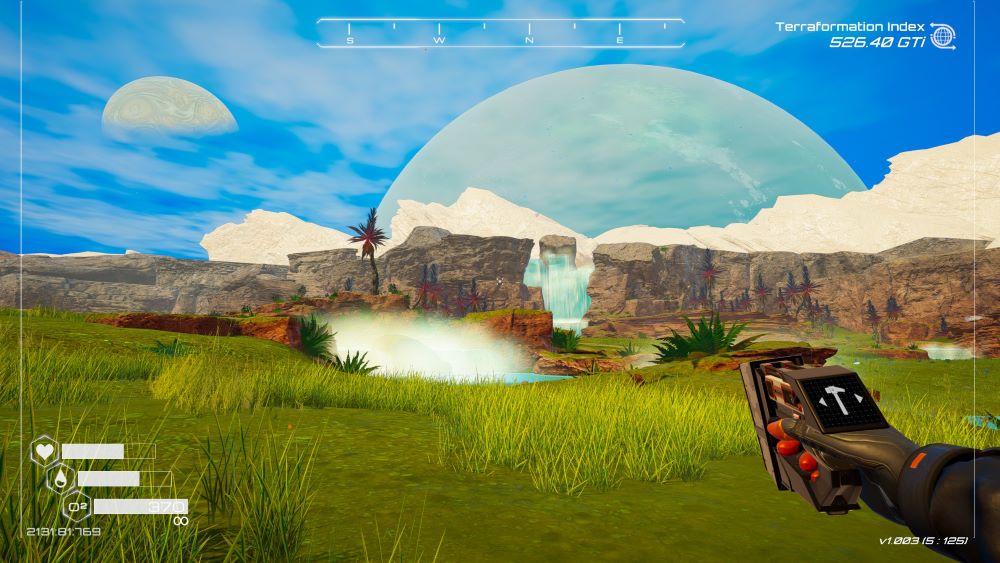
It’s also worth mentioning the more visual sense of progression as you improve Ti: watching the planet bloom. Glaciers recede, opening new travel and resource opportunities. Liquid water starts to form. Weather occurs. You start building Flower Spreaders, grass starts generating, then you upgrade to Tree Spreaders. By the time endgame rolls around, you are flying around searching for the last remnants of secrets left behind, occasionally stopping to gaze at the previously lifeless stone arch now covered in an explosion of color and growth. It’s a real treat.
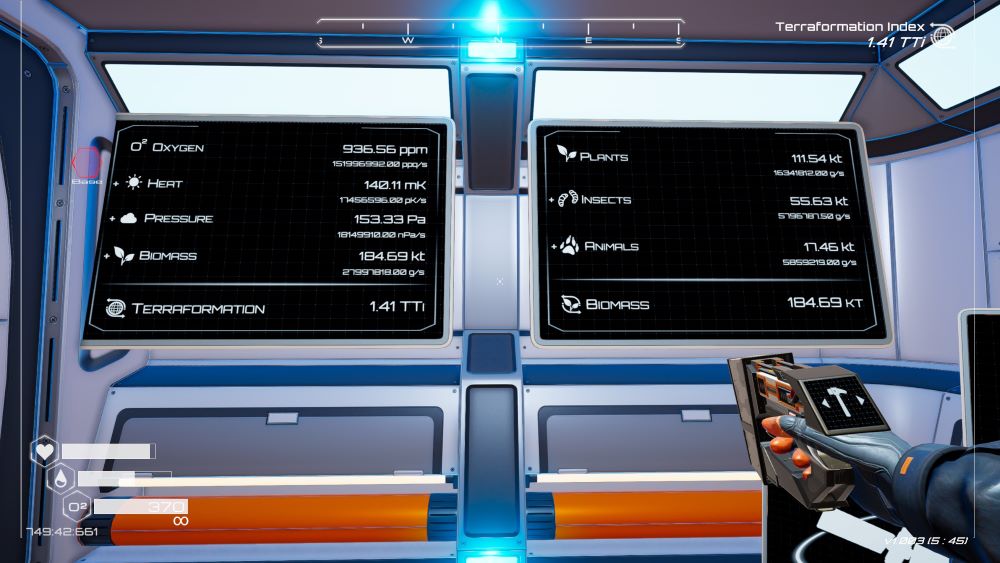
The only shame then is the final stumble. I have unlocked every technology except the final one to end the game. I have explored procedurally-generated wrecks, I have optimized my automation, I have uncovered every mystery on the planet, consumed every bit of novelty. My score is sitting at 1.43 TTi and 5 TTi is the end. After timing it, I would need to leave the game running for 5.5 real-world hours to get to that number.
Could I speed it up? I mean, hopefully. I’ve already built 6+ T5 generators of various types (Pressure, etc), overlapping Optimizers fitted with boosters, dozens of satellites that further juice the numbers by 1000% a pop. Each added machine makes the overall number increase by what feels like an insignificant amount. I spent the entire game waiting for the “Spam End Turn in Civilization” inevitability to kick in, and was surprised every time Planet Crafter bobbed and weaved out of the way. But, alas, it did come after all.
Nevertheless, Planet Crafter did deliver an extremely solid 20-30 hours of entertainment without once leaning into combat or contrivances. If you’re looking for Subnautica minus the thalassophobia, or the first half of Breathedge minus the chatty sidekick, then Planet Crafter is your game.
[Dark Souls] Day 3
I level up my base sword to +5 by farming souls. It’s not my “main” weapon, but until I find a Dexterity-based weapon, it is the one I have, so why not? This awareness, that one can farm currency/XP, dislodges something stuck in my mind. Where has this notion been in all the Git Gud conversations? Of course, there are probably limits to farming – practical or otherwise – and certainly you must respect boss mechanics. But there is a lifeline beyond trial and error, a sense of progression possible to afford you that slightest extra edge.

I feel more comfortable, even in unknown areas.
From the Blacksmith, I try and remember if there was a shortcut to the Undead Burg. Heading lower, I encounter a crippled statue thing that shoots lightning. I hit it once or twice, note how my power attack deals 15 damage, and then just run around it and down the hallway beyond. Kill some plant creatures. Walk to a vista area, look around for a moment, note “there doesn’t seem to be many mobs around here,” and instinctively turn around and parry the blow from another plant creature coming up behind me. Pretty sure getting hit where I was would have sent me flying over the cliff.
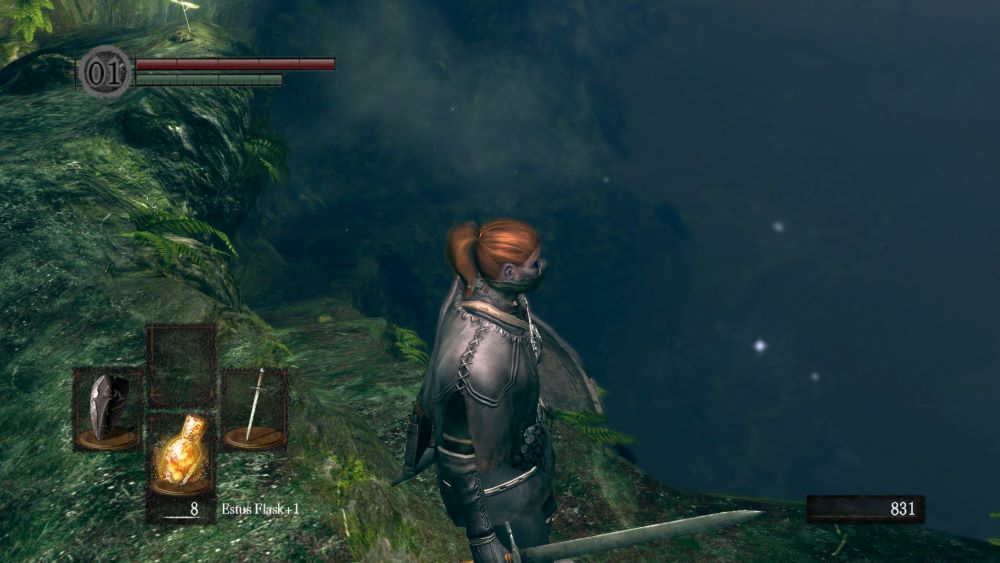
Keep heading down. Find a corpse with a bunch of leather armor and a bow. Head down further. Get waylaid by armored sub-boss. This one has a spear, so I spent a few minutes learning it’s moveset. As I circling him, I started walking down a ramp… and realized that his attacks couldn’t hit me. He eventually started using a new move that actually attacked downward, but I had already thrusted him to 10% from relative immunity. The corpse he was guarding has a shield that gives bonus stamina regen. Welp, that is probably going to be a forever item.
Keep heading down, found a Bonfire, now I’m in the Valley of the Drakes. Die a few times to the first Drake while I learn its moveset. Frustratingly die next attempt when the Drake had barely a sliver of HP; Dark Souls has zero remorse about you getting stunlocked in a lightning breath attack. Regain my souls, then fight it again. This time… the Drake leaps backwards off the cliff and dies. I run past another Drake on the bridge in order to loot the corpse there, then run away back up the elevator, save my game.

Darkest Dungeon plays in my head: “Remind yourself that overconfidence is a slow and insidious killer.”
I know what I am supposed to do, where I’m supposed to go. But I don’t want to. Not yet. Still no Dex weapon. Should I just pivot into some Strength build? Should I murder the Undead Merchant (killing NPCs is definitely a thing in Dark Souls) for his sword? What are the odds that I care about Undead Burg in the future, especially considering how long it took to find the guy in the first place?
Soon. Not today, but soon.
Silver End
I’m done with Valheim for now.
Where we last left off, I had already committed 4-5 real, prime-time, father of a 2-year old, I-should-be-sleeping hours finding and “exploring” mountain ranges bereft of silver. I had contemplated either uncovering the map with cheat codes or using an online tool to explore my world seed – somehow the latter seemed less morally questionable – but then decided against it. When you’re already this far up shit creek, you may as well keep paddling and see how much further it goes.
The answer is: seven. I explored seven mountain ranges before finding one that spawned any silver.
If we want to get technical, the first two mountain ranges were on my starting continent, and even I figured they had a low likelihood of having silver. From there, the modus operandi was to set sail towards any landmass that appeared to have a mountain on it. Luckily, you can tell from quite a distance whether there is a mountain – much farther than the tree-spawning distance, which otherwise tells you whether you’re heading for a swamp, plains, or forest. Unfortunately, all mountains have a similar skybox at range, and thus you do not know whether it’s going to be the size of those open meadow areas, or something more substantial. In my experience though (n=7), if you do not immediately see any drakes flying around, you are wasting your time at that location.
In any case, I finally hit pay-silver on mountain #7. And just like with the swamp, there were at least three separate silver nodes within about a 40m distance from one another. And one of those towers and give you the location of the boss. I had heard those were an extra layer of RNG I could potentially enjoy, but my tower had the location stone. Neat. I set up shop in the tower, moved my smelting infrastructure via portaling, and began getting my dwarf on.

Then… I was done.
The final nail were Stone Golems. As enemies, they’re fine. I had heard they took extra damage from the pickaxe, but honestly it’s way easier to just bash them with a mace and use your shield to almost negate all their attacks. The problem is that they drop Crystals. And Crystals have zero use in the game. Not “limited use” or “decorative item that grants no bonus,” I mean this is an item the devs put into their Early Access game but didn’t bother attaching to any recipe. It was a stark reminder that whatever the game is now is unfinished. Any of the frustrations I have experienced up to this point may not have been intended. The devs might have just not gotten around to it.
Suspension of disbelief: collapsed.
So now I’m off playing other, more finished games. Steam shows 46.6 hours played with Valheim, which is worlds more than I spend on 90% of the games I do end up playing. Other bloggers have already defeated the remaining bosses and still others appear ready to continue onwards past the edge of the page. Which is fine. But if there is any hope that I will feel motivated to play Valheim 6-12 months from now when it will (presumably) be more feature-complete, I had to call it. Should have called it after the swamp fiasco, honestly. But there it is.
Mirror
I am still playing Valheim, off and on. I haven’t felt the need to write about it though, considering how many other bloggers are filling space with their survival narratives. How many times do you need someone to talk about taking down the 2nd boss and (initially) struggling in the Swamp biome? For a minute there, even I started to wonder whether we all entered some kind of writing prompt class and had to elaborate on the same Youtube video of someone else playing Valheim.
What I have come to understand though is that all of us playing the same game and making progress in roughly the same timeframe really puts a mirror to us as gamers. Blog posts by their very nature do this all the time, of course, but when the base experience is so austere, we can’t hide in the minutia.
In examining my own narrative though, I keep coming back to… annoyance.
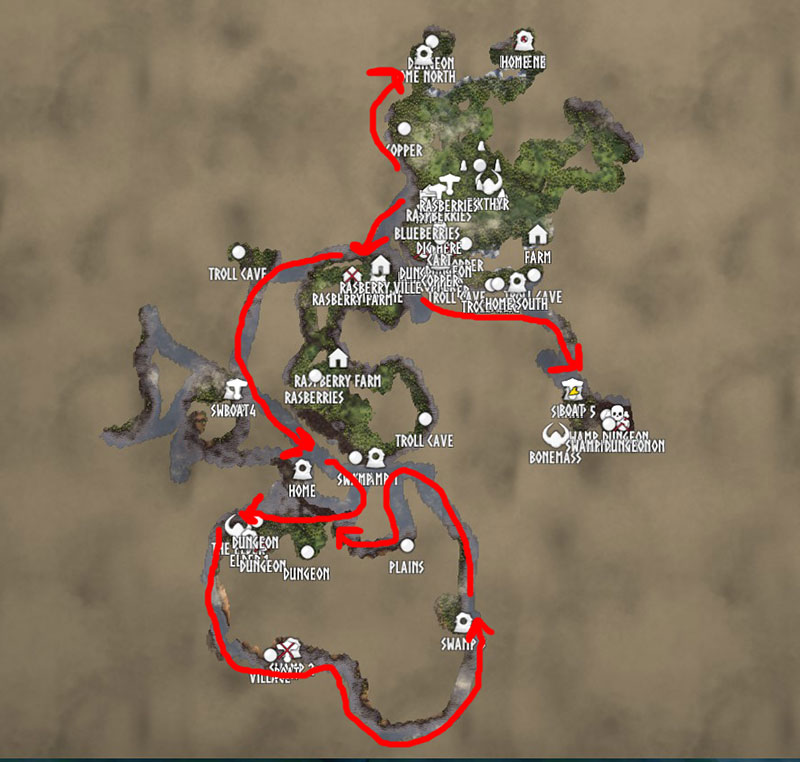
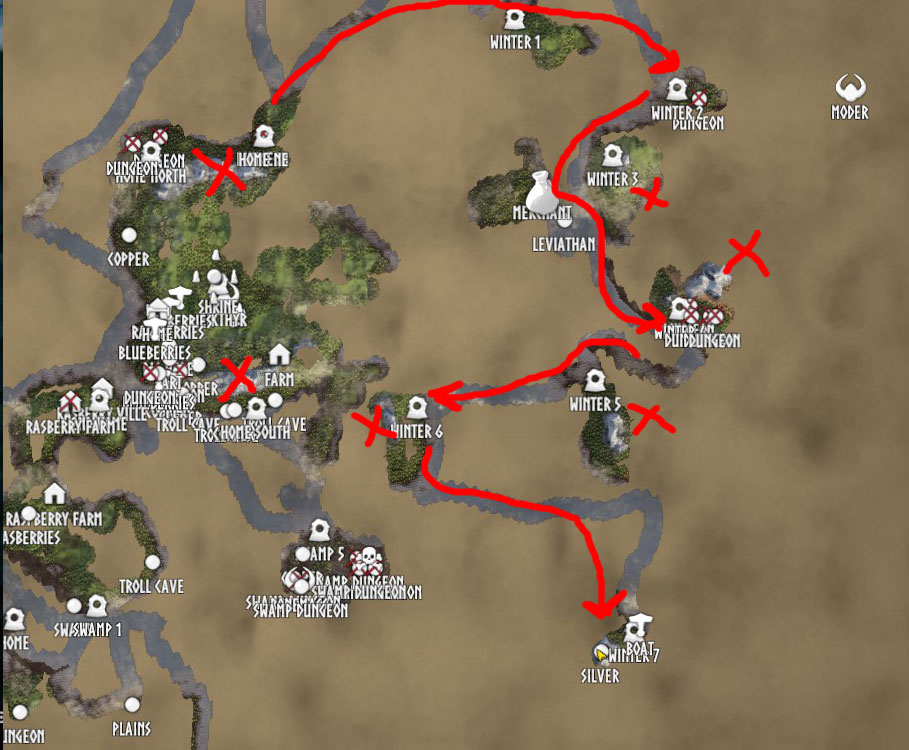
The above is a map of my adventures, starting from the 2nd boss who was like two major islands away. Which is fine. Having them so far away serves as an enforcement mechanism to engage with better boats and creating portals. Which highlights how you can’t take ore with you through portals, and oh you still need to explore the Black Forest to sweep dungeons for the necessary cores. And since you drop everything on death, you have to really be on point when exploring or else you’ll have to build a new boat and sail all over again, so make sure to stop and drop a portal every so often.
The real non-fun happened after killing the 2nd boss though.
The Swamp biome is fine. It’s oppressive and dark and tough to navigate and does a real good job of highlighting how much you do not belong there. The prep work necessary before venturing in (Poison Resist, etc) is precisely the sort of things that make survival games so addicting. If you never bothered to learn what the Wet debuff means on a practical level before, you sure as hell are paying attention now. The desperate struggle to flee while both Wet and Cold, spending what precious Stamina you have left zigging and zagging to avoid Draugr arrows in your back, all while you watch with dread as Poison ticks your remaining HP away is something that I think all of us experienced in our bones.
The non-fun for me was how it took more than 5 hours of “exploration” to find a Swamp biome that even had a Sunken Crypt in the first place. I found Swamps, yes. But Sunken Crypts with their Scrap Iron is the only real reason to ever set foot in one. What I found instead were crypt-less Swamps and a world seed that is apparently 90% Plains, which is a biome two ahead of where I should be. And so I sailed and sailed and slapped portals as far apart as I dared, knowing that dying too far out would likely put an end to my playing Valheim at all.
Then this happened:
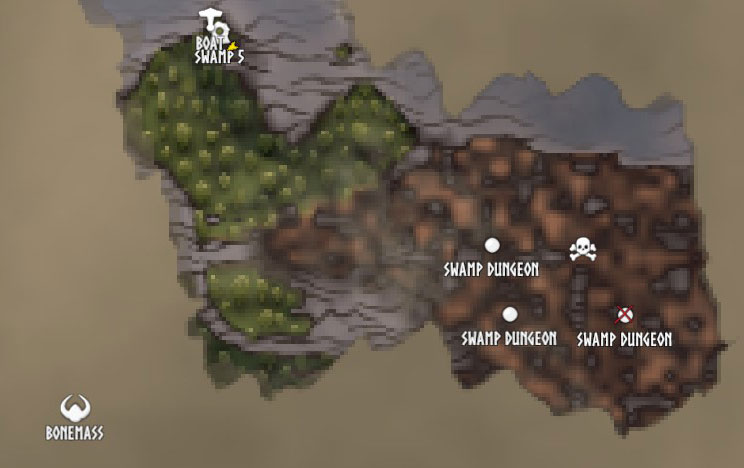
With portal “Swamp 5” I finally located a Swamp biome that actually had Sunken Crypts. Three of them. All within sight of one another. And within one such Crypt I got a read that the 3rd boss was… right next door. Next to another 3-4 Crypts.
Now, perhaps it would be too much to ask that every Swamp has a Sunken Crypt. Too formulaic. On the other hand… come the fuck on. Legitimate Swamps 1-4 were not legitimate enough, eh? I keep thinking how much my perception of the game would be different had I discovered a Sunken Crypt in the first Swamp biome I went to. Then again, maybe not, considering how I’ve clocked another 3-4 hours of “gameplay” finding and exploring Mountains that contain no Silver.
“Okay, you just don’t like exploration.” I mean… maybe? I can agonize for hours and hours in 7 Days to Die or ARK where is the ideal place to create a base. Because that sort of thing actually matters in those games. Valheim is about creating shanty towns next to resources and then portaling everywhere or white-knuckle sailing back to “home base” with a hold filled with ore. Really reminds me of Starbound and No Man’s Sky in that way – “home” is all but an abstraction, a loading screen at the end of an ever-expanding portal chain. The only real anchor in Valheim are carrots, beets, and beer, as those take a few game days produce. But, again, those be located at the ass-end of the world for all it matters.
In any case, I do not consider Valheim’s present state to be a particularly compelling argument for “exploration.” Am I literally “traveling in or through an unfamiliar area in order to learn about it?” Yes. But if procedurally-generated emptiness is what floats your boat, allow me to introduce you to No Man’s Sky, (vanilla) Starbound, and another small indie title called Minecraft.
There doesn’t have to be a treasure chest behind every waterfall, but if there are never any chests or my progress through your game is dependent upon a 10% chance of a randomly-generated waterfall spawning a chest 5% of the time, well, fuck you.
Perhaps I am being too harsh. I talked about ARK a lot before, but I sure as hell wasn’t using standard settings that would require 10 real-world hours of unconscious dino-sitting. So perhaps I uncover the Valheim map a bit via cheats (or view my world seed map) and at least note the next 5 mountain ranges of adequate size so I stop spinning my oars in the wrong direction. Because I have no problem collecting 500 whatever to do the next thing. But I have a huge problem spending the time going to the place where the whatever is supposed to be, and finding that the princess is in another castle, in a different game, and have fun playing through it all over again.
 In An Age
Past is Prologue
Nov 15
Posted by Azuriel
Starfield has been a wild success. Like, objectively: it was the best-selling game in September and has since become the 7th best-selling game for the year. And those stats are based on actual sale figures, unmuddied by Xbox Game Pass numbers. Which is astounding to think about.
[Fake Edit] A success… except in the Game of the Year department. Yikes. It’s at least nominated for Best RPG, along with (checks notes) Lies of P? No more sunlight between RPG-elements and RPG anymore, I guess. Doesn’t matter though, Baldur’s Gate 3 is going to continue drinking that milkshake.
Starfield having so many procedurally-generated planets though, is still a mistake. And its a mistake that Mass Effect: Andromeda took on the chin for all of gamedom a decade ago.
Remember Andromeda? The eagerly-anticipated BioWare follow-up to their cultural phenomenon trilogy? It ended up being a commercial flop, best remembered for terrible facial animations and effectively killing the golden goose. What happened? Procedurally-generated planets. Andromeda didn’t have them, but the (multiple) directors wanted them so badly that they wasted months and years fruitlessly chasing them until there was basically just 18 months left to pump out a game.
You can read the Jason Schreier retrospective (from 2017) for the rest of the story. And in total fairness, the majority of the production issues stemmed from EA forcing BioWare to use the Frostbite engine to create their game. But it is a fact that they spent a lot of time chasing the exploration “dream.”
That’s how it begins. Granted, we wouldn’t see how No Man’s Sky shook out gameplay wise until 2016.
The irony though, is that BioWare started to see it themselves:
And there it is: “it was never fun.” It never is.
I have logged 137 hours in No Man’s Sky, so perhaps it is unfair of me to suggest procedural exploration is never fun. But I would argue that the compelling bits of games like NMS are not the exploration elements – it’s stuff like resource-gathering. Or in games like Starbound, it’s finding a good skybox for your base. No one is walking around these planets wondering what’s over the next hill in the same way one does in Skyrim or Fallout. We know what’s over there: nothing. Or rather, one of six Points of Interest seeded by an algorithm to always be within 2km walking distance of where you land.
Exploring a procedurally generated world is like reading a novel authored by ChatGPT. Yeah, there are words on a page in the correct order, but what’s the point?
Getting back to Starfield though, the arc of its design followed almost the reverse of Andromeda. In this sprawling interview with Bruce Nesmith (lead designer of Skyrim and Bethesda veteran), he talked about how the original scope was limited to the Settled Systems. But then Todd Howard basically pulled “100 star systems” out of thin air and they went with it. And I get it. If you are already committed to using procedural generation on 12 star systems, what’s another 88? A clear waste of time, obviously.
And that’s not just an idle thought. According to this article, as of the end of October, just over 3% of Xbox players have the “Boots on the Ground” achievement that you receive for landing on 100 planets. Just thinking about how many loading screens that would take exhausts me. Undoubtedly, that percentage will creep up over time, but at some point you have to ask yourself what’s the cost. Near-zero if you already have the procedural generation engine tuned, of course. But taking that design path itself excludes things like environmental storytelling and a richer, more tailored gaming experience.
Perhaps the biggest casualty is one more felt than seen: ludonarrative. I talked about this before with Starfield, but one of the main premises of the game is exploring the great unknown. Except everything is already known. To my knowledge, there is not a single planet on any system which doesn’t have Abandoned Mines or some other randomly-placed human settlement somewhere on it. So what are we “exploring” exactly? And why would anyone describe this game as “NASApunk” when it is populated with millions of pirates literally everywhere? Of course, pirates are there so you don’t get too bored exploring the boring the planets, which are only boring because they exist.
Like I said at the top, Starfield has been wildly successful in spite of its procedural nonsense. But I do sincerely hope that, at some point, these AAA studios known for storytelling and/or exploration stop trying to make procedural generation work and just stay in their goddamn lane. Who out here is going “I really liked Baldur’s Gate 3, so I hope Larian’s next game is a roguelike card-battler”? Whatever, I guess Todd Howard gets a pass to make his “dream game” after 25 years. But as we sleepwalk into the AI era, I think it behooves these designers to focus on the things that they are supposedly better at (for now).
We learn from our mistakes eventually, right? Right?
Posted in Commentary, Philosophy
2 Comments
Tags: Exploration, Mass Effect: Andromeda, procedurally-generated, Starfield