Blog Archives
Massive Effect
Having completed Torchlight, I decided to move onward to Mass Effect. Why not Skyrim, which is literally burning a hole through my Steam library? As Liam O’Brian might say, the status of my preparations is in doubt. I prefer one meaty title with a helping of indie garnish along the side – with something like Skyrim, I’m getting the impression that I’ll still be eating turkey sandwiches for months later.
About 5 hours into Mass Effect, all I can say is holy shit.
One of the most groundbreaking things occurred in the city after the first “dungeon.” In talking with a receptionist to the Consort, she winked at me.
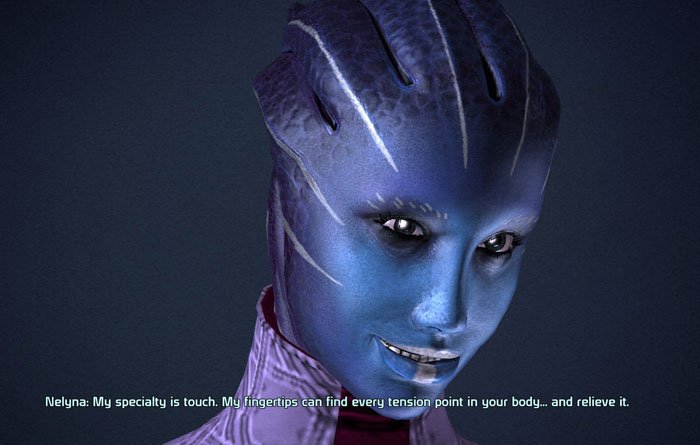
She also said that, but nevermind.
My incredulity may sound facetious, but I am actually very, very impressed.
See, I have been thinking about the problems with storytelling in videogames for quite some time. How is one supposed to convey subtle nuance in a game? In purely written works, it is somewhat easy to evoke the emotion you want to get across, provided you massage the language a bit. For example, consider the following:
‘Look, I can explain,’ he said.
Lord Vetinari lifted an eyebrow with the care of one who, having found a piece of caterpillar in his salad, raises the rest of the lettuce.
How could someone ever translate that in game form? Nevermind Vetinari’s specific sentiment here, think generally: there is an entire genus of expression that the format is preventing designers from expressing.
Games have some pretty unique qualities that cannot be replicated by other mediums too – Far Cry 2’s plot wouldn’t work without player interaction – but many times it feels as though designers simply give up. Game narratives are written in the language of action because of these restrictions on expression. Why are we always killing 10 [%local_wildlife]? Or killing everything, period? Well, how else are you supposed to convey conflict when reduced to crude avatars with clubs? Even though all games have access to written dialog, at some level we do expect everything to be translated into the language of action. And until the last few years, it was functionally impossible to express more than a rudimentary emotional gesture anyway.
There are pitfalls too, of course. Blink during the wink, and you’ll have missed it. Or, hell, focus on the subtitles and miss it too. It is also arguable about whether games should try and be more like the other mediums, instead of focusing on its own unique strengths.
To that last charge, I say “Watch that scene in FF7 again.” Pay close attention at 1:19. More than the murder itself, it was Sephiroth’s smirk that drove home how irredeemably evil the man was. Without the CG movie we would never have saw it; calling attention to smirk in-game via text would have ruined its subtle gravity. While story can certainly be a crutch to prop up forgettable gameplay, story can also be a pole that vaults a game into the classics.
So, Mass Effect, you have my full attention. I just hope you do a little more winking a little less of this:
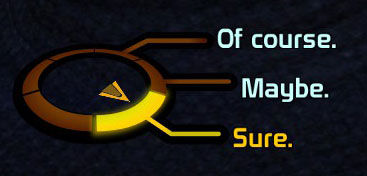
Decisions, decisions.
 In An Age
In Defense of Nostalgia
Aug 2
Posted by Azuriel
“That’s just the nostalgia talking.”
After reading Liore’s post about starting to play Final Fantasy 7 for the first time (from the latest Steam sale), I started thinking about nostalgia. After all, I still consider FF7 in my top three favorite videogames of all time. I have undoubtedly played other games for longer – and it’s likely that I’ve played “better” games since then – but a component of what I describe as “favorite” includes impact on my life.
Nostalgia is always used as a pejorative in videogame discussions, a way of dismissing the assertion that X is better than Y, or that X is still good at all. Hell, I have probably used the term in the same manner. But it seems clear to me now that the “charge” of nostalgia is a bit too sweeping. Sure, sometimes you think something is (still) good simply because you liked it when you were younger. But sometimes you do just so happen to experience a revolution or cultural event as a child. Was the moon landing “just nostalgia talking”? Was MLK’s speeches “just nostalgia talking?”
The cultural impact of FF7 in gaming specifically cannot be overstated. It has sold 10 million copies as of 2010, which might not sound impressive for a game that came out in 1998, but keep in mind that that still makes it the best-selling Final Fantasy title of all time. It pretty much popularized the (J)RPG genre in the United States, and arguably sold the original PlayStation by itself. The graphics, which admittedly don’t hold up well at all today, were revolutionary at the time. And the music? The end of Disc 1? One-Winged Angel? There is a reason why so many people cosplay as FF7 characters and not, say, characters from FF6 or FF4 or FF9.
But let’s assume that is just nostalgia talking. Well… when does nostalgia not talk? Is everything from the past suspect? Do things only get better over time? Are all the good things in gaming just conveniently occurring right now? (Hint: Many MMO bloggers are saying no.) I am not entirely sure that a hyper-focus on the present is any less ridiculous than a longing for the past.
I will be the first to admit I have criticized someone for having “rose-colored glasses” in regards to wistfully looking back to, say, TBC WoW game design. And I do actually still stand by those criticisms: there is nothing about TBC that I don’t honestly and truly believe Wrath improved (with the exception of Kara, maybe). But… I dunno. I’m not sure anymore that I can legitimately claim “that’s just nostalgia talking” in one instance and not levy the same damnation on a game like FF7. Vanilla WoW or even TBC WoW were just as groundbreaking at the time, in their contexts, as FF7 or anything else. Cataclysm? Much less so.
Nostalgia remains a tricky subject though. Can something be both legitimately revolutionary and not hold up to today’s scrutiny? Probably. Like… Pong, maybe. And surely there are others too, although the first thing that came to mind, Super Mario Bros, actually holds up IMO. Secret of Mana? The music alone buoys the game. And, again, I’m not entirely sure why a game “not holding up” is necessarily a deficiency of the game anyway. A timeless classic in other mediums remains amazing by definition, but it is not as though we continuously invent new ways of reading books or watching movies. Meanwhile, there are millions of different iterations on combat systems or simple object interaction. Holding games to the same standards of books and other mediums seems like an unfair comparison in that regard.
And really, who cares if it is “just nostalgia”? Regardless of whether FF7 holds up, it had a significant impact on my (gaming) life if nothing else. I created save files in front of every CG cutscene and showed my friends when they came for sleep-overs. Remember the
MakoJunon Cannon firing? I was showing them that one and my friend David quipped “Is that the gun?” when the camera was panning to the side turrets. I paused a beat and then said “No, that’s the gun” as the Cannon came on-screen. That IRL moment couldn’t get more cinematic if we tried.As I mentioned at the top, I have undoubtedly played other games for longer amounts of time, and probably have played objectively better games too. Nevertheless, I’m not entirely sure whether my favorite games of all time list have really changed. To be honest, I haven’t thought about it all that much. Bastion was good enough to dislodge some SNES game, surely, but which one? Hell, can I even get myself to play my supposedly favorite games again? And if I can’t, should that even mean anything?
I dunno. I also purchased FF7 during the latest Steam sale, and am looking forward to playing it again with no mods (besides the music one that makes it sound like the PS1 original). Will it hold up? Will my opinion on it change? We’ll see. Maybe not soon, but eventually. And then perhaps I should give Xenogears and Final Fantasy Tactics another try too, seeing as they hold spots #1 and #3 respectfully.
Posted in Commentary
8 Comments
Tags: Cultural Impact, FF7, FFT, In Defense, Nostalgia, Xenogears