Blog Archives
There And Back Again?
I came across a thread on Reddit which was a pining for the “old days” of MMOs when you either grouped up or didn’t get to actually play the game. Which, now that I think about it, is a scenario not all that different from empty FPS servers. Anyway, the top-rated comment concluded with this:
The truth of the matter is, those of us that grew up on the hardcore MMOs, we’ve already done it. Most of us just don’t want to do it again. I don’t want to play a MMO that takes over a year to hit the level cap. I don’t want to play a MMO where I have to stand around for hours before I get to play. I don’t want to play a MMO where I can permanently lose everything I’ve done in the last few hours. I’ve already done that; I don’t want to do it again. The novelty of the MMO is gone. There are better ways to enjoy my time.
There is a nuance to this argument that I don’t see all that often, and I’d be interested in what other veteran MMO players have to say about it. It’s one thing to say that once some auto-grouping functions are released, like LFD or LFR, that there is no removing them. But put those aside for a moment and ask yourself: how many times do I feel like I could start over in a “pure” MMO (whatever you define that as)?
Maybe the question is nonsensical, considering we technically “start over” each time we play a new game. On the other hand, I’m not entirely convinced another MMO could bribe me enough to get back into raiding as a full-time job again. Even if your game of choice was EVE, how willing would you be to starting over in a completely new game with similar time-investment requirements? Still willing to spend 1-2 years of real-time building up a skill set? Or do these sort of investment mechanics have diminishing returns regardless of “dumbing down” or other streamlining that might go on?
Review: Torchlight 2
Game: Torchlight 2
Recommended price: $5/bundle
Metacritic Score: 88
Completion Time: 35 hours
Buy If You Like: Torchlight 1, Poorly itemized Diablo-clones

At least the combat feels improved.
Torchlight 2 is the hack-n-slash sequel to the original Torchlight, itself an homage and erstwhile competitor to Blizzard’s Diablo series. Indeed, Torchlight 2 was released around the same time Diablo 3 was making headlines with its controversial always-on requirements and server-dependent gameplay. While it makes a great counter-point to Diablo 3 on the feature listings, Torchlight 2 is essentially more of the same from the original game. Which, in my case, is bad news.
My fundamental gripes with both Torchlight games are their meaningless adherence to archaic game design, and a fundamentally terrible itemization/progression system. Torchlight 2 features four different classes to choose from, each with three separate class trees. While they mainly follow traditional hack-n-slash roles, there does exist room for experimentation: there are more than enough talents to choose from to transform, say, the archer-esque Outlander into a melee-only tank (albeit not likely as powerful as a normal tank class). Where this experimentation immediately breaks down is how there is no respecing in Torchlight 2; at most, you are allowed to get a refund on your last three talent points. While this was how things worked in Diablo 2, it is also true that at one point people thought asbestos as insulation was a good idea.
The more crippling flaw though, and the singular design that undermines everything else the game set out to accomplish is the awful itemization and item progression system. While not as outlandishly terrible as the original Torchlight, it is still entirely possible (and even likely) that you will receive a random drop at level 17 that you will still be using 40 levels later at the end of the game. The core of what made the Diablo series so compelling to play was how items and gold erupted from nearly every enemy you faced, and thus you had a steady supply of dopamine over the course of what otherwise is series of perpetually unengaging clicks. Torchlight 2 has none of that – nearly two-thirds of the game was spent vendoring every ring, helmet, amulet, and pants I came across.
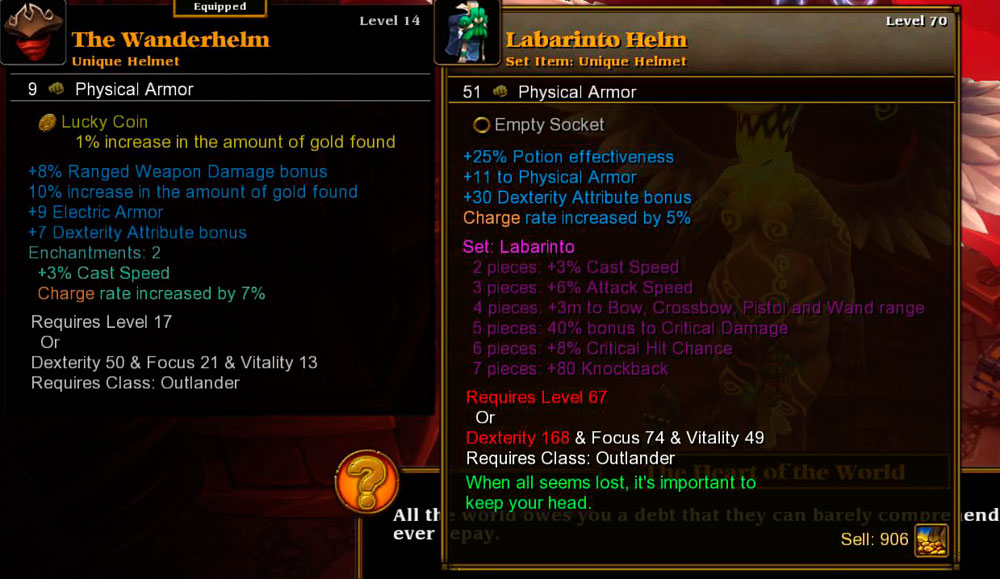
Not even the class-specific helmet from the last boss was much an upgrade to my level 14 helm.
It gets even worse, if you can image that.
Clearing an entire map’s worth of mobs and collecting every single piece of vendorable debris results in what I would like to term one “Gear Unit” (typically 2000g-3000g). Each GU allows you to either purchase one item from a vendor, or upgrade an existing item by either adding gem sockets, enchantments, or purchasing gems themselves. This ridiculous stinginess with gold means you are perpetually strapped for cash, only allowing you to augment the gear you’ve accumulated one map clear at a time. God help you if you’ve finally accepted the fact that you’ll never replace your boots only to have an infinitely rare upgrade drop right after spending 10,000g (or 3 GUs) on your old pair.
Oh, and by the way, the Gold Chests and Boss Chests that you are “rewarded” with for going out of your way to find the keys or defeat said boss end up dropping jack shit 99% of the time. I have found more rares and unique items out of normal, everyday treasure chests than I have ever gotten from boss chests. How do you fuck something like this up?

Oh, hey, a Minecraft reference.
I am spending all this time talking about loot and such because that is the heart and soul of the hack-n-slash genre. To get loot wrong in these sort of games is to create a racing game with poor-handling cars or a FPS where the guns don’t shoot at the crosshairs. Indeed, would anyone play a Diablo-esque game if there was no gear at all? The gameplay, which consists of mowing down tens of thousands of mobs within seconds of their appearing on the screen absolutely is not compelling enough on its own, that’s for goddamn sure.
All of which is certainly a shame, as Torchlight 2 is otherwise an improved sequel in pretty much every other way. The gameplay (such as it is) feels more responsive and impactful; the environments are detailed and fun to look at; the music is about a half dozen artful remixes of the Tristram theme; and I enjoy the visual style. It just feels, you know, completely unrewarding to play.
It is worth mentioning that all of these problems have been solved by better game designers, e.g. the players submitting mods to the game. There are mods that range from introducing new character classes to entirely new dungeons to, you guessed it, fixing the loot issue by guaranteeing Unique or better drops from Gold/Boss chests. I decided early on to stick with the vanilla game because I wanted to get a feel for what the devs learned from the original Torchlight. The answer is “pretty much nothing.” Playing with mods “taints” your character though and otherwise makes you ineligible for achievements. But since the base game feels like such a massive chore to play, I highly recommend anyone deciding to install Torchlight 2 to go ahead and fix what the devs had not the brains and/or balls to do.
Sandbox Quests
Tobold made a post the other day that got me thinking about the more philosophical angle of the differences between themepark and sandbox games. In the post, Tobold relates the common DM nightmare of players striking off on their own, plundering the crypt/castle/ruins before technically getting the quest to do so. While one solution is the Warhammer-esque “Bears bears bears” method (retroactive credit), Tobold went with “All roads lead to Rome” where he simply moved the quest-giver to where the players were going. As I mentioned in the comments to his post, the latter is not particularly innovative; WoW has had the occasional mid-quest updates since Cataclysm, and GW2’s Hearts are all location-based and automatic rather than relying on quest-givers.
The thought that struck me though, was this: at what point does a sandbox become a themepark?
Take, for instance, Darkfall. I don’t think anyone would claim that Darkfall is anything other than a sandbox. But it also has what amounts to “quests” in any other game: Feats. I suppose these are more similar to achievements than quests per se, but they are basically “Do X, Receive Y” activities that drive player behavior. Would having Feats tied to NPCs in a town or camp change Darkfall into a themepark? I don’t see why they would.
It seems clear to me that the difference between sandboxes and themeparks are the difference between player-motivated actions and developer-motivated actions. Do what you want in Darkfall, do Siege of Orgrimmar/Timeless Isle/LDR/etc in WoW. But I am starting to think that that line is a bit fuzzier than it is typically portrayed. “Do what you want in Darkfall, but farming X over in Y is more rewarding than Z.” How different is that really than themeparks? And isn’t it possible for someone to treat a traditional themepark MMO as a sandbox?
So, now I’m thinking that the line between these two paradigms really comes down to developer attitude regarding content. If the developers feel that they have to create the content themselves, it’s a themepark; if the developers let players amuse themselves, it’s a sandbox. Am I missing something critical? I mean, player housing and non-instanced dungeons are prototypical sandbox qualities, but a Darkfall without either is still a sandbox, right? And clearly the line is not drawn at the mere existence of quests or directed player activity either.
Are these themepark/sandbox distinctions more arbitrary than we have been led to believe?
Loot 2.0
The big news of the week has been Blizzard’s rather unprecedented decision to shut down the Diablo 3 AH in March of next year. While I suppose that the start of a new expansion is as good a time as any, I still find it interesting that they are bothering at all – a bit late to close those barn doors, yeah? Then again, I suppose with all the other changes they have made in the time since I stopped playing (a whole year ago?!), the “economy” has become more warped and functionally useless than before. Making it five feet in Act 2 Inferno used to require Resistance scores out the ass, but between the general elite nerfs, the player-decided mob-levels, and the Paragon system, you can probably make it through the game without buying anything.
You would still want to, of course. Even a child should be able to understand that a 5% chance at something good is worth less than buying exactly what you want from someone who was going to vendor the thing anyway. Or anyone playing the game for more than an hour during the open beta weekend, for that matter.
The question though, is what system will replace it? Apparently Blizzard feels it is Loot 2.0:
- New game modes including Loot Runs with guaranteed special item drops when successfully completed.
- Smart drops where a dropped item is guaranteed to roll the appropriate mainstat for the class that finds it.
- Fewer but better item drops, where players will see far fewer items, but the items (especially the rares) will have better stats.
- A new NPC Artisan, the Mystic who has the abiilty to reroll one selected affix on an item.
- Legendary (including Set Items) will get an across the board quality buff.
- Legendary items will drop more often, especially for lower level characters with guaranteed legendary drops from the first kill of many story/quest bosses.
- Legendary items will roll with less low-end variability, to reduce the likelihood that they are complete junk.
- Legendary items will gain variable item levels with stats scaling appropriately — current high level items legendaries will drop on lower difficulties and low level Legendaries will drop in the end game. All stats on these items will scale up or down to be appropriate for the level of the monster that drops them.
Item binding is going to be a key feature of Loot 2.0, with some of the found items, and most or all of the crafted items or items upgraded with the Mystic gaining BoA or BoE to restrict them from being traded or sold. Full details are not yet finalized.
I counted three instances of the word “guaranteed” in there. Not something I usually associate with Diablo games, but hey.
While the above is not an exhaustive list of the Loot 2.0 paradigm – I’m pretty sure that not even Blizzard knows what else they’ll toss against the wall before March – we can see the sort of trajectory taking shape. What is a huge unknown to me though, is what exactly Blizzard plans to do with all the gold left in the economy when the AH doors close. Will the Mystic be an expensive gold sink? That might work… but what about the people who haven’t stockpiled? Will the feature not be for them? Between that and the possible stockpiling of crafting materials, I almost have to assume that Blizzard plans a “currency reset” with the expansion, to go with the inevitable gear reset that comes with an increased level cap.
In any case, watching things play out this week has been interesting while playing Path of Exile on the side. I mentioned before that PoE has something more akin to a lore-based barter economy, but I am finding it even more interesting than before. Effectively, I find myself rolling my own loot back in town when I go to vendor things. Useful Magic/Rare/Unique items do drop out in the wild, but I am finding that the addition of colored gem slots adds another depressing layer of randomness to everything; a given item might be awesome for your class/build, but if it is replacing an item with a good spell-gem configuration, you might end up banking it instead. While there are “currency” items that can add/change sockets, I am finding it almost easier to hold onto normal items with good sockets and then spend my “money” turning that into a Magic/Rare item instead.
That can sort of happen in Diablo 3’s crafting system, but it lacks the granularity and impressive nuance that PoE brings to the table. Scrapping four items to get another shot at getting a useful fifth isn’t the same as being able to choose to reroll an item’s magic properties, adding a new property, adding sockets, adding connections between sockets, changing a socket’s color, and/or stripping the item clean and then possibly rerolling it into a Rare/Unique.
Can I also just mention how addicting just leveling in Path of Exile can be? It’s the standard sort of hack-n-slash, but since your gems can level up too, it feels like I “level” a half-dozen times every 30-40 minutes. “Getting kinda sleepy and I still have 8 bars before level 24. Oh, wait, there’s like a centimeter left on my Raise Zombie gem XP bar. Hmm… let’s go clear out the NW corner.”
But, yeah, loot systems. Borderlands 2 is feeling pretty archaic right now in comparison.
Item Build Paradigms
As you may recall, I have been having a rough time in Borderlands 2. I bought the Season Pass back when I bought the original game, but sort of let things slide somewhere around 95 hours /played, about the time the Hammerlock campaign was released. My main issue, aside from general burnout, was that my character is Zer0, the melee-based ninja/sniper character. Simply put, I was having a hard time surviving in the extended difficulties as someone either in the middle of the action (where mistakes kill you quickly) or trying to snipe when 10 people are shooting at you (whom are extremely accurate with their assault weapons).
Now, I can already hear those of you in the audience: “But, Az, Zer0 is like one of the strongest characters in the game! He can solo the raid bosses!” Sure he can… with a very specific loadout of Legendary/Unique weapons, which either requires luck, grinding, duping, or all three. While I am obviously not allergic to chasing gear drops in games, in this instance all I really wanted to do was finish the Hammerlock DLC and then complete Tiny Tina’s Dragon Keep DLC. You know, at a level in which it’d be challenging and rewarding too – there isn’t any real reason to blow through it on Normal or anything.
Unfortunately, I was stuck between a rock and Ultimate Vault Hunter Mode (UVHM). I beat the game on True Vault Hunter Mode (TVHM) way back when, plowed through it again in “2.5” mode where everything is scaled up to level 50 (the cap at the time), leaving all of the sidequests alone so that I could give myself the option of getting the highest-level versions of the various unique gear. Hell, I even farmed the last boss a few times. UVHM steps it up a few notches though, including a level cap increase, and basically makes Slag elemental weapons (which increase the damage of all other sources) required. Not only did I not really have any of those weapons, my current gear was simply not cutting it… or anything, really.
This past weekend, I finally decided I was going to give it one more shot. My plan of action was to grind to level 51 and then cash in my ~40 Golden Keys and hope that the level-cap inflation on guns would give me something worth shooting. Since I was grinding anyway, I decided to do so in the Torgue DLC, in the repeatable Bar Brawl quest area; each run gives you special DLC currency to purchase, among other things, an Unkempt Harold, e.g. a Legendary everyone seems to use.
So I did. And got it. And now it feels like a whole different game.
The basic gist is that the gun says it deals ~14k damage per shot, but the “bullet” is actually a missile that splits off into 3, 5, and 7 missiles depending on how much distance it gets before impact. The Double Penetrating Unkempt Harold, which is the version I got, does the same thing x2. So, depending on how close something is, a shot from this pistol deals ~196,000 damage. Meanwhile, my best rocket launcher deals 226,000, with a 3-round clip and 7.4 second reload speed. I can carry 700 pistol rounds and reload in under 2 seconds. I could technically pick up another Unique item from a sidequest (The Bee shield) which would add something crazy-stupid like 40,000 damage to my bullets – which ends up being added to each bullet from the Unkempt Harold – but it is already making my TVHM-ish run somewhat of a joke.
What all of this is making me realize is that I don’t like this paradigm. Specifically: the gear-based-build paradigm. “Get item X and now you can do build Y.” Another of the items I picked up was a weapon (the Rubi) that gives heals you for 12% of the damage you inflict while having it equipped. It is another of the sort of “required” weapons for endgame Zer0 builds, as you can abuse the life-gain by dealing melee or grenade damage; the gun itself will never hold a candle to others, but firing one and then swapping back to it before impact will still basically let you heal to full. Combined with the “health-gating” hidden mechanic that prevents you from being one-shot (50% + 1 HP and you will survive any hit), this lets Zer0 basically melee raid bosses.
The problems, as always, are A) getting the gear and B) what to do until you get the gear. I am 100% for different character builds. I don’t even have much of an issue with talent choices leading to different stat weightings, e.g. choosing Talent X makes Haste worth more than Crit or whatever. But building an entire character around single pieces of (rare) equipment? That feels awful to me. Either you don’t have the item yet, in which case you feel weak/incomplete, or you do get the item and suddenly everything else that drops is useless/unrewarding. Plus, there is the whole side-effect of the fact that your character identity feels weakened or nonexistent; do my character choices even matter in the face of my item collection? Am I Zer0 at all, or am I simply “some dude with a Rubi and DPUK?
I decided to take a break from Borderlands 2, and started playing Path of Exile as a backup game. And… whoops! Just like many hack-n-slash games, it too features rare items that you can/should/(have to?) build entire characters around. Because that’s fun. To someone. Sigh.
Design Conundrums: 1 HP vs 0 HP
The difference between a character with 1 hit point and a character with no hit points remaining is immense. Obviously, right? But as I was musing on the extreme nature of the binary state, I started wondering if there was not some better way to handle the situation.
After some reflection, I am not sure that there is.
First, is there a problem at all with the conventional binary system? I’d suggest there is, at least enough of one to go through the thought exercise. One issue is that there isn’t much of difference between 1 HP and 100,000 HP – you are just as powerful and dangerous at one as the other. Some games might have “Execute” abilities that cause you to care about how many HP you have left, but all that is really doing is making the 1 HP “range” larger or simply making it more ambiguous as to your actual HP state.
The more salient problem with the 1 HP to 0 HP divide is what I’d term the Fail Cascade. Card Hunter (out of beta!) provides an especially stark example of this phenomenon. If one of your characters is reduced to 1 HP, they can still drawn 3 new cards each turn, can still attack at full strength, and can otherwise contribute meaningfully on the battlefield (limiting enemy mobility, being the target of spells, etc). Conversely, a dead character contributes nothing: all their cards are discarded, their body is removed from the battlefield, and you are left with potentially 10 cards to kill the remaining enemies instead of 15 cards. A character’s death is especially brutal in Card Hunter because the abilities you have access to are randomly determined from the cards in your deck. Instead of six chances of drawing an attack card to win the game, you are left with four.
Of course, sometimes the sacrifice of a character can turn out to be a winning strategy. In a 3v3 Arena game in WoW, it might be worth losing a DPS to take out the enemy’s healer in pursuit of an stalling game. In Card Hunter, taking out a Goblin Brute or other dangerous foe is worth it if the enemies remaining aren’t as immediately deadly in comparison. But under most circumstances in just about any other game (including the two mentioned), losing one character is an immediately 33% reduction in fighting capacity, and possibly more painful from a synergy point of view.
Is the alternative really that much better though? We could imagine a game where your health as a percentage is tied to your damage as a percentage; if you are are at 10% HP, your attacks only deal 10% of their normal damage. Personally, I recoiled at the very thought of such a system. Whereas the current design is a hard binary, it at least leaves open the possibility of a come-from-behind victory. If taking damage reduced your ability to deal damage in return, the outcome of most battles would be forgone conclusions within the first minutes of any engagement. Indeed, it is arguable whether we would be trading the binary at 1-to-0 HP for the same binary at the other end of the spectrum (whoever dealt damage first).
Now, I would be remiss if I did not mention the Downed State solution in games like Guild Wars 2 and Borderlands 2. Having played both for a while, I definitely appreciated the extra little window it offered between 1 HP and dead. It is certainly better than the alternatives we have currently.
At the same time though… how different is it really? I can still perform at peak capacity at 1 HP, so my HP totals are 1, 0, and -1 instead of just 1 and 0. The other issue is that I felt as though the Downed state started being an excuse for adding in more “sorta instant death” attacks. If a raid boss in WoW has a mechanic that kills you instantly, it has to give you reasonable warning given how powerful it is. Conversely, an attack that instantly sends you to a Downed State is common in both Borderlands 2 ¹ and GW2. It is a “safe” mechanic to use because it can (usually) be recovered from while still retaining a sense of awe/fear from the player.
Perhaps this isn’t even an issue at all, from a design perspective, as the devs rely on the player to gauge his/her own sense of danger. Personally, I don’t really glance at my HP bar until I start dipping below 80%; once at 50% or so, I start actively playing defensive and looking for ways to replenish HP; at 20% or below, I generally stop caring unless victory is in sight, as I see my demise as inevitable. Thus, my reaction is tailor-made for my play-style, rather than dictated by the devs who might want me to care at X% HP when I don’t, and vice versa.
I dunno. Realism rarely makes for more engaging gameplay, but I sometimes think HP is too abstract.
¹ Technically, there is “health gating” in BL2 which prevents any one attack from killing you instantly as long as you have 50% HP + 1. So, I suppose BL2 has both the tri-HP state plus an execute range.
The Siren Call of Dynamism
Looks like we have the next Jesus game:
EverQuest Next Could Fix Everything Wrong With MMORPGs
I’ve played every major massively multiplayer role-playing game released since 1998, yet it feels like I’ve spent the past 15 years playing the same game over and over again. That’s a problem. EverQuest Next is the solution.
I probably should have stopped reading that Kotaku article right there, but I’m a masochist at heart.
Don’t get me wrong, some of the things I’m reading about EverQuest Next sound interesting. Voxel-based things, somehow without looking like Cube World. And… err… yeah. Classless/multi-class systems like The Secret World/FF11. Stylized graphics like WoW, Firefall, Wildstar. Red zones on the ground that you shouldn’t stand in, like most every game these days. Jumping and “parkour” (which means what, exactly, in this context?) like in Guild Wars 2. Reducing abilities down to eight, like Guild Wars 2 again. Dynamic events and “calls to arms” like Guild Wars 2 and Firefall and Warhammer. Hell, considering they brought over Jeremy Soule to do their soundtrack, they probably should have just called the game EverGuildQuestWars2Next.
Then there are the hype red flags. A StoryBricks-based AI that wanders around and sets up camp organically? Neat. But then I started reading this interview:
So, to better understand the Rallying Calls, I wasn’t clear on some things with David Georgeson’s example: say you’ve built a big city, and built these stone walls around it, and now an army has come for a siege. Is that something that happens over a couple hours, or a week?
McPherson: That army siege lasts until the players on the server have completed that stage.
[…]
With the “emergent AI,” though, how can you maintain something indefinitely? If the army comes to attack, and is defeated outright in an hour or the players just ignore it, what then? Do you keep spawning enemies?
Butler: Until the things that spawn them are destroyed.
[…]
So, if orcs are released into the world and wander around looking for areas they like, they’re not coming from some point and spreading outward, they’re spawning from camps they set up?
McPherson: Right, perfect example. So in phase four of this Rallying Call, four large orc warband camps spawn in the hills. Those camps are literally swarming with orcs.
Butler: And they’re unassailable.
McPherson: Until you meet the requirements to move on to that next area and eliminate those. Then you and your army push past them and assault them in their homeland.
Butler: You try to fireball the palisade walls in the orc camps, but the fireball doesn’t take down the walls because you need catapults, because that’s what unlocks the next phase and gives you the ability to assault the camps directly.
[…]
What happens if players don’t do any of this?
Butler: It’s simple, it doesn’t advance. So just like a chapter of a book, right? You’ve got your personal storyline, you’re playing through the game. Your personal contribution and the story that goes with it goes on at whatever pace you choose to pursue. The server has a storyline as well, expressed with these Rallying Calls. If players choose not to pursue them, the clock just doesn’t advance.
Oh. So… these things are completely indistinguishable from anything we’ve seen a thousand times before, all the way back to simple phased quests in WoW? Will there be a little “Catapults put into position: 0/2” blurb in the middle-right side of the screen too? How dynamic and revolutionary.
Getting back to the Kotaku article, the author presents his final conclusion like this:
Addressing the Real Problem
Boredom is the enemy of the MMORPG, plain and simple. Now matter how gorgeous the world, or how animated the player base or how compelling the game itself, eventually all of that content the developers spent years creating is going to grow stale.
That’s the real problem here. MMORPGs have traditionally been developed much like single-player games. There’s a beginning, a middle and an end. They can be padded with downloadable content, but they’re still single-player games with other people crammed in there to keep us from realizing that we’re playing the same thing over and over again.
Maintaining a strong community helps, but its not enough. To really solve the core problem, you’ve got to create what so many games before have promised — a living, breathing, ever-changing world.
EverQuest Next sounds like the solution to me.
Now, he says he has been playing MMOs for the last 15 years, but I get the distinct impression that he hasn’t. All long-term compelling MMO content is player-based. An ever-changing world is irrelevant in comparison to a completely static world populated with other people you like hanging around with. People are still playing the original EverQuest for god’s sake! This is besides the fact that there isn’t a “living, breathing, ever-changing world” in EQN or anywhere.
Even if EQN or some future game actually managed to pull it off, would you even want to play it? As I pointed out back in 2011, player impact on the game world is considerably less interesting than many people make it out to be. Imagine if xxArthasDKlolxx killed an NPC and now you can never interact with said NPC again. Is that what you want? Feature sets that include “destructible environments” always have to be followed up by explanations about how it isn’t permanent, lest new players be introduced to a cratered wasteland made by bored griefers.
EVE has been in the news lately with its dynamic player impact, but all of that has been confined to player social structures, and not the game-world itself; star systems have changed ownership, but it’s not as though there are less NPCs or ice rocks in the universe.
That’s how you do dynamic content: with people. Whether orcs spawn in the valley or on the hill is extremely trivial, considering you still have to remove them in pretty much the same manner as you did 15 resets ago. GW2 has committed itself to two-week content obsoletion cycles, which I guess is one way to avoid the tedium of redoing the same thing over and over. Then again, even if the set pieces change, you are still interacting with the world the same way, more or less, as you did at level 1. “Kill this, click that, jump here, fill up your meter, claim rewards.”
I’m not saying that dynamic/changing content can’t be fun, I’m saying that dynamic content is not some silver bullet for boredom. Things might change randomly or dynamically, but your understanding of their mechanics only increases over time. Nils has talked about this years ago, as I have, but I think Klepsacovic summed it up more poetically here:
That last part is the key: anything I could think of. Early on I did not imagine what else I could want to do in this world. I’d done only a tiny fraction of what I could. This had two effects. One was that I had not run into a limit yet. The other was that I could not imagine a limit. I did not imagine that the sky ended, that the quests ended, that the raids could all be done. These were all true, but since I did not know them and did not even imagine them, they were irrelevant. I was running the infinite distance of a circular path.
Since then I’ve learned and my behavior has changed. I do not run in circular paths. I run out, find the edge, map it out, and then fill it in. This means that very early on my mind has already filled the size of the world, so that all that can happen after are details, with nothing big to be revealed. In my mind it looks like two strategies for filling in a circle. Both start at the center. One draws a line out to the edge and now the radius is known. It then spirals inward, knowing exactly where it is headed. The other starts the spiral at the center. It will cover the same area, but it will do so not knowing where the edge is, what the limits are, until it reaches them.
Cynicism is easy, but it’s also an appropriate response to any claim that non-player dynamism is going to solve anything. You can still get bored playing a procedurally-generated game; if that fact is not the simplest indictment of the intellectual bankruptcy of Mike Fahey’s Kotaku argument, I don’t know what is. People are the only thing that will continue making a game interesting once you have mapped out the circle. The player-built structures and other such things might bridge the gap, but it won’t be enough if you aren’t making friends and setting down roots. Given how EQN is F2P though… well, I’m not holding out hope for a particularly stable, long-term community.
All that said, EQN is now on my radar. If it’s fun, I’ll play it. Hell, I’m kinda interested in the incredibly devious EQN Landmark “game” where you’ll likely pay SOE for the privilege of building content for them (Landmark is F2P, but that just means the costs are hidden). Imagine building your own house – as in, your IRL house – and placing that in game… or selling it to other people. I have never used Portal 2’s puzzle-making feature, but I am always a fan of developers giving players tools to build in-game stuff. Crowd-sourcing is great, but even better is the ability to sorta build your own game design portfolio.
Would I get bored with EQN eventually? No doubt. But I don’t see that inevitability as a negative – it is simply the natural consequence of learning and experiencing things. An MMO doesn’t have to last forever to be worth playing. People and relationships don’t last forever either, but I don’t see anyone saying those are a waste of time.
Constants and Titanic Variables
In the off-chance you haven’t already read thirteen hundred blogs talking about it, VentureBeat broke the news about Blizzard’s new MMO “Titan” being sent back to the drawing board. Depending on how you slice it, that is between 2-7 years of game development being flushed, with 70 of 100 developers being redistributed to other games while the core 30 presumably get called to the carpet.
First thoughts? Well, maybe now Ghostcrawler will have enough staff on hand so that patches can have both raid and dungeon content instead of these unquestionably artificial “dilemmas.” ¿Por qué no los dos?
The normally sanguine Syp thinks Blizzard should scrap Titan altogether due to the risk:
Blizzard cares deeply about its reputation and position as an industry leader. That’s another obstacle, because any stumble, no matter how small, will be taken and used as a weapon against it by capricious gamers. For example, while Diablo III has sold quite well and boasts a healthy population of players, the error 37 and auction house debacles have damaged the game’s reputation while slapping some egg on the face of the studio. Blizzard has had to learn humility over the past couple of years, and it is odd and unnerving to see this formerly arrogant company stuttering out apologies.
His point about holding Blizzard to higher standards is absolutely true, and the Diablo 3 point is especially apt.
Indeed, I am starting to think this Titan decision makes more sense coming from the other direction. What if it was not so much that Titan’s design was terrible or out-dated (having ostensively been drafted pre-mobile, pre-F2P), but rather it was not good enough to justify the loss of 70 top-quality developers for years?
One of the more frustrating realities of game design from the consumer perspective is that current success pays for future projects instead of being reinvested. While it isn’t that big a deal when it comes to single-player games, it’s huge when it comes to MMOs. Just think about the following:
We first reported on Titan back in 2011. Blizzard chief operating officer Paul Sams told us in an interview that “we have taken some of our most experienced developers and put them on [Titan]. We believe we have a dream team. These are the people who made World of Warcraft a success. We are going to blow people’s minds.” [emphasis added]
They had the very designers that crafted WoW into the 8+ million subscription engine it was back in 2004 tied to an unreleased (and now scrapped) game for the last X years. People joked about Ghostcrawler being a part of the B Team for a long time, of course, although I honestly do not have much against the guy. But regardless of where you fall on the WoW line, really think about that alternate universe where the original team was never split. What kind of game would WoW have been? What could we be playing today? Would it still be shedding over a million subs in a quarter?
So that’s my wild, out-of-my-ass idle speculation of the day: the old version of Titan might have been perfectly serviceable, but not crazy-good enough to justify keeping 70 people tied up when the rest of the boat(s) are taking on water. This is Activision Blizzard, after all, home of the billion dollar franchises. The Blizzard half cannot simply expect investors to be patient with Call of Duty and Skylanders propping up an ailing WoW to buy time for a Titan-ic (har har) gamble.
In spite of its age, WoW could be doing just fine as a money-printing machine. It just needs more and better things. And more agile developers. And server merges. Hopefully this transfusion of developers will be enough juice to keep the engine pumping.
Unfair Impressions: Darkfall, Day 2
I felt like the screenshots were not enough to fully immerse you in the world of Darkfall. So here is a video of me attacking some spiders. Don’t forget to switch to 1080p quality!
In terms of the tutorial, I finally realized why I was stuck on the “skinning” portion. While you can loot leather from the glowing gravestones, if you have a skinning knife you can also skin… the gravestones. Because that makes sense. The failure rate seems ridiculously high, but eventually I loot one.
The next step is to hearth to your bindstone, which I did exactly two minutes later. Literally, guys, it’s a 120-second cast. I started it up and left to make my lunch for the next day.
This actually reminds me of another curious thing: AFK-farming seems encouraged in Darkfall. Much like in Guild Wars 2, you must buy a logging axe or herbing sickle in order to gather materials, and these items have charges (durability in this case) that deplete on use. The difference here is that you can start up the animation in Darkfall and walk away from the keyboard – your character will merrily continue chopping timber until (presumably) the axe is worn down to the nub or the tree runs out of wood. It reminds me of what I have heard about mining space rocks in EVE, insofar as gathering only requires button presses once every half-hour. Is that supposed to discourage people from farming, or a concession that farming is so boring the game will do it for you while you Tab out and play something more engaging?
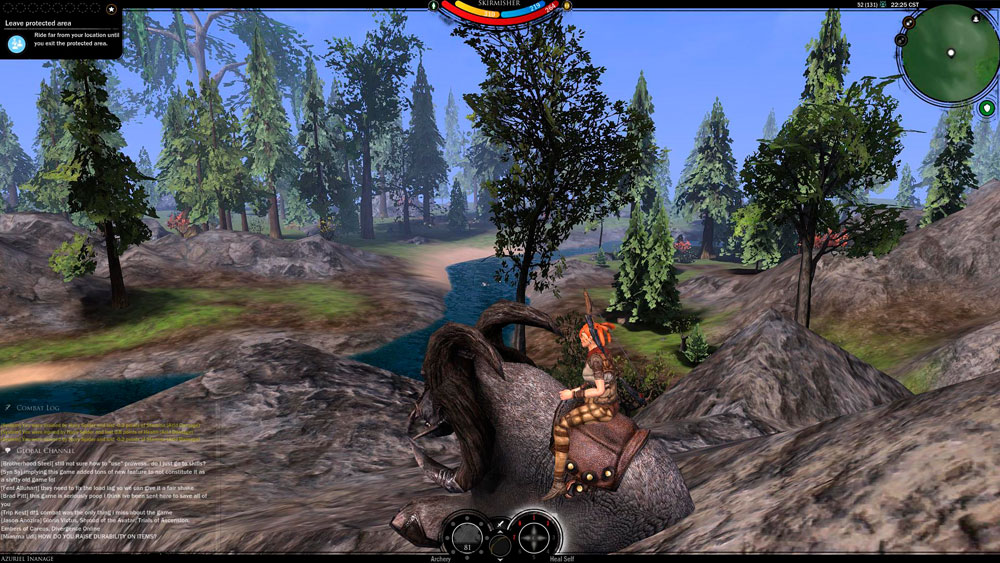
At the Southern FFA border.
In any event, the next stage of the tutorial was taking a 100kg (!) mount idol from the bank and summoning a mount. From there, you are tasked to running to the border of the protected area, sticking your toe over, and then coming back inside. Ah… so I was paranoid for no reason this entire time. Well, sorta. Apparently if you aren’t careful, people can actually steal your mount and ride away. After which I assume you are shit outta luck. Considering that unsummoning the mount takes a minimum of 2 seconds after dismounting, you’ll never want to actually be in town riding the thing.
After much squinting at the abysmal UI, I finally found and dabbled with the Prowess system. Essentially, you earn Prowess doing things, doing a certain number of things (Feats), and presumably other ways too. Prowess essentially act as skill points you use to upgrade skills, increase your ability scores (Strength, Dexterity, etc), and so on. Most skills start a 1 and can be increased up to 100 with an increasingly harsh cost ratio (1:1 up to ~25, then 2:1, etc); each upgrade level typically improves cast speed plus some miscellaneous qualities by some percentage. As an example, putting points into Archery lets me fire faster and deal more damage per arrow, whereas Mining let’s me increase my AFK-yield.
That all makes sense, but I was taken aback a bit from the “Boosts”. At first, I was thinking they were F2P-esque boosts, but that does not appear to be the case.
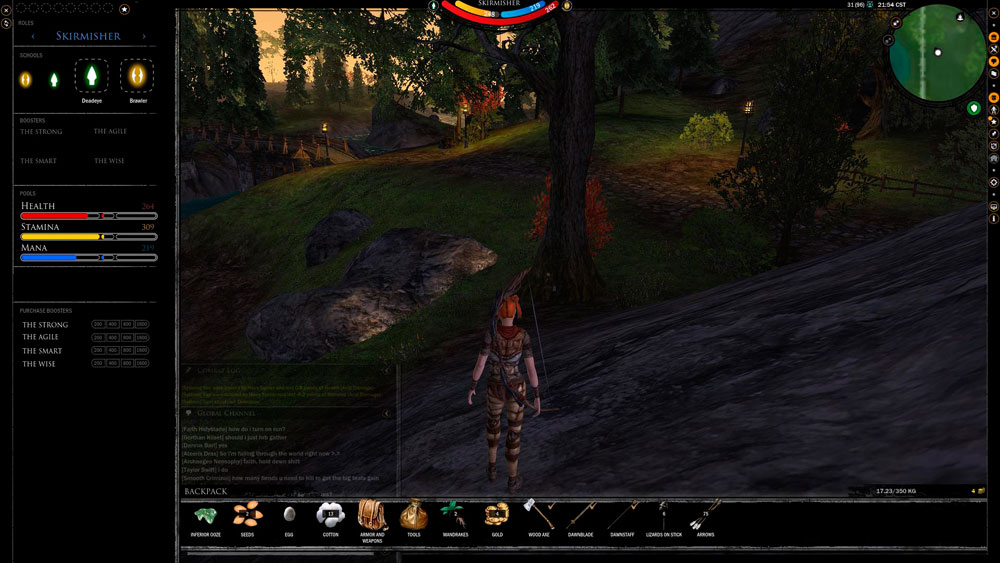
Ha ha, we got you good.
Instead, they are… err. Well, you can buy the first rank of “the Agile” boost for 200 Prowess, and it increases Dexterity by +10 and the Stamina by +37. Considering that manually boosting Dexterity by +1 costs 30 Prowess, I don’t actually know the point of boosts in this context other than a designer “Gotcha!” moment. I mean, I suppose that it is a way to quickly achieve your class’s optimum stats while still offering a Prowess sink for long-term players (e.g. Warrior dumping extra Prowess into Intelligence once everything warrior-y is bought).
If there is a third day of playing Darkfall in my future, my goal is to figure out the crafting side of things. I understand the basics, but I’m a little uncertain about how one actually goes about getting hard currency; considering that crafting consumes gold as well as mats, you have to have a baseline of income from somewhere. None of the mobs I have killed dropped gold thus far. Does it all come from vendoring goods? There are no “quests” of course, and there doesn’t appear to be an AH either.
So… yeah. Darkfall.
 In An Age
Borderlands 2 Masochism
Oct 3
Posted by Azuriel
I finally beat Tiny Tina’s Assault on Dragon Keep a few nights ago. It was… painful.
The DLC itself was fine – it is humorous and touching and has a lot of D&D/MMO jokes. What ended up happening with my situation though is that I completed the DLC on Ultimate Vault Hunter Mode, aka the highest difficulty (well, I guess it goes higher now). This decision was sort of cemented when one of the Treant mobs dropped The Bee, which is a legendary shield whose shield stats are kinda lame, but adds something like 50,000 damage per shot when you fire with full shields. Either intentionally or unintentionally, that extra 50k damage is added per bullet to my Double Penetrating Unkempt Harold (DPUK), which means mobs typically melted in the fury of 2+ million damage with each trigger pull.
Things got even more ridiculous when I acquired the Grog Nozzle, a quest gun that doesn’t deal a whole lot of damage by itself, but has a high chance of Slagging enemies (increasing subsequent damage by 200-300%) while also healing you for ~65% of the damage you deal with it equipped. Even more bizarrely, since it is technically a quest gun (that you can take anywhere) it doesn’t take up an inventory slot either.
The “painful” part to all this was simply playing the game at all. All non-legendary item drops were useless, especially any shields given how The Bee was pretty much required to deal damage. I did swap it out for a bit in a few areas, but I was leaning real hard on the DPUK to carry me through. Other weapons were pretty much a joke: dealing 32k/bullet damage is irrelevant to mobs with tens of millions of HP and the ability to regenerate health extremely quickly. At one point around level 54, I entertained the notion of going back to some of the DLCs to acquire some (upgraded) legendaries just to spice things up and not be shooting a pistol all day. The Sand Hawk would have been interesting, for example, as a submachine gun shooting bullets in the pattern of a bird flapping its wings. But that would mean extending my Ultimate Vault Hunter Mode stay in content I already seen twice now just to complete the current DLC after which I was likely to uninstall immediately.
All of this really struck home how important it is for games to have a smooth progression curve. Where I “screwed up” was hitting the level cap at the end of Mister Torgue’s DLC; thereafter I was stuck in a limbo of too-easy content on one side and content that’s designed to challenge the people who farmed legendaries at the old level cap. While I suppose the latter group needs catered to – especially given how they’re likely to be still playing, and thus willing to buy DLC – the end result is an extremely warped play experience. Your weapons are so strong because the enemies are ridiculous, and the ridiculous enemies makes your shields/HP basically irrelevant, which means you are awkwardly trying to dodge their melee/ranged attacks with generic movement, none of which really feels like Borderlands anymore.
By the way, calling it now: Borderlands 3 will have a more formal Dash/Dodge button, ala MMOs these days. If Gearbox doesn’t add this, it’ll be because they’re really dumb because goddamn precision movement is awkward and annoying right now for how much they require you to do it.
And have I mentioned that because the death penalty is a percentage of your wealth, that you end up losing $400,000 each time you respawn? There is also a few places with instant-death traps, which was
a lot of funnot at all fun. Granted, you can’t really purchase anything for $5,000,000, but that’s another whole issue entirely. It kinda makes even picking up and vendoring loot a waste of time.The more I think about it, the more I come to understand that Borderlands 2 basically ends at level 50. A full playthrough of the vanilla game will end around level 35, and that was a fun experience. After that? Still sorta fun, but the “optimal” path was going straight through the story missions again, skipping all sidequests, until you hit 2.5 mode at level 50. Then you can safely do sidequests for the unique rewards that would stay useful. Increasing the level cap basically screwed over everyone that hit the old cap without legendaries, as you get left with a Faustian bargain of farming bosses for hours or doing DLC missions for no reward.
So if you haven’t played Borderlands 2 yet and are waiting for the GotY edition, that is my advice: play the vanilla game while doing everything, then the DLCs in order, and then pat yourself on the back and be done with it. You can get 120 hours (or more) of play time like I did, but the you’ll face some pretty ridiculous diminishing returns on both fun and sanity.
Posted in Commentary
Comments Off on Borderlands 2 Masochism
Tags: Borderlands 2, Game Design, Loot, Rewards