Blog Archives
No Good Deed Goes Unpunished
In a game with morality choices, would you choose the Good options if the results were often worse?
Most of the games I can think of that had moral choices ended up rewarding you the most if you chose the Good options. In Bioshock, for example, you could either “harvest” the Little Sisters for extra upgrade currency, or you could Cleanse them for a smaller reward. As it turns out though, if you end up Cleansing the Little Sisters they would start dropping off care packages containing ammo and extra upgrade currency, such that you might even come out ahead by going the Good route. The choice also ends up reflecting the tone of the ending, but it luckily skews towards Evil Ending rather than Bad Ending per se.
In thinking back to Bioshock, I started wondering if I would have been more inclined to harvest the Little Sisters if they did not “sweeten the deal” with the gift baskets later. I would like to say “No,” but I also feel like the “Pick the Good option and get bigger reward later” is such a ingrained gaming trope that I am beginning to question which inclination came first. Would the promise of a “better” ending be incentive enough to make Good choices, even if the game proper was made more difficult thereby?
Or to go all the way: what if the only reward of a Good choice in a game was the personal satisfaction of having done the right thing? In other words, what if the player was punished in some way for choosing the moral thing to do? An example could be sparing a bad guy, only to have them return and kill an NPC teammate later. Would the average gamer behavior change? Would the moral players feel better about their choices, or worse?
Sometimes I feel like I want to be a game designer just to screw with people.
The Lockpicking Corollary
In a game with optional lockpicking mechanics, designers must include chests and doors and such that contain treasure to justify the investment of (usually) finite skill points in an otherwise non-combat skill. This reward cannot be too generous however, as it otherwise moves lockpicking from being an “interesting choice” into becoming the only reasonable option.
If a player got midway through a game only to discover a plot-specific item or one-of-a-kind upgrade was behind a door they could not open, the player would be understandably upset. At the same time, without such incentives the opportunity cost of taking Lockpicking over other skills is usually pretty high.
In games with Lockpicking or Hacking, I almost always pour points into training these skills because the “what’s in the boooooooox” feeling is too strong, despite my inevitable disappointment that it’s just some ammo and currency of negligible value. But what else could the designers really do? It all seems like an inevitable Lose-Lose scenario the very moment you introduce the choice; I feel bad for leaving unopened containers behind, and am disappointed with what they contain.
The Stealth Dilemma
As I mentioned last week, I have started playing Kingdoms of Amalur. At one point during the tutorial, the game showcased the ability to perform stealth kills.
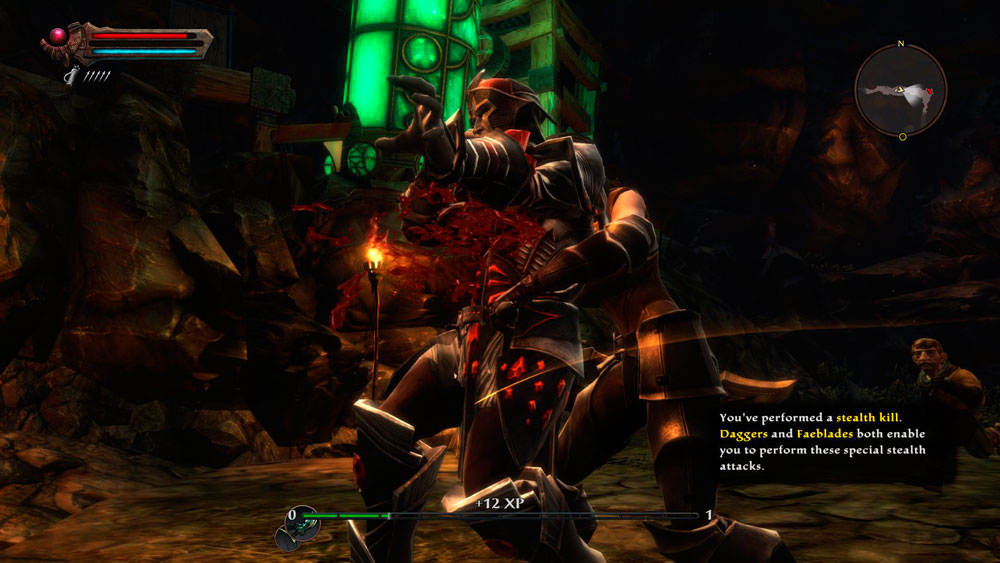
Surprisingly brutal.
So, now I have a dilemma. Do I actually trust the designers to have gone all the way?
Stealth is always a risky game design concept. By its very nature, stealth avoids traditional combat; yet unless a game is stealth-centric – such as Tenchu, Metal Gear Solid, etc – it must feature traditional combat robust enough to satisfy a more action-oriented playstyle. The more robust the traditional combat is though, the more powerful stealth itself becomes. Indeed, as players become stronger and enemies increase in deadliness, stealth can pass a certain threshold of absurdness that makes any other strategy seem poor in comparison.
Few mixed-gameplay games handle stealth well, and even fewer take stealth “all the way.” When I started up Dragon Age: Origins for the first time, I chose to make a dwarf rogue. My thought process at the time was that I always wanted access to lockpicking and trap detection, but the thought of those sneak attack criticals also appealed to the tactical gamer in me.
As it turns out, playing a rogue in DA:O was a pain in the ass. While you can scout out rooms and such, the nature of these sort of games (and most games, actually) is that ambushes are controlled by invisible programming triggers, such as “enter this room.” Sometimes this let me pull some counter-ambush maneuvers, such as flooding a room I knew to be occupied by hidden enemies with fireballs and poison gas. Other times, my rogue was made visible automatically by mini-boss or cut-scene decree. While I could still occasionally score sneak attacks in combat, doing so basically removed my main character from the battle until she could slowly move into position while the rest of the party got battered.
There are only two games in recent memory that I feel handled stealth well. The first is Dishonored. While it is true that the game is stealth-centric and thus shouldn’t really “count,” I was nevertheless impressed by the designers’ gumption to take the stealth mechanics all the way, i.e. even usable on the last boss. Unfortunately, killing the final boss with a single shot also felt horribly dumb, all things considered; it should not have been easier taking out the last boss than the very first enemy you encountered. The opposite wherein bosses are immune to stealth isn’t much fun either, as Deus Ex: Human Revolution demonstrated.
The second game that I felt supported stealth all the way was Skyrim. While I am not entirely sure if you could actually stealth around the last boss (such as it is), there was a talent at the end of the Sneak tree that allowed you to temporarily cloak long enough to activate your heightened Sneak Attack critical multipliers for an attack or two. Like with Dishonored, it felt sort of cheesy, but I had been two-shotting sleeping dragons with my bow for hours beforehand, so I already knew the absurd stealth line had been crossed.
Now that I think about it, Fallout 3 and Fallout: New Vegas also supported stealth gameplay all the way. Indeed, sometimes I feel like my playthroughs would have been 20-30 hours shorter, had I not been crouch-crawling through most of the game.
And so now I am left with the Amalur decision. As I level, shall I invest in stealth-based skills and abilities in the hopes they won’t be made irrelevant by boss battles and dungeon design? Or should I ignore the fig-leaf stealth design and instead focus on more mundane, useful abilities that I can actually utilize against 100% of the enemies I face, including the final boss? Or perhaps I should trust in my moment-to-moment stealth gameplay joys, having what fun I can in whatever percentage of the game allows me to stealth through?
It remains a dilemma either way. Many people celebrate having these sort of choices in their videogames, but choice requires trust in designers that one’s choices will actually be meaningful, and most importantly: balanced. When it comes stealth, as fun as it is, sometimes it is not worth letting the player have his or her way.
Path of Least Resistance
Out of the multitudes of derogatory, loaded phrases, “Path of Least Resistance” is perhaps the one I dislike the most (“welfare epics” is another top contender). The phrase, in a bit of cognitive Jujitsu, attempts to style strength as weakness. “Path of Least Resistance.” Is that not… efficiency? Optimization? Are we supposed to be seeking the path of most resistance? How is that different from simply Doing It Wrong?
The phrase and its implied meaning is more than contradictory though, it’s often hypocritical as well. At its base, it means expending the smallest amount of effort for the greatest gain. Ask those players who bemoan their peers taking the Path of Least Resistance how they feel about “Play to Win.” Is it “cheating” or unsportsmanlike to spam an uncounterable move over and over to ensure victory? Playing to Win is (usually) the Path of Least Resistance. Fair fights are more difficult, and thus more risky – something to be avoided if possible to make the wins easier and more assured.
Those using Path of Least Resistance as a negative attempt to levy moral failings upon players not even participating in the same game as them; the only game in which the Path of Least Resistance is a negative is the game inside the accuser’s own head. Efficiency and efficacy are, in fact, virtues. It is fine to critique game design that results in unintended or counter-intuitive behavior, such as RvR merry-go-rounds instead of gritty trench warfare. But the critique must always be of the rules, not the minds or motivations that master them.
Diablo 3.5 Release Date is… Released
In what undoubtedly was an amazing case of pure coincidence, Diablo 3’s groundbreaking 1.0.4 patch is coming out “the fourth week of August.” Hmm. What day do Blizzard patches come out on? Tuesdays, I think? What is the Tuesday in the last week of August? The… 28th. August 28th. Good thing I have nothing else planned to do that day.
Kidding aside, patch 1.0.4 may as well be called Diablo 3.5 for the sheer scope of the sweeping changes to endgame. Let’s look at them a bit closer:
Co-Op Buffs
Gold/Magic Find will no longer be averaged between party members. While Blizzard admits that they were originally worried about leechers jumping into multiplayer with pure Magic Find gear and thereby not likely pulling their weight, the complete lack of foresight displayed was astonishing. If I am capable of farming Act 1 Inferno by myself with 228% MF, why in god’s name would I join with a random stranger who not only increases monster HP (getting nerfed this patch too, by the way) but likely reduces my level of MF by his/her mere presence?
The other guy gets my bonus, and I get his… what? Pleasurable company?
Pro Design Tip: don’t build your co-op or multiplayer system around Russian Roulette, e.g. you are no better off when you win, but when you lose, you lose big.
Severe, Sweeping Elite Pack Nerfs
And I mean severe. Any one of these changes would be huge on its own, but Blizzard is throwing the whole goddamn pot of spaghetti against the wall to see what sticks. Look at it:
- Elite HP reduced by 10-25%.
- Regular mob HP increased by 5-10%, but 4x more likely to drop magic items.
- Specific nerfs to Fire Chains and Shielding affixes; Invulnerable Minions getting removed.
- Removal of Enrage Timers for Elites (!!!).
- Removal of HP regeneration for Elites after player death (!!!).
Those last two items would have been more than enough to fix most of my issues with Inferno by themselves. The current system is binary: you can either kill the pack (or one member thereof) or you cannot. While removing Enrage Timers and HP regeneration can/will lead to Graveyard Rushes, I never understood how exactly that was a bad thing. Just because I can die six times in a row to finally take out an obstinate foe does not mean I don’t care about those six deaths. Dying in a game is penalty enough because I already wanted to survive; extra penalties are generally superfluous unless death serves some other gameplay function.
Sweeping Item Buffs
Although the buffs appear only targeted for weapons right now, this is nevertheless a big deal:
Weapon damage is the most important stat on a weapon. It can be disheartening to get a lot of weapon drops and you know before even looking at them that they have no chance of being good. To help give weapons a fighting chance, the raw damage value on all level 61 and 62 weapons will be able to roll damage that extends all the way to the top end of level 63.
While we will still see awesome +800 Life per Hit-esque stats on ilevel 62 weapons with unusably low DPS, the mere chance that it could be a better drop instead is a great move forward. Of course, it will lead to rampant stat inflation and subsequent hollowing out of the AH economy, but at this point, who cares? Hell, if we can get to a place where I can get a goddamn upgrade off the ground instead of praying for good drops to sell for gold to buy upgrades from other people, I will gladly throw the entire AH under the bus.
Also, I guess Legendaries are getting buffed? Since the average player is only ever going to see the buffed Legendaries in the AH, I never understood why Blizzard talked much about them at all; it is not as though they are farmable items.
Ridiculous (but Needed) Class Changes
I do not really know anything about the class changes yet, but I am going to go ahead and declare them ridiculous. They would have to be, assuming Blizzard follows through on this:
- Does the skill fill a similar role as an extremely popular skill? If so, buff the skill to be competitive with the popular skill. For example, Bola Shot could be a solid skill, but simply doesn’t have the raw damage when compared to Hungering Arrow, so we’re buffing Bola Shot to be competitive.
- Does a skill have a dominant rune? If so, can we buff the underused runes to be more competitive? A good example here is the Wizard Hydra skill. The Venom Hydra is by far the most popular rune, and for good reason, so we are buffing the other runes to make them more competitive with Venom Hydra.
What could possibly compete with the monk’s Fists of Thunder (Thunderclap rune) or Deadly Reach (Keen Eye rune), for example? Or, god help us all, the One With Everything passive?
_________
I cannot say I have any particular faith that Blizzard will fix everything broken with Diablo 3, but even given this very preliminary information I can confidentially state that I will log back on once 1.0.4 goes live. It may only be long enough to finish out Inferno Act 3 & Act 4 before uninstalling for good, but hey. If there is a chance to relieve blue balls, you go for it.
Melee and Kiting
In the extreme off-chance you have not been following the gripping drama unfolding in the comment section of my post about Guild Wars 2 questing (which long ceased to be about questing), let me summarize my position on the design intention of melee kiting mobs.
…actually, wait. Let me quote GW2’s Jon Peters instead (emphasis mine):
Hey all. I wanted to talk about this a bit since it is a hot topic here and also on the internets. The intention is that both styles are viable. Certainly right now Melee is more difficult than ranged. There are some things we will try to do to address this, but I think the more you play you would find they are closer than you think.
First what’s already there:
- Melee does more damage. Melee damage is simply higher than ranged damage across the board.
- Melee has more control. With a few intentional exception Melee has a lot more control than ranged.
What Melee needs:
- defensive tools on more weapons, particularly on lower armor professions.
- ai needs to favor Melee a bit less than it currently does.
What else:
Finally because of the more action based nature of combat Melee needs to be taught better. Effective Melee requires skills that translate over from FPS games which are notoriously harder on casual players. You have to wasd to move, constantly aim with your mouse camera, and hit skills on 1-5.
Some tips:
If you have learned any good Melee tips that you think we should pass on to newer players feel free to post them here. I’ll start with a few tips of my own.
- If you don’t have mouse look on when using a skill you will turn to face. I sometimes let go of mouse look as I activate to help me aim through the chaos and then click it back down in between attacks.
- Melee has a lot of hard hitting skills and good setup. Utility skills Can really help set up big Melee attacks. Bulls charge on warrior, scorpion wire on thief, judges intervention on guardian.
- Know when to run. No matter what you are not a tank. You have to move in and out avoiding damage. If you have to soak damage try and bring boons like Protection and Regeneration or conditions like Blindness and the very undervalued Weakness.
Thanks for reading this all. Rest assured we will keep working on this and just keep in mind the subtle differences in GW2 combat that take a while to sink in.
The above was posted May 1st, the same day I basically pointed out the same thing, vis-a-vis the melee vs ranged discrepancy, with my first GW2 beta weekend impressions. As of the second beta weekend, there has been no improvement I could detect. Jon mentions that melee deals more damage “across the board,” but what difference happened to exist was not perceptible to me.
But for the sake of argument, let us assume Jon is correct. Let us assume, as Conwolv does, that I “like to make up excuses for [my] poor playstyle” rather than have any possible legitimate complaint. Let us, in other words, look upon the design principals as they exist in their purest form:
- Melee deals more damage | It is more difficult to get/stay in melee range.
- Melee is at greater risk of damage | Melee takes less damage.
- Ranged deals less damage | It is easier to stay on target.
- Ranged is at less risk of damage | Ranged takes more damage.
Do you believe the above is good, balanced game design?
Go ahead and write down your answer.
.
.
Write it down?
.
.
If you wrote “Yes,” you are wrong. Don’t feel too bad though, as Blizzard makes this mistake repeatedly, and ArenaNet appears to be on track to do the same for different reasons.
You see, the problem with the above “balanced” game design is the notion that both ranged and melee are intended to ultimately be viable, e.g. be equivalently good at damage. If ranged DPS is as good as melee in the long-run, that means there is no benefit to it being more difficult to get into/stay in melee range. If melee has greater burst damage to compensate, that merely imbalances PvP and/or forces encounter designers to include adds that need to be killed quickly… and somehow make it so that ranged cannot simply kill them in the time it takes melee to switch targets.
Similarly, “risk” is not a particularly compelling balance mechanism for two reasons. The first is simple psychology: most people are risk averse. Would you rather have $50 right now, or $100 if you win a coin flip? Both have an average payout of $50, so there is no difference between the two… right? Second, there are “perceived fun” barriers that designers have to keep in mind when crafting encounters. Instant-death mechanics are probably not fun for a lot of people, even if that is a way to balance ranged having an easier time avoiding said attack than melee (whom would only take 50% damage or whatever). At the other end, if melee doesn’t take enough damage, they could potentially ignore the mechanic altogether.
There are potentially ways to balance the melee vs ranged rift, but the bottom line is that a “mirrored” approach simply does not cut it.
Flying the Melee Kite
This brings me back to the GW2 melee problem.
Simply put, melee has every possible disadvantage. Instead of melee taking less damage per the balancing mechanism for #2, melee takes the same or more damage. You have less time to react to “Dodge This!” abilities, nevermind how few of those abilities ranged even has to care about. As Jon points out, “You have to move in and out avoiding damage.” What does ranged do? Move… backwards? To be honest, at the levels I played, my Ranger never had to move at all if I lead off with a snare. And here is the thing: even if that changes later, I would not be doing more than my melee toons already do.
More often than not, melee characters having to kite mobs is a sign of design failure. What else could it be, by definition?
One of the interesting defenses that a commenter named Fn0 presented was the following:
GW2 goes further. Capiche? It is not the same. GW2 allows you as melee (as in, you started melee at level 1) to spec as full-blown ranged with the blink of putting a ranged weapon equiped. In GW2 you can respec in battle with they key ` which allows one to, for example, switch between melee and ranged. This means we are much more hybrid than in previous MMOs.
It is an interesting thought that ArenaNet might be endeavoring to do away with both class roles (i.e. the Trinity) and any distinction between ranged and melee classes. I do not believe the argument works particular well, given that melee vs ranged is still a balance issue regardless of whether each class can be both – just because a Thief can be ranged 100% of the time doesn’t fix the fact that melee is imbalanced. And I have a more subjective problem with the idea of presenting Thieves, Guardians, and Warriors as “ranged” archetypes. But it is an interesting thought just the same.
Having said all that, what do you guys think? Is kiting a “standard strategy for melee in all MMO games?” Even in questing and general PvE? Are the discrepancies between melee and ranged classes something you think about at all? I have not played TERA, so I would also be interested in knowing how melee vs ranged is handled in that game. And if you played a game where you thought things were balanced pretty well, let me know that as well in the comments below.
The Diablo 3 AH is Dumb
The Auction House in Diablo 3 is stupid. By which I mean dumb. Idiotic, even. Both Auction House and whoever designed it. And not because of what it may or may not do to the entire balance of the game, but because it is poorly designed period.
You can sort by Buyout price, but not Bid price. Presumably the latter is disabled because the Bid mechanic itself is broken. Much like eBay, you specify your top bid amount and then things are auto-bidded up until someone has the new highest bid. Except the Bid price is not updated in the main auction pane, nor is it reliably updated when you hit refresh. The only true method of discerning the new high bid is to bid once so that it goes to your Auctions page and looking at it there.
By the way, you cannot sort by Time Left either. At first, I thought Blizzard was doing this for our own sakes so as to not recreate the eBay-esque last-second sniper fields. But it occurs to me that the sellers actually win when people do last-second bid wars; the losers would be Blizzard themselves when they get 100,000 people spamming the Refresh button and eating up all their bandwidth.
The AH has a 46-page limit. It is thus possible that if you are searching for any old magic weapon in your level range, sorting by lowest buyout price may leave you with no auctions with buyout prices at all since “null = lowest.” If you want to ONLY look at auctions with buyout prices, you will need to specify a maximum price. Put something cheeky in there like 10,000,000g or whatever, and then sort from there.
Want to sort by weapon DPS? Good luck.
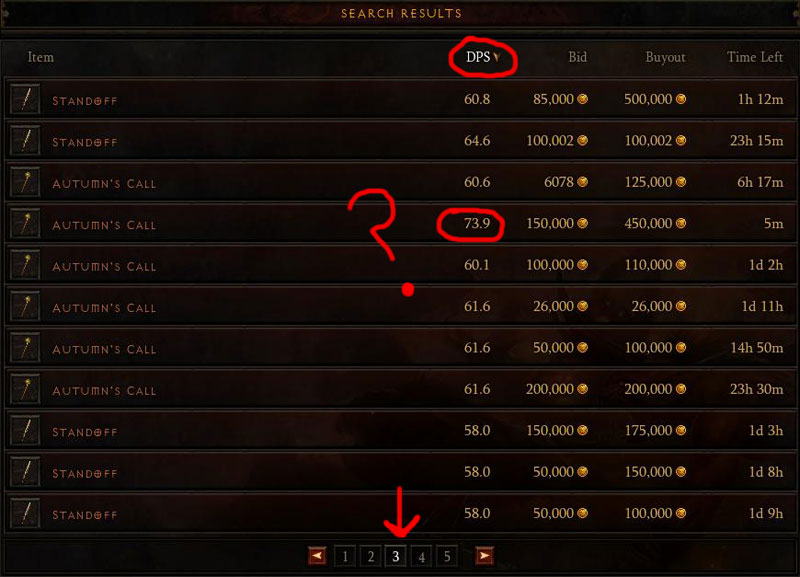
Because that makes sense.
Apparently the “Sort by DPS” script only looks at at the vanilla weapon DPS without factoring in any bonuses, such as +damage or +weapon speed. Which would be one thing, if some secondary script did not compute that exact thing in the DPS column. So if you are using this method to look for weapon upgrades, make sure you check several pages in to be sure some errant +10% weapon damage stat doesn’t outclass all of the items on the first two pages. And, of course, don’t forget how your class’s primary stat will likely further affect things.
Also, big props for the Blizzard designer who thought it would be a keen idea to have the Repair All button not apply to items in your Stash. Since you cannot sell items on the AH with durability damage, it becomes a fun Hide-n-Seek mouse-over minigame (or a Memory one, I suppose) each time you are forced back into the game when the item you want to sell has 48/49 durability.
In other news, I beat the game on Normal with the Monk. Because, hey, Barbarian was fun but I have played the first Act nearly a dozen times already. The pop-up after the final boss reminded me of something though…
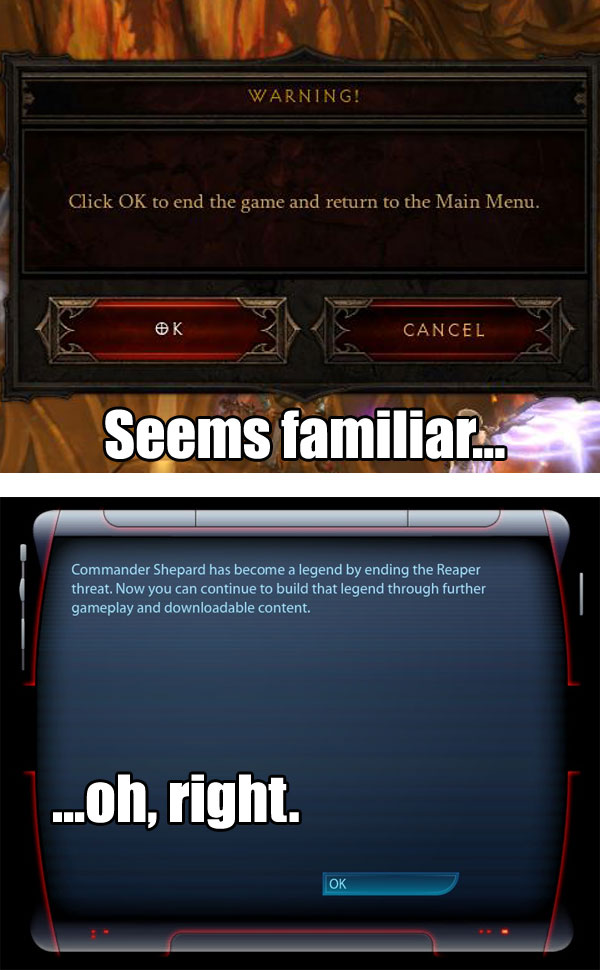
Must have been brothers from another mother.
My current time /played says 14 hours and 5 minutes, but that includes however long it took to breeze through Skeleton King in Nightmare. I remember the very first zombie in Diablo 2 kicking my Necromancer’s ass in Nightmare – the weakness of any skeleton army build is needing unused skeletons – but perhaps my ill-gotten AH goods have been keeping me ahead of the curve. Or perhaps the difficulty wall is down the road.
Regardless, I will probably keep playing the Monk until I’m forced to kite as a melee character, at which point I either see if I can stomach another character through the campaign or simply play something else more deserving of my time, as the case may be.
Entitlement
“Entitlement,” like “casual” before it, is such a loaded word these days that I consider any gaming argument in which it is included to be a lost cause. How can you reason with someone who sees no merit in criticism, or (apparently) believes the rightful state of the consumer is to be one of permanent, ingratiatory groveling? I suppose we should be happy developers deign to part with their digital goods at all, yes?
Keen made a recent post on the subject of people being skeptical about proposed game features that have already been “proven” to work in older titles; things like 500 people fighting over keeps in DAoC, non-instanced player housing, and so on. I was going to write on the subject, when this section of a user comment jumped out of nowhere:
For an entitled gamer, why play a game where you can’t have something when there are plenty of games that will bend over backwards to hand it all to you on a silver platter? And unfortunately, the majority of gamers are entitled. Note that I am not using the word casual here because there are some casual games who are not entitled and some serious gamers who are.
I hate this system. I hate that the vast majority of new games shoot for the lowest common denominator to get as many subs as possible rather than finding a niche in the market and shooting for a reasonable slice of the pie.
At first blush, you may be tempted to agree. Don’t.
It’s dumb, it’s contradictory, it’s asinine. Look at all the whiny, entitled gamers in these sort of comments wanting player housing and 100+ player PvP battles, amirite? Having a preference does not make someone entitled. Wanting to be catered to as a consumer does not make someone entitled. Seeking maximum value for one’s gaming dollars does not make someone entitled. Buying/supporting only the games you like is not being entitled.
I wonder if people even understand what they are saying when they type things like “the vast majority of new games shoot for the lowest common denominator to get as many subs as possible.” That presupposes there is a “higher common denominator” that is being neglected when their own desires are equally fantasy bullshit. It is suggesting that games and mechanics these days are not being built to the satisfaction of their own refined palate, as if they were entitled to that.
You can’t have the argument both ways.
I understand and empathize with the sentiment. We live in a world where Firefly gets canned after a dozen episodes while Jersey Shore will be running its sixth season. Shit is unfair. And I would also agree that (MMO) gaming is in an era of extreme loss aversion; if something like Darkfall could make enough money to finance a sequel, surely that is “successful” enough, right? An investor flight to AAA quality has, in many respects, killed off the “middle class” of game designers. Without said middle class, it is entirely possible there are no designers catering to your preferred play style, and indie games can only go so far.
That said, twisting “entitlement” into (even more of) a pejorative and otherwise demonizing your fellow consumers is ultimately counter-productive. Begrudging them their satisfaction of capitalism working as intended (to them), gets you no closer to your dream game sequel. Instead, it leaves us all bitterly divided, rooting for each others’ failures, while those actually responsible continue eroding consumer surplus in the form of on-disc DLC, always-online DRM serving no other game purpose, and similar nonsense.
In other words: don’t blame the players, blame the game (designers). It is the latter saying your money isn’t good enough.
WoW Should Lose Millions of Subscriptions More Often
Ever have that moment in your academic career, usually right after midterms, when you sort of wake up and realize “Oh, yeah, this might actually be important enough to take seriously”? I am getting the distinct impression Blizzard is going through that right now, as evidenced by their refreshingly direct Dev Blogs lately. The most recent was about the new direction they are taking the Mists of Pandaria loot system. One section reads:
Here is a model I’ve seen some people say they want:
- The boss dies.
- I get the exact item or items I want.
- I never have to come back and kill this boss again.
- I politely ask Blizzard when there will be new content for me to run.
I added that, somewhat tongue in cheek, to point out that the intent of the new system is not to make killing bosses or getting loot more efficient, or to let you choose buffet-style which items you get. We like random loot being random, as long as it isn’t so frustratingly random that you stop enjoying the experience. The intent of the new loot system is really to relieve social pressure on a group of random and anonymous strangers. We think it is reasonable for groups of friends, such as the typical raiding guild, to have a discussion about how to divvy up loot. That discussion is a tried and true RPG tradition going back to D&D or earlier. We don’t think that is a reasonable expectation for Raid Finder, though.
This is such a frank representation of the very essence of MMO gameplay (e.g. random loot creates content), that it honestly shocked me to see it written so casually. The explicit admission of the (warped) social dynamics of LFR is similarly amazing. It is one thing to see these issues examined in blogs and on forums; it is entirely another for a developer, in an age of David Reid-esque bullshit, to treat the audience like adults.
It feels like when the carnie game operator lets you in on the trick.
Another sample section:
Bonus Roll
We have one other new system that will use part of the personal loot model. This is what we’re calling the bonus roll.
Once upon a time, raiders had to invest a lot of time and effort every week preparing for a raid. This felt kind of cool in the abstract because it built anticipation, rewarded players who prepared for raid night, and otherwise just added a little more ceremony to the act of entering the dragon’s lair to seek glory and treasure. The reality is that you spent your time killing mobs to farm flask materials or gathering Whipper Root Tubers. The reality didn’t match the fantasy and we eventually greatly minimized the need to farm consumables altogether. Of course, that led to another problem, as raiders would log on for raid nights, finish, and then have nothing to do the rest of the week. The bonus roll is intended to give those players something to do that is hopefully more enjoyable than grinding elementals or Blasted Lands boars. We want to see players out in the world doing stuff, and we want that stuff to be a little more interesting (if not downright fun) than farming mats.
This is one of those things that, intellectually, shouldn’t be true. But it is.
I am (still) playing Mass Effect 3’s multiplayer and loving it. Is it fun in of itself? I… guess so? Would it still be fun if I had 100% of the guns unlocked, max ranks, infinite consumables, etc? I can tell you right now with a completely straight face: no, it would cease being fun. I derive pleasure from both the act of playing, and the feeling of increase that comes from progression (the accumulation of credits to unlock random weapons, in this case). The only sort of rationalization I can give you to explain this phenomenon is that I can both have fun and experience progression in any number of other games, which puts “just fun” games at a disadvantage.
Game designers undoubtedly realized this years ago, which is why you see “RPG elements” in damn near everything these days.
Back to the Dev Blog (emphasis added):
Area of Effect Looting
Yes, we are doing area looting. After killing a group of enemies, you may have a bunch of corpses lying around (perhaps because you went all Bladestorm on a bunch of hozen). If you loot one of the corpses, the loot window will include items from all of the nearby corpses for which you have loot rights. Some recent games have incorporated a similar feature, and it’s one of those things that players just want in their MMO these days. It’s already in and it works fine.
Does this sound like the Blizzard of WotLK, or TBC or Cataclysm for that matter?
I am not entirely sold on the concept of Valor Points being turned into gear upgrade fuel, for exactly the reason Ghostcrawler mentions: “There will be a bit of a game in trying to decide when to upgrade your gear versus hoping for a new piece to drop from a raid boss […].”
Other than that? I am very impressed by what I have seen thus far. Female Pandaren are in a much better place than female Worgen ever were, the MMO-Champ emote videos really highlights how far animations have came since I started playing in TBC, no major feature has been Dance Studio’d yet, and Blizzard overall seems to be operating at a level of humility and industry not hitherto seen. I mean, hell, Blizzard has already started work on the sixth expansion, i.e. the expansion after the expansion after Mists.
Seems to me that WoW should lose a few million subscriptions more often.
 In An Age
Interesting Choices
Apr 15
Posted by Azuriel
Tobold put up a rather cringe-inducing critique of Mass Effect 3 the other day, prefaced by the Sid Meier quote of “good games are a series of interesting choices.” From there, Tobold argued that ME3 was not a good game, because the story choices being presented did not lead to gameplay changes. Indeed, he goes so far as to say in the comments:
First, that argument is so absurdly cliche that I started questioning whether he was simply trolling us at that point.
Secondly, in point of fact, you could not simply wait for Mass Effect: the Movie because any such film could not encompass the varied plot choices you can make over the course of the game. Characters can die in Mass Effect 1 & 2 and thus not show up in Mass Effect 3, cutting out entire swaths of character arcs. Who makes it through the Suicide Mission? Would the film feature a male Shepard or FemShep? Would the choices be primarily Paragon or Renegade? Which races get the shaft? Would the conclusion be the Red, Blue, or Green Cupcake?
The green one. Always the green one.
Third, I believe Tobold’s stance is exceedingly pernicious to the maturation of gaming as a medium. It simply boggles my mind that a self-professed lover of D&D would twist “interactive story” into a pejorative; are non-interactive stories supposed to be preferable?
Individual agency has a way of submerging players into a narrative in a way that traditional storytelling does not. Just look at the mind-bending (at the time) twist in the original Bioshock and the narrative arc in Far Cry 2. Even if you were not particularly impressed with the depth of these narratives, those story mechanisms simply cannot be replicated in book or movie form. Reducing games to their mere mechanical components would be an incredible tragedy of potential.
What the exchange highlighted to me though, was how squishy the venerable Sid Meier quote actually is.¹ To me, the choice between curing the Krogan genophage or deciding not to was interesting. In fact, I spent ten minutes or so agonizing over it when the dialog wheel was presented. Was it fair of us to cripple an entire species because we feared their hardiness and breeding speed? At first, I was worried about that hypothetical. Once the Reapers were gone, who is to say that the Krogans don’t simply out-breed and out-muscle the rest of us out of the universe? Then I thought: wait a minute, is this not the same sort of argument used against inter-racial marriages in the past, and even concerns about Islam today?
In contrast, Tobold simply picked whatever gave him the most War Assets.
This was meaningful to me, god damn you.
I do agree that a good game is full of interesting choices. But what should be obvious to anyone spending more than a minute thinking about it, is that what is interesting to one person can be boring/irrelevant/pointless to someone else. “Interesting” is not an objective term; Sid Meier may as well quipped “Good games are full of fun” for all the sage wisdom it contains.
¹ The full quote is actually: “According to Sid Meier, a [good] game is a series of interesting choices. In an interesting choice, no single option is clearly better than the other options, the options are not equally attractive, and the player must be able to make an informed choice.” (Rollings & Morris 2000, p. 38.) This does not meaningfully change my objections, as whether an option is “clearly better” and/or “equally attractive” is necessarily subjective. For example, I almost always prefer passive abilities to active ones, to the point that most of the WoW talent tree levels have only a single rational (to me) option.
Posted in Commentary
2 Comments
Tags: Bioshock, Choices, Far Cry 2, Game Design, Genophage, Interactive Storytelling, Mass Effect, Mass Effect 3, Sid Meier, Tobold