Blog Archives
Half-Cocked
So the news out there is that both Avowed and The Outer Worlds 2 flopped. Or, technically, “failed to meet expectations.”
Last year the developer released three games—a rare and impressive achievement for a studio of its size—but two of them failed to meet sales forecasts set by Obsidian’s parent company, Microsoft Corp. “They’re not disasters,” Urquhart says. “I’m not going to say this was a kick in the teeth. It was more like: ‘That sucks. What are we learning?’”
While Grounded 2 was a big hit, the disappointing results from the other two have led Obsidian to “think a lot about how much we put into the games, how much we spend on them, how long they take,” Urquhart says. Both Avowed and The Outer Worlds 2 were in development for more than six years, inflating their production costs and the company’s financial expectations. One of Urquhart’s missions is to cut down development timelines to three or four years per title. (source)
The piling on in the Reddit comments is understandable, and I agree with most of it. Neither Avowed nor The Outer Worlds 2 feel like games that have had 6+ years in development. The equipment upgrade system in Avowed is both punishing and boring, and two of the classes have nothing interesting going on in the Skills department. For TOW2, Skills/Perks were half-assed at best and irrelevant at worst. What in the world were the designers spending all their time on?
During the negotiations with Microsoft, Obsidian’s executives assembled a slideshow presentation for the concept that would become Avowed, pitched as an ambitious cross between megahits The Elder Scrolls V: Skyrim and Destiny that would allow players to battle monsters together in a massive fantasy world. It was an impressive if unlikely proposition. “My thought when I first saw it was, ‘I don’t think there’s a team on the planet that could execute on this,’” says Josh Sawyer, Obsidian’s studio design director. Two years later, Obsidian stripped out the multiplayer feature, and a year after that it assigned a new director to the project. By the time Avowed came out, it had been in the works for nearly seven years.
Ah, well, there you go.
I’m not going to pretend to be an industry insider, or able to speak authoritatively on game design (or any topic, for that matter). But, respectively devs, what the fuck? We have heard for ages that development cycles are getting more expensive, and that is why game prices have to be $70, $80, and higher with macrotransactions. People just swallow the narrative that all the increases in technology and graphical fidelity make the process of making games cost more money. But peel back the layers and all of a sudden it certainly seems like the people in charge are just going off half-cocked.
Game design is an iterative process, yes. Inventing new forms of fun is hard. I can also understand that sometimes the fun only manifests itself once all the various interlocking systems are already in place. Again, though… what the fuck? “Skyrim meets Destiny in massive fantasy world” is not a game, it is barely a concept of a setting. Do these designers believe that the fun will simply manifest itself out of the aether? “If we build it, they will have fun”? Or do they assume that figuring out the fun is the easy part and can be added in later?
During recent breakfast meetings, Urquhart and his deputies discussed some things they could’ve done better with last year’s releases. Perhaps Avowed players needed the option to, say, commit crimes and get arrested to make the world feel more alive. Maybe The Outer Worlds 2 needed stronger virtual companions. It’s hard to imagine a game would sell more copies if it had pickpocketing, but Obsidian’s leaders say seemingly minor ingredients can make a big difference. “Our job, all of us here, is to go make games that people want to play and buy, and if we continue to do that, then we have a solid business,” Urquhart says.
“Minor ingredients,” oh my fucking god. They have no goddamn clue, do they?
Here you go, Obsidian, on the house. I’m not certain how pickpocketing would have worked in Avowed considering none of the NPCs move, but sure, it would be nice flavor. But I recommend starting with the fact that every part of the player progression experience is awful. You are punished for upgrading equipment since resources are finite and enemies don’t respawn, and are also punished for not upgrading equipment as enemies automatically deal 35% more damage if they exceed your tier. When you do upgrade though, you get a whole +4 to whatever stat, with nothing else interesting going on.
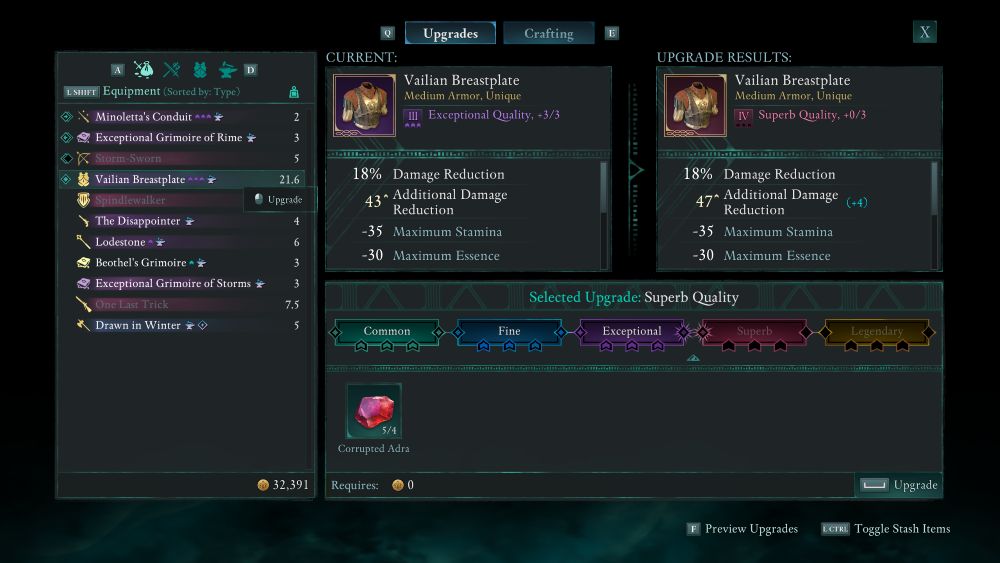
These sort of things are not “minor ingredients.” It’s the whole fucking game! You know, the thing that players do after purchasing your product? P-L-A-Y. Kudos to the people who designed the movement and vaulting inside the game world, but whoever came up with the fiddly bits needs some goddamn coaching. Would it have killed anyone to increase all the values by a few points when upgrading gear? Or playtested the Warrior/Ranger talents against all of the stuff the Wizard could do by default?
As for The Outer Worlds 2, same thing. Skills and Perks were deadass boring. How many of them meaningfully impacted combat at all? In what world should a player feel comfortable breezing through the entire last Act of game with 17 unallocated Skill Points and 5 Perk Points? Nothing I picked felt like it did anything other than add another percentage gain on otherwise extremely low base damage weapon. Hard to get excited about going from 490% increased damage to 520%.

It could be that I’m the one off-base. Maybe the entire problem with the games were one of marketing, or the story not being engaging enough, or the graphics being something-something. In one of the Reddit threads, someone commented how slowly people talked in Avowed being an issue. OK, sure. That said, it possibly couldn’t hurt to make character progression fun or exciting in any way whatsoever.
The hilarious and tragic thing are the lessons (un)learned.
Grounded 2 came together the quickest. Despite the popularity of the original, which the studio released during the pandemic gaming boom of 2020, Obsidian hadn’t planned on greenlighting a sequel until it got a pitch in early 2023 from Eidos Interactive, a studio in Montreal that was looking for outsourcing work. […]
Grounded 2 offers some lessons for a better way forward. Obsidian assigned a few senior staff to orchestrate the production in Montreal from 3,000 miles away, rather than develop the whole thing in-house. Chris Parker, an Obsidian co-founder who supervised development, says the distance was empowering because he could make hard calls more swiftly. One of the game’s vehicles—rideable insects called “buggies”—had originally been designed to be shared by multiple players until Parker and his crew realized the functionality wasn’t coming together, leading them to pivot. “I was like, ‘If this was one of our internal teams, we would work on this for another two or three months,’” Parker recalls. “We made this call because we could tell them what to do. It feels like we still run around with our kid gloves on internally.”
First of all… they hadn’t planned on greenlighting a Grounded sequel? I mean, yeah, not every game needs a sequel, people crave new experiences, sometimes devs want to move on, yadda yadda. Still, it feels bonkers to me that when a game company does strike gold on a fun game concept/design, it often just goes nowhere afterwards. Everyone sings Obsidian’s praises for Fallout: New Vegas, which cost $8 million and only two years to produce. How did that happen? It was basically a Fallout 3 mod. Which is probably why it was so fun in the first place, because it was built on an established foundation of fun.
We’ll have to see with Obsidian whether they take the lessons to heart. But I was also thinking about this other recent tidbit from Blizzard in a different article:
“[Warcraft is] a fantastic IP. In my humble opinion, it’s been underutilized and I just want to bring it to as many people as possible. And that means evolving what Warcraft means, what it is, and where it’s going. We want it to be approachable. Chris Metzen [executive creative director], is sometimes like, ‘I wish we hadn’t called it Warcraft. It sounds intimidating.’ But I’m like, nobody really thinks that about Warhammer. It’s an understood name.
“This idea of ‘third space’ in our online worlds, we can’t even define what that means exactly, but we’re working on figuring that out. We want people to come in, hang out and have birthdays, weddings, raids, grand adventures, play with their friends, meet new friends… all the things that World of Warcraft has been good at for over 20 years. (source)
The easy jokes are, you know, how Blizzard has a TCG, MOBA (abandoned), and Clash Royal-esque mobile app (dead) all within the same narrative universe. But remember, Blizzard had also been working on a fantasy survival game for many years before that got killed in development as well. Wonder what had happened there…
It was conceived to be similar to a more polished version of popular survival games such as Minecraft and Rust, containing “vast” maps supporting up to 100 players. Due to the ambitious map size, the game’s engine was switched from Unreal Engine, in which it was prototyped, to Synapse, an internally-developed engine created specifically for Odyssey and envisioned as something that would be shared by multiple projects. However, the switch led to significant problems – due to delays, Blizzard’s artists were forced to continue prototyping in Unreal, knowing their work would later be discarded. […]
At the time of the Microsoft acquisition, team members remained hopeful they would be allowed to switch back to Unreal Engine due to Microsoft’s stance on allowing game leads rather than executives choose the technology used. While the game was positively received by testers, however, there was estimated to be several years of development time remaining on the project, with even a 2026 release seeming overly optimistic. The news of the game’s cancellation was announced by Microsoft in a company-wide email in late January 2024.[2] Some of the former team members from Odyssey were moved to other projects in development,[2] though a significant portion were laid off.
Of fucking course. I especially liked the “allowing game leads rather than executives choose the technology used.” Seems like a good idea, maybe someone should try it occasionally.
You know, all this does is really highlight that nobody knows what they hell they are doing and it’s a miracle any fun games get built at all.
Review: The Outer Worlds 2
As mentioned, I recently completed The Outer Worlds 2 (TOW2) after about 70 hours of playing. There is a lot of like about TOW2, especially in comparison to the original game, but there is an equal (or greater) amount of terrible game design. Moreover, for all the news articles extolling Obsidian’s return to Fallout: New Vegas form with this title, I see regression at best. And, seriously guys, it’s been 15 years.
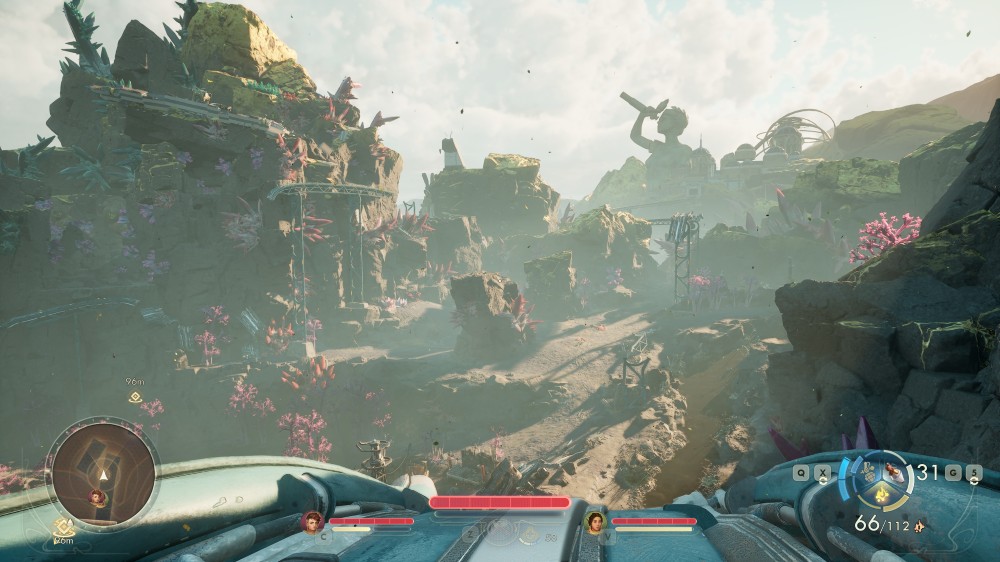
First, the good stuff. The game is gorgeous, maps are large, the skyboxes interesting. One of my criticisms from the first game was that interior spaces felt generic and cut & paste in the “let’s pretend it was on purpose because modular sci-fi habitats” kind of way. Thankfully, TOW2 feels much more diverse and detailed. There is still a definite lack of something that the aging Bethesda Gameybro Engine is able to evoke, but it is worlds better than before. Also, the act of traversing the landscape itself feels great, with double-jumping and auto-vaulting on par or better than with Avowed.
Gunplay and collecting bits and bobs out in the world is also much improved. There are baseball-esque cards sprinkled around everywhere that grant you +1% critical hit chance (etc), which makes exploration more exciting. The world is populated with many junk items that can be broken down into crafting components and then turned into ammo or mods. The original game featured a punishing repair/tinker system that drained you of resources; this one lets you use whatever guns or armor you want (for the most part) straight into the endgame.
Where the game falls apart for me is with the Skill Checks, and a broader fetishization of “choices matter” when they really do not.

Before I begin, there is one aspect of Skills I do want to give Obsidian credit for: they solved the combat vs social skills dilemma. In almost every RPG I have played, allocating a limited amount of points into something like Speech meant you were radically weaker than someone who put them in Guns. Broadly speaking, that is not the case in TOW2. Each point is Speech gives you a +10% damage bonus against Human targets. There is further a Perk called Space Ranger that gives you a 2.5% damage bonus against all targets for every level of Speech you have. While that is not as good as an unconditional 10% per Guns level, it no longer feels as though you need to gimp your character in order to talk to characters in an RPG.
But, see… that’s just the thing. This is a game of “choices” which is governed almost exclusively by Skill checks. In the original game, you could respec, wear gear with Skill bonuses, or even take certain companions with you to achieve certain Skill thresholds. Not anymore. You are hard-capped at level 30, meaning you can have three Skills at 20 with maybe two points elsewhere; two Skills at 20 with a few more at scattered about; or a single 20 Skill and a more even distribution across a few interesting ones. Obsidian devs have said they wanted players’ “choices to matter” and for players to commit to mistakes. Choices made… where? On the character page, prior to knowing anything about the rest of the game? Something like the very meaningful choice between Lockpicking 5 and Lockpicking 6?
The end result is this nonsense:
I spent the last third of the game with 17 unallocated Skill points, and 5 unchosen Perks. This is an epic game design fail on all sorts of levels. For a start, it illustrates how easily I was able to forgo 170% extra gun damage and still breeze through the game (on Normal). Indeed, my “build” was capable of one-shotting every non-boss enemy in the game from stealth… with zero points in Sneak. Second, it makes a mockery of “commitment and/or consequence” seeing as how I was easily able to pop into the character menu and become an expert of any relevant Skill as needed. Finally, it demonstrates how boring the capstone Perks (ones requiring 20 points in X) were, that I was completely unmoved to commit the Skills points needed to get there. As a matter of fact, almost none of the Perks were especially relevant or impactful, which is crazy considering there are 90 of them.
Now, as pointed out in my Tips post, you don’t actually have to max out Skills to avail yourself of all the most meaningful options. You wouldn’t know that while playing the game though, which is part of the problem. A lack of meaningful information precludes a meaningful choice. Would you still choose to get to Speech 20 if you knew Speech 9 was good enough for the kumbaya ending? Or, honestly, Speech 5 considering how odious one of the factions ends up being. And if Speech 5 is good enough, why do we need Speech to be the determining factor in the decisions our character makes at all?
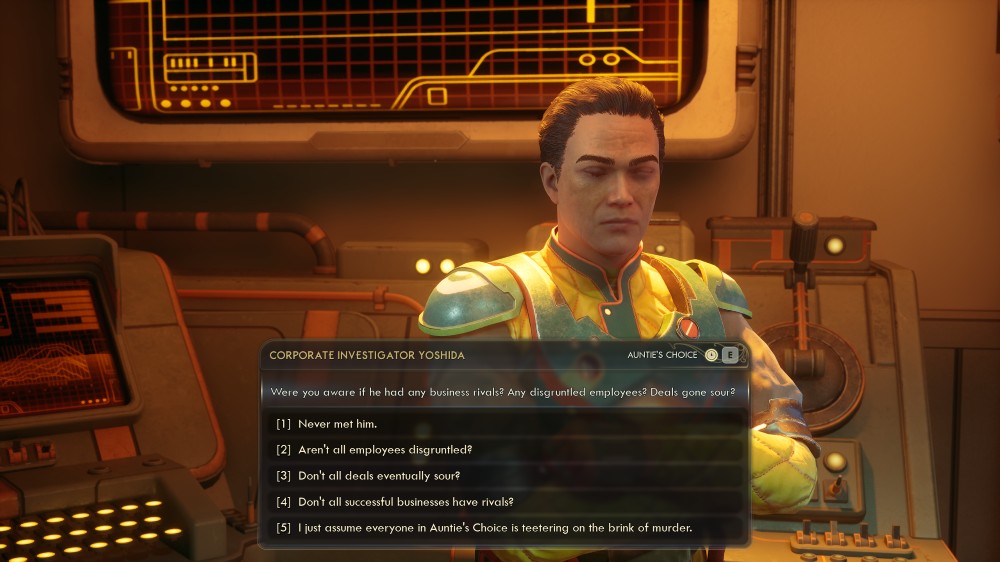
“It’s an RPG.” So are Mass Effect and Dragon Age: Origins. Is a game only an RPG if you have to put points in a Speech skill in order to make decisions? That sounds more like a Roll-playing game, amirite.
Having said all that, a lot of this is moot because the overall narrative of TOW2 is weak. The game starts off fairly strong with a much more consistent tone than the original. You learn about Auntie’s Choice, the ultra-capitalistic caricature of corporations from the first game, and then interact with the Protectorate, the ultra-authoritarian, brainwashing, jobs-assigned-at-birth and report-your-family-members bad guys. Later, you meet the Order, who represent scientists who use math and probability to predict the future. But then the Protectorate becomes generic antagonists and you just have Auntie’s Choice and the Order to play off one another and I could not be less interested. The vaunted, hard-hitting choices from the makers of Fallout: New Vegas boil down to who you want to attack you on sight for not taking them to prom. With a high enough Speech skill, you can take them both. Whee.
Maybe that is reductionist. All I know is that I played through all the faction quests and did not once feel a spec of moral gravity. Compare that to interacting with Caesar’s Legion, NCR, House, or going it alone in New Vegas. The companion quests in TOW2 did fare better than the main story, but it is one of those situations in which you sort of question why the writers are hiding the light under the bushel of characters you technically don’t even have to recruit. Maybe that’s what they mean by choice? Then again, that’s sort of like saying you’re making meaningful choices by not playing the game.
…which I may ultimately recommend.
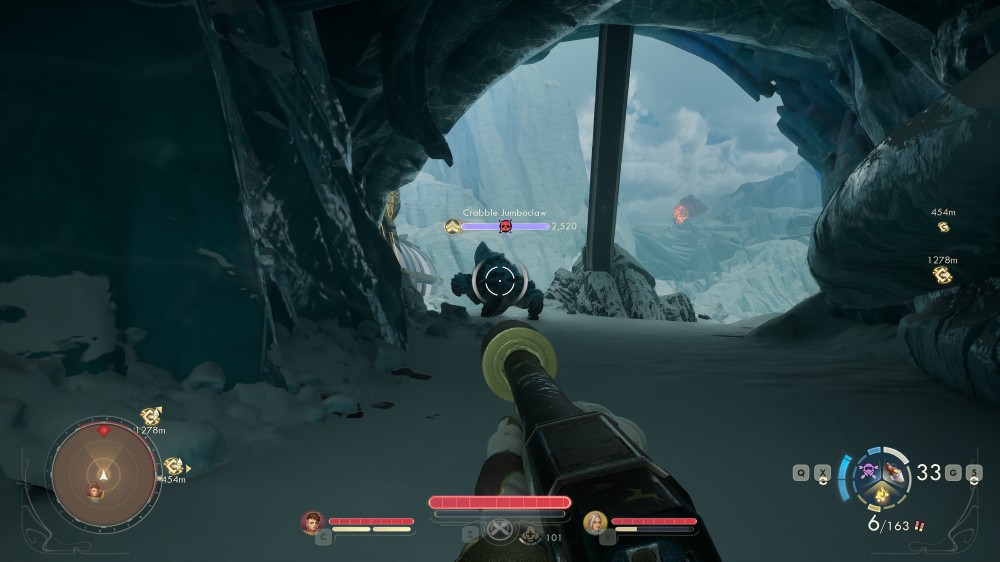
In the final analysis, I did end up playing The Outer Worlds 2 to conclusion after 70 hours, so there’s something there. By the end of the utter slog that is the third act though – especially when Obsidian goes full Starfield with forcing you to fast travel across planets via 10 loading screens to talk to NPCs – all I could really think about is how much better Avowed was in comparison.
And I didn’t really like Avowed. At least it had respecs though.
The Outer Worlds 2 – Skill Checks and Other Tips
I have just completed a full playthrough of The Outer Worlds 2 in 70 hours, achieving the “best” (IMO) ending. Over the course of the game, I was taking notes on various Skill Check thresholds to try and better understand how many points were required for certain outcomes. Here is what I wrote down:
- Act 1 – 2, [4], 5
- Act 2 – [8], 12
- Act 3 – 7, 9, [11], 17
- Negotiations – [9]
- Companions – [14], 20
- Endgame – [7], 20
The bolded number in brackets is the predominant Skill Check level for that particular Act. So, for example, having Speech or Engineering 4 in the first area of the game is good enough to pass the vast majority of the corresponding Skill Checks. It is important to note, however, that some Skill Check levels depend on evidence collection and/or other dialog choices made beforehand.
Do I need Speech 20 in The Outer Worlds 2 for the best ending?
Technically no. There is a Speech 20 check at the very end of the game that bypasses the last fight, and delivers an easy resolution for the final dilemma. However, there are two other good options to resolve the dilemma. The second best requires only Speech 5 and talking down a particularly vexing character earlier in the game. The other option is supposedly convincing a faction leader to solve it with Speech 14. Barring that, you must either convince one of your crew, or go solve it yourself.
Was Lockpicking or Hacking Worth Taking?
I ended the game with Lockpicking 17 and Hacking 11, both of which were enough to open everything in the game except a final Hacking 20 computer at the final fight… which appears to just control a turret. If I remember correctly, the Lockpick 17 Skill Check I encountered was just a room full of forgettable loot, but since I had the Sleight of Hands perk (+10% Sneak Attack/level of Lockpick), I went ahead and kept it rather than reloading the save. Otherwise, I do not recall seeing a Lockpick check of higher than 12.
Is Sneak Worth Taking?
No… unless you are also doing a Melee-focused build. Sneak Attacks are extremely powerful and can one-shot most enemies, but you don’t actually need the Sneak skill to do so. The Treacherous Flaw will give you +100% Sneak Attack damage and Sleight of Hands gives you +10% per level of Lockpick. Between the two, I had +270% Sneak Attack damage across all weapons, which was further increased by various weapon-specific Perks (e.g. Point Blank Artist) and attachments like silencers. I routinely one-shot 3,000 HP enemies with zero points in Sneak.
That said, the Vital Striker Perk gives light weapons half of your Sneak Attack bonus damage even in combat. It does require Sneak 15 and Melee 15 though, so it is a spec-specific, late-game option.
How Useful are the Traits?
Most are functionally useless. The only good ones are:
- Brawny – Bypasses many Engineering checks
- Lucky – Bypasses a few plot/skill checks + grants extra 5% crit chance
- Innovative – Crafting twice as much ammo immensely helps in early game; bypasses a few checks too
In my playthrough, I took Brilliant and Witty (just like me IRL, tee-hee). Brilliant came up once, but otherwise solely functioned as +2 Skill Points. Witty came up as a dialog option all the time, but did absolutely nothing to affect the conversation. Plus, unless you are purposely killing entire factions, the Reputation protection doesn’t matter at all. And if you are doing that, you are probably taking the perk that grants bonus damage against factions that hate you, so Witty is double-useless.
Are there any Must-Have Legendary weapons?
The only Legendary weapon I consistently used throughout the game (once I got it) was Last Whisper. This is an absurdly powerful silenced plasma shotgun that deals +100% damage to unaware enemies (with up to 150% depending on Sneak) that automatically burns the body of anyone it kills. With a number of perks further enhancing Shotgun damage in general, I was able to consistently one-shot all non-boss enemies in the game… even with zero points in Sneak.
Other than that, The Rattler is a Legendary pistol you can (and should) purchase in the first town that holds its own for most of your time in Arcadia, with or without supporting Perks.
Are there any Must-Have Perks?
These come to mind:
- Pickpocket (Lockpick 1) – on launch you could steal quest rewards from NPCs, but that was patched out. Still, you can frequently steal valuable items and some plot items that would normally only appear after killing the NPC.
- Treasure Hunter (Observation 1) – The earlier picked, the better this Perk becomes. Every single container in the game – including piles of poop! – now can contain hundreds of bits worth of crafting ingredients to sell or fashion into useful items. Wouldn’t be surprised this gives 30k+ bits over the course of the game.
- Makeshift Armorer (Engineering 3) – Never took this myself, but if you want to add 500 armor to anything you wear, this is the Perk. The idea is that you craft expensive mods, then scrap/sell them for additional material, then repeat. Keeping Niles around as a companion means you can craft anywhere.
- Contingency Screen (Science 3) – effectively a free ~350 HP for every encounter.
Any Final Tips?
One thing I didn’t realize until very late in the game is that those Mod Vending Machines are actually kind of important. When you purchase a mod from them or a regular vendor, you get the mod and the recipe to craft the mod. This is important to know because you can find Legendary weapons later in the game that are typed to be the same as weapons you found earlier, such as Stun Baton. But when you have all the planets unlocked, good luck remembering which area sells Stun Baton mods – endgame areas only sell endgame weapon-types mods. It’s actually immensely frustrating.
I’m not saying to purchase every mod from every vendor, mind you. Just that if you think you’ll want Silencers on future guns, you may want to buy the Silencer mod for every weapon type that you come across, just in case. Or, I suppose, just have the Wiki handy.
Of All Time
I was browsing a Reddit thread called “We haven’t seen a good space opera game where you play a spaceship commander with a loyal crew since 2012”. The image in the post was for Mass Effect 3, to remove any doubt of to what space opera they were referring. Quite a few people pointed out that, in fact, the Outer Worlds series has been released since then. Amongst the pushback that the Outer Worlds is even remotely close to Mass Effect quality, was this rejoinder:
It’s easy to forget that many people here are young kids who only know things that came out this year.
That’s why you constantly hear about <insert aggressively average game here> being “the greatest of all time”, because for them “all time” is like 3 years.
It’s funny to imagine being a part of a cadre of human beings for which it’s somewhat possible to have a comprehensive experience on a matter. Like, if you were to ask what is the greatest adventure novel of all time, you would have literally a thousand years of human written storytelling to go through. Conversely, the first videogame RPG came out in 1980, depending on your definition of RPG. Even if you limit it to “classical” console-style RPGs, that moves the needle to 1986 with Dragon Quest.
My own personal experience with videogames started in the late NES era, and only really kicked off in the halcyon Squaresoft/SNES days of the mid-90s. Although, even then, there were gaps. For example, I never played Final Fantasy 4. Indeed, I tried playing it a few times in the last decade or so, and couldn’t really bring myself to get particularly far. Which shouldn’t be too surprising considering how few modern videogames (that I even paid for!) I complete on average.
And that sort of brings me back to the quote. Obviously young people exist – I hear their distinct cries of “six SEVEN” down the road all the time. And there is always a conversation surrounding whether old games hold up to modern play, even by the people who profess their greatest of all time status. But it nevertheless feels… tragic? Is that an appropriate word? It feels tragic to imagine a young person’s entire view of quality being limited to such a small time horizon.
That is, of course, how everything works. Has always worked. “GOAT” has always had asterisks galore, even (or especially) if denied. Greatest (in my subjective opinion) of All (that I’m aware of) Time (up to this moment). GIMSOOATIAOTUTTM just didn’t have the same ring to it though.
P.S. This makes me officially old, doesn’t it?
P.P.S. I already had an Officially Old tag from two years ago?! I’m actively turning to dust right now.
Impressions: The Outer Worlds 2
When it comes to The Outer Worlds 2 (TOW2), when compared to the original game, there have been some marked improvements in some areas, and some continued nonsense in others. What follows are my initial impressions after about 12 hours of gameplay, still on the first planet.

One of my gripes from the first game came from what I considered stunted exploration:
Outside of combat, things are so formulaic that I don’t even know why Obsidian bothered with exploration elements at all. There are three ammo types for all guns (light, heavy, energy); there are multiple damage types (physical, corrosive, etc) but they map 1:1 in a cookie-cutter resistance way; 99% of everything you find is either currency, unnecessary food, and more copies of generic guns/armor to break down for generic parts to repair the guns you chosen to use; mods for guns/armor sound important but are again generic nonsense (your melee weapon deals plasma damage now!) that just ticks the customization 101 box. Even the Perks are boring.
I am pleased to report there are now 10 (!) ammunition types! But seriously, there is a much bigger emphasis picking up random pieces of junk to break down into useful materials and then crafting them into other items. I cannot exactly recall if the prior game already had a similar system or not beyond repairing/upgrading, but it certainly feels much better in TOW2. Additionally, there have been several unique “playing cards” sprinkled about that grant permanent buffs when picked up. Overall, it is not on the same level as Fallout whereby you shout in excitement at discovering an Aluminum can amongst a bunch of Tin ones, but it does make general exploration more worth it, with a knock-on effect of making navigating the game world more engaging. The Avowed-style vaulting certainly helps too.
Sadly, one of the things making the world considerably less engaging is the Skill/Perk system.
Not sure if this qualifies as a hot take, but I despise Skills checks in games. “It encourages roleplaying and specialization.” No, it does not. There is nothing more nakedly mechanical and abstract than a Skill check. What is the difference between Speech 3 and Speech 5, from a “roleplaying” perspective?

To me, roleplaying is all about choices you make. When you defeat the bandits, do you forgive them or do you execute them? Do you accept the quest from the shady merchant, or do you turn them in? Or do you complete the quest, keep the item, then kill the merchant yourself while pinning the death on an innocent bystander? Those are meaningful roleplaying choices. Imagine not even having the option to turn the merchant over to the authorities because you put one too many points into Lockpicking last time you leveled up.
To Obsidian’s credit, TOW2 is not entirely binary in the Skills checks thus far. A stuck door can be opened with Engineering 3 or the Brawny Trait. Special medicine can be synthesized via Medical 4 or just winging it via the Lucky Trait. Sometimes just finding incriminating evidence is enough to trigger additional dialog choices. But there are absolutely single Skill checks in quests or conversations and you either have the number, or you have the deficiency rubbed in your face. Which means if you want to roleplay “someone in an RPG who can talk to people,” you need to hyperfocus on maxing out Speech. That’s 20 points, accrued at two points per level. Since there is a level cap of 30, that means you can max out just 3 total skills (out of 12) with everything else being zero, or perhaps max two with some scattered levels in other things for flavor.
To state the obvious, this is not a fun way to play the game. “Yay, level up and… another 2 points into Speech.” Or, in actuality, just leveling up and not choosing any Skills at all because I don’t feel that I have enough information to even make a meaningful choice. Is Speech 4 good enough for this area of the game? Can I afford to raise Sneak to 2 in order to get past this skill check and break into the building in front of me? Or am I going to immediately regret it the next time an NPC starts talking to me?

This is a real scenario I encountered: exploring the map, find a befuddled man in front of a locked house. Don’t have Medical 2, so I fruitlessly exhaust the dialog choices with him. I can see items in the house through the window, but there is no way inside as none of the doors are powered. Up the road is a power sub-station that is malfunctioning, presumably the cause of the locked house. The sub-station repair kit is inside a locked building, and you need Sneak 2 or the Nimble trait to squeeze through the vent. On the roof of the building is the malfunctioning panel, which requires Engineering 3 or the Innovative trait or the repair kit mentioned earlier. If you don’t have any of those… fuck you, I guess.
So, anyway, I’m still running around with 2 loose skill points and about to level up again for a total of 4. Could I put two points in Sneak and solve the area? Sure. How many more Sneak checks will I encounter though? This was literally the first one. Conversely, Engineering has come up quite a lot, so I’m more inclined to put points there instead. But I also have to acknowledge that since I know there will be Speech 20 checks in the game, I only get one other max skill (because I put a point into Guns and Observation), and that was originally going to be Hacking and/or Lockpicking.
This is all very fun, I’m having so much fun, can you tell? So much fun I’m seriously considering deleting 10 hours of progress so I can pick different traits – why did I think Witty was going to be useful if I’m not trying to kill everyone I meet? – and bypass some of these dilemmas. Unless, of course, there will be some future dilemmas with different Skills rendering everything moot.

By the way, I understand that there are indeed real people out there who either don’t care about being locked out of content, or who appreciate the “enforced roleplaying” aspect. I want you to know that I see you… and I don’t understand you. In fact, I may actively hate you. For one thing, the “enforcement” mechanism of discrete Skill checks could have stayed inside your roleplaying mind; you can still commit to your Chaotic Neutral space pirate fantasy without Speech 10 checks sprinkled about. Just, you know, pick those dialog choices, shoot empire guards on sight, or whatever. Hell, I’m more fine with a morality bar governing choices, because at least that is based on prior actions made inside the game world rather than the UI. Where is the fun picking answers before you even get to the questions?
Ultimately, if you have designed your game such that players would rather run around with unspent Skill/Perk points lest they miss out, you have failed IMO. Either by not making them exciting enough to want to pick straight away, or by gating too much content behind them.
Other than, well, all that? The Outer Worlds 2 is pretty good thus far. Time will tell how annoying it will continue getting with Skill checks as we get further into the game. My guess is “loads more annoying.”
I Get No Respec
The Outer Worlds 2’s game director believes implementing 90+ perks with no respec option will lead to role-playing consequences.
“There’s a lot of times where you’ll see games where they allow infinite respec, and at that point I’m not really role-playing a character, because I’m jumping between — well my guy is a really great assassin that snipes from long range, and then oh, y’know, now I’m going to be a speech person, then respec again, and it’s like–” […]
“We want to respect people’s time and for me in a role-playing game this is respecting somebody’s time,” Adler argues. “Saying your choices matter, so take that seriously – and we’re going to respect that by making sure that we give you cool reactivity for those choices that you’re making. That’s respecting your time.
Nah, dawg, having an exit strategy for designer hubris and incompetence is respecting my time.
Imagine starting up Cyberpunk 2077 on launch day and wanting to role-play a knife-throwing guy… and then being stuck for 14 months (until patch 1.5) before the designers get around to fixing the problem of having included knife-throwing abilities with no way to retrieve the knives. As in, whatever you threw – which could have been a Legendary knife! – just evaporated into the ether. Or if you dedicated yourself to be a Tech-based weapon user only to find out the capstone ability that allows tech-based weapons to ignore enemy armor does nothing because enemies didn’t actually have an armor attribute. Or that crafting anything in general is an insane waste of time, assuming you didn’t want to just print infinite amounts of currency to purchase better-than-you-can-craft items.
Or how about in the original release Deus Ex: Human Revolution when you go down the hacking/sneaking route. Only… surprise! There are boss fights in which hacking/sneaking is useless. Very nice role-playing consequences there. Devs eventually fixed this two years later.
The Outer Worlds 2 will not be released in a balanced state; practically no game is, much less ones directed by apparent morons. Undoubtedly we will get the option for inane perks like +50% Explosive Damage without any information about how 99% of the endgame foes will have resistances to Explosive Damage or whatever. In the strictest (and dumbest) interpretation I suppose you could argue that “role-playing” an inept demolition man is still a meaningful choice. But is it really a meaningful choice when you have to trap players into making it? If players wanted a harder time, they could always increase the game difficulty or intentionally play poorly.
Which honestly gets to the heart of the matter: who are you doing this for? Not actual role-players, because guess what… they can (and should) just ignore the ability to respec even if it is available. Commitment is kind of their whole schtick, is it not? No, this reeks of old-school elitist game dev bullshit that was pulled from the garbage bin of history and proudly mounted over the fireplace.
But I’ll tell you, not every game is for every single person. Sometimes you have to pick a lane.”
And yet out of all the available options, you picked the dumbass lane.
It’s funny, because normally I am one to admire a game developer sticking to their strong vision for a particular game. You would never get a Dark Souls or Death Stranding designed by a committee. But by specifically presenting the arguments he did, it is clear to me that “no respecs” is not actually a vision, it’s an absurdist pet peeve. Obsidian is going to give us “cool reactivity” for the choices we make? You mean like… what? If I choose the Bullets Cause Bleed perk my character will say “I’ll make them bleed”? Or my party members will openly worry that I will blow everyone up when I pick the Explosion Damage+ perk? You can’t see it, but I’m pressing X to Doubt.
[Fake Edit]
I just came across developer interviews on Flaws and Character Building. Flaws are bonus/penalty choices you get presented with after a specific criteria is met during gameplay. One example was Sungazer, where you after looking at the sun too many times, you can choose permanent vision damage (bloom and/or lens flair all the time), +100% ranged damage spread, but you can passively heal to 50% HP when outside in the daytime. The other is Foot-In-Mouth where if the game notices you quickly breezing through dialog options, you can opt to get a permanent +15% XP gain in exchange for only having a 15-second timer to make dialog options, after which everything is picked randomly.
While those are probably supposed to be “fun” and goofy examples, this is exactly the sort of shit I was talking about. Sungazer is obviously not something a ranged character would ever select, but suppose I was already committing to a melee build. OK… how often will I be outside? Does the healing work even in combat? How expensive/rare are healing items going to be? Will the final dungeon be, well, a dungeon? I doubt potentially ruining the visuals for the entire rest of the game will ever be worth it – and we can’t know how bad that’s going to be until we experience it! – but even if that portion was removed, I would still need more information before I could call that a meaningful choice.
“Life is full of meaningful choices with imperfect information.” Yeah, no, there’s a difference between imperfect information because the information is unknowable and when the devs know exactly how they planned the rest of the game to go. Letting players specialize in poison damage and then making all bosses immune to poison is called a Noob Trap.
The second video touches more directly on respecs and choices, and… it’s pretty bad. They do their best and everything sounds fine up until the last thirty seconds or so.
Yes, you can experiment and play with it a bit. And you may find something… ‘I try this out and I don’t really like it too much’ you know… you might load a save. You might want to do something different, you might try a different playthrough.
This was right after the other guy was suggesting that if you discover you like using Gadgets (instead of whatever you were doing previously), your now-wasted skill points are “part of your story, part of your experience that no one else had.” Oh, you mean like part of my bad experience that can be avoided by seeing other players warning me that X Skill is useless in the endgame or that Y Skill doesn’t work like it says it does in-game?
Ultimately, none of this is going to matter much, of course. There will be a respec mod out there on Day 1 and the mEaNiNgFuL cHoIcEs crowd will get what they want, those who can mod will get what we want, and everyone else just kind of gets fucked by asinine developers who feel like they know better than the ones who made Baldur’s Gate 3, Cyberpunk 2077, Elden Ring, and Witcher 3.
 In An Age
E33: How It’s Done
Feb 16
Posted by Azuriel
I am not particularly far in Claire Obscur: Expedition 33 (E33) – about 12 hours or so in – but I did want to briefly highlight one fantastic customization system that it has in comparison to, say, Avowed, The Outer Worlds 2, or frankly any game that professes to have player agency/customization at all. That system is of Pictos.
In many ways, Pictos feel like OG Final Fantasy 7 Materia: they are an item you equip that grants both stat bonuses plus a passive ability. Once you complete four combats with a given Pico equipped, the passive ability is permanently learned by everybody. Each character then has a pool of “Luma” they can use in a point-buy way to equip the passives. Some effects are cheap, like being able to gain +1 AP on a Perfect Dodge for 1 Luma; more powerful passives can cost 10, 15, or more. Oh, and of course you can freely move Pictos and Luma around at no penalty (there are respec items for base stats though)!
What gets the juices really flowing are the synergies and tradeoffs. Each character can equip three Pictos apiece, and while so equipped, the passive is granted without spending Luma. Thing is, there is usually an inverse relationship between how much Luma it would otherwise take to get the passive, and the raw bonus stats on the Picto itself. A given Picto might have +50 Speed and +15% Crit Chance, for example, but contains a passive that only saves you 3 Luma. Meanwhile, that 20 Luma passive is attached to like a +300 HP brick.
…which can be still be helpful if one of your characters is wielding a weapon that doubles as damage taken in exchange for another bonus. The downside of which you are mitigating with a passive that reduces damage taken by 50% but you cannot be healed by spells. No worries, just stack a bunch of +HP Picos and practice your sweet, sweet dance (dodge) moves.
Now, think about The Outer Worlds 2 in comparison. There is none!
Yeah, these are not the same type of games, so of course they are not set up in the same way. But there will be people who argue that you choosing Engineering and Medical on the character select screen in TOW2 is some deep gesture of customization when it is, in fact, an a priori straightjacket that railroads your entire playthrough. “I’m roleplaying though!” Roleplaying… what? Arbitrary Man?
Anyway. All I’m saying is that I am wherever I am in the game, and already have more than 40 Pictos to choose from. And unlike in TOW2, I am actually choosing builds and testing them out, because I am not expressly penalized for doing so. That’s some good, engaging game design.
Maybe Obsidian should take notes.
Posted in Commentary
1 Comment
Tags: Armchair Game Development, Clair Obscur: Expedition 33, Customization, Game Design, The Outer Worlds 2