Blog Archives
Clair Obscure: Expedition 33 – Complete
I finally beat Clair Obscure: Expedition 33 (E33) over the weekend after about 50 hours.
I’m not going to go into specific spoilers in this post, but I’ll slap a Yellow warning just in case.

Undoubtedly, one of the burning questions you have after my prior two posts complaining about it, is “did the combat system get any better?” And that answer is… Yes. Technically. Right at the very fucking end, when it least mattered. And for largely all the wrong reasons.
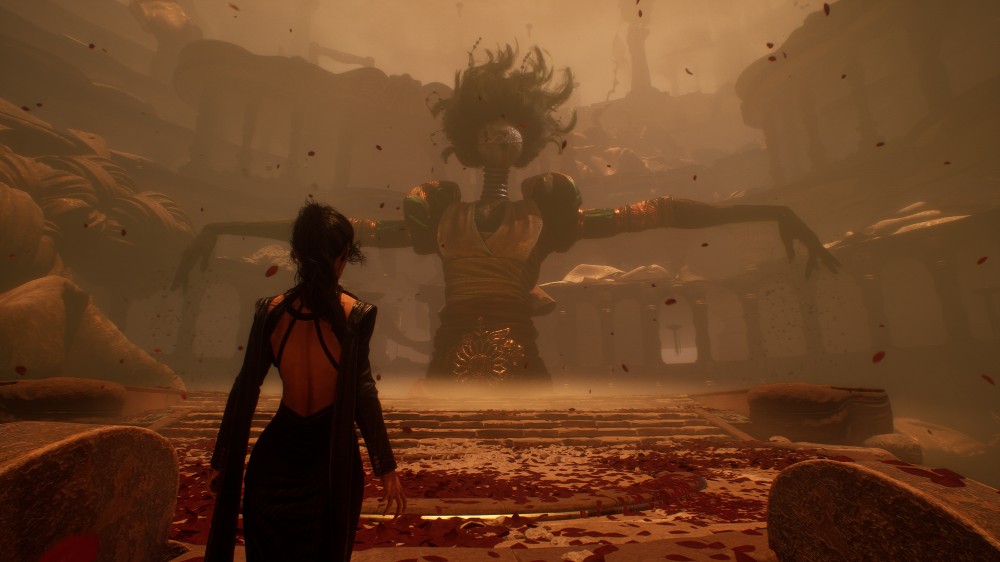
To be clear, the combat system is the exact same as it always was. If you disliked having turn-based combat with quick-time events baked into it from hour one, you’ll still be annoyed with it way later. What eventually changes is that you unlock a large enough variety of Pictos and opportunities to farm the shit out of mobs for special items that permanently increase your ability to equip more of them, that mobs no longer survive your first turn. By the end of the game, I had one character that always acted first, and just spammed the Free Aim attack, usually randomly generating enough extra AP to keep going until everything was dead. If they ran out of AP, they did a Base Attack which hit twice and regained them 6-8 AP to use in their second, bonus turn.
Getting to this point was not a cakewalk. One of the key Pictos necessary for the build only dropped from an optional boss fight that took me over 20 minutes of Dodge/Parrying to defeat. And to even get to that strength required a lot of farming various other endgame zones for drops that leveled up your weapons.
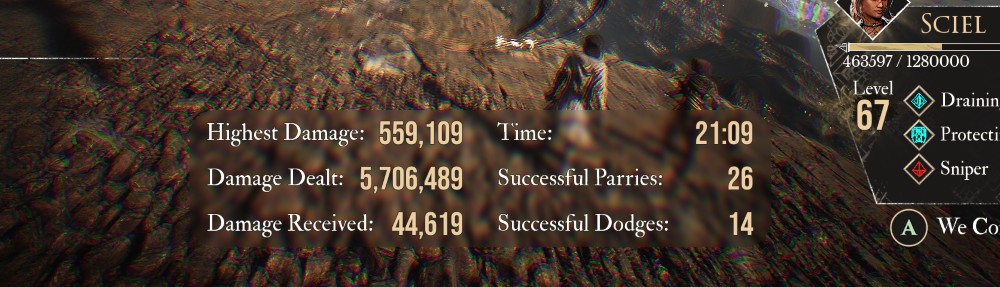
The kicker though is that the game basically forces you down that path. At the beginning of Act 3, you gain access to the final dungeon right away. Which is fine, refreshing almost. When you speak with your companions though, they have “companion quests” available that send you elsewhere in the world… and those places have a MASSIVE, overwhelming increase in difficulty from what you have experienced to this point. I have never seen this design in a videogame before, probably because it is dumb. Having optional harder dungeons – the equivalent of Ruby and Emerald Weapon in FF7 – for flexing? Cool. Hiding companion closure quests behind said harder dungeons, which will ultimately result in you overpowering the final boss as a result? Not cool.
Alternatively… maybe you are just really good at Parries/Dodges. In which case, you will take literally zero damage from any encounter and (eventually) beat every fight without any issue.
You might be asking why I’m dwelling on the combat system when that is not why E33 won all the Game of the Year awards. I’m dwelling on it precisely because that is not why E33 won all those awards.
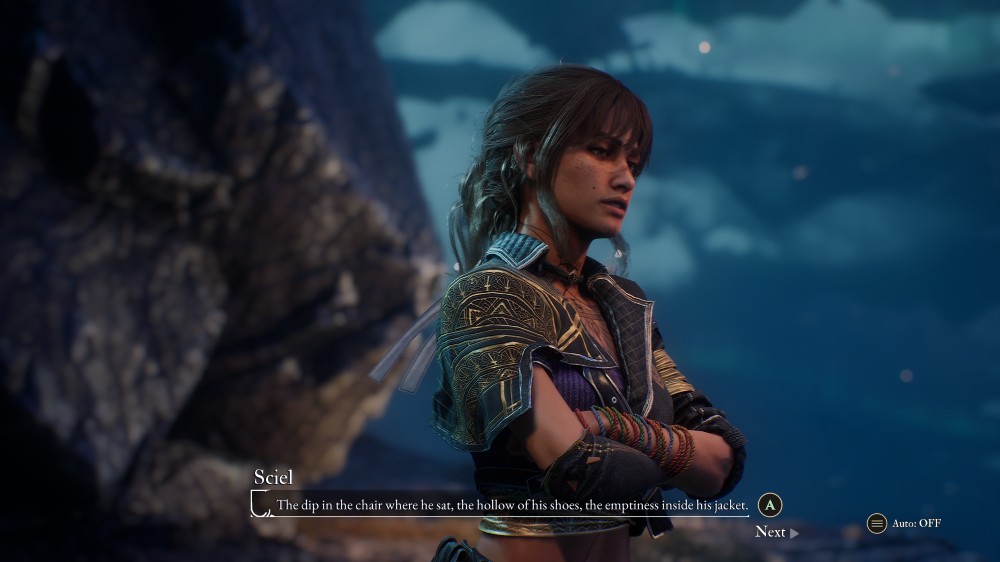
E33 has some of the best art direction I have ever seen in any video game. It has some of the highest production values of any soundtrack I have heard in any video game. Seriously, I was going to go through the OST and suggest some in particular to give you a taste, but goddamn there are 150+ songs and any one of them would be a signature track in any other game. The dialog and character animations feel raw and real. The plot can be trippy and gut-wrenching at the same time, leaving you with impossible choices.
All of that… and I hated playing it. I have zero issues with the way combat is presented, the UI is slick as hell, every new Picto acquired caused me to reexamine every possible synergy (which I enjoy doing). I’m not incapable of the Parries/Dodges, I just don’t like that they exist in the game. If they don’t bother you, or hell, if you enjoy that they exist? More power to you! No doubt E33 is a god-tier game for you.
For me though? I dunno. Back in the day, 20-30 years ago, I would routinely play JRPGs and say that story is worth any amount of repetitive grind. I am not certain that that principle holds anymore. If E33 were any other game, I would have dropped it after the first 5 hours and said it was just not for me. But E33 isn’t just some other game, it’s an entirely new bar that elevates the medium in all ways… but one.
So, there it is. Glad I played Clair Obscur: Expedition 33, glad I experienced it, and glad it’s over.
[E33] Back on the Horse
After a quick, 250-hour detour through Mewgenics and Slay the Spire 2, I am back on the Clair Obscur: Expedition 33 (E33) horse.
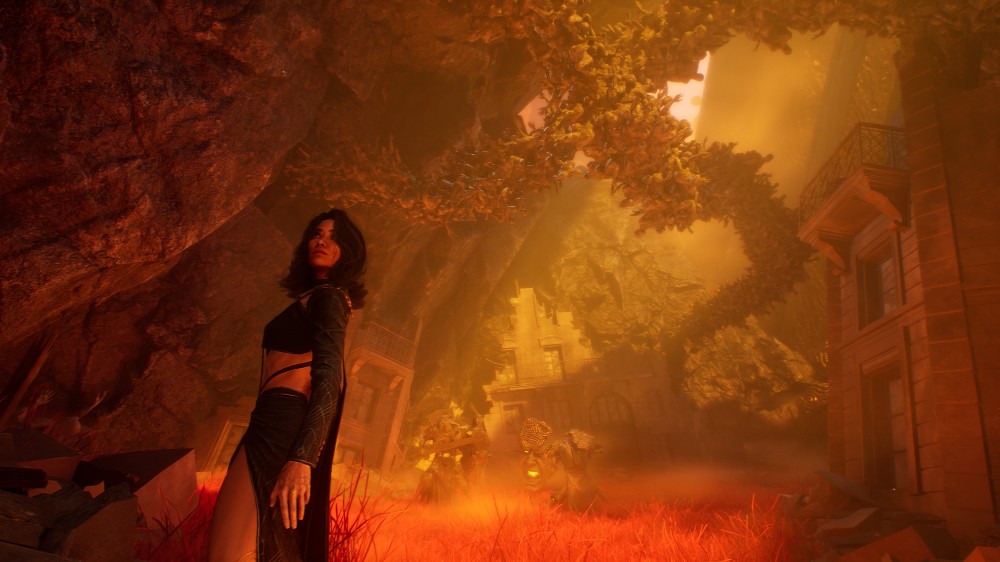
It’s a very beautiful horse. Very sleek, powerful. Just wish I didn’t have to muck the stall all the time.
As before, it all comes down to the combat system. In short, I do not find it fun at all. There are certain aspects of the pre-combat planning bits that I do find engaging. There is a ton of customization when it comes to choosing which Pictos (passives) to have active, with synergies and combos galore. Indeed, the whole thing actively reminded me of Final Fantasy Tactics and the the Job system, where you could mix and match certain abilities together. Every time I pick up a new Picto, I start reviewing the whole list and see where it generates new interactions.
The actual battle execution is just not my cup of tea. I’m no longer “punishing myself” by trying to Parry every enemy attack, and just using Dodge instead. This has improved the experience quite a bit, or at least lowered the frustration, but fundamentally combat is still just a long series of Quick Time Events. You have to Dodge/Parry in games like Dark Souls too, but you can also strafe, run away, approach at different angles, and so on, which makes the Dodge/Parry feel less binary overall. Not so in E33.
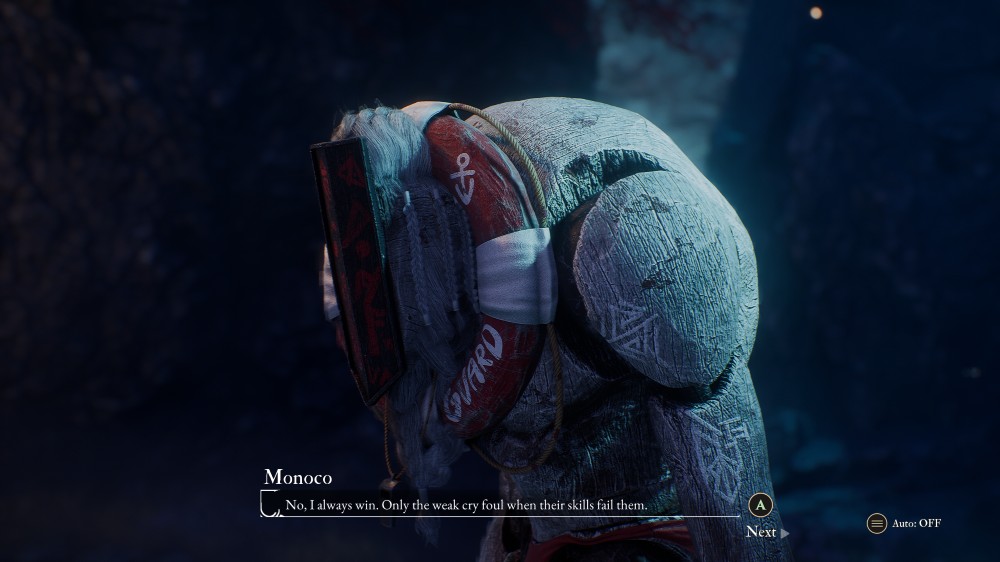
It also doesn’t help that all the fun and exciting parts of combat are heavily focused on the Dodge/Parry mechanics. If you successfully Parry every attack in a sequence, you gain AP and deal immense counter-damage and greatly increase the Break bar. With the right Pictos, you also heal and get a bunch of other bonuses. Dodging attacks gives you like 1 AP total, if you have the appropriate Picto equipped. Granted, certain Picto combinations can give you AP for face-tanking if you don’t want to press buttons at all, but the point is that very clearly the game puts the ideal “Parry everything” reward front and center. So even though I am progressing through the game just fine, it certainly feels like I’m just not engaging with like half of it.
Which… is probably accurate, honestly. If this wasn’t Expedition 33, I would have stopped playing.
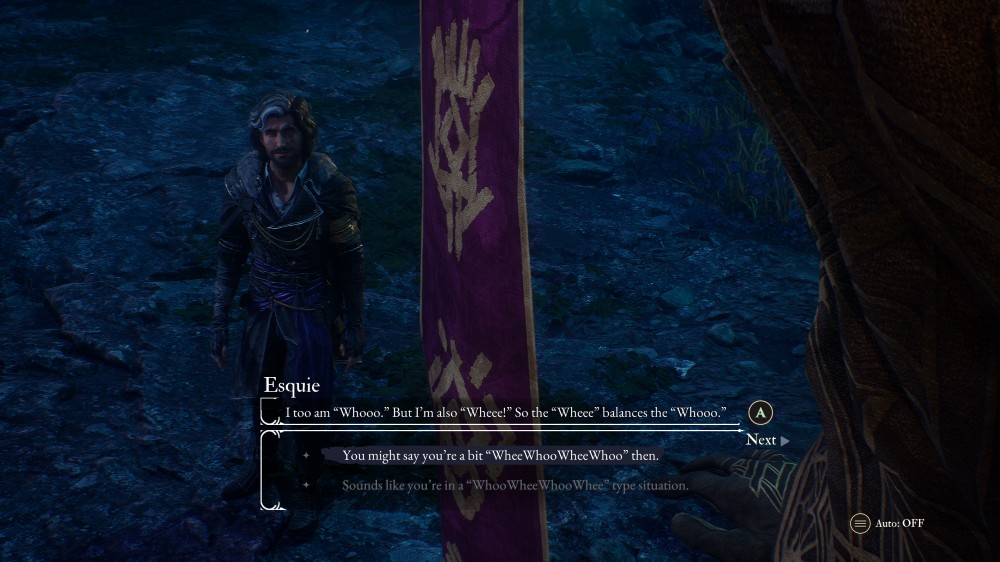
Luckily (?), it is Expedition 33, and I am committed to seeing it through. All the positives about the characters, the emotions, the evocative environments that remind me of Journey are still there. There is something special to be said about a game that compels you to take 5-10 screenshots a session, including of the dialog.
And so, I continue on. For those that come after.
Game Development is Expensive for Dumb Reasons
The average AAA game costs $300 million or more to develop. And as Jason Schreier points out, all that money is for… salaries.
Exact budgets of video-game productions can be tough to corroborate (more transparency from publishers would be nice!) but the numbers I’ve heard floating around AAA game dev these days are $300 million or more — sometimes much more! — which I think helps explain the current state of the industry
To address some frequently asked questions:
- These are US and Canada productions. If you’re wondering why game X cost so much less, it was probably made elsewhere
- These budgets are almost entirely dev salaries + overheard and have nothing to do with executive compensation (which is mostly stock)
Schreier also has a potentially paywalled article that goes into a bit more in-depth, but the short version is that an employee in LA can cost $15,000-$20,000 per month, when considering the full compensation package (salary + benefits). Average that out and a 100-person team budget is $21 million per year. Double that for a 200-person team, etc. That’s your starting point. Now factor in that the game is going to take 5-6 years to develop, and there you go.
But the question we should be asking is: why does it take 5-6 years to develop a game?
The answer may surprise you!
…or not, if you’ve ever worked on a group and/or work project before. It’s scope creep, mismanagement, executive meddling, and a whole lot of hurrying up and waiting. And not anything about fancy graphics.
Everyone who’s worked in the video-game industry for more than a few years has their own horror story. There’s the feature that gets canceled because the CEO’s teenage kid didn’t like it, or the level that everyone knows is going to get axed but that they all have to keep working on because the cancellation hasn’t officially been communicated yet. Or maybe it already has been canceled and nobody told the audio team.
It’s worth noting that video games do need ample iteration to be good, and some of the most successful games have been the result of so-called “wasted” work. Cuts and cancellations are not always a mistake. But there are also countless examples of teams of hundreds floundering in pre-production as they try to figure out what a game’s “core loop” will actually look like.
The very latest example is Edios Montreal cancelling Wildlands, a game that made it all the way into the final debugging phase before being axed this week. Reportedly, it had been “struggling for years, with 4 different game engines used throughout development, narrative direction conflicts, and a budget that had exploded to several hundred million.” The boondoggle also caused a new Deus Ex game to be cancelled, which makes it extra tragic and dumb to me. Nobody asked for this.
The corollary are games in which devs just sort of muck around or go down blind alleys for 4+ years, and then suddenly a completely different finished product emerges 18 (crunched) months later. My favorite example of this is Mass Effect: Andromeda. Instead of following the winning formula of the epic sci-fi trilogy that created it, the devs thought it fruitful to… have the protagonist explore hundreds procedurally-generated worlds.
“They were creating planets and they were able to drive around it, and the mechanics of it were there,” said a person who worked on the game. “I think what they were struggling with was that it was never fun. They were never able to do it in a way that’s compelling, where like, ‘OK, now imagine doing this a hundred more times or a thousand more times.’”
Nearly all of the shortcomings of Andromeda originated from this outrageous scope, along with being forced to use the Frostbite engine. Plus, all the staffing changes, directors leaving, downtime from having devs in three different timezones working together, etc, etc etc. So maybe a lot of things.
Another example? The as-yet unreleased Subnautica 2. Sure, the obvious issue was Krafton’s CEO trying to personally sabotage a payout to the founders. But a hitherto unreported element to the overall story is how the team was floundering. This part was deep within the court records (PDF):
Despite their distance from the heart of the studio, Cleveland and McGuire’s involvement paid off. In the spring of 2024, McGuire teamed up with Cleveland to build a prototype of Subnautica 2 to help guide the team. When it became clear that the existing leadership structure was not working, the Key Employees made a change. The studio replaced Kalina and elevated Anthony Gallegos to lead designer. “[T]he progress of the game . . . completely took off.” This successful course correction set the stage for Cleveland and McGuire to formalize their new roles.
Now, I’m not going to sit and claim that game development is easy in a Rest of the Owl type of way. Any commercially creative endeavor involves a lot of throwing spaghetti at the wall and seeing what sticks. But what I think we as consumers need to start scrutinizing more is the volume of spaghetti, and why the throwers keep getting spun around a bunch of times before the toss. Or why people who can’t boil water and hate pasta anyway are making spaghetti in the first place.
The bottom line is that there’s not a good reason for games to cost $300+ million, nor is there a compelling reason consumers should subsidize these costs with higher MSRPs or microtransactions. Clair Obscur: Expedition 33, won 436 industry awards, including Game of the Year, on a reported budget of less than $10 million. It apparently still took 5 years to develop, so clearly the Sandfall devs weren’t making LA money. Nevertheless, try and argue with the results.
Or maybe we just… let nature take its course as the industry winnows itself.
Level of Enthusiasm: Wiki
You ever felt so engaged in a game that you are updating the Wiki? That’s where I’m at in Mewgenics.
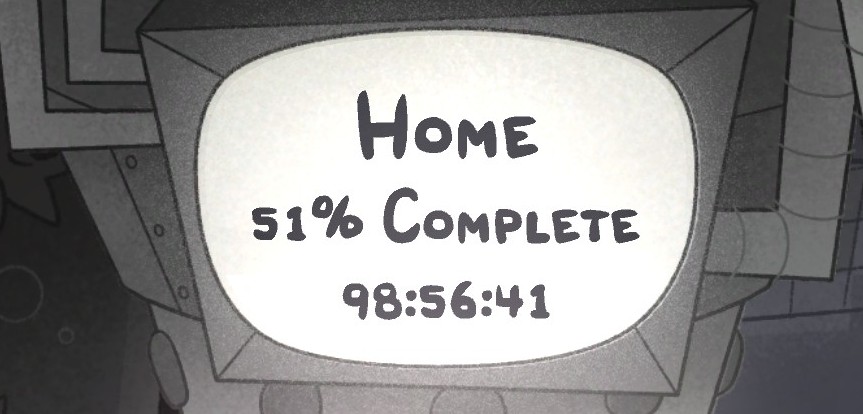
Granted, the Wiki was basically all blank pages since the game came out just a few weeks ago; hard to demonstrate “Wiki-updating enthusiasm” if it is already filled out for you.
But, guys, whew. I play a lot of games, and it is vanishingly rare when I play something that completely consumes the entirety of my play experience. Or should I say: allows itself to consume my play experience. Expedition 33 has a lot going for it and won all kinds of awards for reasons… but I find it difficult to play the game for more than one “session” at a time. Combat is stressful, not fun. Each new area is a hard stopping point wherein you encounter new mobs with new attack patterns you have to memorize so you can Parry them (or die). Two hours is basically my limit for the day.
Mewgenics also technically has stopping points. Maybe all your cats die in a series of unfortunate bouts of RNG. Going into brand new zones can be stressful in its own way too. “This enemy’s ranged attacks delete my equipment? And there are six of them?!” Nevertheless, I persist. And it’s fun. I don’t even bother with GW2 dailies anymore, as that’s 10-20 extra minutes of Mewgenics I could be playing. The last time I experienced this was with Abiotic Factor, and Wartales before that. No doubt I will burn myself out before too much longer, but Christ I almost have 100 hours already.
Not bad for a $30 MSRP game.
E33: How It’s Done
I am not particularly far in Claire Obscur: Expedition 33 (E33) – about 12 hours or so in – but I did want to briefly highlight one fantastic customization system that it has in comparison to, say, Avowed, The Outer Worlds 2, or frankly any game that professes to have player agency/customization at all. That system is of Pictos.
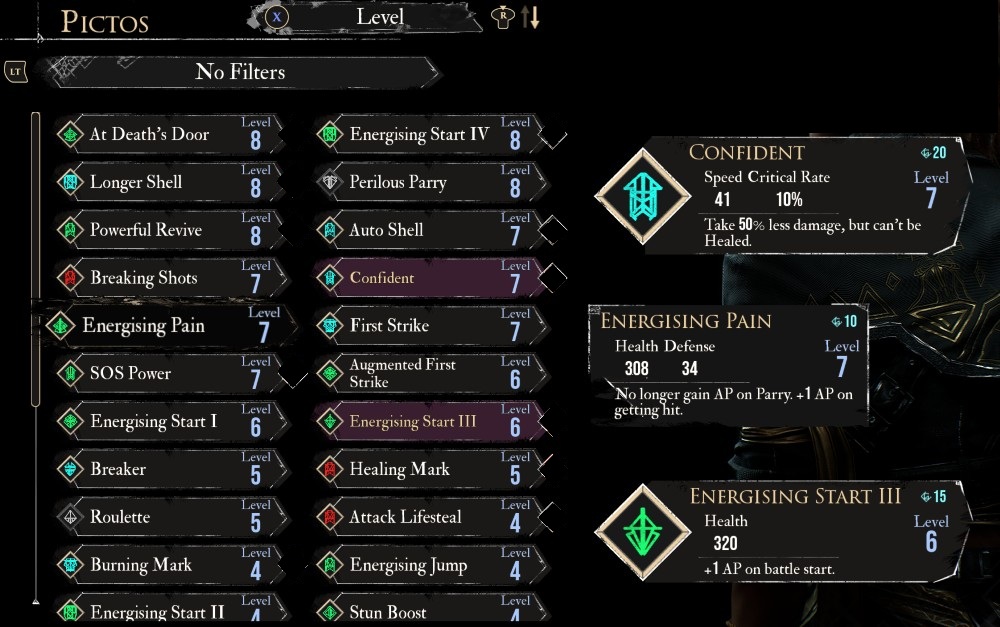
In many ways, Pictos feel like OG Final Fantasy 7 Materia: they are an item you equip that grants both stat bonuses plus a passive ability. Once you complete four combats with a given Pico equipped, the passive ability is permanently learned by everybody. Each character then has a pool of “Luma” they can use in a point-buy way to equip the passives. Some effects are cheap, like being able to gain +1 AP on a Perfect Dodge for 1 Luma; more powerful passives can cost 10, 15, or more. Oh, and of course you can freely move Pictos and Luma around at no penalty (there are respec items for base stats though)!
What gets the juices really flowing are the synergies and tradeoffs. Each character can equip three Pictos apiece, and while so equipped, the passive is granted without spending Luma. Thing is, there is usually an inverse relationship between how much Luma it would otherwise take to get the passive, and the raw bonus stats on the Picto itself. A given Picto might have +50 Speed and +15% Crit Chance, for example, but contains a passive that only saves you 3 Luma. Meanwhile, that 20 Luma passive is attached to like a +300 HP brick.
…which can be still be helpful if one of your characters is wielding a weapon that doubles as damage taken in exchange for another bonus. The downside of which you are mitigating with a passive that reduces damage taken by 50% but you cannot be healed by spells. No worries, just stack a bunch of +HP Picos and practice your sweet, sweet dance (dodge) moves.
Now, think about The Outer Worlds 2 in comparison. There is none!
Yeah, these are not the same type of games, so of course they are not set up in the same way. But there will be people who argue that you choosing Engineering and Medical on the character select screen in TOW2 is some deep gesture of customization when it is, in fact, an a priori straightjacket that railroads your entire playthrough. “I’m roleplaying though!” Roleplaying… what? Arbitrary Man?
Anyway. All I’m saying is that I am wherever I am in the game, and already have more than 40 Pictos to choose from. And unlike in TOW2, I am actually choosing builds and testing them out, because I am not expressly penalized for doing so. That’s some good, engaging game design.
Maybe Obsidian should take notes.
First Impressions: Clair Obscur: Expedition 33
My first play session with Clair Obscur: Expedition 33 lasted about two hours, and I got through the tutorial and far enough to see the first few real battles. And then I didn’t boot the game back up for almost three weeks.
By the end of the second session… yeah, I can start to see why this is winning all of the awards.
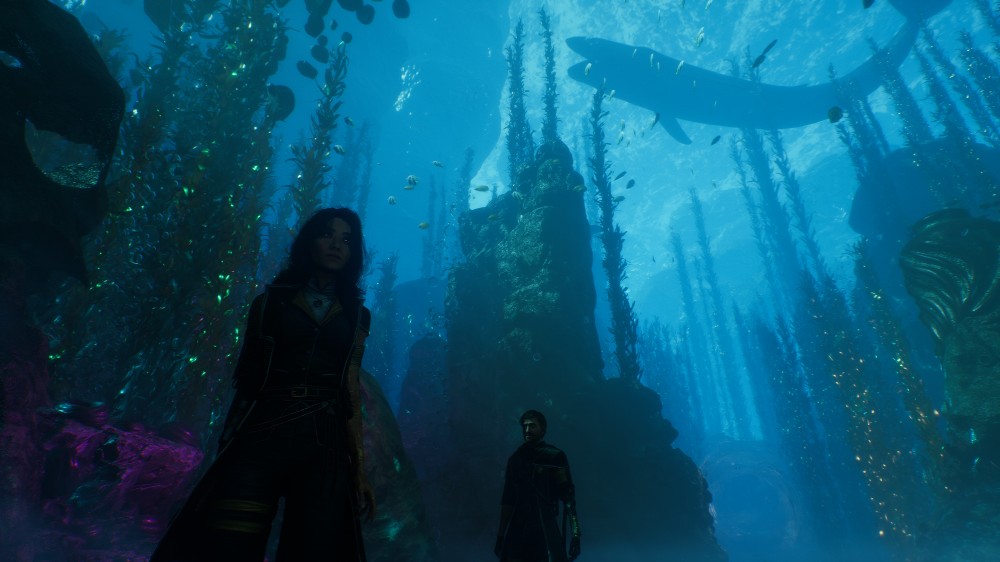
First, the game is trippy and evocative as fuck. The principle bad guy is a goliath-esque woman named The Paintress, which is apt as every environment looks like it sprung directly from some artwork in the Louvre and/or a fever dream. The protagonists live on some kind of island protected by shields or something – with the world itself seeming to have been shattered by some older cataclysm – but the Paintress controls a countdown timer that nevertheless kills everyone older than a specific number. At game start it was 34, and now it’s the eponymous 33. It seems to increment on a yearly basis, but I’m not sure if that was specified (or matters). In any case, every year a small number of adventurers next in line to be erased gets together and attempts to bring the fight to the Paintress. Enter you.
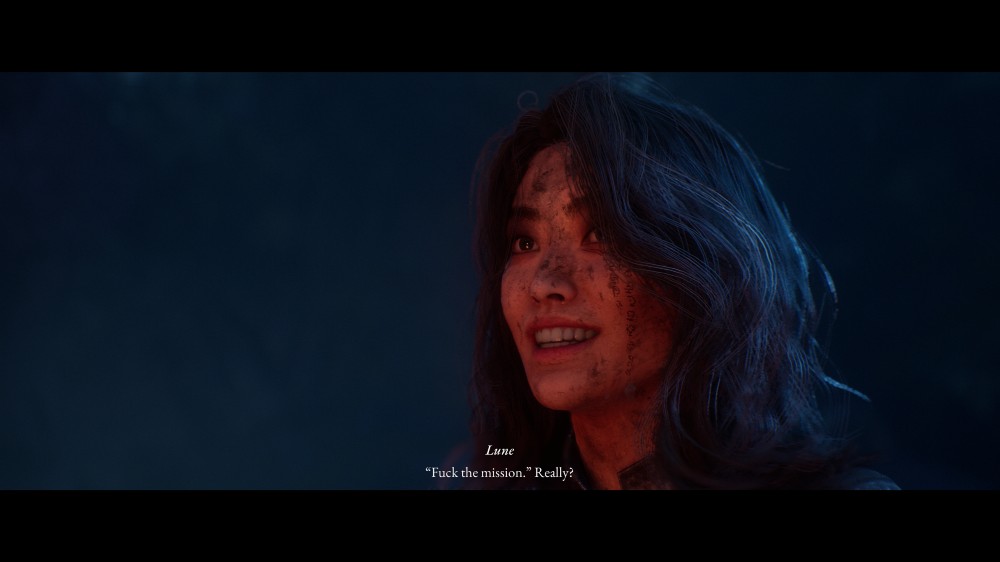
Second, I do want to highly praise the motion-capture and general dialog thus far. It’s passionate, awkward, and deeply human in ways very few other games have been able to reproduce. Nearly 14 years ago, I was blown away by Mass Effect’s wink, and here in Expedition 33 I just witnessed a character search another’s eyes to see if they truly meant what they said. You know, her face close, the silence, her eyes going back and forth with purpose, debriding the layers of your soul. I don’t know how, but they captured it. The bar has been raised again.
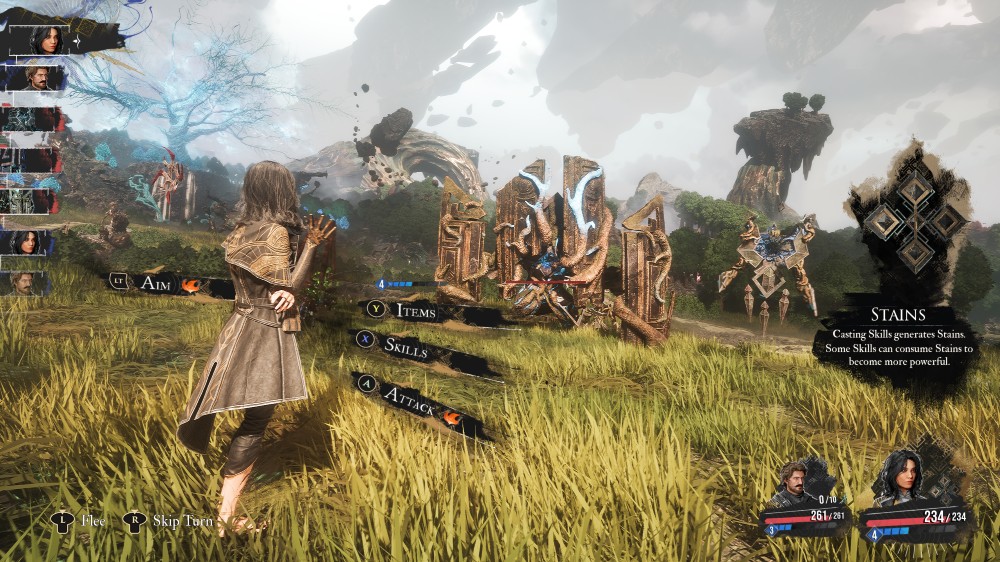
We will have to see how it works out for me over the long haul, but my first impression of Expedition 33’s combat system… is that it’s not fun. Basically, it feels like a turn-based Soulslike. Everything more complex than a basic attack will have a Quick-Time Event sequence in order to juice the skill further. On the enemy’s turn, you are essentially required to either Dodge or Parry their attacks; Dodging has a more forgiving window than Parry, but successfully Parrying every attack will allow the party member to unleash a devastating counter-attack. I say Dodging/Parrying is “required” because the amount of damage you end up taking is significant, and your ability to heal is limited and only refreshed when you arrive at checkpoint flags, e.g. campfires. And yeah, enemies respawn when you rest.
What results is a truly conflicting game thus far. I encountered some enemies in the opening areas that were clearly higher-level than my ability to meaningfully tackle. “The designers just wanted to teach me that not every enemy needs fought, and/or that I may want to revisit places once I gained more levels.” OK, great, very Soulslike of you. Buuuuut, technically, if you just Parry all their attacks, you will defeat them eventually. Which then gets you thinking about why bother putting points in Defense or Vitality, when both are irrelevant if you don’t get hit in the first place. Is that the intentional design? Stack Defense if you aren’t good at the timing, and everyone else go glass cannon?
Again, this is all very early on, so perhaps things will improve. Somehow. Or perhaps the combat system is just something you put up with for the environments, dialog, and plot. That is a very old-school RPG sentiment for 2026, but I’m going to roll with it for now.
 In An Age
About that E33 MoCap
May 18
Posted by Azuriel
I heaped a lot of praise about Clair Obscur: Expedition 33’s (E33) character animations already, and yet I feel a bit remiss for not showing what I was talking about. Below is a Youtube link to a “behind-the-scenes compilation of several early-game scenes, which includes both the finished game sequence (sans official voice actors) + the motion capture actors.
I would not consider these to be spoilers, as they occur within the first 5ish hours of the game. But…
In my First Impressions post, I said the following:
Feel free to watch the whole four-minute video, but the soul debridement happens at around 3:25.
All of it is so ridiculously good that I had to look up whether Sandfall Interactive had invented some secret tech or whatever, because why isn’t every new game coming out like this? Did they pour 80% of their budget into mocap or something?
Near as I can tell… nope. Or, technically nope. Most of the magic outside the performances themselves comes from off-the-shelf features of Unreal Engine 5. So, in many ways the “secret sauce” had a lot to do with being a new, smaller team without a lot of tech debt being able to pivot to an entirely new game engine at the perfect time. As this article points out, most of the work they did in UE4 had to be redone entirely due to the engine differences. One could imagine how much work would be thrown away if instead it was in a custom-made engine. A larger studio with 500 developers with 15+ years of experience on a proprietary engine is thus unlikely to be able to match E33 anytime soon (if ever).
Which… goddamn. Talk about perfect time and place.
In any case, I am a bit more optimistic about the (gaming) future. Sandfall Interactive probably doesn’t quite qualify as an “indie” studio, but I do consider these smaller teams to be the best path through the coming industry implosion. That we get to enjoy premium facial animations while doing so is all the more a bargain.
Posted in Commentary
Comments Off on About that E33 MoCap
Tags: Character Animations, Clair Obscur: Expedition 33, MoCap, UE5, Wink